NOAA Future Aridity against Al Gore’s C20th Precipitation Graphic

Paul Homewood has taken a look at an article in yesterdays Daily Mail – A quarter of the world could become a DESERT if global warming increases by just 2ºC.

The article states

Aridity is a measure of the dryness of the land surface, obtained from combining precipitation and evaporation.  

‘Aridification would emerge over 20 to 30 per cent of the world’s land surface by the time the global temperature change reaches 2ºC (3.6ºF)’, said Dr Manoj Joshi from the University of East Anglia’s School of Environmental Sciences and one of the study’s co-authors.  

The research team studied projections from 27 global climate models and identified areas of the world where aridity will substantially change.  

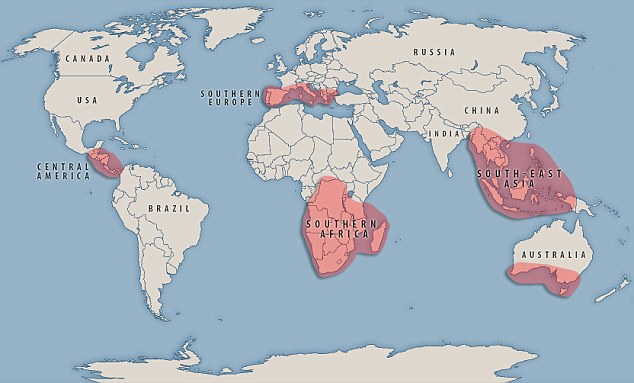
The areas most affected areas are parts of South East Asia, Southern Europe, Southern Africa, Central America and Southern Australia.

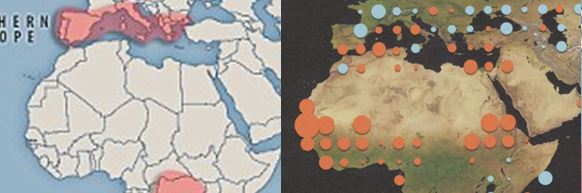
Now, having read Al Gore’s authoritative book An Inconvenient Truth there are statements first about extreme flooding, and then about aridity (pages 108-113). The reason for flooding coming first is on a graphic of twentieth-century changes in precipitation on pages 114 & 115.

This graphic shows that, overall, the amount of precipitation has increased globally in the last century by almost 20%.

 However, the effects of climate change on precipitation is not uniform. Precipitation in the 20th century increased overall, as expected with global warming, but in some regions precipitation actually decreased.

The blue dots mark the areas with increased precipitation, the orange dots with decreases. The larger the dot, the larger the change. So, according to Nobel Laureate Al Gore, increased precipitation should be the far more common than increased aridity. If all warming is attributed to human-caused climate change (as the book seems to imply) then over a third of the dangerous 2ºC occurred in the 20th century. Therefore there should be considerable coherence between the recent arid areas and future arid areas.

The Daily Mail reproduces a map from the UEA, showing the high-risk areas.

There are a couple of areas with big differences.

Southern Australia

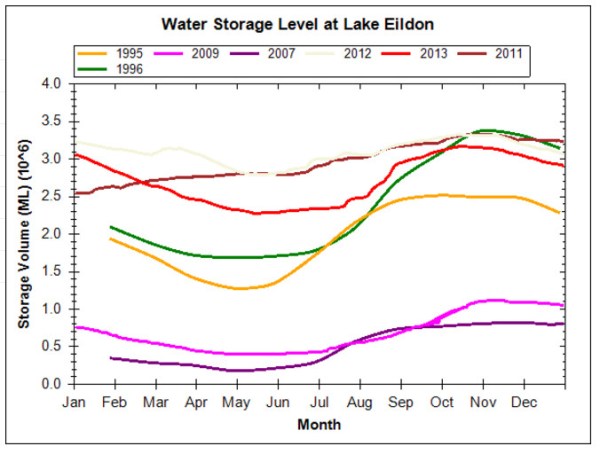
In the 20th century, much of Australia saw increased precipitation. Within the next two or three decades, the UEA projects it getting considerably arider. Could this change in forecast be the result of the extreme drought that broke in 2012 with extreme flooding? Certainly, the pictures of empty reservoirs taken a few years ago, alongside claims that they would never likely refill show the false predictions.

One such reservoir is Lake Eildon in Victoria. Below is a graphic of capacity levels in selected years. It is possible to compare other years by following the historical water levels for EILDON link.

Similarly, in the same post, I linked to a statement by re-insurer Munich Re stating increased forest fires in Southern Australia were due to human activity. Not by “anthropogenic climate change”, but by discarded fag ends, shards of glass and (most importantly) fires that were deliberately started.

Northern Africa

The UEA makes no claims about increased aridity in Northern Africa, particularly with respect to the Southern and Northern fringes of the Sahara. Increasing desertification of the Sahara used to be claimed as a major consequence of climate change. In the year following Al Gore’s movie and book, the UNIPCC produced its Fourth Climate Assessment Report. Working Group II report, Chapter 9 (Pg 448) on Africa made the following claim.

In other countries, additional risks that could be exacerbated by climate change include greater erosion, deficiencies in yields from rain-fed agriculture of up to 50% during the 2000-2020 period, and reductions in crop growth period (Agoumi, 2003).

Richard North took a detailed look at the background of this claim in 2010. The other African countries were Morocco, Algeria and Tunisia. Agoumi 2003 compiled three reports, only one of which – Morocco – had anything near a 50% claim. Yet Morocco seems, from Al Gore’s graphic to have had a modest increase in rainfall over the last century.

Conclusion

The UEA latest doom-laden prophesy of increased aridity flies in the face of the accepted wisdom that human-caused global warming will result in increased precipitation. In two major areas (Southern Australia and Northern Africa), increased aridity is at add odds with changes in precipitation claimed to have occurred in the 20th Century by Al Gore in An Inconvenient Truth. Yet over a third of the of the dangerous 2ºC warming limit occurred in the last century.

Kevin Marshall


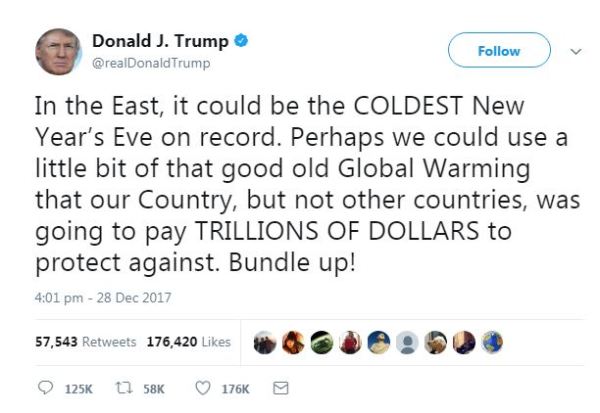
President Trumps Tweet on record cold in New York and Temperature Data

As Record-breaking winter weather grips North-Eastern USA (and much of Canada as well) President Donald Trump has caused quite a stir with his latest Tweet.

There is nothing new in the current President’s tweets causing controversy. This is a hard-hitting one has highlights a point of real significance for AGW theory. After decades of human-caused global warming, record cold temperatures are more significant than record warm temperatures. Record cold can be accommodated within the AGW paradigm by claiming greater variability in climate resultant on the warming. This would be a portent of the whole climate system being thrown into chaos once some tipping point had been breached. But that would also require that warm records are
(a) far more numerous than cold records and
(b) Many new warm records outstrip the old records of a few decades ago by a greater amount than the rise in average temperatures in that area.
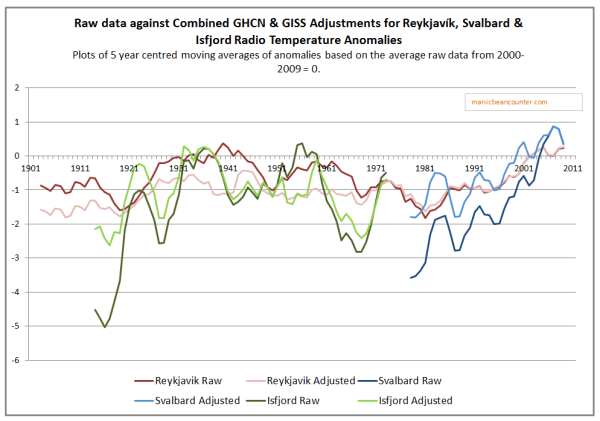
I will illustrate with three temperature data sets I looked at a couple of years ago – Reykjavík, Iceland and Isfjord Radio and Svalbard Airport on Svalbard.

Suppose there had been an extremely high and an extremely low temperature in 2009 in Reykjavík. For the extreme high temperature to be a record it would only have to be nominally higher than a record set in 1940 to be a new record. The unadjusted average anomaly data is the same. If the previous record had been set in say 1990, a new high record would only be confirmation of more extreme climate if it was at least 1C higher than the previous record. But a new cold record in 2009 could be up to 1C higher than a 1990 low record to count as greater climate extremes. Similarly in the case of Svalbard Airport, new warm records in 2008 or 2009 would need to be over 4C higher than records set around 1980, and new cold records would need to be up to 4C higher than records set around 1980 to count as effective new warm and cold records.
By rebasing in terms of unadjusted anomaly data (and looking at monthly data) a very large number of possible records could be generated from one temperature station. With thousands of temperature stations with long records, it is possible to generate a huge number of “records” to analyze if the temperatures are becoming more extreme. But absolute record cold records should be few and far between. However, if relative cold records outstrip relative warm records, then there are questions to be asked of the average data. Similarly, if there were a lack of absolute records or a decreasing frequency of relative records, then the beliefs in impending climate chaos would be undermined.

I would not want to jump ahead with the conclusions. The most important element is to mine the temperature data and then analyze the results in multiple ways. There are likely to be surprises that could enhance understanding of climate in quite novel ways.

Kevin Marshall

Climate Public Nuisance as a justification for Climate Mitigation

Ron Clutz, at his Science Matters blog, has a penchant for producing some interesting articles that open up new areas outside of the mainstream of either climate alarmism or climate scepticism, some of which may challenge my own perspectives. With Critical climate intelligence for jurists and others, Ron has done this again.
There is a lot of ground covered here, and I am sure that it just touches on a few of the many issues. The first area covered is the tort of Public Nuisance, explained by legal scholar Richard O. Faulk. This touches upon areas that I have dealt with recently, particularly this section. (bold mine)

Generally in tort cases involving public nuisance, there is a term, which we all know from negligence cases and other torts, called proximate causation. In proximate causation, there is a “but for” test: but for the defendant’s activity, would the injury have happened? Can we say that climate change would not have happened if these power plants, these isolated five power plants, were not emitting greenhouse gases? If they completely stopped, would we still have global warming? If you shut them down completely and have them completely dismantled, would we still have global warming? 

I think Faulk then goes off the argument when he states.

Is it really their emissions that are causing this, or is it the other billions and billions of things on the planet that caused global warming—such as volcanoes? Such as gases being naturally released through earth actions, through off-gassing?

Is it the refinery down in Texas instead? Is it the elephant on the grasses in Africa? Is it my cows on my ranch in Texas who emit methane every day from their digestive systems? How can we characterize the public utilities’ actions as “but for” causes or “substantial contributions?” So far, the courts haven’t even reached these issues on the merits.

A necessary (but not sufficient) condition to be met for adverse human-caused global warming to be abated, is that most, if not all, human GHG emissions must be stopped. Unlike with smoke particulates, where elimination in the local area will make a big difference, GHGs are well-mixed. So shutting down a coal-fired power station in Oak Creek will have the same impact on the future climate change for people of South-East Wisconsin as shutting down a similar coal-fired power station in Boxburg, Ningxia, Mpumalanga, Kolkata or Porto do Pecém. That is in the range of zero or insignificantly different to zero depending on your perspective on CAGW.

Proximate causation was a term that I should have used to counter Minnesotan valve-turners climate necessity defense. As I noted in that post, to reduce global emissions by the amount desired by the UNIPCC – constraining future emissions to well below 1000 GtCO2e, requires not only reducing the demand for fossil fuels and other sources of GHG emissions, but also requires many countries dependent on the supply of fossil fuels for a large part of their national incomes, to leave at least 75% of known fossil fuel reserves in the ground.

An example of proximate causation to be found in the post of 27 December Judge delivers crushing blow to Washington Clean Air RuleGovernor Inslee called the legislation “the nation’s first Clean Air Rule, to cap and reduce carbon pollution.” But the legislation will only reduce so-called carbon pollution if the reduction is greater than the net increase in other areas of the world. The will not happen as both demand and supply are not covered by global agreements with the aggregate impact

Kevin Marshall

Macron calls for Climate Tariffs against most of the World

From the Independent (via Eric Worrall at WUWT)

In his speech, Mr Macron also called for an EU tariff on goods imported from countries or companies that do not share its climate goals, and pledged to work to raise the cost of carbon within the EU to €30 a tonne.

The EU INDC submission to COP21 Paris states

The EU and its Member States are committed to a binding target of an at
least 40% domestic reduction in greenhouse gas emissions by 2030
compared to 1990,

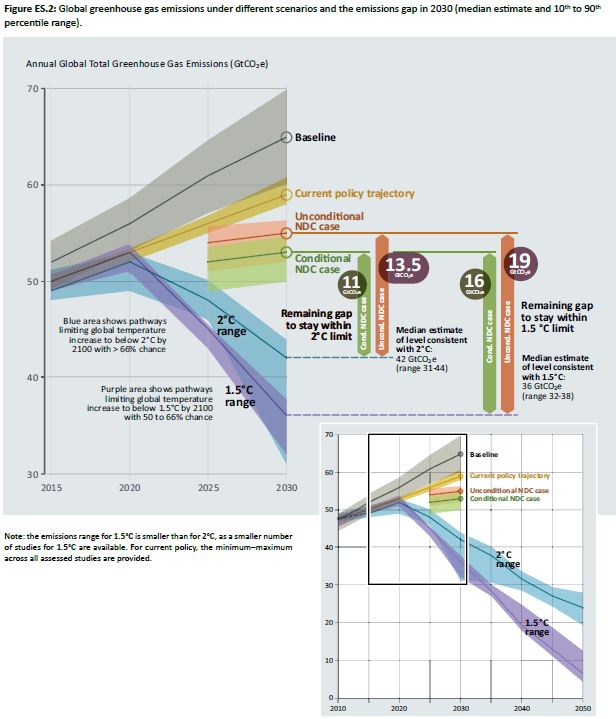
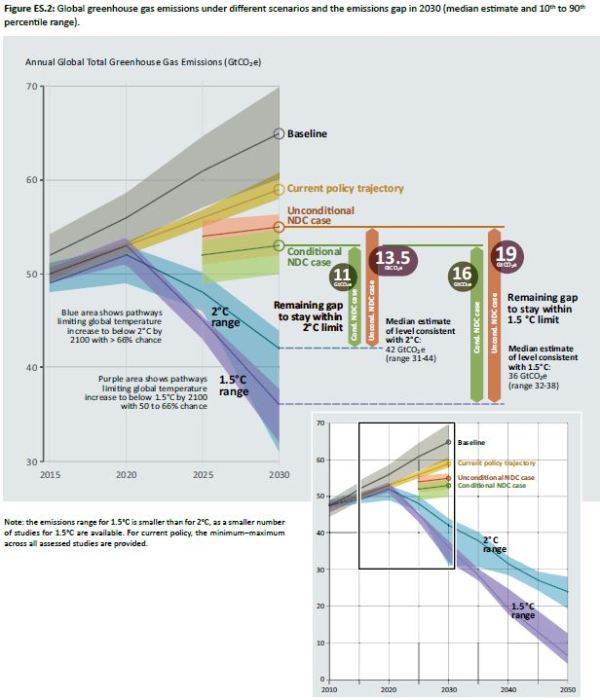
Most INDC submissions do not state they will reduce their greenhouse gas emissions. As a result, even if the proposals are fully met (and the EU is unlikely to meet its target) then emissions are forecast to be higher in 2030 than they are today. This graphic from the UNEP Emissions Gap Report published at the end of October demonstrates the situation quite nicely.

So President Macron is wanting sanctions not just against the USA, but most of the world as well? This includes China, India, nearly every African country,  most countries in SE Asia, the Middle East nations and some other nations besides. Or is it just those who stand up to the useless European climate policies, that are benefiting large businesses with subsidies financed disproportionately by the poor? The rhetoric includes “companies”, on whom sanctions cannot be applied. Further, the €30 carbon price is equivalent to €0.10 on the price of petrol (gasoline). How is a small rise in the cost of fossil fuel energy from a group of countries with less than 10% of GHG emissions going to save the world? As economics Professor Richard Tol has estimated, to achieve the targets would require a global carbon tax from 2020 of $210 and then escalated by 4-6% a year until fossil fuels were unaffordable. Chancellor Angela Merkel claims “Climate change is by far the most significant struggle of our time.” (Independent again). The falsity of this claim is shown by political newcomer President Macron’s trying to marginalize and silence opponents with empty and ineffectual threats.

Valve Turner Micheal Foster’s Climate Necessity Defense

The Climate Necessity Defence for criminal acts to impede the lawful business of the fossil fuel industry cannot be justified. The acts will never of themselves have a significant impact in constraining global greenhouse emissions. In any event, there will always be more than sufficient proven fossil fuel reserves in countries out of the reach of any activist action, or even Government-backed action, to constrain aggregate cumulative fossil fuel emissions to anywhere near the levels commensurate with constraining temperature to 2°C of warming. What it does do is impose immediate harms on the actual victims of the crimes, and harms on the countries in which the crimes are committed. Some of the harms are from benefitting non-policy countries who produce fossil fuels. The conviction last week of climate activist Michael Foster is a clear case study.


The New York Times reports (hattip GWPF) on the conviction by the North Dakota Supreme Court of Seattle resident Michael Foster.

Foster took part in effort on Oct. 11, 2016, to draw attention to climate change by turning off valves on five pipelines that bring Canadian oil south. Foster targeted the Keystone Pipeline in North Dakota. Other activists targeted pipelines in Minnesota, Montana and Washington state.

A jury in North Dakota’s Pembina County on Friday convicted Foster after a weeklong trial of criminal mischief, criminal trespass and conspiracy. He faces up to 21 years in prison when he’s sentenced Jan. 18. The man who filmed his protest action, Samuel Jessup of Winooski, Vermont, was convicted of conspiracy and faces up to 11 years.

What I found interesting was the next sentence.

Foster had hoped to use a legal tactic known as the climate necessity defense — justifying a crime by arguing that it prevented a greater harm from happening.

The Climate Disobedience Center in its article for activists on the climate necessity defense says

The basic idea behind the defense — also known as a “choice of evils,” “competing harms,” or “justification” defense — is that the impacts of climate change are so serious that breaking the law is necessary to avert them.

Foster had his action filmed, shown from 2.07 here.

Keystone Pipeline. North Dakota. I’m Michael Foster. In order to preserve life as we know it and civilization, give us a fair chance and our kids a fair chance, I’m taking this action as a citizen. I am duty bound.

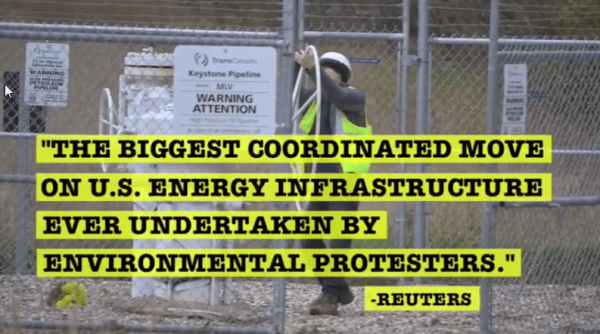
This was a significant action. The video quotes Reuters news agency.

Was this action “preserving life as we know it“? In shutting down the pipeline, (along with four pipelines others in the coordinated action) 590,000 barrels of oil failed to be transported from Canada to the USA that morning. It was merely delayed. If the pipelines are working at full capacity it would maybe have been transported by rail instead. Or more produced in the USA. Or more imported from the Middle East. But suppose that those 590,000 barrels (83000 tonnes) had been left in the ground, never to be extracted, rather than delaying production. What is the marginal difference that it would make climate change?

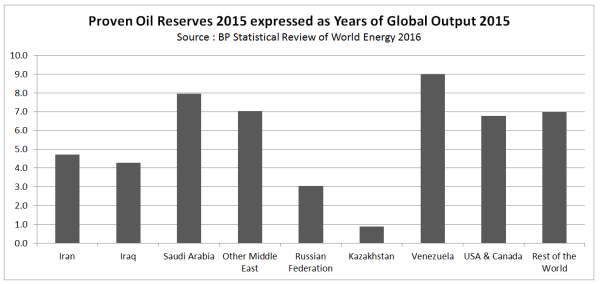
From the BP Statistical Review of World Energy 2016 (full report), I find that global oil production in 2015 was around 92 million barrels per day, or 4362 million tonnes in the full year. Global production would have been 0.6% lower on Oct. 11, 2016 or 0.002% lower in the full year. Yet there is plenty of the stuff in the ground. Proven global reserves are around 50.7 years of global production. Leaving 590,000 barrels in the ground will reduce proven reserves by around 0.000038%. That is less than one part in a million of proven oil reserves. Yet in the last few years, proven reserves have been increasing, as extraction techniques keep improving. This despite production climbing as well. 2015 production was 21% higher than in 2000 and 56% higher than in 1985. Proven reserves in 2015 were 30% higher than in 2000 and 112% higher than in 1985.

I have divided up those 50.7 years of reserves by major areas.

The effect of turning off the oil pipeline is posturing unless it shuts down oil production in Canada and the USA. But that would still leave over 40 years of proven reserves elsewhere. Are Russia and Middle Eastern countries going to shut down their production because of the criminal acts of a few climate activists in the USA?

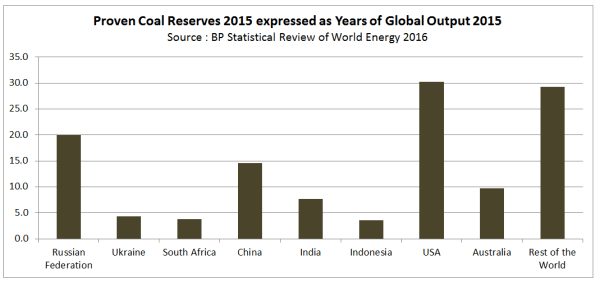
But oil is not the only major fossil fuel. Production of coal in 2015 was 3830 Million tonnes of oil equivalent, 88% of oil production. Proven coal reserves are 123 years of current production. Further, if oil prices rise to the levels seen over the last few years, it will become economic to convert more coal to liquids, a process which consumes four to five times the CO2 of burning oil.

Are China, Russia, India, Australia, Ukraine, Indonesia, South Africa and many other countries going to shut down their production because of the criminal acts of a few climate activists in the USA?

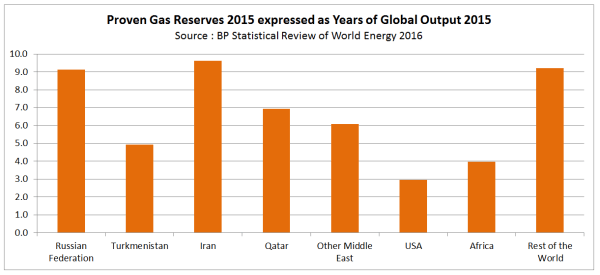
The third major fossil fuel is gas. Production in 2015 was 3200 million tonnes of oil equivalent, 73% of oil production. Proven reserves are equivalent to 52.8 years of current production levels.

The reserves are slightly more centralized than for oil or coal. Like with oil, a large part of available reserves are concentrated in Russia and the Middle East.

Leaving 590,000 barrels in the ground would reduce proven reserves of fossil fuels by around one part in ten million.

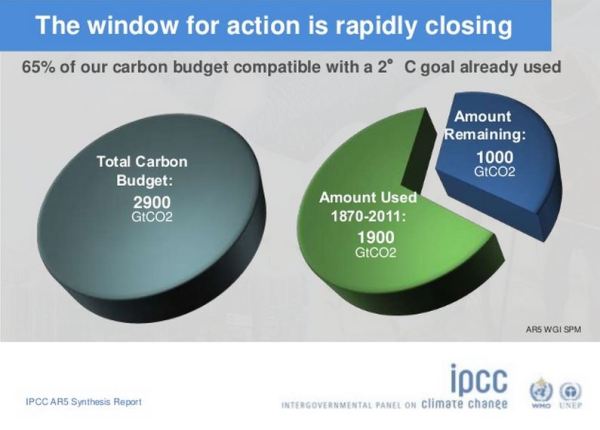
The 50+ years of proven reserves of oil and gas, and 120+ years of proven reserves of coal needs to be put into a policy context. The IPCC AR5 Synthesis Report gave a very rough guide to how much CO2 (or equivalent greenhouse gases) could be emitted to limit warming to less than 2°C. From 2012 it was 1000 GtCO2e.

With emissions in 2011 at around 50 GtCO2e, that gave 20 years. From next year that will be less than 15 years. The recent paper “Emission budgets and pathways consistent with limiting warming to 1.5C” (hereafter Millar et. al 2017) reevaluated the figures, with the 1.5°C not being breached for a further 20 years. Whatever way you look at the figures, most of the proven fossil fuels in the world will have to be left in the ground. That requires the agreement of Saudi Arabia, Russia, Iran, Iraq, Qatar, Kuwait, Turkmenistan, China, India, Venezuela, alongside USA, Canada, Australia and a large number of other countries.

Further, there can be no more extractions of fossil fuels from unproven reserves, which will likely exceed the proven reserves.

The efforts of Micheal Foster and his mates could incite further criminal acts. But massive lawbreaking throughout the United States, it would still be insufficient in the USA to significantly dent the production and distribution of fossil fuels in the USA. Even if that happened, there are plenty of other countries who would willingly meet the existing demand. All that the action is likely to do is push up the costs of production and distribution in the USA, harming the US economy and the futures of people involved in the fossil fuel industries and energy-intensive industries.

It is the aspect of failing to make a significant marginal difference through the action – that is in reducing global greenhouse gas emissions – than renders the climate necessity defense void. Even if large numbers of other actions are inspired by Foster and others, it would still be insufficient to get anywhere close to the constraint in emissions to constrain warming to 1.5°C or 2°C. On a larger scale, even if all major Western economies shut down all fossil fuel production and consumption immediately, it would merely delay by a few years the cumulative aggregate emissions from 2012 onwards exceeding 1000 GtCO2e.

It gets worse. A particular case must be decided on the damage caused to the victims of the crime. In this case the owners of the pipeline, the employees of the business, the customers who do not get their oil, etc. If there are beneficiaries, it is the billions of people in generations to come. The marginal difference to the victims of the action is tangible and has happened. The marginal difference to the beneficiaries is imperceptible and even then based on belief in what amount to nothing more than pseudo-scientific prophecies. But given that a shut-down of production in the USA is likely to be met by increased production elsewhere even these future dispersed and speculated benefits are unlikely to accrue.

More broadly, if specific people need to have their immediate interests sacrificed for the greater good, surely that is the function of Government, not some wayward activists? In that way the harms could be more equitably distributed. With random acts of criminality, the harms are more likely to be based on the prejudices on the activists.

Summary

The Climate Necessity Defence is an invalid justification for the criminal actions of Michael Foster and others in shutting down the oil pipelines from Canada into the USA. The marginal impact on reducing greenhouse gas emissions by the action, if they were not made up by increased production elsewhere, is about one part in ten million. But given that most of the global proven fossil fuel reserves are concentrated in a small number of countries – many of whom have no commitment to reduce emissions, let alone leave the source of major revenues in the ground – the opportunity of producing more is likely to be taken up. Further, the harms the activist’s action is immediate, very definite and concentrated, whilst the benefits of reduced climate change impacts from reduced emissions are speculative and dispersed over tens of billions of people. 

Kevin Marshall

The Policy Gap in Achieving the Emissions Goals

The Millar et al. 2017 has severe problems with the numbers, as my previous post suggested. But there is a more fundamental problem in achieving emissions goals. It is contained in the introductory paragraphs to an article lead author Richard Millar posted at Carbon Brief

The Paris Agreement set a long-term goal of limiting global warming to “well-below” 2C above pre-industrial levels and to pursue efforts to restrict it to 1.5C.

A key question for the upcoming rounds of the international climate negotiations, particularly when countries review their climate commitments next year, is exactly how fast would we have to cut emissions to reach these goals?

In a new paper, published in Nature Geoscience, we provide updated estimates of the remaining “carbon budget” for 1.5C. This is the total amount of CO2 emissions that we can still emit whilst limiting global average warming to 1.5C.

Our estimates suggest that we would have a remaining carbon budget equivalent to around 20 years at current emissions rates for a 2-in-3 chance of restricting end-of-century warming to below 1.5C.

This suggests that we have a little more breathing space than previously thought to achieve the 1.5C limit. However, although 1.5C is not yet a geophysical impossibility, it remains a very difficult policy challenge.

The problem is with the mixing of singular and plural statements. The third paragraph shows the problem.

In a new paper, published in Nature Geoscience, we provide updated estimates of the remaining “carbon budget” for 1.5C. This is the total amount of CO2 emissions that we can still emit whilst limiting global average warming to 1.5C.

In the first sentence, the collective “we” refers to the ten authors of the paper. That is Richard J. Millar, Jan S. Fuglestvedt, Pierre Friedlingstein, Joeri Rogelj, Michael J. Grubb, H. Damon Matthews, Ragnhild B. Skeie, Piers M. Forster, David J. Frame & Myles R. Allen.  In the second sentence, the collective “we” refers to approximately 7500 million people on the planet, who live about 195 countries. Do they speak for all the people in Russia, India, Nigeria, Iran, Iraq, China, Taiwan, North and South Korea, the United States and Australia for instance? What I would suggest is they are speaking figuratively about what they believe the world ought to be doing.

Yet the political realities are that even though most countries have signed the Paris Agreement, it does not commit them to a particular emissions pathway, nor to eliminate their emissions by a particular date. It only commits them to produce further INDC submissions every five years, along with attending meetings and making the right noises. Their INDC submissions are not scrutinized, still less sent back for “improved ambition” if they are inadequate in contributing to the aggregate global plan.

Looking at the substance of the Adoption proposal of the Paris Agreement, section II, point 17 notes gives an indication of the policy gap.

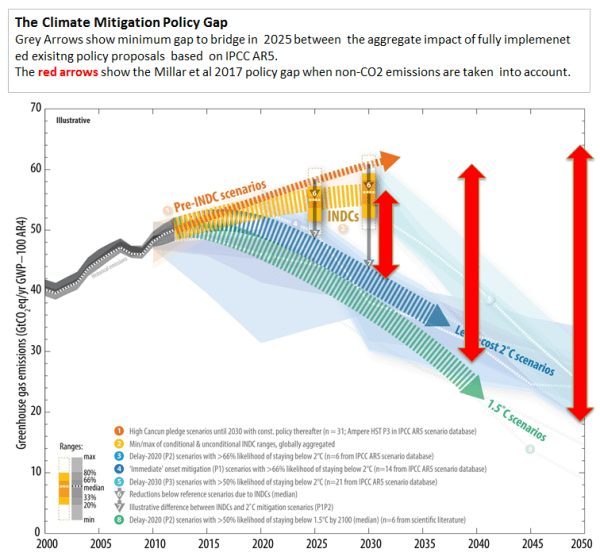
17. Notes with concern that the estimated aggregate greenhouse gas emission levels in 2025 and 2030 resulting from the intended nationally determined contributions do not fall within least-cost 2 ˚C scenarios but rather lead to a projected level of 55 gigatonnes in 2030, and also notes that much greater emission reduction efforts will be required than those associated with the intended nationally determined contributions in order to hold the increase in the global average temperature to below 2 ˚C above pre-industrial levels by reducing emissions to 40 gigatonnes or to 1.5 ˚C above pre-industrial levels by reducing to a level to be identified in the special report referred to in paragraph 21 below;

But the actual scale of the gap is best seen from the centerpiece graphic of the UNFCCC Synthesis report on the aggregate effect of INDCs, prepared in the run-up to COP21 Paris. Note that this website also has all the INDC submissions in three large Pdf files.

The graphic I have updated with estimates of the policy gap with my take on revised Millar et. al 2017 policy gaps shown by red arrows.

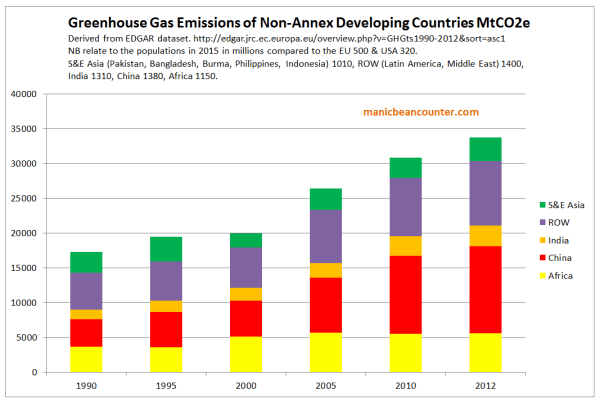
The extent of the arrows could be debated, but will not alter the fact that Millar et. al 2017 are assuming that by adjusting the figures and assuming that they are thinking for the whole world, that the emissions objectives will be achieved. The reality is that very few countries have committed to reducing their emissions by anything like an amount consistent with even a 2°C pathway. Further, that commitment is just until 2030, not for the 70 years beyond that. There is no legally-binding commitment in the Paris Agreement for a country to reduce emissions to zero sometime before the end of the century. Further, a number of countries (including Nigeria, Togo, Saudi Arabia, Turkmenistan, Iraq and Syria) have not signed the Paris Agreement – and the United States has given notification of coming out of the Agreement. Barring huge amounts of funding or some technological miracle most developing countries, with a majority of the world population, will go on increasing their emissions for decades. This includes most of the countries who were Non-Annex Developing Countries to the 1992 Rio Declaration. Collectively they accounted for just over 100% of the global GHG emissions growth between 1990 and  2012.

As some of these Countries’ INDC Submissions clearly state, most will not sacrifice economic growth and the expectations of their people’s for the unproven dogma of politicalized academic activists in completely different cultures say that the world ought to cut emissions. They will attend climate conferences and be seen to be on a world stage, then sign meaningless agreements afterward that commit them to nothing.

As a consequence, if catastrophic anthropogenic global warming is true (like the fairies at the bottom of the garden) and climate mitigation reduction targets are achieved, the catastrophic climate change will be only slightly less catastrophic and the most extreme climate mitigation countries will be a good deal poorer. The non-policy countries will the ones better off. It is the classic free-rider problem, which results in an underprovision of those goods or services. If AGW is somewhat milder, then even these countries will be no worse off.

This is what really irritates me. I live in Britain, where the Climate Change Act 2008 has probably the most ludicrous targets in the world. That Act was meant to lead the world on climate change. The then Environment Secretary David Miliband introduced the bill with this message in March 2007.

From the graphic above COP21 Paris showed that most of the world is not following Britain’s lead. But the “climate scientists” are so stuck in their manipulated models, they forget that their models and beliefs of their peers are not the realities of the wider world. The political realities mean that reduction of CO2 emissions are net harmful to the people of Britain, both now and for future generations of Britains. The activists are just as wilfully negligent in shutting down any independent review of policy as a pharmaceutical company who would push one of its products onto the consumers without an independent evaluation of both the benefits and potential side effects.

Kevin Marshall

Nature tacitly admits the IPCC AR5 was wrong on Global Warming

There has been a lot of comment on a recent paper at nature geoscience “Emission budgets and pathways consistent with limiting warming to 1.5◦C” (hereafter Millar et. al 2017)
When making a case for public policy I believe that something akin to a process of due diligence should be carried out on the claims. That is, the justifications ought to be scrutinized to validate the claims. With Millar et al 2017, there are a number of issues with the make-up of the claims that (a) warming of 1.5◦C or greater will be achieved without policy (b) constraining the emissions
The baseline warming
The introduction states
Average temperatures for the 2010s are currently 0.87°C above 1861–80,
A similar quote from UNIPCC AR5 WG1 SPM page 5
The total increase between the average of the 1850–1900 period and the 2003–2012 period is 0.78 [0.72 to 0.85] °C, based on the single longest dataset available.
These figures are all from the HADCRUT4 dataset. There are three areas to account for the difference of 0.09°C. Mostly, it is the shorter baseline period. Also, the last three years have been influenced by a powerful and natural El-Nino, along with the IPCC, using an average of the last 10 years.
The warming in the pipeline
There are valid reasons for the authors differing from the IPCC’s methodology. They start with the emissions from 1870 (even though emissions estimates go back to 1850). Also, if there is no definite finish date, it is very difficult to calculate the warming impact to date. Consider first the full sentence quoted above.
Average temperatures for the 2010s are currently 0.87°C above 1861–80, which would rise to 0.93°C should they remain at 2015 levels for the remainder of the decade.
This implies that there is some warming to come through from the impact of the higher greenhouse gas levels. This seems to be a remarkably low and over a very short time period. Of course, not all the warming since the mid-nineteenth century is from anthropogenic greenhouse gas emissions. The anthropogenic element is just guesstimated. This is shown in AR5 WG1 Ch10 Page 869
More than half of the observed increase in global mean surface temperature (GMST) from 1951 to 2010 is very likely due to the observed anthropogenic increase in greenhouse gas (GHG) concentrations.
It was after 1950 when the rate of the largest increase in CO2 levels was experienced. From 1870 to 1950, CO2 levels rose from around 290ppm to 310ppm or 7%. From 1950 to 2010, CO2 levels rose from around 310ppm to 387ppm or 25%. Add in other GHG gases, and the human-caused warming should be 3-4 times greater in the later period than the earlier one, whereas the warming in the later period was just over twice the amount. Therefore if there is just over a 90% chance (very likely in IPCC speak) of over 50% of the warming post-1950 was human-caused, a statistical test relating to a period more than twice as long would have a lower human-caused element of the warming as being statistically significant. Even then, I view the greater than 50% statistic as being deeply flawed. Especially when post-2000, when the rate of rise in CO2 levels accelerated, whilst the rise in average temperatures dramatically slowed. There are two things that this suggests. First, the impact could be explained by rising GHG emissions being a minor element in temperature rise, with natural factors both causing some of the warming in the 1976-1998 period, then reversing, causing cooling, in the last few years. Second is that there is a darn funny lagged response of rising GHGs (especially CO2) to rises in temperature. That is, the amount of warming in the pipeline has increased dramatically. If either idea has any traction, then the implied warming to come of just 0.06°C is a false estimate. This needs to be elaborated.
Climate Sensitivity
If a doubling of CO2 leads to 3.00°C of warming (the assumption of the IPCC in their emissions calculations), then a rise in CO2 levels from 290ppm to 398 ppm (1870 to 2014) eventually gives 1.37°C of warming. With other GHGs, this figure should be around 1.80°C. Half that warming has actually occurred, and some of that is natural. So there is well over 1.0°C still to emerge. It is too late to talk about constraining warming to 1.5°C as the cause of that warming has already occurred.
The implication from the paper in claiming that 0.94°C will result from human emissions in the period 1870-2014 is to reduce the climate sensitivity estimate to around 2.0°C for a doubling of CO2, if only CO2 is considered, or around 1.5°C for a doubling of CO2, if all GHGs are taken into account. (See below) Compare this to AR5 WG1 section D.2 Quantification of Climate System Responses
The equilibrium climate sensitivity quantifies the response of the climate system to constant radiative forcing on multicentury time scales. It is defined as the change in global mean surface temperature at equilibrium that is caused by a doubling of the atmospheric CO2 concentration. Equilibrium climate sensitivity is likely in the range 1.5°C to 4.5°C (high confidence), extremely unlikely less than 1°C (high confidence), and very unlikely greater than 6°C (medium confidence).
The equilibrium climate sensitivity ECS is at the very bottom of the IPCC’s range, and equilibrium climate response is reached in 5-6 years instead of mutlicentury time scales. This is on top of the implied assumption that there is no net natural warming between 1870 and 2015.
How much are GHG emissions?
With respect to policy, as global warming is caused by human greenhouse gas emissions, to prevent further human-caused warming requires reducing, and possibly eliminating global greenhouse emissions. In conjunction with the publication of the AR5 Synthesis report, the IPCC produced a slide show of the policy case laid out in the three vast reports. It was effectively a short summary of a summary of the synthesis report. Approaching the policy climax at slide 30 of 35:-

Apart from the policy objective in AR5 was to limit warming from 2°C, not 1.5°C, it also mentions the need to constrain GHG emissions, not CO2 emissions. Then slide 33 gives the simple policy simplified position to achieve 2°C of warming.

To the end of 2011 1900 GTCO2 of CO2 was estimated to have been emitted, whilst the estimate is around 1000 GTCO2 could be emitted until the 2°C warming was reached.
This is the highly simplified version. At the other end of the scale, AR5 WG3 Ch6 p431 has a very large table in a very small font to consider a lot of the policy options. It is reproduced below, though the resolution is much poorer than the original.

Note 3 states
For comparison of the cumulative CO2 emissions estimates assessed here with those presented in WGI AR5, an amount of 515 [445 to 585] GtC (1890 [1630 to 2150] GtCO2), was already emitted by 2011 since 1870
The top line is for the 1.5°C of warming – the most ambitious policy aim. Of note:-
The CO2 equivalent concentration in 2100 (ppm CO2eq ) is 430-480ppm.
Cumulative CO2 emissions (GtCO2) from 2011 to 2100 is 630 to 1180.
CO2 concentration in 2100 is 390-435ppm.
Peak CO2 equivalent concentration is 465-530ppm. This is higher than the 2100 concentration, and if for CO2 alone with ECS = 3 would eventually produce 2.0°C to 2.6°C of warming.
The Probability of Exceeding 1.5 °C in 2100 is 49-86%. They had to squeeze really hard to say that 1.5°C was more than 50% likely.
Compare the above to this from the abstract of Millar et. al 2017.
If CO2 emissions are continuously adjusted over time to limit 2100 warming to 1.5◦C, with ambitious non-CO2 mitigation, net future cumulative CO2 emissions are unlikely to prove less than 250 GtC and unlikely greater than 540 GtC. Hence, limiting warming to 1.5◦C is not yet a geophysical impossibility, but is likely to require delivery on strengthened pledges for 2030 followed by challengingly deep and rapid mitigation.
They use tonnes of carbon as the unit of measure as against CO2 equivalent. The conversion factor is 3.664, so cumulative CO2 emissions need to be 870-1010 GtCO2 range. As this is to the end of 2015, not 2011, as in the IPCC report, it will be different. Subtracting 150 from the IPCC reports figures would give a range of 480 to 1030. That is, Millar et. al 2017 have reduced the emissions range by 75% to the top end of the IPCC’s range. Given the IPCC considered a range of 1.5-1.7°C of warming, this seems somewhat odd to then say it is related to the lower end of the warming band, until you take into account that ECS has been reduced. But then why curtail the range of emissions instead calculating your own? It appears that again the authors are trying to squeeze a result within existing constraints.
However, this does not take into account the much higher levels of peak CO2 equivalent concentrations in table 6.3. Peak CO2 concentrations are around 75-95ppm higher than in 2100. Compare this to the green line in the central graph in Millar et. al 2017.

This is less than 50ppm higher than in 2100. Further in 2100 Millar et. al 2017 has CO2 levels of around 500ppm as against a mid-point of 410 in AR5. CO2 rising from 290 to 410ppm with ECS = 3.0 produced 1.50°C of warming. CO2 rising from 290 to 410ppm with ECS = 2.0 produced 1.51°C of warming. Further, this does not include the warming impact of other GHGs. To squeeze into the 1.5°C band, the mid-century overshoot in Millar et. al 2017 is much less than in AR5. This might be required in the modeling assumptions due to the very short time assumed in reaching full equilibrium climate response.
Are the authors playing games?
The figures do not appear to stack up. But then they appear to be playing around with figures, indicated by a statement in the explanation of Figure 2
Like other simple climate models, this lacks an explicit physical link between oceanic heat and carbon uptake. It allows a global feedback between temperature and carbon uptake from the atmosphere, but no direct link with net deforestation. It also treats all forcing agents equally, in the sense that a single set of climate response parameters is used in for all forcing components, despite some evidence of component-specific responses. We do not, however, attempt to calibrate the model directly against observations, using it instead to explore the implications of ranges of uncertainty in emissions, and forcing and response derived directly from the IPCC-AR5, which are derived from multiple lines of evidence and, importantly, do not depend directly on the anomalously cool temperatures observed around 2010.
That is:-
The model does not consider an “explicit physical link between oceanic heat and carbon uptake.” The IPCC estimated that over 90% of heat accumulation since 1970 was in the oceans. If the oceans were to belch out some of this heat at a random point in the future, the 1.5°C limit will be exceeded.
No attempt has been made to “calibrate the model directly against observations”. Therefore there is no attempt to properly reconcile beliefs to the real world.
The “multiple lines of evidence” in IPCC-AR5 does not include a glaring anomaly that potentially falsifies the theory and therefore any “need” for policy at all. That is the divergence in actual temperatures trends from theory in this century.
Conclusions
The authors of Millar et. al 2017 have pushed out the boundaries to continue to support climate mitigation policies. To justify constraining emissions sufficient stop 1.5°C of warming the authors would appear to have
Assumed that all the warming since 1870 is caused by anthropogenic GHG emissions when there is not even a valid statistical test that confirms even half the warming was from this source.
Largely ignored any hidden heat or other long-term response to rises in GHGs.
Ignored the divergence between model predictions and actual temperature anomalies since around the turn of the century. This has two consequences. First, the evidence appears to strongly contradict the belief that humans are a major source of global warming and by implication dangerous climate change. Second, if it does not contradict the theory, suggests the amount of warming in the pipeline consequential on human GHG emissions has massively increased. Thus the 1.5°C warming could be breached anyway.
Made ECS as low as possible in the long-standing 1.5°C to 4.5°C range. Even assuming ECS is at the mid-point of the range for policy (as the IPCC has done in all its reports) means that warming will breach the 1.5°C level without any further emissions.
The authors live in their closed academic world of models and shared beliefs. Yet the paper is being used for the continued support of mitigation policy that is both failing to get anywhere close to achieving the objectives and is massively net harmful in any countries that apply it, whether financially or politically.
Kevin Marshall
Commentary at Cliscep, Jo Nova, Daily Caller, Independent, The GWPF
Update 25/09/17 to improve formatting.

How the “greater 50% of warming since 1950 is human caused” claim is deeply flawed

Over at Cliscep, Jaime Jessop has rather jokingly raised a central claim of the IPCC Fifth Assessment Report, after someone on Twitter had accused her of not being a real person.

So here’s the deal: Michael Tobis convinces me, on here, that the IPCC attribution statement is scientifically sound and it is beyond reasonable doubt that more than half of the warming post 1950 is indeed caused by emissions, and I will post a photo verifying my actual existence as a real person.

The Report states (AR5 WG1 Ch10 Page 869)

It is extremely likely that human activities caused more than half of the observed increase in GMST from 1951 to 2010.

This extremely likely is at the 95% confidence interval and includes all human causes. The more specific quote on human greenhouse gas emissions is from page 878, section “10.2.4 Single-Step and Multi-Step Attribution and the Role of the Null Hypothesis

Attribution results are typically expressed in terms of conventional ‘frequentist’ confidence intervals or results of hypothesis tests: when it is reported that the response to anthropogenic GHG increase is very likely greater than half the total observed warming, it means that the null hypothesis that the GHG-induced warming is less than half the total can be rejected with the data available at the 10% significance level.

It is a much more circumspect message than the “<a href=”http://stocker IPCC 2013″ target=”_blank”>human influence on the climate system is clear</a>” announcements of WG1 four years ago.  In describing attribution studies, the section states

Overall conclusions can only be as robust as the least certain link in the multi-step procedure.

There are a number of candidates for “least certain link” in terms of empirical estimates. In general, if the estimates are made with reference to the other estimates, or biased by theory/beliefs, then the statistical test is invalidated. This includes the surface temperature data.

Further, if the models have been optimised to fit the surface temperature data, then the >50% is an absolute maximum, whilst the real figure, based on perfect information, is likely to be less than that.

Most of all are the possibilities of unknown unknowns. For, instance, the suggestion that non-human causes could explain pretty much all the post-1950 warming can be inferred from some paleoclimate studies. This reconstruction Greenland ice core (graphic climate4you) shows warming around as great, or greater, than the current warming in the distant past. The timing of a warm cycle is not too far out either.

In the context of Jaime’s challenge, there is more than reasonable doubt in the IPCC attribution statement, even if a statistical confidence of 90% (GHG emissions) or 95% (all human causes) were acceptable as persuasive evidence.

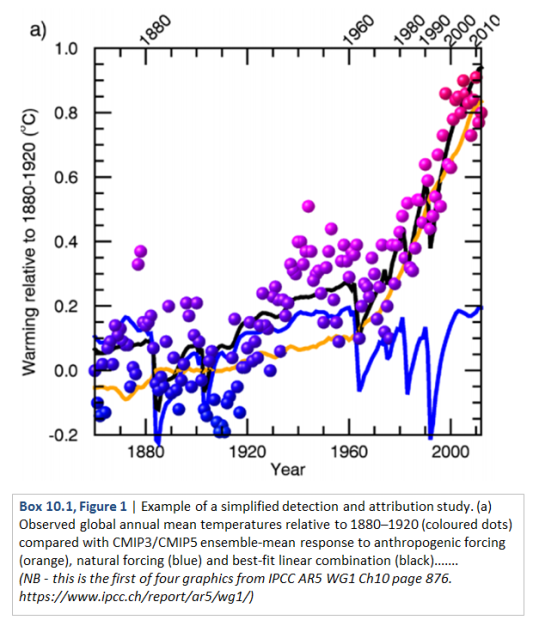
There is a further problem with the statement. Human greenhouse gas emissions are meant to account for all the current warming, not just over 50%. If the full impact of a doubling is CO2 is eventually 3C of warming, then from that the 1960-2010 CO2 rise from 317ppm to 390ppm alone will eventually be 0.9C of warming. Possibly 1.2C of warming from all sources. This graphic from AR5 WG1 Ch10 shows the issues.

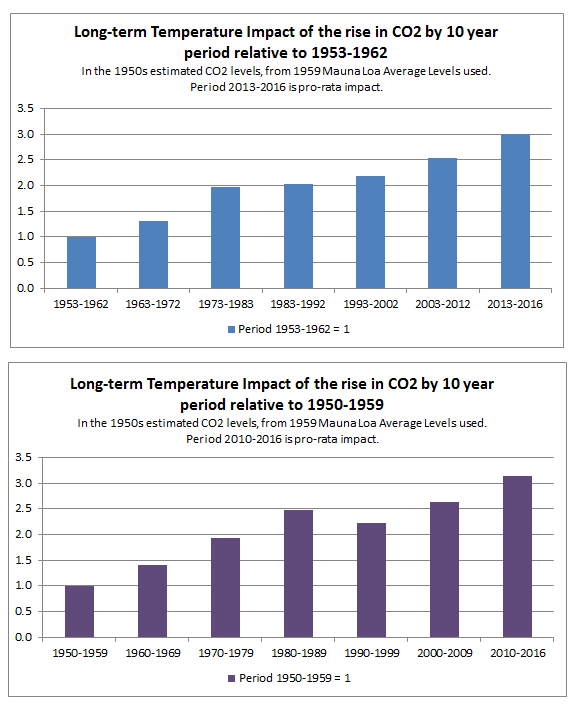
The orange line of anthropogenic forcing accounts for nearly 100% of all the measured warming post-1960 of around 0.8C – shown by the large dots. Yet this is about 60% of the warming in from GHG rises if a doubling of CO2 will produce 3C of warming. The issue is with the cluster of dots at the right of the graph, representing the pause, or slow down in warming around the turn of the century. I have produced a couple of charts that illustrate the problem.

In the first graph, the long term impact on temperatures of the CO2 rise from 2003-2012 is 2.5 times that from 1953-1962. Similarly, from the second graph, the long term impact on temperatures of the CO2 rise from 2000-2009 is 2.6 times that from 1950-1959. It is a darn funny lagged response if the rate of temperature rise can significantly slow down when the alleged dominant element causing them to rise accelerates. It could be explained by rising GHG emissions being a minor element in temperature rise, with natural factors both causing some of the warming in the 1976-1998 period, then reversing, causing cooling, in the last few years.

Kevin Marshall


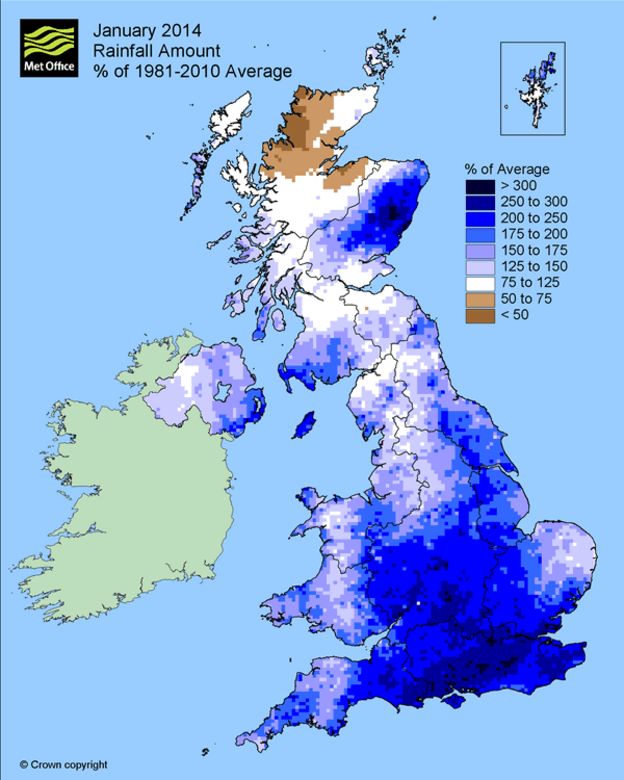
Met Office Extreme Wet Winter Projections

I saw an article in the Telegraph

Met Office warns Britain is heading for ‘unprecedented’ winter rainfall, with records broken by up to 30pc 

Britain is heading for “unprecedented” winter rainfall after the Met Office’s new super computer predicted records will be broken by up to 30 per cent.

Widespread flooding has hit the UK in the past few years leading meteorologists to search for new ways to “quantify the risk of extreme rainfall within the current climate”.

In other words, the Telegraph reporting that the Met Office is projecting that if the current record is, say, 100mm, new records of 130mm could be set.

BBC is reporting something slightly different

High risk of ‘unprecedented’ winter downpours – Met Office

There is an increased risk of “unprecedented” winter downpours such as those that caused extensive flooding in 2014, the UK Met Office says.

Their study suggests there’s now a one in three chance of monthly rainfall records being broken in England and Wales in winter.

The estimate reflects natural variability plus changes in the UK climate as a result of global warming.

The BBC has a nice graphic, of the most extreme winter month of recent years for rainfall.

The BBC goes onto say

Their analysis also showed a high risk of record-breaking rainfall in England and Wales in the coming decade.

“We found many unprecedented events in the model data and this comes out as a 7% risk of a monthly record extreme in a given winter in the next few years, that’s just over Southeast England,” Dr Vikki Thompson, the study’s lead author told BBC News.

“Looking at all the regions of England and Wales we found a 34% chance of an extreme event happening in at least one of those regions each year.”

Not only is there a greater risk, but the researchers were also able to estimate that these events could break existing records by up to 30%.

“That is an enormous number, to have a monthly value that’s 30% larger, it’s a bit like what we had in 2014, and as much again,” said Prof Adam Scaife from the Met Office.

The 30% larger is an outlier.

But over what period is the record?

The Met Office website has an extended version of what the BBC reports. But strangely no figures. There is a little video by Dr Vikki Thomson to explain.

She does say only recent data is used, but no definition of what constitutes recent. A clue lies not in the text, but an explanatory graphic.

It is from 35 years of winters, which ties into the BBC’s graphic from 1981. There are nine regions in England and Wales by the Met Office definition. The tenth political region of London is included in the South East. There could be different regions for the modeling. As Ben Pile and Paul Homewood pointed out in the comments to the Cliscep article, elsewhere the Met Office splits England and Wales into six regions. What is amazing is that the Met Office article does not clarify the number of regions, still less show the current records in the thirty-five years of data. There is therefore no possibility of ever verifying the models.

Put this into context. Northern Ireland and Scotland are excluded, which seems a bit arbitrary. If rainfall was random, then the chance of this coming winter setting a new record in a region is nearly 3%. For any one of nine regions, if data rainfall data independent between regions (which it is not) it is nearly a 26% chance. 34% is higher. But consider the many alternatives ways for the climate patterns to become more extreme and variable. After all, with global warming there climate could be thrown into chaos, so more extreme weather should be emerging as a foretaste of much worse to come. Given the many different aspects of weather, there could be hundreds of possible ways climate could get worse. With rainfall, it could be wetter or drier, in either summer or winter. That is four variables, of which the Met Office choose just one. Or could be in any 1, 2, 3… or 12 month period. Then again, climate change could mean more frequent and violent storms, such as that of 1987. Or it could mean more heatwaves. Statistically, heatwaves records could be a number of different ways, such as, say, 5 consecutive days in a month where the peak daily temperature is more than 5C about the long-term monthly average peak temperature.
So why choose rainfall in winter? Maybe it is because in recent years there have been a number of unusually wet winters. It looks like the Met Office, for all the power of their mighty computers, have fallen for a common fallacy.


Texas sharpshooter fallacy is an informal fallacy which is committed when differences in data are ignored, but similarities are stressed. From this reasoning, a false conclusion is inferred. This fallacy is the philosophical/rhetorical application of the multiple comparisons problem (in statistics) and apophenia (in cognitive psychology). It is related to the clustering illusion, which refers to the tendency in human cognition to interpret patterns where none actually exist.
The name comes from a joke about a Texan who fires some gunshots at the side of a barn, then paints a target centered on the tightest cluster of hits and claims to be a sharpshooter.

A run of extremely wet winters might be due to random clustering, or it could genuine patterns from natural variation, or it could be a sign of human-caused climate change. An indication of random clustering would be to look at many other the different aspects of weather, to see if there is a recent trend of emerging climate chaos. Living in Britain, I suspect that the recent wet weather is just drawing the target around the tightest clusters. Even then, high winter rainfall in Britain high rainfall this is usually accompanied by slightly milder temperatures than average. Extreme winter cold is usually on cloud-free days. So, if winter rainfall is genuinely getting worse it seems that the whole global warming thing for Britain is predicted to become a bit a damp squib.

Kevin Marshall


The Closest yet to my perspective on Climate Change

 Michael S. Bernstam of the Hoover Institution has produced a short post Inconvenient Math. (hattip The GWPF). The opening paragraphs are:-

Climate change faces a neglected actuarial problem. Too many conditions must be met to warrant a policy action on climate change. The following four stipulations must each be highly probable:

1. Global warming will accumulate at 0.12 degrees Celsius or higher per decade.

2. It is anthropogenic, due largely to carbon dioxide emissions.

3. The net effect is harmful to human well-being in the long run.

4. Preventive measures are efficient, that is, feasible at the costs not exceed-ing the benefits.

But even if the probability of each of these stipulations is as high as 85 percent, their compound probability is as low as 50 percent. This makes a decision to act or not to act on climate change equivalent to flipping a coin.

Bernstam later states

In the case of climate change, the conditions are four. They are not random, nor are they arbitrary. To see this, one can run a thought experiment and drop or ignore any of the above foursome. At once, the entire call for action on climate change becomes pointless. If global warming is not ongoing, there is no need to stop it. If it is not anthropogenic, there is no need to curb carbon dioxide emissions. If it is not harmful, there is no need to worry. If preventive measures are inefficient, they would not help and there is no use applying them. It follows that all four conditions are necessary. If just one of them does not hold, action is unnecessary or useless.

That is, for action on climate change to be justified (in terms of having a reasonable expectation that by acting to combat climate change a better future will be created than by not acting) there must be human-caused warming of sufficient magnitude to produce harmful consequences, AND measures that cost less than the expected future costs that they offset.

These sentiments are a simplified version of a series of posts I made in October 2013, where I very crudely deriving two cost curves (costs of climate change and climate mitigation). This aimed to replicate a takeaway quote from the Stern Review.

Using the results from formal economic models, the Review estimates that if we don’t act, the overall costs and risks of climate change will be equivalent to losing at least 5% of global GDP each year, now and forever. If a wider range of risks and impacts is taken into account, the estimates of damage could rise to 20% of GDP or more. In contrast, the costs of action – reducing greenhouse gas emissions to avoid the worst impacts of climate change – can be limited to around 1% of global GDP each year.

I looked at the idea of multiplying the various probabilities together, at least for the costs of climate change.  But instead of the boundary it is a continuous function of an infinite number of possible scenarios. In general I believe the more extreme the costs of warming, the less likely it is to happen. The reason is that we derive the non-visible part of the cost curve can only be objectively derived from the revealed warming from the recent past. Separation of the costs of warming-induced climate change are extremely difficult from the costs of random extreme weather events. Even worse, the costs of extreme natural weather events (especially in terms of death toll) has been falling over time, as Indur Goklany has documented. The fall-back for global-warming theory is to use the late Milton Friedman’s Methodology of Positive Economics. That is to evaluate theory credibility on its predictive ability. If in the short-run climate scientists (or anyone who believes in climate alarmism like Al Gore) are able to make predictions about the signals of impending climate apocalypse, then this should give some credibility for claims of substantially worse to come. The problem is there are a huge number of failed predictions of climate worsening, but not a single one that has come true. This would signify that the true risk (as opposed to the perceived risk from the climate community) of climate change is approximately zero. The divergence of belief from the evidence is likely from the collective navel-gazing of post normal science.

The policy aspect that Bernstam fails to explore is the re-distributional aspects of policy. The theory is that global warming is caused by global greenhouse gas emissions. Therefore climate mitigation must comprise of reducing those global emissions. However, as the COP21 Paris showed most of the worlds population live in countries where there are no GHG emissions reduction policies even proposed. But actually reducing emissions means increasing energy costs, and hampering businesses with onerous regulations. Policy countries are given a comparative disadvantage to non-policy countries, as I tried to show here. The implication is that if developed countries strongly pursue high cost mitigation policies, the marginal cost of non-policy emerging economies switching to emissions reduction policies increases. Thus, whilst Donald Trump’s famous tweet that Global Warming is a Chinese hoax to make US manufacturing non-competitive is false, the impact of climate mitigation policies as currently pursued are the same as if it were true.

There is also a paradox with the costs of climate change. The costs of climate change are largely related to the unexpected nature of the costly events. For instance, ceteris paribus. a category 1 hurricane could be more costly in a non-hurricane area than a stronger hurricane in say Florida. The reason is that in the non-hurricane area buildings will not be as resistant to storms, nor will there be early warning procedures in place as in Florida. The paradox is that more successful climate scientists are in forecasting the risks of climate change, the more people can adapt to climate change, reducing the costs. The current focus on climate consensus, rather than focusing on increasing competency and developing real expertise in the field is actually harmful to future generations if climate change is a actually a serious emerging problem. But the challenge for the climate alarmists is that in developing the real expertise may result in their beliefs about the world are false.

Finally, Bernstam fails to acknowledge an immutable law of public policy. Large complex public policy projects with vague aims; poorly defined plans and lack of measurable costs tend to overshoot on costs and under-perform of benefits. Climate mitigation is an extreme example of complexity, lack of clear objects and lack object measurement of costs per unit of emissions saved.

Kevin Marshall