Empirically Baseless Climate Accountability Claim: Shell and Typhoon Rai

Last month the BBC headlined an article “Shell facing first UK legal claim over climate impacts of fossil fuels“. Typhoon Rai hit the Philippines in late 2021, damaging millions of homes and resulting in 400 deaths. Some of those affected are suing major oil producer Shell in UK courts, claiming that its emissions had a material impact on the severity of that typhoon. The BBC article states

The letter argues that Shell is responsible for 2% of historical global greenhouse gases, as calculated by the Carbon Majors database of oil and gas production, external.

The company has “materially contributed” to human driven climate change, the letter says, that made the Typhoon more likely and more severe.

The group wants to apply Philippine law (where the damage occurred) in a case to be heard in English courts. I will apply my rather cursory understanding of English tort law. That is, it is up to the litigant to prove their case on the balance of probabilities in an adversarial court system. A case is proved with clear evidence. In this case, each piece of evidence needs to be critically reviewed in light of the connection between human emissions and rising greenhouse gas levels; rising greenhouse gas levels and global average temperature rise; the rise in global average temperatures causing (or excerbating) Typhoon Rai; and the damage caused (especially injury and death being related to some function of (a) the strength of the storm and (b) the population impacted). Being a (somewhat) manic former beancounter, I will concentrate on the empirical data. I will also use a Greenpeace article from 23/10/25, which provides much more detail and a useful link to an attribution study.

That 2% figure

The BBC article states “that Shell is responsible for 2% of historical global greenhouse gases“. This is incorrect. The Greenpeace article gets closer, when it states “41 billion tons of CO2e or more than 2% of global fossil fuel emissions.” Going to the Carbon Majors Shell Page, the information box states that the 41.092 GtCO2 is 2.04% of the total CO2 emissions tracked by Carbon Majors from fossil fuels and cement for the period 1751-2013. This means that total emissions in the database were 2014 GtCO2.

Many would dispute whether a 2% contribution is a material contribution. There is a problem with this estimate. Anthropogenic CO2 emissions are mostly from fossil fuel emissions and cement production, but not entirely. There are also emissions from land-use changes. Further, I believe that the most authoritative source of anthropogenic CO2 emissions estimates are from the UNIPCC Assessment Reports. The most recent edition was the Sixth Assessment Report (AR6), published in 2021. AR6 WG3 SPM stated “Historical cumulative net CO2 emissions from 1850 to 2019 were 2400 ± 240 GtCO2 (high confidence)”. Footnote 10 states that this is at the 68% confidence interval. I was taught over 40 years ago that normal, acceptable, statistical confidence intervals were 95%, or double the 68% value. For a legal case in the UK, this should be confirmed by a Chartered Statistician (CStat) of the Royal Statistical Society (RSS), along with a validation of whether the confidence interval was calculated by a valid statistical method. AR6 used data from the Global Carbon Budget. AR6 is a bit coy about citing this source. However, searching “Friedlingstein” in the pdf of the full AR6 WG1 report, gives a reference to Friedlingstein et al., 2019. This is an annual, peer-reviewed article on the Global Carbon Budget.

The period 1850-2019 of the Global Carbon Budget is a century less than the Carbon Majors period of 1751-2023. To reconcile two data sets, I will ignore the period 1751-1849, as anthropogenic CO2 emissions were a tiny fraction of emissions since 1850. The Global Carbon Budget estimates CO2 emissions in 2019 at over 42 GtCO2, so the period 1850-2023 has emissions of 2570 ± (at least) 514 GtCO2. Ignoring the uncertainties, the Shell “share” of CO2 emissions becomes, at most, 1.6% of the total.

CO2 Emissions and Global Warming

However, this estimate ignores the impact of other greenhouse gas emissions on global warming. What about the impact of methane (CH4) emissions from bovine belching and flatulence? Or the methane emissions from sewage, or rotting waste? Or the Nitrous Oxide (N2O) emissions from burning heavy fuel oil in large container ships and supertankers?

The last IPCC assessment report attempted to attribute the observed relative global warming from 1850-1990 to 2010-2019 to various radiative forcing factors. The key graphic from AR6 WG1 SPM is reproduced as figure 1.
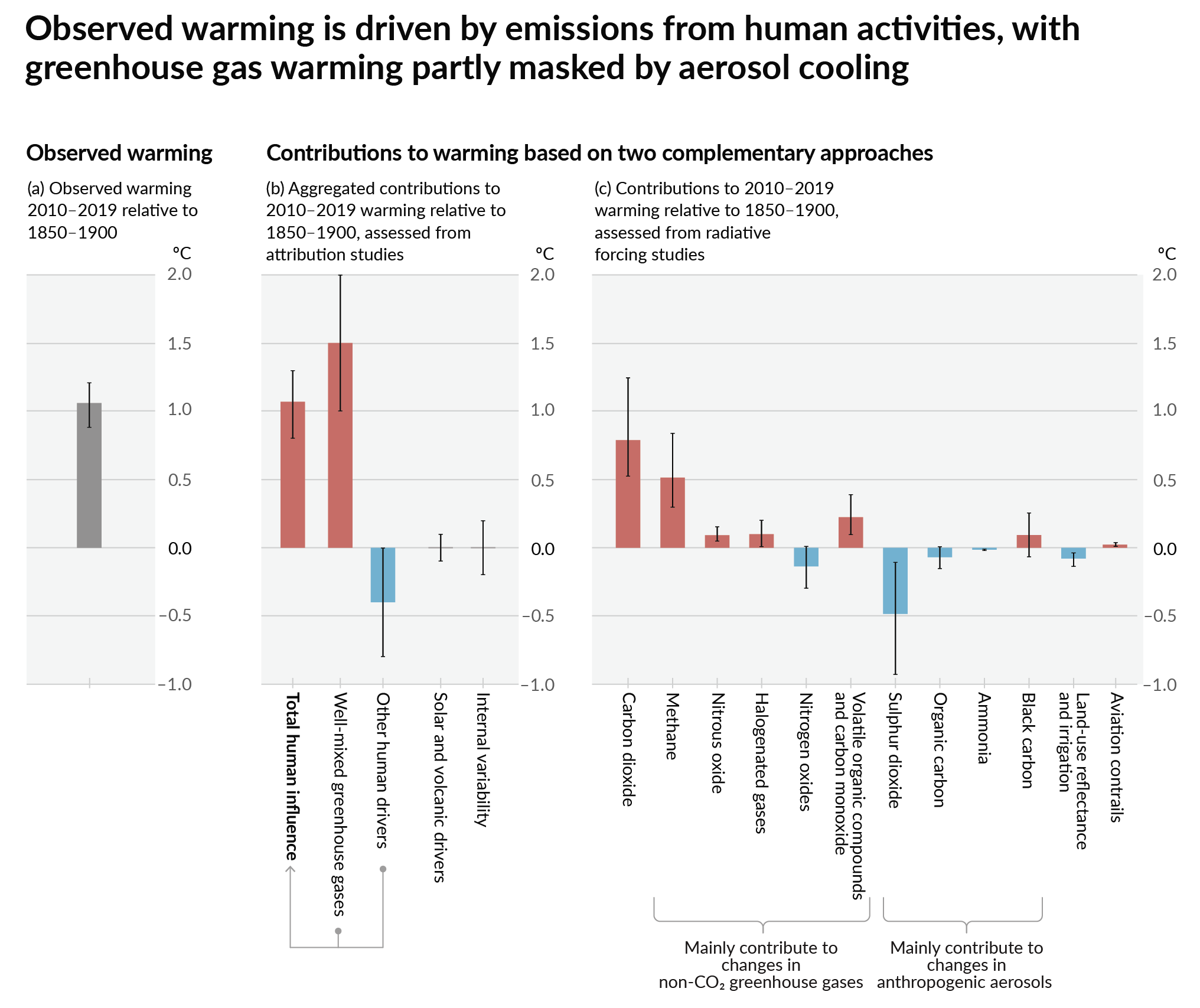
Figure 1 : Figure SPM.2 in IPCC, 2021: Summary for Policymakers. In: Climate Change 2021: The Physical Science Basis. Contribution of Working Group I to the Sixth Assessment Report of the Intergovernmental Panel on Climate Change [Masson-Delmotte, V., P. Zhai, A. Pirani, S.L. Connors, C. Péan, S. Berger, N. Caud, Y. Chen, L. Goldfarb, M.I. Gomis, M. Huang, K. Leitzell, E. Lonnoy, J.B.R. Matthews, T.K. Maycock, T. Waterfield, O. Yelekçi, R. Yu, and B. Zhou (eds.)]. Cambridge University Press, Cambridge, UK and New York, NY,USA, pp. 3−32, doi: 10.1017/9781009157896.001 .]

The key graphic is (c). Carbon dioxide emissions created about 0.8 °C of warming, of which around 80% was from the burning of fossil fuels. Adding to this are the methane emissions from the production of fossil fuels, along with the nitrous oxide and carbon monoxide emissions. Subtracting from this are emissions of nitrogen oxides and sulphur dioxide. The net impact is that about two-thirds of the observed warming. Pro rata, Shell is “responsible” for around 1% of the warming impact or about 0.01 °C of average global temperature over 150 years. Even this could very well be an exaggeration for two reasons. First, the calculated average temperature rise could be biased upwards. Second, some of the true average temperature rise could be due to natural factors, including variations caused by the chaotic nature of climate, or highly complex factors that are incapable of being described by scientific modelling. Much of the warming could be due to a rebound from a period called the Little Ice Age. Further, there was considerable warming during 1910-1940 in the data sets, which, a few years ago, was comparable in magnitude to the post-1975 warming. Yet the global emissions and the rate of rise in CO2 levels was considerably lower than in the later period.

Even using the data from the IPCC AR6, it is very difficult to establish, using a balance of probabilities criterion, that 41 GtCO2 of CO2 emissions raised global average temperatures by at least 0.01 °C since 1850-1900.

Impact of global warming on Typhoons in the Philippines

The BBC article grabbed my attention with the claim that human-caused emissions had made Typhoon Kai both more likely and severe. I am somewhat sceptical, as my cursory knowledge of the empirical evidence is that there is no convincing support for the hypothesis that tropical cyclones (typhoons in the eastern hemisphere, hurricanes in the western hemisphere) have increased markedly since the mid-70s when the rate of global average temperature rise took off. Such a correlation, if established, would be the starting point for claiming that the warming caused the increase.

There are two sources.

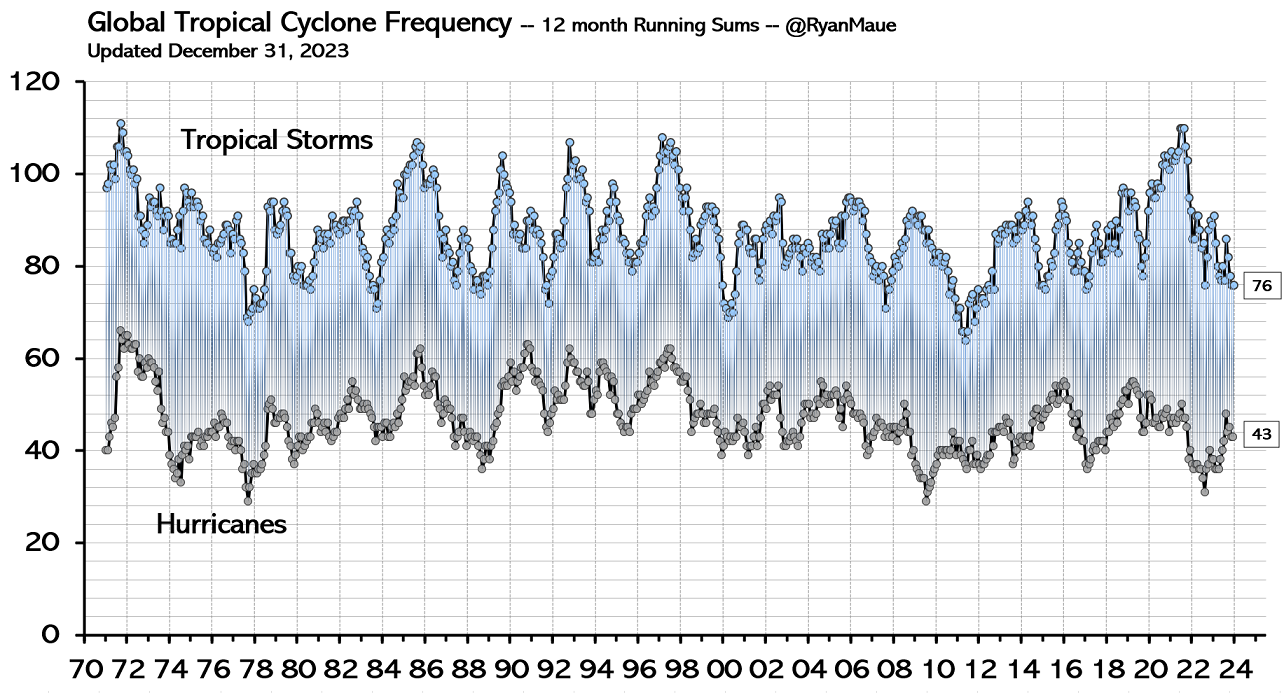
First is a couple of charts from Meteorologist Ryan Maue. These are of tropical cyclone frequency, and global tropical cyclone accumulated cyclone energy (from a peer-reviewed article). Both show data from the early 1970s. Cyclone frequency shows no trend. The cyclone frequency chart is more interesting. There are two major humps in the 1990s; a single peak in the 2000s; a relative energy drought 2008-2015; twin humps 2015-2020 smaller than the 1990s: then a decline into 2023 when the data ceases. At the foot of the chart there is a note. “Global data completeness much lower in the 1970s.” In terms of complete decades, the 1990s and 2000s seem tied for first, then the 2010s, with the 1980s in clear last place.

The second source has charts of Continental US hurricanes making landfall from Roger Pielke Jr. The big advantage is 125 years of consistent data, with no trend in all hurricanes or major hurricanes of Cat 3 and above. With this latest data is an accumulated cyclone energy chart for 1980-2024. This one has a single bar for each calendar year, with a slight downward trend.

With these data-driven prejudices, I took a look at the attribution study that supported the claim of human-caused climate change making Typhoon Rai more likely and more severe. This is, according to the Greenpeace Article, Clarke et al 2025 (The influence of anthropogenic climate change on Super Typhoon Odette (Typhoon Rai) and its impacts in the Philippines). The abstract states

First, we check that the current generation of higher resolution models used in attribution studies can capture the low sea level pressure anomaly associated with Typhoon Odette and hence can be used to study this type of event. A short analysis then compares such circulation analogues and the associated meteorological extremes over three time periods: past (1950-1970), contemporary (2001-2021), and future (2030-2050). Second, a multi-method multi-model probabilistic event attribution finds that extreme daily rainfall such as that observed during Typhoon Odette, has become about twice as likely
during the Typhoon season over the southern-central Philippines due to ACC. Third, a large ensemble tropical cyclone hazard model finds that the wind speeds of category 5 landfalling typhoons like Odette have become approximately 70% more likely due to ACC.

Viewing the data analysis and modelling as a black box, inputting data for 1950-1970 and 2001-2021 leads to the conclusion that Cat 5 Typhoon Odette (Rai) was made 70% more likely due to anthropogenic climate change (ACC). To ensure that this conclusion is not an artifact of inconsistent data quality, the processing of that data before inputting it into the models, and the modelling, one would need to see the complete set of raw data. As a preliminary, a count of each category of typhoon for each of the seven decades, or even by year. Why is this important? On a global level, Ryan Maue warned that global data completeness was much lower in the 1970s, which implies that it was improving. That improvement would have been most marked in the areas with the lowest completeness before the 1970s. The Philippines, a developing country made up of a many islands, probably had much poorer data quality in 1950-1970 than the continental USA. Yet Clarke et al is able, in Figure 1, to show maximum wind speeds as Odette/Rai tracked across the mid-Philippines. Data that could have only come from satellites. 60 years earlier, the calculation of typhoon strength could only have come from measurements on the ground, which may have been very few. Therefore, that raw data could often understate the typhoon category. And if there is no data for measured sub-Cat 1 typhoons, then the total number might be understated. Quite detailed data processing is therefore required to obtain approximately comparable data for the 1950s & 1960s with the 21st century. The less processing, the greater the chance of showing an increase that does not exist in reality, but the greater the processing, the greater the distance from actual data. Does Clarke et al tackle this issue?

Under 3.2.1 Observational data on page 18 is stated

In this section, we use a range of gridded observational and reanalysis products.

They haven’t even examined the real raw data. We can’t get any appreciation of how much the data has been transformed.

All is not lost for those who want to make a case for an ACC-caused increase in major typhoons in the Philippines. The UNIPCC has been struggling to make the connection for decades on a global basis. The 2021 AR6 WG1 (The Physical Science Basis) states in para A.3.4

It is likely that the global proportion of major (Category 3–5) tropical cyclone occurrence has increased over the last four decades, and it is very likely that the latitude where tropical cyclones in the western North Pacific reach their peak intensity has shifted northward; these changes cannot be explained by internal variability alone (medium confidence). There is low confidence in long-term (multi-decadal to centennial) trends in the frequency of all-category tropical cyclones. Event attribution studies and physical understanding indicate that human-induced climate change increases heavy precipitation
associated with tropical cyclones (high confidence), but data limitations inhibit clear detection of past trends on the global scale.

At the broadest level, my skeptical empiricist view is confirmed. There is no clear evidence of tropical cyclones having increased globally. Which means that the likely claim of major tropical cylones increasing is of a trivial quantity, or minor tropical cyclones have decreased. The significant part is about the western North Pacific. Given that there are a number of other areas globally where tropical cyclones occur, this is somewhat that this is the only area where an ACC influence can be found. But the Philippines could be construed as being in the western North Pacific, if the boundary between north and south is strictly the equator. The main islands of the Philippines lie 5 °- 19 ° N, and the Tropic of Cancer 23.6 ° N. For that reason alone, it is worth investigating.

The full report has quite a few mentions of this finding. on page 1747 is the following reference

Sun, J., D.Wang, X. Hu, Z. Ling, and L.Wang, 2019: Ongoing Poleward Migration of Tropical Cyclone Occurrence Over the Western North Pacific Ocean. Geophysical Research Letters, 46(15), 9110–9117,
doi:10.1029/2019gl084260.

Fortunately, the paper is open access. The Key Points are

  • Tropical cyclone occurrence has been shifting poleward to the coast of East Asia from areas south of 20°N from 1982 to 2018
  • The preferential tropical cyclone passage has switched from westward moving to northward recurving since 1998
  • The poleward migration may be primarily attributed to the cyclonic anomaly of the steering flow over East Asia

The main point here is that south of 20°N (which the Philippines occupies), tropical cyclone occurrence has been decreasing. In case of doubt about the geography, check the colourful Figure 1. If one accepts the attribution to human-caused climate change, then the people of the Philippines should be thanking fossil fuel producers, not suing them. However, I am trying to look at what can be established on the balance of probabilities criterion. To repeat the comment in the WG1 SPM

….it is very likely that the latitude where tropical cyclones in the western North Pacific reach their peak intensity has shifted northward; these changes cannot be explained by internal variability alone (medium confidence).

In my (non-legal) opinion, there are two statements in this quotation.

The first is that there is evidence of climatic changes in the western North Pacific. The evidence is from statistical data (with potential data issues), but it far exceeds the balance of probabilities criterion.

The second is a qualitative opinion by a group of experts trying to find evidence of human-caused climate change. Medium confidence is tantamount to the opinion that, applying the balance of probabilities criterion, not even a small part of the observed change can be attributed to human causes.

Linking storm deaths to storm magnitude

In November 1970, Typhoon Bhola hit East Pakistan (now Bangladesh) and West Bengal. The official estimate was 500,000 dead. Most people were killed by the resulting storm surge that flooded the low-lying Ganges Delta. Another tropical cyclone hit Bangladesh in April 1991, killing at least 139,000. These are likely the first and third highest death tolls in the historical record for the old state of Bengal, although the further one goes back, the vaguer the reports. However, since 1991, the reporting of cyclones has become much more precise. The total deaths recorded in all cyclones by Wikipedia (which might be far from complete) since then are below 1,000. The likely reason for a greater than 99% fall in the deaths is the implementation of procedures to save lives. Like storm shelters and/or evacuation of the most vulnerable areas in advance of a cyclone. For the Philippines, with two-thirds of the population of Bangladesh, I count around 21,000 storm deaths in the period 2000-2025. This is highly skewed. The highest reported death toll was Typhoon Haiyan (Yolanda) in 2013 (6,352), followed by Tropical Storm Washi (Sendong) in 2011 (2,546) and Typhoon Bopha (Pablo) in 2012 (1,901). The three years 2011-2013 accounted for just over half the deaths in 2000-2025. The death rate per year from all storms 2000-2011 was about 3 times higher than in 2014-2025. Typhoon Kai in 2021, with 410 deaths, ranks ninth on the list. Of the deaths in 2014-2025, the two worst years were 2022 (467) and 2021 (463). Whilst the Philippines looks to have made great strides in reducing deaths from storms, there is clearly some way to go. That is if the Wikipedia figures are anything to go by.

Deaths are just one measure of the human impacts of powerful storms. There are also injuries, damage to property and the disruption to people’s lives. There has been much research on this topic in general, along with investigations afterwards to understand how the wide range of those human impacts can be lessened when similar events occur in the future. Whether or not the frequency of typhoons is increasing.

Conclusions and additional thoughts

Typhoon Rai was a Category 5 tropical cyclone that crossed the Philippines in December 2021, killing around 410 people. The claim has been made that the calculated 41 GtCO2 (2% of historical emissions) of CO2 emissions generated from the burning of fossil fuels extracted by Shell materially contributed to the severity of the storm.

The 2% material contribution is likely much smaller. In terms of the contribution to the human-caused global warming up to 2021, it is difficult to establish, through rigorous application of the balance probabilities criteria to AR6 WG1 evidence, that this quantity of emissions resulted in even 1% of the warming during 1850-2019. Even then, IPCC modelling makes the assumption that all the actual rise in global average temperatures is human-caused, which seems unwarranted when compared with the empirical evidence.

Key to attributing that warming to a 70% increase in the frequency of Cat 5 typhoons is data showing that such storms have increased both globally and in the Philippines area. The global data does not show such an increase. An attribution study comparing 1950-1970 and 2001-2021 did not look at the raw data. Thus, the authors cannot have looked at data quality and consistency issues in the entire period 1950-2021.

The attribution paper’s claimed increase in the frequency Cat 5 typhoons might conflict with the AR6 WG1 SPM report. The only case, the report finds, of climatic changes to global cyclones globally implies a reduction in tropical cyclones in the area of the Philippines during 1982-2018. Of course, it might still be that tropical cyclones were higher in 2001-2021 compared to 1950-1970, whilst declining during 1982-2018. But that still undermines the attribution paper.

Arguments about whether tropical cyclones have increased or not are invalid if the issue at stake is the human cost. A cursory look at the number of deaths suggests the death toll from the strongest typhoons appears to have decreased by over 90% since a run of severe storms in 2011-2013. This reduction is probably due to measures taken to reduce the human impacts.

As Shell has stated, the case against them is baseless. It is probably more baseless than they realised.

There are some additional thoughts on the Carbon Majors database. The most obvious one is why Shell. After all, BP is the largest historic British fossil fuel producer by potential emissions, although just 4% more than Shell. Globally, at the top of the list is China with seven times the “responsibility” of Shell. More generally, the database has three types of entities. These are (with shares) Investor-owned Company (24%), Nation State (15%) and State-owned Entity (30%). Smaller entities make up the remaining 31%. In fairness, any action should be a class-action suit against the whole world. That is not going to happen, so any successful action taken against investor-owned companies in, say UK or the USA, will be to the benefit of State entities in, say, China, Russia or Iran.
Key Error in Climate Policy Illustrated

Good example of the key logical error in climate policy justifications is illustrated by an article posed in a Los Angeles Times article and repeated by Prof. Roger Pielke Jnr on Twitter. This error completely undermines the case for cutting greenhouse gas emissions.

The question is

What’s more important: Keeping the lights on 24 hours a day, 365 days a year, or solving the climate crisis?

It looks to be a trade-off question. But is it a real trade-off?

Before going further I will make some key assumptions for the purposes of this exercise. This is simply to focus in on the key issue.

  1. There is an increasing human-caused climate crisis, that will only get much worse, unless…
  2. Human greenhouse gas (GHG) emissions are cut to zero in the next few decades.
  3. The only costs of solving the climate crisis to the people of California are the few blackouts every year. This will remain fixed into the future. So the fact that California’s electricity costs are substantially higher than the US national average I shall assume for this exercise are nothing to do with any particular state climate-related policies.
  4. The relevant greenhouse gases are well-mixed in the atmosphere. Thus the emissions of California, do not sit in a cloud forever above the sunshine state, but are evenly dispersed over the whole of the earth’s atmosphere.
  5. Global GHG emissions are the aggregate emissions of all nation states (plus international emissions from sea and air). The United States’ GHG emissions are the aggregate emissions of all its member states.

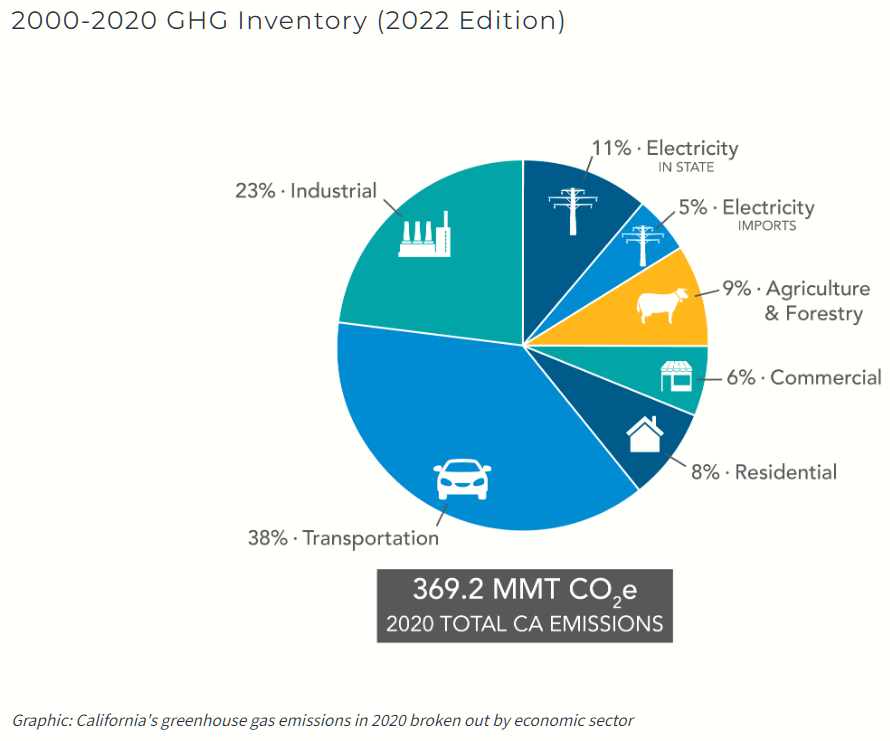
Let us put the blackouts in context. The State of California has a helpful graphic showing a breakdown of the state GHG emissions.

Figure 1: California’s greenhouse gas emissions in 2020 broken out by economic sector

Electricity production, including imports, accounts for just 16% of California’s GHG emissions or about 60 MMtCO2e. Globally in 2020 global GHG emissions were just over 50,000 MMtCO2e. So the replacing existing electricity production from fossil fuels with renewables will cut global emissions by 0.12%. Replacing all GHG emissions from other sources will cut global emissions by 0.74%. So California alone cannot solve the climate crisis. There is no direct trade-off, but rather enduring the blackouts (or other costs) for a very marginal impact on climate change for the people of California. These tiny benefits of course will be shared by the 7960 million people who do not live in California.

More generally, the error is in assuming that the world follows the “leaders” on climate change. Effectively, the world the rest of the world is assumed to think as the climate consensus. An example is from the UK in March 2007 when then Environment Minister David Miliband was promoting a Climate Bill, that later became the Climate Change Act 2008.

In the last 16 years under the UNFCCC COP process there has been concerted efforts to get all countries to come “onboard”, so that the combined impact of local and country-level sacrifices produces the total benefit of stopping climate change. Has this laudable aim been achieved?

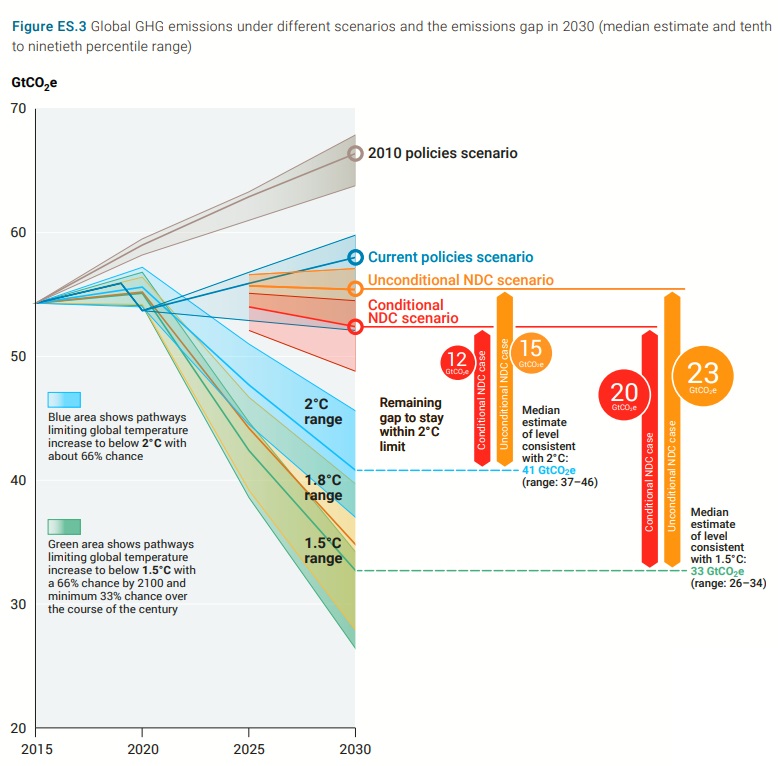
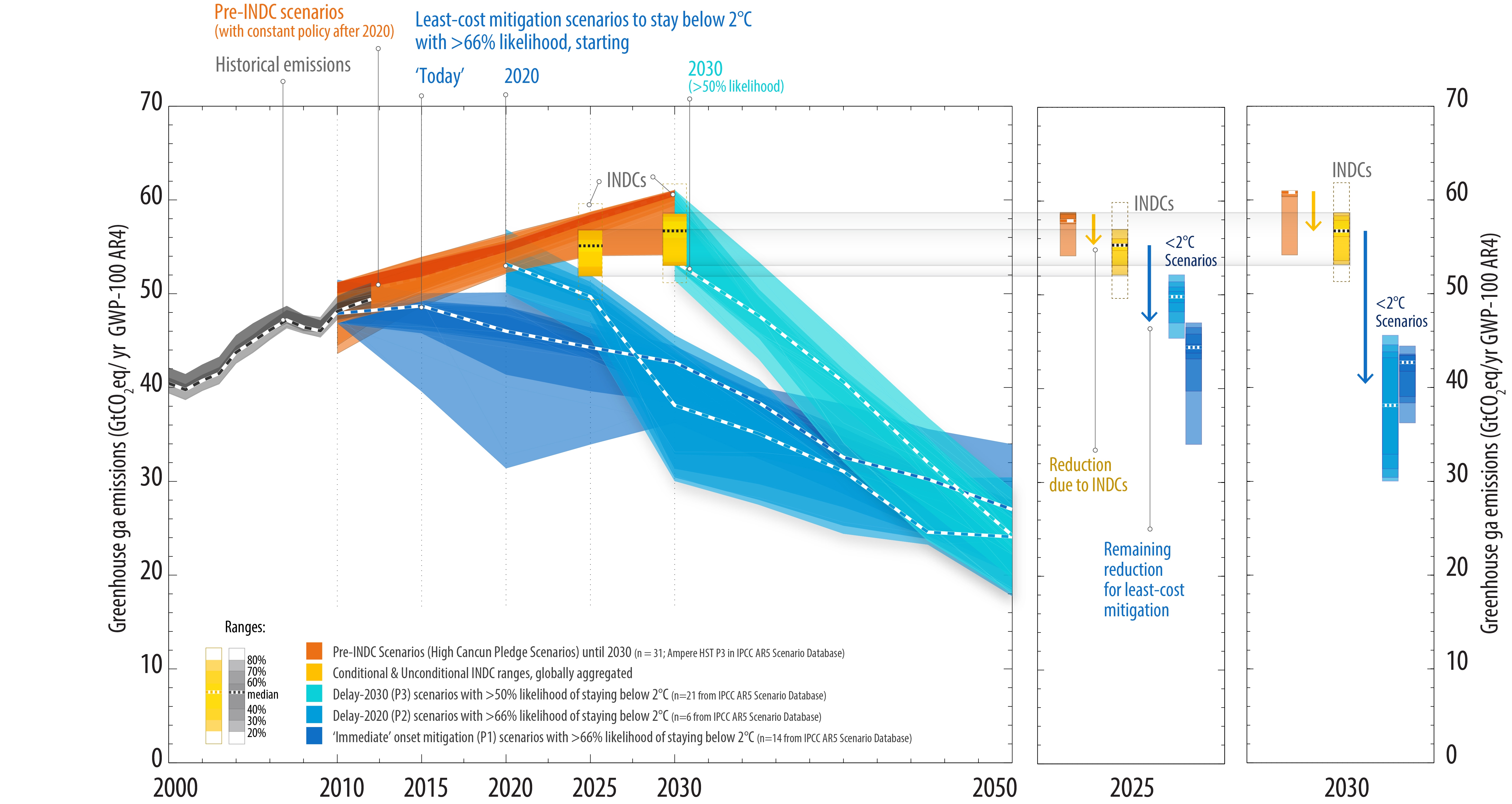
I will just go back to 2015, despite the United Nations Framework Convention on Climate Change Treaty (that set up the UNFCCC body) entering into force in March 1994. In preparation for COP 21 Paris most countries submitted “Intended Nationally Determined Contributions” (INDCs). The submissions outlined what post-2020 climate actions they intended to take under a new international agreement, now called the Paris Agreement. On the 1st November 2015 the UNFCCC produced a Synthesis Report of the aggregate impact of the INDCs submitted up to 1st October. The key chart is reproduced below.

Figure 2 : Summary results on the aggregate effect of INDCs to 1st November 2015.

The aggregate impact is for emissions still to rise through to 2030, with no commitments made thereafter. COP21 Paris failed in it’s objectives of a plan to reduce global emissions as was admitted in the ADOPTION OF THE PARIS AGREEMENT communique of 12/12/2015.

  1. Notes with concern that the estimated aggregate greenhouse gas emission levels in 2025 and 2030 resulting from the intended nationally determined contributions do not fall within least-cost 2 ˚C scenarios but rather lead to a projected level of 55 gigatonnes in 2030, and also notes that much greater emission reduction efforts will be required than those associated with the intended nationally determined contributions in order to hold the increase in the global average temperature to below 2 ˚C above pre-industrial levels by reducing emissions to 40 gigatonnes or to 1.5 ˚C above pre-industrial levels by reducing to a level to be identified in the special report referred to in paragraph 21 below;

Paragraph 21 states

  1. Invites the Intergovernmental Panel on Climate Change to provide a special report in 2018 on the impacts of global warming of 1.5 °C above pre-industrial levels and related global greenhouse gas emission pathways;

The request lead, 32 months later, to the scary IPCC SR1.5 of 2018. The annual COP meetings have also been pushing very hard for massive changes. Has this worked?

Figure 3 : Fig ES.3 from UNEP Emissions Gap Report 2022 demonstrating that global emissions have not yet peaked

The answer from the UNEP Emissions Gap Report 2022 executive summary Fig ES.3 is a clear negative. The chart, reproduced above as Figure 3, shows that no significant changes have been made to the commitments since 2015, in that aggregate global emissions will still be higher in 2030 than in 2015. Indeed the main estimate is for emissions in 2030 is 58 GtCO2e, up from 55 GtCO2e in 2015. Attempts to control global emissions, hence the climate, have failed.

Thus, in the context of the above assumptions the question for the people of California becomes.

What’s more important: Keeping a useless policy that is causing blackouts, or not?

To help clarify the point, there is a useful analogy with medicine.

If a treatment is not working, but causing harm to the patient, should you cease treatment?

In medicine, like in climate policy, whether or not the diagnosis was correct is irrelevant. Morally it is wrong to administer useless and harmful policies / treatments. However, there will be strong resistance to any form of recognition of the reality that climate mitigation has failed.

Although the failure to reduce emissions at the global level is more than sufficient to nullify any justification for emissions reductions at sub-global levels, there are many other reasons that would further improve the case for a rational policy-maker to completely abandon all climate mitigation policies.

Why Just Stop Oil have no sense of proportion

In an article at Conservative Women, I believe Paul Homewood vastly understates the insignificance of keeping new discoveries of UK oil & gas in the ground. We need to look at the accepted numbers.


In the 2014 UNIPCC AR5 WG3 report it was estimated that 1100 GtCO2 from 2011 was needed to reach the dreaded 2°C of warming. McGlade & Ekins 2015 (DOI: 10.1038/nature14016) estimated that known fossil fuel reserves were 3 times this. On quick search on the internet in 2017 I found that potential fossil fuel sources are a number of times these known reserves.


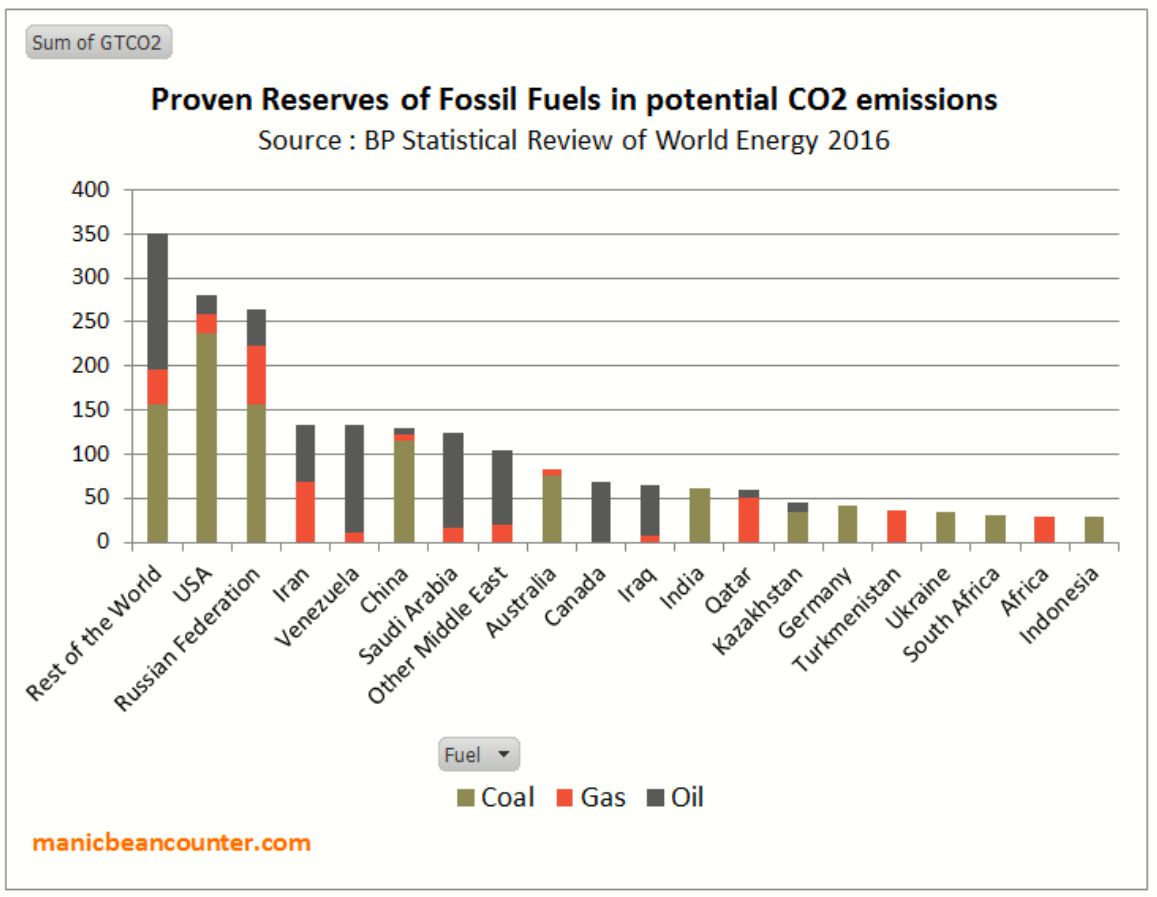
The oil & gas licences cover trivial amounts of global fossil fuels available. Using the BP’s measure of proven reserves, I did a quick conversion to representative CO2 emissions, then divided it into major locations. Total emissions figures were up to 20% lower than McGlade & Ekins due to (a) different reserves figures & (b) Not allowing for higher emitting fossil fuel sources like oil from Canadian tar sands or German lignite coal, reproduced in figure 1. Still, given the unequal global distribution of fossil fuel reserves

Figure 1 – Estimates of the approximate potential CO2 emissions from proven fossil reserves using data from the BP Statistical Review of World Energy 2016. These figures may understate coal.

In 2018, it was projected that the emissions to meet the 1.5°C targets were equivalent to a straight line reduction in emissions to zero between 2020 and 2050. That is producing 15 years of 2020 emissions in a 30 year period, or about less than 13 years starting January 2024. Using the BPs estimates of production & proven reserves for 2019, there are about 50 years of oil, 50 years of gas and 132 years of coal. That means leaving >70% of oil, >70% of gas and >90% of coal reserves in the ground. How significant is the UK in this. It is well out of the top 20 countries in oil, gas and coal reserves, so would not have appeared in Figure 1 with far more countries itemised. Using the 2019 estimated reserve figures the UK had 0.16% of oil, 0.094% of gas and 0.0024% of coal reserves. Overall UK fossil fuel reserves in terms of potential emissions are less than 1 part is a 1000 of the global total. The new oil & gas licences may increase the UK reserves, but it is highly unlikely to significantly increase the global share.

If the activists were in reality concerned about stopping dangerous climate change, then they would be trying to persuade Russia, China, India, Indonesia, Saudi Arabia, Iran, Venezuela etc. to all leave their considerable fossil fuel reserves on the ground. This is aside from Western countries such as USA, Canada, Australia, Germany & Poland.

Just Stop Oil have literally no sense of proportion. I have no doubt they are sincere in their beliefs. But their policy demands are in no way connected to their beliefs in some sort of impending climate apocalypse.

Kevin VS Marshall

Hansen’s 1988 Scenario C against Transient Climate Response in IPCC TAR 2001

In a recent comment at Cliscep Jit made the following request

I’ve been considering compiling some killer graphs. A picture paints a thousand words, etc, and in these days of short attention spans, that could be useful. I wanted perhaps ten graphs illustrating “denialist talking points” which, set in a package, would be to the unwary alarmist like being struck by a wet fish. Necessarily they would have to be based on unimpeachable data.

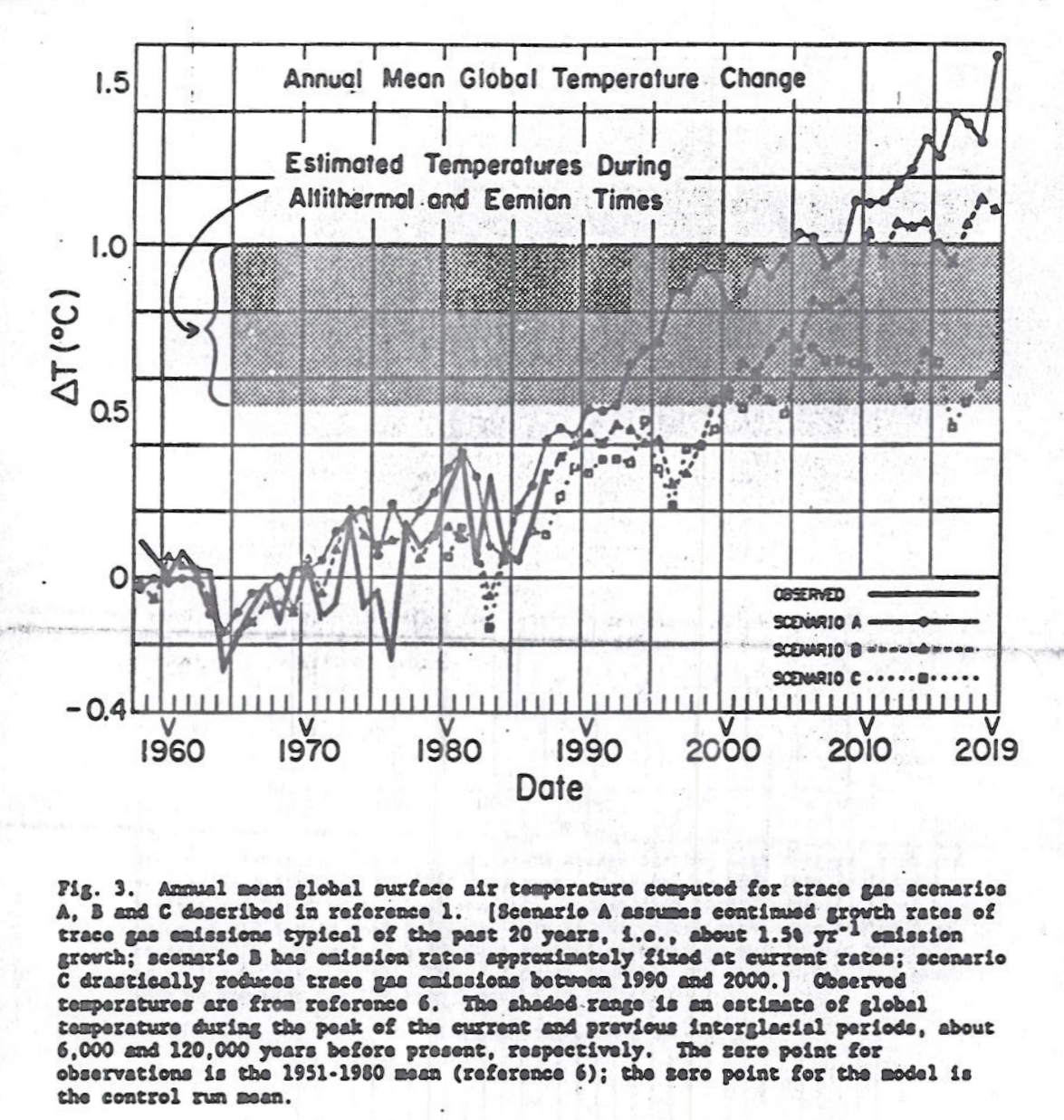
One of the most famous graphs in climate is of the three scenarios used in Congressional Testimony of Dr James Hansen June 23 1988. Copies are poor, being copies of a type-written manuscript. The following is from SeaLevel.info website.

Fig 3 of Hansen’s Congressional Test June 23 1988

The reason for choosing this version rather than the clearer version in the paper online is that the blurb contains the assumptions behind the scenarios. In particular “scenario C drastically reduces trace gas emissions between 1990 and 2000.” In the original article states

scenario C drastically reduces trace gas emissions between 1990 and 2000 such that greenhouse forcing ceases to increase after 2000.

In current parlance this is net zero. In the graph this results in temperature peaking about 2007.

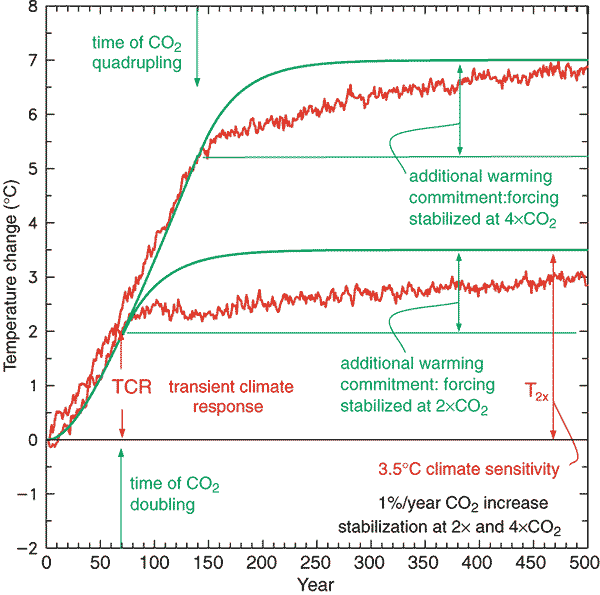
In the IPCC Third Assessment Report (TAR) 2001 there is the concept of Transient Climate Response.

TAR WG1 Figure 9.1: Global mean temperature change for 1%/yr CO2 increase with subsequent stabilisation at 2xCO2 and 4cCO2. The red curves are from a coupled AOGCM simulation (GFDL_R15_a) while the green curves are from a simple illustrative model with no exchange of energy with the deep ocean. The transient climate response, TCR, is the temperature change at the time of CO2 doubling and the equilibrium climate sensitivity, T2x, is the temperature change after the system has reached a new equilibrium for doubled CO2, i.e., after the additional warming commitment has been realised.

Thus, conditional on CO2 rising at 1% a year and the eventual warming from a doubling of CO2 being around 3C, then at the point when doubling has been reached temperatures will have risen by about 2C. From the Mauna Loa data annual average CO2 levels have risen from 316 ppm in 1959 to 414 ppm in 2020. That is 31% in 60 years or less than 0.5% a year. Assuming 3C of eventual warming from a CO2 doubling then the long time period of the transient climate response

  • much less than 1C of warming could so far have resulted from the rise in CO2 since 1959
  • it could be decades after net zero is achieved that warming will cease.
  • the rates of natural absorption of CO2 from the atmosphere are of huge significance.
  • Calculation of climate sensitivity even with many decades CO2 data and temperature is near impossible unless constraining assumptions are made about the contribution of natural factors; the rate of absorption of CO2 from the atmosphere; outgassing or absorption of CO2 by the oceans; & the time period for the increase in temperatures from actual rates of CO2 increase.
  • That is, change in a huge number variables within a range of acceptable mainstream beliefs significantly impacts the estimates of emissions pathways to constrain warming to 1.5C or 2C.
  • If James Hansen in 1988 was not demonstrably wrong false about the response time of the climate system and neither is TAR on the transient climate response, then it could be not be possible to exclude within the range of both the possibility that 1.5C of warming might not be achieved this century and that 2C of warming will be surpassed even if global net zero emissions is achieved a week from now.

Kevin Marshall

Warming in Canada is making temperatures less extreme

Yesterday the BBC broadcast “Climate Change – The Facts”. Jaime Jessop has already posted the first of a promised number of critical commentaries. Alex Cull has already started a transcript. Another here.

At the start the narrator says

What we’re doing right now is we’re so rapidly changing the climate, for the first time in the world’s history people can see the impact of climate change.

Greater storms, greater floods, greater heatwaves, extreme sea-level rise.

This reminds me of Jaime’s article of 4th April – Canada’s Burning and it’s Mostly Because of Humans Says Federal Government Report 

The true headline claim from the Canada’s Climate Change Report 2019 was

Both past and future warming in Canada is, on average, about double the magnitude of global warming.

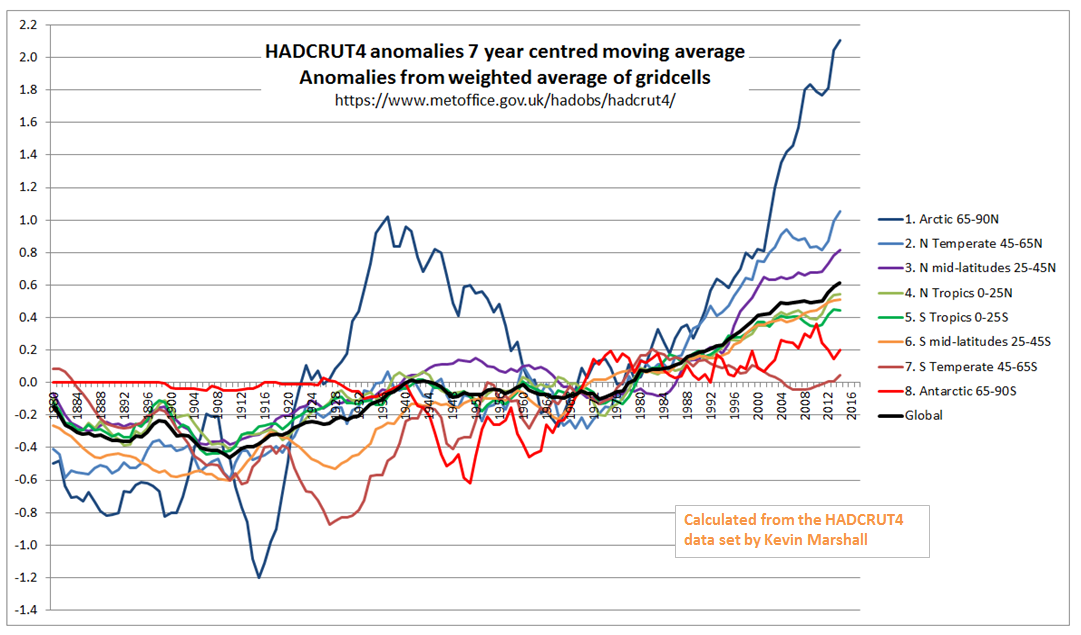
This observation is since 1948. This is partly because land has warmed faster than the oceans and partly because the greatest warming is in the Arctic. See two graphics I produced last year from the HADCRUT4 data. Note that much of the Canada-US border is at 49N, though Toronto is at 44N.

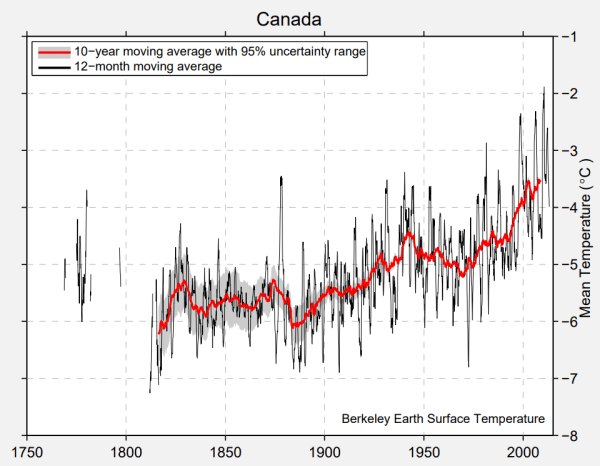
Canada is land based and much of its area is in the in the Arctic. Being part of a continental land mass, Canada also has extremely cold winters and fairly hot summers. But overall it is cold. Average Canadian temperatures from Berkeley Earth in 2013 were still -3.5C, up from -5.5C in 1900. BE graphic reproduced below.

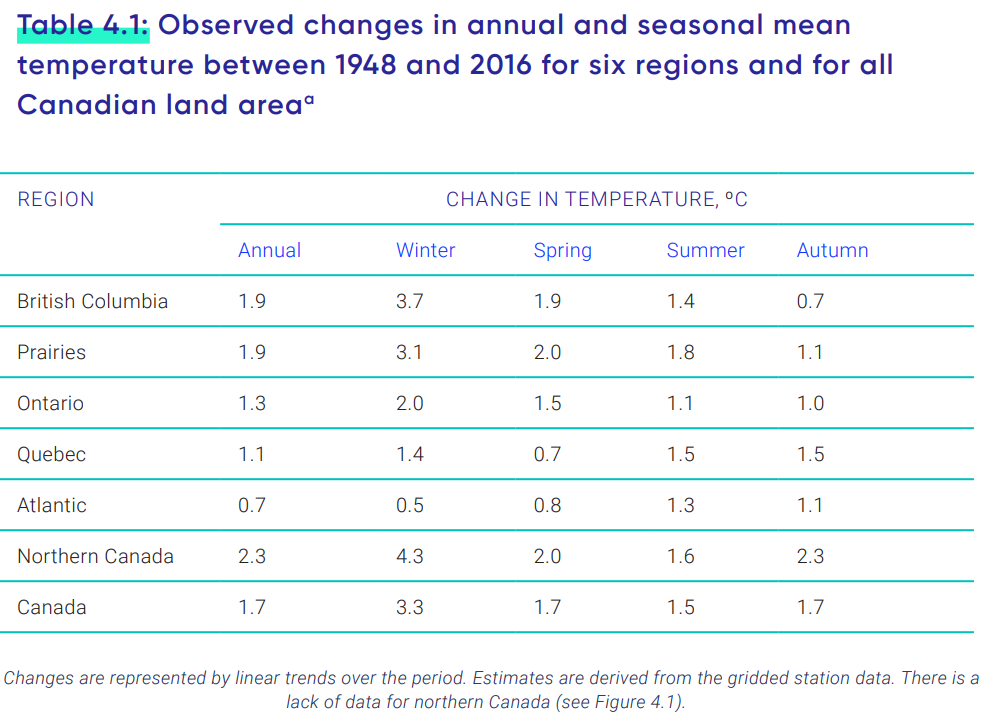
The question is, does this mean that climate is becoming more extreme? The report on page 127 has a useful table

In Canada as a whole, and in four of the six areas, Winter average temperatures have warmed faster than those in the Summer. The other two have coastal influences, where I would expect the difference between  summer and winter to be less extreme than Canada as a whole. Climate has generally become less extreme.
However, if climate is becoming more extreme as a result of general warming then it this would result in more warm temperature records than cold temperature records to be set in recent decades. From Wikipedia has Lists of extreme temperatures in Canada.

Of the 13 Provinces and Territories, only two have heat records more recent than 1950. That is Nunavut in 1989 and Yukon in 2004. For extreme cold, records are more spread out, with the two most recent in 1972 & 1973.

Wikipedia also has lists of highest & lowest temperatures ever recorded in Canada as a whole. The hottest has duplicates in terms of adjacent places, or the same places on adjacent days. Not surprisingly nearly all are located well inland and close to the US border. The record highest is 45.0 °C on July 5, 1937. The bottom half of the list is of records of 43.3 °C or 110 °F. The three most recent were set in 1949, 1960 and 1961.
The coldest ever recorded in Canada was -63.0 °C on February 3, 1947 at Snag Yukon. The third lowest was −59.4 °C in 1975. On the list are three from this century. −49.8 °C on January 11, 2018, −48.6 °C on December 30, 2017 and −42 °C on December 17, 2013. Eleven of the thirteen provinces and territories are represented in the 31 records on the coldest list, and there is 21.9 °C difference between the top and bottom of the list. Seventy years of Winter warming in Canada have raised average temperatures by 3.3 °C, but the extreme low temperatures are 13 °C higher.

It would seem that the biggest news is of winter warming of 3.3 °C in 70 years has resulted in far less extreme cold, and considerably lower extreme cold temperatures. The more moderate summer warming has not resulted in record heatwaves. The evidence is that Canada’s warming has made temperatures less extreme, contradicting the consensus claims that warming leads to more extremes. In Canada, global warming appears to be causing climate changing for the better. So why is the Canadian Government trying to stop it?

Kevin Marshall

Bogus linking of Cyclone Idai Mozambique to climate change

The news last week was full of reports of the impacts of Cyclone Idai on South-East Africa, particularly on Mozambique. This has inevitably been linked to climate change. Jaime Jessop brings attention to a “Climate Justice” article at the Conversation “Cyclone Idai: rich countries are to blame for disasters like this – here’s how they can make amends“. The article states

It is inevitable that people will connect Idai and climate change. It is always tricky to establish a direct causal link, but thanks to the evidence provided by a number of reports from the Intergovernmental Panel on Climate Change (IPCC), including this most recent one from October 2018, we know that climate change is bound to increase the intensity and frequency of storms like Idai. At the very least, this crisis is a harbinger of what is coming.

As Jessop points out, the most recent IPCC SR15 has low confidence in any increase in trends in global cyclone activity, nor in the severity. In term low confidence I interpret to mean that evidence, if available, is highly speculative and/or is contradicted by better evidence. The Conversation article fails to read the evidence. Climate change is not “bound to increase the intensity and frequency of storms like Idai“. Even if that were, Idai is not caused by climate change.

At the BBC Matt McGarth tries to make the climate connection,

While Cyclone Idai is the seventh such major storm of the Indian Ocean season – more than double the average for this time of year – the long-term trend does not support the idea that these type of events are now more frequent.
The interesting thing for the area is that the frequency of tropical cyclones has decreased ever so slightly over the last 70 years,” said Dr Jennifer Fitchett from the University of the Witwatersrand in South Africa who has studied the question.
Instead, we are getting a much higher frequency of high-intensity storms.
Climate change is also changing a number of factors in the background that are contributing to making the impact of these storms worse.

There is absolutely no doubt that when there is a tropical cyclone like this, then because of climate change the rainfall intensities are higher,” said Dr Friederike Otto, from the University of Oxford, who has carried a number of studies looking at the influence of warming on specific events.
And also because of sea-level rise, the resulting flooding is more intense than it would be without human-induced climate change.

Evidence of more high frequency storms

Dr Jennifer Fitchett enlarges on the change in cyclone activity at the Conversation. In Tropical cyclone Idai: The storm that knew no boundaries she states

Historically, nine storms that had reached tropical cyclone intensity made landfall on Mozambique. A larger number of weaker tropical systems, including tropical storms and depressions affect the region, with a total landfall of all tropical systems of 1.1 per annum.

The link is to an open access article.

Fitchett and Grab 2014 : A 66‐year tropical cyclone record for south‐east Africa: temporal trends in a global context – International Journal of Climatology

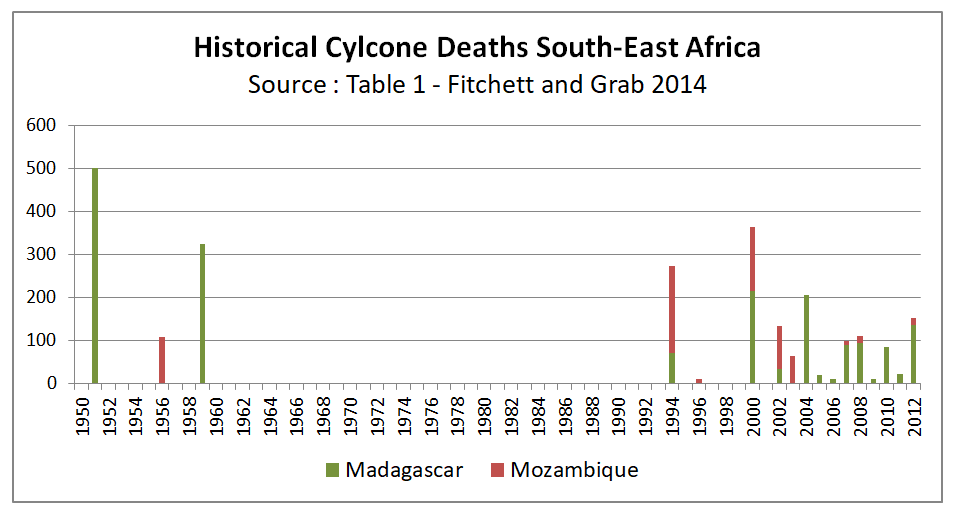
Table 1 contains details of historical records for Madagascar and Mozambique. I have summarized the numbers of deaths by year.

The claim of  an increase in severe storms over the last 70 years by Dr Fitchett is evidenced by a glance at this graph. But there are issues. For Mozambique there are no recorded major cyclones between 1956 and 1994, nor for Madagascar between 1959 and 1994. Does this mean that there was major cyclone drought for over thirty-five years?
The history of the two countries suggests reasons for the lack of records other than lack of events to be observed. Historically Mozambique was a lightly-administered Portuguese Colony. There was a War of Independence covering 1964-1974 and following Independence a Civil War 1977-1992. Madagascar became Independent of France in 1960. There was increasing strife, culminating in a socialist-Marxist dictatorship from 1975 to 1993. The dictatorship was largely cut-off from the outside world. 1994 was the first year both countries were clear of the major strife that afflicted them for  decades, so it is hardly surprising this was the first year in decades when the severe impacts of cyclones was reported.
A BBC Report gives colloquial evidence to support the storms being nothing unusual. A video report of Cyclone Idai says it is the strongest winds Mozambique has had in the last ten years.

The evidence of less cyclones, but a claim more high-intensity ones looks like a rejection of objective evidence in favour of sensationalist reporting.

Evidence of Sea Level Rise

The desperation is indicated by mentioning sea level rise, which has risen by a few centimetres in the 50 years. Although centered on the coastal town of Beira, Mozambique, the vast areas impacted also include parts of the land-locked countries of Zimbabwe and Malawi. The nearest point to the sea of either country’s borders appear to be much greater than 150 kilometres. For some perspective, in Britain, the furthest point from the sea is Coton in the Elms at 70 miles or 113km distance.
Singling out one person is maybe unfair. Climate alarmism is a consensus enterprise, which gives primacy to mantras, rather than verification of conjectures with evidence of the natural world. However, the false attribution of sea level rise in the article is by Dr Friederike Otto. One profile I found states:-

Friederike (Fredi) is the Acting Director of the Environmental Change institute and an Associate Professor in the Global Climate Science Programme where she leads several projects understanding the impacts of man-made climate change on natural and social systems with a particular focus on Africa and India.
Her main research interest is on extreme weather events (droughts, heat waves, extreme precipitation), improving and developing methodologies to answer the question ‘whether and to what extent external climate drivers alter the likelihood of extreme weather’. She furthermore investigates the policy implication of this emerging scientific field.
Fredi is co-investigator on the international project World Weather Attribution which aims to provide an assessment of the human-influence on extreme weather in the immediate aftermath of the event occurring.

Dr Otto also featured in Nature last year, for attributing the 2018 Northern European heatwave to climate change. As Jaime Jessop found out, the selective evidence and modelling assumptions to support this attribution was contradicted by looking at the wider data.

Policy Implications

If the real desire is to look at making rational policy decisions to ameliorate the impact of emerging extreme weather events, then it is necessary properly assess the type, severity and geographical extent and likelihood of these impacts. Otherwise resources will be wasted on projects that do not address the issues. That includes only accepting claims made about an emerging impact when they are properly verified by the evidence. Otherwise, climate alarmism will ensure that resources are directed away from making a real difference to the lives of the poorest people.

Not only is the “Climate Justice” movement singling out a few countries to pay compensation for damages without evidence of damage caused, they are also helping to ensure that resources are directed away from making a real difference to the lives of the poorest people.

Kevin Marshall

Example of dogmatic pseudo-science on coral reef bleaching

I have already posted twice on coral reefs, but skirted round the article on Coral Alarmism by Geoff Price at his own blog on April 2nd 2018, reposted at ATTP eleven months later. By reposting this article Prof Ken Rice has shown how derisory is the evidence for global warming being the cause of increasing coral bleaching. 

Checking the sources that Price gives for (a) evidence of global warming (b) media sources of coral bleaching reveal there is no unambiguous underlying evidence to make a persuasive case  linking of one with the other. Further. the major peer review paper that Price cites finds that changes in severe coral bleaching events are not explained by global warming.

Evidence of global warming related to coral reefs

The first issue I want to deal with is the evidence that Price presents for the increase in coral bleaching being due to global warming.

Price first states the dogma

In our window of time here and on our watch, we’re observing the unfolding collapse of global coral reef cover – the largest living structures on the planet, relatively priceless in terms of human and economic value, and stunningly beautiful – due to human-induced stresses, now most prominently from human-caused global anthropogenic (greenhouse) warming of the oceans.

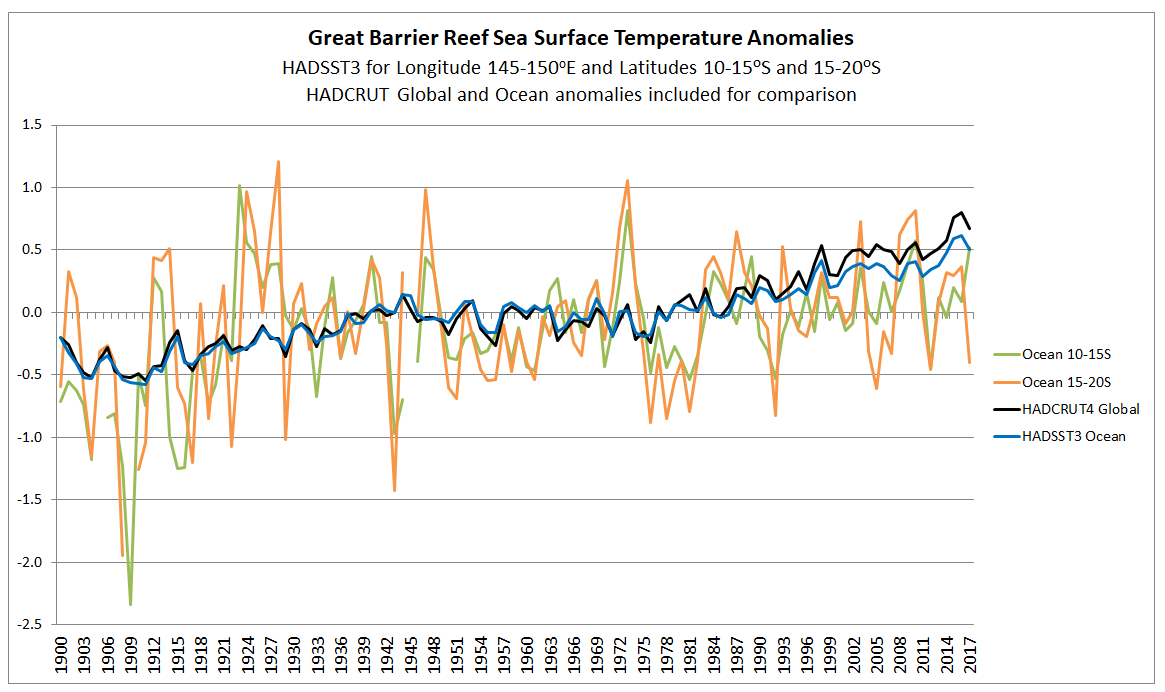
The claim of human induced warming is not backed up by any evidence.  That global average temperatures have been rising for well over a century  does not mean that this was human-induced. It could be natural or just some random cyclical cycle in a chaotic complex system, or some combination of all three. The evidence of warming oceans is the NOAA data of estimated increase in ocean heat content from 1960. There are a number of things wrong with this approach. The data period is only from 1960; heat stress in corals is from the amount of temperature rise; and the data is for 0-700m down, whilst most corals reside just a few meters below the surface. A much better measure is the sea surface temperature data records, which measures temperature just below the surface.

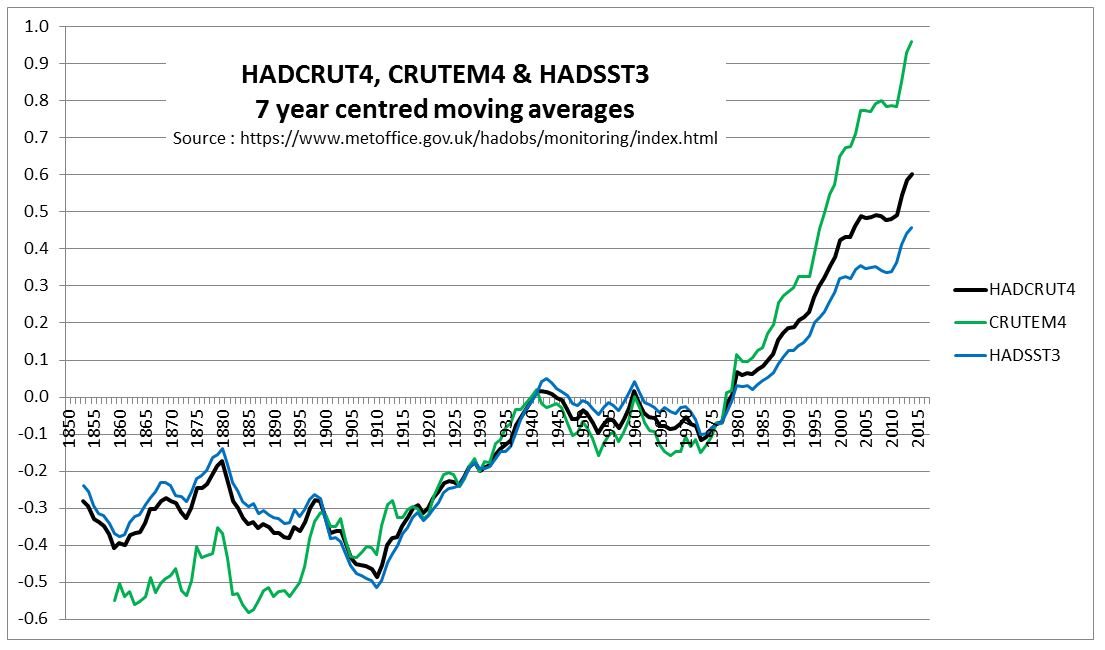
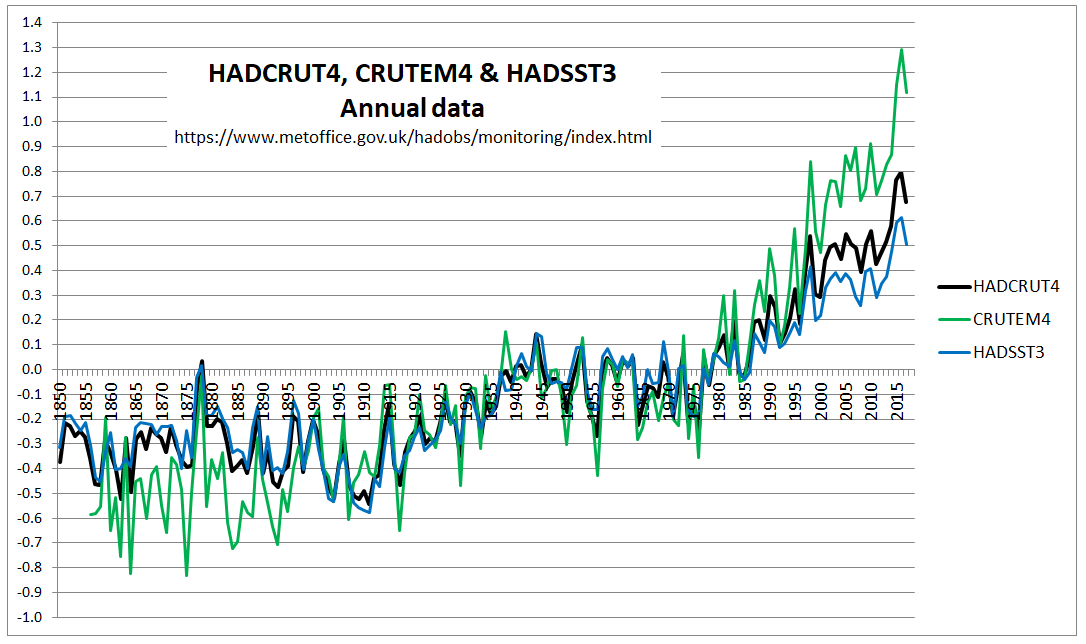
Below is the HADCRUT4 land and ocean anomalies temperature anomalies that I charted last year.


Crucially, the HADSST3 ocean warming data shows a similar global average temperature increase in the early twentieth century as the post 1975 warming. Both were about 0.5C, a value likely much less than the seasonal sea surface temperature change. Also, the rise in GHG gases – especially of CO2 – is much more post 1950 than from 1800 to 1940. The data does not support the idea that all warming is human-caused, unless global warming is caused by Mother Gaia anticipating the rise in CO2 levels.

Even then, then rise in global sea surface temperatures is not an indication of warming in a particular area. The Great Barrier Reef, for instance has shown little or no warming since 1980. From my previous post, observed major bleaching events do not correspond to any rise in warming, or any increase in extreme temperatures.

Media Sources do not support hypothesis

Even if Geoff Price cannot provide proper evidence of the rise in average temperatures that coral reefs are experiencing, at least he could provide credible scientific evidence of the link between warming and increase in coral bleaching. Price states

Some articles in major media break through, e.g. Global Warming’s Toll on Coral Reefs: As if They’re ‘Ravaged by War’, though the impact on public awareness and policy action remains low. The impact is global including the Great Barrier Reef (GBR), Japan, the South PacificHawaii, the Florida keys, and Belize.

Rather than presenting empirical evidence, or at least scientific articles, relating increased coral reef bleaching to global warming, Price bizarrely “quotes” from various media sources. To show how bizzare, I have made some notes of the sources,

As if “Ravaged by War”

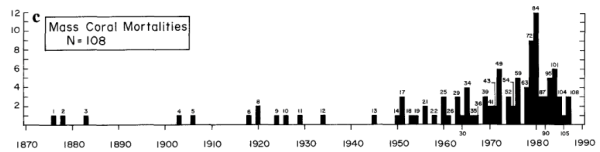
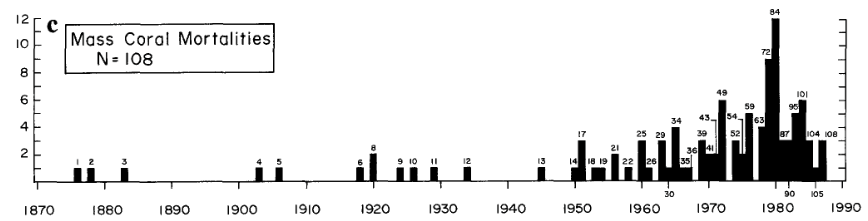
The “Ravaged by War” article in the New York Times of Jan 4 2018. At the start of the article is stated “large-scale coral bleaching events……were virtually unheard-of before the 1980s“, whereas later on is stated ”before 1982-3, mass bleaching events across wide areas were nonexistent.”  The perceived lack of bleaching before the 1980s is changed into a fact. The lack of perception is due to lack of wide-scale research. But even 1982-3 as the first year of reporting of mass bleaching is contradicted by Figure 1c in Glynn 1993, reference 3 in the Hughes et al 2018 paper that prompted the NYT article. 1978 and 1979 have far more recorded mass coral mortalities than 1982 and 1993.

Evidence of global bleaching

The link is to a page of high quality pictures of coral bleaching from around the world. The rise of digital photography, and the increase in the numbers of people diving reefs with cameras in the last twenty years is evidence observation bias not of real increase. In the past, lack of wide-scale human perception does not mean the issue was not there.

Great Barrier Reef Bleaching

From the UK Independent April 20 2016 is the headline “Great Barrier Reef: Half of natural wonder is ‘dead or dying’ and it is on the brink of extinction, scientists say“.

The event is partly being caused by the strong El Nino weather system that has swept across the world in the last year. But global warming is the underlying cause, say scientists, and so the bleaching and death is likely to continue.

“We’ve never seen anything like this scale of bleaching before. In the northern Great Barrier Reef, it’s like 10 cyclones have come ashore all at once,” said Professor Terry Hughes, conveyor of the National Coral Bleaching Taskforce, 

The claim that global warming is the underlying cause of the bleaching is not attributed to any one person, or group. Prof Terry Hughes only makes a statement about the current state of affairs not being observed before, not that, in reality, it is unprecedented. Again a difference between perceptions and underlying reality.

Japan

The Japanese study is from an environmentalist website Down to Earth on January 13 2017. It states

Experts have, for quite a while now, believed that corals are among the most susceptible organisms to climate change. In fact, the world has already lost 30-40 per cent of its total documented coral cover.

According to the ministry’s estimate, 70 per cent of the Sekisei lagoon in Okinawa had been killed due to bleaching, which occurs when unusually warm water forces coral to expel the algae living in their tissues. Unless water temperatures quickly return to normal, the coral eventually dies from lack of nutrition.

Based on the survey done on 35 locations in Japan’s southernmost reaches from November to December 2016, the ministry observed that the plight of the reef has become “extremely serious” in recent years.

According to a Japanese media, the dead coral has now turned dark brown and is now covered with algae. It also revealed that the average sea surface temperature between June and August 2016 in the southern part of the Okinawa island chain was 30.1°C—one to two degrees warmer than usual. According to the Japan meteorological agency, it was also the highest average temperature since records began in 1982.

There is no link to the original source and from the statement the article is probably relying on media sources in English. Therefore there is no way of verifying whether the claims are due to warming. I would assume that the authors, like myself, do not speak Japanese, and the script is incomprehensible to them. Further, the article highlights just one of 35 locations in the Japanese study. This should be a signal that the cause of that extreme example of coral bleaching is more than just extreme temperatures.

Searching “Sekisei Lagoon” I come up with lots of returns, mostly about Coral bleaching. There was one is a short 2017 article at the Japanese Ministry of Environment website, and sponsored by them. The second paragraph states

(C)orals in the (Sekisei) Lagoon have extensively diminished since park designation because of various reasons: terrestrial runoffs of red clay and wastewater; coral bleaching due to high water temperatures; and outbreaks of the predatory crown-of-thorns starfish (Acanthaster planci). Initial efforts have been made to reduce terrestrial runoffs to help the natural recovery of coral ecosystem health. Studies on coral distribution and techniques for reef rehabilitation are also in progress.

It is does not look like global warming in the sole cause of the excessive coral bleaching in Sekisei Lagoon. It is also local human factors and a large predator. A little research of crown-of-thorns starfish reveals that sudden increases in populations are poorly understood and that it is also found on the Great Barrier Reef. Acanthaster planci has a number of predators, the lack of which might indicate reasons for the outbreaks.

Other Media Sources

The South Pacific source is a blog post from March 2016 on American Samoan Reefs, a small part of the total extent of islands across the vast region. It is about coral bleaching being on hold, but there is an alert due to recent abnormally high temperatures. If bleaching did follow it would have been due to the El Nino event, which caused abnormally high average temperatures globally.

The Hawaii source, does not give a link to the peer reviewed article on which it is based. Looking at the article, it is (a) based on surveys in 2014 and 2015, but with no data on historical events (b) claims that elevated temperatures were present in Hawaii, (but does not show that the global average temperature were not elevated (c) provides no evidence of comparative surveys in the past to show the issue has got worst. In the first sentence of the introduction it is implied that the entire 0.9 °C in average SSTs is due to rise in GHGs, a totally unsupportable statement. Peer J’s boasted rapid peer review process has failed to pick up on this,

The Florida Keys reference is a Washington Post article of June 25 2017 about how loss of the coral reefs through temperature rise will impact on tourism. It assumes that temperature rise is the sole course of coral reef loss.

Finally the Belize article a New York Times opinion piece from July 6 2017, about a researcher visiting the coral reefs. There is no data provided for either local warming or trends in bleaching.

Hughes et al 2018

The major scientific article that Price refers to is

Spatial and temporal patterns of mass bleaching of corals in the Anthropocene DOI: 10.1126/science.aan8048 . (Hughes et al 2018) 

Unusually this paper is open access. I quite like the attempt to reduce the observation bias when they state

Here we compiled de novo the history of recurrent bleaching from 1980 to 2016 for 100 globally distributed coral reef locations in 54 countries using a standardized protocol to examine patterns in the timing, recurrence, and intensity of bleaching episodes, including the latest global bleaching event from 2015 to 2016.

This does not eliminate the observation bias, but will certainly lesson the bias. They then make the observation

Since 1980, 58% of severe bleaching events have been recorded during four strong El Niño periods (1982–1983, 1997–1998, 2009–2010, and 2015–2016) (Fig. 2A), with the remaining 42% occurring during hot summers in other ENSO phases.

Considering that 2017 was also a severe bleaching events and global average temperatures were higher than in the 2015 El Nino year and in 2018, not to state it is an El Nino year is a maybe a bit dubious. Even so, on this basis El Nino free years are runs of 13, 10 and 4. This is not unlike the statement in the abstract

The median return time between pairs of severe bleaching events has diminished steadily since 1980 and is now only 6 years.

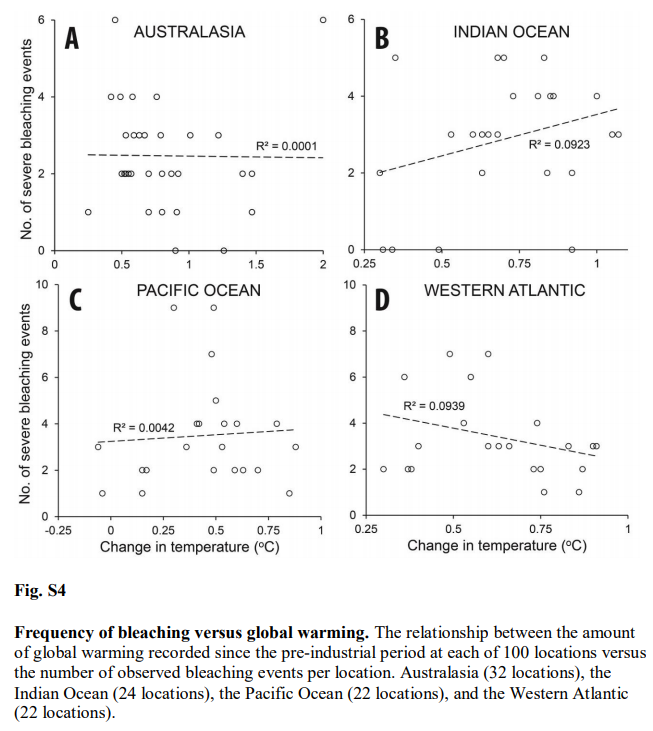
The paper makes no direct claims about the increase in observed coral bleaching being related to global warming. But This is because the data does not show this. Supplementary data figure 4 tests the relationship between the number of severe coral bleaching events per location and warming at that location across four regions.

For Australia R2 = 0.0001. That is zero. Better results can be achieved from two random unrelated data sets.
The best relationship is for the West Atlantic – mostly the Caribbean. That is R2 = 0.0939. The downward slope implies a negative relationship.  But still less than 10% of the variation in severe bleaching events is explained by rising temperatures.

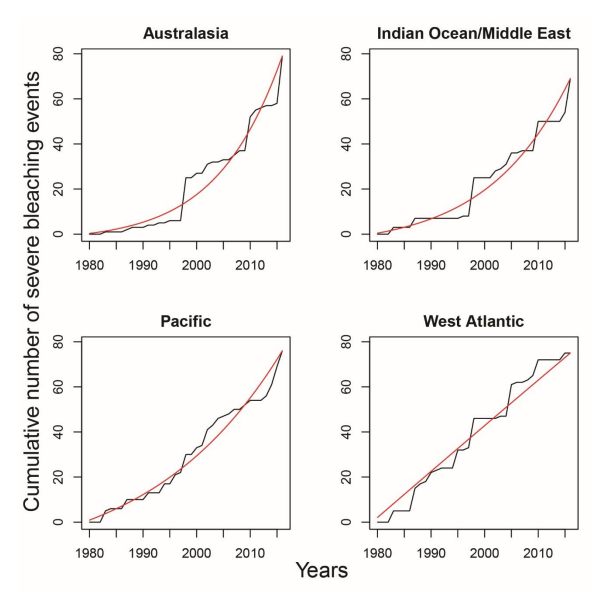
Figure 2A of the Supplementary materials I also find interesting in the context of Jaime Jessop’s contention that coral bleaching is related to El Ninos.

Note that this is cumulative recorded severe bleaching events. The relative size of individual years is from the increase in that year.
For Australasia, the three standout years are 1998, 2010 and 2016/2017. These are El Nino years, confirming Jaime’s hypothesus.
For the West Atlantic there were also an unusual number of severe bleaching events in 1995 and 2005. No El Ninos there, but 2005 saw a record number of hurricanes in the area, and 1995 also saw an unusually high number including Hurricane Andrew, the last category 5 to make landfall in the USA. Although excess heat might be the principal cause of stress in coral reefs, I am sure they might also get stressed by severe storms, with the accompanying storm surges.
If severe storms can lead to bleaching there is a problem with observation of bleaching. From Heron et al 2016 we learn that since the 1990s satellites have made twice-weekly recording of surface temperatures are 0.5 degree grids (about 50km), then comparing with the SST data to detect unusual runs of DHWs. Since 2015, a new product was launched with just 5km grids. It is then left to some intrepid scientists to go out in a boat, dive down and take samples. If severe storms do not have unusually high temperatures, then there will be no alerts of bleaching, so unless there are other attempts to observe, this will not be picked up, or could be picked up a short while later after an episode of unusual warming. Before the 1990s, there was no such over-all detection system, and likely much less researchers. Many of the bleaching events occurring before 1990 may not have been picked up, or if they were, there may have been less ability to define that events as major.

Concluding Comments

By re-posting a dogmatic article ATTP has done a service to climate scepticism. Laying out a very bad, but well-referenced, case for global warming causing increased coral reef bleaching shows the inadequacies of that case. Where long periods of data collated on a consistent basis is used there is no correlation. Further, increasing observed frequency of bleaching events since is mostly due El Nino events being closer together, whilst the increase in observed bleaching can be accounted for by the greatly improved methods of detection and the resources put into observing, which are many times what they were a few decades ago.

Geoff Price’s method of presenting the opinions of others, rather than focusing on the underlying data that supports the conjecture, is something in common with ATTP and others of the climate community. When checked, the fail to connect with any underlying reality.

There is a rider to be made. The case for global warming is very poor by the traditional scientific methods of confronting conjectures with evidence of the natural world, and letting such evidence being the ultimate arbiter of that conjecture. From the consensus viewpoint popular today it is collective opinion that is the arbiter. The above is from the former point of view, which means from the latter view this is misinformation.

Is increasing Great Barrier Reef coral bleaching related to climate change or observation bias?

In the previous post I looked at whether the claimed increase in coral bleaching in the Great Barrier Reef was down to global average temperature rise. I concluded that this was not the case as the GBR has not warmed, or at least not warmed as much as the global temperatures. Here I look further at the data.
The first thing to state is that I recognize that heat stress can occur in corals. Blogger Geoff Price (in post at his own blog on April 2nd 2018, reposted at ATTP eleven months later) stated

(B)leaching via thermal stress is lab reproducible and uncontroversial. If you’re curious, see Jones et al 1998, “Temperature-induced bleaching of corals begins with impairment of the CO2 fixation mechanism in zooxanthellae”.

I am curious. The abstract of Jones et al 1998 states

The early effects of heat stress on the photosynthesis of symbiotic dinoflagellates (zooxanthellae) within the tissues of a reef‐building coral were examined using pulse‐amplitude‐modulated (PAM) chlorophyll fluorescence and photorespirometry. Exposure of Stylophora pistillata to 33 and 34 °C for 4 h resulted in ……….Quantum yield decreased to a greater extent on the illuminated surfaces of coral branches than on lower (shaded) surfaces, and also when high irradiance intensities were combined with elevated temperature (33 °C as opposed to 28 °C). …..

If I am reading this right. the coral was exposed to a temperature increase of 5-6 °C for a period of 4 hours. I can appreciate that the coral would suffer from this sudden change in temperature. Most waterborne creatures would be become distressed if the water temperature was increased rapidly. How much before it would  seriously stress them might vary, but it is not a serious of tests I would like to carry out. But is there evidence of increasing heat stress causing increasing coral bleaching in the real world? That is, has there been both a rise in coral bleaching and a rise in these heat stress conditions? Clearly there will be seasonal changes in water temperature, even though in the tropics it might not be as large as, say, around the coast of the UK. Also, many over the corals migrate up and down the reef, so they could be tolerant of a range of temperatures. Whether worsening climate conditions have exacerbated heat stress conditions to such an extent that increased coral bleaching has occurred will only be confirmed by confronting the conjectures with the empirical data.


Rise in instances of coral bleaching

I went looking for long-term data that coral bleaching is on the increase and came across and early example. 

P. W. Glynn: Coral reef bleaching: Ecological perspectives. Coral Reefs 12, 1–17 (1993). doi:10.1007/BF00303779

From the introduction

Mass coral mortalities in contemporary coral reef ecosystems have been reported in all major reef provinces since the 1870s (Stoddart 1969; Johannes 1975; Endean 1976; Pearson 1981; Brown 1987; Coffroth et al. 1990). Why, then, should the coral reef bleaching and mortality events of the 1980s command great concern? Probably, in large part, because the frequency and scale of bleaching disturbances are unprecedented in the scientific literature.

One such example of observed bleaching is graphed in Glynn’s paper as Figure 1 c

But have coral bleaching events actually risen, or have the observations risen? That is in the past were there less observed bleaching events due to much less bleaching events or much less observations? Since the 1990s have observations of bleaching events increased further due to far more researchers leaving their families the safe climates of temperate countries to endure the perils of diving in waters warmer than a swimming pool? It is only by accurately estimating the observational impact that it is possible to estimate the real impact.
This reminds me of the recent IPPR report, widely discussed including by me, at cliscep and at notalotofpeopleknowthat (e.g. here and here). Extreme claims were lifted a report by billionaire investor Jeremy Grantham, which stated

Since 1950, the number of floods across the world has increased by 15 times, extreme temperature events by 20 times, and wildfires sevenfold

The primary reason was the increase in the number of observations. Grantham mistook increasing recorded observations in a database with real world increases, than embellished the increase in the data to make that appear much more significant. The IPPR then lifted the false perception and the BBC’s Roger Harrabin copied the sentence into his report. The reality is that many extreme weather events occurred prior to the conscientious worldwide cataloguing of them from the 1980s. Just because disasters were not observed and reported to a centralized body did not mean they did not exist.
With respect to catastrophic events in the underlying EM-DAT database it is possible to have some perspective on whether the frequency of reports of disasters are related to increase in actual disasters by looking at the number of deaths. Despite the number of reports going up, the total deaths have gone down. Compared to 1900-1949 in the current decade to mid-2018 “Climate” disaster deaths are down 84%, but reported “Climate” disasters are 65 times more frequent.
I am curious to know how it is one might estimate the real quantity of reported instances of coral bleaching from this data. It would certainly be a lot less than the graph above shows.


Have temperatures increased?

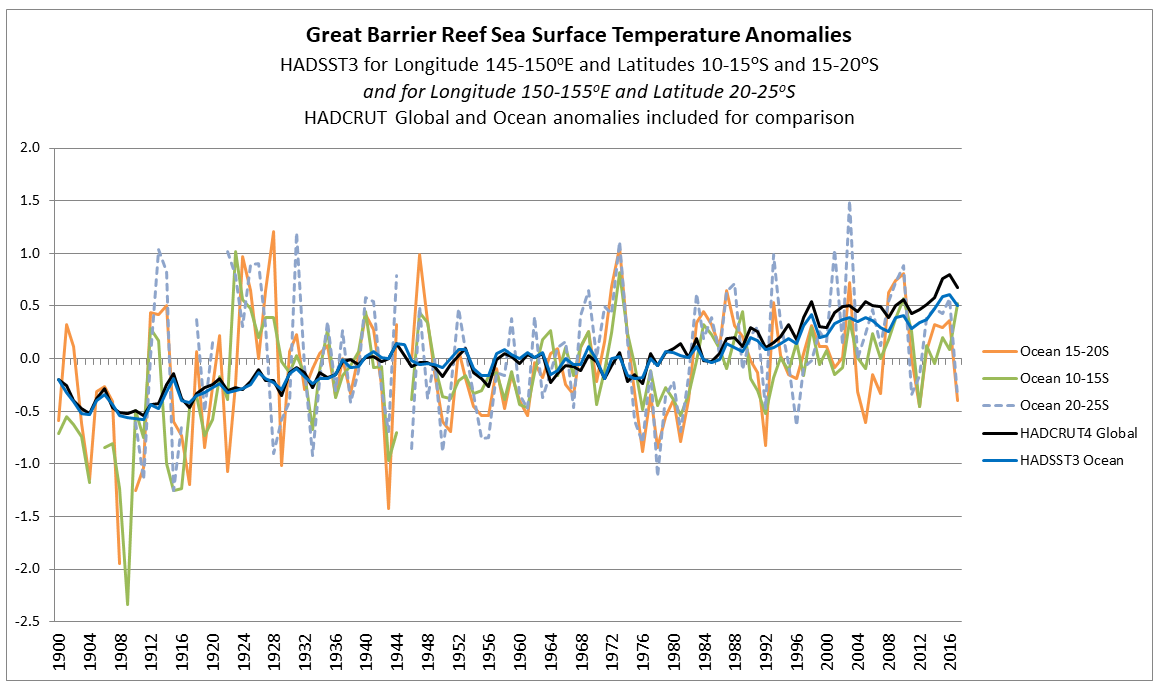
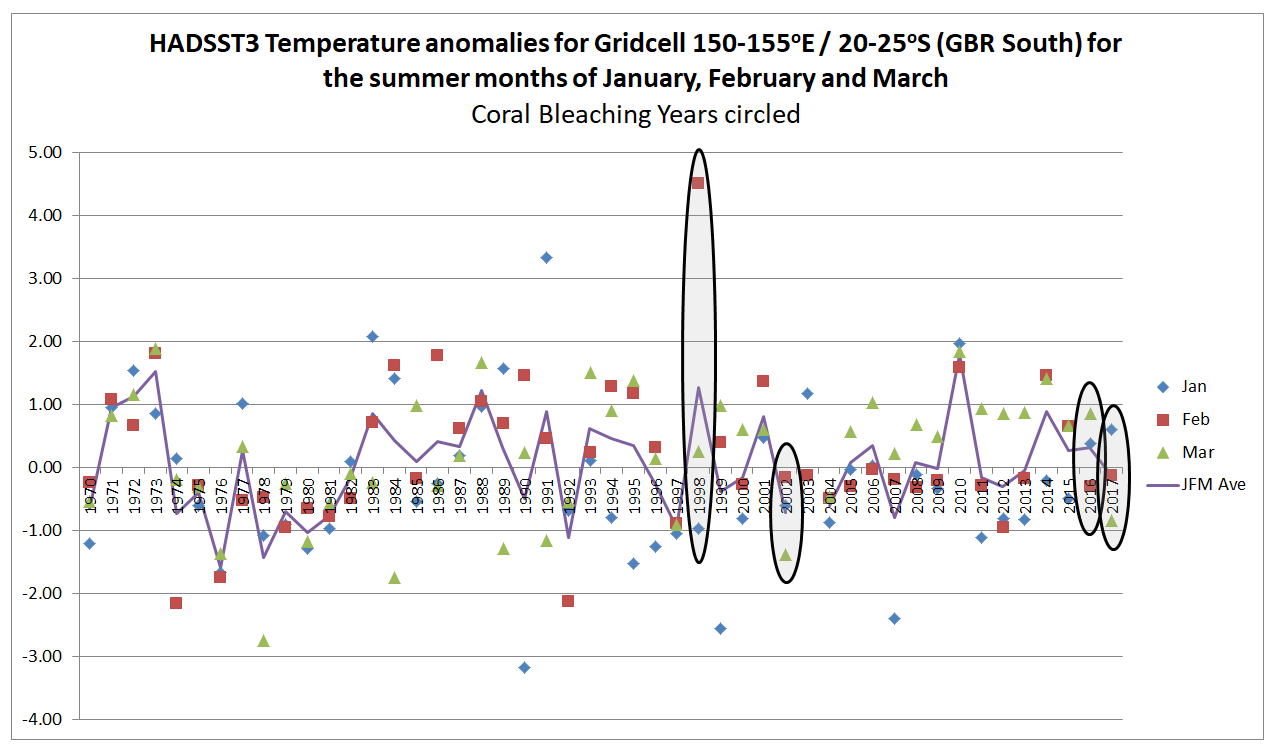
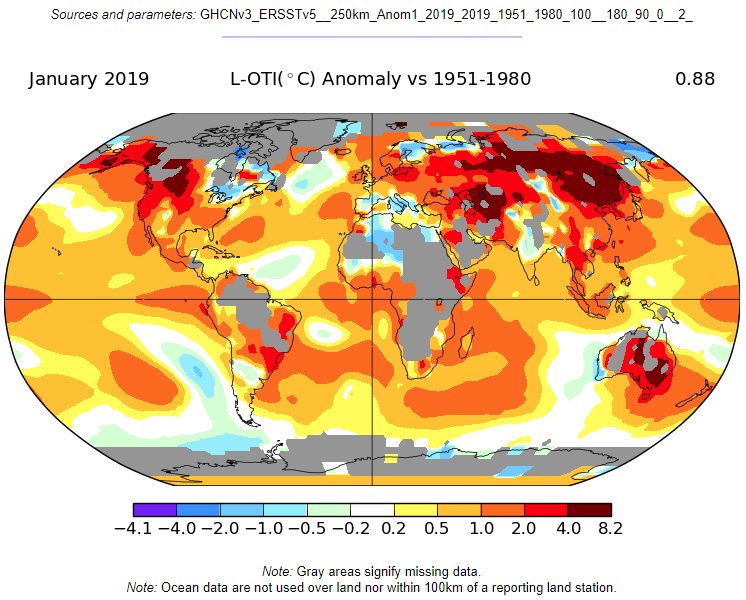
In the previous post I looked at temperature trends in the Great Barrier Reef. There are two main sources that suggest that, contrary to the world as a whole, GBR average temperatures have not increased, or increased much less than the global average. This was shown on the NASA Giss map comparing Jan-2019 with the 1951-1980 average and for two HADSST3 ocean data 5ox5o gridcells. For the latter I only charted the temperature anomaly for two gridcells which are at the North and middle of the GBR. I have updated this chart to include the gridcell 150-155oE / 20-25oS at the southern end of the GBR.

There is an increase in warming trend post 2000, influenced particularly by 2001 and 2003. This is not replicated further north. This is in agreement with the Gistemp map of temperature trends in the previous post, where the Southern end of the GBR showed moderate warming.


Has climate change still impacted on global warming?

However, there is still an issue. If any real, but unknown, increase in coral bleaching has occurred it could still be due to sudden increases in surface sea temperatures, something more in accordance with the test in the lab.
Blogger ATTP (aka Professor Ken Rice) called attention to a recent paper in a comment at cliscep

The link is to a pre-publication copy, without the graphics or supplementary data, to

Global warming and recurrent mass bleaching of corals – Hughes et al Nature 2017

The abstract states


The distinctive geographic footprints of recurrent bleaching on the Great Barrier Reef in 1998, 2002 and 2016 were determined by the spatial pattern of sea temperatures in each year.


So in 2002 the GBR had a localized mass bleaching episode, but did not share in the 2010 pan-tropical events of Rice’s quote. The spatial patterns, and the criteria used are explained.

Explaining spatial patterns
The severity and distinctive geographic footprints of bleaching in each of the three years can be explained by differences in the magnitude and spatial distribution of sea-surface temperature anomalies (Fig. 1a, b and Extended Data Table 1). In each year, 61-63% of reefs experienced four or more Degree Heating Weeks (DHW, oC-weeks). In 1998, heat stress was relatively constrained, ranging from 1-8 DHWs (Fig. 1c). In 2002, the distribution of DHW was broader, and 14% of reefs encountered 8-10 DHWs. In 2016, the spectrum of DHWs expanded further still, with 31% of reefs experiencing 8-16 DHWs (Fig. 1c). The largest heat stress occurred in the northern 1000 km-long section of the Great Barrier Reef. Consequently, the geographic pattern of severe bleaching in 2016 matched the strong north-south gradient in heat stress. In contrast, in 1998 and 2002, heat stress extremes and severe bleaching were both prominent further south (Fig. 1a, b).

For clarification:-

Degree Heating Week (DHW) The NOAA satellite-derived Degree Heating Week (DHW) is an experimental product designed to indicate the accumulated thermal stress that coral reefs experience. A DHW is equivalent to one week of sea surface temperature 1 deg C above the expected summertime maximum.

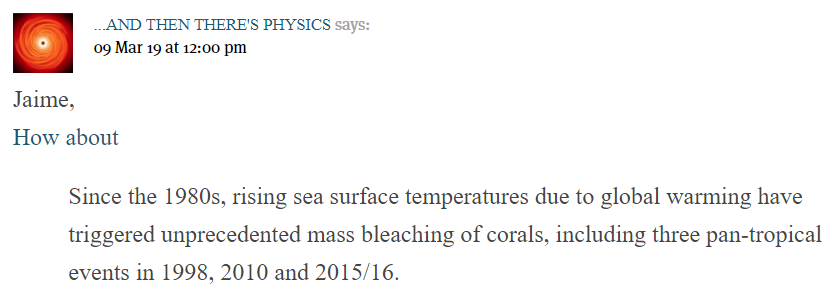
That is, rather than the long-term temperature rise in global temperatures causing the alleged increase in coral bleaching, it is the human-caused global warming changing the climate by a more indirect means of making extreme heat events more frequent. This seems a bit of a tall stretch. However, the “Degree Heating Week” can be corroborated by the gridcell monthly HADSST3 ocean temperature data for the summer months if both the measures are data are accurate estimates of the underlying data. A paper published last December in Nature Climate Change (also with lead author Prof Terry Hughes) highlighted 1998, 2002, 2016 & 2017 as being major years of coral bleaching. Eco Watch has a short video of maps from the paper showing the locations of bleaching event locations, showing much more observed events in 2016 and 2017 than in 1998 and 2002.

From the 2017 paper any extreme temperature anomalies should be most marked in 2016 across all areas of the GBR. 2002 should be less significant and predominantly in the south. 1998 should be a weaker version of 2002.
Further, if summer extreme temperatures are the cause of heat stress in corals, then 1998, 2002, 2016 & 2017 should have warm summer months.
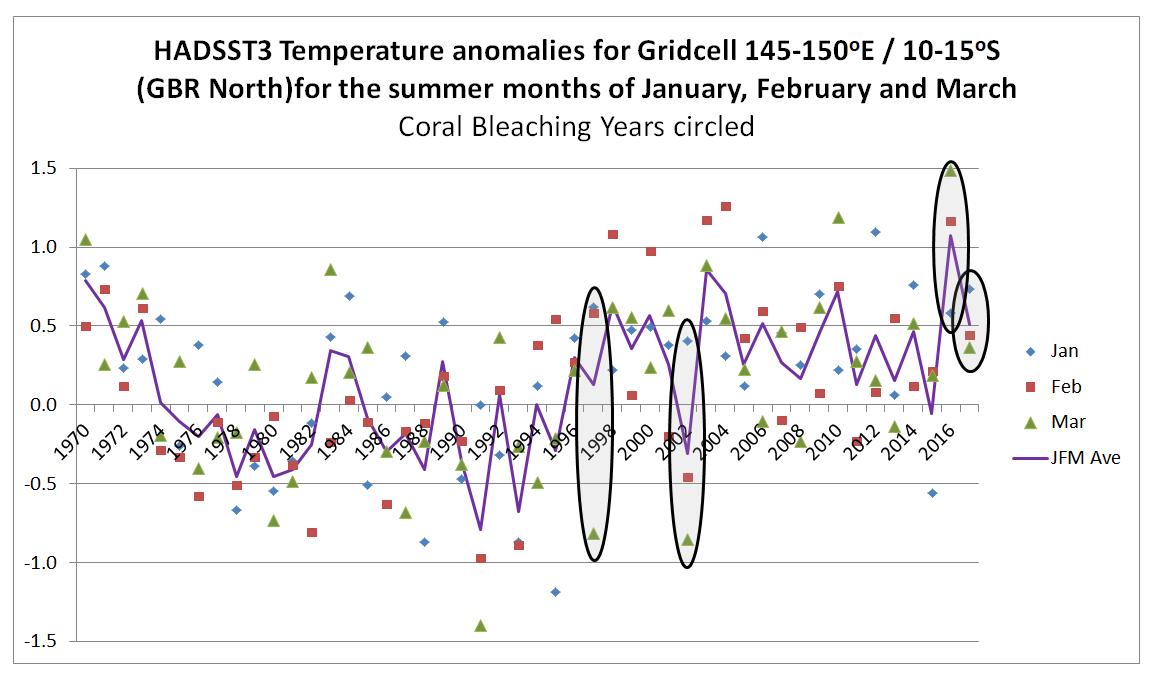
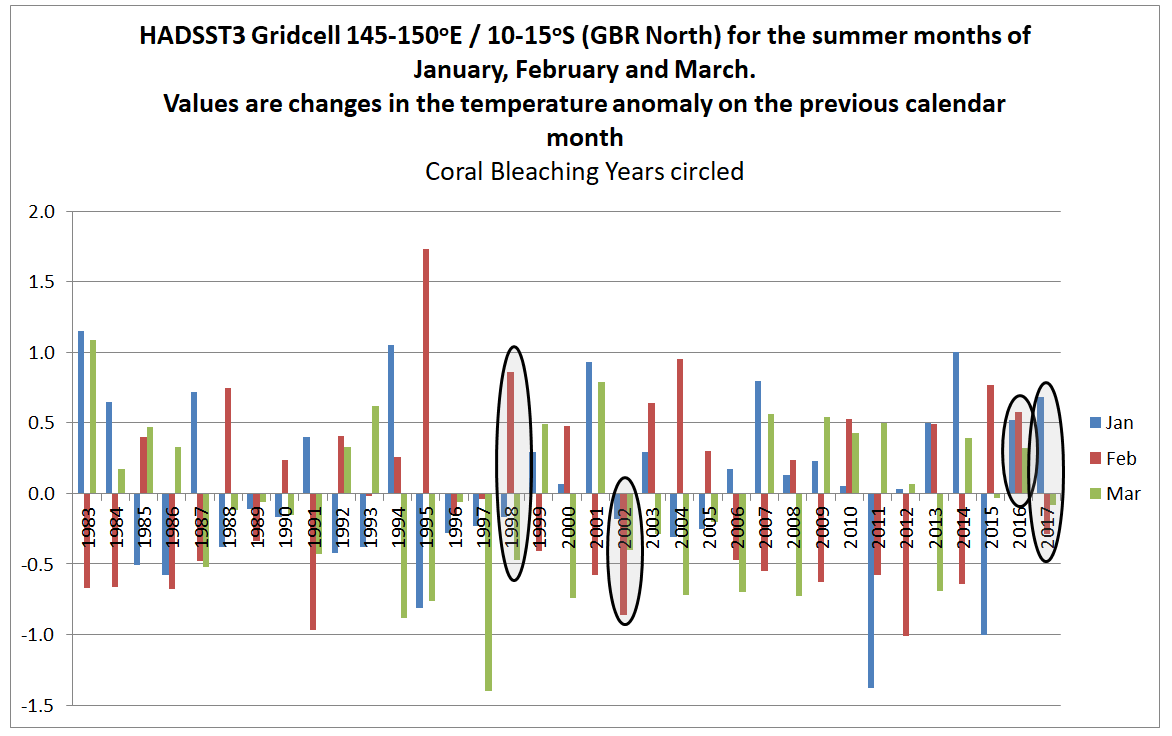
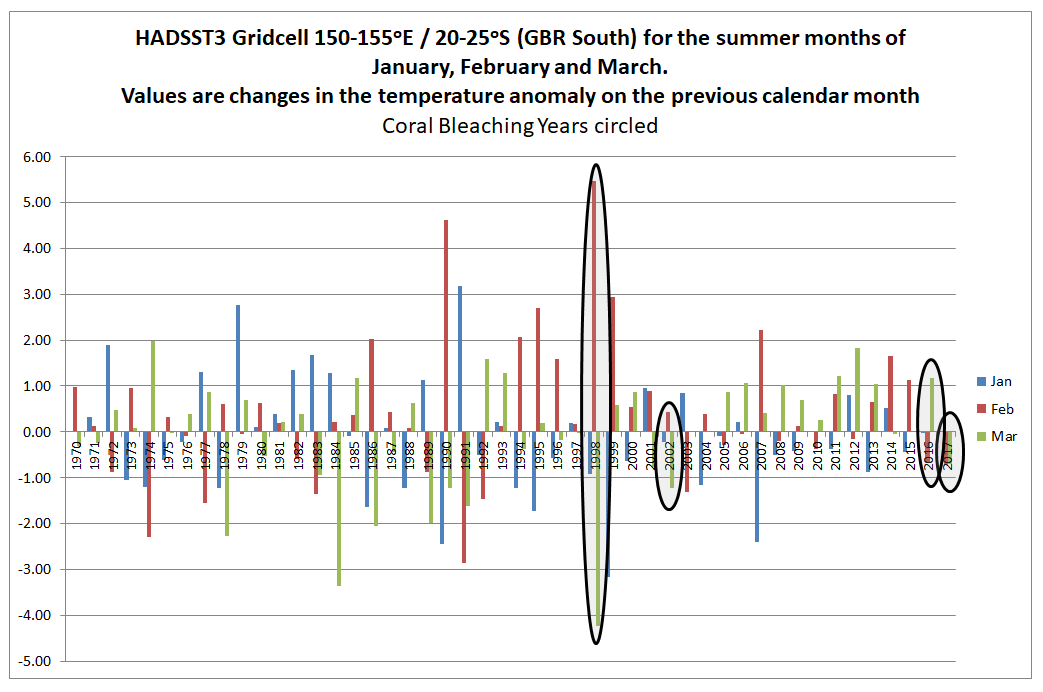
For gridcells 145-150oE / 10-15oS and 150-155oE / 20-25oS respectively representing the northerly and summer extents of the Great Barrier Reef, I have extracted the January February and March anomalies since 1970, then circled the years 1998, 2002, 2016 and 2017. Shown the average of the three summer months.

In the North of the GBR, 2016 and 2017 were unusually warm, whilst 2002 was a cool summer and 1998 was not unusual. This is consistent with the papers findings. But 2004 and 2010 were warm years without bleaching.
In the South of the GBR 1998 was exceptionally warm in February. This might suggest an anomalous reading. 2002 was cooler than average and 2016 and 2017 about average.
Also note, that in the North of the GBR summer temperatures appear to be a few tenths of a degree higher from the late 1990s than in the 1980s and early 1990s. In the South there appears to be no such increase. This is the reverse of what was found for the annual average temperatures and the reverse of where the most serious coral bleaching has occurred.
On this basis the monthly summer temperature anomalies do not seem to correspond to the levels of coral bleaching. A further check is to look at the change in the anomaly from the previous month. If sea surface temperatures increase rapidly in summer, this may be the cause of heat stress as much as absolute magnitude above the long-term average.

In the North of the GBR the February 1998 anomaly was almost a degree higher than the January anomaly. This is nothing exceptional in the record. 2002, 2016 & 2017 do not stand out at all.

In the South of the GBR, the changes in anomaly from one month to the next are much greater than in the North of the GBR. February 1998 stands out. It could be due to problems in the data. 2002, 2016 and 2017 are unexceptional years. There also appears to be less volatility post 2000 contradicting any belief in climate getting more extreme. I believe it could be an indication that data quality has improved.

Conclusions

Overall, the conjecture that global warming is resulting in increased coral bleaching in the Great Barrier Reeg directly through rising average temperatures, or indirectly through greater volatility in temperature data, is not supported by the HADSST3 surface temperature data from either the North or South of the reef. This does not necessarily mean that there is not a growing problem of heat stress, or though this seems the most likely conclusion. Alternative explanations could be that the sea surface temperature anomaly is inadequate or that other gridcells show something different.
Which brings us back to the problem identified above. How much of the observed increase in coral bleaching is down to real increases in coral bleaching and how much is down to increased observations? In all areas of climate, there is a crucial difference between our perceptions based on limited data and the underlying reality.

Kevin Marshall

Empirical evidence contradicts theory that coral bleaching of Great Barrier Reef is a result of Global Warming

At Cliscep, Jaime Jessop looks at Coral Reefs again. She quotes from

Spatial and temporal patterns of mass bleaching of corals in the Anthropocene DOI: 10.1126/science.aan8048 . (Hughes et al 2018) 

The first line is 

The average surface temperature of Earth has risen by close to 1°C as of the 1880s (1), and global temperatures in 2015 and 2016 were the warmest since instrumental record keeping began in the 19th century.

The surface temperature consists of two parts, land and ocean data. HADCRUT4 data since 1850 is as follows.

Recent land warming is significantly greater than ocean warming. Further, in the last 50 years the warming in the tropics was slightly  less than the global average, with the greatest warming being north of the tropics. Below is a split of the HADCRUT4 data into eight bands of latitude that I compiled last year. 

NASA GISS have maps showing trends across the globe. The default is to compare the most recent month with the 1951-1980 average.

The largest coral reef on the planet is the Great Barrier Reef off the North West Coast of Australia. From the map the warming is -0.2 to 0.2 °C. By implication, Hughes et al are claiming that coral bleaching in the Southern Hemisphere is being caused not by local average surface temperature rise but by a global average heavily influenced by land-based northern hemisphere temperature rise.

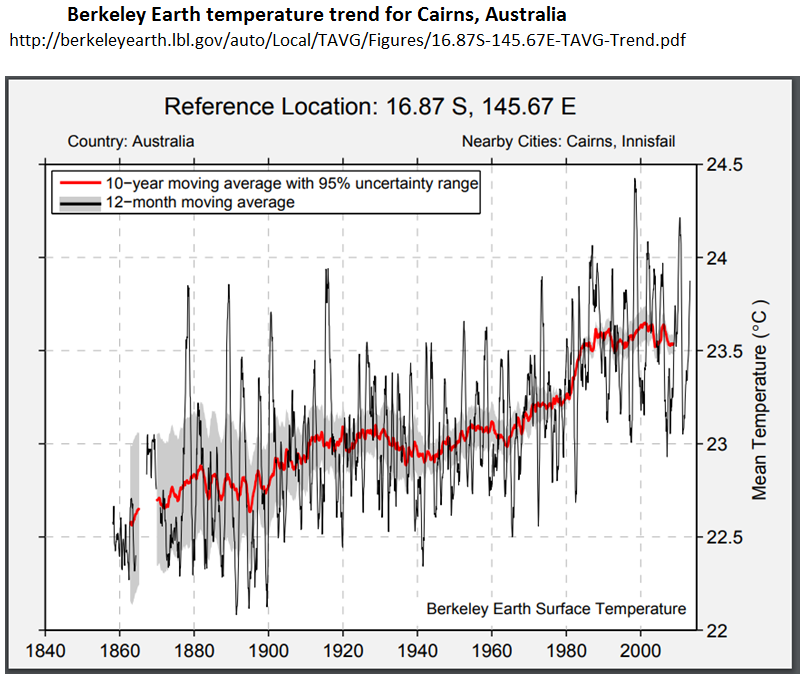
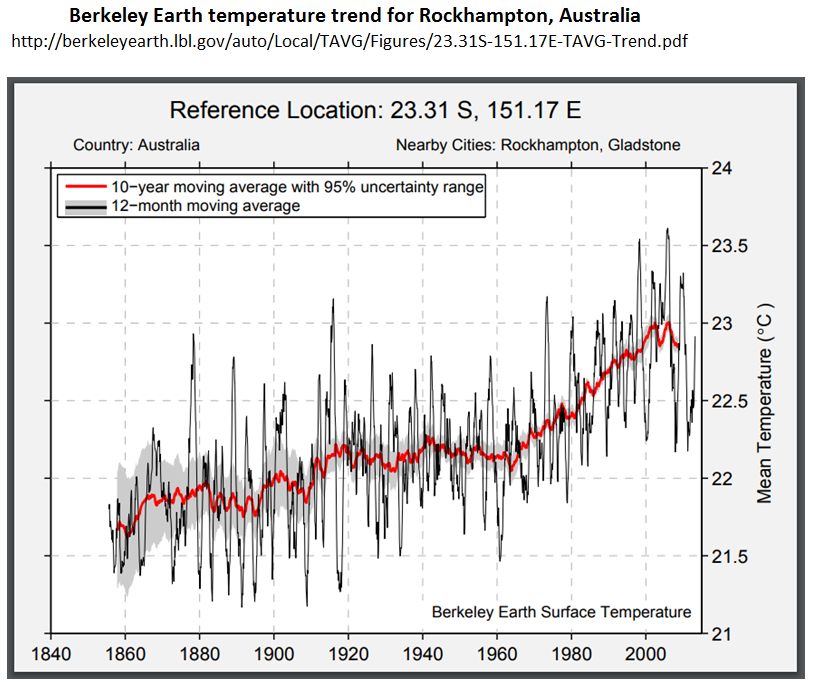
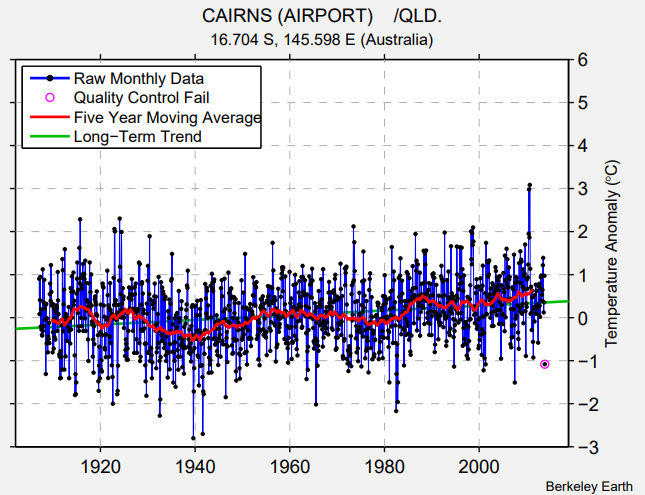
However, this is only a modeled estimate of trends. Although local data trends for the sea is not readily available, Berkeley Earth does provide trends for towns on the coastline adjacent to the GBR. I have copied the trends for Cairns and Rockhampton, one located in the middle section of the GBR, the other at the Southern tip.

Cairns, in the middle of the GBR, has no warming since 1980, whilst Rockhampton has nearer the global average and no warming trend from 1998 to 2013. This is consistent with the NASA GISS map.

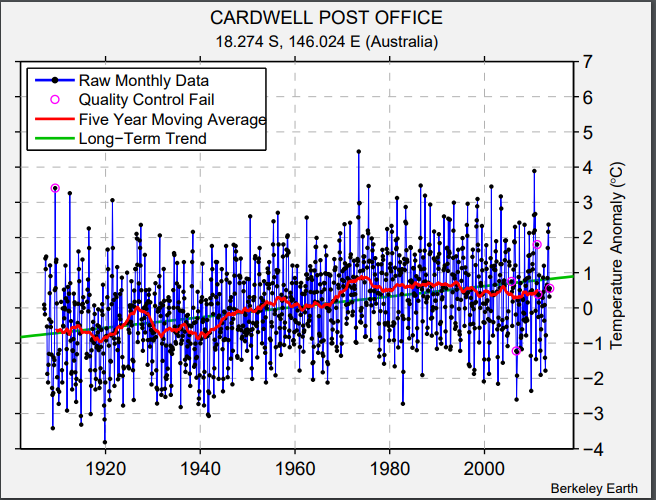
BE are extremely thorough, providing the sites which make up the trend, with the distance from the location. The raw data reveals a more complex picture. For Townsville (one-third of the way from Cairns to Rockhampton) the station list is here. Looking at the list, many of the temperature data sets are of short duration, have poor quality data (e.g. Burdekin Shire Council 4875), or have breaks in the data (e.g. Ayr, Burdekin Shire Council 4876). Another issue with respect to the Great Barrier Reef is that many are inland, so might not be a good proxy for sea surface temperatures. However, there are a couple of stations that can be picked out with long records and near the coast.
Cardwell Post Office 152368 had peak temperatures in the 1970s and cooling since. Relative to other stations, BE’s algorithms estimated there was a station bias of over 0.5°C in the 1970s.

Cairns Airport 152392 (with data since 1908, twenty years before planes first flew from the site! ) has cooling in the 1930s and warming from 1940 to the late 1950s. The opposite of the global averages. There are no station bias adjustments until 1950, showing that this is typical of the regional expectation. Recent warming is confined to 1980s and a little post 2000.

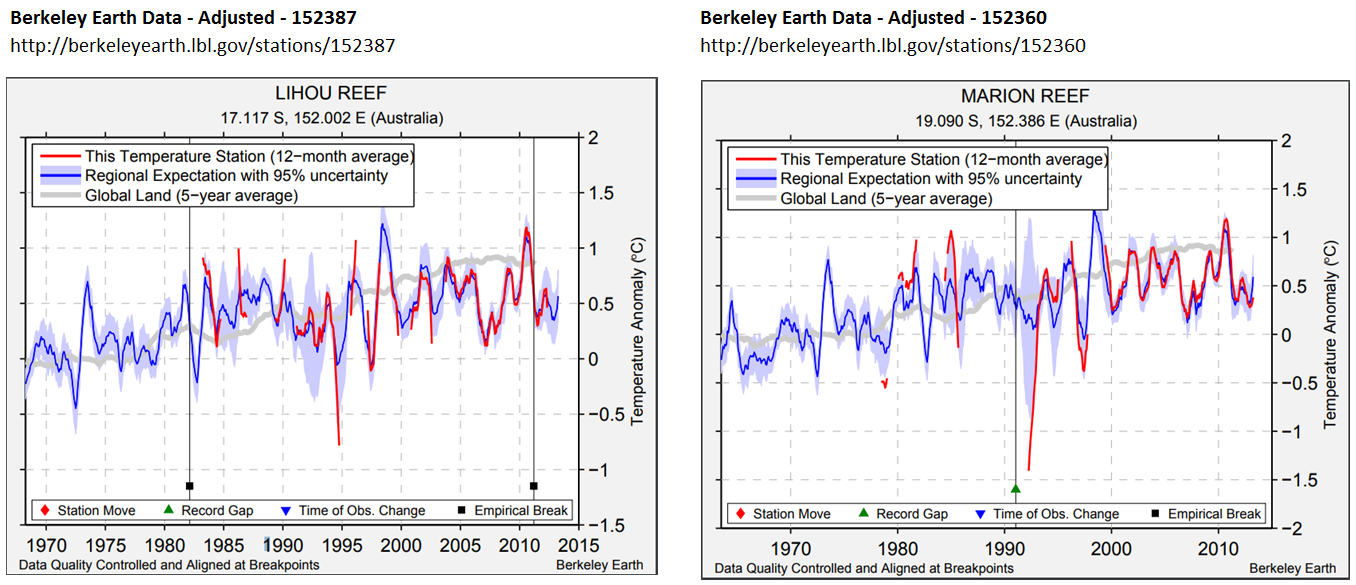
These results are confined to the land. I have found two sites on the GBR that have give a similar picture. Lihou Reef (17.117 S 152.002 E) and Marion Reef (19.090 S 152.386 E). Both for fairly short periods and the quality of the data is poor, which is not surprising considering the locations. But neither show any warming trend since the 1980’s whereas the faint grey line of the global land data does show a warming trend.

The actual temperature data of the GBR indicates that not only are average temperatures not a cause of GBR bleaching, but that calculated global average temperature trends are not replicated on the North East Australian coast. With respect to the world’s largest coral reef, increase incoral bleaching is not empirically linked to any increase in average global temperatures.

UPDATE 11/03/19 – 20:10

Following a comment by Paul Matthews, I have found the sea surface temperature data by location. The HADSST3 data is available in 5o by 5o gridcells. From data that I downloaded last year I have extracted the gridcells for 145-150oE/10-15oS and 145-150oE/15-20oS which cover most of the Great Barrier Reef, plus a large area besides. I have charted the annual averages alongside the HADCRUT4 global and HADSST3 ocean anomalies.

Ocean surface temperatures for the Great Barrier Reef show no warming trend at all, whilst the global averages show a quite distinct warming trend. What is more important, if the coral bleaching is related to sudden increases in sea temperatures then it is the much more massive increases in local data that are important, not the global average. To test whether increases in temperatures are behind bleaching events requires looking for anomalous summer months in the data. Another post is required.     

The context of Jaime Jessop’s Cliscep article

After multiple comments at a blogpost by Jaime Jesssop in early January 2018 Geoff M Price wrote a post at his own blog “On Coal Alarmism” on 2nd April 2018. ATTP re-posted 11 months later on 5th March 2019. Personally I find the post, along with many of the comments, a pseudo-scientific and discriminatory attack piece. That may be the subject of another post.

Kevin Marshall

What would constitute AGW being a major problem?

Ron Clutz has an excellent post. This time on he reports on A Critical Framework for Climate Change. In the post Ron looks at the Karoly/Tamblyn–Happer Dialogue on Global Warming at Best Schools particularly at Happer’s major statement. In my opinion these dialogues are extremely useful, as (to use an old-fashioned British term) are antagonists are forces by skilled opponents to look at the issues in terms of a level playing field. With the back and forth of the dialogue, the relative strengths and weaknesses are exposed. This enables those on the outside to compare and contrast for themselves. Further, as such dialogues never fully resolve anything completely, can point to new paths to develop understanding. 

Ron reprints two flow charts. Whilst the idea is of showing the issues in this way to highlight the issues is extremely useful correct. I have issues with the detail. 


In particular on the scientific question “Is it a major problem?“, I do not think the “No” answers are correct.
If there was no MWP, Roman warming, or Bronze Age warming then this would be circumstantial evidence for current warming being human-caused. If there has been 3 past warming phases at about  1000, 2000 and 3000 years ago, then this is strong circumstantial evidence that current warming is at least in part due to some unknown natural or random factors. Without any past warming phases at all then it would point to the distinctive uniqueness of the current warming, but that still does not mean not necessarily mean that it is a major net problem. There could be benefits as well as adverse consequences to warming. But the existence of previous warming phases under many studies and only being able to claim by flawed statistics that the majority of warming since 1950 in human-caused (when there was some net warming for at least 100 years before that suggests a demonstrable marginal impact of human causes far less than 100% of total warming. Further there is issues with

(a) the quantity of emissions a trace gas to raise that the atmospheric levels by a unit amount

(b) the amount of warming from a doubling of the trace gas – climate sensitivity

(c) the time taken for rises on a trace gas to raise temperatures.

As these are all extremely difficult to measure, so a huge range of equally valid answers. It is an example of the underdetermination of scientific theory.

At the heart of the underdetermination of scientific theory by evidence is the simple idea that the evidence available to us at a given time may be insufficient to determine what beliefs we should hold in response to it.

But even if significant human-caused warming can be established, this does not constitute a major problem. Take sea-level rise. If it could be established that human-caused warming was leading to sea level rise, this may not, on a human scale, be a major problem. At current rates sea levels from the satellites are rising on average by 3.5mm per year. The average adjusted level from the tide gauges are less than that – and the individual tide gauges show little or no acceleration in the last century. But if that rate accelerated to three or four times that level, it is not catastrophic in terms of human planning timescales. 

The real costs to humans are expressed in values. The really large costs of climate change are based not so much on the physical side, but implausible assumptions about the lack of human responses to ongoing changes to the environment. In economics, the neoclassical assumptions of utility maximisation and profit maximisation are replaced by the dumb actor assumption.

An extreme example I found last year. In Britain it was projected that unmitigated global warming could lead to 7000 excess heatwave deaths in the 2050s compared to today. The projection was most of these deaths would occur in over 75s dying in hospitals and care homes. The assumption was that medical professionals and care workers would carry on treating those in the care in the same way as currently, oblivious to increasing suffering and death rates.  

Another extreme example from last year was an article in Nature Plants (a biology journal) Decreases in global beer supply due to extreme drought and heatThere were at least two examples of the dumb actor assumption. First was failure by farmers to adjust output according to changing yields and hence profits. For instance in Southern Canada (Calgary / Edmonton) barley yields under the most extreme warming scenario were projected to fall by around 10-20% by the end of the century. But in parts of Montana and North Dakota – just a few hundred miles south – they would almost double. It was assumed that farmers would continue producing at the same rates regardless, with Canadian farmers making losses and those in Northern USA making massive windfall profits. The second was in retail. For instance the price of a 500ml bottle of beer in Ireland was projected to increase under the most extreme scenario in Ireland by $4.84 compared to $1.90 in neighbouring Britain. Given that most of the beer sold comes from the same breweries; current retail prices in UK and Ireland are comparable (In Ireland higher taxes mean prices up to 15% higher); cost of a 500ml bottle is about $2.00-$2.50 in the UK; and lack of significant trade barriers, there is plenty of scope with even a $1.00 differential for an entrepreneur to purchase a lorry load of beer in the UK and ship it over the Irish Sea. 

On the other hand nearly of the short-term forecasts of an emerging major problem have turned out to be false, or highly extreme. Examples are

  • Himalayan Glaciers will disappear by 2035
  • Up to 50% reductions in crop yields in some African Countries by 2020
  • Arctic essentially ice-free in the summer of 2013
  • Children in the UK not knowing what snow is a few years after 2000
  • In the UK after 2009, global warming will result in milder and wetter summers

Another example of the distinction between a mere difference and a major problem is the February weather. Last week the UK experienced some record high daytime maximum temperatures of 15-20C. It was not a problem. In fact, accompanied by very little wind and clear skies it was extremely pleasant for most people. Typical weather for the month is light rain, clouds and occasional gales. Children on half-term holidays were able to play outside, and when back in school last week many lessons were diverted to the outdoors. Over in Los Angeles, average highs were 61F (16C) compared to  February average of 68F (20C). This has created issues for the elderly staying warm, but created better skiing conditions in the mountains. More different than a major problem. 

So in summary, for AGW to be a major problem it is far from sufficient to establish that most of the global warming is human caused. It is necessary to establish that the impact of that warming is net harmful on a global scale.

Kevin Marshall