James Hansen favouring Richard Lindzen over IPCC

Much has been made of James Hansen’s recent claim in a youtube video that runaway global warming will make the oceans boil. However, people have not picked up an earlier point, where the father of global warming alarmism clearly contradicts the consensus.

In the first minute of the clip, Hansen talks about the impact of ice sheets disintegrating in the polar regions. All this extra cold fresh water decreases ocean temperatures. This, in turn, increases the temperature gradient between the poles and the tropics. This, in turn, increases the strength of storms.

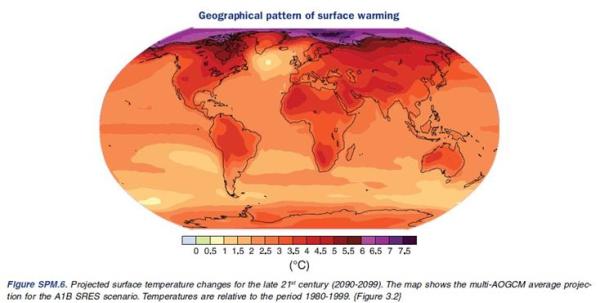
If Hansen looks his own GISSTEMP figures for global average temperatures, he will notice that the warming has been higher is the Artic than in the tropics. According to UNIPCC in 2007, the fastest warming in this century will be in the Arctic. I propose that cooling of the Arctic Ocean will have two effects. First it will counterbalance the most extreme warming of the planet, thereby reduce the total temperature rise. Also it will counter-balance some of the rise in temperatures, so reducing the impact of Greenland ice melt and slowing the reduction in sea ice. Second, it will reduce the impact of extreme storms. If melting ice cools the oceans, it is a negative feedback.


Sources of the boiling oceans comment are:-

WUWT comments 2 and 3 by Eric Worrall

http://carbon-sense.com/ on April 13th 2013

C3 Headlines


China’s Renewable Policy in Context – The Ningxia Example

China has been lauded for an aggressive renewable policy, particularly for wind turbines. When you next hear praise for this policy, consider the example of the Ningxia Hui Autonomous Region in Mid-China. There are wind turbines being developed here, but only in the context of massive industrial development. That primary motive for the industrial development in this area is coal. For instance

Sun Mountain has something China needs very badly to feed the thundering beast of its economy: 14.6 billion tons of coal reserves lying under its rocky, arid desert. There are also 5 billion tons of limestone, nearly 2 billion tons of dolomite, and – a modern touch this – 300 days of wind power per year. But there is no doubt that King Coal, a tyrannical monarch who has devoured land and lives in Ningxia for the past 50 years, rules Sun Mountain. If China is to quench its thirst for electricity and industrial chemicals the old king will be on the throne for many years to come.

The scale of the development is seen from another, 2008, article.

Shenhua Ningxia Coal Industry Company….. has begun construction of a 1000 square kilometer coal-chemical complex in northwest China’s Ningxia province. The 280 billion yuan (40 billion USD) project, located at Ningdong, 42 kilometers southeast of provincial capital, Yinchuan, will include coal production, electricity generation and coal chemicals, including coal to liquid fuel conversion (CTL). (Italics mine)

The coal will be partly used for power generation.

By the time the base is fully operational in 2020 it will have eight power plants with a capacity of 30 million KW.

That is eight power plants in one small region, each bigger than anything in Britain. But why develop coal to liquid fuel conversion?

With China’s crude oil imports rising 12.3 percent to 163.17 million tons in 2007, and the price of oil reaching $140 a barrel in 2008, one of the most keenly watched facilities in the Ningdong base will be its coal to oil conversion plants.

As of 2013, one of these plants is already in operation, and should be producing the equivalent of 70,000 barrels per day (bpd) if the mid-2006 forecasts were correct. The other is being constructed, with a capacity of over 90,000 bpd. Although these two plants will only provide the equivalent of 4% of the 163.17 million tonnes imported in 2007, China has huge reserves of coal. Further, Ningxia is one of just 30 main coal producing areas.

This 2008 article admits to drawbacks of CTL.

Coal liquefaction projects have many drawbacks from the point of view of the environment and resource conservation. Firstly they consume vast amounts of water, which is a huge concern in China’s dry northwest. Fifty-seven percent of the land area of Ningxia is desert. The Ningdong coal-chemical base will draw 100 million tons of water from the Yellow river every year. Secondly, the process of liquefying coal emits much more carbon dioxide than conventional coal fired power stations. When fully operational, the Ningdong base will discharge 80,000 cubic meters of Carbon Dioxide (CO2) per day …….. Finally, while liquefied coal fuels provide an alternative to crude oil, they are not necessarily an efficient use of coal. It takes four to five tons of coal to produce one ton of oil, so coal to oil projects deplete coal reserves much more rapidly than conventional coal power generation.

Therefore, China’s rush into renewables should be seen as just a small part of the general industrialisation of China, whilst minimising dependence on external energy sources. The eco-image, such as support for Earth Day and Kite Tournaments is just to keep the environmentalists from trying to sabotage China’s rush to western levels of prosperity for 1300 million people.

Velicogna 2009 and Chen et al 2009 on Acceleration in Antarctic Ice Melt

This blog post started out as some musings on the different way of measuring the changes in the mass of Antarctic land ice, as a follow up to a couple of comments to Jo Nova’s posting “Antarctica gaining Ice Mass — and is not extraordinary compared to 800 years of data.” The problem with this is that it looks at just part of the total ice mass balance. These lead me to look at the major papers that looked to Total Mass Balance. There are two from 2009, using early data from the GRACE satellite gravity mission Velicogna and Chen et al. In comparing the various estimates, I discovered three anomalies that should have been detected as part of the peer review process.

Error in Velicogna Summary

The abstract notes

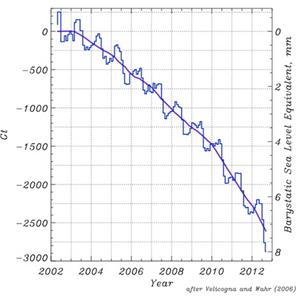
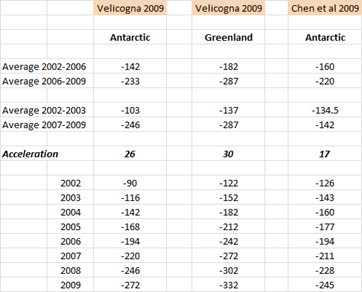
In Greenland, the mass loss increased from 137 Gt/yr in 2002–2003 to 286 Gt/yr in 2007–2009, i.e., an acceleration of −30 ± 11 Gt/yr2 in 2002–2009. In Antarctica the mass loss increased from 104 Gt/yr in 2002–2006 to 246 Gt/yr in 2006–2009, i.e., an acceleration of −26 ± 14 Gt/yr2 in 2002–2009.

When I tried to replicate this for Greenland, the figures worked out. Starting with 122 Gt/yr a year ice loss in 1992 and adding 30 to each year gives the “137 Gt/yr in 2002–2003 to 286 Gt/yr in 2007–2009“. But for Antarctica, adding 26 to each year cannot give “the mass loss increased from 104 Gt/yr in 2002–2006 to 246 Gt/yr in 2006–2009“. However, if the statement is rephrased with the Greenland timescales as “the mass loss increased from 104 Gt/yr in 2002–2003 to 246 Gt/yr in 2007–2009” then the numbers work out.


The spread sheet is easy to construct. For Velicogna Antarctica, start with -90 in 2002 and subtract 26 from the preceding year. The average uses the “=AVERAGE()” function in Excel.

So why did this dating error occur? There is no apparent reason in the Velicogna paper to use two different averages over such a short time frame. I might suggest that there is another reason. The two papers were published weeks apart (Velicogna 13th Oct and Chen 22nd Nov) and used the same data for Antarctica over similar periods (Velicogna Apr 02 – Feb 09 and Chen Apr 02 – Jan 09). The impact of both would be enhanced if they had comparative statistics. For instance Zwally & Giovinetto 2011 state

Table 2 includes two GRACE-based mass loss estimates of 104 Gt/year (Velicogna 2009) and 144 Gt/year (Chen et al. 2009) for the period 2002–2006 and two estimates of 246 Gt/year (Velicogna 2009) and of 220 Gt/year (Chen et al. 2009) for the period 2006–2009.

Correcting Velicogna, it becomes

Table 2 includes two GRACE-based mass loss estimates of 142 Gt/year (Velicogna 2009) and 144 Gt/year (Chen et al. 2009) for the period 2002–2006 and two estimates of 233 Gt/year (Velicogna 2009) and of 220 Gt/year (Chen et al. 2009) for the period 2006–2009.

That is, the two papers become far more consistent if the averages are corrected. It would appear that Velicogna changed the dates without doing the maths.

Form of the acceleration

Velicogna states in the abstract

We find that during this time period the mass loss of the ice sheets is not a constant, but accelerating with time, i.e., that the GRACE observations are better represented by a quadratic trend than by a linear one, implying that the ice sheets contribution to sea level becomes larger with time.

This quadratic trend is backed up by graphs on the NASA website (Antarctica) and NOAA websites (Greenland)


For ice melt Velicogna is stating that, not only would the trend be for each year to be greater than the previous year, but for the incremental increase to be greater than the last.

But, if ∂M is the change in ice mass, from the following functions were used in my spread sheet to replicate both Velicogna’s and Chen’s results.

For Velicogna 2009, Antarctica

∂M = -90 – 26(Year-2002)

For Velicogna 2009, Greenland

∂M = -122 + 30(Year-2002)

For Chen et al. 2009, Antarctica

∂M = -126 + 17(Year-2002)

These are all linear functions. I do not have access to Chen’s paper, but Velicogna’s abstract does not conform to her model.

Discontinuous functions in Chen et al. 2009

The abstract for Chen states

… our data suggest that East Antarctica is losing mass, mostly in coastal regions, at a rate of −57±52 Gt yr−1, apparently caused by increased ice loss since the year 2006.

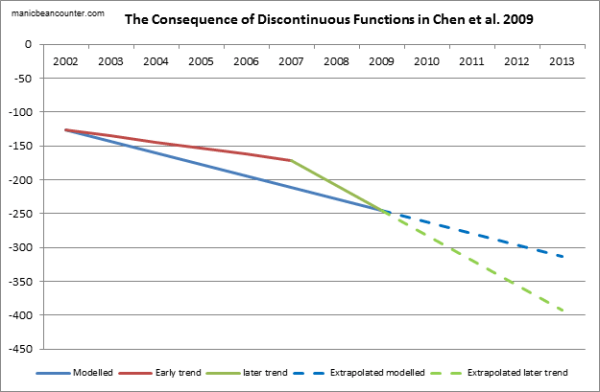
Chen detection of increased ice loss is similar to Velicogna’s. But unlike Velicogna, Chen suggests that there is a discontinuous function. In other words, Chen’s graph would look like this.


Although it is possible to extrapolate from a discontinuous function, it would be highly misleading to do so. It suggests there is no underlying empirical relationship to be observed, in direct contradiction to Velicogna. Further, over a short period it is impossible to say whether this is the shift in the underlying rate of change in Antarctic melt, or if this new direction be quickly reversed. Fortunately, the two studies were published over three years ago, so there are alternative studies to compare the projection against. This will be the topic of the next post.

J. L. Chen, C. R. Wilson, D. Blankenship & B. D. Tapley Nature Geoscience 2, 859 – 862 (2009) Published online: 22 November 2009 doi:10.1038/ngeo694

Velicogna, I. (2009), Increasing rates of ice mass loss from the Greenland and Antarctic ice sheets revealed by GRACE, Geophys. Res. Lett., 36, L19503, doi:10.1029/2009GL040222

H. Jay Zwally, Mario B. Giovinetto (2011) Surveys in Geophysics September 2011, Volume 32, Issue 4-5, pp 351-376, Overview and Assessment of Antarctic Ice-Sheet Mass Balance Estimates: 1992–2009 10.1007/s10712-011-9123-5

Two Comments on Antarctic Ice Accumulation

Jo Nova blogs on a study that claims the Antarctic continent is accumulating ice mass at a rapid rate. I have made two comments. One is opposing someone who claims that Antarctica is actually losing ice. The other is that the claimed rate of ice accumulation does not make sense against known data on sea levels.

Manicbeancounter

April 17, 2013 at 6:27 am · Reply

John Brooks says

I’m also interested that the mass of antarctic land ice follows solar irradiance. This makes perfect sense. However I can’t see why the effective of an increase in the greenhouse effect wouldn’t have exactly the same result.

Maybe you should look at the period covered by the graph John. There is an 800 year correlation of mass of antarctic land ice with solar irradiance, with the biggest movements in both prior to 1800. Insofar as the greenhouse effect is significant, it is nearly all after 1945.

And for some reason, I’ve got the idea in my head that antarctic land ice is decreasing.

Sure enough from the Carbon Brief link, this quote

Measurements from the Gravity Recovery and Climate Experiment (GRACE) satellite since 2002 have shown that the mass of the Antarctic ice sheet is decreasing at an average rate of 100 cubic kilometres every year – the size of a small UK city.

(emphasis mine)
The size of a city is usually measured in area, not volume. The ancient City of York, for instance, has an area of 272 square kilometres (105 square miles) and a population of 125,000. Or maybe they mean the volume of the buildings in a city? A famous building in New York is the Empire State Building. Not only is it quite tall it also has quite a large volume. Around 1,040,000 cubic metres or 0.001 cubic kilometres in fact. So does the Carbon Brief claim that a small UK city have a volume of buildings equivalent to 100,000 Empire state buildings? Or each average person in a small UK city occupies a building volume greater than Buckingham Palace?
Alternatively, does John Brooks quote a source that does not have a clue about basic maths?

Manicbeancounter

April 17, 2013 at 8:01 am · Reply

I think this paper does not stack up. I worked as a management accountant in industry for 25 years. One thing I learnt early on when estimating or forecasting was to sense-check the estimates. No matter how good your assumptions are, when estimating or extrapolating well beyond the data trend (where there is potential for error), the best check on the data is by reconciling with other data.
From the above

“The SMB of the grounded AIS is approximately 2100 Gt yr−1, with a large interannual variability. Those changes can be as large as 300 Gt yr−1 and represent approximately 6% of the 1989–2009 average (Van den Broeke et al., 2011).”

A gigatonne of ice is equivalent to a cubic kilometre of water. If the land ice volume is increasing, the water must come from somewhere. Nearly all of that water needs to come from the oceans.
Now for some basic maths. A gigatonne is a billion tonnes. As water has a relative density of 1.0, a tonne of water (1,000 litres) is a cubic metre. Therefore a gigatonne of water is a cubic kilometre (1000^3 = 1,000,000,000 = one billion).
A further factor to consider is the area of the oceans. According to my Times Concise Atlas, the total area of the oceans and seas (excluding the enclosed waters like the Dead Sea and Lake Baykal) is 325,000,000km^2. A cubic kilometre of water added to an enclosed sea of one million square kilometres, would raise the sea level by just 1mm (1000mm x 1000m = 1,000,000mm in a kilometre). So 325km^3 = 325Gt-1 of new ice accumulation above sea level in Antarctica would reduce sea levels by 1mm, or 2100GT-1 by 6.5mm.
Some of the ice accumulation will be on ice shelves, so the impact of 2100GT-1 extra ice per annum extra ice might be to reduce sea levels by just 5mm per annum. Also sea levels might be rising by a little less than the 3.2mm a year that official figures claim, but there is no evidence that sea levels are falling. Further, any net ice melt elsewhere (mostly Greenland) is only adding 1mm to sea level rise. So the rest must be mostly due to thermal expansion of the oceans. I think that the evidence for the oceans heating is very weak and of insignificant amounts. Even Kevin Trenberth in his wildest flights of fantasy would not claim the missing heat (from the air surface temperatures) adds more than 1-2mm to sea level rise.
What this study does show is that by honestly looking at data in different ways, it is possible to reach widely different conclusions. It is only by fitting the data to predetermined conclusions (and suppressing anything outside the consensus) that consistency of results can be achieved.

My scepticism on global warming stems from a belief that scientific evidence is strengthened by being corroborated from independent sources. Honest and independent data analysis means that wildly different conclusions can be reached. Comparing and contrasting these independent sources leads me to believe that the public face of the global warming climate change consensus massively exaggerates the problem.

Kevin Marshall

Bjorn Lomborg on Climate Costs in the Australian

Australian Climate Madness blog points to an article, “Wrong way, go back“, in the Australian Newspaper by Skeptical Environmentalist Bjorn Lomberg on Australia’s climate policies. This is my comment.

This statement in the article is significant

When economists estimate the net damage from global warming as a percentage of gross domestic product, they find it will indeed have an overall negative impact in the long run but the impact of moderate warming (1C-2C) will be beneficial. It is only towards the end of the century, when temperatures have risen much more, that global warming will turn negative.

Now consider the Apocalypse Delayed? posting of March 28th. Referring to an Economist article, it says that a number of empirical studies show that climate sensitivity is much lower than the climate models assume. Therefore, moving into the net cost range seems much less likely.
But why are there net costs? Lomberg’s calculations are based on William Nordhaus’s DICE model that

calculates the total costs (from heat waves, hurricanes, crop failure and so on) as well as the total benefits (from cold waves and CO2 fertilisation).

I would claim that the destablisation of the planet’s climate by rapid warming has very little evidence. Claims in AR4 that hurricanes were getting worse; that some African countries would see up to a 50% reduction in crop yields by 2020; that the Himalayan Glaciers would largely disappear by 2035; that the Amazon rainforest could catastrophically collapse – all have been over-turned.
Thus the policy justification for avoiding climate catastrophe as a result rising greenhouse gases is a combination of three components. First, a large rise in temperatures. Second, the resulting destablisation of the climate system having net adverse consequences. Third, is that the cost of constraining the rise in greenhouse gases is less than the cost of doing nothing.
It is only this third aspect that Bjorn Lomberg deals with. Yet despite that he shows that the Australian Government is not “saving the planet for future generations”, but causing huge net harm. Policy-making should consider all three components.

That is, there are three components to the policy justification to combatting “climate change” by constraining the growth in greenhouse gas emissions

  1. That there will be a significant amount of global warming.
  2. That this is net harmful to the planet and the people on it.
  3. That the net harm of policies is less than the net harm of warming. To use a medical analogy, the pain and risks of treatment are less than the disease.

Lomberg, using the best cost model available, comes up with far less costs of global warming than, say, the Stern Review of 2006. He also uses actual policy costs to assess the net harm of global warming. Lomberg does not, however, challenge the amount of warming from a given quantity of CO2 rise, nor the adverse consequences of that warming. The Economist article
and editorial of March 30th conversely challenges the quantity of warming from arising from a given rise in CO2, but just sees it as “apocalypse delayed” and not “apocalypse debunked“.

Kevin Marshall

Dehumanizing Climate Sceptics

Steve Mcintyre did some research on Dr Paul Bain – the same who Jo Nova had a long correspondence with a few months ago.

Dehumanizing Language
A few months ago, in an article in Nature Climate Change, Paul Bain, another Australian psychologist, repeatedly used the term “denier” to refer to climate skeptics. Bain defended this usage at Judy Curry’s on the basis that it would “activate the strongest confirming stereotypes” in his target audience:
By using the term “denier” we wanted to start with something that would activate the strongest confirming stereotypes in this audience
Bain’s usage was sharply criticized by skeptic blogs (though it was not an issue that I bothered with.) Judy Curry made the following interesting suggestion:

Somebody needs to research the sociology and psychology of people that insist that anyone that does not accept AGW as a rationale for massive CO2 mitigation efforts is a “denier.”

Judy’s invitation unfortunately was not followed up in the comments. Had this been done, people would have made the surprising discovery that, in his “day job”, Bain primarily wrote about the use and function of derogatory epithets (e.g. cockroach in the Hutu-Tutsi and other racially charged terms). Bain observed that a primary function of dehumanizing language is to reinforce the self-esteem of the “in group”:
For example, Bain observed

Subtle forms of dehumanization are often explained with reference to …the idea that the in group is attributed “the human essence” more than outgroups, and hence outgroups are implicitly seen as “non-human”. ..

People typically evaluate their in-groups more favorably than out-groups and themselves more favorably than others…

such labeling has the effect of denying full humanness to the out group, reinforcing the self-esteem of the in-group..

The denial of full humanness to others, and the cruelty and suffering that accompany it, is an all-too familiar phenomenon…

Despite Bain’s prolific writing on the use and abuse of dehumanizing epithets, he was oddly oblivious to the function of the term “denier” as a means of dehumanizing IPCC critics.

My interpretation of Bains’ scientific research is that likening sceptics to Nazis or pedophiles shows the collective insecurities and feelings of inadequacy of those making the comments. Deep down they know that their beliefs are built on sand, and are desperately finding ways not to acknowledge this. Dehumanizing those who challenge their beliefs is nothing new. It is an easy position to fall into, and takes courage to challenge.

Tung and Zhou claim of constant decadal anthropogenic warming rates in last 100 years

Bishop Hill reports on

A new paper in PNAS entitled ‘Using data to attribute episodes of warming and cooling in instrumental records’ looks important. Ka-Kit Tung and Jiansong Zhou of the University of Washington report that anthropogenic global warming has been overcooked. A lot.

My comment was:-

My prediction is that this paper will turn out to have exaggerated the anthropogenic influence, rather than have under-estimated it.

The relevant quote:-

The underlying net anthropogenic warming rate in the industrial era is found to have been steady since 1910 at 0.07–0.08 °C/decade

Greenhouse gas emissions have not been increasing at a steady rate. The most important is CO2. A couple of years ago I tried to estimate from country data (filling in important gaps) how global CO2 emissions had increased. The increases per quarter century were

1900-1925 85%

1925-1950 60%

1950-1975 185%

1975-2000 45%

That meant global CO2 emissions increased more than 12 times (1100%) in 100 years. The conversion rate to retained CO2 seems to be roughly constant – 4Gt of carbon equivalent to increase CO2 levels by 1ppm. Furthermore, the C20th warming was nearly all in two phases. 1910-1945 and 1975-1998. Rather than temperature rise being related to CO2 emissions, it seems out of step. That would imply a combination of two things for the anthropogenic warming rate to be constant at 0.07–0.08 °C/decade. First is that CO2 has massively diminishing returns. Second is that CO2 emissions alone have a much smaller impact on the global average temperature changes (as reported in HADCRUT4), than this paper concludes.

Supplementary Information

This source of the emissions data is

Boden, T.A., G. Marland, and R.J. Andres. 2010. Global, Regional, and National Fossil-Fuel CO2 Emissions. Carbon Dioxide Information Analysis Center, Oak Ridge National Laboratory, U.S. Department of Energy, Oak Ridge, Tenn., U.S.A. doi 10.3334/CDIAC/00001_V2010

The CO2 levels are for Mauna Loa back to 1959, and estimated backwards from there to 1780.


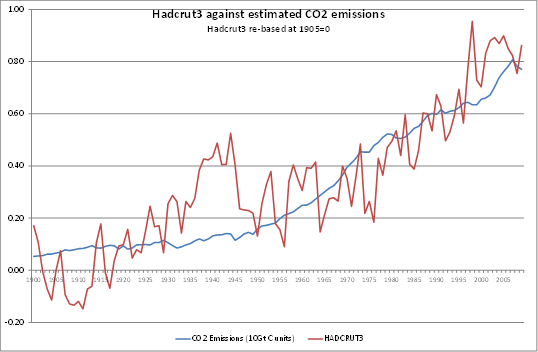
The above chart shows by estimated CO2 emissions (expressed in units of 10Gt of carbon equivalents) shown as against the HADCRUT3 data set. This shows a slow rate of increase in CO2 emissions in the first half of the twentieth century, with falls in emissions during the Great Depression (1929-1933) and at the end of the Second World War (1945). From 1950 to 1973 there was a huge upsurge in emissions with the post-war economic boom, then stalls in 1973 (The OPEC oil embargo) and 1980-83 (global recession). After 2000 there was another surge in emissions, mostly due to rapid growth in China.

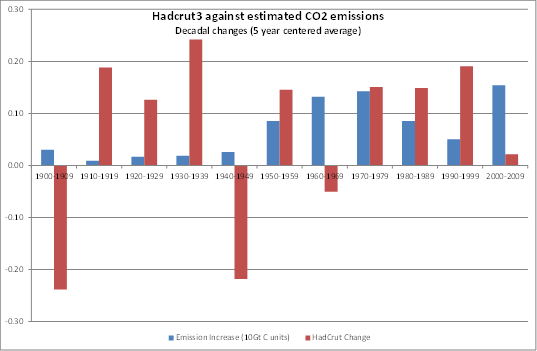
The temperature increases followed a different pattern. There were two periods of increasing temperatures in the twentieth century – From 1910-1945 and 1975-1998. The decadal changes graph below shows clearly the change in emissions. The temperature changes by decade exaggerate the falls in temperature in the Edwardian decade and the 1940s.


What is clearly illustrated is why I believe the anthropogenic influence on temperature was not similar in every decade from 1910, as Ka-Kit Tung and Jiansong Zhou claim.

The Calculus of Climate Change morality

A couple of days ago Jo Nova highlighted another example of an environmentalist, Jonathan Moylan, who thought that to save the planet they were morally justified in committing criminal acts. My posting is on one journalist’s opinion that Moylan should be applauded, not prosecuted.

Katherine Wilson in the Age opinion says

Moylan’s hoax asks us to consider a broader category of victims: the world’s citizens and environments who are facing the real consequence of big polluters such as coal companies.

When asked by the Newcastle Herald whether his actions were justified, Moylan said

 My intention was to get ANZ Bank to expose themselves as the backers of the Maules Creek project. Some media organisations have used the word ”justify” – this is not my word. My prime concern is the local community, which has been feeling very despondent – the forest, our health and our water.

That is Moylan does not think he is saving the planet from catastrophic climate change. Or at least he claiming not to do have done so after the event. Let us, however, assume that Katherine Wilson is correct in assuming Moylan’s actions were more to do global climate change than local environmental issues.

The moral case is that the harms caused in the necessary publicizing of an issue are insignificant compared to beside larger damage occurring. It we were able to go back in a time machine to April 20th 1889, and strangle the newly born son of Klara and Alois Hitler, would we be justified in doing so. One death could have saved the life of millions, as without a charismatic leader the extremist nationalist elements in Weimar Germany would never have come to the fore. But what if the communists had come to power in Germany instead? They were certainly the main opposition that the Nazis staged street battles with in the 1920s. Suppose that they joined with the Soviets to invade Poland and then the rest of Europe? With the many millions of people that died in the Gulags, along with the tens of millions that had died in the collectivisation of agriculture, could the death of an infant conceivably have caused even greater misery?

I use this example, not to ponder nor the morality of killing infants (or later killing the Adolf Hitler once he became the charismatic leader of the Nazi party). It is to consider whether, for climate change, such a calculus of causing a small harm will lead to the prevention of a larger harm. With respect to climate change, this depends on three factors. First, the likely harm from future unimpeded climate change will have catastrophic consequences. Second, the likely harm of the action to highlight awareness of the issue is trivial compared to the impending climate catastrophe. Third, that will be significant success in getting the issue recognised.

If climate change is vastly exaggerated then there is a risk that Moylan is campaigning for policies that are not justified. The treatment is more harmful than the ailment. If the harm caused by the action is vastly greater than anticipated, or the full extent is not recognised post the event (“you’ve got to crack a few eggs to make an omelette” mentality), then there is an element of recklessness. If there are already policies in place to optimally tackle the issue, and the media is already on the side of the consensus opinion, then aggressive action to further highlight the cause is that is already more than fully recognised is positively harmful to society. It could lead to policies not justified by the scientific evidence, however construed.

Consider the following from Katherine Wilson’s argument.

At the parliamentary level, Greens senator Christine Milne has applauded his actions as being ”part of a long and proud history of civil disobedience, potentially breaking the law, to highlight something wrong”.

Read more: 
http://www.theage.com.au/opinion/society-and-culture/the-hoax-we-had-to-have-20130110-2cix8.html#ixzz2HrZL2qbJ

Like the Nazis smashing up the shops of Jews, or beating up communists to highlight that their great nation is being over-run? Most people will now accept that the racist laws that existed in America’s Deep South in the 1950s, or the denial of universal suffrage for all adults in Britain prior to 1918 were immoral, and therefore at least some of the protests were justified. But most sane people will accept that the cause of the Nazis was evil, so any sort of illegal actions to promote their ideas is wrong. Wilson and Milne are assuming they stand on the moral high ground. Whilst not considering them as bad as the Nazis, I do believe them morally to be nearer to that position than of Martin Luther King, or Emmeline Pankhurst, as the points below will demonstrate.

For those citizens who have not given up on the conviction that taking action is ”the greatest moral, economic and environmental challenge of our generation”, there is little choice but to pull off hoaxes of this kind.

Read more: http://www.theage.com.au/opinion/society-and-culture/the-hoax-we-had-to-have-20130110-2cix8.html#ixzz2HrZbJTY9

Again, others may disagree. Al Qaeda sees the greatest challenge as spreading Islam. For millions in Southern Europe finding a job, or being paid for their work, is far more important. Dr Indur Goklany. looking at the consensus projections of climate impacts thinks that in the next few decades there are far more important issues facing humanity.

Moylan’s hoax asks us to consider a broader category of victims: the world’s citizens and environments who are facing the real consequence of big polluters such as coal companies.

Read more: 
http://www.theage.com.au/opinion/society-and-culture/the-hoax-we-had-to-have-20130110-2cix8.html#ixzz2HreCE8d7

For more than two billion people in Asia, any environmental problems of rapid development may seem trivial to the huge benefits of being able to eat better, or having access to ever-increasing levels of healthcare and education.

For all the ”free market of ideas” posturing, the media and finance marketplace that Moylan sought to disrupt is not some equal playing field operating under rules of fair play. As countless journalism academics have documented, news agendas are set by public servants, PR agents, politicians and business leaders.

Read more: 
http://www.theage.com.au/opinion/society-and-culture/the-hoax-we-had-to-have-20130110-2cix8.html#ixzz2HrZwtWaP

It would be nice to know where Moylan’s views are under-represented. I know that I live on the other side of the planet here so I may have the wrong perspective. Did the Gillard Government enact a carbon tax last July to look tackle the problem of climate change? Was this policy one of the most stringent in the world? Does the “Age” publish the opinions environmentalists? Does the “Age” give fair coverage of both sides, or does it give voice to those deliberately misrepresent the sceptic position? Does the major TV network give impartial coverage, deliberately misrepresent one side? For example, when Jo Nova was interviewed for a “debate” on climate.

This is why Moylan orchestrated his hoax at a time when the Australian Securities Exchange is operating at a fraction of normal levels.

Read more: http://www.theage.com.au/opinion/society-and-culture/the-hoax-we-had-to-have-20130110-2cix8.html#ixzz2Hra4WJ6L

Wilson is implying that Moylan planned the attacked to minimize the potential damage. But Jonathan Moylan has said

“.. it has had a much bigger impact than I expected.”

It looks like Katherine Wilson is trying to make Moylan out as somebody who understood the cost-benefit calculus of minimal damage for maximum effect, whereas Moylan is claiming the opposite.

True, his action may have affected the sort of ”ordinary” people who have blind faith that finance markets are based on trust and immutable laws. But are the people who gamble their spare funds in coal industry investments really the victims here?

Read more: http://www.theage.com.au/opinion/society-and-culture/the-hoax-we-had-to-have-20130110-2cix8.html#ixzz2Hre6ea2i

Wilson in effect condemns Moylan. Finance markets are based on trust. If the hoax has consequences for undermining peoples trust in making contracts, then the consequential costs are far greater than the short-term losses. She would have to show that she has in place an alternative system where trust is not important. I can think of some, but these are inferior to a market-based system, both morally (based on rule by fear) and economically. Wilson then makes an assumption about the investors. It might be people’s pensions that are at stake here. It might be from people who do not share environmentalist’s morality, or who simply think that the Labor Government is doing sufficient from the carbon tax.

To charge Moylan on the basis of fraud would also be disingenuous. As Fairfax journalist Eric Johnston reported on Tuesday, the ASX is subject to frequent hoaxes. How many rogue traders have used false takeover bids or issued statements to profit illegally from movements in the market? How many finance journalists and PR agents were complicit in deceiving finance markets in the lead-up to the global financial crisis?

Read more: 
http://www.theage.com.au/opinion/society-and-culture/the-hoax-we-had-to-have-20130110-2cix8.html#ixzz2HrerI3p2

My reading of the law is that Moylan should be charged just the same as those who hoax for personal gain, or simply to cause damage for non-ideological reasons. The motives should be taken into account in deciding the severity of the charge, and if found guilty, the severity of the punishment. It could be argued that his hoax should be treated far more seriously than a fraud for personal gain, as it could viewed as an act of economic sabotage. In fact Wilson in effect condemns him For instance, burning down an empty building to instil fear should be viewed far more seriously than an arsonist who has a fixation with seeing buildings burn. In the first case, it undermines the rule of law, along with the other causes

In summary, none of the three conditions to say that there is a moral benefit in breaking the law are met. First. the climate change issue is likely to be grossly exaggerated. Second. the hoax may have had huge harm. Third, climate change policies have already been enacted and the media presence is considerable. For a journalist to claim otherwise is the sign of a blinkered extremist.

Kevin Marshall

My opinions are my own. If they are in error, then I will consider reasoned replies. If anyone would like a right of reply, I would be happy to publish it, so that people can compare the arguments. I reserve the right to publish a counter argument. If you wish to contact me, please do so through the comments. I will not publish any approach for debate, but reserve the right to publish any approach that uses threats to shut-off my counter-arguments, despite due warning.
Are Climate Change and Obesity Linked?

Judith Curry has a (somewhat tongue-in-cheek) look at the links between climate change and obesity.

One of the two references is to the care2 website.

Consider the three alleged “links” between climate change and obesity that Dr Curry summarised:-

  • Rising inactivity rates because of hot temperatures
  • Drought-induced high prices on healthy foods
  • Food insecurity promotes unhealthy food choices

Rising inactivity is commonly thought to be due to less manual work, the rise of the car and evermore staring at the TV or computer. If a rise of 0.8C in temperature were a major factor then in Britain you would see (for instance) the Scots being more active than those in the South of England, or people being more active in winter than summer. In both cases the opposite is true.

Drought-induced high prices would have to show that droughts were the main cause of high prices of health foods compared to junk foods. Maybe convenience and taste have something more to do with the preference for unhealthy diets. Also you would need to show that rising food prices are connected to decreasing crop yields. Biofuels may have more with the rising food prices.

Food insecurity diminishes as per capita income rises, whilst obesity increases. That is the poorest of the world have hunger as a problem, whilst the rich countries have obesity as a growing problem. Obesity may be a problem of the poor in the developed nations, but food as a whole is not a problem.

The above article is a very extreme example of

The underdetermination thesis – the idea that any body of evidence can be explained by any number of mutually incompatible theories

Kuhn Vs.Popper: The Struggle for the Soul of Science – Steve Fuller 2003 Page 46.

Kevin Marshall

Climate Journalists now out of line with scientists

Judith Curry has reviewed the major climate stories of 2012. She notes

The theme of these seems to be dangerous impacts of climate change, bypassing of course the issue of attribution of these events.  Maybe the big story is that a critical mass of bad weather events happened in the U.S., so we are experiencing in the U.S. another round of what we experienced post Katrina in terms of elevating concern about global warming.

The leaked draft AR5 SPM Page 3 Lines 46-47

Changes in many extreme weather and climate events have been observed, but the level of confidence in these changes varies widely depending on type of extreme and regions considered.

The leaked draft AR5 SPM Page 4 Lines 10-11

There is low confidence in observed large-scale trends in drought, due to lack of direct observations, dependencies of inferred trends on the index choice, and geographical inconsistencies in the trends

The leaked draft AR5 SPM Page 4 Lines 14-16

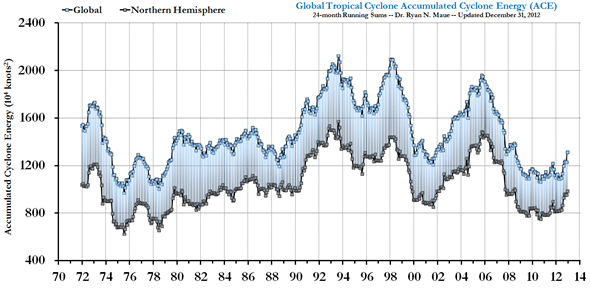
Tropical cyclone data provides low confidence that any reported long-term changes are robust, after accounting for past changes in observing capabilities. This is a revision from previous IPCC Assessments Reports…

Are the commentators going to come into line with the consensus of scientific opinion, or will it be the other way round? Maybe, like in the disaster movies, they will continue to insist to believe that the world only consists of USA.

For those who still think that extreme weather is still increasing, check out the Wattupwiththat “Extreme Weather” page. In particular take a look at Ryan Maue’s accumulated cyclone energy graph.