Australian Climate Science Opinion Survey – Confirming Prejudices?*

This survey I took in June is not the one used in the recent Lewandowsky et al paper. The one I took at “Watching the Deniers” is a development that 2010 survey. There are less questions on conspiracy theories (but “NASA faked the moon landing”, along with Diana, JFK and MLK assassinations are are still in) along with exactly the same questions on Free markets v Environmentalism. But the new survey has more on political beliefs (a good thing in my view) along with new sections on religious beliefs and GM foods. It seems to be directed beyond the free-marketeers, to other groups like the American Religious Right.

The Psychology Department of the University of Western Australia, under psychology research assistant Charles Hanich is conducting a short questionnaire on Science and Society.

UPDATE – The survey questions are available here.

SCIENCE AND SOCIETY

This study explores people’s beliefs about a wide range of topics, ranging from scientific propositions to claims made in the media and on the internet. In addition, the survey is interested in your attitudes towards your own life and issues confronting modern societies at the moment.

The questions all have five options – Strongly Disagree, Disagree, Neutral, Agree and Strongly Agree.

The questions are from both perspectives, so that people who are anything but totally neutral will have to agree with some questions and disagree with others.

The sections as follows (My headings)

  1. Climate Change – 5 questions
  2. Genetically Modified Foods – 5 questions
  3. Vaccines – Benefits and harms – 5 questions
  4. Position of the Conservative / Liberal perspective (US definitions) – 7 questions
  5. Select neutral (check of the software, or check for spam?) – 1 questions
  6. Free market system v social justice / environment / sustainability – 5 questions
  7. Conspiracy theories (political) – 6 questions
  8. Conspiracy theories (scientific) – 6 questions
  9. Personal Spirituality & Religion – 8 questions
  10. Evolution – views upon – 7 questions
  11. Corporations – 13 questions
  12. Personal emotional outlook – 6 questions

That is 74 questions in total. Like a lot of surveys, it understates the questions (“about 40”) and the time taken.

Climate Change Questions

  1. I believe that the climate is always changing and what we are currently observing is just natural fluctuation.
  2. I believe that most of the warming over the last 50 years is due to the increase in greenhouse gas concentrations.
  3. I believe that the burning of fossil fuels over the last 50 years has caused serious damage to the planet’s climate.
  4. Human CO2 emissions cause climate change.
  5. Humans are too insignificant to have an appreciable impact on global temperature.

There is a complete absence of questions about future projections of warming; whether that warming is catastrophic or benign; of the strength of the science or the uncertainties; our trust in what scientists are telling us; nor of the ability of policy to do anything successfully combat it. These are the questions that many sceptics, including myself, are grappling with.

Genetically Modified Foods
Questions

  1. I believe that genetic modification is an important and viable contribution to help feed the world’s rapidly growing population.
  2. I believe genetically engineered foods have already damaged the environment.
  3. The consequences of genetic modification have been tested exhaustively in the lab, and only foods that have been found safe will be made available to the public.
  4. I believe that because there are so many unknowns, that it is dangerous to manipulate the natural genetic material of foods.
  5. Genetic modification of foods is a safe and reliable technology.

In contrast these are questions do look at the benefits and costs of the science; the current impacts and future impacts; along with the strength of the science and the uncertainties.

NB the vaccines section follows more on the model of GM foods section rather than climate change.

The political spectrum questions I will leave for others to comment upon. It seems to be written by an American-influenced “liberal” who lacks knowledge of the full spectrum of political thought.

Free Markets v social justice / environment / sustainability

  1. An economic system based on free markets unrestrained by government interference automatically works best to meet human needs.
  2. The free market system may be efficient for resource allocation but it is limited in its capacity to promote social justice.
  3. The preservation of the free market system is more important than localized environmental concerns.
  4. Free and unregulated markets pose important threats to sustainable development.
  5. The free market system is likely to promote unsustainable consumption.

It is based on a notion of free-market anarchy against on the beneficial utopian society. No mention of awkward facts, like the worst environmental disasters and social injustices in the last century occurred in authoritarian regimes of left and right.

Conspiracy theories (political)

  1. A powerful and secretive group known as the New World Order is planning to eventually rule the world through an autonomous world government which would replace sovereign governments.
  2. The assassination of Martin Luther King, Jr. was the result of an organized conspiracy by U.S. government agencies such as the CIA and FBI.
  3. The Apollo moon landings never happened and were staged in a Hollywood film studio.
  4. The assassination of John F. Kennedy was not committed by the lone gunman Lee Harvey Oswald but was rather a detailed organized conspiracy to kill the President.
  5. The U.S. government allowed the 9-11 attacks to take place so that it would have an excuse to achieve foreign (e.g., wars in Afghanistan and Iraq) and domestic (e.g., attacks on civil liberties) goals that had been determined prior to the attacks.
  6. Princess Diana’s death was not an accident but rather an organised assassination by members of the British royal family who disliked her.

Basically, if you read the communiques and the proclamations coming out of annual meeting like Copenhagen, Cancun and Durban that say we must have a strong global organization to impose climate change, you should consider yourself as much a crank or nutter as those who think George Bush was capable of the phenomenally detailed planning required to stage the 9-11 attacks (but totally failed to successfully bring peace through conquest in Iraq or Afghanistan).

Conspiracy theories (Scientific)

  1. The claim that the climate is changing due to emissions from fossil fuels is a hoax perpetrated by corrupt scientists who wish to spend more taxpayer money on climate research.
  2. U.S. agencies intentionally created the AIDS epidemic and administered it to Black and gay men in the 1970s.
  3. The alleged link between second-hand tobacco smoke and ill health is based on bogus science and is an attempt by a corrupt cartel of medical researchers to replace rational science with dogma.
  4. The HIV virus causes AIDS.
  5. Smoking causes lung cancer.
  6. Lead in drinking water poses a serious long-term health risk.

The questions on climate and second-hand tobacco smoke lump two concepts together; a lot of money wasted for very little output along with the alleged motives of those practicing their research. In between is a particularly distasteful conspiracy theory, the very idea of which would be repellent to most people. The other three questions are simple statements of well-established science. There is no loading or controversy.

Religion and Evolution.

  1. God is important in my life
  2. I believe there is a life after death
  3. I get comfort or strength from religion
  4. There is no proof of God: if there is a God, he would have shown himself by now
  5. I think of myself as a religious person
  6. I have made a personal commitment to live my life for God
  7. I have had an experience of spiritual worship that was very moving and powerful
  8. I have experienced a definite answer to prayer or specific guidance from God
  9. Modern humans are the product of evolutionary processes that have occurred over millions of years
  10. The theory of evolution is based on speculation and not valid scientific observation and testing
  11. Most scientists accept evolutionary theory to be a scientifically valid theory
  12. There is a significant body of data that supports evolutionary theory
  13. Humans exist today in essentially the same form in which they always have
  14. Evolution is a scientifically valid theory
  15. Current evolutionary theory is the result of sound scientific research and methodology

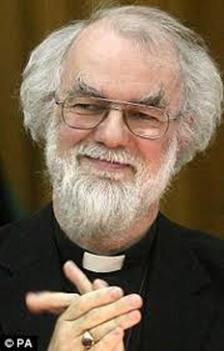
This is meant to distinguish between the US bible-belt evangelical Christians and the atheistic scientific community. It does so in a non-partisan way, so that Muslims could answer as well. However, it does not take into account the more nuanced, earnest, balanced and thoughtful approaches to the interactions of hard science and the timeless spiritual truths, as typified, is not caricatured, by Dr Rowan Williams, The Archbishop of Canterbury.
Corporations

  1. Corporations are not respectful of laws
  2. Corporations do not accept accountability for their actions
  3. People who run corporations will lie if doing so will increase company profits
  4. Corporations do not care about acting ethically
  5. Corporations will break laws if they can make more money from it
  6. Corporations put their own interests above the public’s interests
  7. Corporations are driven by greed
  8. Corporations care only about money
  9. Corporations want power at any cost
  10. Corporations take a lot more than they give
  11. Corporations intentionally deceive the public
  12. Corporations do not consider the needs of their employees when making business decisions
  13. Corporations exploit their workers

Any notion of balance goes completely out of the window. It is by far the largest section in a questionnaire on “Science and Society”. There is no switching between good points of corporations – such as technological breakthroughs, or much of our phenomenal prosperity. That includes the “Eco” technologies and the must-have gadgets from a fruity American 70s start-up. It is almost as if they want the more moderate participants to give up in disgust. Do avoid permanent psychological damage, they questionnaire end with a few personal questions about things in life you are thankful for, and people that you are grateful to.

The missing sections

No not the political spectrum one. The missing questions that a more balanced questionnaire might ask.

  1. General trust in climate science.
  2. Trust in carefully presented evidence, with questions respectively answered, as against the dogma of “scientists agree”.
  3. Questions for the Australian people, of whether carbon tax policies are worthwhile
  4. Questions on trust in government; the motives of politicians; the ability to deliver on promises. In relation to both Western democracies and tyrannies past and present.
  5. The importance of tackling climate change relative to other issues like unemployment and prospective financial meltdown in parts of Europe.

Conclusion

When devising a questionnaire, one must always try to eliminate bias, and avoid emotionally loaded the questions that will prejudice the answers. Neither should it contain multiple issues in a question. This survey does just the opposite. It is started off being deliberately designed to elicit certain polarized responses, ending up showing the deeply prejudiced and politically extreme position of the author.

*Please note. I am not aware of any copyright restrictions on reposting the questions. I accessed this from “Watching the Deniers” website, where there was no mention of copyright material. Neither was there any mention of copyright on the introductory front page. The doing a search I only came across a link to a 2010 survey. Neither could I find a link within The University of Western Australia Website, though it is on their servers.
Mid-Pacific Coral temperature proxies from Gergis et al. 2012

How odd is the Palmyra Atoll Coral Proxy?

In the last post I noted that there was something odd about the Palmyra proxy used in the Gergis paper, particularly in the late 20th century. This is at 5°52′ N, 162°06′ W.

There are four other coral proxies in the Mid-Pacific area. There are two proxy studies from
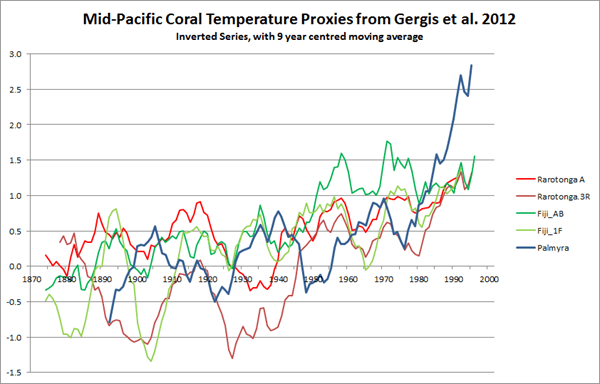
Rarotonga in the Cook Islands at 21° 14′ 0″ S, 159° 47′ 0″ W and two from the Fiji. For all five proxies I calculated a nine year centred moving average.


Palmyra shows a late 20th century warming trend more than twice that of the other series. Unless there is a locally recorded temperature anomaly on the atoll, then this is clearly wrong. If there is a local temperature spike, then it one should question why it is included in a reconstruction for which it is over 2000km outside the boundary. Either way it should be deleted from the study.

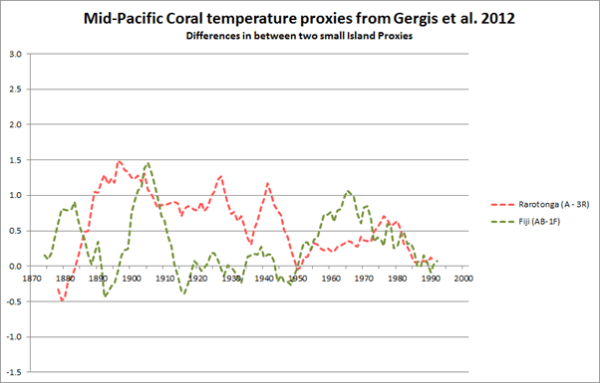
So how reliable are coral proxies. Here we have two pairs. If they are a good proxy for temperature, then they should be a good proxy for each other. On Fiji, they studies be less than 150km apart and on Rarotonga less than 10km apart, meaning they should be near identical. So I have plotted the differences between the moving averages.


It is not a statistically sound method, but indicative of the real issues with the proxy data sets. It also seems that the further back, the greater the consistency. The Palmyra study has four sections, the oldest of which starts in the 12th Century. Although Gergis claims to have done a series of tests for robustness, there is no correlation test over the known temperature record. Given that a central conclusion is:-

The average reconstructed temperature anomaly in Australasia during A.D. 1238-1267, the warmest 30-year pre-instrumental period, is 0.09°C (±0.19°C) below 1961-1990 levels.

Given that there is some question of the selection of the ice core studies at Vostok in preference for the closer and more robust studies at Ice Dome, then central conclusion of the study is not credible on such a small number of proxies.

Palmyra Atoll Coral Proxy in Gergis et al 2012

There is a lot of discussion on Bishop Hill (here and here) and Climate Audit of a new paper in Journal of Climate “Evidence of unusual late 20th century warming from an Australasian temperature reconstruction spanning the last millennium“, with lead author, Dr Joëlle Gergis. The reconstruction was based upon 27 climate proxies, one of which was a coral proxy from Palmyra Atoll.

There are two issues with this study.

Location

The study is a “temperature reconstruction for the combined land and oceanic region of Australasia (0°S-50°S, 110°E-180°E)“. The study lists Palmyra Atoll as being at 6° S, 162° E, so within the study area. Wikipedia has the location at 5°52′ N, 162°06′ W, or over 2100Km (1300 miles) outside the study area. On a similar basis, Rarotunga in the Cook Islands (for which there are two separate coral proxy studies), is listed as being at 21° S, 160° E. Again well within the study area. Wikipedia has the location at 21° 14′ 0″ S, 159° 47′ 0″ W, or about 2000Km (1250 miles) outside the study area. The error has occurred due to a table with columns headed “Lon (°E)”, and “Lat (°S). Along with the two ice core studies from Vostok Station, Antarctica (Over 3100km, 1900 miles south of 50° S) there are 5 of the 27 proxies that are significantly outside the region.

Temperature Reconstruction

Palmyra Atoll reconstruction is one of just three reconstructions that has any data before 1430. From the abstract, a conclusion was

The average reconstructed temperature anomaly in Australasia during A.D. 1238-1267, the warmest 30-year pre-instrumental period, is 0.09°C (±0.19°C) below 1961-1990 levels.

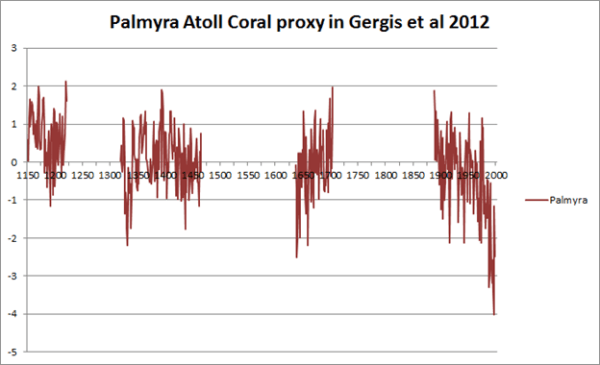
From the proxy matrix I have plotted the data.


This indicates a massive change in late twentieth century temperatures, with 1996 being the most extreme on record.

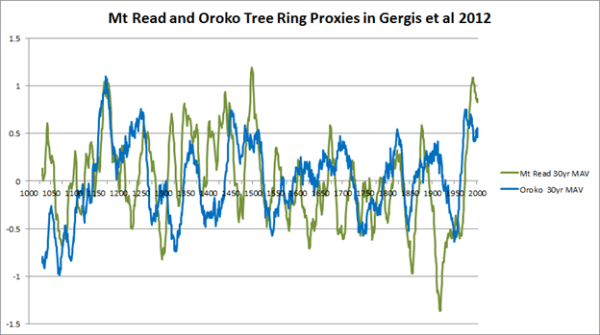
The other two data sets with pre-1430 data are tree ring proxies from Mount Read, Tasmania and Oroko, New Zealand. These I have plotted with a 30 year moving average, with the data point at the last year.


There is something not right with the Palmyra Atoll proxy. The late 20th century trend is far too extreme. In the next posting I will compare to some other coral data sets.

George Monbiot’s narrow definition of “charlatan”

Bishop Hill quotes George Monbiot

I define a charlatan as someone who won’t show you his records. This looks to me like a good [example]: http://t.co/5hDF57sI

Personally, I believe that for word definitions one should use a consensus of the leading experts in the field. My Shorter OED has the following definition that is more apt.

An empiric who pretends to wonderful knowledge or secrets.

Like John Cook’s definition of “skeptic“, Monbiot’s definition is narrower and partisan. Monbiot was referring to maverick weather forecaster Piers Corbyn. If someone has a “black box” that performs well under independent scrutiny, then they are charlatan under Monbiot’s definition, but not the OED’s. This could include the following.

  • A software manufacturer who does not reveal their computer code.
  • A pharmaceutical company that keeps secret the formulation of their wonder drug.
  • A soft drink manufacturer, who keeps their formulation secret. For instance Irn-Bru®.

The problem is that these examples have a common feature (that Piers Corbyn would claim to share to some extent). They have predictive effects that are replicated time and time again. A soft drink might just be the taste. Climate science cannot very well replicate the past, and predictions from climate models have failed to come about, even given their huge range of possible scenarios. This is an important point for any independent evaluation. The availability of the data or records matter not one iota. It is what these black boxes say about the real world that matters. I would claim that as empirical climate science becomes more sophisticated, no one person will be able to replicate a climate model. Publishing all the data and code, as Steve McIntyre would like, will make as much difference as publishing all the data and components of a mobile phone. Nobody will be able to replicate it. But it is possible to judge a scientific paper on what it says about the real world, either through predictions or independent statistical measures of data analysis.

Forcings – Hansen et al 2000 v UNIPCC 2007

Two months ago I did an analysis of aerosols in the UNIPCC AR4 report, observing that

  1. That the IPCC can’t add up.
  2. The figures appear contrived to show that only CO2 was the problem.

Anthony Watts has a posting today “Shocker: The Hansen/GISS team paper that says: “we argue that rapid warming in recent decades has been driven mainly by non-CO2 greenhouse gases“. This is based on the James Hansen (and others) paper analysing natural forcings, with the following graphic.


Hansen et al Figure 1: Estimated climate forcings between 1850 and 2000.

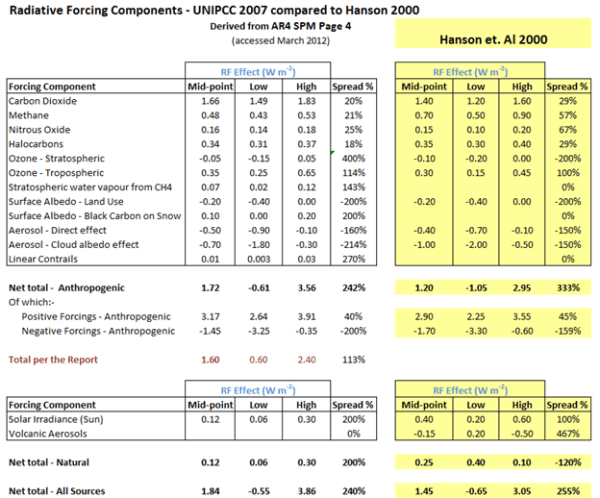
I thought that I would do a quick the comparison between what the IPCC were saying in 2007, with what Hansen et al. were saying in 2000.

According to the UNIPCC

  1. Hansen underestimated CO2 component.
  2. Hansen overestimated the CH4 component.
  3. Hansen overestimated the impact of the sun.

However, Hanson could counter that the UNIPCC have completely forgotten about the impact of volcanoes.

It could be completely coincidental, that further analysis by climate scientists gives a greater role to CO2, and therefore even stronger justification for constraining CO2 emissions. However, although they became more certain on positive forcings, they are less certain than Hansen on aerosols. It gives even greater credence to the cynical view that the climate science community are exaggerating the influence of anthropogenic forcings on climate. Given the billions of dollars annually being poured into research one could reasonably expect a reduction in the uncertainties over time.

Big Oil Funding of Climate Denial – An Examination of the Thesis

It is a common them by those who most dogmatically support the climate change agenda that the opposition are funded by big oil and similarly evil companies. There are potentially a number of angles to this viewpoint.

  1. If money does influence outcomes then we should see that where money on one side is hundreds of times greater than a ragbag of critics, then the critics will be drowned out. This is clearly not the case.
  2. When political parties complain of a money bias, this often goes hand-in-hand of complaints of media bias. But in the global warming sceptics have the most grounds for complaint on the media front. For instance the policies of the BBC and Guardian Newspaper.
  3. Maybe then the sceptics are winning, despite the lack of funds and despite the strong media bias against them, because they are using inappropriate language. My belief is that it is the mainstream who are guilty of intolerant and misleading language.
  4. Maybe the outside money has led to sceptics having undue influence on decision-making, subverting the democratic process. Like the WWF has achieved with the IPCC process?
  5. Maybe the sceptics are guilty of campaigns to misrepresent the status of the science. Like the eco activists “cajoling” scientific organisations to make political proclamations?
  6. Maybe it is the source of funding that creates the greatest bias. In the case of big oil money, if they decided to fund both ways, there are two ways to go. Either, the credibility of both sides is forever tainted, or, if the money was loaded massively one way, then on one side is tainted far more than the other.
  7. Maybe it is because big oil funds climate denial that we should be most concerned. The alternative explanation is that public knowledge of the funding will lead to attacks by environmental groups. To support of attacks by environmental groups (and hence viewing the secrecy of “denial” funding) require two moral points to be maintained. The first is that the views supported are evil. Second, that character assassination, or blockading of premises, or physical attacks on opponents are legitimate ways of opposing those you disagree with.
  8. Maybe, big oil could be viewed by some as being immoral or evil. Others might view with suspicion funding from anyone who makes their money in the gambling industry (especially if they pleaded guilty to money laundering in connection to those activities). They may also view with suspicion currency market speculators, especially one who made over $1bn at the expense of UK taxpayers.
  9. Maybe it is only recent big oil funding that has tainted the policy outcomes. The alleged bad reputation of the oil industry was largely down to one individual in creating a virtual US monopoly in oil production in the late nineteenth century. I do not see a similar smearing of the activities of the foundation created with the ultimate in big oil money.

In short I can see no valid reason to base rejection of critical viewpoints on climate change simply because of unsubstantiated allegations of big oil funding.

I offer an alternative view of those who make these allegations. The belief in “evil funding” stems from a belief they are guardians of some fundamental and irrefutable truths. Furthermore, these truths are concerning a future apocalypse. By implication, those who have an unwillingness to accept that truth is due to out-right lying, or having being deceived by some evil entities, or because they are not right in the head. Historically, those who have maintained to be Truth Guardians, have never substantiated their arguments or allowed for error, or allowed the slightest deviation. Instead they have sought to discourage or prevent people exploring alternatives, knowing deep down that the process of questioning will lead to the understanding that their beliefs are either extreme or in many respects wrong.

Mr P’nHead pulls a face

I purchased this papier-mâché sculpture from an exhibition at Didsbury Library, South Manchester, in about 1990. I have lost the article from the South Manchester Reporter, which the name of the artist. If I remember rightly he was then around 20. Most of the artist’s other exhibits were black ink and pencil cartoons such as of Charlie Chaplin, Elvis Presley and Groucho Marx.

Does anyone know who the artist might be?

My reason for purchasing was the uniqueness of the work, along with being unable to unambiguously discern the expression. What do you think?

Scottish Sceptic on summarizing the sceptic position

I came across the blog Scottish Sceptic at the weekend. At the site, the owner has been compiling a non-polemical summary of the mainstream sceptic view of the science. Unlike here, the statement studiously avoids discussion of policy or politics. I made the following comment in the hope of furthering discussion.

I have had a look through the above, and it appears a fair summary the sceptic position of the science. In general it shows how magnitude and likelihood go in opposite directions. The best corroborated science has trivial implications. The most alarming predictions are basically of the form “If A then maybe B. If B then possibly C. If C happens in a certain way then it could be D. D is an extremely alarming situation” This then gives the headline like

Leading scientists are concerned we are heading for D“.

Having read quite widely on sceptic ideas, on the subject of climate models, sceptics view them as “black boxes“. This would not be concerning if they followed the normal scientific procedure of rigorously evaluating the predictions with the actual data, and adjusting accordingly. Instead, it appears to be past data that gets adjusted to the models, along with some very fuzzy analysis.

Another point is that sceptics tend to see a scientific approach as questioning, identifying anomalies, and getting ever more precise answers. Mainstream climate science is nearer to a definition of “science is what scientists do”.

That leads to another point. Sceptics tend to demand higher levels of evidence. The mainstream seems to accept levels of evidence that a criminal court of law would reject. “Scientists believe/agree”, or “Climate Models predict” or comments a court would reject such views as either hearsay or unsubstantiated. So in the wider world sceptics are not the ones with the marginal position.

Dinosaur Flatulence Caused Pre-historic Warming?

A lighter note on the global warming issue is to be found today’s Telegraph. (also at BBC, Foxnews, inhabitat, The Scotsman) Seems that methane emissions may have been a bigger problem pre-history.

”A simple mathematical model suggests that the microbes living in sauropod dinosaurs may have produced enough methane to have an important effect on the Mesozoic climate,” said study leader Dr Dave Wilkinson, from Liverpool John Moores University.

It is speculative, but how far much warming was this? The article says

Scaling up, assuming a global vegetated area of 75 x 106km2 (equivalent to half the total land area), gives global methane production from sauropods of 520 Tg (520 million tonnes). This is comparable to the total modern-day methane emission. For comparison, total pre-industrial Holocene global methane emission was roughly 200 Tg per year, capable of sustaining an atmospheric methane mixing ratio of about 0.7 ppm, and the modern mixing ratio of about 1.8 ppm is supported by roughly 500–600 Tg of global emission.

The IPCC estimates that current methane levels produce (with feedbacks) about 0.4 degrees of warming. Using Idso 1998, this reduces to 0.05 degrees. Either way a quite trivial amount. What is noted is that the number of dinosaurs is huge, as the temperatures and CO2 levels were much higher than today. Without the icecaps there was more available land, and with more verdant vegetation (again both due to temperature and CO2) the animal mass supportable was much higher.

In other words, higher CO2 and temperatures are good for both flora and fauna.

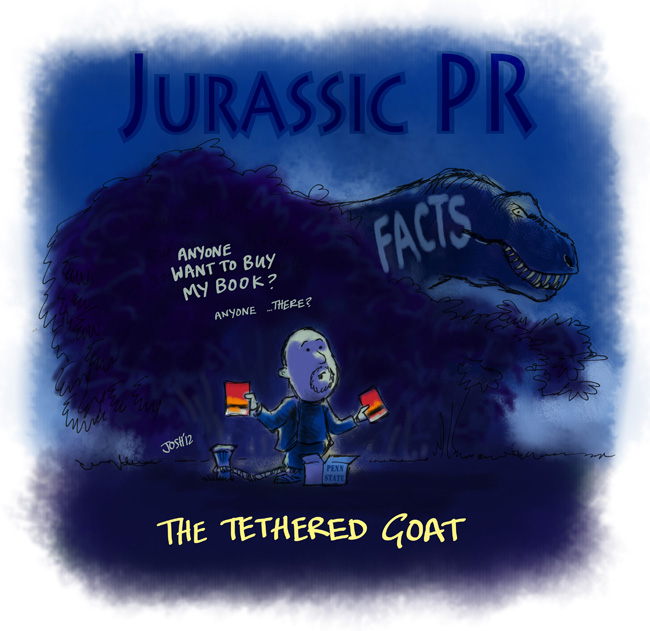
Maybe Josh can to an appropriate dinosaur cartoon – like the recent one below!

IPCC’s 1990 Temperature Projections – David Evans against Mike Buckley

The following comments by Mike Buckley (referenced here) are more revealing about the state of climate science than any errors on Evan’s part.


  1. Surface Temperatures v lower tropospheric temperatures.

    As a beancounter (accountant) I like to reconcile figures. That is to account for the discrepancies. Jo Nova, Anthony Watts and others have found numerous reasons for the discrepancies. The surface temperature records have many “adjustments” that brings reality into line with the models. Whatever excuses you can conjure up, as an accountant I would say that they fail to offer a “true and fair view”.

  2. Trend lines should not start at the origin.

    So you disagree with standard forecasting? That is you start with the current position.

  3. Trend lines should be curved.

    Agreed. This is for simplicity. See next point.

  4. Trend lines should be further apart.

    Are you saying that the climate models have a wider predictive band of 0.75 celsius over 25 years? If they were straight lines, over a century they cannot get within 3 degrees. If Dr Evans had not simplified, the range would have been much greater.

There is a way of more precisely comparing the models with the actuals. The critical variable is CO2 levels. Therefore we should re-run the models from 1990 with actual CO2 data. By then explaining the variances, we can better achieve better understanding and adjust the models for the future. But there is plenty of evidence that this needs to be done by people who are independent. It will not happen, as the actual rise in CO2 was similar to the highest projections of the time.

The philosopher of science Karl Popper is remembered for the falsification principle. A less stringent criteria is that progressive science confronts the anomalies and gets predictions ever closer to the data. Pseudo-science closes ranks, makes up excuses, and “adjusts” perceptions of reality to fit the theory. Progressive science is highly competitive and open, whilst pseudo-science becomes ever more dogmatic, intolerant and insular.