At THE CLIMATE SKEPTIC, today’s Climate News Round-Up states
“New Energy Secretary opposed Rosebank oil field in previous job” – Miatta Fahnbulleh, who previously led the New Economics Foundation, attacked new fossil fuel projects as “irresponsible and shortsighted” before taking charge of the nation’s energy policy, says GB News.
As the GB News article notes, New Energy Secretary Miatta Fahnbulleh was formerly head of the New Economics Foundation, which, amongst other things, opposed the still-to-be-approved Rosebank oil field. Whilst being called an eco-zealot for previous statements on Twitter, Ms Fahnbulleh now states she now thinks decisions about the North Sea need a more pragmatic approach.
However, opposition to Rosebank based on economic grounds demonstrates a lack of understanding of economics. Or at least economics post the marginalist revolution of the 1870s. To understand the marginal climate impact (and thus any economic impact), we need some figures.
In an environmental impact assessment, it was estimated that the oil from the Rosebank oil field could emit 250 million tonnes of CO2 over its lifetime. That is 0.25 GtCO2. What is the impact on global emissions?
2021 IPCC AR6 WG3 SPM tells us “Historical cumulative net CO2 emissions from 1850 to 2019 were 2400 ± 240 GtCO2” at the 68% confidence interval. The Rosebank emissions would, at most, increase cumulative emissions by 0.01%. Given that CO2 emissions are still around 43 GtCO2 a year, and have increased slightly since 2019, this is an exaggeration.
But how much would Rosebank affect global average temperatures? Figure SPM.2 from AR6 WG1 SPM gives an indication.
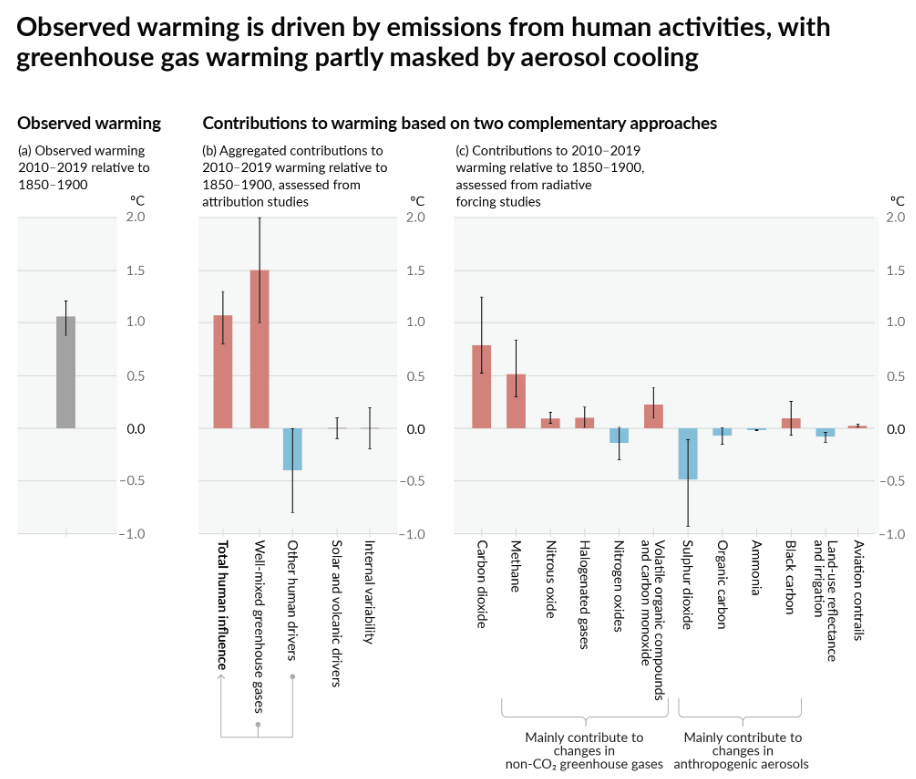
Those 2400 GTCO2 of CO2 emissions accounted for, at most, half of the 1oC of warming from 1850 to 2019, if the negative impact of aerosols (mostly from the burning of fossil fuels) is taken into account. The marginal economic “climate” benefit of stopping Rosebank is zero, unless you deal with numbers much less than 1% of any statistical significance levels. This is if one accepts a 68% confidence interval. Normal statistics uses a 95% confidence, or double the confidence interval.
On the other hand, the economic benefits of approving Rosebank are highly significant to the people of the Shetland Islands. More generally, UK production of oil and gas mostly benefits the UK economy. But the benefits of costly UK climate policies on climate are global.
Looking at climate policy costs alone, failing to allow new oil and gas production in the North Sea is an opportunity cost borne by the UK. This might be a net benefit to the rest of the world as the UK imports oil and gas that it could have produced. The marginal climate benefits of such policies are highly insignificant. The British share of such benefits is likely much less than 1% of this highly insignificant amount. When thinking about this last point, remember that CO2 is a well-mixed trace gas. Thus any harms of heightened CO2 levels will be global. By implication, any prevented climate harms by arresting the rise in CO2 levels through CO2 emissions reductions will be global.
A short further step is needed. Assume all countries adopt broadly similar emissions reduction policies. Then for any one country the costs of climate mitigation policies will always vastly exceed the climate benefits (prevented future costs) of that mitigation. Nearly all the climate benefits will be gotten for free from the policies of the rest of the world. There is the biggest economic free rider problem ever imagined.
This free rider problem for uniform global policies is just theoretical. When opportunity costs are taken into account, most countries face much larger mitigation costs than Nordhaus and others conceive. The opportunity costs for countries dependent on fossil fuel production (like Kuwait, Saudi Arabia or Russia) are much greater than for countries (like Italy or Spain) with very few resources. More widely accepted are the opportunity costs for developing countries. Constraining emissions growth, or even cutting emissions growth, would constrain economic growth. The opportunity costs over decades would be enormous. Yet without the whole world having similar policies, economically it does not make sense for any country to reduce its emissions.
Economic theory has yet to work through this logic. It means that even the most rigorous analysis of the economics of climate change (such as that of 2018 Nobel Laureate William Nordhaus) is rendered useless. Cutting emissions by the UK will always impose costs greatly in excess of any benefits to the people of the UK. Only by making the false assumption that the world is a unitary policy-making body with similar cost structures can a conclusion be drawn that the benefits of emissions cutting exceed those of the policy costs.


1 Comment