NOAA Greenland Ice Sheet Report Card 2012 – False Statement on Ice Mass Balance Change

There is an error with my interpretation of the graph. Please see comment

On 14th January 2013, NOAA produced a 2012 report on the Greenland Ice Sheet by Box et al.

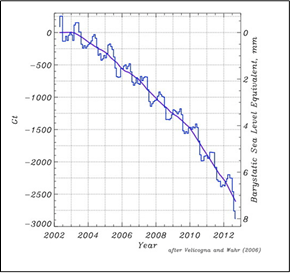
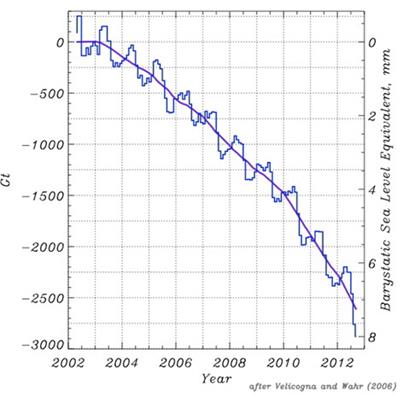
Under the section “Greenland Mass Changes from GRACE“, is contained the following graphic as Fig 5.19.


The Velicogna and Wahr 2006 citation should set alarm bells ringing for the following reasons.

  1. The paper only included observations to the end of April 2006. From 49 months of data the graph extrapolates a trend 74 months ahead.
  2. The title is “Acceleration of Greenland ice mass loss in spring 2004″. This should suggest that the authors found a discontinuity in the series bang slap in the middle of the data set. To quote the paper,

    A fit to the GRACE results for all Greenland before and after April 2004 yielded ice loss trends of 104 +/- 54 km3 yr-1 during April 2002–April 2004, and 342 +/- 66 km3 yr-1 during May 2004–April 2006.

    That is the author’s found two functions. There is no quadratic function with 49 months of data to extrapolate, but two linear functions. The latter has just 24 months of data.

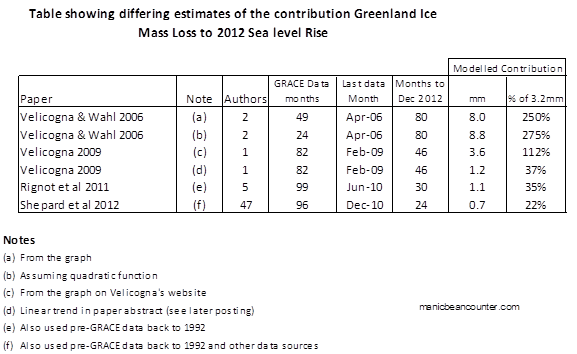
  3. The satellite is still operating, churning out data, and there are more recent scientific papers, with much better data. I have put some suggestions in a table below.
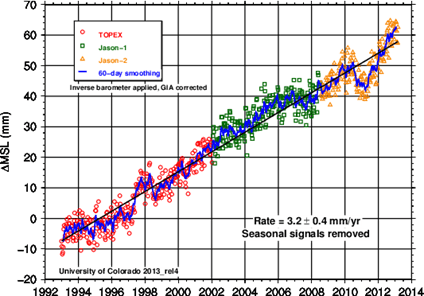
  4. Sea level rise trend has remained more or less linear at around 3.2mm per year over the last twenty years. So, if this graph is accurate, the contribution from Greenland ice melt has risen from 0% to 250% of the sea level rise in a decade. By implication, the contribution of all other factors (including Antarctica ice melt and cooling of the oceans) has slipped from 100% to -150% in the same period.


The Shepard paper has 47 authors, including Velicogna, Wahr, and 4 of the 5 contributors to Rignot 2011. Although only published weeks before the NOAA report card, John Wahr was an author on both.

Isabella Velicogna was co-author of both Rignot and Sheppard paper, but the Velicogna Research Group still posts up an updated graph from Velicogna 2009, in the full knowledge that that its 2012 predictions have been falsified by higher quality scientific papers that the professor has co-authored.

Finally, although the Shepard paper is likely to be the most accurate, total polar ice melt is modelled to have risen from 10% to 30% of sea level rise in 20 years. It would be an interesting exercise to try to reconcile the difference.

In summary, Fig 5.19 of the NOAA gives a modelled ice melt for Greenland Ice Sheet Report Card 2012 that is more than ten times the value of much more recent and higher quality data. Further, the expert on ice melt, John Wahr, was a co-author of the unpublished data, and therefore would have known that the graph did not fit experience. The other climate scientists should have enough knowledge of the rest of climatology to know that the graph was totally out of line with the consensus estimates of sea level rise.

Kevin Marshall

Rignot, E., I. Velicogna, M. R. van den Broeke, A. Monaghan, and J. Lenaerts (2011), Acceleration of the contribution of the Greenland and Antarctic ice sheets to sea level rise, Geophys. Res. Lett., 38,

Shepard et al. 2012. A Reconciled Estimate of Ice-Sheet Mass Balance, Science 338, 1183 (2012); DOI: 10.1126/science.1228102

Velicogna, I. (2009), Increasing rates of ice mass loss from the Greenland and Antarctic ice sheets revealed by GRACE, Geophys. Res. Lett., 36, L19503, doi:10.1029/2009GL040222

Velicogna, I. and J. Wahr. 2006. Acceleration of Greenland ice mass loss in spring 2004. Nature, 443(7109), 329-331. doi:10.1038/Nature05168.


Watermelon Energy Policy – Green Renewables backed by Red Diesel

My last past was on the Fulcrum Power application to build a 20MW diesel power station. I predict that this will be part of the next big scandal to hit so-called renewables sector.

Fulcrum Power are planning to become part of the National Grid’s STOR (Short Term Operating Reserve) scheme. The STOR End of Year Report 2011/12 summary is

In 2011/12 National Grid procured on average 3230 megawatts (MW) for the six seasons, at a cost of £70.4m in availability payments. This was made up on average of 2160 MW for the Committed service and 1071 MW for the Flexible service. The actual MW availability provided through STOR during the peak demand of each day between 1st April 2011 and 31st March 2012, averaged out at 2172 MW. This represents an increase of 6.2% over the average MW availability for peak of each day during the 2010/11 term.

There were 421 successful STOR tenders in 2011/12, of which 191 units were Committed service providers and 230 units were Flexible service providers.

The average availability price for both Committed and Flexible STOR was £9.13/MW/h and the average utilisation price was £232.37/MWh. This represents an increase of 0.6% on 2010/11 average availability prices and a decrease of 7.7% on 2010/11 average utilisation prices.

National Grid utilised a total of 173.3 gigawatt hours (GWh) of STOR, yielding utilisation payments of £32.3m; and thus marks increases of 73% and 66%, respectively, when compared with the total STOR utilisation for 2010/11 and its cost.

The total expenditure for STOR during the 2011/12 term was £102.7m.

This 20MW scheme would add less than 1% to the total STOR capacity, which is currently costing just over £100m per year. Neither is this the

The STOR scheme is used at the moment in case of the emergency shut-down of a major power station. In the future I predict it is likely to be to cover two sources.

  • With increasing reliance on wind turbines, for in the sub-zero winter temperatures, caused by windless high pressure systems.
  • With the shutting down of the older generations of coal and nuclear capacity without new base-load power coming along, to provide peak time capacity on windless days.

The BBC report on the Fulcrum Power planning application stated

Two diesel power stations planned in Plymouth will compensate for fluctuations in supplies from green energy, say developers.

Green Frog Power got planning permission last year and Fulcrum Power has made an application for a similar power station.

Green Frog Power recently received financing of £75m to build 200MW of standby power. They must have these mini stations all over the place. They are not alone. The “STOR Market Information for TR19” report notes that in Year 7 showed that whilst the accepted STOR was around 3000MW, the rejected applications were about 6300MW. There is a huge amount of generating capacity out there of 3MW or more. However, much of this will be old diesel engines, with efficiencies far less than the coal-fired or nuclear power stations than are being shut down. The cost per kwh would also be about two or three times those of the coal-fired power stations, if used as base-load. But used as peak demand carrying load on windless days, they could be five to ten times the cost. The gas-fired power stations currently used for peak times could be switched to base load. All the extra diesel being used could hit car drivers in the wallets as well in the winter.

So the good point here is that the lights are unlikely to go out. We have plenty of temporary capacity. The bad news is that the dithering over shale gas and the banning of new coal-fired power stations could push energy costs through the roof and might even increase CO2 emissions.

James Delingpole likes to call the green movement “watermelons“. That is, they are politically green on the outside, but socialist red on the inside. In Britain, diesel not used for transport does not carry excise duties. It carries a red dye, to easily identify its illicit use in road vehicles. British energy policy is likely to become a watermelon policy – green renewables on the surface, but red diesel at the safety core.

Green Frog Power

STOR scheme description

STOR scheme documents

STOR End of Year Report 2011/12

STOR Market Information for TR19

BBC on the Fulcrum Power planning application


Financial costs of Fulcrum Power’s Green Diesel Plant

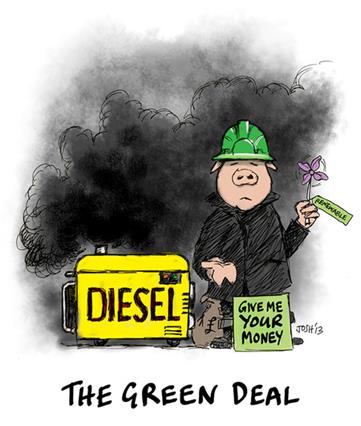
The BBC reports on a planning application submitted by Fulcrum Power to Plymouth Council to build a 20 MW diesel engine power station. This plant will operate backup for when renewables energy fails – mostly in the form of the wind failing to blow in the cold weather. Bishop Hill is, rightly, quite scathing because the diesel power is required to backup so-called green solutions. Josh weighs in with a cartoon


My posting is on the scandalous cost of this backup power station.

(Links are at the foot of the posting)

The BBC says

The application by Fulcrum Power is for a 20 megawatt (MW) Stor (Short Term Operating Reserve) power station on the former Toshiba plant at Ernesettle Lane, which company bosses said would cost “several million pounds”.

Its 52 generators will consume more than 1.1m litres of diesel a year, or about one tanker a week.

A litre of diesel with generate around 4kwh hours of electricity. (The normal measure is grams/kwh. A small diesel generator uses about 200 g/kwh and the RD of diesel is about 0.83 from memory). A 20 MW power station will therefore consume about 5,000 litres an hour of fuel. 1.1m litres will be consumed in just 220 hours, which means the plant is expected to operate for the equivalent of full power for just 2.5% of the hours in a year.

These companies will be paid a backup fee by the National Grid and then a rate per kwh generated. For this calculation I will look at just the cost per kwh. The fuel cost is easy. Diesel currently costs about £0.60 a litre, so that is £0.15 per kwh or 50% more than what I paid on my last electricity bill.

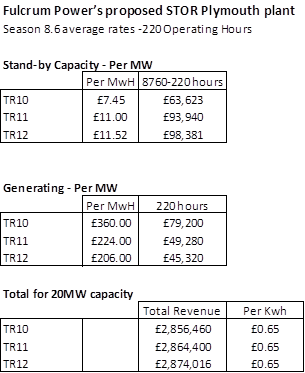
I tried to do some quick estimates and believe that the operating costs and cost of capital on “several million pounds” would be as much again. Being a little more curious, I did a search and found the “National Grid STOR Market Information Report No.19” on the National Grid’s Website. There is a bidding process every couple of months for Short Term Operating Reserve (STOR) capacity. Within the report is published the average winning and rejected bid rates. The most recent was season 8.6. As expected the bid is in two parts. First, a standby rate and second a (much higher) generating rate. There are bands, with the lower the standby rate, the higher the generating rate. I plugged the values into Excel and found that on all three rates Fulcrum Power could receive the equivalent of £0.65 Kwh. Gross Revenue would be around £2.86m. Deducting the cost of 1.1m litres for diesel leaves a contribution of £2.2m. There is probably a few hundred thousand of fixed costs, but payback on “several million pounds” looks to be pretty quick.


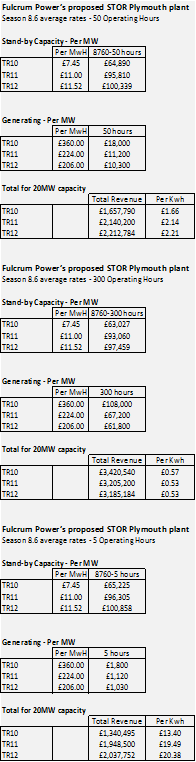
I have also done a check on other operating hours, shown below. The average in 2011-12 for STOR capacity was nearer 50 hours. At this level the revenue is much lower and more varied – from £1.66m to £2.12m. Dropping to just 5 hours per year still gives £1.34m to £2.04m.

Kevin Marshall

BBC Report

Fulcrum Planning Application

Bishop Hill blog report

Josh Cartoon

Cartoons by Josh

Fulcrum Power

National Grid STOR

National Grid STOR Market Information Report No.19


Ed Davey’s anti-science, anti-British and anti-Liberal attack on Climate Sceptics

Ed Davey, Secretary of State for Climate and Energy has, according to the Telegraph recently said

“Of course there will always be uncertainties within climate science and the need for research to continue.

I agree that there are uncertainties with climate science. But if you only allow believers in that “science” to contribute, without any training in decision-making under conditions of uncertainty, then the conclusions drawn out of that research will be wrong.

“But some sections of the press are giving an uncritical campaigning platform to individuals and lobby groups,”

Such as the Guardian, the BBC, or central government departments? It can work both ways.

“This is not the serious science of challenging, checking and probing.”

Are you speaking of sceptics or of climatology? You must first establish that climatology is not just a science, but is a science of the highest standards.

“This is destructive and loudly clamouring scepticism born of vested interest, nimbyism, publicity seeking contraversialism or sheer blinkered, dogmatic, political bloody-mindedness.”

Matthew 7:3-5 says

Why do you stare at the splinter in your neighbour’s eye, but ignore the plank in your own? How can you say to your neighbour “Here – let me get the splinter out of your eye,” when you’ve got the plank in your own? You’re just play-acting! First take the plank out of your own eye, then you’ll see clearly to take the splinter out of your neighbour’s eye.”

These two thousand year old words, translated by Tom Wright (Britain’s leading New Testament Scholar and former Bishop of Durham), show the issue of climatology. Professor Stephan Lewandowsky or Bob Ward, or desmogblog are some of the “planks” that deliberately blind and prejudice people from examining the evidence, moral and political arguments for themselves. Putting in a milder fashion, you cannot say that people are wrong, or have a massively inferior argument, if you cannot first demonstrate that you are on the side of truth, or encourage others compare and contrast your arguments with the opponents. As I posted last week, there is a strong lack of a positive case for the science. As I posted last week, this should be a combination of trumpeting the short-term predictive successes, showing that climate science build on the traditions of the greatest scientists and philosophies of science and also of the moral case covered below.

“This tendency will seize upon the normal expression of scientific uncertainty and portray it as proof that all climate change policy is hopelessly misguided.”

Rubbish. Criticism of policy is often for separate reasons to scientific uncertainty. The argument is that the costs of policy are far greater than then benefits. Some of the policy might be totally ineffective, or in trying to reduce CO2 emissions may make people less capable of dealing with the impacts, through making them poorer.

He added: “By selectively misreading the evidence, they seek to suggest that climate change has stopped so we can all relax and burn all the dirty fuel we want without a care.”

Sceptics say that climatologists selectively read the evidence. Many would say that increased CO2 provides net benefits, and I do not come across any blog that we should create general pollution without a care. Many of the leading sceptic blogs (WUWT, BishopHill, Jo Nova) accept that increased greenhouse gases will lead to some level of warming, but not a significant one. As put by Warren Meyer, most sceptics deny the catastrophe, not the basic science.

“Those who argue against all the actions we are taking to reduce emissions, without any serious and viable alternative, are asking us to take a massive gamble with the planet our children will inherit, in the face of all the evidence, against overwhelming odds.”

I believe that morally politicians should act like medical professionals. They should have a duty of care towards the patient. That duty should be based on the reasonable expectation that treatment will leave the patient better off than not being treated at all. If anyone claims that climatology and public-policy making have the same level of knowledge of diagnosis and treatment as medical professionals and pharmacy on such ailments as common cancers or arthritis, then they are wrong. I would say that climate “ethics” needs to catch up with medical ethics as well.

Finally, let me point to four areas where Ed Davey is severely out of line.

First, my late father voted for the Liberal Party for over 50 years at every election – bar at one local election where no Liberal was standing. Then he voted for the underdog Conservative candidate. He believed in the consensus through seeking the middle ground, a thoroughly British trait. This middle ground was the opposite of the extremism of climatology, which is increasingly about demeaning the opposition and denying them a platform to speak.

Second, a virtue of English Common Law is that of letting the accused have the same rights of presentation, and to have the same rules of evidence as for the prosecution. This is not in the belief that the most notorious criminals can get off scot free. It is because the most guilty who proclaim their innocence will most convince an independent jury of their guilt as their lies and ridiculous stories unravel. On the other side, if the prosecution, convinced of the guilt of the accused perverts or supresses the evidence, the later unravelling of the case will undermine the rule of law. It did with the Guildford Four and the Birmingham Six, men falsely sentenced for heinous crimes that they did not commit. Another example is that I strongly believe that those who do not accept that around six million Jews were massacred in the Nazi genocide should not be silenced. Rather, comparing their evidence will the overwhelming evidence of the historical truth will demonstrated that there is no debate, and those deniers are have an inability to assess the evidence. Silencing such views will lead to false conspiracy theories that there is something to hide.

Third, is the British sense of fair play. The very British idea of having a level playing field is not unconnected to the fact that most major sports are British inventions, or have been strongly influenced by British rule-making. Winning is not at any cost is not the point. It is playing the game to the best of one’s ability. There is a lesson in life as well. Somebody might be far superior in a sport, or in science, or in any intellectual field, than anyone else alive. But it is only by going head-to-head with others that everyone will be convinced. But in losing in sport, we go back and try harder. If we are beaten in science, we are forced to re-examine our conclusions, and may improve. Finding out where we went wrong, or how to improve from failures is a general lesson in life. Within wider society it leads to improvement.

Fourth is something very anti-British. The most evil powers, whether governments, religious cults or tribal gangs, are those who assert their power by belittling and silencing others. Ed Davey and climatologists are not in their league by any means. But they fall into a false sense of superiority by demeaning others. It is a very human trait to practice this, but has mostly held back humanity.

The previous Secretary of State, Chris Huhne, earlier this year convicted of perverting the course of justice, was similarly dogmatic. Why there should be two ministers so at odds with the older philosophy of the moderate Liberal Party traditions is the subject of the next post.
Lamar Smith and Implementing effective policy on climate change

There has been considerable ire directed at Texan Congressman Lamar Smith for his Washington Post Op-Ed entitled “Overheated rhetoric on climate change doesn’t make for good policies


Lamar begins

Climate change is an issue that needs to be discussed thoughtfully and objectively. Unfortunately, claims that distort the facts hinder the legitimate evaluation of policy options

Lamar concludes

Instead of pursuing heavy-handed regulations that imperil U.S. jobs and send jobs (and their emissions) overseas, we should take a step back from the unfounded claims of impending catastrophe and think critically about the challenge before us. Designing an appropriate public policy response to this challenge will require that we fully assess the facts and the uncertainties surrounding this issue, and that we set aside the hyped rhetoric.

I could not agree more. Judith Curry shows that the so-called “scientific” criticism is less balanced than the politician’s initial comments.

To think critically and objectively about any complex problem, it needs to be broken down into sub-sections with relevant areas of expertise. This is no more important in climate change policy, which science demands belief and people get lost in irrelevant detail. A starting point is to divide the issue into three parts, with the relevant experts in brackets.

1. Whether there is a potential problem. (Scientists)

2. Whether that potential problem is non-trivial. (Economists interpreting the scientists work)

3. Whether there is the ability to do something positive about that problem. (Economists and public policy-makers to formulate any policy. Economist/auditors, with some input from scientists, to interpret the results.)

1. Whether there is a potential problem.

The potential problem most would accept. Increase the level of greenhouse gases and average temperatures goes increase. It actually folds into the second.

2. Whether that potential problem is non-trivial.

But the second is far more important. The starting point to see if the size of the problem, it to break any potential impacts down into the components of magnitude, likelihood, time for changes to occur and the weighting that can be given to the scientific evidence. This is discussed here. Like in many other areas, the weighting we give to expert opinion should be based on a track record. Climate science is still very much in its infancy and many of the projected signposts were either wrong (worsening storms, accelerating sea level rises) or much too extreme (temperature rises). In fact any alleged successes are either through luck or through the initial prediction being so vague that it could hardly fail to be correct. There should also be a recognition concerning any potential benefits. For instance, Scotland would benefit from being a tad warmer, and increased CO2 may help plant growth. There is also a question of the quality of the climate model projections. There seems little or attempt at quality improvement through learning from past mistakes and building on successes. Further I see plenty of claims of being on the side of peer-reviewed science, and on consensus, whilst have a huge public-relations effort but little about building on the traditions of the greatest scientists, or learning from the philosophers of science. “Climate Science” seems somewhat out of that mainstream.

3. Whether there is the ability to do something positive about that problem.

The third is where the policy-makers step in. Are they able to deliver a policy that will tackle the issues at a lower costs than the benefits? To give a medical analogy, have they sufficient qualifications and the moral duty of care, that where they inflict painful treatments, the patient (the human race and/or Mother Gaia) is better off than if they had done nothing. Given the massive policy failures so far, the answer seems highly negative. Given that much of the effort is going into shutting down and policy discussion by believers in the science and in the policy, failures seem set to continue through deliberate negligence of this issue.

To take the medical analogy further, treatment is tempered by the uniqueness of the ailment and the track record in treating that ailment. For instance hip replacements have been performed for many years and are quite frequent, so the risks and pain of treatment, along with the mortality rates are known. So an otherwise reasonably healthy person of forty whose hip joints need replacing to enable them to walk would be recommended for the operation. A frail ninety year old would not. But we have never had human-caused climate change before. Indeed, there is a huge dispute about how serious the symptoms will actually be. They have not come to fruition just yet. Furthermore the “treatment” has not been properly tested. Neither have those devising the treatment any sort of qualifications or track record in devising similar treatments. Why do I know this? Because there has never been a global initiative to use economic tools to drive through a solution to a problem whose outward characteristics (though not necessarily the causes) are a naturally-occurring phenomena, neither are involved people who have experience is getting consensus on global issues, such as nuclear non-proliferation.

Note on the Moral View

I have a strong moral view that politicians should act to make the world a better place, as the underlying desired outcome of public service. It can be on the world stage or in a local community. Climate policy means imposing costs now to avoid much higher costs later. It might be a simplistic and naïve view, but the opposite – that politicians work to make a net negative impact, or do not care what effect they have, or simply work to serve some small factional interest (and to hell with everybody else) – are views that are at least distasteful and at worst downright evil. Like a medical professional, they have a duty of care to make sure there is a reasonable expectation that net positive outcomes will happen, and to monitor that progress.

Kevin Marshall

Abused Women and Claims of Climate Consensus

Steven Goddard, in explaining why women consistently show stronger support for President Obama than men, comments.

Many people with feminine personalities fall into co-dependency, and are satisfied by ridiculous lies in a thoroughly abusive relationship.

That is a bit strong. In modern terminology, women tend to network more than men. In older terminology, they like to gossip and form opinions on the basis on their social interactions. Such characteristics help hold social units together, but do make women more prone to being won over by emotive arguments that males.

But women in abusive relationships have very low self-esteem being continually told that they are inferior. The men in their lives tell them that their opinion does not count. Any signs of questioning are rebutted verbally, emotionally and physically. The greatest abusers tend to be the biggest liars and the most emotionally inadequate. In more traditional, male-dominated communities such abusers claim legitimacy from that society for practices (such as adultery) that it would not condone. Unfortunately the traditional male-dominated churches have used alleged biblical authority to support the male-abusers in marriage, and even to excuse or down-play paedophilia.

In terms of climatology, claims of superiority of climate scientists have some parallels with these abusing and hate-filled men. Supporters of climate consensus claim that deniers are psychologically inferior and totally incapable of understanding the world around them. They stamp down on any dissent with spurious reasons, such as alleged funding by big oil, yet do not admit to their own funding, nor (and far more dangerously) their own very dogmatic belief systems. They claim the authority of science, but never define what science is, nor how their dogma fits into the best traditions of science.

There are increasing exceptions to the feminine submissiveness. The late Margaret Thatcher is the most extreme. She had a strong sense of values and phenomenal determination to pursue those values. But Thatcher also considered and vigorously questioned any briefings before making decisions. If a case could be made she would change her mind. This may in part be due to a traditional training in science. It is part also due to a feminine side of empathy with opposing points of view.

This feminine trait of talking to other people and listening to different views might explain why although all sides of the climate argument are dominated by men, the most prominent climate bloggers women are sceptical. This includes Joanne Nova, Donna Laframboise, Judith Curry and Lucia. Before someone points out some women alarmists blogs, their respective Alexa rankings are currently 149873, 883955, 393802 and 619501.

Late Bluebells and Rhododendrons

A few years ago here in Britain we were told have every year the flowers were blooming earlier and earlier because of global warming. One of the most beautiful natural woodland signs of spring is a carpet of bluebells in April time. Well this morning I took a walk in Workington in the far north of England and the bluebells were in full bloom. Mixed with the smell of wild garlic it was a wonderful experience. Here in Manchester, the bluebells in my garden – in the most informal, organic and highly naturalistic sense of the term – are still in bloom about a month later than normal. By now I have had to lop the dead heads and pull up the long leaves before they rot, becoming food for the slugs that plague the garden. The rhododendron is blooming at least a week late. They normally are in bloom for two weeks in late May. By 1st June, the flowers are past their best. I also include a picture of the lilac tree, obtained with the house and occasionally pruned in a most irregular fashion.

The rhododendron was purchased from Bodnant Garden in North Wales over 20 years ago. Despite my near total inattention, it seems to grow a little each year. This coincided with the period when I ceased being a volunteer rhodie-basher with the National Trust. In many parts of Britain the common purple-flowering ponticum has spread through many areas with peat soils, becoming an invasive species. The bushes grow to over ten metres high, and completely cover the ground, to the exclusion of other plants, including re-generating trees in woodland areas. The waxy evergreen leaves are also acidic, so once cleared the soil can be poisoned for years after. I describe myself as a “slightly” manic beancounter. There was nothing slight about the manic ferocity that I used to hack the invaders down with a bow saw, smash and tear up the roots with a mattock and then consign the whole lot with to a flaming pyre. 

The bluebell seeds were given to me by the late Joyce and Jack Page, a keen pair of organic gardeners. I was warned that they could spread, so ignored their advice and scattered them in various patches in the both front and back. Now, every other year I dig out all the bulbs I can find, but they keep re-sprouting.


Green Energy Unicorns

It is not just sufficient to diagnose a problem and get some noisy activists to think up a solution. It is not even sufficient to get some of the greatest economists to devise the theoretically ideal policy. It is also necessary to drive that policy through to a conclusion. Donna Laframboise provides a catalogue of recent green energy failures. It is far from being an exhaustive list, but it amply illustrates that even if we are facing an imminent climate apocalypse, these green policies are not only useless, they are making us poorer, and thus making the situation worse.

Donna Laframboise's avatarBig Picture News, Informed Analysis

Everywhere it has been tried, green energy is costly, unreliable & financially unsustainable over the long term. Here’s a reading list for those still in doubt.

I’ve recently been writing about the fossil fuel divestment movement which, according to someaccounts, is “sweeping” US college campuses. In the opinion of the idealistic young activists involved in this movement, fossil fuels are passé.

“It’s time for a new age of renewables” they declare. College endowment funds should invest in “renewable energies” instead.

Why do we hold on so firmly to green fantasies? Why won’t we admit that currently available renewable energy sources don’t measure up?

This past March, the chief investment officer for California’s state pension plan called investments in clean technology “a noble way to lose money.” It’s possible, he acknowledged, that some of these investments might turn out to be profitable on a timescale of…

View original post 694 more words

Three Positive Ways to Counter Climate Denial

Anyone who reads this blog will know that I am deeply sceptical of the whole global warming scare. That stems from trying to compare and contrast the arguments through understanding different positions. One element I found coming to the fore is trying to shut down any criticism by maligning of opponents through untruths, derogatory comments and questioning of motives. A recent example of is Paul Syvrets’ attack on Jo Nova, a Vince Whirlwind’s follow up to my comment.

Suppose for one moment that alarmists of being on the side of science, and hold the fundamental truth about the coming apocalypse unless the human race repents of its evil ways. As climate science is based on public relations, I would suggest that the whole approach of attacking opponents and shutting them out of the media is a PR disaster. Tell somebody they are wrong and smearing them will get their backs up and help persuade others you are not on the side of truth. Now scientific models are too difficult for the lay public to understand, and outputs ambiguous to the uninitiated.

Let me suggest three, very positive, ways of winning over people from the “false prophets of climate denial”.

First is building up a track record in predictions

As I have often read, only true climate scientists can understand the science. But people will understand when through the using the climate models clear, bold predictions are made that later come true. Nobody will expect a 100% hit rate, but a good track record will be sufficient to convert the most waverers.

Let me help out with some examples, which I am sure some climate scientists can complete.

  1. More than twenty years ago the models predicted a continuing upward trend in global surface temperatures if greenhouse gases emissions were not severely curtailed. Emissions have exceeded our worst expectations so…..
  2. In 2000 in both Britain and Germany, it was predicted that children would grow up no knowing what snow was. The decreasing can trend can be found ……
  3. Following the massive heat wave in Europe in 2003, it was predicted that would extreme heat waves would become more frequent. This trend is shown….
  4. Following Hurricane Katrina, it was predicted that would be an upward trend in these severe storms. The evidence can be found……
  5. In 2007 the UNIPCC predicted that climate change could lead to a drop fall in crop yields by up to 50% in some African countries by 2020. The latest evidence to support this prediction consists of…..
  6. One of the most visible signs of warming is the disappearing snows of Kilimanjaro. This continuing trend can be found…..
  7. One of the direst predicted consequences of global warming is accelerating sea level rise. The latest data demonstrating this trend can be found at…
  8. One of the biggest contributors to sea level rise is melting of the polar ice caps. Velicogna and Wahr 2006 predicted that the contribution to sea level rise from Greenland alone would rise from zero to over 1mm per annum between 2002 and 2012. The actual data to support this is to be found……


Second is that the doubters believe that climate scientists practice pseudo-science.

To counter this

  • Show that the methods are in the tradition of the greatest scientists like Newton, Pasteur, Einstein and Feynman. Where different, explain why climate science’s methods are superior, or more appropriate.
  • Define clearly the boundaries of climate science, and the different skills and specialisms within it. People might then start appreciating what how complex and diverse the subject actually is.
  • Demonstrate how climate science learns from the different philosophies of science.
  • Demonstrate how climate science utilizes basic distinctions of philosophy. For instance the differences between open and closed questions, between positive and normative statements and between a priori and empirical statements.
  • Show how, like in the field of medical science, climate science is advancing and over-turning or modifying previously held views through better quality analysis.
  • Climate science needs to draw upon a number of areas. Demonstrating how the science draws upon specialists in statistics, forecasting and other disciplines where it overlaps.
  • Show how proper controls are being implemented and adhered to in order to prevent any conflicts of interest from, for instance, the same people creating temperature sets who are also the trying to vigorously promote their theories.

Third is the support of policy controls

Medical practitioners and pharmaceutical companies fully realise that whilst medication properly diagnosed can deliver huge benefits, it can also generate great harm if there is not a proper diagnosis, or the incorrect medication or dosage of that medication was prescribed. Similarly, there would be great alarm if the armed forces did not have proper control of their weapons, so that rogue elements could seize control of those weapons to start an insurrection.

From a policy point of view, the UNIPCC in the Summary for Policymakers in 2007 that

Peer-reviewed estimates of the social cost of carbon in 2005 average US$12 per tonne of CO2, but the range from 100 estimates is large (-$3 to $95/tCO2).

Given that it would be totally immoral to impose policy whose consequences are more damaging that the issue it is supposed to alleviate, proposals for the proper implementation and control of policy are to be found ……

I welcome any discussion or debate on these issues. If you have more examples, or help with links, please use the comments.

Kevin Marshall

Update 29/05/13 23.56

To encourage debate , left the following comment at http://watchingthedeniers.wordpress.com/six-aspects-of-denial/

In any realm of life, calling people names, or making claims that they think are false will only get their backs up. Further blocking them from any access to the media will generate the idea they are a victimized minority.
The best public relations present positive images about one’s own ideas. Negative images of opponents always backfire. I have made three suggestions how this might be done.
First, loudly proclaim the predictions of climate change that have come true.
Second, counteract the claims of pseudo-science by demonstrating that climate science not only builds of the greatest scientists and philosophies of science, but enhances them.
Third, disperse the claims about pursuing high-risk policies, by proposing safeguards and audit checks against them being usurped by profiteers and swindlers.
See https://manicbeancounter.com/2013/05/29/three-positive-ways-to-counter-climate-denial/

Update 30/05/2013 03.00

Watching the Deniers says:

Nice comment. Thanks for posting it.

I hope this leads to positive discussion, and recognition that there are legitimate positions that can be taken contrary to one’s own. 

Update 30/05/2013 00.19

Have also contacted desmog.blog at http://www.desmogblog.com/contact_us with the following.

As you are experts in public relations, you must realize that negative images against opponents will create a group of “victims” who will garner support from the alleged “oppression” by the media. Much better is to present positive image of climate science. I have suggested three ways this could be done at my blog.

Three Positive Ways to Counter Climate Denial

Best Regards
Kevin Marshall

Update 02/06/2013 20.40

Posted to the Guardian  here:-

Why all this negativity? Imagine if a similar public relations campaign was launched against those who deny that six million Jews died in the Holocaust? Headline would be

“Deniers of the Holocaust are wrong because they disagree with 99.9% of expert historians.”

It would have just created an underclass of believers in denial, claiming that the “truth” was being suppressed. I know that projections about the future are more difficult to persuade people of than historical facts, but a positive public relations campaign might include:- 
1. Short-term predictive successes. A track record of bold predictions that turn out true is highly persuasive.
2. Showing that climate science is building on traditions of the greatest scientists and philosophies of science.
3. Third is the support of policy controls. Many nay-sayers point to alleged policy failures that enrich businesses at the expense of the poor. Campaigning for independent auditing of policy outcomes would show concern for wider society.

Australian Car Industry – When in a hole stop digging

At Jo Nova’s unthreaded there is a debate going on about Australian car industry. Started up in the post war era, it is currently going through a crisis. In fact, despite large subsidies, it is collapsing. The major messages I want to get across are:-

  • Learn from other countries. Britain in the 1970s for instance.
  • When in a hole, stop digging. If the car industry is failing, throwing money at it might win a few votes, but damage the economy.
  • Australians have the energy, and entrepreneurial skills, in abundance to create new wealth-generating opportunities.
  • Australians (like other countries) are being crippled by the short-sighted hand of Government, who should recognize that do not have the skills, nor the incentives required to create an industrial policy that is of net benefit to the country as a whole.

On making a new start and learning the lessons of Brazil

To successfully start a new car company is virtually impossible in the modern world. In recent decades the successful ones have been in China, but with the help of, and by copying, established marques. Outside of China, there was Proton of Malaysia. There original car was a 1984 Mitsubishi Lancer. That end of the market you do not want to get into – high subsidies and reliant on cheap labour. The last major car company start-up was (I believe) Honda.
Then there are niche markets. McLaren is doing well in the UK, but a midget and building on its F1 base. As the majority of F1 cars are made around Silverstone, it had an advantage of a skilled labour pool and (most importantly) the engineering and design skills.
The alternative is to do what Brazil did. For years it did not allow any imports. There were four foreign car companies building in Brazil (Fiat, Ford, GM and VW). The quality was shocking, models were decades older than Europe and the the companies colluded. VW built a variant of the Ford Escort and the Beetle came off Ford production lines. In 1994, they opened up to imports, but with a 25% import tax. Very quickly 70-80% of the market was imports. So the Brazilians stuck a 70% tax. The response over a decade was for more foreign companies to open assembly plants. Then came Mercosur – the “free-trade” zone covering most of South America. Now there are plants from Renault, Mercedes (mostly the A-class), Audi and Volvo amongst others.
The major problem of taking this route is the restriction of choice. The Mercosur market (including Brazil, Argentina and Mexico) is a number of times bigger than Australia, and last time I looked, had a more limited choice and higher prices than in Europe.
Learn for Australia what the biggest businesses did in the 1980s. Stick to what you are good at. Let the market develop in Australia based on its comparative advantages. That is farming (which you have developed from low margin sheep farming to high margin wine production) and mining. Then there is tourism as well, so long as you don’t let your government tax air travel.
In the longer term there are spin-off industries. In Britain we don’t have much manufacturing, but we have some of the world’s best designers. Oil production is declining, but a disproportionate amount of global off-shore technological expertise is around Aberdeen.
The mistake of most people to associate wealth with making actual things. It is not. Wealth is about creating greater value than the inputs. Assembling everyday, easily reproducible, objects adds very little value, so is confined to the poorest countries. For instance textiles in Bangladesh, or assembly of commodity items in China. The real wealth comes from new ideas, or taking existing processes and doing them more efficiently and/or effectively than anyone else. That is staying ahead of the game.

A readable primer on the economics is Israel Kirzner’s “Competition and Entrepreneurship.”

When in a hole, stop digging. Lessons of the British Experience

Andrew McRae is torn between ending the subsidies and letting the car industry fold.

Hi Andrew,

I can see why you are torn between Government Industrial policy and letting free markets work. I finished high school and went to university during the early Thatcher years and saw both sides. In the 1970s one of the most famous British cars was the MG Midget – a tiny two seater sports car. There were huge protests when production was stopped, with each car costing twice the selling price. Like most of the cars produced in Britain it was unreliable, particularly when compared with the Japanese competition. The country subsidised many industries, spending 5-8% GDP on subsidies. We tried to get into the computers – and failed. The one bright spot was Concord, developed with the French. A phenomenal technological achievement, it cost £4bn (A$40bn+ in todays money) and the few made were virtually given away. It was a case study in how an original government project at low cost with high rewards switches to the opposite. When mooted in the mid-50s, it was to cost £80m with a market for hundreds of planes.

One thing that you must not lose sight of is the existing workers in your car industry. In Britain in the 1970s there were millions employed in manufacturing, whether the car industry, steel, shipbuilding, engineering, or technology assembly lines. Another 250,000 jobs were in coal mining. Many who were made redundant in their 50s never got jobs again. Many others only obtained lower paid unskilled work. There is still incredible bitterness towards the whole Thatcher legacy. But the fault lay not with ending “industrial policy”, with its ever-growing subsidies, but in starting it in the first place. It is the same principle as for the carbon tax. Even assuming the theoretical case was true, the people least qualified to implement the policy are the politicians. Not because they cannot hire the best experts to devise a policy. It is for business and a carbon tax to work you need to make changes, which will hurt people. In manufacturing you need to continually cut jobs and change. With an “optimal” policy to reduce CO2 emissions some jobs need to be destroyed (to get huge benefits) and people suffer hardship. Politicians who are so openly ruthless get voted out pretty quickly, even though they are doing the best for the country. The best long-term interests of the country are the biggest vote losers, if those politicians are advised think short-term and are advised by spin doctors. Yet the interests of a modern developed country are in providing the structures to enable the future wealth-creating opportunities to develop. Australia is probably the pre-eminent example of a country for this to happen, as there are many people with vision, ability and the passion to make things happen, along with the ability to take risks. The crippling disability that they need to overcome is the risk-averse dead-hand of government who cannot see beyond the next set of opinion polls.