Carbon Capture and Storage Loses another £100m but saves up to £10bn

Last week the National Audit Office published a report Carbon Capture and Storage: the second competition for government support. The main headline was

“The Department has now tried twice to kick start CCS in the UK, but there are still no examples of the technology working. There are undoubtedly challenges in getting CCS established, but the Department faced an uphill battle as a result of the way it ran the latest competition. Not being clear with HM Treasury about what the budget is from the start would hamper any project, and caused particular problems in this case where the upfront costs are likely to be high. The Department must learn lessons from this experience if it is to stand any chance of ensuring the first CCS plants are built in the near future.”

Amyas Morse, head of the National Audit Office, 20 January 2017

Key elements

  • Two Projects in the Competition.
  • When project cancelled £100m had already been spent.
  • The first competition running from 2007 to 2011.
  • Full subsidy from the Treasury (i.e. Taxpayers) would have been £1 Billion
  • Over 15 years, subsidy from consumers would have been £3.9 Billion to £8.9 Billion
  • Would have captured 1Mt to 2 Mt of CO2 a year.
  • Consumer subsidy between £105 and £172 Mwh, on top of the current wholesale price of around £45 Mwh.

The BBC carried the story, correctly citing many of the costs, as did the Express, which stated

At the time it was cancelled, the competition had two preferred bidders: the White Rose consortium in North Yorkshire which planned to build a new coal plant with the technology, and Shell’s scheme in Peterhead, Aberdeenshire, to fit CCS to an existing gas plant operated by SSE.

The NAO report said the department initially estimated it would cost consumers – who would subsidise electricity from the schemes – between £2 billion and £6 billion over 15 years, but by 2015, this estimate had risen to as much as £8.9 billion.

The report found the Treasury was concerned over the costs to consumers, and that the competition was aiming to deliver CCS before it was cost-efficient to do so.

Joanne Nova points to a July 2015 post on the subject of CCS by Anton Lang. He stated

CCS artificially raises the costs of coal fired power in two ways

First, it raises the initial construction cost for any new large scale coal fired plant by around 60%.

Second, the CCS process is hugely energy intensive — consuming up to 40% of the electricity generated by the plant. So  the plant can only sell 60% of the actual power it produces.

As a (slightly manic) beancounter, I like to put the costs in context.

  1. How much would the cost have been if the Treasury had not pulled the plug per tonne of CO2 saved?
  2. What is the value of the subsidy be if China and India adopted the plan?

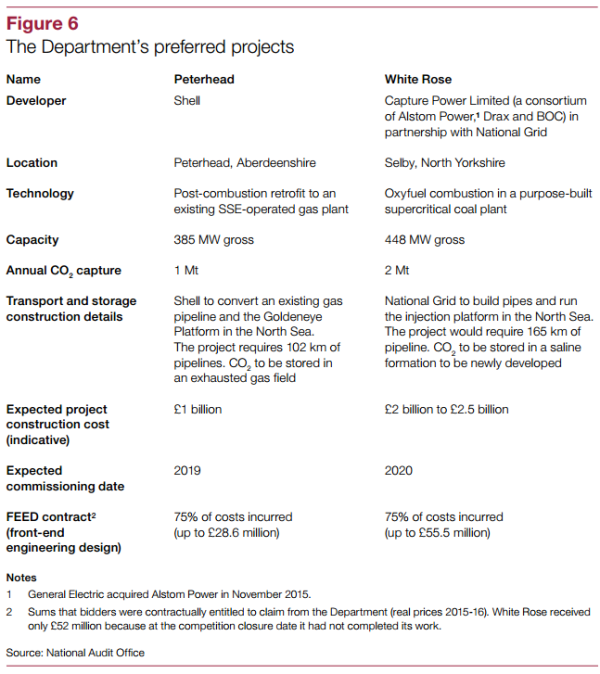
In the full NAO report (a 389kb pdf) Figure 6 gives details of the two schemes shortlisted in the competition.

It is the Peterhead scheme that would incur the lower subsidy of £105 Mwh. The £3.9 billion works out at an average 290 Mw production, or 76% of capacity over 15 years. It is cheaper due to adapting old plant. The disadvantage is that there is only 30 Mt of CO2 storage capacity in the area, so the area does not have the facility to develop much more unless further infrastructure development is made to pump the CO2 offshore into old oil wells.

The White Rose scheme has higher subsidy of £172 Mwh. The £8.9 billion works out at an average 394 Mw production, or 88% of capacity over 15 years. It is new plant, but has the advantage of 520 Mt of CO2 storage capacity in the area.

If we add in the £1bn subsidy without interest, over 15 years the cost per tonne of CO2 saved is about £264 (US$330, A$435) for the Peterhead project and £300 (US$374, A$490) for the White Rose project.

The NAO report in figure 12 that the subsidy could come down to £94 Mwh with scale.

Let us see what would be the cost if India and China adopted CCS for the current coal-fired power stations, but increasing capacity by 25% to cover the efficiency losses. Assume subsidy is just $100 Mwh.

According to Greenpeace (could be unreliable), China has about 900,000 MW of capacity. Add in 25% and assume 70% capacity, gives around $700bn a year subsidy. This is about 6% of current GDP.

From Wikipedia, India had 310 000 MW of capacity in 2015.  Add in 25% and assume 70% capacity, gives around $240bn a year subsidy. This is about 12% of current GDP.

I am sure that China and India will want to follow the UK’s lead. The only slight issue is finding a hole big enough. Maybe instead they could build some big greenhouses and grow tomatoes very rapidly.

Kevin Marshall


Bernie Saunders demonstrates why he was not fit to be President

Senator Bernie Saunders of Vermont was for a while running a close second to Hillary Clinton in the Democrat Primaries. Had his extreme left views, advanced years and the fact that he is the junior Senator from the 49th most populous State, he might have stood a chance against a former First Lady and Secretary of State. But Senator Sanders’ recent questioning of Scott Pruitt shows why he is unfit for high office. Ron Clutz has transcribed more of the dialog, by I think two statements encapsulate this.

At 0.45

As you may know, some 97% of scientists who have written articles for peer-reviewed journals have concluded that climate change is real, it is caused by human activity, and it is already causing devastating problems in the US and around the world. Do you believe that climate change is caused by carbon emissions from human activity?

There is no 97% survey of scientists which conclude these things. As Ron Clutz observes the nearest to definite questions was Examining the Scientific Consensus on Climate Change – Doran and Zimmerman 2009, where the second question was

2. Do you think human activity is a significant contributing factor in changing mean global temperatures?

One could answer “yes” if you thought that 10% of the rise in the was due to land use changes, and the rest due to natural factors. It does not ask about fossil fuel emissions, and the question allows for belief in other factors other than human activity whether known or unknown. Neither does it ask if temperature rise is net harmful, with huge devastating impacts already evident.

There is also the Cook et. al survey of peer-reviewed academic papers that I looked after listening to a lecture Cook gave at Bristol University in late 2014. The survey just looked to the assumption that humans cause some warming, whether explicit or implied. Like the Doran and Zimmerman survey it is just hearsay. This Sen. Sanders presents as good evidence that there is already a clear catastrophic problem caused by changes in the climate. If there is real and overwhelming evidence, why does Sen. Sanders not refer to that instead of misrepresenting bogus opinion polls?

Senator Sanders then goes even further.  At 1.50

While you are not certain, the vast majority of scientists are telling us that if we do not get our act together and transform out energy system away from fossil fuel there is a real question as to the quality of the planet that we are going to be leaving our children and our grandchildren. So you are applying for a job as Administrator at the EPH to protect our environment. Overwhelming majority of scientists say we have to act boldly and your’re telling me that there needs to be more debate on this issue and that we should not be acting boldly.

Sanders now says a majority of scientists are telling us we must change our energy systems. Aside from the fact that only a very small minority of scientists have any sort of competency in the field of climate, (and there is evidence a lot of demonstrated incompetency within the small group e.g. here), they have no expertise in the economic or moral cases for policy. For policy the interpretation of the moral imperatives and the practical possibilities should be the realm of politicians. For those who sit on specialist committees, they should at least have their own developed views on the field.

Senator Bernie Saunders has taken some very dodgy opinion polls, grossly exaggerated the findings, and then ascribed statements to the climatologists that are far removed, and way beyond, any competencies they might have. As I see it, the role of President of the United States, as a leader, is to critically interpret what they are given in order to make decisions for the nation. That is the exact opposite of what Sanders did last week.

Kevin Marshall 


Tristram Hunt MP confirms the Labour split on Brexit

In July, following the Brexit vote, I made a couple of posts looking at Chris Hanretty’s has estimated EU referendum vote split for the 574 parliamentary constituencies in England and Wales. In the The Democratic Deficit in the Referendum Result, I concluded

The results show two things.
First is that there is a huge divergence in Referendum vote across the English and Welsh constituencies.
Second is that a disproportionate number of the constituencies with strong votes either for remaining in the EU or leaving the EU have a Labour Party MP.

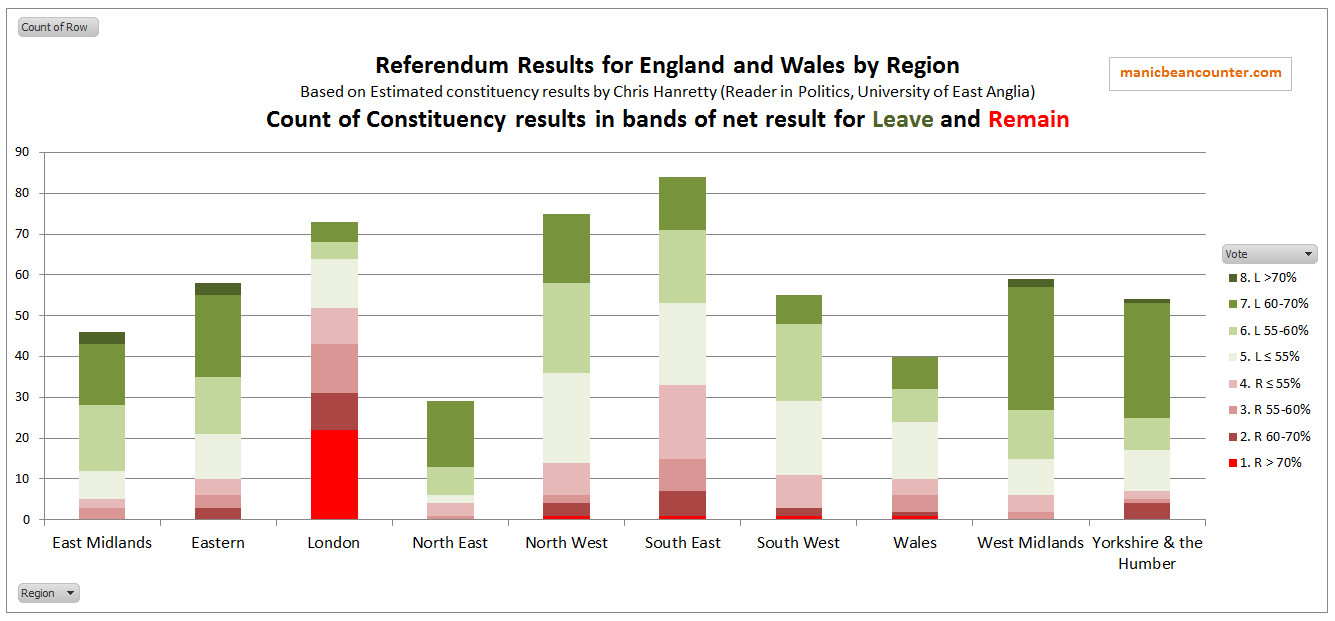
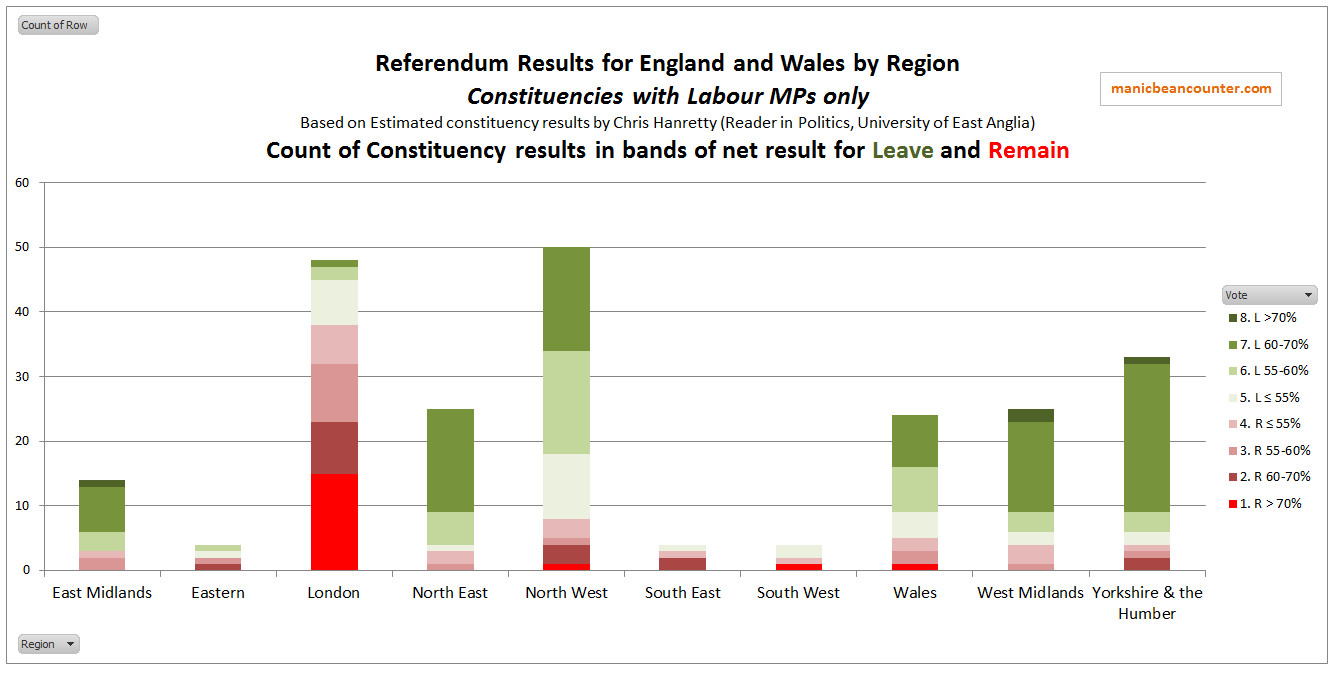
The divergence is shown by two graphs of the Leave / Remain constituency split by region  – the overall result and the 231 constituencies with a Labour MP

The second post looked at the seats that Labour must win if it is to become the largest party at the next General Election. In England and Wales most of the target seats voted to leave the EU. But in Scotland, where Labour lost 40 seats to the SNP, every single constituency likely voted to remain in the EU. Further in London, which was strongly remain, reside about 40% of Labour members. There is a fundamental split.

One of the most Pro-Leave constituencies is Stoke on Trent Central. Pro-Remain Labour MP Tristram Hunt is resigning to take up the prestigious post of Director of the V&A Museum. Guido Fawkes had a post this afternoon TRISTRAM HUNT ON LABOUR’S EXISTENTIAL CRISIS.

https://youtu.be/ZtAHuCBv9J0

Guido’s comment concurs with what I have concluded:-

In other words, Labour is increasingly irrelevant in Brexit Britain, and Tristram doesn’t have the answer…

Kevin Marshall

Tim Farrons false claims on the EU Referendum Vote

Yesterday, in reaction to Prime Minister Theresa May clearly laying out the Brexit means leaving the European Union, Liberal Democrat leader Tim Farron was vocal in denouncing what was said. On the positive side, despite having just 9 seats in Parliament and getting 8% of the vote, Farron was acting as an opposition spokesperson (an intentional aim) instead of the Leader of the Opposition who is nominally the Parliamentary leader of a Party that got nearly 4 times the number of votes and 29 times the number of seats as the Lib Dems in 2015. This attempted takeover of the role of Opposition is intentional.   However, Farron misrepresents those who, like me, voted leave.

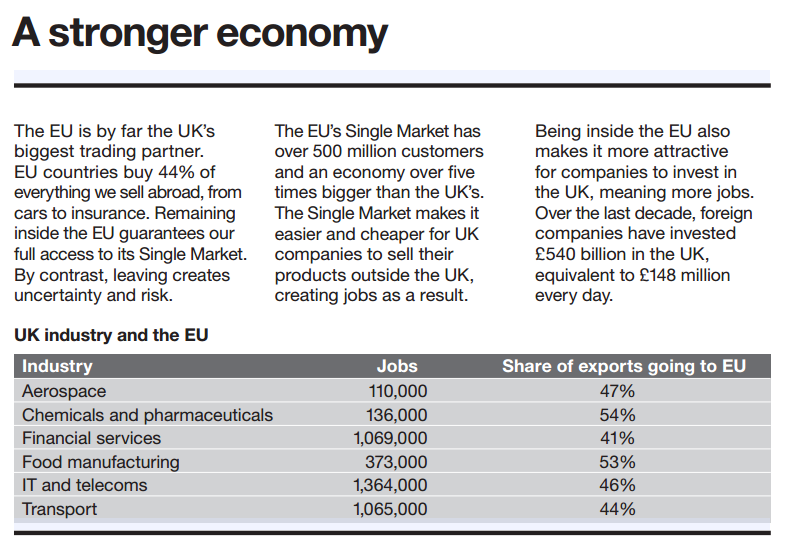
Is it the case that Theresa May is opting for a hard Brexit that the vast majority of leave voters did not want? The primary reference source is a glossy pro-EU Government booklet that was delivered to every household in Britain. The Stronger Economy page is below.

This seems clearly to state that remaining in the EU means leaving the Single Market. What it implies – quite wrongly in my view – is that leaving that single market will mean the loss of lots of UK jobs that depend on EU trade.

On page 8 in bold, was stated:-

No other country has managed to secure significant access to the Single Market, without having to:

• follow EU rules over which they have no real say

• pay into the EU

• accept EU citizens living and working in their country

As immigration was a bit issue, people who voted leave as a way of controlling immigration were clear that this meant leaving the single market. Anyone who thought that an independent UK could pick and choose was clearly ignoring the statements from both sides.

But the worst part is that Tim Farron is claiming that Theresa May is acting undemocratically as the specific Brexit deal will not be put to a referendum. On June 23rd the British people voted to gain our Independence from the EU institutions. The major decision-making body of the EU is not democratically-elected; the budget is so opaque that nobody can exercise proper control of where the money is spent, and there has been no sign-off of the audited accounts in over 20 years. A half-in half-out deal would be even less democratic, whilst the Hard Brexit would mean that the democratically-elected Government of the United Kingdom of Great Britain & Northern Ireland would gain greater powers.

Kevin Marshall

Trump is wrong on China Global Warming Hoax but right on the policy consequences

Summary

  • Donald Trump’s famous tweet that Global Warming is a Chinese Hoax is false, but the policy implications are correct.

  • Total proposed climate policies under the Paris Agreement will not stop global emissions rising, but the policy aim is to have global emissions falling rapidly after 2020.

  • The Rio Declaration 1992 exempted developing countries from a primary obligation to constrain, let alone reduce, emissions. 

  • By 2012 the exempted countries accounted for 64% of global emissions and over 100% of the global emissions growth since 1990.

  • The exempted, countries will collectively have emissions rising for decades to come.

  • The most efficient policy is a carbon tax, applied globally. But even this is highly inefficient, only working by making fossil fuel use unaffordable to all but the very rich. That is morally unacceptable in developed countries, whilst would stop developing countries developing, likely leading to civil wars.

  • Actual climate mitigation policies are less efficient and more costly than a carbon tax.

  • Pursuing mitigation policies in just the developed countries harms the poor disproportionately and harms manufacturing. Such policies may not even reduce global emissions.

  • Even if catastrophic global warming is true, the policy reality is the same as if it were a hoax. In either case they are net harmful to the policy countries.

  • Like with utterly ineffective drugs that harm the patient, the rational response to climate mitigation policies is to ban them.


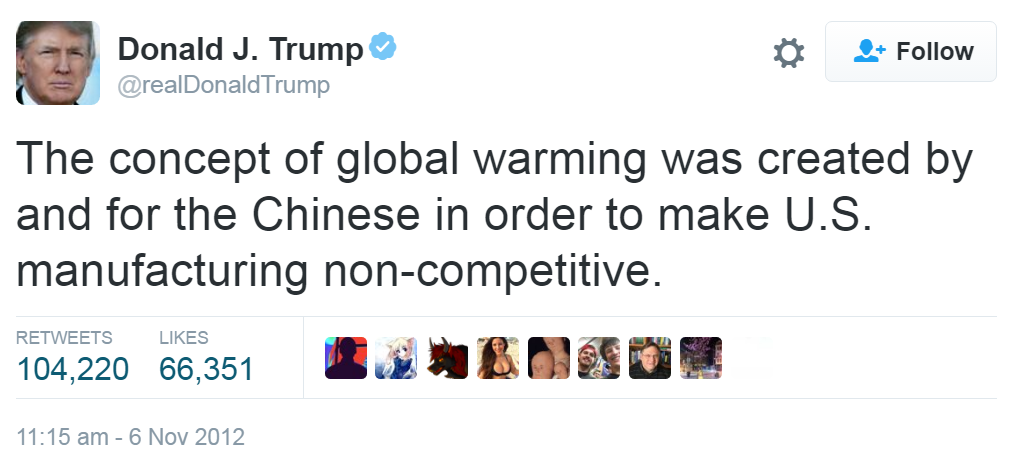
President-elect Donald Trump infamously claimed on Twitter

The concept of global warming was created by and for the Chinese in order to make U.S. manufacturing non-competitive.

I believe that statement to be totally false. The Chinese had nothing (or essentially nothing) to do with the climate alarmism that the Western intelligentsia (especially in the Anglosphere) seem to religiously accept as a series of a priori truths. But the policy implications of believing such a false position are pretty much the same for a policy-maker that (a) accepts as truth catastrophic global warming hypothesis, (b) puts their country first (but still values highly people in other countries, with an emphasis on the poor and the oppressed) (c) but understands the realities of global policy-making, along with the full economic impact of mitigation policy.

The Realities of Actual Mitigation Policy

The hypothesis is the basic form is that global human greenhouse gas emissions (mostly CO2) are resulting in rising greenhouse gas levels. This is forecast to cause large increases in global average temperatures, which in turn, many believe, will be catastrophic to the climate system. The major policy is to reduce the global greenhouse gas emissions to near zero.
The UNIPCC AR5 Synthesis Report, Summary for Policymakers 2014 tried to the maths very simple. They only looked at CO2 for the ballpark figures. Using the central assumption of a doubling of CO2 gives 3 degrees of warming, then 2 degrees comes when CO2 levels hit 450ppm. At end of 2016 it levels were about 404ppm, and rising at over 2ppm per year. Only is some warming from other greenhouse gases, so we are well beyond the 420ppm. That gives maybe 15 years tops. Somehow though figures seem to have been stretched a bit to give more time, something I will look at in a later post.
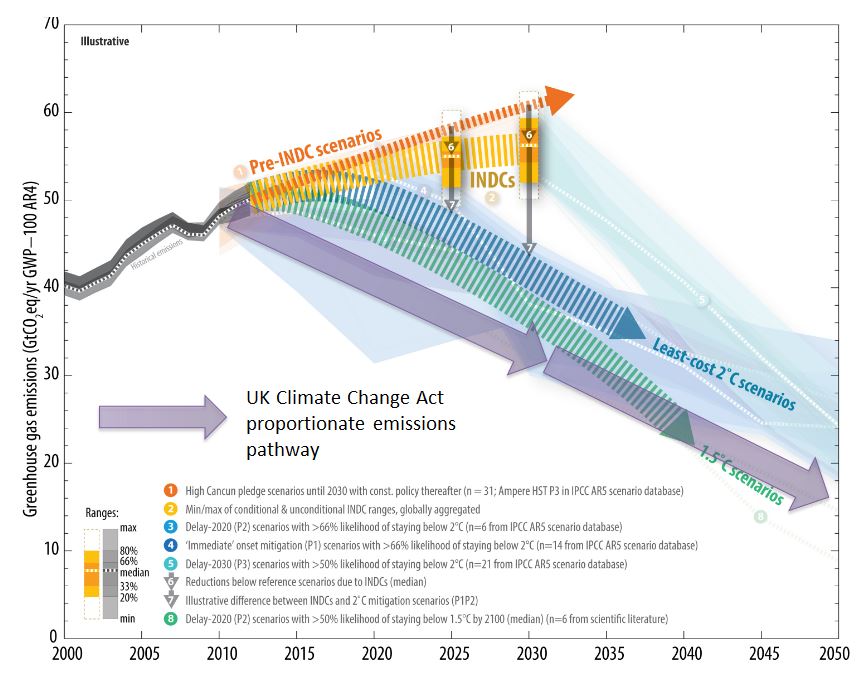
The UNFCCC – the body that brings all the countries together to cut emissions to save the planet – had an all-out bash at COP21 Paris in December 2015. In the lead-up all countries (excluding the EU countries, who let the masters in Brussels take the lead) made submissions on how they would contribute towards saving the world, or at least make a start up to 2030. Many were so vague, it was difficult to decipher the “ambition”. This was done to appear like the countries were doing something substantial, when in fact the proposals were often so insubstantial, that targets could be achieved by doing nothing at all. The UNFCCC put all the INDC submissions together on a global emissions graph.

The graph is very simple. Before the INDCs, emissions were forecast to follow the thin dark orange arrow. With the INDCs, the thick light orange forecast is still tracking upwards in 2030. The least-cost 2C scenarios is the blue arrow. This is going down by 2020, and by 2030 is substantially lower than today. The graph gives a very clear message – the whole exercise is pretty much an expensive waste of time. 40,000 people attended the meeting at Le Bourget airport North of Paris, including the vast majority of World Leaders. Rather than be honest, they went through the usual format with a breakthrough at five past midnight. Then they sent the “experts” away to think up yet more scary scenarios to get better proposals in the future.


Little More Policy will be Forthcoming

If they actually read the 1992 Rio Declaration, like Robin Guenier did in October 2015, they would have found out why. In particular Guenier draws attention to this statement in the declaration.

“The extent to which developing country Parties will effectively implement their commitments under the Convention … will take fully into account that economic and social development and poverty eradication are the first and overriding priorities of the developing country Parties.” [My emphasis]

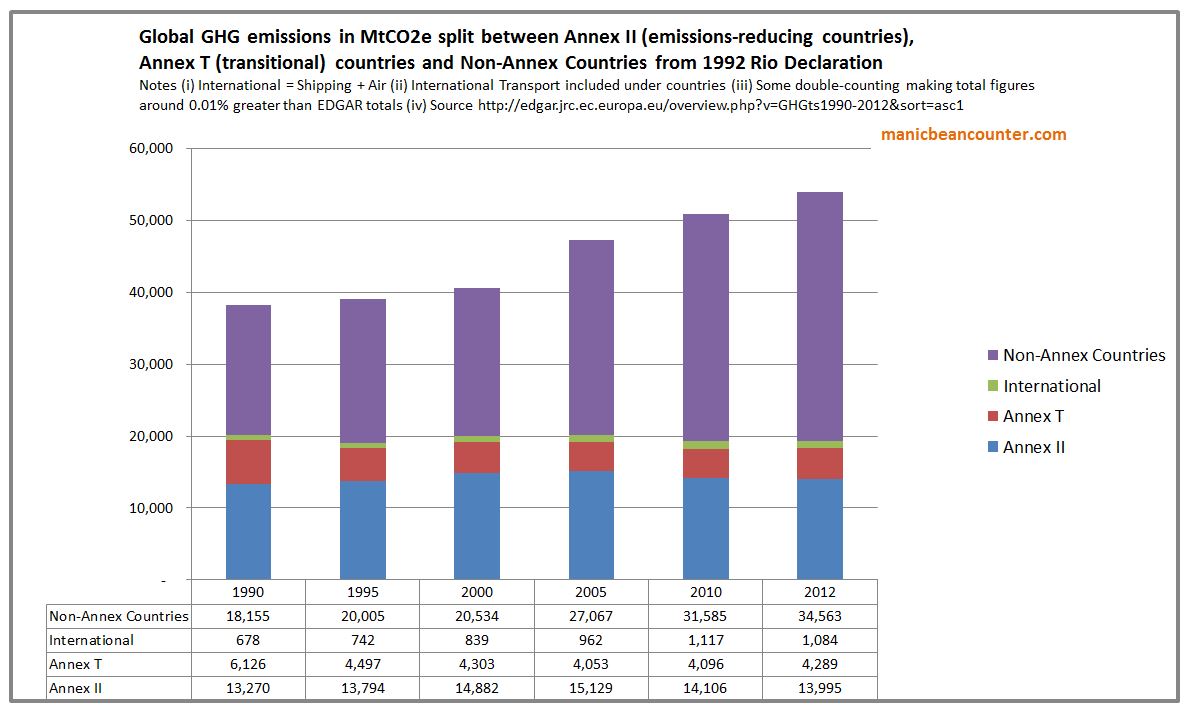
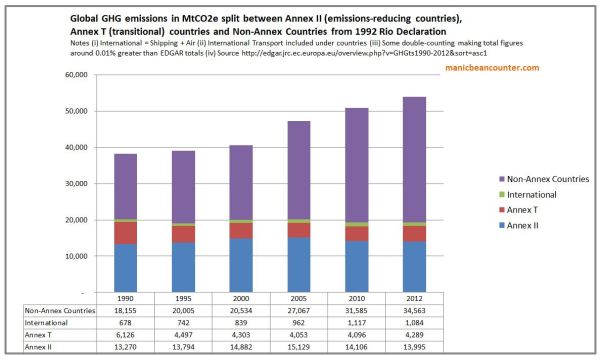
These non-Annex 1 developing countries have had phenomenal economic growth, with driven by rapid development of cheap energy from fossil fuels. Guenier quotes some CO2 emissions figures. Instead, I have used the broader estimates of greenhouse gas emissions from the European Commissions’ EDGAR database, grouping the figures into the Annex I countries (the rich OECD countries, like the USA, Japan, European Union, Canada, Australia etc.); the Annex I Transitional economies (basically the ex-Soviet bloc in Europe); International air and shipping; and the Non-Annex, rest of the world.


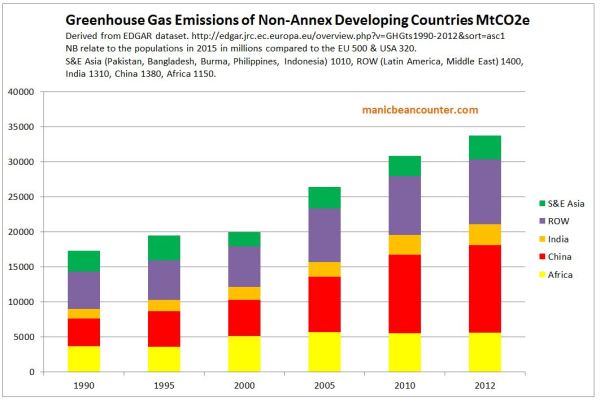
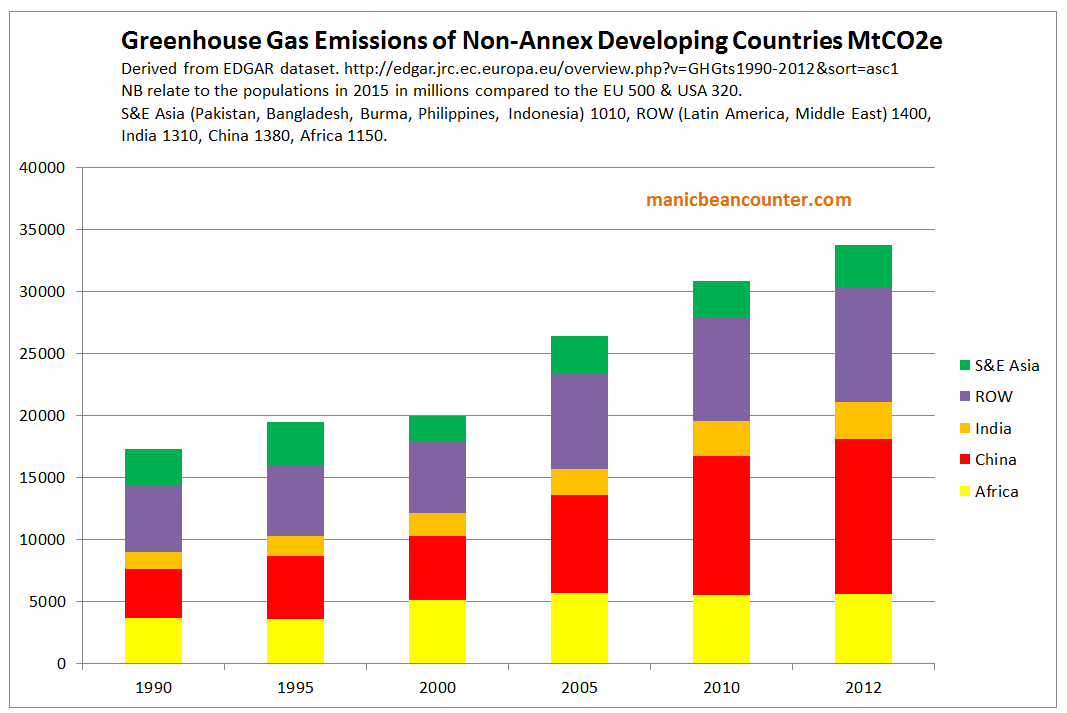
The figures are quite clear. The growth in emissions in 22 years was greater in the Non-Annex developing countries than the world as a whole. But this is just the developing countries starting to catch up. The breakdown of the Non-Annex developing county emissions is below.

This “developing” part of the world now has 84% of the global population, but in 2012 was just 64% of the greenhouse gas emissions. India and China each have more than 4 times the population of the USA, Africa 3.5 times and S&E Asia 3 times. Whilst in China emissions growth will peak soon, in India emissions growth is only recently taken off.  In S&E Asia and Africa emissions growth has yet to really take off. No matter what the USA and a few other developed countries do, it will not make a big difference to the long-term outlook for GHG emissions. Now compare the global emissions to the UNFCCC graph of INDCs of the target emissions reductions for 2030. The UNFCCC scale is in billions of tonnes, whilst the scale I use is in millions. The least cost 2C scenario is lower in 2040 that the total non-Annex countries in 2012. Even without emissions growth in the non-Annex countries, the Annex countries could cut emissions by 100% and still the 2C limit will be breached by the 84% who live in countries with no obligation to cut their emissions.
But maybe the USA should cut emissions anyway? After all it will not cost much, so these developing nations will be brought into line. I only recently realized how wrong this view was. Economics Prof Richard Tol it one of the World’s leading climate economists, who (unlike me) happens to believe in the moral case for cutting greenhouse gas emissions. In a recent paper, “The Structure of the Climate Debate”, Tol explained how a global carbon tax was theoretically the most efficient means to reduce global greenhouse gas emissions. Use regulation, or rationing, or subsidies of renewables, and it will be more expensive – less bang for your bucks. However, I objected. He seemed to be saying that the carbon tax necessary to cut global emissions worked out at less than the taxation on gasoline in Britain. At over $3 (a level that is similar in much of Europe) there are still quite high levels of fuel usage. I can still remember my high school economics teacher, in teaching about elasticity of demand, said that a good example of inelastic demand were the “sin” taxes on booze, alcohol, tobacco and petrol (gasoline). You could have quite high taxes without impacting on demand. Well, after a few exchanges at cliscep blog turns out Tol (in the more technical Tol 2013 paper) was recommending a $210 tCO2 tax to be imposed in 2020 globally, plus an escalator of 5.5% a year forever. It would eventually make fossil-fuelled energy use unaffordable to all but the Hollywood A-listers. I showed British readers in GBP would that would mean, but for the US readers $210tCO2 is about $1.83 per gallon of gasoline. There would be uproar if it was introduced, and people might get more fuel efficient cars. With the escalator that would rise to over $3 a gallon in 2030, $9 2050, $35 in 2075 and$132 a gallon in 2100. There would also be similar hikes in electricity from coal and gas. This might not be fast enough to achieve the reductions required by the UNFCCC, but would not be sustainable in a country with democratic elections every few years.

But actual climate mitigation policies, are far less effective that the carbon tax. This includes subsidies or loan guarantees to speculative and unsustainable businesses, or flash renewable technologies that fail to deliver,

The carbon tax might be harmful to the poor and middle classes in America, but think of what it would do to the living standards of the poorest half of the world. Countries where parents are hoping that their children might enjoy cheap energy for cooking, lighting or heating, would see those hopes dashed. For billions of people their children or grandchildren would never have a family car, or be able to travel by plane. If the Governments of India, China or Indonesia tried to impose such high and escalating taxes there could be economic collapse similar to that of Greece, and likely civil wars.

Should the Rich countries still do something?

So maybe the United States, and other rich countries, should still adopt policies regardless. After all, they should pay for the (alleged) harms that are leading to disaster. But if the proposers had any understanding of the real world, they would know that just as economic growth has been propelled by abundant supplies of cheap, available and reliable energy. In international trade what is “cheap” is a relative concept. In the nineteenth century steam power was very expensive compared to electricity today. But at this point in time, when developing countries are make power more available and driving their unit energy costs down. Steam power was much cheaper, and more available than water power, which in turn was cheaper than human or animal power. Yet implementing emissions reduction policies, the rich countries are driving those unit energy costs up just as developing countries have been driving unit energy costs down and making power more available. The USA and EU countries are generating a comparative disadvantage. But, as the developed nations tend to be more energy efficient, the net effect on global emissions may be to increase them, despite the policy countries decreasing theirs. That net effect is unlikely to be as large as any actual savings in the policy countries. What is more, the costs of policy will fall on the poor, and those areas of employment with high energy usage and that compete internationally.

An argument for climate mitigation is that it is to make small sacrifices now to save future generations from the much larger costs of future catastrophic climate change. That is only true if global emissions are cut significantly, at a cost lower than the actual harmful impacts that would have occurred without policy. As policy to cut emissions will makes very little difference to global emissions, then the sacrifices could be of a small benefit in non-policy countries, but be to the net disadvantage of future generations in the policy countries. The biggest burden of the costs of policy will fall on the poorer sections of society and manufacturing in the policy countries.

The Moral Case Against Climate Mitigatiom

If the medical profession insisted on patients taking drugs that did not work and had harmful side effects, then in litigious America they would be sued for all they had, and likely jailed. But when the climate alarmists, back by the liberal establishment, insist on policy that cannot work and causes substantial harms they are not held to account. Indeed, so pervasive are the beliefs in climate alarmism, it is an act of heresy to even question this false policy. Now the tables are turned.

The first thing that should be done with harmful drugs that cannot work is to ban them from sale. For an incoming President, the first thing to do with harmful and useless policies is to rescind them.

Kevin Marshall


Friends of the Earth distorting the evidence for Fracking in the UK

Summary

Friends of the Earth have a webpage claiming to be “fracking facts”. The key points I make are.

  • The claims of dangers of fracking raise questions, that need to be answered before they can be considered credible.
  • The claim that fracking could affect house prices is totally unsupported.
  • The claim that shale gas will not significantly affect energy prices is based on out of date data. The British Geological Survey has shown that the potential of shale gas is huge. Friends of the Earth has played a major role in preventing that potential being realized.
  • FoE has consequently helped prevent shale gas from relieving the energy crisis brought upon by the Climate Change Act 2008.
  • Claims that pursuing shale gas in Britain will affect global emissions are pure fantasy. Also is a fantasy the belief that Britain is leading the way on emissions reductions. We ain’t leading if collectively the world is not following. The evidence shows clearly shows this.  

In the previous post I looked at how FoE blatantly mislead about an agreement they reached with the Advertising Standards Authority, which caused the unusual step of ASA Chief Executive Guy Parker issuing a strongly worded statement to defend the ASA’s integrity.

In this post I will look at FoE’s position on fracking, from Fracking definition? What does fracking mean? Read our fracking facts

I will look at various statements made (with FoE quotes in purple), showing how well they are supported by the evidence and/or providing alternative perspectives.

From the section What are the dangers of fracking?

Industry statistics from North America show that around 6% of fracking wells leak immediately.

Leaking wells lead to a risk of water contamination. Lord Smith, former chair of the Environment Agency, has said this is the biggest risk posed by fracking.

So it’s particularly concerning that the Government has now said it will allow fracking companies to drill through aquifers which provide household drinking water.

This raises some questions.

  • If leaks are a problem, with respect to fracking in the UK has this been risk assessed, with appropriate measures taken to prevent leaks?
  • Does that statistic of 6% allow for when there is natural leakage in the area of fracking leaking in the water supplies are venting into the atmosphere in the area where fracking is occurring? This was the case in the images of the flaming water faucet in the movie Gasland.
  • Have there been steps taken in the USA to reduce genuine leaks?
  • Has the proportion of wells leaking gas in the USA been increasing or decreasing?
  • Has the average amount of gas leaked been increasing or decreasing?
  • How when extracting gas from well below water aquifers, through a lined tube, that is both water-tight and gas-tight, is that gas (and fracking fluids) meant to leech into the water supply?

Then there is the statement without evidence.

Fracking could also affect house prices.

This was one of the issues FoE in its agreement with the ASA have the assurance not to repeat claims that fracking affects property prices, unless the evidence changes. Legally there might be cop-out where that assurance does not apply to claims made on its website. Literally, the statement is not untrue, just as the claim that a butterfly flapping its wings on the North Downs could lead to a typhoon in the South China Sea.

Would fracking bring down energy bills?

It’s very unlikely. Fracking company Cuadrilla has admitted that any impact on bills would be “basically insignificant”.

Claims that fracking would create a lot of jobs have also been overstated. According to Cuadrilla, each of its proposed 6-year projects in Lancashire that were recently rejected by the council would only have created 11 jobs.

The claim about Cuadrilla is sourced from an Independent article in June 2013.

“We’ve done an analysis and it’s a very small…at the most it’s a very small percentage…basically insignificant,” said Mark Linder, a public relations executive at Bell Pottinger who is also responsible for Cuadrilla’s corporate development.

The article later says

“According to Poyry, Lancashire shale gas production could also reduce the country’s wholesale gas and electricity prices by as much as 4 per cent between 2014 and 2035, which corresponds to an average saving of £810m/year,”

It is not surprising that shale gas developments in Lancashire alone will not have a significant impact on UK energy prices, especially if that is restricted to a few sites by one company. But over three years later the landscape has changed. The British Geological Survey has been publishing estimates of the quantities of shale gas (and oil) that exists beneath the ground.

The figures are at first hard to comprehend. They are large numbers in units of measure that ordinary people (even people with some knowledge of the field) find hard to comprehend, let alone put into some perspective. In my view, the figures need to be related to annual British consumption. Page 8 of the DECC UK Energy Statistics, 2015 & Q4 2015 estimates gas demand at 794 TWh in 2015.

The BGS uses tcf (tera cubic feet) for its’ estimates, which (like a domestic gas bill) can be converted from TWh. The 794 TWh is about 2.7 tcf. Not all shale gas is recoverable. In fact possibly only 10% of reserves is recoverable on existing technology, and depending on the quality of the deposits.

There are also shale oil deposits, measured by the BGS in both barrels and millions of tonnes. Refinery production (a rough estimate of consumption) was 63 million tonnes in 2015. I will again assume 10% recovery, which may be overly prudent.

The biggest shock was published just a few weeks after the Independent article on 27th July 2013. The size of the Bowland shale was truly staggering. The central estimate is 1329 tcf, meaning enough to satisfy 49 years of current UK gas demand. Potentially it is more, due to the depth of deposits in many areas. No significant deposits of oil are thought to be present

On 23rd May 2014 BGS published the results for the Weald Basin, a large area in the South East of England. Whilst there were no significant deposits of gas, the central estimate of 591 million tonnes is enough to supply the UK for one year.

On 25 June 2014 the Welsh Government published the estimates for Wales. The main gas deposits are thought to be in Wrexham/Cheshire and in South Wales and estimated about 65 tcf, or just over two years of UK demand. (Strictly the Welsh estimate is somewhat below this, as Wrexham is on the Welsh border and Cheshire is an English county. )

On 23rd May 2014 BGS published the results for the Midland Valley of Scotland. The central estimate for shale gas was 80.3 tcf (3 years of UK demand) and for shale oil 800 million tonnes (15 months of refinery production).

Most recently on 13th October 2016, BGS published the results for the Jurassic shale of the Wessex area. Central estimate for shale oil was 149 million tonnes, equivalent to three months of UK refinery production.

In all, conservatively there is estimated to be sufficient gas to supply the UK for over 54 years and oil for two and half years. The impact on supply, and therefore the impact on jobs and (in the case of gas) on energy prices, demands on the ability of businesses to profitability develop these resources. As has happened in the USA, the impact on jobs is mostly dependent on the impact on prices, as low prices affect other industries. In the USA, industries that are sensitive to energy prices (or use gas as a raw material) have returned from overseas, boosting jobs. FoE has played no small part in delaying planning applications with spurious arguments, along with generating false fears that could have made regulations more onerous than if an objective assessment of the risks had been made.

Fracking can’t help any short term or medium term energy crisis.

Even if the industry was able to move ahead as fast as it wants, we wouldn’t see significant production until about 2025.

This is actually true and up to date. If it were not for the Climate Change Act along with eco-activists blocking every move to meet the real energy demands in the most affordable and efficient way possible, there would be no prospective energy crisis. In terms of shale gas meeting energy demands (and gas-fired power stations being built) FoE should claim some of the credit for preventing the rapid develop of cheap and reliable energy sources, and thus exacerbating fuel poverty.

Will fracking help us to tackle climate change?

Shale gas and shale oil are fossil fuels. They emit greenhouse gases. Avoiding the worst impacts of climate change means getting off fossil fuels as soon as possible.

Scientists agree that to stop dangerous climate change, 80% of fossil fuels that we know about need to stay in the ground.

Setting up a whole new fossil fuel industry is going in completely the wrong direction, if the UK is to do its fair share to stop climate change.

The hypothesis is that global emissions lead to higher levels of greenhouse gases. In respect of CO2 this is clear. But the evidence that accelerating rate of rise in CO2 levels has led to accelerating average global temperatures is strongly contradicted by real world data. There is no scientific consensus that contracts this conclusion. Further there is no proper scientific evidence to suggest that climate is changing for the worse, if you look at the actual data, like leading climate scientist Dr John Christy does in this lecture. But even if the catastrophic global warming hypothesis were true (despite the weight of real world data against it) global warming is global. Britain is currently emitting about 1.1% of global emissions. Even with all the recently discovered shale gas and oil deposits, under the UK is probably less than 1% of all estimated fossil fuel deposits. Keeping the fossil fuels under British soil in the ground will do nothing to change the global emissions situation.  Britain tried to lead the way with the Climate Change Act of 2008, in committing to reduce its emissions by 80% by 2050. The INDC submissions leading up to COP21 Paris in December 2015 clearly showed that the rest of the countries were collectively not following that lead. The UNFCCC produced a graph showing the difference of the vague policy proposals might make.  I have stuck on the approximate emissions pathway to which the UK is committed.

The FoE is basically objecting to fracking to keep up the appearance that the UK is “doing its bit” to save the world from catastrophic global warming. But in the real world, global warming ain’t happening, neither are the predicted catastrophes. Even if it were, whatever Britain does will make no difference. FoE attempting to deny future jobs growth and stop the alleviation of fuel poverty to maintain the fantasy that Britain is leading the way on climate change.

 Isn’t it better to have our own gas rather than importing it?

…….

If we went all out for shale, our gas imports would stay at current levels as the North Sea supply declines – and imports could increase by 11%.

This claim, without any reference, is based likely based on the same out of date sources as below. If FoE and fellow-travellers kept out of the way with their erroneous legal challenges and distortions then shale gas has a huge potential to cause imports to decline.

Kevin Marshall

Friends of the Earth still perverting the evidence for fracking harms

Yesterday, the Advertising Standards Authority at long last managed to informally resolve the complaints about a misleading leaflet by Friends of the Earth Trust and Friends of the Earth Ltd. This is no fault of the ASA. Rather FoE tried to defend the indefensible, drawing out the process much like they try to draw out planning inquiries. From the Guardian

“After many attempts by Friends of the Earth to delay this decision, the charity’s admission that all of the claims it made, that we complained about, were false should hopefully put a stop to it misleading the UK public on fracking,” said Francis Egan, chief executive of Cuadrilla. …..

According to the BBC

Friends of the Earth (FOE) must not repeat misleading claims it made in an anti-fracking leaflet, the advertising watchdog has said.

The fundraising flyer claimed fracking chemicals could pollute drinking water and cause cancer and implied the process increases rates of asthma.

The charity “agreed not to repeat the claims,” the Advertising Standards Authority (ASA) said.

All pretty clear. As the BBC reports that the eco-worriers are not to be told that they are misleading the public.

Donna Hume, a campaigner for the environmental charity, said it would “continue to campaign against fracking” because it was “inherently risky for the environment”.

……..

Ms Hume said Cuadrilla “started this process to distract from the real issues about fracking” and was trying to “shut down opposition”.

“It hasn’t worked though. What’s happened instead is that the ASA has dropped the case without ruling,” she said.

“We continue to campaign against fracking, alongside local people, because the process of exploring for and extracting shale gas is inherently risky for the environment, this is why fracking is banned or put on hold in so many countries.”

Donna Hume was just acting as mouthpiece to the FoE, who issued a misleading statement about the case. They stated

Last year fracking company Cuadrilla complained to the Advertising Standards Authority about one of our anti fracking leaflets.

But after more than a year, the complaint has been closed without a ruling.

The scientific evidence that fracking can cause harm to people and the environment keeps stacking up. Friends of the Earth is not alone in pointing out the risks of fracking, to the climate, to public health, of water contamination, and to the natural environment.

ASA Chief Executive Guy Parker, took the unusual step of setting the record straight.

But amidst the reports, the public comments by the parties involved and the social media chatter, there’s a risk that the facts become obscured.

So let me be clear. We told Friends of the Earth that based on the evidence we’d seen, claims it made in its anti-fracking leaflet or claims with the same meaning cannot be repeated, and asked for an assurance that they wouldn’t be. Friends of the Earth gave us an assurance to that effect. Unless the evidence changes, that means it mustn’t repeat in ads claims about the effects of fracking on the health of local populations, drinking water or property prices.

Friends of the Earth has said we “dropped the case”. That’s not an accurate reflection of what’s happened. We thoroughly investigated the complaints we received and closed the case on receipt of the above assurance. Because of that, we decided against publishing a formal ruling, but plainly that’s not the same thing as “dropping the case”. Crucially, the claims under the microscope mustn’t reappear in ads, unless the evidence changes. Dropped cases don’t have that outcome.

The ASA, which tries to be impartial and objective, had to take the unusual statement to combat FoE deliberate misinformation. So what is the scientific evidence that FoE claim? This from the false statement that ASA was forced to rebut.

The risks of fracking

In April 2016, a major peer-reviewed study by research institute PSE Healthy Energy was published in academic journal PLOS ONE, which assessed 685 pieces of peer-reviewed scientific literature from around the world over 2009-2015 and found:

  • “84% of public health studies contain findings that indicate public health hazards, elevated risks, or adverse health outcomes”

  • “69% of water quality studies contain findings that indicate potential, positive association, or actual incidence of water contamination”

  • “87% of air quality studies contain findings that indicate elevated air pollutant emissions and/or atmospheric concentrations”

I suggest readers actually read what is said. Hundreds of studies cannot identify, beyond reasonable doubt, that there is a significant large risk to human health. If any single study did establish this it would be world news. It is just hearsay, that would be dismissed by a criminal court in the UK. A suggestion is from what the  PLOS-ONE Journal does not include in the submission criteria, that is normal in traditional journals – that submissions should have something novel to say about the subject area. As an online journal it does not have to pay its way by subscriptions, as authors usually have to pay a fee of $1495 prior to publication.

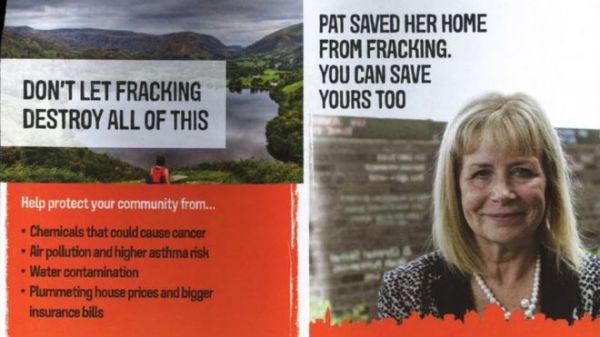
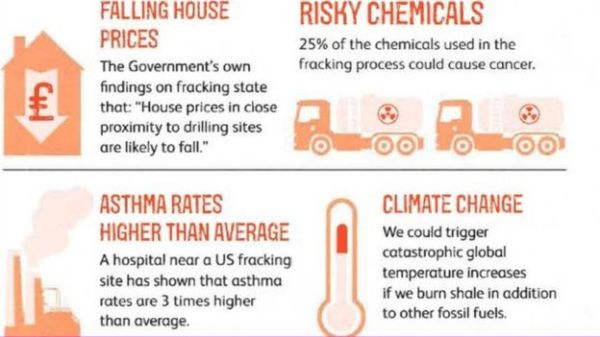
But this still leaves the biggest piece of misinformation that FoE harps on about, but was not included in the ruling. Below is the BBC’s two pictures of the leaflet.

foe-false-fracking-leaflet-bbc

foe-false-fracking-leaflet-bbc2

It is the the issue of climate change that goes unchallenged. Yet it is the most pernicious and misleading claim of the lot. If fracking goes ahead in the UK it will make not a jot of difference. According to the EU EDGAR data the UK emitted just 1.1% of global GHG emissions in 2012. That proportion is falling principally because emissions are rising in other countries. It will continue to fall as emissions in developing countries rise, as those countries develop. That is China, India, the rest of South East Asia and 50+ African nations. These developing countries, which are exempt from any obligation to constrain emissions under the 1992 Rio Declaration, have 80% of the global population and accounted for over 100% of emissions growth between 1990 and 2012. I have summarized the EDGAR data below.

ghg-ems-annnon

So who does the FoE speak for when they say “We could trigger catastrophic global temperature increases if we burn shale in addition to other fossil fuels“?

They do not speak for the USA, where shale gas has replaced coal, and where total emissions have reduced as a result, with real pollutants falling. There the bonus has been hundreds of thousands of extra jobs. They do not speak for China where half of the global increase (well 53%) in GHG emissions between 1990 and 2012 occurred. They cannot speak for Britain, as if it triggers massive falls in energy costs like in the USA (and geologically the North of England Bowland shale deposits look to be much deeper than the US deposits, so potentially cheaper to extract) then industry could be attracted back to the UK from countries like China with much higher emissions per unit of output.

Even worse, F0E do not speak for the British people. In promoting renewables, they are encouraging higher energy prices, which have lead to increasing fuel poverty and increased winter deaths among the elderly. On the other hand the claims of climate catastrophism from human emissions look to be far fetched when this century global average temperature rises have stalled, when according to theory they should have increased at an accelerated rate.

Kevin Marshall

Update 7th Jan 11am

Ron Clutz has posted a good summary of the initial ruling, along with pointing to a blog run by retired minister Rev. Michael Roberts, who was one of the two private individuals (along with gas exploration company Cuadrilla) who made the complaint to ASA.

The Rev Roberts has a very detailed post on the 4th January giving extensive background history of FoE’s misinformation campaign against shale gas exploration in the Fylde. There is one link I think they should amend. The post finishes with what I believe to be a true statement.

Leaflet omits main reason for opposition is Climate change

https://www.foe.co.uk/page/no-fracking-lancashire

The link is just to a series of posts on fracking in Lancashire. It is one of them is

Lancashire fracking inquiry: 3 reasons fracking must be stopped

The first reason is climate change. But rather than relate emissions to catastrophic global warming, they point to the how allowing development of fossil fuels appears in relation to Government commitments made in the Climate Change Act 2008 and the Paris Agreement. FoE presents their unbalanced case in much fuller detail in the mis-named Fracking Facts.

Update 2 7th Jan 2pm

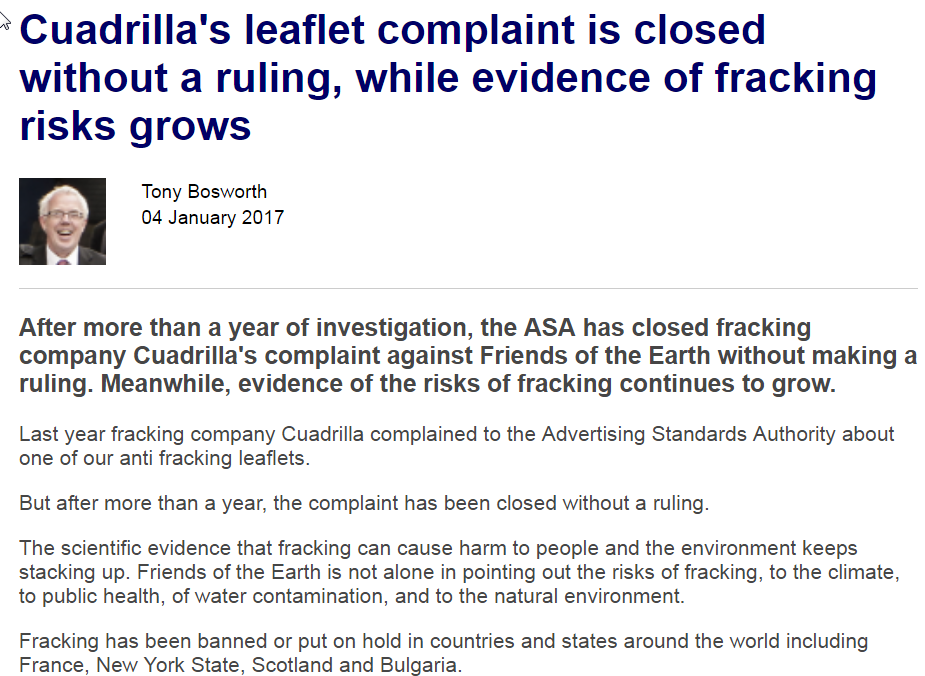
I have rechecked the post Cuadrilla’s leaflet complaint is closed without a ruling, while evidence of fracking risks grows, where Friends of the Earth activist Tony Bosworth makes the grossly misleading statement that ASA closed the case without a ruling. The claim is still there, but no acknowledgement of the undertaking that F0E made to ASA. F0E mislead the public in order to gain donations, and now tries to hide the information from its supporters by misinformation. Below, is a screenshot of the beginning of the article.

Carbon emissions – social benefits from enhanced growth

Key Points

  1. Cheap fossil fuels were undoubtedly a major element in China’s very high levels of economic growth.
  2. If Canada were to unilaterally cut its emissions, the impact on global emissions would be tiny.
  3. A reduction in economic growth of 0.01% from now to 2100 would have a larger value in 2100 than the projected  monetary costs of catastrophic climate change in 2100.
  4. Developing nations with up to two-thirds of global emissions, are excluded from any obligation to constrain emissions under the Rio Declaration.
  5. Climate mitigation increases unit energy costs, creating a comparative disadvantage for policy countries.
  6. If non-policy developing countries were later to adopt mitigation policies, they would not only have higher energy costs, but would lose the comparative advantage of being a non-policy country. A few countries pursuing climate mitigation policies increases the marginal cost of other countries adopting similar policies.

Introduction

Ron Clutz has yet another excellent article, this time on SBC: Social Benefits of Carbon

Ron points to the benefits of increased CO2 levels, such as from increased plant growth. But, by far the biggest benefit is the from the use of fossil fuels as an engine of economic growth. I made two comments, which are slightly amended here.

How much did fossilized carbon fuel China’s economic growth?

By far the most important point made in Ron’s article is the impact of fossil fuels on economic growth rates. Take China – the most extreme example in history, at least for major economies, According to the UNFCCC country brief produced for COP21 Paris, economic growth in China averaged 10.3% pa from 1990-2012. In the same period CO2 emissions increased by 6.1% pa. It meant GDP per capita (with 19% population growth) was 7.25 times higher in 2012 than 1990, and emissions per capita were over 3 times higher.

country-brief-2014_-china

How much of the economic growth would have happened without the huge investment in cheap energy sources – principally coal? If economic growth would have averaged a mere 7%, GDP per capita would have 3.7 times higher in 2012 than 1990. This is why people in China are willing to suffer the terrible, acrid, pollution that engulfs many major cities.

Unilateralist Canada reducing emissions by 90%

A hypothetical example with growth impacts

Whilst unable to estimate the effects of cheap energy on China’s phenomenal growth, I would still contend that the compound effect on economic growth of cheap fossil fuels is far greater than the estimates of the projected harms of climate catastrophe. At the start of December Ron Clutz had a post Climate Costs in Context. This referred to a Manhattan Institute Report which estimated the costs of global warming could reach $15trn by 2100 – or 2.5% of global output of $600trn. Reducing economic growth by 0.03% would have the same effect on output, though people would accept a much bigger reduction in growth to avoid 2.5% costs of catastrophes.

This leads to a bigger issue, that it not discussed. Suppose an economy like Canada with 1.5% of global emissions, unilaterally imposed a policy from January 1st 2017 that was guaranteed to reduce emissions by 90% by 2100. Without the policy, global emissions would be double 2016 levels in 2100. With the policy they will be 1.9865 times higher.
Let us also assume that

(1) 2100 costs of climate change are 2.50% of GDP globally and for Canada, without Canada’s policy.
(2) 2100 costs of climate change are 2.45% of GDP globally and for Canada, with Canada’s policy.
(3) The only cost of this policy is to reduce long-term growth rates from 2.00% to 1.99%
(4) All outcomes and calculations are certain.

Even then, the the descendants in 2100 Canada would still not thank the current generation, as output would be 8% lower, to save costs of just 0.05% of GDP. If current GDP is C$1600bn, with 2% growth GDP in 2100 will be C$8443bn. At 2.5% costs of climate change will be $211bn. Reduce that to 2.45% reduces costs by just over $4.2bn. But GDP with 1.99% growth GDP will be 8% or $668bn lower.
Even if all countries reduced emissions by 90% (and thus reduced costs of climate change to effectively zero) mitigation policy would may not make sense on these “heroic” assumptions. Canada would exchange $210bn of random catastrophic costs for $668bn of certain costs. But that would be only if the costs were totally random. If costs were in part predictable, then, without the economic growth impact of climate mitigation policies, additional economic could be used to counteract the direct effects of the warming through adaptation.
But the reality is much closer to Canada acting unilaterally; there are significant policy costs; and the impact on growth is far greater. Worst of all, is the competitive impact.

The Comparative Disadvantage of Climate Mitigation

Assume

(a) Cheap energy is a key driver of economic growth

(b) A country, like Canada, with aggressive climate mitigation policies,  is competing on world markets with less developed countries with little or no mitigation policies.

(c) Climate Mitigation policies, like renewables or a carbon tax, increase unit energy costs.

(d) Some industries with globalized market, like steel, aluminium, shipbuilding or chemicals, energy costs form a significant part of the costs of production.

I would suggest that the imposition of climate mitigation policies increases the unit cost of production, creating a comparative disadvantage compared to countries with little or no mitigation policies. 2017 marks the 200th anniversary of David Ricardo’s theory of comparative advantage. Ably explained by Prof Donald J. Boudreaux, it is perhaps the only principle in economics that it universally true. Climate mitigation is only being pursued, in varying degrees, by a limited number of countries. Developing nations with up to two-thirds of global emissions, are excluded from any obligation to constrain emissions under the Rio Declaration. Developed countries, by imposing mitigation policies, create comparative advantages to the non-policy developing countries that they trade with. Therefore, the marginal cost of those developing countries adopting mitigation policies is greater if developed countries have already mitigation policies in place, than if all countries had adopted them together in equal measure. This implies that those economies like Russia, South Korea and China, who might be able to afford to adopt climate mitigation on the increased energy costs alone, will not do so due to competitor countries having established costly mitigation policies.

Kevin Marshall

How strong is the Consensus Evidence for human-caused global warming?

You cannot prove a vague theory wrong. If the guess that you make is poorly expressed and the method you have for computing the consequences is a little vague then ….. you see that the theory is good as it can’t be proved wrong. If the process of computing the consequences is indefinite, then with a little skill any experimental result can be made to look like an expected consequence.

Richard Feynman – 1964 Lecture on the Scientific Method

It’s self-evident that democratic societies should base their decisions on accurate information. On many issues, however, misinformation can become entrenched in parts of the community, particularly when vested interests are involved. Reducing the influence of misinformation is a difficult and complex challenge.

The Debunking Handbook 2011 – John Cook and Stephan Lewandowsky

My previous post looked at the attacks on David Rose for daring to suggest that the rapid fall in global land temperatures at the El Nino event were strong evidence that the record highs in global temperatures were not due to human greenhouse gas emissions. The technique used was to look at long-term linear trends. The main problems with this argument were
(a) according to AGW theory warming rates from CO2 alone should be accelerating and at a higher rate than the estimated linear warming rates from HADCRUT4.
(b) HADCRUT4 shows warming stopped from 2002 to 2014, yet in theory the warming from CO2 should have accelerated.

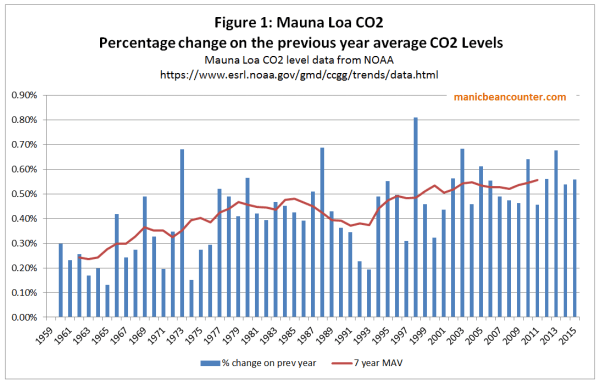
Now there are at least two ways to view my arguments. First is to look at Feynman’s approach. The climatologists and associated academics attacking journalist David Rose chose to do so from a perspective of a very blurred specification of AGW theory. That is human emissions will cause greenhouse gas levels to rise, which will cause global average temperatures to rise. Global average temperature clearly have risen from all long-term (>40 year) data sets, so theory is confirmed. On a rising trend, with large variations due to natural variability, then any new records will be primarily “human-caused”. But making the theory and data slightly less vague reveals an opposite conclusion. Around the turn of the century the annual percentage increase in CO2 emissions went from 0.4% to 0.5% a year (figure 1), which should have lead to an acceleration in the rate of warming. In reality warming stalled.

The reaction was to come up with a load of ad hoc excuses. Hockey Schtick blog reached 66 separate excuses for the “pause” by November 2014, from the peer-reviewed to a comment in the UK Parliament.  This could be because climate is highly complex, with many variables, the presence of each contributing can only be guessed at, let alone the magnitude of each factor and the interrelationships with all factors. So how do you tell which statements are valid information and which are misinformation? I agree with Cook and Lewandowsky that misinformation is pernicious, and difficult to get rid of once it becomes entrenched. So how does one evaluate distinguish between the good information and the bad, misleading or even pernicious?

The Lewandowsky / Cook answer is to follow the consensus of opinion. But what is the consensus of opinion? In climate one variation is to follow a small subset of academics in the area who answer in the affirmative to

1. When compared with pre-1800s levels, do you think that mean global temperatures have generally risen, fallen, or remained relatively constant?

2. Do you think human activity is a significant contributing factor in changing mean global temperatures?

Problem is that the first question is just reading a graph and the second could be is a belief statement will no precision. Anthropogenic global warming has been a hot topic for over 25 years now. Yet these two very vague empirically-based questions, forming the foundations of the subject, should be able to be formulated more precisely. On the second it is a case of having pretty clear and unambiguous estimates as to the percentage of warming, so far, that is human caused. On that the consensus of leading experts are unable to say whether it is 50% or 200% of the warming so far. (There are meant to be time lags and factors like aerosols that might suppress the warming). This from the 2013 UNIPCC AR5 WG1 SPM section D3:-

It is extremely likely that more than half of the observed increase in global average surface temperature from 1951 to 2010 was caused by the anthropogenic increase in greenhouse gas concentrations and other anthropogenic forcings together.

The IPCC, encapsulating the state-of-the-art knowledge, cannot provide firm evidence in the form of a percentage, or even a fairly broad range even with over 60 years of data to work on..  It is even worse than it appears. The extremely likely phrase is a Bayesian probability statement. Ron Clutz’s simple definition from earlier this year was:-

Here’s the most dumbed-down description: Initial belief plus new evidence = new and improved belief.

For the IPCC claim that their statement was extremely likely, at the fifth attempt, they should be able to show some sort of progress in updating their beliefs to new evidence. That would mean narrowing the estimate of the magnitude of impact of a doubling of CO2 on global average temperatures. As Clive Best documented in a cliscep comment in October, the IPCC reports, from 1990 to 2013 failed to change the estimate range of 1.5°C to 4.5°C. Looking up Climate Sensitivity in Wikipedia we get the origin of the range estimate.

A committee on anthropogenic global warming convened in 1979 by the National Academy of Sciences and chaired by Jule Charney estimated climate sensitivity to be 3 °C, plus or minus 1.5 °C. Only two sets of models were available; one, due to Syukuro Manabe, exhibited a climate sensitivity of 2 °C, the other, due to James E. Hansen, exhibited a climate sensitivity of 4 °C. “According to Manabe, Charney chose 0.5 °C as a not-unreasonable margin of error, subtracted it from Manabe’s number, and added it to Hansen’s. Thus was born the 1.5 °C-to-4.5 °C range of likely climate sensitivity that has appeared in every greenhouse assessment since…

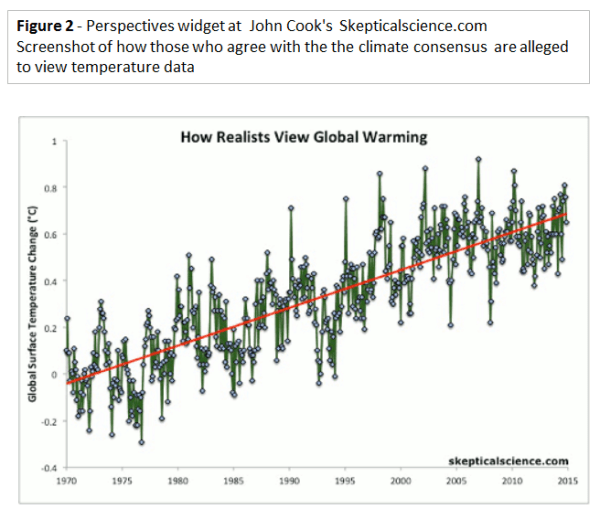
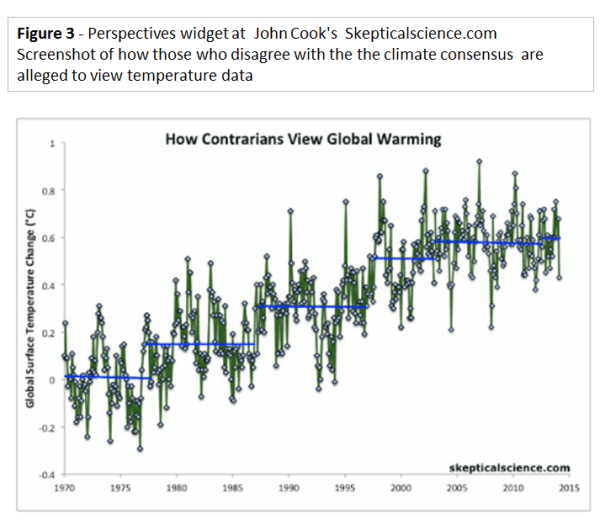
It is revealing that quote is under the subheading Consensus Estimates. The climate community have collectively failed to update the original beliefs, based on a very rough estimate. The emphasis on referring to consensus beliefs about the world, rather than looking outward for evidence in the real world, I would suggest is the primary reason for this failure. Yet such community-based beliefs completely undermines the integrity of the Bayesian estimates, making its use in statements about climate clear misinformation in Cook and Lewandowsky’s use of the term. What is more, those in the climate community who look primarily to these consensus beliefs rather than the data of the real world will endeavour to dismiss the evidence, or make up ad hoc excuses, or smear those who try to disagree. A caricature of these perspectives with respect to global average temperature anomalies is available in the form of a flickering widget at John Cooks’ skepticalscience website. This purports to show the difference between “realist” consensus and “contrarian” non-consensus views. Figure 2 is a screenshot of the consensus views, interpreting warming as a linear trend. Figure 3 is a screenshot of the non-consensus or contrarian views. They is supposed to interpret warming as a series of short, disconnected,  periods of no warming. Over time, each period just happens to be at a higher level than the previous. There are a number of things that this indicates.

(a) The “realist” view is of a linear trend throughout any data series. Yet the period from around 1940 to 1975 has no warming or slight cooling depending on the data set. Therefore any linear trend line derived for a longer period than 1970 to 1975 and ending in 2015 will show a lower rate of warming. This would be consistent the rate of CO2 increasing over time, as shown in figure 1. But for shorten the period, again ending in 2015, and once the period becomes less than 30 years, the warming trend will also decrease. This contracts the theory, unless ad hoc excuses are used, as shown in my previous post using the HADCRUT4 data set.

(b) Those who agree with the consensus are called “Realist”, despite looking inwards towards common beliefs. Those who disagree with warming are labelled “Contrarian”. This is not inaccurate when there is a dogmatic consensus. But it utterly false to lump all those who disagree with the same views, especially when no examples are provided of those who hold such views.

(c) The linear trend appears as a more plausible fit than the series of “contrarian” lines. By implication, those who disagree with the consensus are viewed as as having a distinctly more blinkered and distorted perspective than those who follow the consensus. Yet even using gistemp data set (which is gives greatest support to the consensus views) there is a clear break in the linear trend. The less partisan HADCRUT4 data shows an even greater break.

Those who spot the obvious – that around the turn of the century warming stopped or slowed down, when in theory it should have accelerated – are given a clear choice. They can conform to the scientific consensus, denying the discrepancy between theory and data. Or they can act as scientists, denying the false and empirically empty scientific consensus, receiving the full weight of all the false and career-damaging opprobrium that accompanies it.

fig2-sks-realists


fig3-sks-contras

Kevin Marshall


Climate Experts Attacking a Journalist by Misinformation on Global Warming

Summary

Journalist David Rose was attacked for pointing out in a Daily Mail article that the strong El Nino event, that resulted in record temperatures, was reversing rapidly. He claimed record highs may be not down to human emissions. The Climate Feedback attack article claimed that the El Nino event did not affect the long-term human-caused trend. My analysis shows

  • CO2 levels have been rising at increasing rates since 1950.
  • In theory this should translate in warming at increasing rates. That is a non-linear warming rate.
  • HADCRUT4 temperature data shows warming stopped in 2002, only resuming with the El Nino event in 2015 and 2016.
  • At the central climate sensitivity estimate of doubling of CO2 leads to 3C of global warming, HADCRUT4 was already falling short of theoretical warming in 2000. This is without the impact of other greenhouse gases.
  • Putting a linear trend lines through the last 35 to 65 years of data will show very little impact of El Nino, but has a very large visual impact on the divergence between theoretical human-caused warming and the temperature data. It reduces the apparent impact of the divergence between theory and data, but does not eliminate it.

Claiming that the large El Nino does not affect long-term linear trends is correct. But a linear trend neither describes warming in theory or in the leading temperature set. To say, as experts in their field, that the long-term warming trend is even principally human-caused needs a lot of circumspection. This is lacking in the attack article.


Introduction

Journalist David Rose recently wrote a couple of articles in the Daily Mail on the plummeting global average temperatures.
The first on 26th November was under the headline

Stunning new data indicates El Nino drove record highs in global temperatures suggesting rise may not be down to man-made emissions

With the summary

• Global average temperatures over land have plummeted by more than 1C
• Comes amid mounting evidence run of record temperatures about to end
• The fall, revealed by Nasa satellites, has been caused by the end of El Nino

Rose’s second article used the Met Offices’ HADCRUT4 data set, whereas the first used satellite data. Rose was a little more circumspect when he said.

El Nino is not caused by greenhouse gases and has nothing to do with climate change. It is true that the massive 2015-16 El Nino – probably the strongest ever seen – took place against a steady warming trend, most of which scientists believe has been caused by human emissions.

But when El Nino was triggering new records earlier this year, some downplayed its effects. For example, the Met Office said it contributed ‘only a few hundredths of a degree’ to the record heat. The size of the current fall suggests that this minimised its impact.

There was a massive reaction to the first article, as discussed by Jaime Jessop at Cliscep. She particularly noted that earlier in the year there were articles on the dramatically higher temperature record of 2015, such as in a Guardian article in January.There was also a follow-up video conversation between David Rose and Dr David Whitehouse of the GWPF commenting on the reactions. One key feature of the reactions was claiming the contribution to global warming trend of the El Nino effect was just a few hundredths of a degree. I find particularly interesting the Climate Feedback article, as it emphasizes trend over short-run blips. Some examples

Zeke Hausfather, Research Scientist, Berkeley Earth:
In reality, 2014, 2015, and 2016 have been the three warmest years on record not just because of a large El Niño, but primarily because of a long-term warming trend driven by human emissions of greenhouse gases.

….
Kyle Armour, Assistant Professor, University of Washington:
It is well known that global temperature falls after receiving a temporary boost from El Niño. The author cherry-picks the slight cooling at the end of the current El Niño to suggest that the long-term global warming trend has ended. It has not.

…..
KEY TAKE-AWAYS
1.Recent record global surface temperatures are primarily the result of the long-term, human-caused warming trend. A smaller boost from El Niño conditions has helped set new records in 2015 and 2016.

…….

2. The article makes its case by relying only on cherry-picked data from specific datasets on short periods.

To understand what was said, I will try to take the broader perspective. That is to see whether the evidence points conclusively to a single long-term warming trend being primarily human caused. This will point to the real reason(or reasons) for downplaying the impact of an extreme El Nino event on record global average temperatures. There are a number of steps in this process.

Firstly to look at the data of rising CO2 levels. Secondly to relate that to predicted global average temperature rise, and then expected warming trends. Thirdly to compare those trends to global data trends using the actual estimates of HADCRUT4, taking note of the consequences of including other greenhouse gases. Fourthly to put the calculated trends in the context of the statements made above.


1. The recent data of rising CO2 levels
CO2 accounts for a significant majority of the alleged warming from increases in greenhouse gas levels. Since 1958 CO2 (when accurate measures started to be taken at Mauna Loa) levels have risen significantly. Whilst I could produce a simple graph either the CO2 level rising from 316 to 401 ppm in 2015, or the year-on-year increases CO2 rising from 0.8ppm in the 1960s to over 2ppm in in the last few years, Figure 1 is more illustrative.

CO2 is not just rising, but the rate of rise has been increasing as well, from 0.25% a year in the 1960s to over 0.50% a year in the current century.


2. Rising CO2 should be causing accelerating temperature rises

The impact of CO2 on temperatures is not linear, but is believed to approximate to a fixed temperature rise for each doubling of CO2 levels. That means if CO2 levels were rising arithmetically, the impact on the rate of warming would fall over time. If CO2 levels were rising by the same percentage amount year-on-year, then the consequential rate of warming would be constant over time.  But figure 1 shows that percentage rise in CO2 has increased over the last two-thirds of a century.  The best way to evaluate the combination of CO2 increasing at an accelerating rate and a diminishing impact of each unit rise on warming is to crunch some numbers. The central estimate used by the IPCC is that a doubling of CO2 levels will result in an eventual rise of 3C in global average temperatures. Dana1981 at Skepticalscience used a formula that produces a rise of 2.967 for any doubling. After adjusting the formula, plugging the Mauna Loa annual average CO2 levels into values in produces Figure 2.

In computing the data I estimated the level of CO2 in 1949 (based roughly on CO2 estimates from Law Dome ice core data) and then assumed a linear increased through the 1950s. Another assumption was that the full impact of the CO2 rise on temperatures would take place in the year following that rise.

The annual CO2 induced temperature change is highly variable, corresponding to the fluctuations in annual CO2 rise. The 11 year average – placed at the end of the series to give an indication of the lagged impact that CO2 is supposed to have on temperatures – shows the acceleration in the expected rate of CO2-induced warming from the acceleration in rate of increase in CO2 levels. Most critically there is some acceleration in warming around the turn of the century.

I have also included the impact of linear trend (by simply dividing the total CO2 increase in the period by the number of years) along with a steady increase of .396% a year, producing a constant rate of temperature rise.

Figure 3 puts the calculations into the context of the current issue.

This gives the expected temperature linear temperature trends from various start dates up until 2014 and 2016, assuming a one year lag in the impact of changes in CO2 levels on temperatures. These are the same sort of linear trends that the climate experts used in criticizing David Rose. The difference in warming by more two years produces very little difference – about 0.054C of temperature rise, and an increase in trend of less than 0.01 C per decade. More importantly, the rate of temperature rise from CO2 alone should be accelerating.


3. HADCRUT4 warming

How does one compare this to the actual temperature data? A major issue is that there is a very indeterminate lag between the rise in CO2 levels and the rise in average temperature. Another issue is that CO2 is not the only greenhouse gas. More minor greenhouse gases may have different patterns if increases in the last few decades. However, the change the trends of the resultant warming, but only but the impact should be additional to the warming caused by CO2. That is, in the long term, CO2 warming should account for less than the total observed.
There is no need to do actual calculations of trends from the surface temperature data. The Skeptical Science website has a trend calculator, where one can just plug in the values. Figure 4 shows an example of the graph, which shows that the dataset currently ends in an El Nino peak.

The trend results for HADCRUT4 are shown in Figure 5 for periods up to 2014 and 2016 and compared to the CO2 induced warming.

There are a number of things to observe from the trend data.

The most visual difference between the two tables is the first has a pause in global warming after 2002, whilst the second has a warming trend. This is attributable to the impact of El Nino. These experts are also right in that it makes very little difference to the long term trend. If the long term is over 40 years, then it is like adding 0.04C per century that long term trend.

But there is far more within the tables than this observations. Concentrate first on the three “Trend in °C/decade” columns. The first is of the CO2 warming impact from figure 3. For a given end year, the shorter the period the higher is the warming trend. Next to this are Skeptical Science trends for the HADCRUT4 data set. Start Year 1960 has a higher trend than Start Year 1950 and Start Year 1970 has a higher trend than Start Year 1960. But then each later Start Year has a lower trend the previous Start Years. There is one exception. The period 2010 to 2016 has a much higher trend than for any other period – a consequence of the extreme El Nino event. Excluding this there are now over three decades where the actual warming trend has been diverging from the theory.

The third of the “Trend in °C/decade” columns is simply the difference between the HADCRUT4 temperature trend and the expected trend from rising CO2 levels. If a doubling of CO2 levels did produce around 3C of warming, and other greenhouse gases were also contributing to warming then one would expect that CO2 would eventually start explaining less than the observed warming. That is the variance would be positive. But CO2 levels accelerated, actual warming stalled, increasing the negative variance.


4. Putting the claims into context

Compare David Rose

Stunning new data indicates El Nino drove record highs in global temperatures suggesting rise may not be down to man-made emissions

With Climate Feedback KEY TAKE-AWAY

1.Recent record global surface temperatures are primarily the result of the long-term, human-caused warming trend. A smaller boost from El Niño conditions has helped set new records in 2015 and 2016.

The HADCRUT4 temperature data shows that there had been no warming for over a decade, following a warming trend. This is in direct contradiction to theory which would predict that CO2-based warming would be at a higher rate than previously. Given that a record temperatures following this hiatus come as part of a naturally-occurring El Nino event it is fair to say that record highs in global temperatures ….. may not be down to man-made emissions.

The so-called long-term warming trend encompasses both the late twentieth century warming and the twenty-first century hiatus. As the later flatly contradicts theory it is incorrect to describe the long-term warming trend as “human-caused”. There needs to be a more circumspect description, such as the vast majority of academics working in climate-related areas believe that the long-term (last 50+ years) warming  is mostly “human-caused”. This would be in line with the first bullet point from the UNIPCC AR5 WG1 SPM section D3:-

It is extremely likely that more than half of the observed increase in global average surface temperature from 1951 to 2010 was caused by the anthropogenic increase in greenhouse gas concentrations and other anthropogenic forcings together.

When the IPCC’s summary opinion, and the actual data are taken into account Zeke Hausfather’s comment that the records “are primarily because of a long-term warming trend driven by human emissions of greenhouse gases” is dogmatic.

Now consider what David Rose said in the second article

El Nino is not caused by greenhouse gases and has nothing to do with climate change. It is true that the massive 2015-16 El Nino – probably the strongest ever seen – took place against a steady warming trend, most of which scientists believe has been caused by human emissions.

Compare this to Kyle Armour’s statement about the first article.

It is well known that global temperature falls after receiving a temporary boost from El Niño. The author cherry-picks the slight cooling at the end of the current El Niño to suggest that the long-term global warming trend has ended. It has not.

This time Rose seems to have responded to the pressure by stating that there is a long-term warming trend, despite the data clearly showing that this is untrue, except in the vaguest sense. There data does not show a single warming trend. Going back to the skeptical science trends we can break down the data from 1950 into four periods.

1950-1976 -0.014 ±0.072 °C/decade (2σ)

1976-2002 0.180 ±0.068 °C/decade (2σ)

2002-2014 -0.014 ±0.166 °C/decade (2σ)

2014-2016 1.889 ±1.882 °C/decade (2σ)

There was warming for about a quarter of a century sandwiched between two periods of no warming. At the end is an uptick. Only very loosely can anyone speak of a long-term warming trend in the data. But basic theory hypotheses a continuous, non-linear, warming trend. Journalists can be excused failing to make the distinctions. As non-experts they will reference opinion that appears sensibly expressed, especially when the alleged experts in the field are united in using such language. But those in academia, who should have a demonstrable understanding of theory and data, should be more circumspect in their statements when speaking as experts in their field. (Kyle Armour’s comment is an extreme example of what happens when academics completely suspend drawing on their expertise.)  This is particularly true when there are strong divergences between the theory and the data. The consequence is plain to see. Expert academic opinion tries to bring the real world into line with the theory by authoritative but banal statements about trends.

Kevin Marshall