Australian Climate Science Opinion Survey – Confirming Prejudices?*

This survey I took in June is not the one used in the recent Lewandowsky et al paper. The one I took at “Watching the Deniers” is a development that 2010 survey. There are less questions on conspiracy theories (but “NASA faked the moon landing”, along with Diana, JFK and MLK assassinations are are still in) along with exactly the same questions on Free markets v Environmentalism. But the new survey has more on political beliefs (a good thing in my view) along with new sections on religious beliefs and GM foods. It seems to be directed beyond the free-marketeers, to other groups like the American Religious Right.

The Psychology Department of the University of Western Australia, under psychology research assistant Charles Hanich is conducting a short questionnaire on Science and Society.

UPDATE – The survey questions are available here.

SCIENCE AND SOCIETY

This study explores people’s beliefs about a wide range of topics, ranging from scientific propositions to claims made in the media and on the internet. In addition, the survey is interested in your attitudes towards your own life and issues confronting modern societies at the moment.

The questions all have five options – Strongly Disagree, Disagree, Neutral, Agree and Strongly Agree.

The questions are from both perspectives, so that people who are anything but totally neutral will have to agree with some questions and disagree with others.

The sections as follows (My headings)

  1. Climate Change – 5 questions
  2. Genetically Modified Foods – 5 questions
  3. Vaccines – Benefits and harms – 5 questions
  4. Position of the Conservative / Liberal perspective (US definitions) – 7 questions
  5. Select neutral (check of the software, or check for spam?) – 1 questions
  6. Free market system v social justice / environment / sustainability – 5 questions
  7. Conspiracy theories (political) – 6 questions
  8. Conspiracy theories (scientific) – 6 questions
  9. Personal Spirituality & Religion – 8 questions
  10. Evolution – views upon – 7 questions
  11. Corporations – 13 questions
  12. Personal emotional outlook – 6 questions

That is 74 questions in total. Like a lot of surveys, it understates the questions (“about 40”) and the time taken.

Climate Change Questions

  1. I believe that the climate is always changing and what we are currently observing is just natural fluctuation.
  2. I believe that most of the warming over the last 50 years is due to the increase in greenhouse gas concentrations.
  3. I believe that the burning of fossil fuels over the last 50 years has caused serious damage to the planet’s climate.
  4. Human CO2 emissions cause climate change.
  5. Humans are too insignificant to have an appreciable impact on global temperature.

There is a complete absence of questions about future projections of warming; whether that warming is catastrophic or benign; of the strength of the science or the uncertainties; our trust in what scientists are telling us; nor of the ability of policy to do anything successfully combat it. These are the questions that many sceptics, including myself, are grappling with.

Genetically Modified Foods
Questions

  1. I believe that genetic modification is an important and viable contribution to help feed the world’s rapidly growing population.
  2. I believe genetically engineered foods have already damaged the environment.
  3. The consequences of genetic modification have been tested exhaustively in the lab, and only foods that have been found safe will be made available to the public.
  4. I believe that because there are so many unknowns, that it is dangerous to manipulate the natural genetic material of foods.
  5. Genetic modification of foods is a safe and reliable technology.

In contrast these are questions do look at the benefits and costs of the science; the current impacts and future impacts; along with the strength of the science and the uncertainties.

NB the vaccines section follows more on the model of GM foods section rather than climate change.

The political spectrum questions I will leave for others to comment upon. It seems to be written by an American-influenced “liberal” who lacks knowledge of the full spectrum of political thought.

Free Markets v social justice / environment / sustainability

  1. An economic system based on free markets unrestrained by government interference automatically works best to meet human needs.
  2. The free market system may be efficient for resource allocation but it is limited in its capacity to promote social justice.
  3. The preservation of the free market system is more important than localized environmental concerns.
  4. Free and unregulated markets pose important threats to sustainable development.
  5. The free market system is likely to promote unsustainable consumption.

It is based on a notion of free-market anarchy against on the beneficial utopian society. No mention of awkward facts, like the worst environmental disasters and social injustices in the last century occurred in authoritarian regimes of left and right.

Conspiracy theories (political)

  1. A powerful and secretive group known as the New World Order is planning to eventually rule the world through an autonomous world government which would replace sovereign governments.
  2. The assassination of Martin Luther King, Jr. was the result of an organized conspiracy by U.S. government agencies such as the CIA and FBI.
  3. The Apollo moon landings never happened and were staged in a Hollywood film studio.
  4. The assassination of John F. Kennedy was not committed by the lone gunman Lee Harvey Oswald but was rather a detailed organized conspiracy to kill the President.
  5. The U.S. government allowed the 9-11 attacks to take place so that it would have an excuse to achieve foreign (e.g., wars in Afghanistan and Iraq) and domestic (e.g., attacks on civil liberties) goals that had been determined prior to the attacks.
  6. Princess Diana’s death was not an accident but rather an organised assassination by members of the British royal family who disliked her.

Basically, if you read the communiques and the proclamations coming out of annual meeting like Copenhagen, Cancun and Durban that say we must have a strong global organization to impose climate change, you should consider yourself as much a crank or nutter as those who think George Bush was capable of the phenomenally detailed planning required to stage the 9-11 attacks (but totally failed to successfully bring peace through conquest in Iraq or Afghanistan).

Conspiracy theories (Scientific)

  1. The claim that the climate is changing due to emissions from fossil fuels is a hoax perpetrated by corrupt scientists who wish to spend more taxpayer money on climate research.
  2. U.S. agencies intentionally created the AIDS epidemic and administered it to Black and gay men in the 1970s.
  3. The alleged link between second-hand tobacco smoke and ill health is based on bogus science and is an attempt by a corrupt cartel of medical researchers to replace rational science with dogma.
  4. The HIV virus causes AIDS.
  5. Smoking causes lung cancer.
  6. Lead in drinking water poses a serious long-term health risk.

The questions on climate and second-hand tobacco smoke lump two concepts together; a lot of money wasted for very little output along with the alleged motives of those practicing their research. In between is a particularly distasteful conspiracy theory, the very idea of which would be repellent to most people. The other three questions are simple statements of well-established science. There is no loading or controversy.

Religion and Evolution.

  1. God is important in my life
  2. I believe there is a life after death
  3. I get comfort or strength from religion
  4. There is no proof of God: if there is a God, he would have shown himself by now
  5. I think of myself as a religious person
  6. I have made a personal commitment to live my life for God
  7. I have had an experience of spiritual worship that was very moving and powerful
  8. I have experienced a definite answer to prayer or specific guidance from God
  9. Modern humans are the product of evolutionary processes that have occurred over millions of years
  10. The theory of evolution is based on speculation and not valid scientific observation and testing
  11. Most scientists accept evolutionary theory to be a scientifically valid theory
  12. There is a significant body of data that supports evolutionary theory
  13. Humans exist today in essentially the same form in which they always have
  14. Evolution is a scientifically valid theory
  15. Current evolutionary theory is the result of sound scientific research and methodology

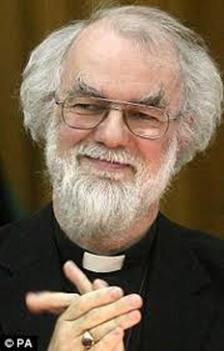
This is meant to distinguish between the US bible-belt evangelical Christians and the atheistic scientific community. It does so in a non-partisan way, so that Muslims could answer as well. However, it does not take into account the more nuanced, earnest, balanced and thoughtful approaches to the interactions of hard science and the timeless spiritual truths, as typified, is not caricatured, by Dr Rowan Williams, The Archbishop of Canterbury.

Corporations

  1. Corporations are not respectful of laws
  2. Corporations do not accept accountability for their actions
  3. People who run corporations will lie if doing so will increase company profits
  4. Corporations do not care about acting ethically
  5. Corporations will break laws if they can make more money from it
  6. Corporations put their own interests above the public’s interests
  7. Corporations are driven by greed
  8. Corporations care only about money
  9. Corporations want power at any cost
  10. Corporations take a lot more than they give
  11. Corporations intentionally deceive the public
  12. Corporations do not consider the needs of their employees when making business decisions
  13. Corporations exploit their workers

Any notion of balance goes completely out of the window. It is by far the largest section in a questionnaire on “Science and Society”. There is no switching between good points of corporations – such as technological breakthroughs, or much of our phenomenal prosperity. That includes the “Eco” technologies and the must-have gadgets from a fruity American 70s start-up. It is almost as if they want the more moderate participants to give up in disgust. Do avoid permanent psychological damage, they questionnaire end with a few personal questions about things in life you are thankful for, and people that you are grateful to.

The missing sections

No not the political spectrum one. The missing questions that a more balanced questionnaire might ask.

  1. General trust in climate science.
  2. Trust in carefully presented evidence, with questions respectively answered, as against the dogma of “scientists agree”.
  3. Questions for the Australian people, of whether carbon tax policies are worthwhile
  4. Questions on trust in government; the motives of politicians; the ability to deliver on promises. In relation to both Western democracies and tyrannies past and present.
  5. The importance of tackling climate change relative to other issues like unemployment and prospective financial meltdown in parts of Europe.

Conclusion

When devising a questionnaire, one must always try to eliminate bias, and avoid emotionally loaded the questions that will prejudice the answers. Neither should it contain multiple issues in a question. This survey does just the opposite. It is started off being deliberately designed to elicit certain polarized responses, ending up showing the deeply prejudiced and politically extreme position of the author.

*Please note. I am not aware of any copyright restrictions on reposting the questions. I accessed this from “Watching the Deniers” website, where there was no mention of copyright material. Neither was there any mention of copyright on the introductory front page. The doing a search I only came across a link to a 2010 survey. Neither could I find a link within The University of Western Australia Website, though it is on their servers.

Big Oil Funding of Climate Denial – An Examination of the Thesis

It is a common them by those who most dogmatically support the climate change agenda that the opposition are funded by big oil and similarly evil companies. There are potentially a number of angles to this viewpoint.

  1. If money does influence outcomes then we should see that where money on one side is hundreds of times greater than a ragbag of critics, then the critics will be drowned out. This is clearly not the case.
  2. When political parties complain of a money bias, this often goes hand-in-hand of complaints of media bias. But in the global warming sceptics have the most grounds for complaint on the media front. For instance the policies of the BBC and Guardian Newspaper.
  3. Maybe then the sceptics are winning, despite the lack of funds and despite the strong media bias against them, because they are using inappropriate language. My belief is that it is the mainstream who are guilty of intolerant and misleading language.
  4. Maybe the outside money has led to sceptics having undue influence on decision-making, subverting the democratic process. Like the WWF has achieved with the IPCC process?
  5. Maybe the sceptics are guilty of campaigns to misrepresent the status of the science. Like the eco activists “cajoling” scientific organisations to make political proclamations?
  6. Maybe it is the source of funding that creates the greatest bias. In the case of big oil money, if they decided to fund both ways, there are two ways to go. Either, the credibility of both sides is forever tainted, or, if the money was loaded massively one way, then on one side is tainted far more than the other.
  7. Maybe it is because big oil funds climate denial that we should be most concerned. The alternative explanation is that public knowledge of the funding will lead to attacks by environmental groups. To support of attacks by environmental groups (and hence viewing the secrecy of “denial” funding) require two moral points to be maintained. The first is that the views supported are evil. Second, that character assassination, or blockading of premises, or physical attacks on opponents are legitimate ways of opposing those you disagree with.
  8. Maybe, big oil could be viewed by some as being immoral or evil. Others might view with suspicion funding from anyone who makes their money in the gambling industry (especially if they pleaded guilty to money laundering in connection to those activities). They may also view with suspicion currency market speculators, especially one who made over $1bn at the expense of UK taxpayers.
  9. Maybe it is only recent big oil funding that has tainted the policy outcomes. The alleged bad reputation of the oil industry was largely down to one individual in creating a virtual US monopoly in oil production in the late nineteenth century. I do not see a similar smearing of the activities of the foundation created with the ultimate in big oil money.

In short I can see no valid reason to base rejection of critical viewpoints on climate change simply because of unsubstantiated allegations of big oil funding.

I offer an alternative view of those who make these allegations. The belief in “evil funding” stems from a belief they are guardians of some fundamental and irrefutable truths. Furthermore, these truths are concerning a future apocalypse. By implication, those who have an unwillingness to accept that truth is due to out-right lying, or having being deceived by some evil entities, or because they are not right in the head. Historically, those who have maintained to be Truth Guardians, have never substantiated their arguments or allowed for error, or allowed the slightest deviation. Instead they have sought to discourage or prevent people exploring alternatives, knowing deep down that the process of questioning will lead to the understanding that their beliefs are either extreme or in many respects wrong.

Scottish Sceptic on summarizing the sceptic position

I came across the blog Scottish Sceptic at the weekend. At the site, the owner has been compiling a non-polemical summary of the mainstream sceptic view of the science. Unlike here, the statement studiously avoids discussion of policy or politics. I made the following comment in the hope of furthering discussion.

I have had a look through the above, and it appears a fair summary the sceptic position of the science. In general it shows how magnitude and likelihood go in opposite directions. The best corroborated science has trivial implications. The most alarming predictions are basically of the form “If A then maybe B. If B then possibly C. If C happens in a certain way then it could be D. D is an extremely alarming situation” This then gives the headline like

Leading scientists are concerned we are heading for D“.

Having read quite widely on sceptic ideas, on the subject of climate models, sceptics view them as “black boxes“. This would not be concerning if they followed the normal scientific procedure of rigorously evaluating the predictions with the actual data, and adjusting accordingly. Instead, it appears to be past data that gets adjusted to the models, along with some very fuzzy analysis.

Another point is that sceptics tend to see a scientific approach as questioning, identifying anomalies, and getting ever more precise answers. Mainstream climate science is nearer to a definition of “science is what scientists do”.

That leads to another point. Sceptics tend to demand higher levels of evidence. The mainstream seems to accept levels of evidence that a criminal court of law would reject. “Scientists believe/agree”, or “Climate Models predict” or comments a court would reject such views as either hearsay or unsubstantiated. So in the wider world sceptics are not the ones with the marginal position.

John Redwood lights the “Global Warming” fuse again

John Redwood bravely touched on the global warming subject again in “Challenging establishment orthodoxies“.

One of the strange features of global warming theory is the reaction of its leading protagonists. They say it is scientifically derived, but then go on to say the science is proven and established. I thought the essence of scientific method was to reach a hypothesis that seemed to fit the facts, and then to keep trying to improve or destroy it by further testing or experiment. This seems to be a thesis where the aim is always to buttress it rather than test it. For many years scientists thought Newton had said the last word on planetary motion, but the twentieth century did not rest until they had replaced or improved on the Newtonian universe in a dramatic way.”

My comment (following from previous comments made on this blog) was

You will notice that whenever you mention “Global Warming” that you are guaranteed to get a greater number of comments compared to practically any other issue. Further the views are probably more polarized and politicized than any other issue.
However, the way to proceed might not be one of hypothesis testing. The data is complex and most of the science is about future events. Rather, it might be worth using the experience with which you are more familiar.
1. In business, a new investment proposal will just be assessed on the theoretical profits, but on the capacity to see that proposal through to actual success. The Stern Review allegedly gave the theory, but there was nothing on public policy issues of controlling policy costs, and maximizing policy benefits (CO2 benefits). Whatever the policy, this failure to focus and project management is a sure guarantee of policy disaster.
2. In politics, the greatest threat to extremist and untenable viewpoints has been from the majority who are able to compare these viewpoints to their other perspectives. That is why authoritarian regimes only can exist in an environment where they silence criticism. There is growing evidence of excluding contrary views without a fair hearing in our scientific institutions, in research funding, and in the mainstream media.
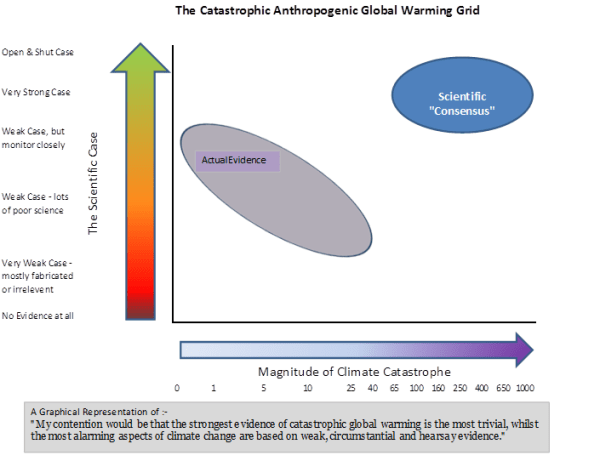
3. Science at the frontiers about making bold hypotheses that can be falsified by later testing. Similarly, the police in a crime investigation make conjectures and then gather evidence. Established science (on which policy should be based) is like a successful prosecution in a criminal case. It is about presenting the evidence and under-going a cross examination by the opponents. This to convince a randomly-selected group of people. My contention would be that the strongest evidence of catastrophic global warming is the most trivial, whilst the most alarming aspects of climate change are based on weak, circumstantial and hearsay evidence.

Two relevant references
https://manicbeancounter.com/2011/02/13/climate-change-in-perspective-%E2%80%93-part-2-of-4-the-mitigation-curve/
https://manicbeancounter.com/2012/02/20/a-climate-change-global-warming-spectrum/

The Morality of Lying and Exaggerating for Climate Science

In the Guardian today, James Garvey, argues that the actions of Peter Gleick in lying to obtain documents from the Heartland Institute could be justified in the interests of the wider good. He says

The documents, if authentic, show that Heartland takes money – in secret – from people who have something to gain by the idea that climate science is uncertain, and then spread that idea with enthusiasm. Do I actually need to say this in 2012? There is no controversy in the scientific community about Heartland’s target: the fact of warming and the human role played in it.

What Heartland is doing is harmful, because it gets in the way of public consensus and action. Was Gleick right to lie to expose Heartland and maybe stop it from causing further delay to action on climate change?

There are some issues with this statement

  • The most important strategy document is almost certainly fake. Peter Gleick was accused of being the source of the leak by Steven Mosher, because this document was in his distinctive style of writing, including grammatical errors. Gleick denies he wrote the fake document, but now admits to (the lesser crime of) obtaining the other documents by deception.
  • The following statement is ambiguous

    There is no controversy in the scientific community about Heartland’s target: the fact of warming and the human role played in it

    It can mean one of four options. First, that the “scientific community” believe what the Heartland’s target is (so there must be a straw poll somewhere). Second, the scientific community believe in anthropogenic global warming. In which case there a definition of who is in the “scientific community” and who is out. The “97% of scientists believe” was a small subset of all scientists in the climate field, who were asked two very trivial questions, so the degree of belief is not in the predicted level of catastrophe that will justify drastic action. Third as to whether the human role played in (global warming) is a fact. The statement of global average surface temperatures being higher than they were 50, 100, 150, or 400 years ago is incontrovertible (though the actual amount is debatable), but the human role is a subject of wide controversy. They are two separate facts, so the human role is just a belief of the 97% of 1.6% of those who answered two trivial questions, which was just over 30% of those who received questionnaires. Whatever the ambiguities in the statement, it does not rely on scientific evidence, as there is plenty of controversy of the anthropogenic contribution due to a lack of incontrovertible scientific evidence.

  • If the scientific consensus was created by a minority  and maintained by “outing” any who voiced concerns, with activists seeking to annul their funding, then that “consensus” opinion should be viewed with a little bit of scepticism.
  • The statement “What Heartland is doing is harmful, because it gets in the way of public consensus and action.” is a potential moral minefield. If 90% of the population decide that it is alright to persecute a peaceful minority would that be alright? If 90% of the population strongly believe that potential terrorists should be held without trial and tortured, would that be alright?

But leaving these issues aside, the problem with telling lies, or exaggerating, is when you are found out. Once you have lost people’s trust, it is very hard to regain that trust. Dale Carnegie in “How To Win Friends And Influence People” made this very point. 
However, from a purely utilitarian point of view it might be permissible to mislead a suspect criminal in order to find the evidence, at it is not that person’s trust that you want to maintain. The wider public will generally think well of you if you get a criminal off the streets. But if it is to marginalise you opponents, it will backfire if the wider public then perceive that you cannot be trusted. This is especially true when much of the case for climate change is based on trust in scientists to report accurately on a complex subject.

The reasons that there is growing distrust in the scientific consensus are multiple:

  • Michael Mann’s hockey stick studies were based on cherry-picked data, biased weightings of individual studies that showed hockey sticks over the ones that did not AND the favoured studies have all been overturned.
  • The UNIPCC 2007 report did not live up the projected image in a number of areas. The Himalayan Glaciers episode is only the tip of the non-melting iceberg. It is full of partisan analysis and exclusion of contrary science.
  • The Climategate email hack also showed the public image of certainties held by a wide number of scientists is nothing of the sort. The core group are highly partisan, and have taken strenuous efforts to exclude contrary views from the journals.

Finally, please remember that activists have got every major scientific body, including the Royal Society, to make proclamations in favour of Global Warming Alarmism. If public funding of science is seen to go to those who lie and exaggerate, then there will be increased distrust in all areas of science. These activists scientists are risking more than their own reputations.


A Climate Change / Global Warming Spectrum

In politics, most people’s views can be placed on a spectrum, when it comes to climate change / global warming there is no such perspectives. The views are often polarized, particularly by those who believe in a future climate catastrophe. This is an initial attempt at a grid aimed at clarifying the issues. Your constructive advice is sought on how this might be improved.

When there are contentious or politicized issues, a spectrum of opinions emerge where there is free discussion of ideas. This is true in politics and the Christian religion. In both, there is not just a one-dimensional spectrum of ideas, but multi-dimensional perspectives. For instance, in politics it has been argued that the left-right spectrum should be split into economic and moral issues. The United States Libertarian Party has had a simple survey running since 1995. A more comprehensive (but still American-orientated) survey is the Political Spectrum Quiz.

Another idea comes from Greg Craven, who did a series of zany You-Tube videos on Climate Change, particularly such as The Most Terrifying Video You’ll Ever See” and “How it all ends“. He claimed that for the mass of non-scientists it was best to take a risk-based approach, grading the science on the credibility of those who made the claims. One objection with his analysis was it was based on polar extremes. That is either the worst climate catastrophe imaginable, or it is all a hoax. I proposed that there was a spectrum of possible outcomes, with the apocalyptic catastrophe at one extreme and the null outcome at the other. Basically there is a spectrum of views.

For this spectrum, the possible scenarios are from the null outcome on the left, rising to a huge climate catastrophe on the right.

Craven’s argument was to consider either 0 or 1000, whereas I claimed that the UNIPCC scenarios (representing the “consensus” of climate scientists), allowed for a fair range of outcomes. I have provided a log scale, as this puts clear distance between someone who believes in a low risk of catastrophe of extreme catastrophe to someone who says there is no risk at all. For instance, if someone believes that there is a 1% chance of the worst case, a 9% chance of loss of 100 and a 90% chance of a loss of 10, then their score would be 0.01*1000 + 0.09*100 + 0.90*10 = 28. In other words, for that person, especially if they are risk averse, there is still a very significant issue that should justify serious consideration of some type of global policy action.

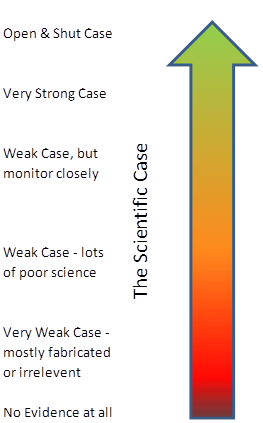
But this measure of the prospective level of climate catastrophe needs to be based upon something. That something is scientific evidence, not people’s intuitions or gut feelings. If we imagine that the uncertainties can be measured as risks (as neoclassical economists do) then then the worst case scenario can only be attained if there is near certain, unambiguous scientific evidence in support of that prediction. If the evidence is weak statistically, gives highly variables results depending on methodology or data sets, or only tangential to the prediction, then a lower risk weighting lower than 1 will need to be ascribed. For an overall picture, we need to ascribe a weighting to the body of evidence. I propose a traffic light system. In outline green is for an overwhelming body of evidence, red is for no proper evidence whatsoever, and amber is for some weak evidence. Something along the following lines:-

Basically, an unambiguous case for impending global catastrophe must have a substantial body of strong scientific evidence to substantiate that case, with little or no contrary evidence. I will develop on another day the analogy with evidence presented to a criminal court by the prosecution. However, for the present, an analogy that is relevant is that this conclusion is only reached once the evidence fails to fall over under independent cross-examination.

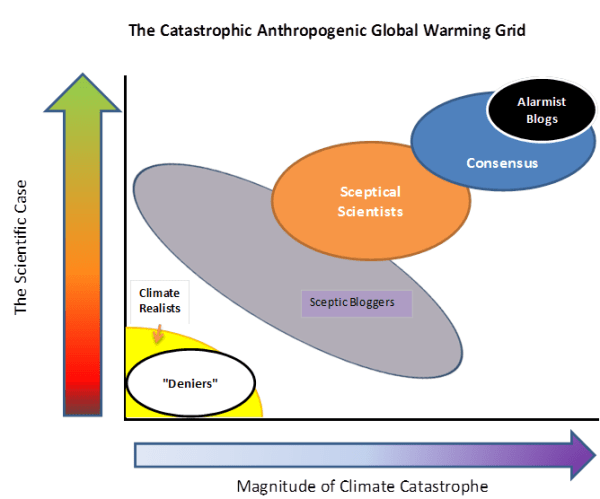
This gives us a grid with the magnitude of the climate catastrophe on the X axis, and the scientific case on the Y axis. The grid, with my first opinion of where people various groups are placed, is given below. I know it is controversial – the whole aim is to get people to start thinking constructively about their views.

Alarmist Blogs (for instance Skeptical Science and Desmogblog) have an extreme black-and-white one world where they are always right, and anyone who disagrees is the polar opposite . “Deniers” is a bogeyman construct of their making.

If one reads the detail of UNIPCC AR4 report, the “Consensus” of climate scientists allow for some uncertainties, and for scenarios which are not so catastrophic.

The more Sceptical Scientists, such as Richard Lindzen, Roger Pielke Snr and Roy Spencer, view increasing greenhouse gases as a serious issue for study. However, they view the evidence as being both much weaker than the “consensus” and pointing to a much less alarming future.

The most popular Sceptic Blogs, such as Wattsupwiththat, Climate Audit and Bishop Hill I characterise as having a position of “The stronger the evidence, the weaker the relevance“. That is they allow for a considerable spread of views, but neither dismiss rise in CO2 as of no consequence, nor claim that the available evidence is strong.

Finally, the Climate Realists such as Joanne Nova and the British Climate Realists website. They occupy a similar position as the “deniers”, but from a much more substantial position. They can see little or no evidence of catastrophe, but huge amounts of exaggeration dressed up as science.

What are your opinions? What position do you think you lie on the grid? Is there an alternative (and more informative) way of characterizing the different positions?

A Bet Won on the Warming Standstill

Congratulations to Dr David Whitehouse of the GWPF for winning a bet with Dr James Annan.

The bet, made in 2007, was that by 2011 that HADCRUT3 temperature record of 1998 would not be beaten by 2011. The bet was made at the instigation of the BBC Radio 4 program “More or Less”. Annan then provided data analysis to show why he was odds-on favourite to win the bet here and here. Both RealClimate and Mark Lynas had earlier weighed in with articles giving the mainstream viewpoint. I post on Dr Annan’s blog the following comment

The mark of good science is not to predict the obvious, but to predict the unlikely.

Dr Whitehouse has stated that it was going beyond the obvious that enabled him to take on the bet. His full analysis can be found at both the GWPF and wattsupwiththat.

Of course there are those who will point to the biased GISSTEMP to show that the warming is continuing. See my analysis here about why that dataset looks to be a little biased. There are of course those who will still maintain the warming is continuing (such as Roger Black of the BBC), but the true measure is the predictive ability.


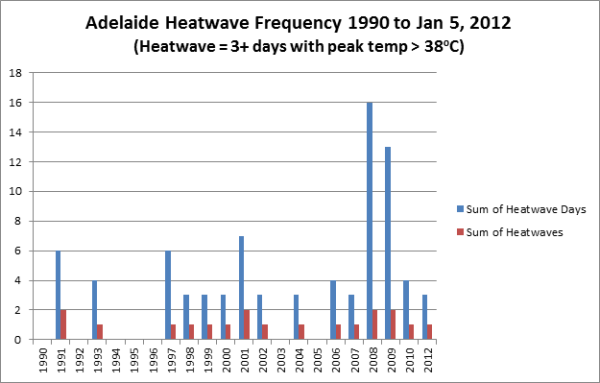
Adelaide – a decline in extreme heatwaves?

Joanne Nova has posted data from Ian Hill on extreme heatwaves in Adelaide, Australia. To quote

It’s another mindless record used to remind the public to “keep the faith” and recite the litancy:

“Adelaide had it’s hottest start to the year since 1900 Sky news

Picking three particular days out of 365 and comparing them over a century is about as cherry-pickingly meaningless as it gets. But Ian Hill went back through the records to find that not only have there been 79 heatwaves in Adelaide since 1887, but there have been 51 heat-waves that were hotter since 1887.

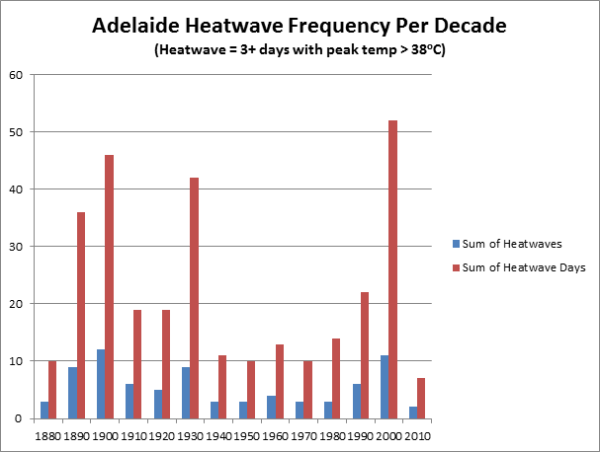
I have done a bit of number crunching of my own, that is quite revealing. Higher temperatures are meant to lead to more extreme heatwaves. Using Ian Hill’s figures Adelaide is providing an exception. Hill’s definition of a heatwave is 3 or more consecutive days where the maximum temperature exceeds 38oC. I have downloaded the figures and categorised by decade. There are two ways I have analysed this data. First is by the number of heatwaves per decade. Second is the number of days per decade.


There are a number of points.

  1. The temperature data only starts in 1887, so the 1880s are probably more significant.
  2. The current decade might be more significant.
  3. Last decade, beginning 2000 was no more significant than the decades 1890s, 1900s, or 1930s.
  4. The 1990s was no more significant than the decades 1910s and 1920s

Is there, however, a revival of extreme heatwaves in the last twenty years?

Nope. Just a couple of extreme years in 2008 and 2009.


WWF aims for World Domination?

Donna Laframboise has a posting on the sheer scale of the World Wildlife Fund (cross- posted at wattsupwiththat). No longer a small cuddly charity it has global revenues of €524m, 5,000 staff and a presence in 30 countries.

This is Part 1. What will part 2 bring? Might I guess that it could be on future ambitions?

Might I suggest that Donna Laframboise will direct us to pages 26 & 27 of the 2010 Annual Review (Page 14 on Google Docs)? WWF is celebrating its’ 50th Anniversary, so naturally it will look ahead.

The Section is “WHAT WE WILL ACHIEVE“. There is no “might” or “by supporting others”. It is what WWF will achieve on their on.

The first is mild and a laudatory objective, well-within their remit.

By 2022 the number of tigers in the wild has doubled from just 3,200 in 2010.”

That is great and why many support the WWF, along with saving pandas and polar bears. Although, they might need to persuade others, like the Indonesian and Indian Governments, to do most of the work. Next is a bit more ambitious.

By 2030 “the amazon’s land and freshwater ecosystems are properly conserved, so they’re no longer under threat.”

A bit more ambitious, but short of funding thousands of armed environment enforcement officers to police over a million square miles of Brasil, Peru, Columbia, Bolivia and Venezuela, along with the necessary legal powers this may not be achieved without some assistance. Sovereignty issues spring to mind.

By 2020 “Through energy efficiency, sustainable management of natural resources and emissions cuts, China’s economy is growing within the capacity of one planet.

Now, unless this is meaningless guff, China will make actual cuts in their emissions through the actions of WWF (not the UNIPCC). Currently the Chinese government has said it will grow their emissions by less the nation’s growth rate. With 10% growth, it means the current plans are for China’s emissions will more than double from 2010 levels and still meet the targets. An actual cuts would mean closure of new coal-fired power stations, closing the airports, denying hundreds of millions the prospect of car ownership, covering the area in windmills and a drastic reduction of growth to maybe 2-3%. This could only be achieved by a coup d’etat followed by a government as brutal as Mao Zedong or Josef Stalin in their primes. But the biggest one is.

By 2050 “Global Greenhouse gas emissions have been cut by 80% compared to 1990 levels”

This is the biggest ambition by far. Since 1990 greenhouse gas emissions has increased substantially. So the level of cuts in little more than a generation is immense. There is no global agreement in place, nor is there likely to be. Even if there were an agreement, it cannot be achieved without vast human suffering (here & here). To impose a reduction not just in growth, but in living standards as well, would require a highly repressive global regime, the like of which the world has never seen. There are three possible scenarios

1. WWF has advanced plans underway for World Domination

First it will take over the UNIPCC (where it is already highly influential). Then it will organise a coup d’etat in China. It will then use this as a springboard for world domination.

2. The WWF has a vastly overblown sense of its’ own importance

The WWF has been taken over by a bunch of climate extremists who have lost a true perspective on reality.

3. The WWF does not internally check its’ major annual report

Which means that the longer reports WWF produces on climate change, (the famous grey literature on UNIPPC AR4) are probably not checked as well. WWF therefore needs to clean-up its act if it is to be taken seriously as an environmental organisation.

One might notice an ascending order of likelihood in the scenarios 🙂

Al Gore’s faulty case for CAGW

Wattsupwiththat have an estimate of Al Gore’s Climate Reality online viewing figures. I posted at the follow-up article

manicbeancounter says:

September 22, 2011 at 12:17 pm

I was one of those who stayed for over 5 minutes.

A video they had justified the case for global warming by re-doing the CO2 in a jar experiment – very nicely as well. Only they did not say what the concentrations were compared to the atmosphere (probably >1000 times the 0.04% at the moment).

Then in the space of a sentence mentioned feedbacks amplifying the effect.

So of the predicted warming up to 6 degrees centigrade this century predicted by the most extreme alarmists, Al Gore’s little video had a flawed experiment to justify the insignificant first 20%, and a “trust the computer models” for the alarming bit.

Don’t take my word for it – I am just a (slightly) manic beancounter. Check out for yourself at http://climaterealityproject.org/video/climate-101/

By the way – don’t worry about the stats – Alexa currently ranks this site at 16,989 and Climate Reality at 64,734.

REPLY: I have a post coming up on this video, which is online here also, without the need to visit Gore’s site: http://vimeo.com/28991442
-Anthony