Labour’s Hypocrisy on Rising Energy Bills

If you go to the Labour Party’s website there is an announcement.

Clicking down will take you to energy price calculator. I found out with Ed’s policy I could save £112 per year.

Two weeks after the announcement, still no links to the actual plan, but there is a video to watch.

Just one minute and twenty-six seconds for a distinguished actor to say the following:-

How do you feel when you see your energy bill sitting at the front door and you know that it is going to be even higher than the last one?

And how do you feel when you read in the newspaper that your energy providers’ profits are up yet again?

Millions of ordinary families are struggling to keep up with bills. Bills that are rising faster than wages.

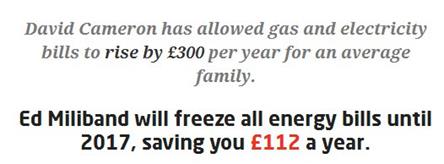
Since David Cameron became Prime Minister, he’s allowed gas and electricity to rise by an average of £300 a year and sat by as energy companies make record profits. Under this Government a privileged few come before hard-families. Ed Miliband and Labour are going to change that. Ed’s energy plan will mean a tough new regulator with the power to challenge the energy companies and keep prices down. Under Ed’s energy plan gas and electricity bills will be frozen. That’s right frozen. Under the Tories you have overpaid. Labour will fight the cost of living crisis and build an economy that works for working people.

The inference is that your bills are rising solely due to the ever-increasing profits of the energy companies. Further the nasty Tories had it in their power stop it. Along will come Labour and stop all that.

I have looked up the figures. Since the 2009, the energy regulator OFGEM has required the six big energy companies to produce financial data by five segments. That is for electricity generation, along with supply data for electricity and gas, each split between domestic and non-domestic supply. I have analysed all four years of data for the six companies, using links provided by OFGEM. There is, of course, no financial data available for 2013 as the year has yet to finish.

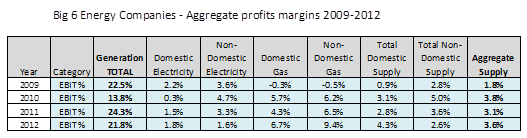
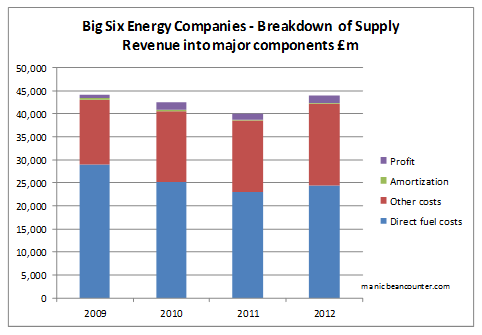
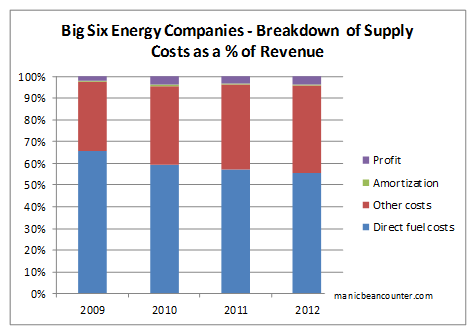
If Labour are correct in their inference of price rises being due to increasing profits then profits will be increasing as a percentage of sales. With the typical household’s bill rising by over 20% between May 2010 and the end of 2012, profits as a percentage of revenue would be rising sharply. The following shows the percentage components of revenue.

The narrow band in purple for profit increased from 1.8% of sales to 3.8%. It is not increasing profits that have caused the price rises. The reason for doubling is because, in total, the six major companies lost money on gas supply in 2009. Nor is there a sharp difference between domestic and non-domestic supply margins. You could claim that the energy companies are making more money on generation instead. They are not, as the full margins, by segment, by year, show below.

The total sales breakdown enhances the picture.

Although total are broadly the same in 2009 and 2012, revenue from domestic customers was 13%, whilst that from non-domestic customers was 17% lower. The reason Labour have a higher figure is they rely on OFGEM’s notional average user, who uses the same amount of energy year-in-year out. Real hard-working families have responded to rising prices by reducing consumption.

What is most important is why unit costs have risen. Labour are correct when they say it is not due to the wholesale price of energy. As already demonstrated, they are incorrect to say it is due to rising profits. The real reason is “other costs”. These rose from 32% to 40% of revenue in just four years. That is from £14.1bn to £17.7bn in just four years or a 25% increase. On declining volumes this is more significant for consumers.

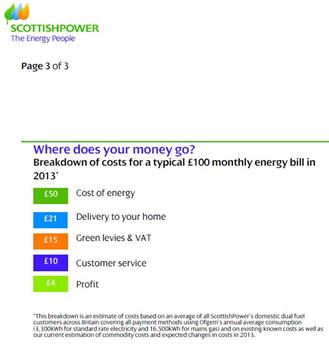
These figures are corroborated by a breakdown by my energy supplier, Scottish Power.

With VAT at 5%, the Scottish power says that its charges to the domestic customer in 2013 are made up of 53% for fuel and 43% for other charges. This compares to the industry average in 2012 of 55.7% for fuel and 40.6% for “other costs” plus “amortization”. The higher proportion of other charges to domestic customers is to be expected, as small domestic customers have lower costs. The relevant domestic figures from the big six are 51.8% for fuel and 44.0% for other charges. Given the obviously rounded Scottish Power figures, they are remarkably close to the industry average.

The supply market is fiercely competitive, hence the real reason for the ability of customers to save money by switching suppliers. Therefore it is doubtful that internal costs will have risen. What has risen is the delivery of the energy to the home (National Grid, local delivery, and cost of meters), along with green levies. So it is likely over 75% of the price increases to the customer are due to factors outside of the energy supplier’s control.

Where does responsibility lie for the above-inflation price increases?

The dash for “clean” energy to save the planet is enshrined in the Climate Change Act 2008. It was pushed through the House of Commons when Ed Miliband was Environment Secretary. This accelerated the growth in green levies and the requirement for a more extensive grid network to carry the wind-generated electricity from remote turbines. Delve further in the profits on electricity generation and you will find that fossil fuel generation has margins of 10%. A price freeze will eliminate the supply profits in six months, and the generation profits in two years. The is a sure way to get a near monopoly in gas supply, and cause the rapid shut-down of three-quarters of generating capacity. It is an act of gross hypocrisy by Ed Miliband to threaten to destroy a competitive industry to remedy a problem that he is responsible for.


NB First time comments are moderated. The comments can be used as a point of contact.

Kevin Marshall
Tyndall Centre’s New Totalitarianism

Updated with more examples 14/12/13 11am

The Tyndall Centre for Climate Change Research (HQ at the University of East Anglia, with branch office just down road from me at Manchester University) held The Radical Emission Reduction Conference: 10-11 December 2013 at the offices of the Royal Society. Joanne Nova reporting on the conference quoted the following:-

Today, in 2013, we face an unavoidably radical future. We either continue with rising emissions and reap the radical repercussions of severe climate change, or we acknowledge that we have a choice and pursue radical emission reductions: No longer is there a non- radical option.

My first reaction was

These people have not discovered logic or the real world outside of their groups. For instance

1. Where are the robust, unambiguous, forecasts of “severe climate change” impacts? Lacking this, the “do-nothing” scenario could be an alternative.

2. Radical emission reduction policies may not work. Useless policies could end up causing mass impoverishment, leaving future generations much less able to cope with the coming climate apocalypse.

3. Radical emission reduction policies may be both necessary and work in theory, but will never be enacted because “radical” activists have not learnt the art of persuasion and appreciating that other points of view are possible.

Following an initial reading of the conference abstracts, this initial reaction was somewhat understated. The 1.01MB file is at radicalplanabstracts.pdf. Some notes.

The Philosopher’s case for Totalitarianism

On pages 15 to 17 is ‘Responsibility for radical change in emission of greenhouse gases’

Page 16

Generally it is acceptable to frame scenarios of climate change in terms of cost-efficiency, percentages of emission reduction or the target atmospheric CO2 concentration. Yet we develop the argument that predefining the outcome of any change limits the possible processes leading to this change. In fact, when we already know the necessary outcome, the change that is necessary cannot be considered radical at all.

Page 17

For the radical change in greenhouse gas emissions the responsibility towards the radicalness of change means that those involved in the climate change negotiations and policy-making need to let go of their preconceived notions of climate, change, and general structure of cause and effect, science and human life.

And in conclusion

We argue that one cannot desire radical change without acknowledging that we (individuals and institutions) may be swept off our feet, that we may lose influence and control. We need to accept that modifications are not going to bring about radical emission reductions. What we need is radical change, including radical change in our own backyard, our understanding of leadership and in our own epistemic notions of what change means.

All that matters is saving the planet. It is not about saving the planet for future generations, as we humans do not matter. It is not about the climate models being accurate – as they are supposed to about modelling cause (increasing greenhouse gas levels) with the effect (catastrophic anthropogenic global warming). And it is not science.

The Economist’s case for Totalitarianism

On pages 7 to 9 is ‘Demand-side regulation in the policy mix to achieve radical CO2 reductions: modelling global decarbonisation with E3MG

Page 7

Radical reductions in CO2 emissions from reductions in consumption of fossil fuels across the economy could be modelled as coming from changes in life-styles, regulations or prices or a mix of all three. The main demand-side sources arise from the use of fossil fuels in buildings, transport and industry, and indirectly, via the use of electricity generated from fossil fuels. We assume that the power sector becomes decarbonised via a mix of emission trading schemes and regulations. We then consider the implications of a rapid reduction in demand-side fossil-fuel use coming from higher energy prices and regulation of equipment standards and energy efficiency.

To achieve the plan, all the advanced countries (and some not-so-advanced like Belarus) will introduce emissions trading schemes ETS with low tariffs in 2015, sharply escalating after 2020. Emerging economies (e.g. China, Brazil & Mexico) will introduce schemes in 2020 at lower rates. By 2030, in conjunction with tougher economic regulations, coal-fired power stations will be phased out.

With respect to the regulations

These effects are then strengthened from 2020 onwards, with the energy saving, the associated investment and increase in prices all rising by some 17%pa. By 2030 the strength of the regulations is about 5 times that assumed by the IEA. The scale of this increase gives an indication of just how strong regulations have to become.

Italics mine. The plan will only work if it far, far tougher than anything yet on the table. At least the models predict that there will be a small net benefit.

The Increase in investment, including indirect effects, is about 4% above the reference scenario by 2030. Combined with the effects of revenue recycling and the lower growth in world oil prices, it generates more output and employment, raising both growth rates by some 0.2 percentage points each year over the decade.

So in China, which has had near 10% annual growth for over two decades based on cheap coal-based energy, can switch to much more expensive and less reliable “clean” energy sources, with a small net benefit. Hmmm.

People will change their lifestyles if they are unable to afford to do otherwise. Businesses who do not respond will be expropriated for the common good, and their denialist bosses sent to be re-educated in labour camps. The plan will work, and the economic models are infallible. Any deviation from the plan will be therefore be due to economic sabotage.

The Psychologist sees a problem – but does not want to say so

On pages 12 to 13 is ‘Psychology of human acceptance and engagement

A short abstract, quoted in full

The need to voluntarily write off fossil fuel reserves is now clear. The continuing exponential nature of CO2 emissions tells us that none of the talk and action to date on climate change has produced a detectable dent in the trajectory. It also strongly suggests that since efficiency and innovation have gone hand in hand with emissions growth, they are, in themselves, more likely to be integral to the dynamics of growth than to enable mitigation. The exponentiality further suggests that a feedback mechanism needs breaking at the global system level; there is plenty of evidence that local reductions are absorbed elsewhere in the system, like a squeezed balloon.

(Especially in the absence of very widespread CCS), a global constraint on the extraction of fuel is a ‘must have’. All actions can therefore be viewed in terms of their contribution to the conditions under which the global socio- economic system might shift to one in which humans have voluntarily agreed to leave fuel in the ground. Such conditions are more than the cocktail of science, politics, technology and economics to which most climate change analysis, including the above summary, is constrained. The most critically lacking element is the psychology of human acceptance of and engagement with a problem such as climate change, characterised by its abstraction, uncertainty and inescapably global systemic nature. We need to view this as an unsolved mystery, the most ignored part of the puzzle and critical to bridging the void between rationale analysis and policy.

My interpretation is that human beings do not want to sacrifice their immediate interests to some ill-defined and distant goals spoken by some “Johnny foreigners” who do not share their values. Further, leaders of energy-producing authoritarian countries will not leave these fossil fuels in the ground when they know that to do so would lead to economic collapse, swiftly followed by a violent overthrow of their regimes and their possible deaths.

The Social Scientist’s case for a Dictatorship

On pages 23 to 25 is ‘Social science prospects for radical change’

The only acknowledged truth is from the UNIPCC and the Stern Review. No acknowledgement that contrary perspectives are possible.

Social psychologists, among others, have drawn attention to the potential for climate mitigation which could be unlocked through the application of insights into the affective, cognitive, value-based, and social and broader contextual determinants of people’s actions.

Social Scientists must change the way we think.

Despite the acknowledged need to understand and influence the role of the individual in contributing to climate change, the disparity between what might be and what has been achieved has become discomfiting.


They are not getting the message across, and they cannot understand why.


With the exception of the establishment of a small number of iconic behaviours such as recycling, it has proved extremely difficult to bring about meaningful transformations in personal emissions at either the individual or societal level. On the basis of a number of reviews, it would seem that whilst some change is achievable, there are profound limits to what can be accomplished using current, conventional approaches.


Translation – we need more power.


Current methods of persuasion have failed. We need something different.


First up is control of the press, followed by enforced re-education have been the historical approaches.


There has been an expectation that change be confined to small-scale and undemanding changes in behaviour (for example, switching off unused appliances); a concomitant neglect of highly impactful activities because of the perceived political infeasibility of doing so (for example, levels of consumption);


Translation – we need more power.


… a reluctance on the part of social scientists to take strong normative positions (specifically, to see themselves as advocates for change rather than disinterested theoreticians);


Translation – we need stronger and more dogmatic beliefs in the cause.


…. and a lack of integration – and at times outright hostility – between different disciplinary traditions (for example between behavioural science and social practice based approaches).


Translation – we need only achieve this power if we unite into a unified force.


In the first instance, we suggest that a radical social science of climate change mitigation would set out deliberately to enter territory which is complex and often seemingly intractable – but where personal emissions are significant.


Basically ban the use of cars and forget about foreign holidays in aeroplanes. Persuade people to do without the elements of consumerist society, such as designer clothes, televisions, computers, washing machines, Christmas etc.


That these behavioural changes are nothing to do with combatting a global climate change problem is shown by a very telling omission. There is no mention of any country other than the UK.


Democracy and human rights may have to be suspended


On pages 25 to 26- ‘Is wartime mobilisation a suitable policy model for rapid national climate mitigation?


The abstract concludes


We find that, while wartime experience suggests some potential strategies for rapid climate mitigation in the areas of finance and labour, it also has severe limitations, resulting from its lack of democratic processes. Furthermore, since restructuring the existing socio-economic system to mitigate climate change is more complex than fighting a war and since the threat of climate change is less obvious to non-scientists, it is unlikely that the public will be unified in support of such executive action.


Again, nothing about the global economy, just the UK.


And opportunities exploited for a radical redistribution of emissions


On pages 27 to 29 is ‘Personal carbon trading in a radical future


Personal carbon trading (PCT) is a radical and innovative mitigation policy which offers an equitable means of reducing emissions from household energy use and personal travel. PCT offers two dimensions of fairness – firstly, everyone gets an equal carbon allowance, a ‘fair share’. Secondly, modelling of the impacts of a PCT scheme shows it would be progressive and would disadvantage fewer low-income people than an alternative policy of carbon taxation.


Everyone will be allocated an equal share, and the computer models show that it will work.


What is left out is the problem of rolling this out globally to solve a global problem.


As I always say, compare and contrast my interpretations with what is actually written. When a publicly-funded body brings together a number of academics from different disciplines, all calling for massively increased power, there is something amiss. When it is held within the UK’s “academy of sciences” building, it is being given an official veneer of respectability.


NB First time comments are moderated. The comments can be used as a point of contact.

Kevin Marshall
Notes Labour’s Analysis of the Energy Market

Labour’s Green Paper on Energy has been found by Alex Cull (comment at Dec 2, 2013 at 1:03 PM) at the site “Your Britain“, in the Agenda 2015 section. Having read it, I can see why the Labour Party are not keen for the electorate to find the document. Some quick observations, that I believe are sufficient to show that Labour have not bottomed out the only, let alone the best, explanation of why retail prices have risen so fast in last few years. What this clearly shows is that Labour’s proposed policy freeze is not just misplaced; it is positively harmful to Britain having future low-cost and secure energy supplies.

Note 03/12/13: This post will be added to over the coming days.

Update 04/12/13: Note on declining investment in “clean energy”

Billions not Millions

The Executive Summary states

Lack of competition in the retail market has resulted in consumers paying £3.6m more than they need to each year.

Caption to Table 1 on page 7 states

Lack of competition in the retail market has resulted in consumers paying £3.6 billion more than they need to

Error in Calculation

The source of the £3.6bn is from Which?

The consumer group Which? found that 75 per cent of customers are on the most expensive tariffs offered by suppliers – their standard tariff – and are not getting the cheapest deal in the market. They estimate that since 2011, families across the country have paid £3.6 billion a year more than they need to as a result. That means that households are on average paying £136 each year because the retail market is not working in the way that a competitive market should. If this market was genuinely competitive, energy companies would face stronger incentives to drive their costs down and pass savings to consumers through lower prices and cheaper tariffs; but this is not happening.

That implies that

  1. In a perfectly competitive market, the single price would be the very cheapest rate available.
  2. As a consequence the big six energy companies are pocketing the difference.

So, there is a monopoly profit of greater than £3.6bn. Ofgem monitors the big six energy firms. The BBC reported on 25th November that

Overall, profits in generation and supply across the half-dozen firms fell from £3.9bn in 2011 to £3.7bn in 2012.

So the competitive market profit fell from £0.3bn to £0.1bn? I don’t think so. The price differential is due to competition working, not due to its’ failure. Like in many areas, if you shop around you can get a better deal than those who do not, as sellers will discount to win your business. If you do not shop around, you will get a bad deal. Look at insurance, hotel rooms, flights or even consumer goods. Reducing competition will cause profits will rise, and the savvy consumer will lose out. Regulate enough and even those who never haggle will not get a good deal.

Decline in those switching suppliers

…. a confusing system of 900 tariffs makes it hard for consumers to actively engage in this market. Since 2008, the number of people switching energy supplier has fallen by over 50 per cent, and switching levels are now at the lowest level on record. Low levels of switching means that the big energy companies have a ‘captured market’ which reduces the incentives to keep prices competitive.

Fig 1 shows a decline in number of people transferring between suppliers between year to year. This shows a decline from around … to …. Is this evidence of a decline?

All other things being equal, then it is evidence of declining competitiveness. But all other things are not equal. A supplier can take action to retain the business. There is passive action and non-passive action.

Passive action is when the customer tries to move away, or threatens to. They are can offered a better deal to retain the business.

Proactive action is to offer the customer a better deal. For instance, I moved supplier in 2012 on a 12 month contract. In July, just before the end of the deal, the supplier offered me their best deal. This I accepted, after a quick check.

A decline in transfers could therefore be due to suppliers taking action to retain custom. This saves on their costs, and consumer’s inconvenience, whilst keeping the market competitive. As the cost to energy companies is less, this can keep overall costs down.

A test of this is to look at the differential between the standard tariff and the competitive tariffs over time for each supplier. If that has widened over time in line with the decrease in those switching then the Labour Party are correct. If it has widened, I would be surprised given the increasing number and sophistication of the price comparison websites. It would be a failure both of government policy over many years and the market to respond to those incentives.

Differential between wholesale and retail prices

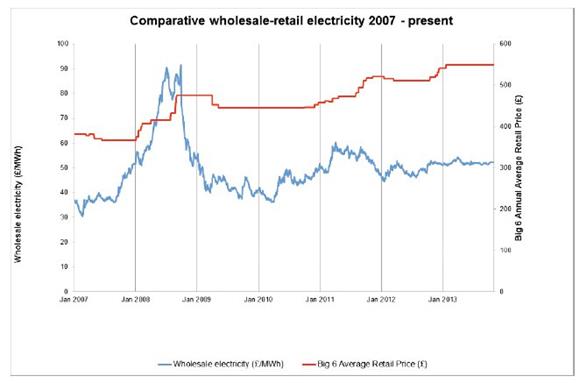
Figure 2 on page 11 is meant illustrate for the electricity and gas markets how the wholesale prices have stayed roughly the same, but the retail prices have widened. The graphic for the electricity market is shown below.

The explanation is as follows.

Wholesale energy prices have been relatively stable since the winter of 2011, rising by an average of 1 per cent a year. However, the large energy companies have increased energy prices by an average of 10.4 per cent a year over this period (Figure 3). This has led to a growing gap between wholesale and retail prices that cannot be explained by the growth in network costs or policy costs which account for 20 per cent and nine per cent of the bill respectively.

So the explanation is derived from the following logic

  1. Prices have risen by over 30% in the last 3 years.
  2. Wholesale prices form the biggest part of the cost to the consumer and have not moved very much.
  3. Other costs have grown, but now only account for 29% of the bill.
  4. By implication, the profits of the energy companies have increased at the expense of the consumer.

Let us first assume that the scales are comparable. The left hand scale is the wholesale cost in £/MWh. The right hand scale in the average annual retail cost per household. In 2010 the average household was paying about £430 for their electricity, compared with £550 in Jan-2013. The wholesale price component rose from around £280 to £310. So “other costs” rose by around £90. This is a huge increase in costs. With around 26 million households, this is around £2.4bn – well on the way to accounting for the £3.6bn claimed above. There is gas as well remember, so there could be an argument.

But what are the other costs?

These include

  1. Standing charges. The costs of operating the National Grid, and replacing meters in homes, along with subsidies for the poor.
  2. Renewables Obligations (RO) and Feed-in-tariffs (FIT). That is the subsidies that the owners of wind turbines and solar panels get over and above the wholesale price of electricity. For instance, operators of offshore wind turbines will get a similar amount in RO as from the market price.
  3. The small, but growing STOR scheme.
  4. The fixed costs of the retail operation. That is the staff to produce the bills, operate the call centres, along with the cost of a sales force to get you to switch.
  5. The net is the retail margin.

Let us assume that “network costs or policy costs” and policy costs doubled in three years as a proportion of the total electricity bill. That is from 14.5% to 29%. That would be £97 of the £90 increase in margin. This hypothetical example needs to be tested with actual data. However, the lack of the rise in profits is corroborated by OFGEM figures for the Big 6 Energy Companies, as I summarized out last week.

The margins on “supply” have not increased, and are still at the level of a discount supermarket. The margins on “generation” derive from selling at wholesale and the proceeds of the subsidies. Unless Labour are implying that the “Big 6” are guilty of false reporting to OFGEM, the vast majority of the increase in differential between wholesale cost and selling price is accounted for by factors other than profits to the energy companies. Labour are implying the vast majority of the increase in differential between wholesale cost and selling price is accounted for by the profits to the energy companies, and therefore misleading the electorate.

Interpretation of clean energy investment figures

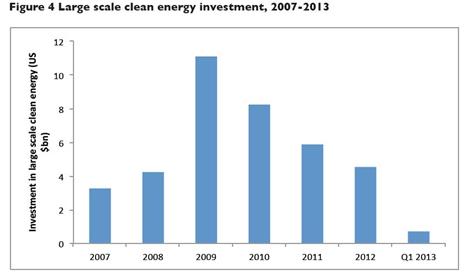
Figure 4 is the following chart

The fall in investment, at a time when it should be accelerating, is a result of the policy environment and protracted decision-making by Government. The Government has been widely blamed for failing to provide the policy certainty needed to de-risk investment.

There is an alternative way to interpret this data. Labour lost the general election in May 2010. What might be more significant is the passage of the Climate Change Act 2008. In the next year investment was nearly 3 times higher, then falling each year since. The Climate Change Act 2008 greatly enhanced the incentives for “clean energy” investment, hence the leap. There are only a finite number of opportunities, so the investment is reducing year-on-year. This being despite the biggest source of revenue coming from index-linked subsidies loaded onto electricity bills. Another reason is that many in the industry saw problems with the technology, that are only now coming to light. In particular the lifespan of the turbines might be shorter than previously thought. Further, the opposition to the wind turbines (where most of the investment is concentrated) is increasing, such as against the proposed Atlantic Array that would have blighted the Bristol Channel. Campaigners are also increasingly concerned about noise pollution.

Therefore, I propose that declining investment is not due to Government spin doctors failing to sweet-talk big business, but due to the reality of “clean energy” turning out to fall far short of the sales patter.

NB First time comments are moderated. The comments can be used as a point of contact.

Kevin Marshall
Energy Firms making bigger AND smaller profits

We have heard a lot recently about how rising electricity and gas prices are a result of the large profits of the energy companies. Ed Milliband went on the attack at the Labour Party Conference, proposing a price freeze if Labour gets into power. With energy prices going up 10% a year I wandered how large these profits must be. The BBC today gives some clues.

Regulator Ofgem says the big six energy suppliers saw profit margins in the supply of gas and electricity rise to 4.3% in 2012, up from 2.8% in 2011.

And the watchdog says supplier profit per household customer rose to £53 last year, from £30 a year earlier.

However, the power generation profit margins at the firms fell from 24% in 2011 to 20% in 2012.

Overall, profits in generation and supply across the half-dozen firms fell from £3.9bn in 2011 to £3.7bn in 2012.

So the retail profits have increased, but the overall profits have decreased. This is despite turnover having increased due a large hike in prices. It is a incorrect to say that the double-digit price increases paid for larger profits of the big six energy suppliers. The following tries to explain why.

Ofgem has not uploaded this latest data to its website, so I have to piece together from what is available. Factsheet 118 details the comparison of 2011 with 2010. It says


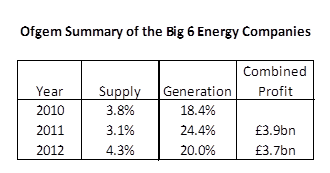
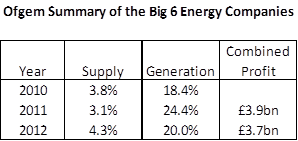
•     the average profit margin across all six suppliers for

supplying gas and electricity to homes and businesses

declined from 3.8 per cent in 2010 to 3.1 per cent in

2011

•     the margins in generation, however, increased from

18.4 per cent in 2010 to 24.4 per cent in 2011. This is

because of higher wholesale electricity prices. Typical

generation margins also tend to be higher than in supply

to finance the capital investment needed to build power

stations.

A summary of these figures is below


In other words, there is mostly an about face from the very profitable 2011, but still much higher profits than in 2010.

Given that the profits from power generation are much higher, we need to look at this more closely. What should be recognized is the relevant rate of return generation is not ROS (Return on Sales), but ROCE (Return on Capital Employed). An indicator of this can be gleaned from Ofgem’s summaries of the major’s accounts for 2011.

For example, Scottish power has two power sectors. In 2011 it had an EBIT of 168.5 on sales of 1677.0 on “generation” and EBIT of 91.0 on sales of 172.0 on “renewables”. So the older generation has a ROS of just 10%, and the newer, cleaner, renewables a ROS of 53%. To some extent this is not surprising. Renewables – mostly wind turbines – require a huge upfront capital investment, but low operating costs. Also, the renewables capital stock is much newer. But an additional figure is also revealing – the terra-watt hours sold. The “generation” produces £82.60m/TWh, whilst “renewables” produces £101.20m/TWh.

The only other producer to give a split of energy generation is EDF energy, only this time between nuclear and non-nuclear. For nuclear power, the ROS is 40% and £48m/TWh, and for non-nuclear power, the ROS is 10% and £47m/TWh. With Hinckley C, the guaranteed index-linked rate is a minimum £92.50m/TWh.

Thoughts

  1. The large profits are in power generation.
  2. The profits in terms of ROS will increase with new investments, even if ROCE stays the same.
  3. The profits in terms of ROS will additionally increase with the investment in renewables and nuclear, even if ROCE stays the same as initial outlay per unit of electricity is much higher, and the operating costs are tiny, when compared with a coal or gas-fired power stations.
  4. Higher capital investment will mean above-inflation rises in headline profits and ROS, even if the proper measure of profit for generation – ROCE – stays the same.
  5. The responsibility for the Climate Change Act 2008, that generates the higher ROS figures (and much more expensive electricity) is primarily due to the last Labour Government. It was steered through by the then Environment Secretary Ed Miliband. To freeze retail prices will reduce the ROCE of the energy companies, giving a clear signal not to invest in the power generating capacity to stop the lights going out. If you want lower prices and profits, then have a truly liberalized market with fossil fuels given equal status.

Kevin Marshall


1 Replicating Stern – The Costs of Climate Change and Policy Graph

One aspect of neoclassical economics that is extremely useful is the representation of an economic theory in a graphical form. Where would any introductory course be without Alfred Marshall’s supply and demand curves? For many years, the ideas of John Maynard Keynes’s ideas were synthesised in the Sir John Hicks’s IS-LM curves. These graphs have the advantage of enabling analysis of the logical consequences of changes in the overall context of the problem under consideration. In climate, there is a lot of shouting between the different camps, but what appears to be a complete inability to put the consequences of global warming and the mitigation policy option of globally constraining the growth of greenhouse gas emissions into their proper context. Therefore, when assumptions are changed, or new information becomes available, it is difficult to put those into the overall context of the “climate change” issue.

Sir Nicholas (now Lord) Stern’s report of 2006 (In the Summary of Conclusions) had the two ideas separated when it claimed

Using the results from formal economic models, the Review estimates that if we don’t act, the overall costs and risks of climate change will be equivalent to losing at least 5% of global GDP each year, now and forever. If a wider range of risks and impacts is taken into account, the estimates of damage could rise to 20% of GDP or more. In contrast, the costs of action – reducing greenhouse gas emissions to avoid the worst impacts of climate change – can be limited to around 1% of global GDP each year.


This leads to two offsetting sets of costs. The first is the “do-nothing approach” of letting greenhouse gas emissions spiral out of control, raising global temperatures by a number of degrees and throwing the weather systems out of control. The other is the policy costs of constraining the rise in emissions by switching to “cleaner” forms of living in general and energy-production in particular. It is should not be confused with a cost-benefit approach. Stern is proposing to exchange a very high set of costs in the distant future, with a much lower set of policy costs now. His proposal is not to incur costs in exchange for a stream of benefits (like when constructing a new motorway), but to minimize total costs of climate change and policy.

Constructing the graph

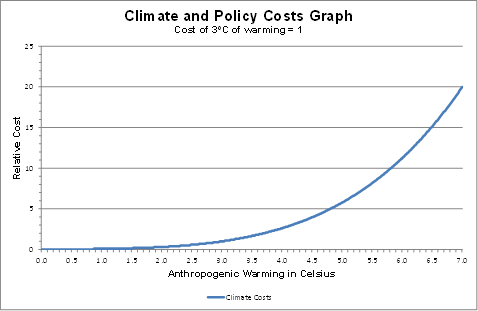
We are told by the climate scientists that some of the minor consequences of around 0.8oC of warming over the last century are already visible. But their climate models project this is utterly insignificant compared to what will happen if greenhouse gases continue to increase unchecked for the next century or more. The large increases in temperature – around 4oC to 7oC or higher – would cause massive disruption to the climate system. It is fair to say that as global temperatures increase, these costs would increase exponentially. These “costs” are in the broadest sense. They are not just the human costs of property damage, failed harvests, population migrations and land being submerged by rising seas. These include the damage to the eco-systems and species extinction. Assuming a top end of 7oC the cost curve would look something like this.

The relative cost scales 7oC of warming are set to be twenty times the costs of constraining global warming to 3oC, or the mid-range of estimates by the IPCC for a doubling of CO2 from pre-industrial levels of 280ppm, and an approximate policy target.

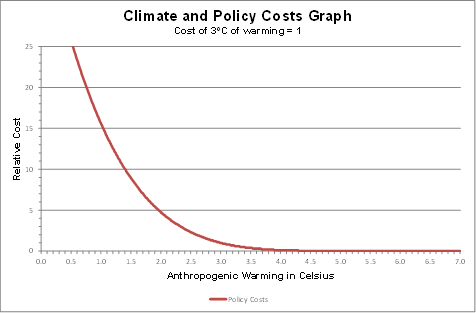
Conversely, the cost of stopping any more warming will be huge. Hugely aggressive policies would quickly stop any increases in emissions and could bring about major reductions. But such policies would bring to a halt the fast-growing economies of China and India, and would considerably worsen the recession in much of Europe. However, it is possible to postulate that low-cost policies that give the odd nudge here and there over a long period could reap large rewards. In line with climate costs, I have set the relative cost of constraining the rise in global temperatures to 3oC above the pre-industrial levels to 1. So the curve might look like the one below.

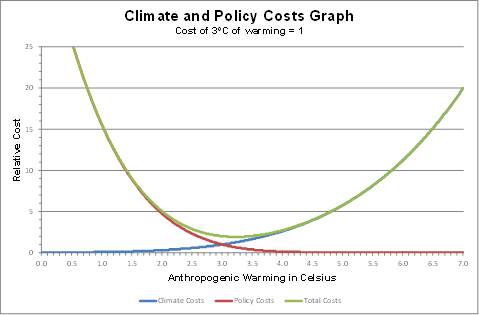
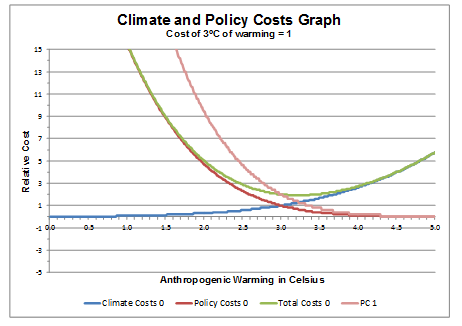
Combining the two curves gives a total cost graph.

The total costs curve is derived by the addition of the climate and policy cost curves.

This replicates Stern’s statement above. The “do-nothing” scenario is ten times more expensive than the optimal cost-minimization scenario.

Some points to note.

First is that the total cost curve has quite a wide minimum area. Even if a lot of the main policy targets are missed, doing something looks to be far better than doing nothing at all.

Second, is that cost minimization strategy is at a higher temperature level than the intersection of the curves. However, a risk-averse strategy (which most people would expect in avoiding a prospective global catastrophe) would aim for a somewhat lower temperature increase.

Third is that “policy” should be called mitigation policy. That is preventing climate change costs from occurring by constraining the rise in greenhouse gases. As will be seen later, the alternative (or complementary) adaptation policies are included within the climate costs curve. The full reasons will be explained later, but the main one is that climate mitigation is something that, by definition, needs to be tackled at a global level, whereas adaptation can be done at the local, country or regional levels.

Fourth, is a clear separation of mitigation policy considerations from the projections of climate science. Yet new information from the science and policy areas can be put into a total context of acting in the best interests of the planet and the human population.

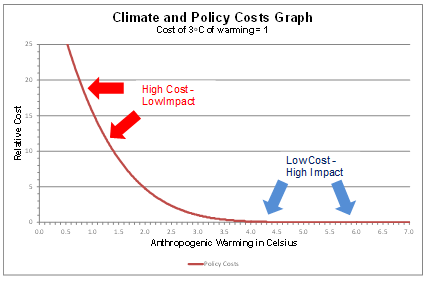
Fifth, an issue with the policy curve is the change in gradient. There must exist a set of policy options which are low cost, high impact (LC-HI) as well as the high cost, low impact (HC-LI). There are two possible types of policies which should be avoided. First are those with costs, but with zero impact (C-ZI) and second are those with a net negative impact (NNI).

Sixth, any look at climate projections and policy options show they are all over the place. The assumptions of single curves are highly restrictive ones. But like in

Finally, on climate costs there is an issue with projections about future costs. The data we have is from less than one degree of warming, and a minute fraction of projected costs. As shall be shown, the handling of this issue is crucial.

Kevin Marshall

2 Climate Change Policy Choices

The risks from policy are becoming increasingly well-known. The question is how to manage these risks. Assuming there is a genuine problem, which is possible to overcome through policy, what are we doing to make a real difference? The policy curve gradient assumes there must exist a set of policy options which are low cost, high impact (LC-HI) as well as the high cost, low impact (HC-LI).

There are two possible types of policies which should be avoided. First are those with costs, but with zero impact (C-ZI) and second are those with a net negative impact (NNI). All of these costs may include unintended consequences, which may not be fully recognized.

The choice is quite clear. Policy creation and policy implementation requires a high degree of focus in driving through effective emission reductions.


3 The Mitigation Policy Curve – Part 1

One of the aspects of neoclassical economics is that you make a whole host of assumptions, some of which are highly unrealistic. This enables one to look at the consequences of removing or changing the assumptions one at a time. For this exercise, let us assume the global cost curves are correct. That is to assume that if no policy is enacted that there will be significant global warming with catastrophic consequences for the planet and the people upon it, whilst there are a set of feasible global policies that mitigate against this.

As stated above, for a viable mitigation policy curve to exist, there must exist a set of low cost, high impact (LC-HI) policies. If you believe, as I do, that public policy should aim to make the maximum positive difference, and at a minimum to avoid net harm, then for climate change there is a duty of care in creation and implementation of policy that this truly happens.

The Small Country Problem

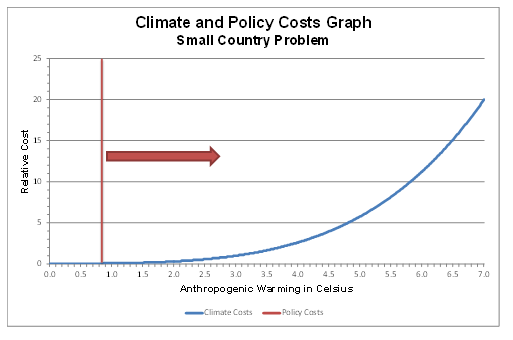
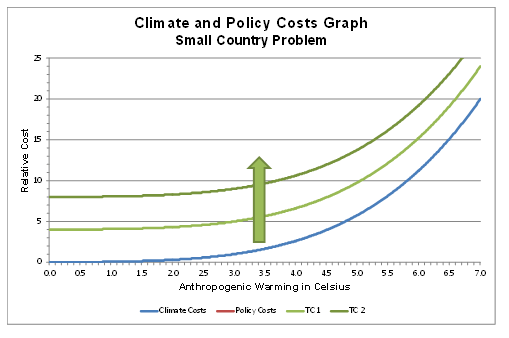
A small country is faced with the same climate cost curve as the entire planet. That is, if nothing is done to constrain the growth in greenhouse gas (GHG) emissions this country will face the same escalating costs of climate change. The only difference is that this cost is no longer relative to total gross world product (GWP), but relative to its own GDP. Assuming that the country’s emissions are an insignificant part of the total world amount to begin with, no matter how effective that country is in constraining its own emissions growth path, or even in cutting its total emissions, its policy cost curve will be vertical. It will move to the right with the relentless rise in global temperatures.

The total costs curve, for any temperature level will simply be the addition of the climate change costs and the money spent on emissions reductions.

The more spent by this small country, the greater its prestige in the green movement for unilaterally leading the way on “saving the planet.” But if nobody follows the small country’s example, then its “conspicuous impoverishment”(1) will be in vain.

Avoiding the small country example

How do we avoid the small country example, where the total costs are just added to by wasted effort on cutting emissions?

The standard answer is along the lines of saying if everybody does their bit, with the rich countries taking the lion’s share of the responsibility, then everything will be just fine. What is more, Britain already has some of most draconian emissions reductions targets in the world, as imposed by the Climate Change Act 2008 and others, such as the EU and Australia are also contributing. The small country argument does not hold.

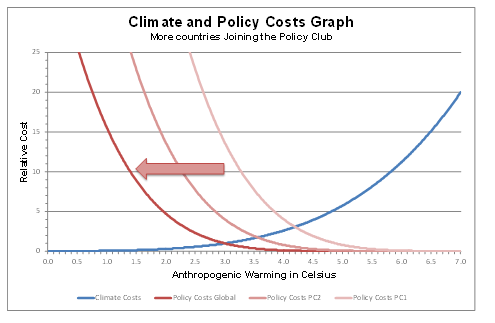
The minority of countries pursuing emission reduction policies I will term the PC1 group. Still assume for the moment that the policy cost curve is correct. The current issue is to enlarge that group to make it the PC2 group. Eventually it is to convince every country to join making the policy curve truly global. As the group enlarges the policy curve shifts to the left.

If all PC1 countries commit to restrain global warming to 3oC, then they can only do so by crippling their economies. The relative cost is a global one after all. They still could cripple their economies if they went to the climate costs equal policy costs point. If the PC1 countries accounted for 25% of GWP, then they would have a benefit a quarter of all the countries acting together. So should the in the economic interests of an outsider country to help create an enlarged group PC2, that represents 50% of GWP? The PC1 group will rid the planet of over 75% of the climate change costs. The PC2 group could halve that again.

Would it be in the economic interests of a country to join the PC2 group, or stay outside?

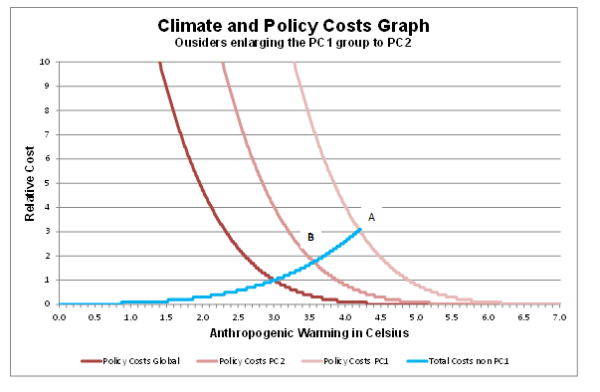
My Excel graph gets a bit blocky here – sorry.

Let’s do the maths, with approximate numbers. Enlarging the policy-enacting group moves from point A to point B.

PC1 group members have a climate cost of 3.1 plus a policy cost of 3.1/25% = 12.4

Non PC1 members have a climate cost of 3.1 = 3.1

PC2 group members have a climate cost of 1.7 plus a policy cost of 1.7/50% = 5.1

Non PC1 members have a climate cost of 1.7 = 1.7.

So to join the enlarged PC2 group, would increase costs from 3.1 to 5.1. To stay outside the policy countries would be better for the citizens of that country, even if there is a workable policy to adopt and the clear prospect of catastrophic global warming if no mitigation policy is enacted.

Later arguments on the effectiveness of policy and prospective costs of climate will make this choice look even more unambiguous. This aspect of all countries not acting together to share proportionately the costs has not, as far as I am aware, been seriously looked at in the literature. This is why the annual COP meetings – conferences in exotic locations – will never get anywhere. Any leaders that are persuaded to join the policy-enactors, unless their country will be disproportionately made worse by climate change, are acting against their own national interests.


Policy Risk

Policies carry risks. There is a risk of them not being effective, and costs running out of control. There is also a risk of a ratchet effective. That is once the policy is implemented, vested interests are created that make it very difficult to withdraw the policy even if results fall far short of those expected. The above assumes policy success. Policy failure within PC1 countries will demonstrate to potential PC2 countries that they should avoid adopting mitigation policies, no matter how great they believe in the looming climate catastrophe.


  1. Thorstein Veblen attacked in the rich for the “conspicuous consumption”. The “conspicuous impoverishment” of the global warming movement is a variant on this, the difference is that the “prestige” that Veblen went to those wasting their money. The “prestige” heaped on the unilateralist country by the green movement on those implementing the policy and not those suffering the policy consequences.


4 The Mitigation Policy Curve – Part 2 – Counter-Examples

In the first part on the mitigation policy curve I looked at

  • The Small Country Problem. How one small country acting unilaterally will make an insignificant impacts of global climate change.
  • How it is very likely to be against the economic interests of any country to join the small group of countries already with climate mitigation policies.

In this section I will look at two examples that go completely against logical thinking. There can be instances (like in Britain) where bold policies increase global warming at great cost to that economy, but the shale gas, which constrains global warming at net benefit to the gas-producing country?

To see the effect of policy, there is a need for analysis both at the front-end (prior to implementation), during and after. The question is about the gradient of the policy cost curve, at the point

Policy increasing global emissions?

We know that policy countries are in a minority of countries. With the structure of global growth this amount will fall.

Look at the long-term. Implementing a policy, you are saying to businesses that, ceteris paribus, your energy costs are going to rise year-on-year relative to those in non-policy countries. There will be a bigger incentive to make technological efficiency gains in these countries, but those gains can be transplanted to non-policy countries. In this global emissions may decrease more rapidly than they would have done, but the policy countries bear well over 100% of the costs and it becomes a policy benefit to the non-policy countries. By implication they will achieve around 200% of the global decline in emissions.

Question is, will it be more or less than 200% of the decline? Could it be that the policy countries energy-efficient factories are replaced by less energy-efficient factories in the non-policy countries?
There is some economic theory needed here. The Solow growth model shows a technological growth curve. Developing countries can achieve rapid growth by adapting to higher-productivity by adapting existing technologies. Their lower-unit labour costs will enable to undercut the more advanced economies, but the growth in these economies will grow the global economy as well. Most of this is unit labour costs. But by adapting previous generation technologies and exploiting labour costs less than a tenth those of the rich countries, they can under-cut the rich world. Greater technological advance is mostly in unit labour costs, but it can also mean lower unit energy costs. The portion of global output transferred from the rich countries to the poorer developing countries could result in higher total energy use, and ceteris paribus, higher CO2 emissions.

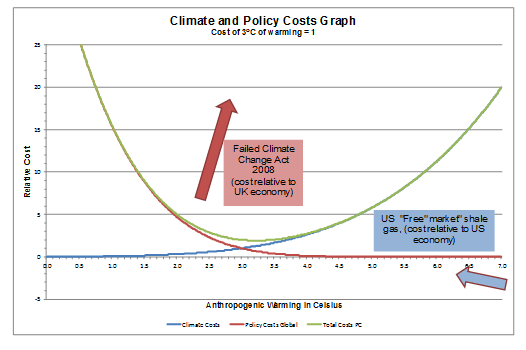
What is clear is that policy countries will increase unit energy costs. There is a two-pronged approach in Britain. The European-wide carbon-trading scheme will restrict supply of energy, bidding up the price. But also renewables cost more than fossil fuels. So the two-pronged approach doubly increases unit energy costs. Increasing unit energy costs accelerates the switching of manufacturing to developing countries, mostly China. The blue bit above postulates that energy per unit of output is globally could increase. But that is part of the problem. China has much higher CO2 emissions per unit of output as Britain. If Britain’s aggressive rush to renewables is successful, then this gap will increase, as much of Chinese energy output is from coal. A de-carbonised British economy will also be a de-industrialised one. But overall global emissions will have increased through switching of output to China.

The biggest cost of the policy for Britain is nothing to do with switching low-CO2 emitting production to high CO2 emitting countries. It is the restriction on economic growth. Loss of jobs from manufacturing, and pushing up higher energy costs elsewhere constrains growth. Due to the long-term consequences of that pushes policy costs through the roof. In the sectors where jobs are lost overseas, the policy curve is positive. If British Climate Change Act 2008 is massively unsuccessful in meeting the carbon targets, it could be a very expensive policy to increase global CO2 emissions.

The Shale-Gas Counter Example

In the USA, a consequence of the shale gas revolution has been to drastically reduce unit energy costs to industry. But also there has been a switch away from coal. As CO2 emissions of gas are around half that of coal, US CO2 emissions have been falling with electricity prices. The US is enjoying both cheaper and cleaner energy. Consequently, some chemical factories that relocated to China have returned to the USA. China has a greater proportion in its electricity production than USA, and the gap is widening. So the switching of a factory from USA reduces global CO2 emissions, even though the total energy usage remains the same.

Let me show this graphically.

Suppose (as is likely at present), the Climate Change Act 2008 falls a long way short of its target but unintentionally moves a substantial part of manufacturing to China through higher costs. For Britain this will be a large cost relative to British, but may be a net contributor to global warming. The policy curve points gets a positive slope! Conversely, “free market” shale gas in the USA has constrained global carbon emissions doubly by reducing US carbon emissions per unit of output, and switching production from China, where carbon emissions per unit of output are higher. It is having positive benefits on the US economy as well (hence negative costs), whilst constraining (slightly) the top-end of global warming.

5 The Climate Cost Curve

This is a draft proposal in which to frame our thinking about the climatic impacts of global warming, without getting lost in trivial details, or questioning motives. It is an updated version of a draft posted on 26/10/2012.

The continual rise in greenhouse gases due to human emissions is predicted to cause a substantial rise in average global temperatures. This in turn is predicted to lead severe disruption of the global climate. Scientists project that the costs (both to humankind and other life forms) will be nothing short of globally catastrophic.

That is

CGW= f {K}                 (1)

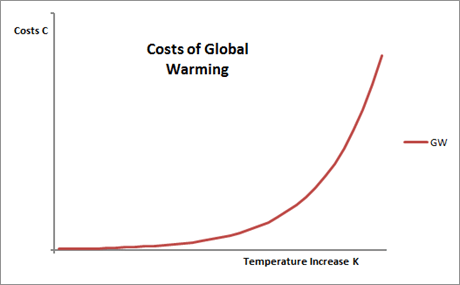
The costs of global warming, CGW are a function of the change in the global average surface temperatures K. This is not a linear function, but of increasing costs per unit of temperature rise. That is

CGW= f {Kx} where x>1            (2)

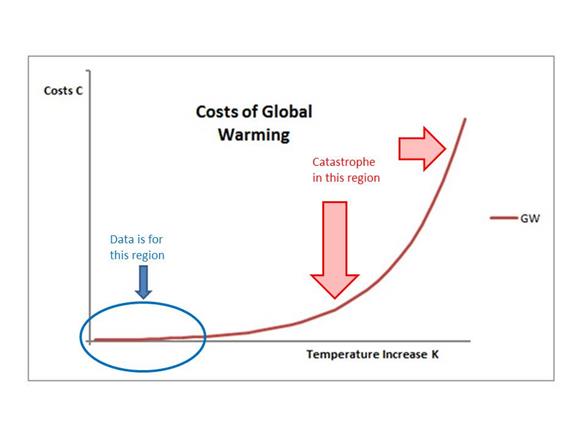
Graphically

The curve is largely unknown, with large variations in the estimate of the slope. Furthermore, the function may be discontinuous as, there may be tipping points, beyond which the costly impacts of warming become magnified many times. Being unknown, the cost curve is an expectation derived from computer models. The equation thus becomes

E(CGW)= f {Kx}                (3)

The cost curve can be considered as having a number of interrelated elements of magnitude M, time t and likelihood L. There are also the adaptation costs/benefits (which should lead to a planned credit) along with the costs involved in taking actions based on false expectations. Over a time period, costs are normally discounted by r. Then there are two subjective factors – The collective risk factor R, and, when considering a policy response, a weighting W should be given to the scientific evidence. That is

E(CGW)=f {M,1/t,L,A,│Pr-E()│,r,R,W}    (4)

Magnitude M is the both severity and extent of the impacts on humankind or the planet in general in a physical sense.

Time t is highly relevant to the severity of the problem. Rapid changes in conditions are far more costly than gradual changes. Also impacts in the near future are more costly than those in the more distant future due to the shorter time horizon to put in place measures to lessen those costs.

Likelihood L is also relevant to the issue. Discounting a possible cost that is not certain to happen by the expected likelihood of that occurrence enables due unlikely but catastrophic events to be considered alongside near certain events.

Adaptation A is for a project to adapt to the changed climate, to lessen or null the costs. It is the difference between the actual costs spent and the climate impacts saved. Upon completion, a project should have a net credit value.

│Pr-E()│ is the difference between the predicted outcome, based on the best analysis of current data at the local level, and the expected outcome, that forms the basis of adaptive responses. It can create a cost in two ways. If there is a failure to predict and adapt to changing conditions then there is a cost. If there is adaptation to an anticipated future condition that does not emerge, or is less severe than forecast, there is also a cost. │Pr-E()│= 0 when the outturn is exactly as forecast in every case. Given the uncertainty of future outcomes, there will always be costs incurred if the climate cost savings from adaptation is a unitary value. If there are a range of possible scenarios, then this value could be a credit.

Discount rate r is a device that recognizes that people prioritize according to time horizons. Discounting future costs or revenue enables us to evaluate the discount future alongside the near future.

Collective risk factor R, is the risk preference weighting. If policy-makers assume a collective risk-neutral position, then this weighting will be 1. Risk lovers – the gamblers and many self-made billionaires – have a weighting of less than one. Those who take out insurance are risk averse. Insurance gives a certain premium to compensate if a much greater probabilistic loss occurs. For instance, the probability of a £200,000 house being completely destroyed in a year is around 1 in 10,000. So the expected loss is just £20 in any year. Most people are risk averse when it comes to their most valuable asset, so would pay a premium of far greater than £20 compensate for this unlikely loss. With respect to potential catastrophes, we usually expect governments to take a risk-averse approach. That is to potentially spend more on certain costs (like flood defences) than the total expected losses from letting catastrophes from happening. For any problem on a vast scale, we need to articulate the risk preference weighting. The “precautionary principle”, used in arguing for tough and immediate mitigation policies, effectively creates a collective risk factor many times greater than 1. NB, as the costs of climate change will increase with time, a risk averse weighting is the equivalent of a negative discount rate r. That is, you could assume R = f {-r}.

Finally the Weighting (W) is concerned with the strength of the evidence. How much credence do you give to projections about the future? Here is where value judgements come into play. I believe that we should not completely ignore alarming projections about the future for which there is highly circumstantial evidence, but neither should we accept such evidence as the only possible future scenario. In fact, by its very nature the “evidence” will be highly circumstantial. Consider the costs of climate change graph again. The data we have (which needs to converted into evidence) is for a very short section, and for miniscule fluctuations in costs, compared to the predicted catastrophe.
This leads to a vast area of evidence quality as

  • Small errors or biases in temperature measurement will have huge impacts on future projections. (Impacts on historical climate sensitivity)
  • Small errors or biases in distinguishing between natural and human-caused extreme weather events or short-run climatic changes will have huge impacts on projected costs.

If we assume that some sort of climate catastrophe is going to happen, convincing an independent third-party could include

  • Science building a clear track record of short-run predictive successes, both on warming trends and damage impacts.
  • Learning from the errors and exaggerations.
  • Be very clear as to the quality and relevance of the evidence.
  • Corroborating evidence. Show the coherence of one part of the picture with another. For instance, trying to reconcile with estimates of polar ice cap rate of melt with the rate of sea level rise reveals some very interesting questions.
  • Corroboration of between different techniques and evaluation methods.
  • For a junior science, show the underlying methodology draws upon the best of the mature sciences and philosophies of science.

The prediction of catastrophe is highly emotive. There are comparisons here with the justice system in has Britain failed where there are highly emotive crimes, for instance the IRA bringing their bombing campaign to the British mainland in the early 1970s.

  • Clear separation of the understandable emotion, from the evidence gathering.
  • Developing, and continually improving, quality standards for evidence gathering
  • A dim view taken for tampering with, or suppression of evidence.
  • A dim view taken on influencing the jury.
  • Allowing the accused a strong defence. The lack of any credible defence argument, despite a strong defence team, will remove any “reasonable doubt” in the minds of the jury, where the accused is in denial of the overwhelming evidence of their guilt.

6 A halving of climate sensitivity

Lord Lawson, in a spirited attack on the Energy Bill passing through parliament, said in the House of Lords on 18th June 2013

There is an emerging consensus among scientists that the climate sensitivity of carbon is probably less than they thought. That means, importantly, that any dangers from warming, if they occur, are postponed well into the next century. It means that there is no urgency to go ahead in this way, not only because the uncertainties are in the distant future but because we have no idea what technologies will develop over the next 100 years.

The analysis I have developed shows Lord Lawson understates how significant the climate sensitivity issue to the problem of catastrophic warming and mitigation policy.

In my analysis, the maximum warming would be 7oC. There can be a case for warming topping out at some level, as

  • There are diminishing returns to increases in greenhouse gas on temperature.
  • There are diminishing returns at some point for unit rises in emissions on levels of GHGs. That is, higher levels of GHGs in the atmosphere will lead to higher levels of absorption.

I will assume that climate sensitivity is halved, but will assume that temperatures eventually reach 5oC above pre-industrial levels.

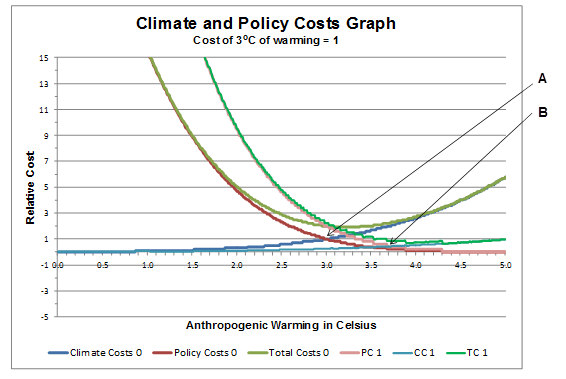
The simple curve to work out the consequences is the policy curve. Any constraint of greenhouse gas levels will only have half the impact on temperature. The policy curve will shift to the right to PC1.

The climate costs curve is somewhat more difficult. The elements to consider in the curve are

E(CGW)=f {M,1/t,L,A,│Pr-E()│,r,R,W}

I have highlighted the elements to consider.

Time t will be doubled. Warming rates will therefore be halved. Some of the harmful consequences of warming are from unprecedented rapid change. For many animals and plants, it is speculated sudden change is much more damaging than a slower change. More importantly, sudden changes in average temperature could jolt climate systems into different patterns. Savannahs could become deserts, or the monsoon could shift. Another aspect to consider is that rapid warming of the tundra could release massive amounts of CH4 into the atmosphere, further accelerating warming. Or rapid warming could lead to rapid disintegration and breakup of the polar ice caps, leading to rapid acceleration of sea level rise. The slower warming will make us much less likely to cross these climate tipping points.

Adaptations A
can be phased in more gradually. For instance, with sea level rise, the Thames Barrier will no longer be adequate. A replacement to last 50 years will need to be much less extensive. If warming causes crop yields to fall by increased drought there is more time to adjust.

With changes happening more slowly, (and less chaotically), the adaptation cost errors, │Pr-E()│, are likely to be less.

For any positive rate of discount r, then the current net present value will be lower for the much extended warming period. However, as Stern had a discount value of not much different to zero, allowing for a discount rate would totally cover the other issues.

For all of these reasons, the climate cost curve will move down to CC1 and total cost curve to TC1. The point where policy costs equals climate change costs moves from A to B. That is at a significantly higher temperature, and for a much lower level of policy cost.

I have steered away from the weighting W issues. But given that sensitivity is a core issue that the climate models have got consistently wrong, then any weighting given to other predictions should be viewed with greater scepticism.