This survey I took in June is not the one used in the recent Lewandowsky et al paper. The one I took at “Watching the Deniers” is a development that 2010 survey. There are less questions on conspiracy theories (but “NASA faked the moon landing”, along with Diana, JFK and MLK assassinations are are still in) along with exactly the same questions on Free markets v Environmentalism. But the new survey has more on political beliefs (a good thing in my view) along with new sections on religious beliefs and GM foods. It seems to be directed beyond the free-marketeers, to other groups like the American Religious Right.
The Psychology Department of the University of Western Australia, under psychology research assistant Charles Hanich is conducting a short questionnaire on Science and Society.
UPDATE – The survey questions are available here.
SCIENCE AND SOCIETY
This study explores people’s beliefs about a wide range of topics, ranging from scientific propositions to claims made in the media and on the internet. In addition, the survey is interested in your attitudes towards your own life and issues confronting modern societies at the moment.
The questions all have five options – Strongly Disagree, Disagree, Neutral, Agree and Strongly Agree.
The questions are from both perspectives, so that people who are anything but totally neutral will have to agree with some questions and disagree with others.
The sections as follows (My headings)
- Climate Change – 5 questions
- Genetically Modified Foods – 5 questions
- Vaccines – Benefits and harms – 5 questions
- Position of the Conservative / Liberal perspective (US definitions) – 7 questions
- Select neutral (check of the software, or check for spam?) – 1 questions
- Free market system v social justice / environment / sustainability – 5 questions
- Conspiracy theories (political) – 6 questions
- Conspiracy theories (scientific) – 6 questions
- Personal Spirituality & Religion – 8 questions
- Evolution – views upon – 7 questions
- Corporations – 13 questions
- Personal emotional outlook – 6 questions
That is 74 questions in total. Like a lot of surveys, it understates the questions (“about 40”) and the time taken.
Climate Change Questions
- I believe that the climate is always changing and what we are currently observing is just natural fluctuation.
- I believe that most of the warming over the last 50 years is due to the increase in greenhouse gas concentrations.
- I believe that the burning of fossil fuels over the last 50 years has caused serious damage to the planet’s climate.
- Human CO2 emissions cause climate change.
- Humans are too insignificant to have an appreciable impact on global temperature.
There is a complete absence of questions about future projections of warming; whether that warming is catastrophic or benign; of the strength of the science or the uncertainties; our trust in what scientists are telling us; nor of the ability of policy to do anything successfully combat it. These are the questions that many sceptics, including myself, are grappling with.
Genetically Modified Foods
Questions
- I believe that genetic modification is an important and viable contribution to help feed the world’s rapidly growing population.
- I believe genetically engineered foods have already damaged the environment.
- The consequences of genetic modification have been tested exhaustively in the lab, and only foods that have been found safe will be made available to the public.
- I believe that because there are so many unknowns, that it is dangerous to manipulate the natural genetic material of foods.
- Genetic modification of foods is a safe and reliable technology.
In contrast these are questions do look at the benefits and costs of the science; the current impacts and future impacts; along with the strength of the science and the uncertainties.
NB the vaccines section follows more on the model of GM foods section rather than climate change.
The political spectrum questions I will leave for others to comment upon. It seems to be written by an American-influenced “liberal” who lacks knowledge of the full spectrum of political thought.
Free Markets v social justice / environment / sustainability
- An economic system based on free markets unrestrained by government interference automatically works best to meet human needs.
- The free market system may be efficient for resource allocation but it is limited in its capacity to promote social justice.
- The preservation of the free market system is more important than localized environmental concerns.
- Free and unregulated markets pose important threats to sustainable development.
- The free market system is likely to promote unsustainable consumption.
It is based on a notion of free-market anarchy against on the beneficial utopian society. No mention of awkward facts, like the worst environmental disasters and social injustices in the last century occurred in authoritarian regimes of left and right.
Conspiracy theories (political)
- A powerful and secretive group known as the New World Order is planning to eventually rule the world through an autonomous world government which would replace sovereign governments.
- The assassination of Martin Luther King, Jr. was the result of an organized conspiracy by U.S. government agencies such as the CIA and FBI.
- The Apollo moon landings never happened and were staged in a Hollywood film studio.
- The assassination of John F. Kennedy was not committed by the lone gunman Lee Harvey Oswald but was rather a detailed organized conspiracy to kill the President.
- The U.S. government allowed the 9-11 attacks to take place so that it would have an excuse to achieve foreign (e.g., wars in Afghanistan and Iraq) and domestic (e.g., attacks on civil liberties) goals that had been determined prior to the attacks.
- Princess Diana’s death was not an accident but rather an organised assassination by members of the British royal family who disliked her.
Basically, if you read the communiques and the proclamations coming out of annual meeting like Copenhagen, Cancun and Durban that say we must have a strong global organization to impose climate change, you should consider yourself as much a crank or nutter as those who think George Bush was capable of the phenomenally detailed planning required to stage the 9-11 attacks (but totally failed to successfully bring peace through conquest in Iraq or Afghanistan).
Conspiracy theories (Scientific)
- The claim that the climate is changing due to emissions from fossil fuels is a hoax perpetrated by corrupt scientists who wish to spend more taxpayer money on climate research.
- U.S. agencies intentionally created the AIDS epidemic and administered it to Black and gay men in the 1970s.
- The alleged link between second-hand tobacco smoke and ill health is based on bogus science and is an attempt by a corrupt cartel of medical researchers to replace rational science with dogma.
- The HIV virus causes AIDS.
- Smoking causes lung cancer.
- Lead in drinking water poses a serious long-term health risk.
The questions on climate and second-hand tobacco smoke lump two concepts together; a lot of money wasted for very little output along with the alleged motives of those practicing their research. In between is a particularly distasteful conspiracy theory, the very idea of which would be repellent to most people. The other three questions are simple statements of well-established science. There is no loading or controversy.
Religion and Evolution.
- God is important in my life
- I believe there is a life after death
- I get comfort or strength from religion
- There is no proof of God: if there is a God, he would have shown himself by now
- I think of myself as a religious person
- I have made a personal commitment to live my life for God
- I have had an experience of spiritual worship that was very moving and powerful
-
I have experienced a definite answer to prayer or specific guidance from God
- Modern humans are the product of evolutionary processes that have occurred over millions of years
- The theory of evolution is based on speculation and not valid scientific observation and testing
- Most scientists accept evolutionary theory to be a scientifically valid theory
- There is a significant body of data that supports evolutionary theory
- Humans exist today in essentially the same form in which they always have
- Evolution is a scientifically valid theory
- Current evolutionary theory is the result of sound scientific research and methodology
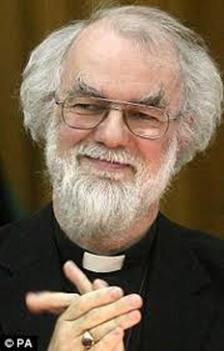
This is meant to distinguish between the US bible-belt evangelical Christians and the atheistic scientific community. It does so in a non-partisan way, so that Muslims could answer as well. However, it does not take into account the more nuanced, earnest, balanced and thoughtful approaches to the interactions of hard science and the timeless spiritual truths, as typified, is not caricatured, by Dr Rowan Williams, The Archbishop of Canterbury.
Corporations
- Corporations are not respectful of laws
- Corporations do not accept accountability for their actions
- People who run corporations will lie if doing so will increase company profits
- Corporations do not care about acting ethically
- Corporations will break laws if they can make more money from it
- Corporations put their own interests above the public’s interests
- Corporations are driven by greed
- Corporations care only about money
- Corporations want power at any cost
- Corporations take a lot more than they give
- Corporations intentionally deceive the public
- Corporations do not consider the needs of their employees when making business decisions
- Corporations exploit their workers
Any notion of balance goes completely out of the window. It is by far the largest section in a questionnaire on “Science and Society”. There is no switching between good points of corporations – such as technological breakthroughs, or much of our phenomenal prosperity. That includes the “Eco” technologies and the must-have gadgets from a fruity American 70s start-up. It is almost as if they want the more moderate participants to give up in disgust. Do avoid permanent psychological damage, they questionnaire end with a few personal questions about things in life you are thankful for, and people that you are grateful to.
The missing sections
No not the political spectrum one. The missing questions that a more balanced questionnaire might ask.
- General trust in climate science.
- Trust in carefully presented evidence, with questions respectively answered, as against the dogma of “scientists agree”.
- Questions for the Australian people, of whether carbon tax policies are worthwhile
- Questions on trust in government; the motives of politicians; the ability to deliver on promises. In relation to both Western democracies and tyrannies past and present.
- The importance of tackling climate change relative to other issues like unemployment and prospective financial meltdown in parts of Europe.
Conclusion
When devising a questionnaire, one must always try to eliminate bias, and avoid emotionally loaded the questions that will prejudice the answers. Neither should it contain multiple issues in a question. This survey does just the opposite. It is started off being deliberately designed to elicit certain polarized responses, ending up showing the deeply prejudiced and politically extreme position of the author.
*Please note. I am not aware of any copyright restrictions on reposting the questions. I accessed this from “Watching the Deniers” website, where there was no mention of copyright material. Neither was there any mention of copyright on the introductory front page. The doing a search I only came across a link to a 2010 survey. Neither could I find a link within The University of Western Australia Website, though it is on their servers.