There is a lot of discussion on Bishop Hill (here and here) and Climate Audit of a new paper in Journal of Climate “Evidence of unusual late 20th century warming from an Australasian temperature reconstruction spanning the last millennium“, with lead author, Dr Joëlle Gergis. The reconstruction was based upon 27 climate proxies, one of which was a coral proxy from Palmyra Atoll.
There are two issues with this study.
Location
The study is a “temperature reconstruction for the combined land and oceanic region of Australasia (0°S-50°S, 110°E-180°E)“. The study lists Palmyra Atoll as being at 6° S, 162° E, so within the study area. Wikipedia has the location at 5°52′ N, 162°06′ W, or over 2100Km (1300 miles) outside the study area. On a similar basis, Rarotunga in the Cook Islands (for which there are two separate coral proxy studies), is listed as being at 21° S, 160° E. Again well within the study area. Wikipedia has the location at 21° 14′ 0″ S, 159° 47′ 0″ W, or about 2000Km (1250 miles) outside the study area. The error has occurred due to a table with columns headed “Lon (°E)”, and “Lat (°S). Along with the two ice core studies from Vostok Station, Antarctica (Over 3100km, 1900 miles south of 50° S) there are 5 of the 27 proxies that are significantly outside the region.
Temperature Reconstruction
Palmyra Atoll reconstruction is one of just three reconstructions that has any data before 1430. From the abstract, a conclusion was
The average reconstructed temperature anomaly in Australasia during A.D. 1238-1267, the warmest 30-year pre-instrumental period, is 0.09°C (±0.19°C) below 1961-1990 levels.
From the proxy matrix I have plotted the data.
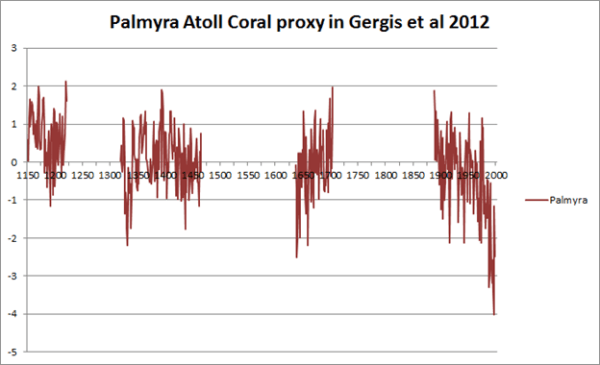
This indicates a massive change in late twentieth century temperatures, with 1996 being the most extreme on record.
The other two data sets with pre-1430 data are tree ring proxies from Mount Read, Tasmania and Oroko, New Zealand. These I have plotted with a 30 year moving average, with the data point at the last year.
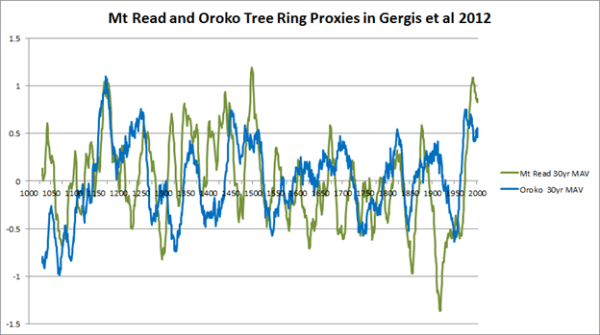
There is something not right with the Palmyra Atoll proxy. The late 20th century trend is far too extreme. In the next posting I will compare to some other coral data sets.




 ManicBeancounter