Lewandowsky et al. 2012 MOTIVATED REJECTION OF SCIENCE – Part 1

The paper Lewandowsky, Oberauer & Gignac – NASA faked the moon landing|Therefore (Climate) Science is a Hoax: An Anatomy of the Motivated Rejection of Science (in press, Psychological Science) is one of the most biased and pernicious surveys I have come across. This posting is about the opening remarks.

The paper starts by accepting the validity of science is from beliefs of scientists.


More than 90% of climate scientists agree that the global climate is changing largely due to human CO2 emissions (Anderegg, Prall, Harold, & Schneider, 2010; Doran & Zimmerman, 2009)

The first paper simply says that of the climate scientists who are convinced of climate change arguments as far more numerous and publish far more than scientists that are unconvinced. The most positive spin you can put on this is that those who believe in and are passionate about what they are doing tend to succeed more than those who don’t. You would probably find similar proportions of belief within New Testament theology or Marxian economics. It says nothing about the truth and the validity of the main claim – unless we act quickly to reduce global carbon emissions, the planet is heading for catastrophic global warming.

The second paper asked two questions:-

1. When compared with pre-1800s levels, do you think that mean global temperatures have generally risen, fallen, or remained relatively constant?
2. Do you think human activity is a significant contributing factor in changing mean global temperatures?

It is only the second question that mentions the human element. In maths “largely” (i.e. > 50%) is a subset of “significant” (a measurable part). Neither is CO2 the only human factor causing climate change (Methane plus other gases increase the greenhouse effect, aerosols offset the warming). Further, the Doran and Zimmerman paper is (to put it charitably) is a hugely flawed survey. Reference to it in another “peer reviewed” survey shows does not bode well for the quality of the results.

Analysis of the Survey Questions here and actual questions here

Climate Change Questionnaire of Univ of Western Australia

This is the climate change questionnaire questions in the survey I answered in early June 2012 and commented upon here.

UPDATE

It has been brought to my attention that this is NOT the questionnaire used in Lewandowsky et al 2012. There are similarities but this appears to be a development of the 2010 survey, and was probably being trailed at Watching the Deniers site. It was located on the University of Western Australia site – try the link.  THE ACTUAL (& shorter) QUESTIONNAIRE is analyzed here.

I believe that this survey is the basis of the recent paper:-

Lewandowsky, Oberauer & GignacNASA faked the moon landing|Therefore (Climate) Science is a Hoax: An Anatomy of the Motivated Rejection of Science (in press, Psychological Science)

Note to Professor Lewandowsky of University of Western Australia

If this is not the original survey, but has been doctored in any way, I will happily publish the actual survey. I will also provide details of the researcher and the url for any investigation. I can be contacted through the moderated comments. I am not aware of any copyright restrictions on reposting the questions. I accessed this from “Watching the Deniers” website, where there was no mention of copyright material. Neither was there any mention of copyright on the introductory front page. The doing a search I only came across a link to a 2010 survey. Neither could I find a link within The University of Western Australia Website, though it is on their servers.

Please indicate how much you agree with the following statements:


Strongly Disagree

Disagree

Neutral

Agree

Strongly Agree

I believe that the climate is always changing and what we are currently observing is just natural fluctuation.


Please indicate how much you agree with the following statements: I believe that the climate is always changing and what we are currently observing is just natural fluctuation. Strongly Disagree

I believe that the climate is always changing and what we are currently observing is just natural fluctuation. Disagree

I believe that the climate is always changing and what we are currently observing is just natural fluctuation. Neutral

I believe that the climate is always changing and what we are currently observing is just natural fluctuation. Agree

I believe that the climate is always changing and what we are currently observing is just natural fluctuation. Strongly Agree

I believe that most of the warming over the last 50 years is due to the increase in greenhouse gas concentrations.


Please indicate how much you agree with the following statements: I believe that most of the warming over the last 50 years is due to the increase in greenhouse gas concentrations. Strongly Disagree

I believe that most of the warming over the last 50 years is due to the increase in greenhouse gas concentrations. Disagree

I believe that most of the warming over the last 50 years is due to the increase in greenhouse gas concentrations. Neutral

I believe that most of the warming over the last 50 years is due to the increase in greenhouse gas concentrations. Agree

I believe that most of the warming over the last 50 years is due to the increase in greenhouse gas concentrations. Strongly Agree

I believe that the burning of fossil fuels over the last 50 years has caused serious damage to the planet’s climate.


Please indicate how much you agree with the following statements: I believe that the burning of fossil fuels over the last 50 years has caused serious damage to the planet’s climate. Strongly Disagree

I believe that the burning of fossil fuels over the last 50 years has caused serious damage to the planet’s climate. Disagree

I believe that the burning of fossil fuels over the last 50 years has caused serious damage to the planet’s climate. Neutral

I believe that the burning of fossil fuels over the last 50 years has caused serious damage to the planet’s climate. Agree

I believe that the burning of fossil fuels over the last 50 years has caused serious damage to the planet’s climate. Strongly Agree

Human CO2 emissions cause climate change.


Please indicate how much you agree with the following statements: Human CO2 emissions cause climate change. Strongly Disagree

Human CO2 emissions cause climate change. Disagree

Human CO2 emissions cause climate change. Neutral

Human CO2 emissions cause climate change. Agree

Human CO2 emissions cause climate change. Strongly Agree

Humans are too insignificant to have an appreciable impact on global temperature.


Please indicate how much you agree with the following statements: Humans are too insignificant to have an appreciable impact on global temperature. Strongly Disagree

Humans are too insignificant to have an appreciable impact on global temperature. Disagree

Humans are too insignificant to have an appreciable impact on global temperature. Neutral

Humans are too insignificant to have an appreciable impact on global temperature. Agree

Humans are too insignificant to have an appreciable impact on global temperature. Strongly Agree

Please indicate how much you agree with the following statements:


Strongly Disagree

Disagree

Neutral

Agree

Strongly Agree

I believe that genetic modification is an important and viable contribution to help feed the world’s rapidly growing population.


Please indicate how much you agree with the following statements: I believe that genetic modification is an important and viable contribution to help feed the world’s rapidly growing population. Strongly Disagree

I believe that genetic modification is an important and viable contribution to help feed the world’s rapidly growing population. Disagree

I believe that genetic modification is an important and viable contribution to help feed the world’s rapidly growing population. Neutral

I believe that genetic modification is an important and viable contribution to help feed the world’s rapidly growing population. Agree

I believe that genetic modification is an important and viable contribution to help feed the world’s rapidly growing population. Strongly Agree

I believe genetically engineered foods have already damaged the environment.


Please indicate how much you agree with the following statements: I believe genetically engineered foods have already damaged the environment. Strongly Disagree

I believe genetically engineered foods have already damaged the environment. Disagree

I believe genetically engineered foods have already damaged the environment. Neutral

I believe genetically engineered foods have already damaged the environment. Agree

I believe genetically engineered foods have already damaged the environment. Strongly Agree


Please indicate how much you agree with the following statements: The consequences of genetic modification have been tested exhaustively in the lab, and only foods that have been found safe will be made available to the public. Strongly Disagree

The consequences of genetic modification have been tested exhaustively in the lab, and only foods that have been found safe will be made available to the public. Disagree

The consequences of genetic modification have been tested exhaustively in the lab, and only foods that have been found safe will be made available to the public. Neutral

The consequences of genetic modification have been tested exhaustively in the lab, and only foods that have been found safe will be made available to the public. Agree

The consequences of genetic modification have been tested exhaustively in the lab, and only foods that have been found safe will be made available to the public. Strongly Agree

I believe that because there are so many unknowns, that it is dangerous to manipulate the natural genetic material of foods.


Please indicate how much you agree with the following statements: I believe that because there are so many unknowns, that it is dangerous to manipulate the natural genetic material of foods. Strongly Disagree

I believe that because there are so many unknowns, that it is dangerous to manipulate the natural genetic material of foods. Disagree

I believe that because there are so many unknowns, that it is dangerous to manipulate the natural genetic material of foods. Neutral

I believe that because there are so many unknowns, that it is dangerous to manipulate the natural genetic material of foods. Agree

I believe that because there are so many unknowns, that it is dangerous to manipulate the natural genetic material of foods. Strongly Agree

Genetic modification of foods is a safe and reliable technology.


Please indicate how much you agree with the following statements: Genetic modification of foods is a safe and reliable technology. Strongly Disagree

Genetic modification of foods is a safe and reliable technology. Disagree

Genetic modification of foods is a safe and reliable technology. Neutral

Genetic modification of foods is a safe and reliable technology. Agree

Genetic modification of foods is a safe and reliable technology. Strongly Agree

Please indicate how much you agree with the following statements:


Strongly Disagree

Disagree

Neutral

Agree

Strongly Agree

I believe that vaccines are a safe and reliable way to help avert the spread of preventable diseases.


Please indicate how much you agree with the following statements: I believe that vaccines are a safe and reliable way to help avert the spread of preventable diseases. Strongly Disagree

I believe that vaccines are a safe and reliable way to help avert the spread of preventable diseases. Disagree

I believe that vaccines are a safe and reliable way to help avert the spread of preventable diseases. Neutral

I believe that vaccines are a safe and reliable way to help avert the spread of preventable diseases. Agree

I believe that vaccines are a safe and reliable way to help avert the spread of preventable diseases. Strongly Agree

I believe that vaccines have negative side effects that outweigh the benefits of vaccination for children.


Please indicate how much you agree with the following statements: I believe that vaccines have negative side effects that outweigh the benefits of vaccination for children. Strongly Disagree

I believe that vaccines have negative side effects that outweigh the benefits of vaccination for children. Disagree

I believe that vaccines have negative side effects that outweigh the benefits of vaccination for children. Neutral

I believe that vaccines have negative side effects that outweigh the benefits of vaccination for children. Agree

I believe that vaccines have negative side effects that outweigh the benefits of vaccination for children. Strongly Agree

Vaccines are thoroughly tested in the laboratory and wouldn’t be made available to the public unless it was known that they are safe.


Please indicate how much you agree with the following statements: Vaccines are thoroughly tested in the laboratory and wouldn’t be made available to the public unless it was known that they are safe. Strongly Disagree

Vaccines are thoroughly tested in the laboratory and wouldn’t be made available to the public unless it was known that they are safe. Disagree

Vaccines are thoroughly tested in the laboratory and wouldn’t be made available to the public unless it was known that they are safe. Neutral

Vaccines are thoroughly tested in the laboratory and wouldn’t be made available to the public unless it was known that they are safe. Agree

Vaccines are thoroughly tested in the laboratory and wouldn’t be made available to the public unless it was known that they are safe. Strongly Agree

The risk of vaccinations to maim and kill children outweighs their health benefits


Please indicate how much you agree with the following statements: The risk of vaccinations to maim and kill children outweighs their health benefits Strongly Disagree

The risk of vaccinations to maim and kill children outweighs their health benefits Disagree

The risk of vaccinations to maim and kill children outweighs their health benefits Neutral

The risk of vaccinations to maim and kill children outweighs their health benefits Agree

The risk of vaccinations to maim and kill children outweighs their health benefits Strongly Agree

Vaccinations are one of the most significant contributions to public health.


Please indicate how much you agree with the following statements: Vaccinations are one of the most significant contributions to public health. Strongly Disagree

Vaccinations are one of the most significant contributions to public health. Disagree

Vaccinations are one of the most significant contributions to public health. Neutral

Vaccinations are one of the most significant contributions to public health. Agree

Vaccinations are one of the most significant contributions to public health. Strongly Agree

Please indicate how much you agree with the following statements:


Strongly Disagree

Disagree

Neutral

Agree

Strongly Agree

I am politically more liberal than conservative.


Please indicate how much you agree with the following statements: I am politically more liberal than conservative. Strongly Disagree

I am politically more liberal than conservative. Disagree

I am politically more liberal than conservative. Neutral

I am politically more liberal than conservative. Agree

I am politically more liberal than conservative. Strongly Agree

In any election, given a choice between a Republican and a Democratic candidate, I will select the Republican over the Democrat.


Please indicate how much you agree with the following statements: In any election, given a choice between a Republican and a Democratic candidate, I will select the Republican over the Democrat. Strongly Disagree

In any election, given a choice between a Republican and a Democratic candidate, I will select the Republican over the Democrat. Disagree

In any election, given a choice between a Republican and a Democratic candidate, I will select the Republican over the Democrat. Neutral

In any election, given a choice between a Republican and a Democratic candidate, I will select the Republican over the Democrat. Agree

In any election, given a choice between a Republican and a Democratic candidate, I will select the Republican over the Democrat. Strongly Agree

Communism has been proven to be a failed political ideology.


Please indicate how much you agree with the following statements: Communism has been proven to be a failed political ideology. Strongly Disagree

Communism has been proven to be a failed political ideology. Disagree

Communism has been proven to be a failed political ideology. Neutral

Communism has been proven to be a failed political ideology. Agree

Communism has been proven to be a failed political ideology. Strongly Agree

I cannot see myself ever voting to elect conservative candidates.


Please indicate how much you agree with the following statements: I cannot see myself ever voting to elect conservative candidates. Strongly Disagree

I cannot see myself ever voting to elect conservative candidates. Disagree

I cannot see myself ever voting to elect conservative candidates. Neutral

I cannot see myself ever voting to elect conservative candidates. Agree

I cannot see myself ever voting to elect conservative candidates. Strongly Agree

The major national media are too left-wing for my taste.


Please indicate how much you agree with the following statements: The major national media are too left-wing for my taste. Strongly Disagree

The major national media are too left-wing for my taste. Disagree

The major national media are too left-wing for my taste. Neutral

The major national media are too left-wing for my taste. Agree

The major national media are too left-wing for my taste. Strongly Agree

Socialism has many advantages over capitalism.


Please indicate how much you agree with the following statements: Socialism has many advantages over capitalism. Strongly Disagree

Socialism has many advantages over capitalism. Disagree

Socialism has many advantages over capitalism. Neutral

Socialism has many advantages over capitalism. Agree

Socialism has many advantages over capitalism. Strongly Agree

On balance, I lean politically more to the left than to the right.


Please indicate how much you agree with the following statements: On balance, I lean politically more to the left than to the right. Strongly Disagree

On balance, I lean politically more to the left than to the right. Disagree

On balance, I lean politically more to the left than to the right. Neutral

On balance, I lean politically more to the left than to the right. Agree

On balance, I lean politically more to the left than to the right. Strongly Agree

Select ‘neutral’ from the options below


Srongly Disagree

Disagree

Neutral

Agree

Strongly Agree


Select ‘neutral’ from the options below   Srongly Disagree

  Disagree

  Neutral

  Agree

  Strongly Agree

Please indicate how much you agree with the following statements:


Strongly Disagree

Disagree

Neutral

Agree

Strongly Agree

An economic system based on free markets unrestrained by government interference automatically works best to meet human needs.


Please indicate how much you agree with the following statements: An economic system based on free markets unrestrained by government interference automatically works best to meet human needs. Strongly Disagree

An economic system based on free markets unrestrained by government interference automatically works best to meet human needs. Disagree

An economic system based on free markets unrestrained by government interference automatically works best to meet human needs. Neutral

An economic system based on free markets unrestrained by government interference automatically works best to meet human needs. Agree

An economic system based on free markets unrestrained by government interference automatically works best to meet human needs. Strongly Agree

The free market system may be efficient for resource allocation but it is limited in its capacity to promote social justice.


Please indicate how much you agree with the following statements: The free market system may be efficient for resource allocation but it is limited in its capacity to promote social justice. Strongly Disagree

The free market system may be efficient for resource allocation but it is limited in its capacity to promote social justice. Disagree

The free market system may be efficient for resource allocation but it is limited in its capacity to promote social justice. Neutral

The free market system may be efficient for resource allocation but it is limited in its capacity to promote social justice. Agree

The free market system may be efficient for resource allocation but it is limited in its capacity to promote social justice. Strongly Agree

The preservation of the free market system is more important than localized environmental concerns.


Please indicate how much you agree with the following statements: The preservation of the free market system is more important than localized environmental concerns. Strongly Disagree

The preservation of the free market system is more important than localized environmental concerns. Disagree

The preservation of the free market system is more important than localized environmental concerns. Neutral

The preservation of the free market system is more important than localized environmental concerns. Agree

The preservation of the free market system is more important than localized environmental concerns. Strongly Agree

Free and unregulated markets pose important threats to sustainable development.


Please indicate how much you agree with the following statements: Free and unregulated markets pose important threats to sustainable development. Strongly Disagree

Free and unregulated markets pose important threats to sustainable development. Disagree

Free and unregulated markets pose important threats to sustainable development. Neutral

Free and unregulated markets pose important threats to sustainable development. Agree

Free and unregulated markets pose important threats to sustainable development. Strongly Agree

The free market system is likely to promote unsustainable consumption.


Please indicate how much you agree with the following statements: The free market system is likely to promote unsustainable consumption. Strongly Disagree

The free market system is likely to promote unsustainable consumption. Disagree

The free market system is likely to promote unsustainable consumption. Neutral

The free market system is likely to promote unsustainable consumption. Agree

The free market system is likely to promote unsustainable consumption. Strongly Agree

Please indicate how much you agree with the following statements:


Strongly Disagree

Disagree

Neutral

Agree

Strongly Agree

A powerful and secretive group known as the New World Order is planning to eventually rule the world through an autonomous world government which would replace sovereign governments.


Please indicate how much you agree with the following statements: A powerful and secretive group known as the New World Order is planning to eventually rule the world through an autonomous world government which would replace sovereign governments. Strongly Disagree

A powerful and secretive group known as the New World Order is planning to eventually rule the world through an autonomous world government which would replace sovereign governments. Disagree

A powerful and secretive group known as the New World Order is planning to eventually rule the world through an autonomous world government which would replace sovereign governments. Neutral

A powerful and secretive group known as the New World Order is planning to eventually rule the world through an autonomous world government which would replace sovereign governments. Agree

A powerful and secretive group known as the New World Order is planning to eventually rule the world through an autonomous world government which would replace sovereign governments. Strongly Agree

The assassination of Martin Luther King, Jr. was the result of an organized conspiracy by U.S. government agencies such as the CIA and FBI.


Please indicate how much you agree with the following statements: The assassination of Martin Luther King, Jr. was the result of an organized conspiracy by U.S. government agencies such as the CIA and FBI. Strongly Disagree

The assassination of Martin Luther King, Jr. was the result of an organized conspiracy by U.S. government agencies such as the CIA and FBI. Disagree

The assassination of Martin Luther King, Jr. was the result of an organized conspiracy by U.S. government agencies such as the CIA and FBI. Neutral

The assassination of Martin Luther King, Jr. was the result of an organized conspiracy by U.S. government agencies such as the CIA and FBI. Agree

The assassination of Martin Luther King, Jr. was the result of an organized conspiracy by U.S. government agencies such as the CIA and FBI. Strongly Agree

The Apollo moon landings never happened and were staged in a Hollywood film studio.


Please indicate how much you agree with the following statements: The Apollo moon landings never happened and were staged in a Hollywood film studio. Strongly Disagree

The Apollo moon landings never happened and were staged in a Hollywood film studio. Disagree

The Apollo moon landings never happened and were staged in a Hollywood film studio. Neutral

The Apollo moon landings never happened and were staged in a Hollywood film studio. Agree

The Apollo moon landings never happened and were staged in a Hollywood film studio. Strongly Agree

The assassination of John F. Kennedy was not committed by the lone gunman Lee Harvey Oswald but was rather a detailed organized conspiracy to kill the President.


Please indicate how much you agree with the following statements: The assassination of John F. Kennedy was not committed by the lone gunman Lee Harvey Oswald but was rather a detailed organized conspiracy to kill the President. Strongly Disagree

The assassination of John F. Kennedy was not committed by the lone gunman Lee Harvey Oswald but was rather a detailed organized conspiracy to kill the President. Disagree

The assassination of John F. Kennedy was not committed by the lone gunman Lee Harvey Oswald but was rather a detailed organized conspiracy to kill the President. Neutral

The assassination of John F. Kennedy was not committed by the lone gunman Lee Harvey Oswald but was rather a detailed organized conspiracy to kill the President. Agree

The assassination of John F. Kennedy was not committed by the lone gunman Lee Harvey Oswald but was rather a detailed organized conspiracy to kill the President. Strongly Agree

The U.S. government allowed the 9-11 attacks to take place so that it would have an excuse to achieve foreign (e.g., wars in Afghanistan and Iraq) and domestic (e.g., attacks on civil liberties) goals that had been determined prior to the attacks.


Please indicate how much you agree with the following statements: The U.S. government allowed the 9-11 attacks to take place so that it would have an excuse to achieve foreign (e.g., wars in Afghanistan and Iraq) and domestic (e.g., attacks on civil liberties) goals that had been determined prior to the attacks. Strongly Disagree

The U.S. government allowed the 9-11 attacks to take place so that it would have an excuse to achieve foreign (e.g., wars in Afghanistan and Iraq) and domestic (e.g., attacks on civil liberties) goals that had been determined prior to the attacks. Disagree

The U.S. government allowed the 9-11 attacks to take place so that it would have an excuse to achieve foreign (e.g., wars in Afghanistan and Iraq) and domestic (e.g., attacks on civil liberties) goals that had been determined prior to the attacks. Neutral

The U.S. government allowed the 9-11 attacks to take place so that it would have an excuse to achieve foreign (e.g., wars in Afghanistan and Iraq) and domestic (e.g., attacks on civil liberties) goals that had been determined prior to the attacks. Agree

The U.S. government allowed the 9-11 attacks to take place so that it would have an excuse to achieve foreign (e.g., wars in Afghanistan and Iraq) and domestic (e.g., attacks on civil liberties) goals that had been determined prior to the attacks. Strongly Agree

Princess Diana’s death was not an accident but rather an organised assassination by members of the British royal family who disliked her.


Please indicate how much you agree with the following statements: Princess Diana’s death was not an accident but rather an organised assassination by members of the British royal family who disliked her. Strongly Disagree

Princess Diana’s death was not an accident but rather an organised assassination by members of the British royal family who disliked her. Disagree

Princess Diana’s death was not an accident but rather an organised assassination by members of the British royal family who disliked her. Neutral

Princess Diana’s death was not an accident but rather an organised assassination by members of the British royal family who disliked her. Agree

Princess Diana’s death was not an accident but rather an organised assassination by members of the British royal family who disliked her. Strongly Agree

Please indicate how much you agree with the following statements:


Strongly Disagree

Disagree

Neutral

Agree

Strongly Agree

The claim that the climate is changing due to emissions from fossil fuels is a hoax perpetrated by corrupt scientists who wish to spend more taxpayer money on climate research.


Please indicate how much you agree with the following statements: The claim that the climate is changing due to emissions from fossil fuels is a hoax perpetrated by corrupt scientists who wish to spend more taxpayer money on climate research. Strongly Disagree

The claim that the climate is changing due to emissions from fossil fuels is a hoax perpetrated by corrupt scientists who wish to spend more taxpayer money on climate research. Disagree

The claim that the climate is changing due to emissions from fossil fuels is a hoax perpetrated by corrupt scientists who wish to spend more taxpayer money on climate research. Neutral

The claim that the climate is changing due to emissions from fossil fuels is a hoax perpetrated by corrupt scientists who wish to spend more taxpayer money on climate research. Agree

The claim that the climate is changing due to emissions from fossil fuels is a hoax perpetrated by corrupt scientists who wish to spend more taxpayer money on climate research. Strongly Agree

U.S. agencies intentionally created the AIDS epidemic and administered it to Black and gay men in the 1970s.


Please indicate how much you agree with the following statements: U.S. agencies intentionally created the AIDS epidemic and administered it to Black and gay men in the 1970s. Strongly Disagree

U.S. agencies intentionally created the AIDS epidemic and administered it to Black and gay men in the 1970s. Disagree

U.S. agencies intentionally created the AIDS epidemic and administered it to Black and gay men in the 1970s. Neutral

U.S. agencies intentionally created the AIDS epidemic and administered it to Black and gay men in the 1970s. Agree

U.S. agencies intentionally created the AIDS epidemic and administered it to Black and gay men in the 1970s. Strongly Agree

The alleged link between second-hand tobacco smoke and ill health is based on bogus science and is an attempt by a corrupt cartel of medical researchers to replace rational science with dogma.


Please indicate how much you agree with the following statements: The alleged link between second-hand tobacco smoke and ill health is based on bogus science and is an attempt by a corrupt cartel of medical researchers to replace rational science with dogma. Strongly Disagree

The alleged link between second-hand tobacco smoke and ill health is based on bogus science and is an attempt by a corrupt cartel of medical researchers to replace rational science with dogma. Disagree

The alleged link between second-hand tobacco smoke and ill health is based on bogus science and is an attempt by a corrupt cartel of medical researchers to replace rational science with dogma. Neutral

The alleged link between second-hand tobacco smoke and ill health is based on bogus science and is an attempt by a corrupt cartel of medical researchers to replace rational science with dogma. Agree

The alleged link between second-hand tobacco smoke and ill health is based on bogus science and is an attempt by a corrupt cartel of medical researchers to replace rational science with dogma. Strongly Agree

Please indicate how much you agree with the following statements:


Strongly Disagree

Disagree

Neutral

Agree

Strongly Agree

The HIV virus causes AIDS.


Please indicate how much you agree with the following statements: The HIV virus causes AIDS. Strongly Disagree

The HIV virus causes AIDS. Disagree

The HIV virus causes AIDS. Neutral

The HIV virus causes AIDS. Agree

The HIV virus causes AIDS. Strongly Agree

Smoking causes lung cancer.


Please indicate how much you agree with the following statements: Smoking causes lung cancer. Strongly Disagree

Smoking causes lung cancer. Disagree

Smoking causes lung cancer. Neutral

Smoking causes lung cancer. Agree

Smoking causes lung cancer. Strongly Agree

Lead in drinking water poses a serious long-term health risk.


Please indicate how much you agree with the following statements: Lead in drinking water poses a serious long-term health risk. Strongly Disagree

Lead in drinking water poses a serious long-term health risk. Disagree

Lead in drinking water poses a serious long-term health risk. Neutral

Lead in drinking water poses a serious long-term health risk. Agree

Lead in drinking water poses a serious long-term health risk. Strongly Agree

Please indicate how much you agree with the following statements:


Strongly Disagree

Disagree

Neutral

Agree

Strongly Agree

The HIV virus causes AIDS.


Please indicate how much you agree with the following statements: The HIV virus causes AIDS. Strongly Disagree

The HIV virus causes AIDS. Disagree

The HIV virus causes AIDS. Neutral

The HIV virus causes AIDS. Agree

The HIV virus causes AIDS. Strongly Agree

Smoking causes lung cancer.


Please indicate how much you agree with the following statements: Smoking causes lung cancer. Strongly Disagree

Smoking causes lung cancer. Disagree

Smoking causes lung cancer. Neutral

Smoking causes lung cancer. Agree

Smoking causes lung cancer. Strongly Agree

Lead in drinking water poses a serious long-term health risk.


Please indicate how much you agree with the following statements: Lead in drinking water poses a serious long-term health risk. Strongly Disagree

Lead in drinking water poses a serious long-term health risk. Disagree

Lead in drinking water poses a serious long-term health risk. Neutral

Lead in drinking water poses a serious long-term health risk. Agree

Lead in drinking water poses a serious long-term health risk. Strongly Agree


Please indicate how much you agree with the following statements:


Strongly Disagree

Disagree

Neutral

Agree

Strongly Agree

God is important in my life


Please indicate how much you agree with the following statements: God is important in my life Strongly Disagree

God is important in my life Disagree

God is important in my life Neutral

God is important in my life Agree

God is important in my life Strongly Agree

I believe there is a life after death


Please indicate how much you agree with the following statements: I believe there is a life after death Strongly Disagree

I believe there is a life after death Disagree

I believe there is a life after death Neutral

I believe there is a life after death Agree

I believe there is a life after death Strongly Agree

I get comfort or strength from religion


Please indicate how much you agree with the following statements: I get comfort or strength from religion Strongly Disagree

I get comfort or strength from religion Disagree

I get comfort or strength from religion Neutral

I get comfort or strength from religion Agree

I get comfort or strength from religion Strongly Agree

There is no proof of God: if there is a God, he would have shown himself by now


Please indicate how much you agree with the following statements: There is no proof of God: if there is a God, he would have shown himself by now Strongly Disagree

There is no proof of God: if there is a God, he would have shown himself by now Disagree

There is no proof of God: if there is a God, he would have shown himself by now Neutral

There is no proof of God: if there is a God, he would have shown himself by now Agree

There is no proof of God: if there is a God, he would have shown himself by now Strongly Agree

I think of myself as a religious person


Please indicate how much you agree with the following statements: I think of myself as a religious person Strongly Disagree

I think of myself as a religious person Disagree

I think of myself as a religious person Neutral

I think of myself as a religious person Agree

I think of myself as a religious person Strongly Agree

I have made a personal commitment to live my life for God


Please indicate how much you agree with the following statements: I have made a personal commitment to live my life for God Strongly Disagree

I have made a personal commitment to live my life for God Disagree

I have made a personal commitment to live my life for God Neutral

I have made a personal commitment to live my life for God Agree

I have made a personal commitment to live my life for God Strongly Agree

I have had an experience of spiritual worship that was very moving and powerful


Please indicate how much you agree with the following statements: I have had an experience of spiritual worship that was very moving and powerful Strongly Disagree

I have had an experience of spiritual worship that was very moving and powerful Disagree

I have had an experience of spiritual worship that was very moving and powerful Neutral

I have had an experience of spiritual worship that was very moving and powerful Agree

I have had an experience of spiritual worship that was very moving and powerful Strongly Agree

I have experienced a definite answer to prayer or specific guidance from God


Please indicate how much you agree with the following statements: I have experienced a definite answer to prayer or specific guidance from God Strongly Disagree

I have experienced a definite answer to prayer or specific guidance from God Disagree

I have experienced a definite answer to prayer or specific guidance from God Neutral

I have experienced a definite answer to prayer or specific guidance from God Agree

I have experienced a definite answer to prayer or specific guidance from God Strongly Agree

Select option ‘C’ from below:


A

B

C

D

E

F

G

H


Select option ‘C’ from below:   A

  B

  C

  D

  E

  F

  G

  H

Please indicate how much you agree with the following statements:


Strongly Disagree

Disagree

Neutral

Agree

Strongly Agree

Modern humans are the product of evolutionary processes that have occurred over millions of years


Please indicate how much you agree with the following statements: Modern humans are the product of evolutionary processes that have occurred over millions of years Strongly Disagree

Modern humans are the product of evolutionary processes that have occurred over millions of years Disagree

Modern humans are the product of evolutionary processes that have occurred over millions of years Neutral

Modern humans are the product of evolutionary processes that have occurred over millions of years Agree

Modern humans are the product of evolutionary processes that have occurred over millions of years Strongly Agree

The theory of evolution is based on speculation and not valid scientific observation and testing


Please indicate how much you agree with the following statements: The theory of evolution is based on speculation and not valid scientific observation and testing Strongly Disagree

The theory of evolution is based on speculation and not valid scientific observation and testing Disagree

The theory of evolution is based on speculation and not valid scientific observation and testing Neutral

The theory of evolution is based on speculation and not valid scientific observation and testing Agree

The theory of evolution is based on speculation and not valid scientific observation and testing Strongly Agree

Most scientists accept evolutionary theory to be a scientifically valid theory


Please indicate how much you agree with the following statements: Most scientists accept evolutionary theory to be a scientifically valid theory Strongly Disagree

Most scientists accept evolutionary theory to be a scientifically valid theory Disagree

Most scientists accept evolutionary theory to be a scientifically valid theory Neutral

Most scientists accept evolutionary theory to be a scientifically valid theory Agree

Most scientists accept evolutionary theory to be a scientifically valid theory Strongly Agree

There is a significant body of data that supports evolutionary theory


Please indicate how much you agree with the following statements: There is a significant body of data that supports evolutionary theory Strongly Disagree

There is a significant body of data that supports evolutionary theory Disagree

There is a significant body of data that supports evolutionary theory Neutral

There is a significant body of data that supports evolutionary theory Agree

There is a significant body of data that supports evolutionary theory Strongly Agree

Humans exist today in essentially the same form in which they always have


Please indicate how much you agree with the following statements: Humans exist today in essentially the same form in which they always have Strongly Disagree

Humans exist today in essentially the same form in which they always have Disagree

Humans exist today in essentially the same form in which they always have Neutral

Humans exist today in essentially the same form in which they always have Agree

Humans exist today in essentially the same form in which they always have Strongly Agree

Evolution is a scientifically valid theory


Please indicate how much you agree with the following statements: Evolution is a scientifically valid theory Strongly Disagree

Evolution is a scientifically valid theory Disagree

Evolution is a scientifically valid theory Neutral

Evolution is a scientifically valid theory Agree

Evolution is a scientifically valid theory Strongly Agree

Current evolutionary theory is the result of sound scientific research and methodology


Please indicate how much you agree with the following statements: Current evolutionary theory is the result of sound scientific research and methodology Strongly Disagree

Current evolutionary theory is the result of sound scientific research and methodology Disagree

Current evolutionary theory is the result of sound scientific research and methodology Neutral

Current evolutionary theory is the result of sound scientific research and methodology Agree

Current evolutionary theory is the result of sound scientific research and methodology Strongly Agree

Please indicate how much you agree with the following statements:


Strongly Disagree

Disagree

Neutral

Agree

Strongly Agree

Corporations are not respectful of laws


Please indicate how much you agree with the following statements: Corporations are not respectful of laws Strongly Disagree

Corporations are not respectful of laws Disagree

Corporations are not respectful of laws Neutral

Corporations are not respectful of laws Agree

Corporations are not respectful of laws Strongly Agree

Corporations do not accept accountability for their actions


Please indicate how much you agree with the following statements: Corporations do not accept accountability for their actions Strongly Disagree

Corporations do not accept accountability for their actions Disagree

Corporations do not accept accountability for their actions Neutral

Corporations do not accept accountability for their actions Agree

Corporations do not accept accountability for their actions Strongly Agree

People who run corporations will lie if doing so will increase company profits


Please indicate how much you agree with the following statements: People who run corporations will lie if doing so will increase company profits Strongly Disagree

People who run corporations will lie if doing so will increase company profits Disagree

People who run corporations will lie if doing so will increase company profits Neutral

People who run corporations will lie if doing so will increase company profits Agree

People who run corporations will lie if doing so will increase company profits Strongly Agree

Corporations do not care about acting ethically


Please indicate how much you agree with the following statements: Corporations do not care about acting ethically Strongly Disagree

Corporations do not care about acting ethically Disagree

Corporations do not care about acting ethically Neutral

Corporations do not care about acting ethically Agree

Corporations do not care about acting ethically Strongly Agree

Corporations will break laws if they can make more money from it


Please indicate how much you agree with the following statements: Corporations will break laws if they can make more money from it Strongly Disagree

Corporations will break laws if they can make more money from it Disagree

Corporations will break laws if they can make more money from it Neutral

Corporations will break laws if they can make more money from it Agree

Corporations will break laws if they can make more money from it Strongly Agree

Corporations put their own interests above the public’s interests


Please indicate how much you agree with the following statements: Corporations put their own interests above the public’s interests Strongly Disagree

Corporations put their own interests above the public’s interests Disagree

Corporations put their own interests above the public’s interests Neutral

Corporations put their own interests above the public’s interests Agree

Corporations put their own interests above the public’s interests Strongly Agree

Corporations are driven by greed


Please indicate how much you agree with the following statements: Corporations are driven by greed Strongly Disagree

Corporations are driven by greed Disagree

Corporations are driven by greed Neutral

Corporations are driven by greed Agree

Corporations are driven by greed Strongly Agree

Corporations care only about money


Please indicate how much you agree with the following statements: Corporations care only about money Strongly Disagree

Corporations care only about money Disagree

Corporations care only about money Neutral

Corporations care only about money Agree

Corporations care only about money Strongly Agree

Corporations want power at any cost


Please indicate how much you agree with the following statements: Corporations want power at any cost Strongly Disagree

Corporations want power at any cost Disagree

Corporations want power at any cost Neutral

Corporations want power at any cost Agree

Corporations want power at any cost Strongly Agree

Corporations take a lot more than they give


Please indicate how much you agree with the following statements: Corporations take a lot more than they give Strongly Disagree

Corporations take a lot more than they give Disagree

Corporations take a lot more than they give Neutral

Corporations take a lot more than they give Agree

Corporations take a lot more than they give Strongly Agree

Corporations intentionally deceive the public


Please indicate how much you agree with the following statements: Corporations intentionally deceive the public Strongly Disagree

Corporations intentionally deceive the public Disagree

Corporations intentionally deceive the public Neutral

Corporations intentionally deceive the public Agree

Corporations intentionally deceive the public Strongly Agree

Corporations do not consider the needs of their employees when making business decisions


Please indicate how much you agree with the following statements: Corporations do not consider the needs of their employees when making business decisions Strongly Disagree

Corporations do not consider the needs of their employees when making business decisions Disagree

Corporations do not consider the needs of their employees when making business decisions Neutral

Corporations do not consider the needs of their employees when making business decisions Agree

Corporations do not consider the needs of their employees when making business decisions Strongly Agree

Corporations exploit their workers


Please indicate how much you agree with the following statements: Corporations exploit their workers Strongly Disagree

Corporations exploit their workers Disagree

Corporations exploit their workers Neutral

Corporations exploit their workers Agree

Corporations exploit their workers Strongly Agree

Please indicate how much you agree with the following statements:


Strongly Disagree

Disagree

Neutral

Agree

Strongly Agree

I have so much in life to be thankful for


Please indicate how much you agree with the following statements: I have so much in life to be thankful for Strongly Disagree

I have so much in life to be thankful for Disagree

I have so much in life to be thankful for Neutral

I have so much in life to be thankful for Agree

I have so much in life to be thankful for Strongly Agree

If I had to list everything that I felt grateful for, it would be a very long list


Please indicate how much you agree with the following statements: If I had to list everything that I felt grateful for, it would be a very long list Strongly Disagree

If I had to list everything that I felt grateful for, it would be a very long list Disagree

If I had to list everything that I felt grateful for, it would be a very long list Neutral

If I had to list everything that I felt grateful for, it would be a very long list Agree

If I had to list everything that I felt grateful for, it would be a very long list Strongly Agree

When I look at the world, I don’t see much to be grateful for


Please indicate how much you agree with the following statements: When I look at the world, I don’t see much to be grateful for Strongly Disagree

When I look at the world, I don’t see much to be grateful for Disagree

When I look at the world, I don’t see much to be grateful for Neutral

When I look at the world, I don’t see much to be grateful for Agree

When I look at the world, I don’t see much to be grateful for Strongly Agree

I am grateful to a wide variety of people


Please indicate how much you agree with the following statements: I am grateful to a wide variety of people Strongly Disagree

I am grateful to a wide variety of people Disagree

I am grateful to a wide variety of people Neutral

I am grateful to a wide variety of people Agree

I am grateful to a wide variety of people Strongly Agree

As I get older I find myself more able to appreciate the people, events, and situations that have been part of my life history


Please indicate how much you agree with the following statements: As I get older I find myself more able to appreciate the people, events, and situations that have been part of my life history Strongly Disagree

As I get older I find myself more able to appreciate the people, events, and situations that have been part of my life history Disagree

As I get older I find myself more able to appreciate the people, events, and situations that have been part of my life history Neutral

As I get older I find myself more able to appreciate the people, events, and situations that have been part of my life history Agree

As I get older I find myself more able to appreciate the people, events, and situations that have been part of my life history Strongly Agree

Long amounts of time can go by before I feel grateful to something or someone


Please indicate how much you agree with the following statements: Long amounts of time can go by before I feel grateful to something or someone Strongly Disagree

Long amounts of time can go by before I feel grateful to something or someone Disagree

Long amounts of time can go by before I feel grateful to something or someone Neutral

Long amounts of time can go by before I feel grateful to something or someone Agree

Long amounts of time can go by before I feel grateful to something or someone Strongly Agree

What is your age?


What is your gender?

Esper et al 2012 Orbital forcing of tree-ring data – Corroborating the Sceptic Position

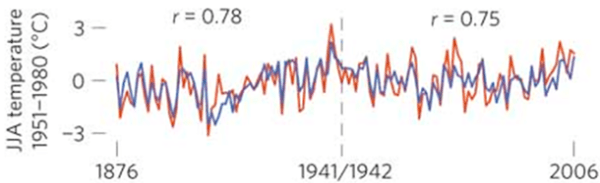
A new summer temperature reconstruction using of tree ring densities in Northern Scandinavia stir, raising some difficult questions for those who believe that C20th warming was caused by human activity

There are a couple of elements that corroborate sceptical beliefs that are not alluded to elsewhere.

Pointer to a low influence of CO2

There has been a decline in summer temperatures of 0.6 degrees.


From the abstract

Solar insolation changes, resulting from long-term oscillations of orbital configurations1, are an important driver of Holocene climate23. The forcing is substantial over the past 2,000 years, up to four times as large as the 1.6 W m−2 net anthropogenic forcing since 1750

That is (From the supplementary information figure S13), a decline in temperatures of around 0.6 Celsius is due to a net reduction in orbital forcings of 6 W m−2.

From a 1998 article by Sherwood Idso* on climate sensitivities,

a total greenhouse warming of approximately 33.6°C sustained by a thermal radiative flux of approximately 348 W m–2

That is 6 W m−2 gives approximately 0.6 degrees temperature change. This implies 1.6 W m−2 gives approximately a 0.16 degree temperature change, so CO2 is not the largest influence on C20th warming.

Pointer to the global temperature adjustments being wrong

Yesterday I reblogged pieces of evidence by Steven Goddard indicating that the historical temperature record has been systematically manipulated. In particular, the inter-war warming has been reduced, whilst recent warming has been increased. From the paper, this abstract of the more recent warming trends.

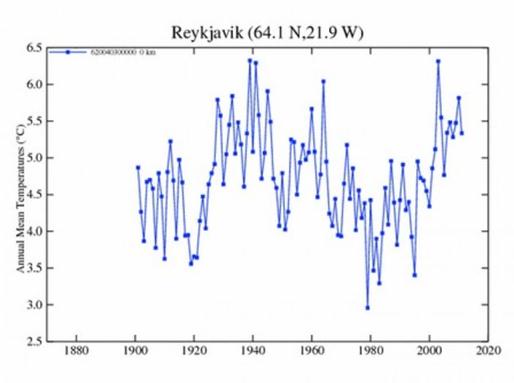
Now compare with two versions of the Reykjavik mean temperatures to see which is closer. I know that Reykjavik is between 50 and 350 miles south of the area surveyed, but it does seem to corroborate one version over the other.

A possible alternative explanation to the lower late C20th temperatures  is in the comments at NoTricksZone. DirkH says

The line actually becomes unreliable from 1912 to the present as it is done with a “100 year spline filter” the paper says. Don’t give to much on the shape of the final wiggle. Can’t find any more information but obviously the window for the filter shrinks near the end, how will it react? Dunno…

Hu McCulloch ain’t too impressed: (2009)

http://climateaudit.org/2009/08/23/spline-smoothing/

*Joanna Nova has a summary here.

This post by Steven Goddard brings together a number of pieces of evidence that “real world” data has been systematically adjusted to fit the theory.
BEWARE THE FLASHING GRAPHS LOWER DOWN.

This is only the second time I have reblogged somebody else’s work in the four years my blog has been running. The reason is that I often observe lots of pieces of evidence that suggest bias, but rarely are some of the pieces of evidence put together to corroborate each other.
Other bits of evidence (from memory)
1. The Darwen, Australia temperature record.
2. The temperature record for New Zealand.
3. The temperature record for Australia – which has recently be replaced to evade an external audit.
4. The HADCRUT temperature series being brought into line with GISTEMP to save having to hide the divergence.

It is not just ex-post adjustments of individual temperature series that creates an artificially large warming trend. There are also the statistical methods used to determine the “average” reading.

Tony Heller's avatarReal Climate Science

There wasn’t any hockey stick prior to the year 2000.

The 1990 IPCC report showed that temperatures were much cooler than 800 years ago.

www.ipcc.ch/ipccreports/far/wg_I/ipcc_far_wg_I_full_report.pdf

Briffa’s trees showed a sharp decline in temperatures after 1940

The 1975 National Academy Of Sciences report also showed a sharp decline in temperatures after 1940

www.sciencenews.org/view/download/id/37739/name/CHILLING_POSSIBILITIES

NCAR reported a sharp drop in temperatures after 1940

denisdutton.com/newsweek_coolingworld.pdf

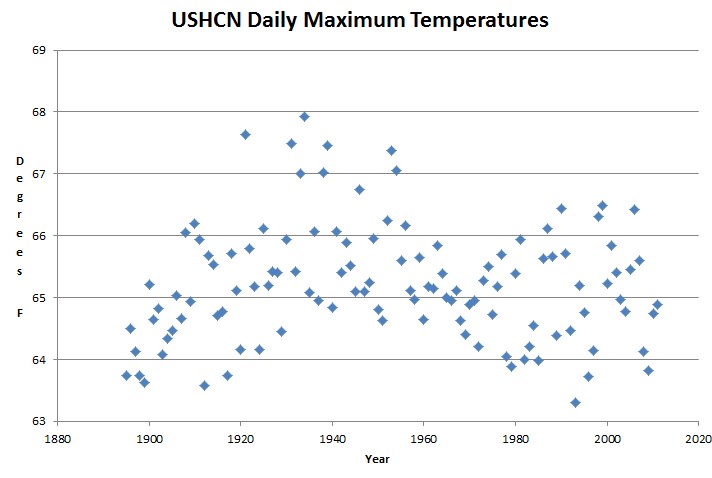
The USHCN daily temperature data showed a sharp decline in temperatures after 1940

GISS graphs from the eastern Arctic showed a sharp decline in temperatures after 1940

Data.GISS: GISS Surface Temperature Analysis

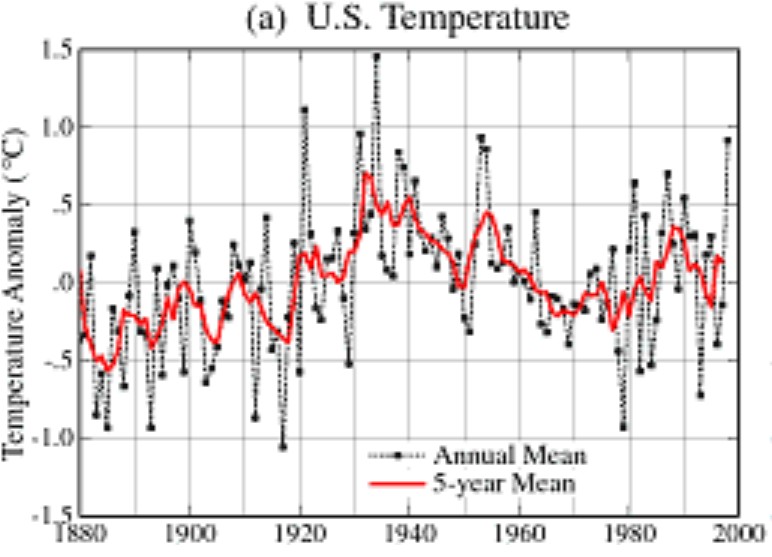
GISS US temperature graphs showed a sharp drop in temperatures after 1940

NASA GISS: Science Briefs: Whither U.S. Climate?

The Directors of CRU and NCAR forecast a continuing drop in temperatures.

Hubert Lamb CRU Director : “The last twenty years of this century will be progressively colder

http://news.google.com/newspapers/

John Firor NCAR director : “it appears…

View original post 322 more words

Gergis 2012 Mark 2 – Hurdles to overcome

BishopHill reported yesterday on the withdrawn Gergis paper that

The authors are currently reviewing the data and methods. The revised paper will be re-submitted to the Journal of Climate by the end of July and it will be sent out for peer review again.

It is worth listing the long list of criticisms that have been made of the paper. There are a lot of hurdles to overcome before Gergis et al 2012 should qualify for the status of a scientific paper.

My own, quite basic, points are:-

  1. Too few proxies for such a large area. Just 27 for > 5% of the globe.
  2. Even then, 6 are well outside the area.
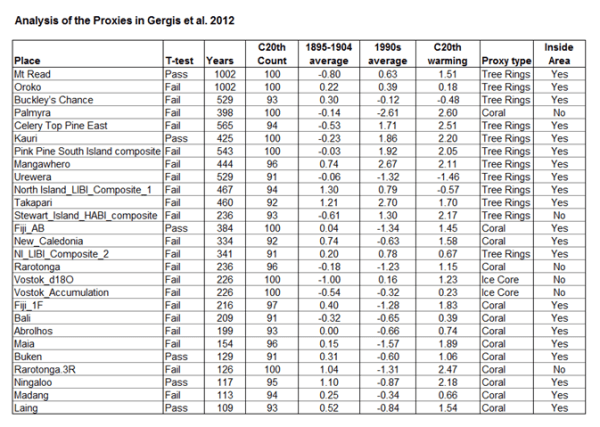
  3. Of these six, Gergis’s table makes it appear 3 are inside the area. My analysis is below.


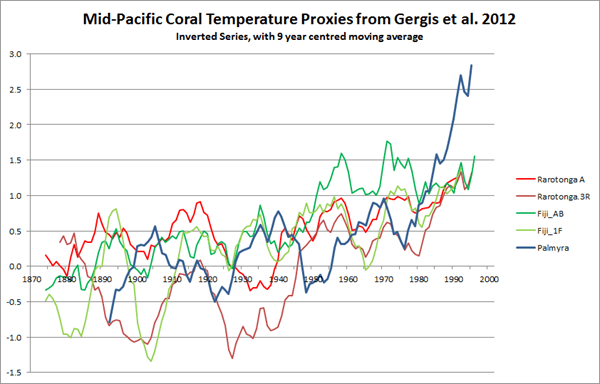
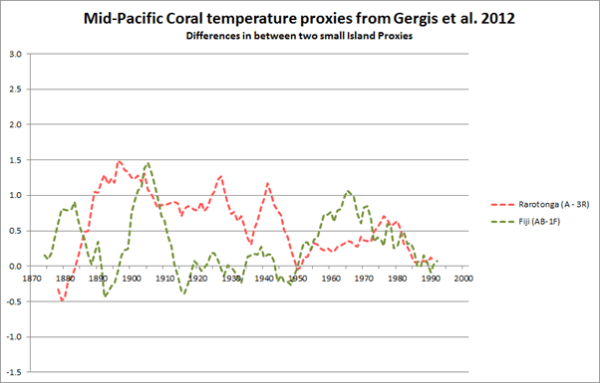
  4. Despite huge area, there are significant clusters – with massive differences between proxies at the same or nearby sites.
  5. There are no proxies from the sub-continental land mass of Australia.
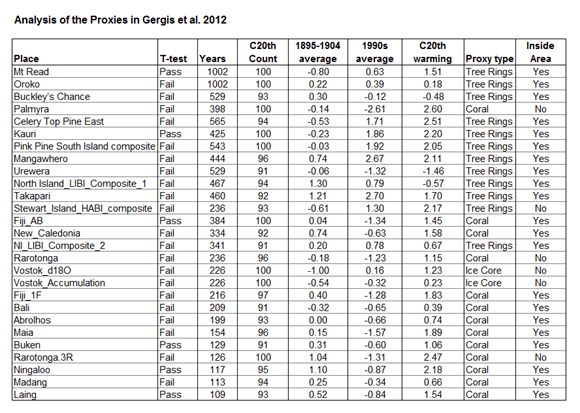
  6. Need to remove the Palmyra Proxy because (a) it has errant readings (b) fails the ‘t’ test (c) > 2000km outside of the area, in the Northern Hemisphere.
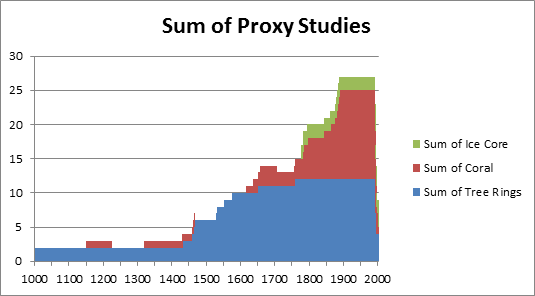
  7. Without Palmyra the medieval period becomes the warmest of the millennium. But with just two tree ring proxies, one at 42 O South and the other at 43 O S representing an range from 0 to 50O S, this is hardly reliable. See the sum of proxies by year. Palmyra is the coral proxy in the 12th, 14th and 15th centuries.


On top of this are Steve McIntyre’s (with assistance from JeanS and RomanM) more fundamental criticisms:-

  1. The filtering method of Gergis excluded the high quality Law Dome series, but included the lower quality Vostok data, and the Oroko tree ring proxy. McIntyre notes that Jones and Mann 2003 rejected Oroko, but included Law Dome on different criteria.
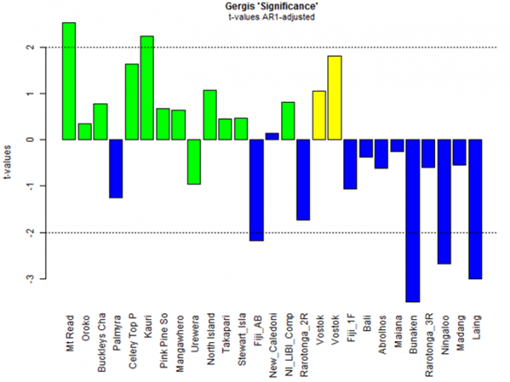
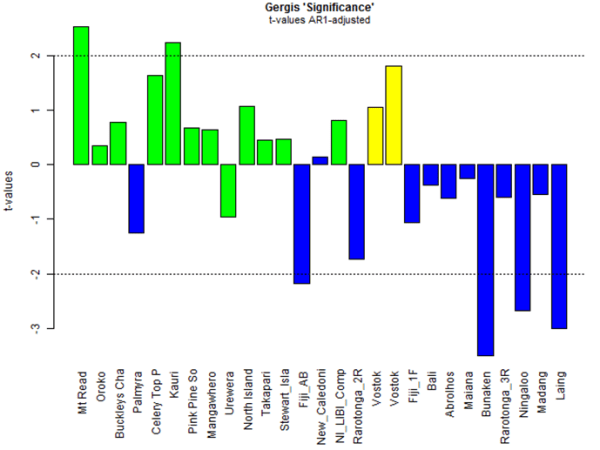
  2. Gergis screening correlations were incorrectly calculated. JeanS calculated properly. Only 6 out of 27 proxies passed. (NB none of the six proxies outside the area passed)


  3. The Gergis initially screened 62 proxies. Given that the screening included proxies that should not have included 21 proxies, but should it have included some of the 35 excluded proxies. We do not know, as Gergis has refused to reveal these excluded proxies.
  4. Screening creates a bias in the results in favour of the desired result if that correlation is with a short period of the data. RomanM states the issues succinctly here. My, more colloquial take, is that if the proxies (to some extent) randomly show C20th warming or not, then you will accept proxies with a C20th uptick. If proxies show previous fluctuations (to some extent) randomly and (to some extent) independently of the C20th uptick, then those previous fluctuations will be understated. There only has to be a minor amount of randomness to show bias given that a major conclusion was

    The average reconstructed temperature anomaly in Australasia during A.D. 1238-1267, the warmest 30-year pre-instrumental period, is 0.09°C (±0.19°C) below 1961-1990 levels.

UPDATE 03/08/12

The end of July submissions date seems to have slipped to the end of September.

BBC Newsround is misleading our children on climate change impacts

For nearly 40 years the BBC has shown “Newsround” a children’s version of the news. This morning I caught a glimpse of a report on Rio+20 at around 7.40am, with examples from the Isle of Man. In the main bulletin at 5.30pm a much fuller report was given. This later report was again from the Isle of Man, but with a very different slant. (UK based people view here) I have made two separate complaints:-

Complaint about the 7.40am report

Newsround reported on the Rio+20 meetings – aimed at getting agreements to combat global warming. Then switched to the Isle of Man. Mentioned about pollution, coastal erosion and oil running out. Then has a High School Girl show us the impact of recent coastal erosion. This gave the following misleading impressions.

1. Pollution is solely about global warming. It is not.

2. Man-made climate change caused the erosion. If it did (through contributing to a sea-level rise of less than 30cm in the last century) it was a very minor effect. Coastal erosion, with beach build-up elsewhere is a natural feature.

3. If one believes that CO2 is causing adverse climate change then oil running out is a positive thing. It should mention that Rio+20 is looking to find ways to encourage us to leave the stuff in the ground.

Complaint about the 5.30pm report

1. Local coal supplies were running out, which an elderly lady was finding more expensive. Missed out that this was (a) a local problem (b) coal is the worst of the fossil fuels for causing climate change (c) there are abundant global supplies (d) so Rio+20 is looking encouraging making it more expensive to leave the stuff in the ground.

2. A schoolgirl pointing to cliff erosion, the implication that this was caused by climate change. It was not pointed out that in the last 20 years sea levels have risen by just 0.06 metres, so the 20 metres of retreat of a soft cliff will be approximately 100% due to natural coastal erosion.

3. A schoolboy saying he can no longer kayak in the sea due to raw sewage being pumped into the sea. This is a local problem. In most areas of Europe this is reducing by national government action.

Summary

Newsround shows quite contradictory messages through editing. It creates the impression that only global governance can solve what are local problems; creates the misleading view that nasty humans are the cause of all the environmental issues; and fails to point out that the “solutions” to climate change involve making fossil fuels more expensive. That means old ladies who continue to use coal getting poorer; children being increasingly denied holidays in warmer countries; and parents spending less time with their children due to having to spend longer travelling by public transport, as car travel becomes too expensive.

97% of Climate Scientists claim they are not “Climate Deniers” Survey

In the back of my mind on analysing Charles Hanich‘s bogus Climate & Science questionnaire recently, was another, more prominent, survey. The 2009 questionnaire by Peter T. Doran and Maggie Kendall Zimmerman, amongst scientists, concluded

It seems that the debate on the authenticity of global warming and the role played by human activity is largely non-existent among those who understand the nuances and scientific basis of long-term climate processes. The challenge, rather, appears to be how to effectively communicate this fact to the policy makers and the public who mistakenly perceive debate among scientists.

Laurence Solomon has shown has biased the result actually was. First by excluding scientists who might be give greater emphasis on natural causes, like “solar scientists, space scientists, cosmologists, physicists, meteorologists and astronomers.” Second, by whittling down the 3146 responses from “earth scientists” to just 77, they create an insignificant sample. Here I want to consider some points that can be drawn from the method and the conclusion

Questions do not isolate the trivial from the catastrophic

The Survey Questions were

1. When compared with pre-1800s levels, do you think that mean global temperatures have generally risen, fallen, or remained relatively constant?

2. Do you think human activity is a significant contributing factor in changing mean global temperatures?

Most people would accept that temperatures have risen in the past 200 years. Most climate scientists who are active in the field of researching anthropogenic global warming will tend to think human activity has a significant impact. However, this could not mean as little as 10% or over 100% of recent surface temperature warming could be accounted for by human activity. As such the questions are far from sufficient to establish consensus that there on a high level problem that requires a high level policy response.

Identifiable responses create bias

Laurence Solomon has shown has biased the result actually was. First by excluding scientists who might be give greater emphasis on natural causes, like “solar scientists, space scientists, cosmologists, physicists, meteorologists and astronomers.” Second, by whittling down the 3146 responses from “earth scientists” to just 77, they create an insignificant sample.

However, there is a further element. The responses were identified, hence the ability to classify the core scientists. What if you are a practicing climate scientist, who no longer believes in the scientific case for global warming? The scientist finds themselves in the position of a priest/pastor/minister of religion in the Christian Church who has lost faith. They may enjoy the status, and the work, and the people they work with. With a questionnaire such as this, there is a risk of being “outed”. There are three strategies to adopt. Firstly it is not to respond. Secondly, to respond, but rationalise or lie. The wording of the question allows for rationalising. Thirdly, is to answer truthfully, risking your career, along with possible damage to friendships and co-workers funding. This is a huge issue for opinion surveys on controversial subjects. The best way to get honest answers is to guarantee anonymity, and for the survey to be conducted by an independent polling organisation.

Publishing record is not a good indicator of scientific understanding

Climate science, like in many other empirical research areas, is full of papers with multiple authors. The issues are complex, and the workload enormous, so the bulk of the work is done by the research assistants, and often most of the science. The lead authors may act as a project manager, or even just a name to get the work published. Major journals need articles by big names to maintain readership and prestige. The leading scientists, by publishing in the major journals, and having lots of works cited are able to attract funding for further projects and thus promote the other department members and the prestige of the university or other institution to which they belong. Thus looking to a core group based on publishing record might be misleading. Some of the leading scientists might now be more managers than cutting edge scientists. Others might be so enmeshed in the detail and hard-working, that they might never step back and question the bigger picture.

On the other hand, highly intelligent people who believe that the science is flawed, or dogmatic, will never have the desire to enter the field, or move into other areas when they change their minds. Alternatively, they may stay in the subject, but keep quiet about their views, backing away from publishing.

The Boundaries of Climate Change Denial

Many of the “pro-consensus”, “pro-science” blogs call those who think the science is faulty, flawed, or unsubstantiated, “deniers” or “denialists”, without ever defining the characteristic features actually are. This survey gives us the minimum criteria for knowing that someone is not a denier. It is someone who supports the “mainstream” view that the world has warmed, and that humans are to some extent, part responsible for it. This survey can only be taken as a public proclamation by a small minority that they are true believers.

If, however, the definition of “denier” is anything different then there is the logical possibility that people can be both part of the mainstream and climate change deniers. As such the word “denier” is nothing more than a term of discrimination and abuse by those in the mainstream.

Update

Published in response to an article in Nature, mentioning “Deniers” in the Scientific literature for the first time. Responses by Anthony Watts, Bishop Hill and Warren Meyer.


How Gergis Suppressed The Medieval Warm Period

The now withdrawn Gergis paper proudly proclaimed in the abstract

The average reconstructed temperature anomaly in Australasia during A.D. 1238-1267, the warmest 30-year pre-instrumental period, is 0.09°C (±0.19°C) below 1961-1990 levels.

On this basis, Gergis was able to say

A preliminary assessment of the roles of solar, volcanic, and anthropogenic forcings and natural ocean–atmosphere variability is performed using CSIRO Mk3L model simulations and independent palaeoclimate records. Solar and volcanic forcing does not have a marked influence on reconstructed Australasian temperature variations, which appear to be masked by internal variability.

This conclusion is from a single rogue proxy – the coral proxy from Palmyra Atoll.

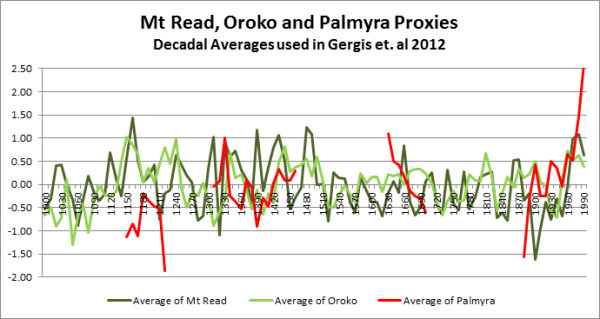
There were only three temperature proxies covering this medieval peak period. Both Mt. Read in Tasmania and Oroko in New Zealand are tree ring proxies that cover the entire millennium. The Palymyra Atoll coral proxy data covers just 398 years over 4 periods. These are 1151-1221, 1319-1465, 1637-1704 and 1888-1999. Following Gergis, I have calculated the decadal averages. Below is the plot from my pivot table for the three proxies.


I contend that Palmyra is distinctly “odd” due to the following.

  1. Nowhere in the world am I aware of a single instance of massive cooling during the early 13th Century. If not rogue data, the it must be a purely local phenomena.
  2. Nowhere in the world am I aware of a single instance of massive cooling during the 17th Century. Nor was I aware the early 17th century had significant warm period. If not rogue data, it must be a purely local phenomena.
  3. The Hadcrut3 global temperature set has slight cooling at the end of the 19th century / start of the 20th Century, and a warming period from 1910 to 1940 almost as large as the warming period from 1975 to 1998. If not rogue data, it must be a purely local phenomena.
  4. The post 1960 warming trend is phenomenal. In fact it makes the twentieth century warming trend the largest of all the 27 proxies. (See table “Analysis of the Proxies in Gergis et al. 2012” below)

For these three reasons it would appear to be an outlier. So what is the impact?

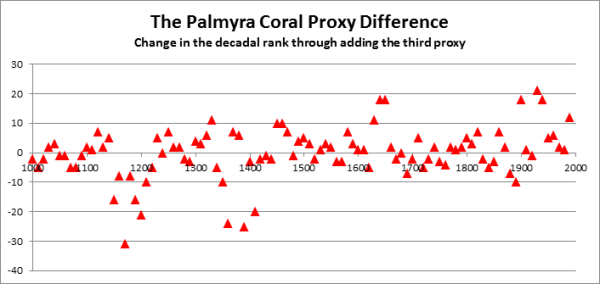
I looked at the decadal average of the two tree-ring proxies and ranked the hundred decades from 1 for the highest to 100 for the lowest. I then took the decadal average of the three tree-ring proxies and similarly ranked the results.

The change is the decadal ranking was as follows:-


The medieval warm period is suppressed, and the twentieth century is “enhanced”.

Now let us be clear. There were 24 other proxies in the data set. However, none of the others were prior to 1430. Therefore the impact on the overall ranking will not be quite so marked. However, the fact remains that the conclusion that last decade of the 20th century is the warmest of the millennium is based on this one rogue data set.

But there are two more reasons that the Palmyra data set should not have been included in the reconstruction.

Firstly, the Gergis paper was withdrawn upon the publication of the JeanS ‘Gergis Significance’ t-values. Unsurprisingly, Palmyra was one of the proxies that failed the t-test, so is a rogue data set. See table below.

Secondly, is geography. The study is a “temperature reconstruction for the combined land and oceanic region of Australasia (0°S-50°S, 110°E-180°E)“. Palmyra Atoll is located at 5°52′ N, 162°06′ W, or over 2100Km (1300 miles) outside the study area.

Conclusion.

The Palmyra Atoll coral proxy study is clearly an outlier statistically and geographically. In no way can it be considered a suitable proxy for the Australasia region, yet the major, headline, conclusion of the Gergis et al 2012 temperature reconstruction relied upon it.


Australian Climate Science Opinion Survey – Confirming Prejudices?*

This survey I took in June is not the one used in the recent Lewandowsky et al paper. The one I took at “Watching the Deniers” is a development that 2010 survey. There are less questions on conspiracy theories (but “NASA faked the moon landing”, along with Diana, JFK and MLK assassinations are are still in) along with exactly the same questions on Free markets v Environmentalism. But the new survey has more on political beliefs (a good thing in my view) along with new sections on religious beliefs and GM foods. It seems to be directed beyond the free-marketeers, to other groups like the American Religious Right.

The Psychology Department of the University of Western Australia, under psychology research assistant Charles Hanich is conducting a short questionnaire on Science and Society.

UPDATE – The survey questions are available here.

SCIENCE AND SOCIETY

This study explores people’s beliefs about a wide range of topics, ranging from scientific propositions to claims made in the media and on the internet. In addition, the survey is interested in your attitudes towards your own life and issues confronting modern societies at the moment.

The questions all have five options – Strongly Disagree, Disagree, Neutral, Agree and Strongly Agree.

The questions are from both perspectives, so that people who are anything but totally neutral will have to agree with some questions and disagree with others.

The sections as follows (My headings)

  1. Climate Change – 5 questions
  2. Genetically Modified Foods – 5 questions
  3. Vaccines – Benefits and harms – 5 questions
  4. Position of the Conservative / Liberal perspective (US definitions) – 7 questions
  5. Select neutral (check of the software, or check for spam?) – 1 questions
  6. Free market system v social justice / environment / sustainability – 5 questions
  7. Conspiracy theories (political) – 6 questions
  8. Conspiracy theories (scientific) – 6 questions
  9. Personal Spirituality & Religion – 8 questions
  10. Evolution – views upon – 7 questions
  11. Corporations – 13 questions
  12. Personal emotional outlook – 6 questions

That is 74 questions in total. Like a lot of surveys, it understates the questions (“about 40”) and the time taken.

Climate Change Questions

  1. I believe that the climate is always changing and what we are currently observing is just natural fluctuation.
  2. I believe that most of the warming over the last 50 years is due to the increase in greenhouse gas concentrations.
  3. I believe that the burning of fossil fuels over the last 50 years has caused serious damage to the planet’s climate.
  4. Human CO2 emissions cause climate change.
  5. Humans are too insignificant to have an appreciable impact on global temperature.

There is a complete absence of questions about future projections of warming; whether that warming is catastrophic or benign; of the strength of the science or the uncertainties; our trust in what scientists are telling us; nor of the ability of policy to do anything successfully combat it. These are the questions that many sceptics, including myself, are grappling with.

Genetically Modified Foods
Questions

  1. I believe that genetic modification is an important and viable contribution to help feed the world’s rapidly growing population.
  2. I believe genetically engineered foods have already damaged the environment.
  3. The consequences of genetic modification have been tested exhaustively in the lab, and only foods that have been found safe will be made available to the public.
  4. I believe that because there are so many unknowns, that it is dangerous to manipulate the natural genetic material of foods.
  5. Genetic modification of foods is a safe and reliable technology.

In contrast these are questions do look at the benefits and costs of the science; the current impacts and future impacts; along with the strength of the science and the uncertainties.

NB the vaccines section follows more on the model of GM foods section rather than climate change.

The political spectrum questions I will leave for others to comment upon. It seems to be written by an American-influenced “liberal” who lacks knowledge of the full spectrum of political thought.

Free Markets v social justice / environment / sustainability

  1. An economic system based on free markets unrestrained by government interference automatically works best to meet human needs.
  2. The free market system may be efficient for resource allocation but it is limited in its capacity to promote social justice.
  3. The preservation of the free market system is more important than localized environmental concerns.
  4. Free and unregulated markets pose important threats to sustainable development.
  5. The free market system is likely to promote unsustainable consumption.

It is based on a notion of free-market anarchy against on the beneficial utopian society. No mention of awkward facts, like the worst environmental disasters and social injustices in the last century occurred in authoritarian regimes of left and right.

Conspiracy theories (political)

  1. A powerful and secretive group known as the New World Order is planning to eventually rule the world through an autonomous world government which would replace sovereign governments.
  2. The assassination of Martin Luther King, Jr. was the result of an organized conspiracy by U.S. government agencies such as the CIA and FBI.
  3. The Apollo moon landings never happened and were staged in a Hollywood film studio.
  4. The assassination of John F. Kennedy was not committed by the lone gunman Lee Harvey Oswald but was rather a detailed organized conspiracy to kill the President.
  5. The U.S. government allowed the 9-11 attacks to take place so that it would have an excuse to achieve foreign (e.g., wars in Afghanistan and Iraq) and domestic (e.g., attacks on civil liberties) goals that had been determined prior to the attacks.
  6. Princess Diana’s death was not an accident but rather an organised assassination by members of the British royal family who disliked her.

Basically, if you read the communiques and the proclamations coming out of annual meeting like Copenhagen, Cancun and Durban that say we must have a strong global organization to impose climate change, you should consider yourself as much a crank or nutter as those who think George Bush was capable of the phenomenally detailed planning required to stage the 9-11 attacks (but totally failed to successfully bring peace through conquest in Iraq or Afghanistan).

Conspiracy theories (Scientific)

  1. The claim that the climate is changing due to emissions from fossil fuels is a hoax perpetrated by corrupt scientists who wish to spend more taxpayer money on climate research.
  2. U.S. agencies intentionally created the AIDS epidemic and administered it to Black and gay men in the 1970s.
  3. The alleged link between second-hand tobacco smoke and ill health is based on bogus science and is an attempt by a corrupt cartel of medical researchers to replace rational science with dogma.
  4. The HIV virus causes AIDS.
  5. Smoking causes lung cancer.
  6. Lead in drinking water poses a serious long-term health risk.

The questions on climate and second-hand tobacco smoke lump two concepts together; a lot of money wasted for very little output along with the alleged motives of those practicing their research. In between is a particularly distasteful conspiracy theory, the very idea of which would be repellent to most people. The other three questions are simple statements of well-established science. There is no loading or controversy.

Religion and Evolution.

  1. God is important in my life
  2. I believe there is a life after death
  3. I get comfort or strength from religion
  4. There is no proof of God: if there is a God, he would have shown himself by now
  5. I think of myself as a religious person
  6. I have made a personal commitment to live my life for God
  7. I have had an experience of spiritual worship that was very moving and powerful
  8. I have experienced a definite answer to prayer or specific guidance from God
  9. Modern humans are the product of evolutionary processes that have occurred over millions of years
  10. The theory of evolution is based on speculation and not valid scientific observation and testing
  11. Most scientists accept evolutionary theory to be a scientifically valid theory
  12. There is a significant body of data that supports evolutionary theory
  13. Humans exist today in essentially the same form in which they always have
  14. Evolution is a scientifically valid theory
  15. Current evolutionary theory is the result of sound scientific research and methodology

This is meant to distinguish between the US bible-belt evangelical Christians and the atheistic scientific community. It does so in a non-partisan way, so that Muslims could answer as well. However, it does not take into account the more nuanced, earnest, balanced and thoughtful approaches to the interactions of hard science and the timeless spiritual truths, as typified, is not caricatured, by Dr Rowan Williams, The Archbishop of Canterbury.

Corporations

  1. Corporations are not respectful of laws
  2. Corporations do not accept accountability for their actions
  3. People who run corporations will lie if doing so will increase company profits
  4. Corporations do not care about acting ethically
  5. Corporations will break laws if they can make more money from it
  6. Corporations put their own interests above the public’s interests
  7. Corporations are driven by greed
  8. Corporations care only about money
  9. Corporations want power at any cost
  10. Corporations take a lot more than they give
  11. Corporations intentionally deceive the public
  12. Corporations do not consider the needs of their employees when making business decisions
  13. Corporations exploit their workers

Any notion of balance goes completely out of the window. It is by far the largest section in a questionnaire on “Science and Society”. There is no switching between good points of corporations – such as technological breakthroughs, or much of our phenomenal prosperity. That includes the “Eco” technologies and the must-have gadgets from a fruity American 70s start-up. It is almost as if they want the more moderate participants to give up in disgust. Do avoid permanent psychological damage, they questionnaire end with a few personal questions about things in life you are thankful for, and people that you are grateful to.

The missing sections

No not the political spectrum one. The missing questions that a more balanced questionnaire might ask.

  1. General trust in climate science.
  2. Trust in carefully presented evidence, with questions respectively answered, as against the dogma of “scientists agree”.
  3. Questions for the Australian people, of whether carbon tax policies are worthwhile
  4. Questions on trust in government; the motives of politicians; the ability to deliver on promises. In relation to both Western democracies and tyrannies past and present.
  5. The importance of tackling climate change relative to other issues like unemployment and prospective financial meltdown in parts of Europe.

Conclusion

When devising a questionnaire, one must always try to eliminate bias, and avoid emotionally loaded the questions that will prejudice the answers. Neither should it contain multiple issues in a question. This survey does just the opposite. It is started off being deliberately designed to elicit certain polarized responses, ending up showing the deeply prejudiced and politically extreme position of the author.

*Please note. I am not aware of any copyright restrictions on reposting the questions. I accessed this from “Watching the Deniers” website, where there was no mention of copyright material. Neither was there any mention of copyright on the introductory front page. The doing a search I only came across a link to a 2010 survey. Neither could I find a link within The University of Western Australia Website, though it is on their servers.

Mid-Pacific Coral temperature proxies from Gergis et al. 2012

How odd is the Palmyra Atoll Coral Proxy?

In the last post I noted that there was something odd about the Palmyra proxy used in the Gergis paper, particularly in the late 20th century. This is at 5°52′ N, 162°06′ W.

There are four other coral proxies in the Mid-Pacific area. There are two proxy studies from
Rarotonga in the Cook Islands at 21° 14′ 0″ S, 159° 47′ 0″ W and two from the Fiji. For all five proxies I calculated a nine year centred moving average.


Palmyra shows a late 20th century warming trend more than twice that of the other series. Unless there is a locally recorded temperature anomaly on the atoll, then this is clearly wrong. If there is a local temperature spike, then it one should question why it is included in a reconstruction for which it is over 2000km outside the boundary. Either way it should be deleted from the study.

So how reliable are coral proxies. Here we have two pairs. If they are a good proxy for temperature, then they should be a good proxy for each other. On Fiji, they studies be less than 150km apart and on Rarotonga less than 10km apart, meaning they should be near identical. So I have plotted the differences between the moving averages.


It is not a statistically sound method, but indicative of the real issues with the proxy data sets. It also seems that the further back, the greater the consistency. The Palmyra study has four sections, the oldest of which starts in the 12th Century. Although Gergis claims to have done a series of tests for robustness, there is no correlation test over the known temperature record. Given that a central conclusion is:-

The average reconstructed temperature anomaly in Australasia during A.D. 1238-1267, the warmest 30-year pre-instrumental period, is 0.09°C (±0.19°C) below 1961-1990 levels.

Given that there is some question of the selection of the ice core studies at Vostok in preference for the closer and more robust studies at Ice Dome, then central conclusion of the study is not credible on such a small number of proxies.