Is the Rawlings and Thrasher English Elections Forecast a bit timid?

At the weekend I posted my forecast for the English council elections to take place on May 4th, using a comparison with opinion polls both now and 2013, along with the forecast made by Harry Hayfield at Political Betting.

On Sunday, The Times published a forecast from Colin Rawlings and Michael Thrasher, both Professors of Politics at the University of Plymouth.

Again they use local by-election results a a basis for their forecast, and come up with similar results to Hayfield for the Lib-Dems (+9%) and UKIP (-12%). The biggest difference is with Labour, predicting no change, as against -4% for Hayfield. More relevant is the forecast for seats, where they predict Conservative +50, Labour -50, Lib Dem +100, UKIP -100

Despite these chaps having considerable experience of election data, having written a number of post-election reports for the Electoral Commission, I believe that their forecasts might be somewhat out. This I have split into share of the vote and seat predictions.

Rawlings & Thrasher share of the vote prediction

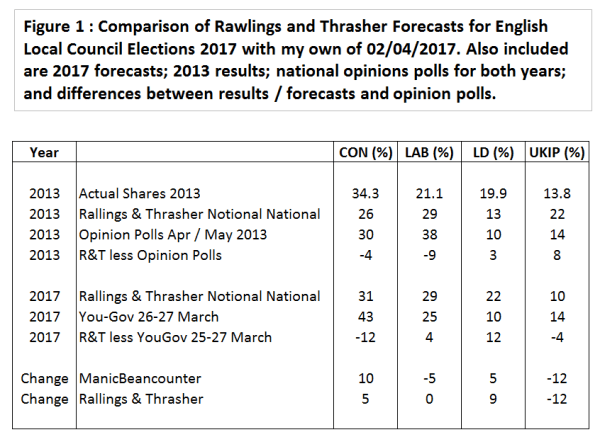
I have summarized some data in figure 1.

Rawlings & Thrasher base their forecast on the Notional National Change, so I have shown the difference between those figures and the General Election Opinion Polls. There are reasons why the local council elections are different from the opinion polls, aside from the fact that opinion polls may not fully reflect actual decisions.

In 2013 UKIP benefitted in the local elections as people used their vote as a protest against the Coalition Government and/or in support of an EU Referendum.  That no longer exists as Brexit is underway; whilst UKIP is in disarray and has fund-raising issues. In this I would agree with Rawlings and Thrasher in a huge drop in support for UKIP, swinging from outperforming the opinion polls, to underperforming.

With the Liberal Democrats, I would agree that they should not only outperform the opinion polls, but do so by a greater margin than in 2013, when being in Coalition Government damaged their brand as being the alternative to the Conservatives in the non-socialist areas. This year they may also benefit as being the Party of those most opposed to Brexit. But the actual share of the vote was 20%. For the notional share of the National Vote to rise nine points would indicate a larger rise to over 30% of the actual vote. It would effectively make the arch-Remainers effectively the biggest beneficiaries of the fall in support for UKIP. That is possible, but would imply very large underlying switches in effective party support. Also, this large net increase in Lib-Dem vote share would be despite no net movement in the general election opinion polls in the last five years. Even if local by-elections results indicate such a swing, when voting for full councils I do not believe that this will replicate this result.

The forecast for Labour to have no change from 2013 is perhaps the most out of line with reality. Just four years ago Labour seemed likely to be in a position to be win the 2015 election. Now they are 13 points lower in the opinion polls. Most of the councils concerned are in the Conservative heartlands, with Labour traditionally trailing in third place. They thus have less far to fall than nationally, but barring a miracle in the next four weeks, they will lose vote share.

By difference, this leaves the Conservatives making much larger gains that 5% of the Notional National Vote.

Rawlings and Thrasher seat change predictions

This I think is the most timid part of the seat changes to repeat they are

Conservative +50, Labour -50, Lib Dem +100, UKIP -100

Prof John Curtice on the Sunday Politics thought, based upon a 12 point swing in the opinion polls, Labour could suffer a much bigger loss of seats than the 50 forecast by Rallings and Thrasher. (hattip Guido Fawkes)

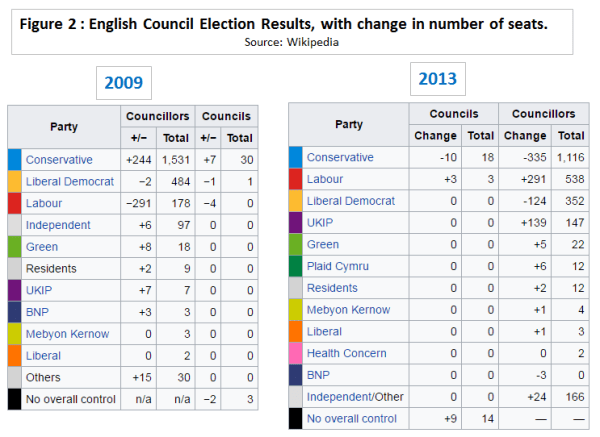
But to get an idea of the likely level of seat changes, it is worth looking at the changes in the similar (but not quite identical in terms of seats and councils) council elections in 2009 and 2013. These, from Wikipedia (here and here) are shown in Figure 2.

Please note that the numbers do not quite stack up due to (a) one more council in 2013 (b) boundary changes (c) by-elections. But broad comparisons can still be made.

UKIP gained 139 seats in 2013. The swing from 2009 to 2013 was probably greater than the counter swing they will likely suffer next month, so the loss of 100 seats is a reasonable estimate.  Similarly the Lib Dem estimate of 100 seats gain seems about right, despite the likely net change in fortunes maybe be less at a National level not likely nearly countering the loss in popularity between 2009 and 2013.

When it comes to Labour, they are nationally in a worse position than in 2009. So their loss of seats could be greater than then suffered in 2009. A reduction of 300 seats, or nearly 60% of the defended seats, seems a reasonable forecast, with a 200 seat loss or less being a relatively good night for Labour with their current unpopularity.

The Conservatives should easily be the biggest gainers. Most of the councils are in Conservative Heartlands. Others, like Lancashire and Derbyshire, are where they have managed majorities in the recent past. Yet in 2013 the Conservative share of the vote was below that achieved in the UK as a whole in the General Election just two years later. Two years after the General Election, the party is in a considerably stronger position, so should gain considerably. A gain of 300 seats is my forecast.

Final points

An aspect to consider in local elections is the impact of turnout. In their report on the 2013 English and Anglesey Council Elections, Rawlings and Thrasher noted that turnout was 31%, compared with over 39% in 2009.

In the similar 2009 report they note that this turnout was higher than in the previous three years.

Could the relatively high turnout be due to the confidence of Conservative voters? In 2009 the Conservative vote was 44.5%, 10% higher than in 2013. Labour had a 12.7% share (over 8% lower) and Lib-Dems were at 24.9% (5% higher). Then the Conservatives were a year away from going back into Government. In 2013, they looked like reverting to opposition. In 2017, there is a new sense of optimism among Conservative supporters, not seen since the end of the Falklands War – or at least with their Brexit supporters. These are concentrated in the middle-aged and older people, among whom turnout is usually higher than in the population at large. On the other hand, the Labour-supporting Remainers might stay at home, being doubly-demoralised. The change in seats could be even bigger than in either 2009 or 2013.

These are of course my forecasts compared with those of others who have more experience in these matters. What is crucial is how analyzing the difference between forecasts and actual results can deepen our collective understanding of what is happening in an interesting period in British history.

Kevin Marshall


Local Elections Forecast May 2017

At Political Betting Harry Hayfield has produced a forecast for the County Council elections in May 2017, just six weeks away. I have long followed this blog, though I neither bet nor follow the politics of the blog propriotor Mike Smithson (Lib-Dem & Pro-Remain on Brexit). However, it is the very differences that provide an alternative perspective. Harry Hayfield’s basic assumptions County Council elections in England are:-

In the local by-elections, areas that voted REMAIN saw the following change:
Con -9%, Lab -4%, Lib Dem +12%, UKIP -12%, Greens 0%, Ind -10%, Others +23%
Where as areas that voted to LEAVE saw the following change:
Con +4%, Lab -4%, Lib Dem +7%, UKIP -9%, Greens +1%, Ind +4%, Others -3%

With any forecast there is a lot of work involved in converting these into seats. Any baseline, when compared to the actual results will help develop an understanding of both of National opinion in turbulent times and also how it impacts at the local politics. What I would note is that the Counties are mainly Conservative territory; has a large Independent / Other representation (though this has been declining for decades); and is predominantly Remain voting, but not extremely more than the UK average.

But that said Harry Hayfield’s forecasts seem to be at odds with the opinion polls. Taking the UK Polling Reports opinion poll figures for (a) 28/04/13 to 10/05/13 and (b) 05/02/17 to 19/02/17 (the latest available) the change in voting intention is about

Con +11%, Lab -13%, Lib Dem +0%, UKIP -2%, Greens +2%.

Since then the Conservatives and Lib Dems at improved slightly at the expense of UKIP and Labour. The latest YouGov figures, for 25-27 March,  are

Con 43%, Lab 25%, Lib Dem 11%, UKIP 10%

And the change on 2013 are about

Con +13%, Lab -14%, Lib Dem +1%, UKIP -4%

The actual share of the vote – skewed by being counties – was

Conservative 34.3%, Labour 21.1%, UKIP 19.9%, Lib Dem 13.8% and Green 3.5%

therefore – Other 7.4%

In terms of the County Councils, perhaps 85% were for Leave in the EU Referendum, on the basis that maybe three-quarters of Parliamentary Constituencies in in England and Wales voted for Leave, and most of the Remain vote was in the Metropolitan areas. So why should the Conservatives only improve by 4% in most of the Council areas on 2013 when they are 13% up in the opinion polls nationally?

Harry Hayfield’s assumptions diverge from the opinion polls from being based upon recent by-elections nationally. That is upon a maybe half a dozen by-elections a week, These one-off events usually have low turnouts, and are highly impacted by protest votes.  The biggest reason for protest votes at the present time is the Brexit issue. It will have an impact on the local elections, with the Remain protest vote being stronger than the Leave support vote. But this will be much less than in by-elections due to (a) higher turnout due to area-wide elections (b) higher turnout on average as the counties tend to have higher turnout than the Metropolitan areas (c) the protest vote is concentrated in the cities, especially London. The latter is evidenced by the two recent very large petitions to change the referendum rules after the EU referendum and to cancel the State Visit of President Trump.

That said, using by-election results is a as good as any considering the political landscape has changed dramatically in the past four years. By using clear assumptions on forecasts it is possible to understand where they go wrong. But that understanding will be only on the empirical differences between forecast and actual. What I will now do is to give a forecast based on reasons (maybe my unfounded opinions) with some notes on the parties. This might muddy the waters a bit, but here goes.

For UKIP 2013 elections were a “game-changer“, to use Nigel Farage’s term. UKIP then got nearly double the share in the County vote as in the National opinion polls. A party campaigning on a single national issue made huge gains on votes at local government level. The 20% of vote share was a precursor to the 26.6% in the European Parliament elections achieved in 2014.  This impact is now gone, and the grassroots support needed to field and promote thousands of candidates may have diminished due to internal strife. Local by-elections may not fully reflect this impact, as they can concentrate their much reduced resources. UKIP’s share may go below the National Opinion polls. On these grounds I will go for a -13% change on 2013, giving UKIP 7% of the vote.

The Liberal-Democrats, are usually the main opposition to the Conservatives in the Counties and also usually perform much better than in General Elections. In 2013 they were in Coalition with the Conservatives, which severely damaged their standing as a local opposition. The 13.8% of the vote was 3-4% ahead of the opinion polls. This margin might not be much more than in previous 20 years, but in those years the Lib-Dems were doing much better nationally. Any bounce I believe will be mostly due to being the respectable face of hard-line opposition to Brexit. This could be bet positive, but put some folks off voting for them on local issues. I would guess at an increase of 5% giving the Lib-Dems 19% of the vote.

The Labour Party cannot fall nearly as far in the English Counties, where support is much lower than the national average. At the end of April and beginning of May 2013 they were polling 38-39% nationally, but achieved 21.1% of the vote. Will they still fall? In 2013 they managed to overtake the Lib-Dems with 538 to 352 seats, as against 247 to 476 in 2009, so the 21.1% was actually an improvement. Nationally Labour are doing worse (or at least no better) than in 2009. What is more, they have lost a lot of their working class base, which would have formed some of the core support in the Counties. I would estimate a 5% fall.

The Independents were once a major contingent in local politics, but only achieved 7.4% of the vote in 2013. How will this go? I would hope for an increase as people vote again for local representatives based on local issues. With the decline of UKIP, and maybe the Lib-Dems tarnished in the eyes of some for going very anti-Brexit, I think they may gain ground to around 10%. The Greens maybe the same.

By difference, the Conservatives will have a 11% increase in the vote share to 45% of the vote share. This is fairly similar to the change in national opinion polls over the last four years (from 30 to 41%). Indeed, it might be a low estimate, as in 2013 the Coalition Government was suffering from normal mid-term blues. At present, the Government is in the unusual position of being significantly more popular than when elected.

So, in conclusion, Harry Hayfield’s estimate was as follows

In the local by-elections, areas that voted REMAIN saw the following change:
Con -9%, Lab -4%, Lib Dem +12%, UKIP -12%, Greens 0%, Ind -10%, Others +23%
Where as areas that voted to LEAVE saw the following change:
Con +4%, Lab -4%, Lib Dem +7%, UKIP -9%, Greens +1%, Ind +4%, Others -3%

The LEAVE areas are at least 5 times more than the REMAIN areas. My estimate, for all English areas with a complete council elections in 2013 & 2017 is as follows.

Con +10%, Lab -5%, Lib Dem +5%, UKIP -12%, Ind/others +2%.

It is the actual results that will matter, and possible lessons to be learnt during a time of massive change in British politics.

Kevin Marshall

Climate Delusions 2 – Use of Linear Warming Trends to defend Human-caused Warming

This post is part of a planned series about climate delusions. These are short pieces of where the climate alarmists are either deluding themselves, or deluding others, about the evidence to support the global warming hypothesis; the likely implications for changing the climate; the consequential implications of changing / changed climate; or associated policies to either mitigate or adapt to the harms. The delusion consists is I will make suggestions of ways to avoid the delusions.

In the previous post I looked at how for the Karl el al 2015 paper to be a pause-buster required falsely showing a linear trend in the data. In particular it required the selection of the 1950-1999 period for comparing with the twenty-first century warming. Comparison with the previous 25 years would shows a marked decrease in the rate of warming. Now consider again the claims made in the summary.

Newly corrected and updated global surface temperature data from NOAA’s NCEI do not support the notion of a global warming “hiatus.”  Our new analysis now shows that the trend over the period 1950–1999, a time widely agreed as having significant anthropogenic global warming, is 0.113°C decade−1 , which is virtually indistinguishable from the trend over the period 2000–2014 (0.116°C decade−1 ). …..there is no discernable (statistical or otherwise) decrease in the rate of warming between the second half of the 20th century and the first 15 years of the 21st century.

…..

…..the IPCC’s statement of 2 years ago—that the global surface temperature “has shown a much smaller increasing linear trend over the past 15 years than over the past 30 to 60 years”—is no longer valid.

The “pause-buster” linear warming trend needs to be put into context. In terms of timing the Karl reevaluation of the global temperature data was published in the run-up to the COP21 Paris meeting which aimed to get global agreement on reducing global greenhouse gas emissions to near zero by the end of the century. Having a consensus of the World’s leading climate experts admitting that warming was not happening strongly implied that there was no big problem to be dealt with. But is demonstrating a linear warming trend – even if it could be done without the use of grossly misleading statements like in Karl paper – sufficient to show that warming is caused by greenhouse gas emissions?

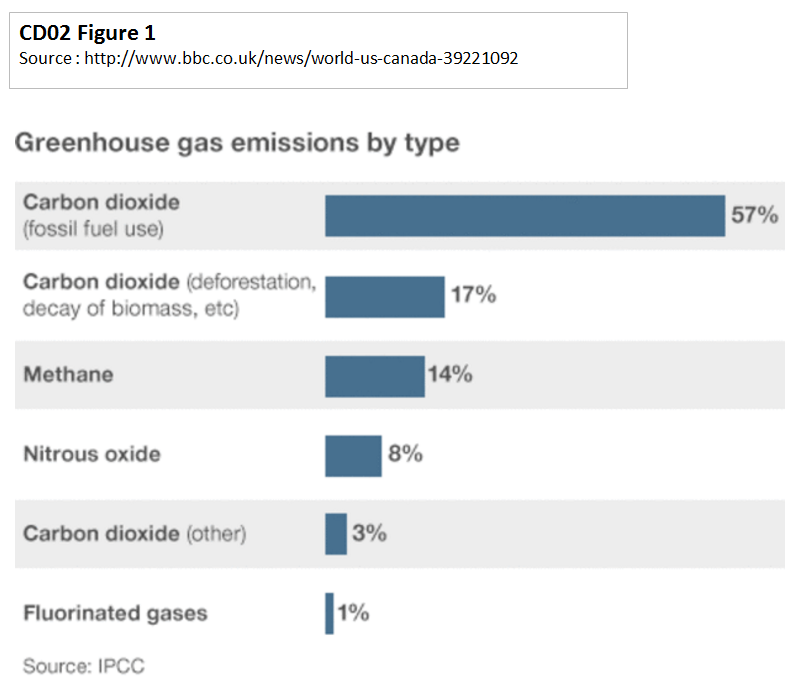
The IPCC estimates that about three-quarters of all greenhouse emissions are of carbon dioxide. The BBC’s recently made a graphic of the emission types, reproduced as Figure 1.


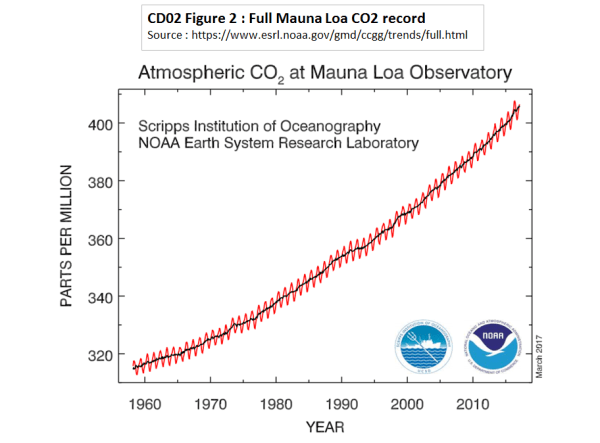
There is a strong similarity between the rise in CO2 emissions and the rise in CO2 levels. Although I will not demonstrate this here, the emissions data estimates are available from CDIAC where my claim an be verified. The issue arises with the rate of increase in CO2 levels. The full Mauna Loa CO2 record shows a marked increase in CO2 levels since the end of the 1950s, as reproduced in Figure 2.

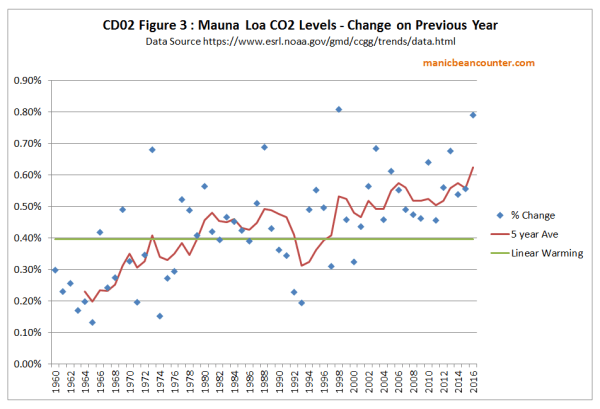
What is not so clear is that the rate of rise is increasing. In fact in the 1960s CO2 increased on average by less than 1ppm per annum, whereas in the last few years it has exceeded over 2ppm per annum. But the supposed eventual impact of the impact of the rise in CO2 is though a doubling. That implies that if CO2 rises at a constant percentage rate, and the full impact is near instantaneous, then the rate of warming produced from CO2 alone will be linear. In Figure 3 I have shown the percentage annual increase in CO2 levels.

Of note from the graph

  • In every year of the record the CO2 level has increased.
  • The warming impact of the rise in CO2 post 2000 was twice that of the 1960s.
  • There was a marked slowdown in the rate of rise in CO2 in the 1990s, but it was only for a few years below the long term average.
  • After 1998 CO2 growth rates increased to a level greater for any for any previous period.

The empirical data of Mauna Loa CO2 levels shows what should be an increasing impact on average temperatures. The marked slowdown, or pause, in global warming post 2000, is therefore inconsistent with CO2 having a dominant, or even a major role, in producing that warming. Quoting a linear rate of warming over the whole period is people deluding both themselves and others to the empirical failure of the theory.

Possible Objections

You fail to isolate the short-term and long-term effects of CO2 on temperature.

Reply: The lagged, long-term effects would have to be both larger and negative for a long period to account for the divergence. There has so far been no successful and clear modelling, just a number of attempts that amount to excuses.

Natural variations could account for the slowdown.

Reply: Equally natural variations could account for much, if not all, of the average temperature rise.in preceding decades. Non-verifiable constructs that contradict real-world evidence, are for those who delude themselves or others.  Further, if natural factors can be a stronger influence on global average temperature change for more than decade than human-caused factors, then this is a tacit admission that human-caused factors are not a dominant influence on global average temperature change.

Kevin Marshall


Climate Delusions 1 – Karl et al 2015 propaganda

This is the first is a planned series of climate delusions. These are short pieces of where the climate alarmists are either deluding themselves, or deluding others, about the evidence to support the global warming hypothesis; the likely implications for changing the climate; the consequential implications of changing / changed climate; or associated policies to either mitigate or adapt to the harms. The delusion consists is I will make suggestions of ways to avoid the delusions.

Why is the Karl et al 2015 paper, Possible artifacts of data biases in the recent global surface warming hiatus proclaimed to be the pause-buster?

The concluding comments to the paper gives the following boast

Newly corrected and updated global surface temperature data from NOAA’s NCEI do not support the notion of a global warming “hiatus.”  …..there is no discernable (statistical or otherwise) decrease in the rate of warming between the second half of the 20th century and the first 15 years of the 21st century. Our new analysis now shows that the trend over the period 1950–1999, a time widely agreed as having significant anthropogenic global warming (1), is 0.113°C decade−1 , which is virtually indistinguishable from the trend over the period 2000–2014 (0.116°C decade−1 ). Even starting a trend calculation with 1998, the extremely warm El Niño year that is often used as the beginning of the “hiatus,” our global temperature trend (1998–2014) is 0.106°C decade−1 —and we know that is an underestimate because of incomplete coverage over the Arctic. Indeed, according to our new analysis, the IPCC’s statement of 2 years ago—that the global surface temperature “has shown a much smaller increasing linear trend over the past 15 years than over the past 30 to 60 years”—is no longer valid.

An opinion piece in Science, Much-touted global warming pause never happened, basically repeats these claims.

In their paper, Karl’s team sums up the combined effect of additional land temperature stations, corrected commercial ship temperature data, and corrected ship-to-buoy calibrations. The group estimates that the world warmed at a rate of 0.086°C per decade between 1998 and 2012—more than twice the IPCC’s estimate of about 0.039°C per decade. The new estimate, the researchers note, is much closer to the rate of 0.113°C per decade estimated for 1950 to 1999. And for the period from 2000 to 2014, the new analysis suggests a warming rate of 0.116°C per decade—slightly higher than the 20th century rate. “What you see is that the slowdown just goes away,” Karl says.

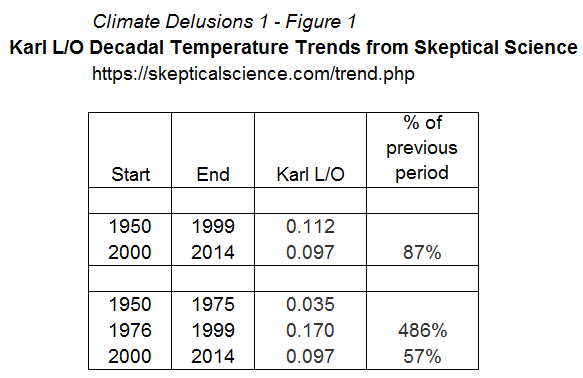
The Skeptical Science Temperature trend data gives very similar results. 1950-1999 gives a linear trend of 0.113°C decade−1 against 0.112°C decade−1 and for 2000-2014 gives 0.097°C decade−1 against 0.116°C decade−1. There is no real sign if a slowdown,

However, looking at any temperature anomaly  chart, whether Karl. NASA Gistemp, or HADCRUT4, it is clear that the period 1950-1975 showed little or no warming, whilst the last quarter of the twentieth century show significant warming.  This is confirmed by the Sks trend calculator figures in Figure 1.

What can be clearly seen is the claim of no slowdown in the twenty-first century compared with previous years is dependent on the selection of the period. To repeat the Karl et. al concluding claim.

Indeed, according to our new analysis, the IPCC’s statement of 2 years ago—that the global surface temperature “has shown a much smaller increasing linear trend over the past 15 years than over the past 30 to 60 years”—is no longer valid.

The period 1976-2014 is in the middle of the range, and from the Sks temperature trend is .160. The trend is significantly higher than 0.097, so a slowdown has taken place. Any remotely competent peer review would have checked what is the most startling claim. The comparative figures from HADCRUT4 are shown in Figure 2.

With the HADCRUT4 temperature trend it is not so easy to claim that there is no significant slowdown. But the full claim in the Karl et al paper to be a pause-buster can only be made by a combination of recalculating the temperature anomaly figures and selection of the 1950-1999 period for comparing the twenty-first century warming. It is the latter part that makes the “pause-buster” claims a delusion.

Kevin Marshall


Stoke Central By-Election – Labour’s achievement in statistics

Yesterday’s Parliamentary By-Elections were quite significant. The number of firsts about the result in Copeland have been gone over in fine detail. But in Stoke Central the winning Labour Candidate, Gareth Snell, can point to some records and distinctions that he has achieved. Purely in the interests of balance, I would like to help out. 🙂

Of the 650 MPs currently in the House of Commons, he will have the distinction of being elected on the least votes cast. Snell, in winning with 7853 votes, has removed from bottom place Angus MacNeil, SNP MP for Na h-Eileanan An Iar, who won with just 8662 votes. But this constituency covering the Hebrides has less than half of the Stoke-on-Trent Central electorate. Further, now 94% of sitting MPs are sitting in the House of Commons by virtue of winning with at least twice the numbers votes. In 2015 Tristram Hunt won Stoke Central with just 19.3% of electorate voting for him  – the lowest in England. Gareth Snell MP won with just 14.2% of the electorate voting for him, the lowest in Britain. Bottom place was previously held by Alasdair McDonnell, SDLP MP for Belfast South with 14.7% of the electorate voting for him. But in Belfast South six candidates saved their deposit, and seventh placed UKIP just missed out in getting 4.9% of the votes. In Stoke only four candidates saved their deposit and fifth placed Green candidate only got 1.4% of the vote. Whilst in Belfast South the majority was 2.3% of the votes cast, in Stoke Central it was 12.4%.

Another statistic is to look at the runner-ups in the General Election 2015. 560 of the 650 second-placed candidates received more than Gareth Snell’s 7853 votes. On average in GE 2015 the winners on average received and 23634 and the runners up 12121 votes, respectively 3 times and 1.5 times Snell’s mighty vote count. Although there were just 232 Labour MPs elected in 2015, 506 Labour Candidates received more than 7853 votes than Snell received yesterday. In the constituencies where they stood Labour received on average 14813 votes, nearly twice the votes received to win Stoke Central by a considerable margin. Of the 125 Labour candidates who received less votes than Gareth Snell, only 11 achieved the runner-up slot. The rest were lower-placed.

But this was a by-election, where turnout is usually much lower than at General Elections. Yet here Gareth Snell again sets records. You have to go all the way back to 15 July 2004 to find a winning candidate who won a by-election with less votes. That was Labour candidate Liam Byrne became the MP for Birmingham Hodge Hill with just 7451 votes. There have been 44 by-elections in between. Yet back then on average people won by-elections with smaller number of votes.

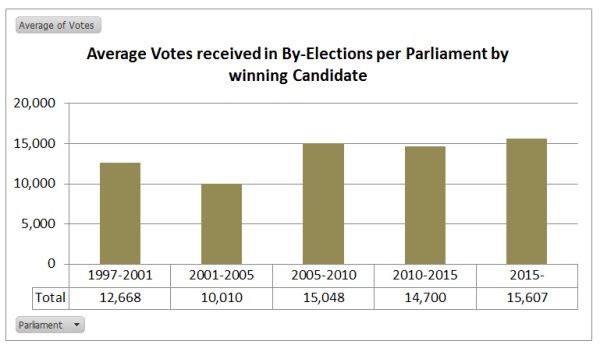
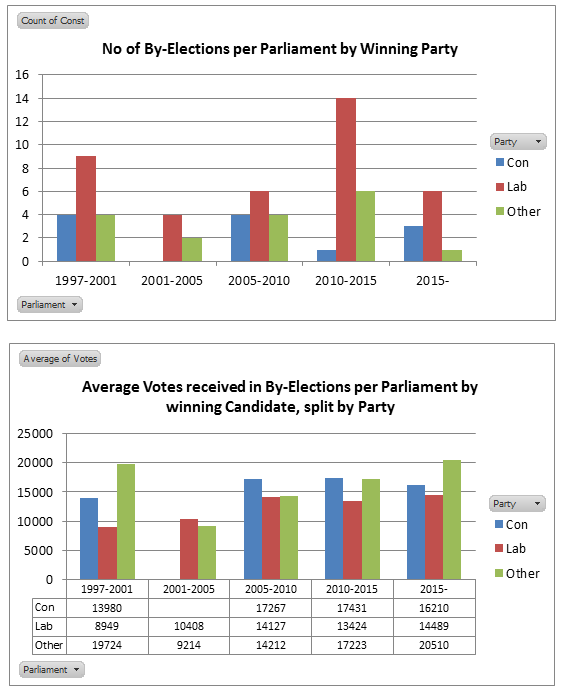
In the current Parliament winning by-election candidates achieve 50% more votes on average than in the 2001-2005 Parliament. It looks like more people turn out to by-elections now, maybe due to more focussed campaigning by the parties, and the greater national significance of the result than when Labour had large majorities in the House of Commons. Maybe it is due to the fact that less people tend to vote in Labour-held seats than for other parties. Below I show the numbers of by-elections held, splitting the winners into Conservative, Labour and Other.

The Labour Party seem to win by-elections with about 40% more votes than they did in 2001-2005.

Data for the 2015 General Election can be derived from http://www.data.parliament.uk/dataset/general-election-2015

Kevin Marshall

Petitions on EU Referendum and Trump State Visit show dominance of Labour Party by London activists

In the UK it is possible to raise a petition to Parliament. If that petition obtains 10,000 signatures, there is a written response from the Government. If there are more than 100,000 signatures, the matter is discussed in Parliament. In less than two years 48 proposals have been discussed in Parliament, with another 14 pending. By far the largest was for EU Referendum Rules triggering a 2nd EU Referendum, which had 4.15 million signatures. It was never going to get far, as it would have meant changing the rules for the referendum vote after the vote had taken place. But it acted as a protest for the substantial and vocal minority who did not like result.

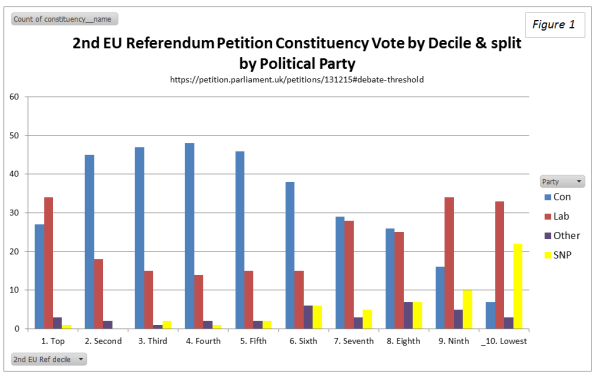
The signatures by constituency are available for download. There are a also non-UK signatures, which I shall ignore. I ranked the signatures by constituency, and divided the 650 constituencies into tenths, or decile groups. The constituencies I then classified by political party of the current MP, giving the graph shown in Figure 1.

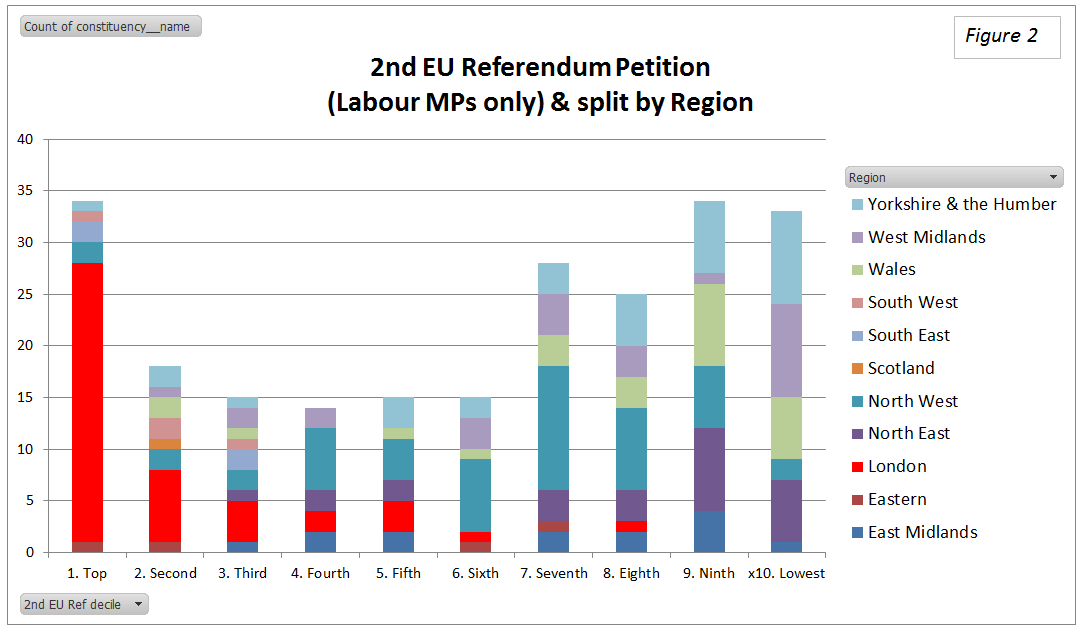
Compared to the Conservative constituencies the Labour Party has a few dominant activist constituencies on in terms of wanting to overturn the EU Referendum results, whilst most are far less active. It is even worse if you include the SNP, many of which were Labour constituencies prior to 2015. Figure 2 splits these 231 Labour seats into the 14 regions.

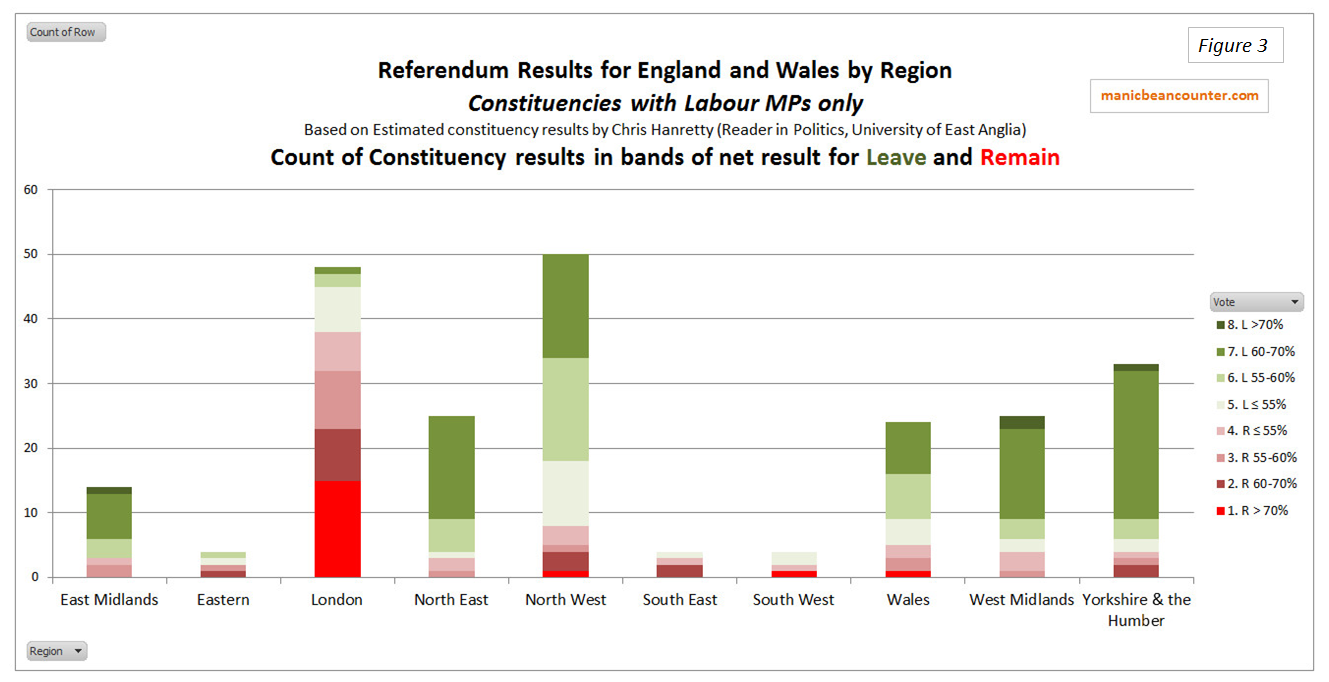
Of the 34 Labour-held seats in the top decile, 27 are in London. The Labour heartlands of the North of England. parts of the Midlands and in Wales are far less activist. Those 27 London constituencies (or 15% of Labour seats) registered 41% of all signatures in Labour seats. 15% of Labour seats registered slightly more signatures than the lowest 140 or 60%. This lines up with the an analysis of the estimated split of the EU Referendum vote I did last year, and shown again as Figure 3.

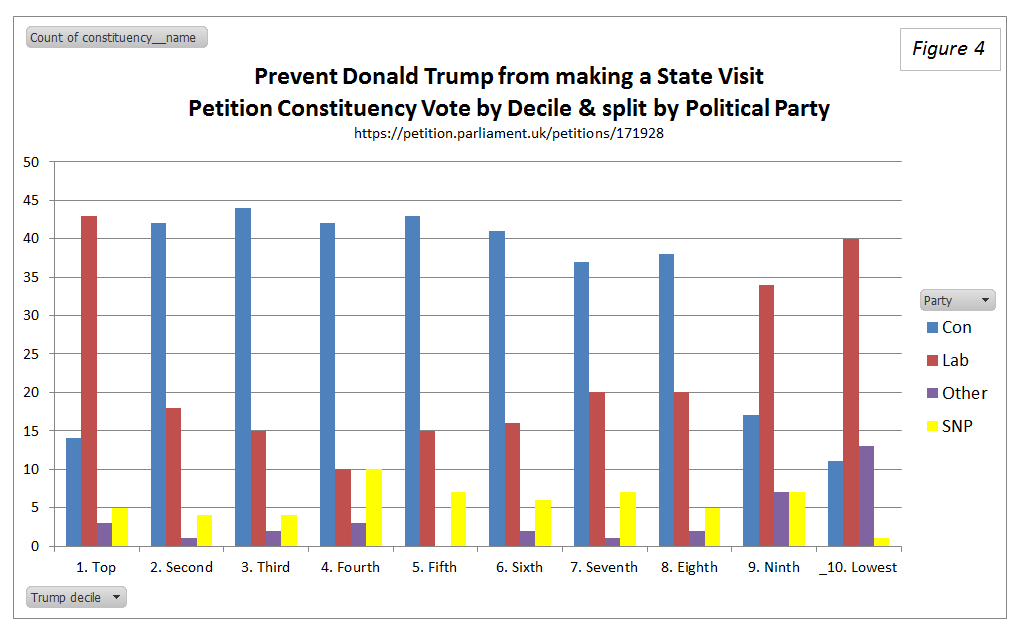
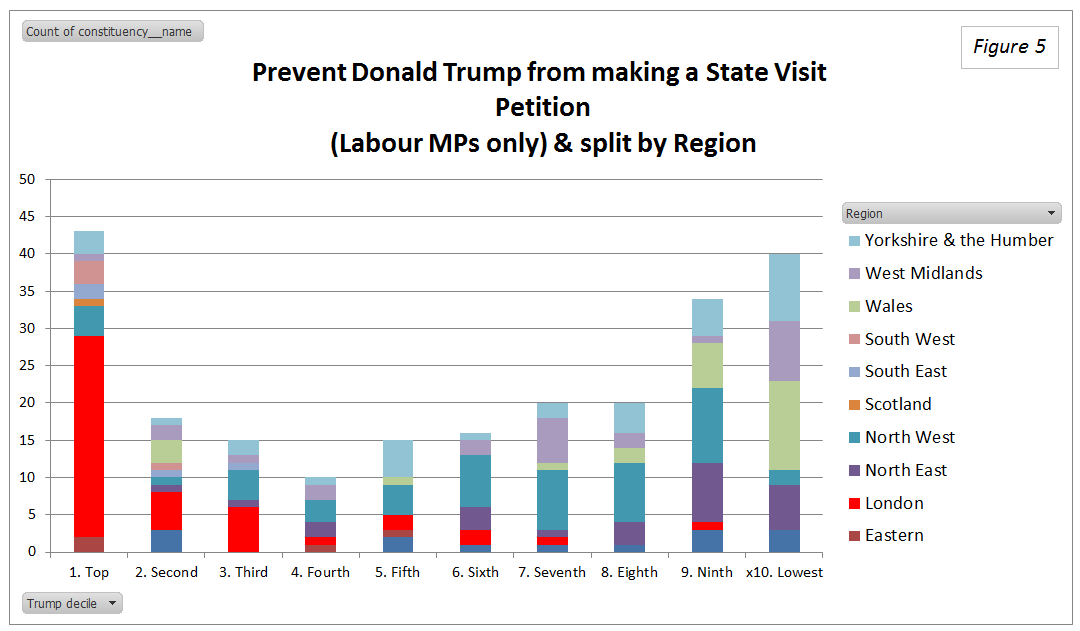
The Labour seats that most virulently voted remain in the EU that are unsuprisingly the Labour seats with the most signatories who wanted to overturn the democratic result that goes against them. But it in terms of signatories, London-based activists skew the result even more, meaning that within in a political party their views are likely dominant over the those held in the majority of Labour-held seats. As Labour Party members are mostly pro remain, this means that going with party and not will the majority view in the constituencies that they represent.  There is a similarity with attitudes to Donald Trump’s prospective State visit to the UK. A petition against this is Prevent Donald Trump from making a State Visit to the United Kingdom. This currently has 1.85m signatures up from the 1.82m when I downloaded the figures a few days ago. Figure 4 shows the decile groups by political party of the current MP and the Figure 5 shows the split by region of the labour constituencies.

The Labour constituencies dominate even more the top 65 of constituencies by signatories, with the same 27 London constituencies being represented in the top decile. With 15% of Labour seats they registered 32% of all signatures in Labour seats and registered slightly more signatures than the lowest 144 or 62%. A very similar pattern to the EU referendum.

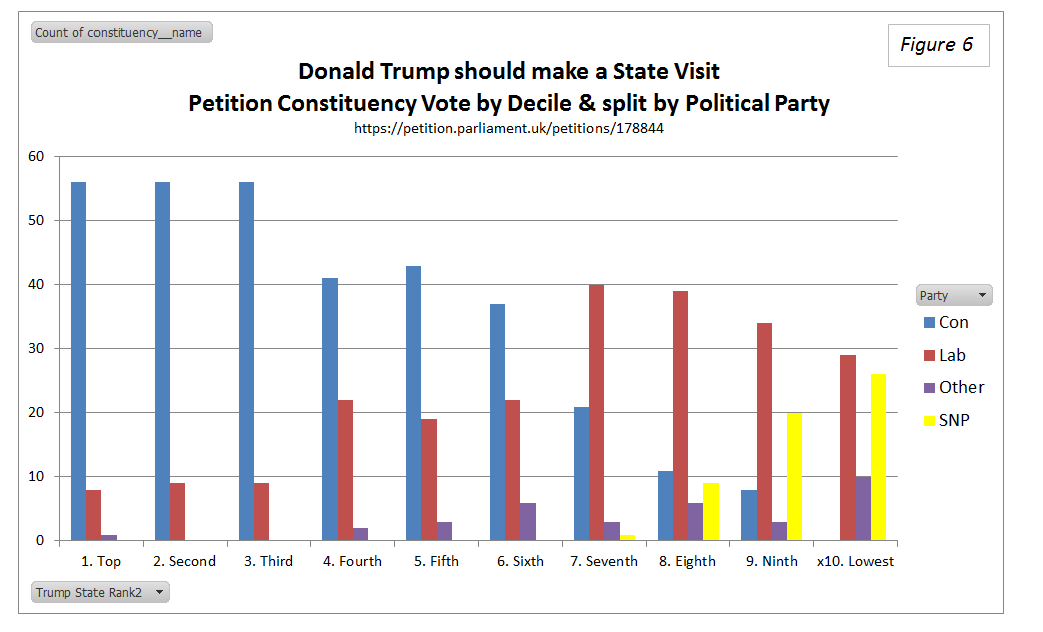
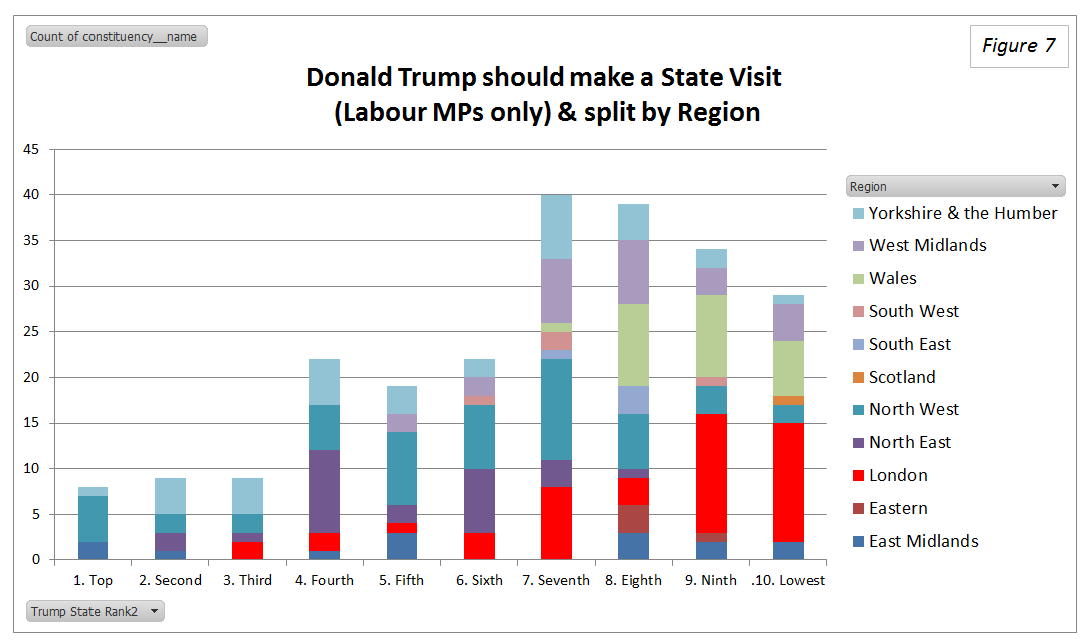
This petition has been countered by Donald Trump should make a State Visit to the United Kingdom. With just 307,000 signatories or one sixth signatories of the Prevent State visit, it might nor seem as relevant. Figure 6 and Figure 7, are from when the signatories were about 275,000.

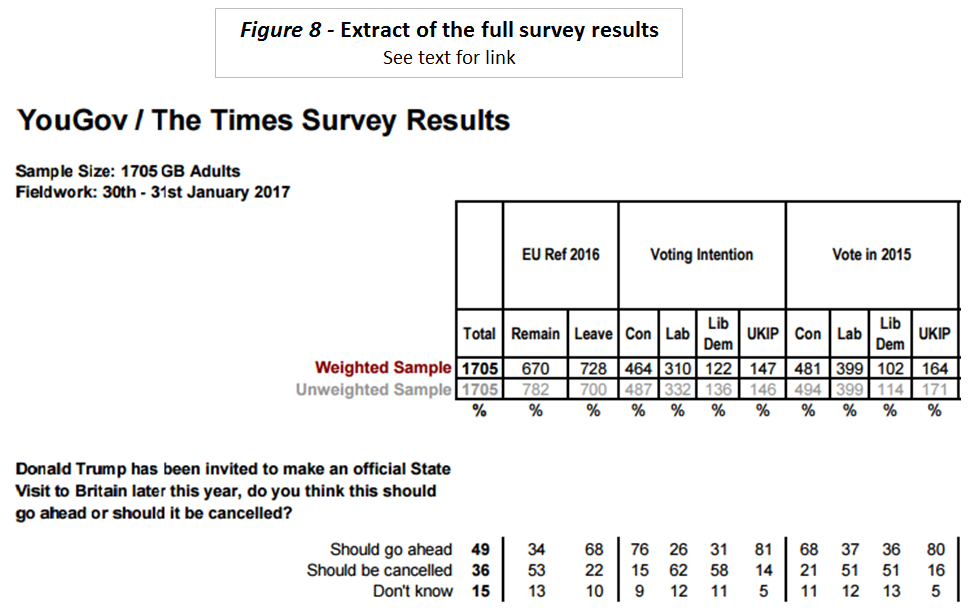
The Labour constituencies are fairly united in their apathy for wanting a Donald Trump State visit, but are divided in the expressed opposition to a state visit. But are the far greater numbers of the “Stop Trump” signatories reflected in the wider population? YouGov Published an opinion poll on 1st February on the topic. Almost half the sample thought the state visit should go ahead, whilst just over a third thought it should not. In the detail, the poll also divides the country into five regions, with London separated out. Even here, the opinion was 46 to 38% in favour of the Trump state visit. The real problems for Labour are shown in the extract  of the detail in Figure 8 below.


Those who intend to vote Labour now are a smaller group than those who voted Labour in 2015. Proportionately if 30.4% voted Labour in 2015, 25% would do so now. In the unweighted sample, it implies around 70% of the of the 67 lost would support the state visit. The remaining Labour voters are much more against the majority who expressed an opinion than in GE2015. This indicates a party in general decline. That the opinion seems to be centered on London, this indicates the collapse in the Labour vote has in the traditional Labour heartlands of the Midlands, the North and Wales has further to go.

Yet if the visit does go ahead it is the noisy protesters that will come out in their thousands, the majority will be Labour supporters based in London, who shout down everybody else.


Warming Bias in Temperature Data due to Consensus Belief not Conspiracy

In a Cliscep article Science: One Damned Adjustment After Another? Geoff Chambers wrote:-

So is the theory of catastrophic climate change a conspiracy? According to the strict dictionary definition, it is, in that the people concerned clearly conferred together to do something wrong – namely introduce a consistent bias in the scientific research, and then cover it up.

This was in response to last the David Rose article in the Mail on Sunday, about claims the infamous the Karl et al 2015 breached America’s National Oceanic and Atmospheric Administration (NOAA) own rules on scientific intergrity.

I would counter this claim about conspiracy in respect of temperature records, even in the strict dictionary definition. Still less does it conform to a conspiracy theory in the sense of some group with a grasp of what they believe to be the real truth, act together to provide an alternative to that truth. or divert attention and resources away from that understanding of that truth. like an internet troll. A clue as to know why this is the case comes from on of the most notorious Climategate emails. Kevin Trenberth to Micheal Mann on Mon, 12 Oct 2009 and copied to most of the leading academics in the “team” (including Thomas R. Karl).

The fact is that we can’t account for the lack of warming at the moment and it is a travesty that we can’t. The CERES data published in the August BAMS 09 supplement on 2008 shows there should be even more warming: but the data are surely wrong. Our observing system is inadequate.

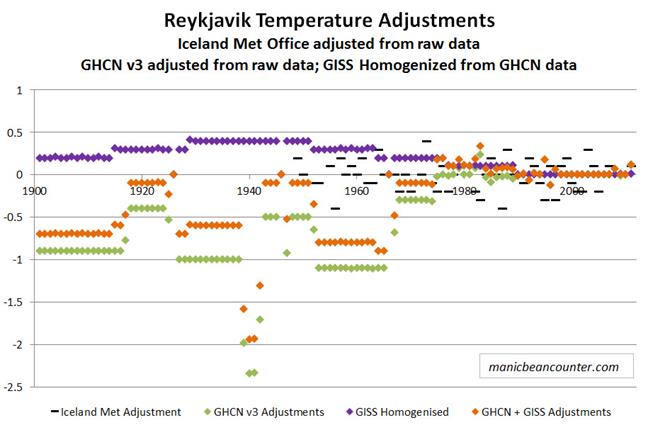
It is the first sentence that was commonly quoted, but it is the last part is the most relevant for temperatures anomalies. There is inevitably a number of homogenisation runs to get a single set of anomalies. For example the Reykjavik temperature data was (a) adjusted by the Iceland Met office by standard procedures to allow for known locals biases (b) adjusted for GHCNv2 (the “raw data”) (c) adjusted again in GHCNv3 (d) homogenized by NASA to be included in Gistemp.

There are steps that I have missed. Certainly Gistemp homogenize the data quite frequently for new sets of data. As Paul Matthews notes, adjustments are unstable. Although one data set might on average be pretty much the same as previous ones, there will be quite large anomalies thrown out every time the algorithms are re-run for new data. What is more, due to the nature of the computer algorithms, there is no audit trail, therefore the adjustments are largely unexplainable with reference to the data before, let alone with reference to the original thermometer readings. So how does one know whether the adjustments are reasonable or not, except through a belief in how the results ought to look? In the case of the climatologists like Kevin Trenberth and Thomas R. Karl, variations that show warmer than the previous run will be more readily accepted as correct rather than variations that show cooler. That is, they will find reasons why a particular temperature data set now shows greater higher warming than before. but will reject as outliers results that show less warming than before. It is the same when choosing techniques, or adjusting for biases in the data. This is exacerbated when a number of different bodies with similar belief systems try to seek a consensus of results, like  Zeke Hausfather alludes to in his article at the CarbonBrief. Rather than verifying results in the real world, temperature data seeks to conform to the opinions of others with similar beliefs about the world.

Kevin Marshall

IPCC AR5 Synthesis Report Presentation Miscalculated the Emissions for 2C of Warming

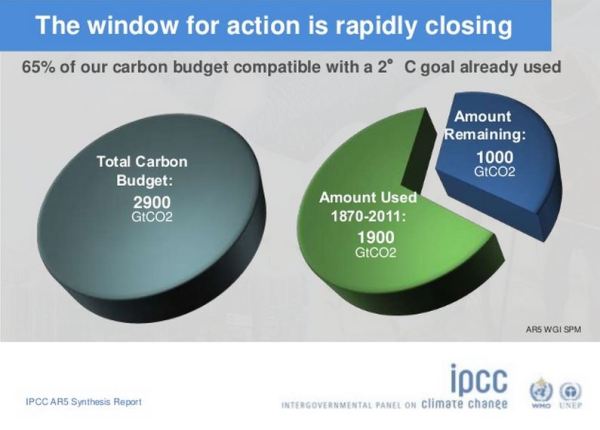
In a previous post I mistakenly claimed that the Ladybird Book on Climate Change (lead author HRH The Prince of Wales) had incorrectly interpreted the AR5 IPCC Synthesis Report in its egg-timer. It is the IPCC that is at fault.
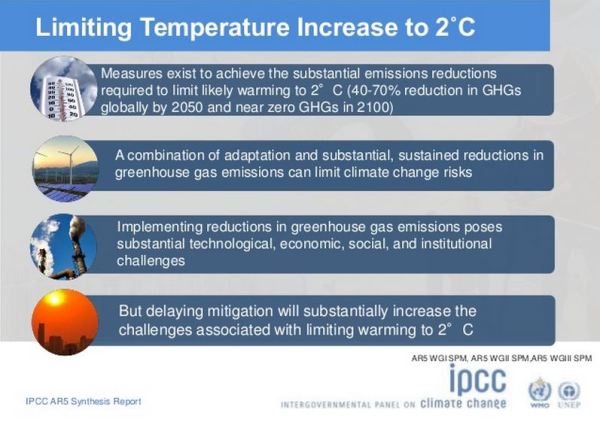
In 2014 the IPCC produced a simplified presentation of 35 slides to summarize the AR5 Synthesis Report Summary for policy makers. A quick summary of a summary of the synthesis report.

Slide 30 on Limiting Temperature Increase to 2C, clearly states that it is global reductions in greenhouse gas emissions that are needed.


The Ladybird egg-timer is adapted from slide 33 of 35.

As a (slightly manic) beancounter I like to reconcile the figures. How are the 1900 GtCO2 and the 1000 GtCO2 arrived at? It could be that it is GtCO2e, like the throughout the synthesis report, where other greenhouse gases are recast in terms of CO2, which accounts for well over half of the warming from trace gases.

Some assumptions for my quick calculations.

1. A doubling of CO2 will lead to a warming of 3C. This was the central estimate of the Charney Report 1979 (pdf), along with all five of the UNIPCC assessment reports.
2. If the pre-industrial level of CO2 was 280ppm, the dangerous 2C of warming will be reached at 445ppm. Rounded this is 450ppm.
3. In 2011 the Mauna Loa CO2 level was 391.63 ppm.
4. Using the CDIAC World CO2 emission figures, gives the following figures for billions of tonnes of CO2 to achieve a 1ppm rise in CO2 levelsin the graph below. In the five years to 2011 on average it took 17.02 billion tonnes of CO2 to raise CO2 levels by 1 ppm. Lets round it to 17.

Now some quick calculations.
Start with 280ppm
Add 111.76 (=1900/17) gives 391.76. Pretty close to the CO2 level in 2011 of 391.63ppm
Add 58.82 (=1000/17) gives 450.58. Given rounding, this pretty close to 450ppm.

There are problems with these calculations.

  • The estimate of 17 GtCO2e is on the high side. The World CO2 emissions from the CDIAC National Emissions spreadsheet gives a sum of 1069.68 GtCO2 from 1960 to 2011, against a rise in CO2 of 74.72 ppm. That is 14.3 GtCO2e over the whole period. Since 2011 there has been a drop towards this long-term average.
  • The Ladybird Book, like the UNFCCC at COP21 Paris December 2015 talks about restraining emissions to 1.5C. If a doubling of CO2 leads to 3.000C of warming then going from 280ppm to 401ppm (the average level in 2015) will eventually 1.555C of warming. This is a tacit admission that climate sensitivity is vastly overstated.
  • But the biggest error of all is that CO2 is only the major greenhouse gas (if you forget about water vapour). It might be the majority of the warming impact and two-thirds of emissions, but it is not all the warming impact according to theory. That alone would indicate that climate sensitivity was 2 instead of 3. But actual warming from 1780 to 2011 was less than 1C, against the 1C from CO2 alone if CS=2. That indicates that CS ≈ 1.3. But not all of the warming in the last 230 years has been due to changes in GHG levels. There was also recovery from the Little Ice Age. Worst of all for climate alarmism is the divergence problem. In this century the rate of warming should have increased as the rate of CO2 levels increased, in turn due to an increase in the rate of rise in CO2 emissions. But warming stopped. Even with the impact of a strong El Nino, the rate of warming slowed dramatically.


Conclusion

The IPCC calculated their figures for 1000 billion tonnes of CO2 emissions for 2C of warming based on CO2 being the only greenhouse gas and a doubling of CO2 levels producing 3C of warming. On that basis 401ppm CO2 level should produce >1.5C of warming. Add in other greenhouse gases and we are in for 2C of warming without any more greenhouse gas emissions. It is only if climate sensitivity is much lower is it theoretically possible to prevent 2C of warming by drastically reducing global CO2 emissions. The IPCC, have concocted figures knowing that they do not reconcile back to their assumptions.

The questions arise are (a) where do the cumulative emissions figures come from? and (b) whether the UNIPCCC has copied these blatant errors in the COP processes?

This is an extended version of a comment made a Paul Homewoods’ notalotofpeopleknowthat blog.

Kevin Marshall

My Amazon Review of Ladybird Book of Climate Change

The following is my Amazon review of Ladybird Book of Climate Change.

The format goes back to the Ladybird Books of my childhood, with text on the left and a nice colour picture on the right. Whilst lacking in figures and references it provides an excellent summary of the current case of climate alarmism and the mitigation policies required to “save the world”. As such it is totally lopsided.
For instance, on page 35 is a drawing of 3 children holding a banner with “1.5 to stay alive”. The central estimate of the climate consensus since the Charney report of 1979 is that a doubling of CO2 levels will lead to 3C of warming. That means a rise from 280 to 400ppm would give 1.54C of warming. With the impact of the rise in other greenhouse gas levels the 2C of warming should already of happened. Either it is somehow hidden, ready to jump out at us unawares, or the the impact of emissions on climate has been exaggerated, so policy is not required.
The other major problem is with policy. The policy proposals are centered around what individuals in the UK can do. That is recycle more, eat less red meat and turn the heat down. There is no recognition that it is global GHG emissions that cause atmospheric GHG levels to rise. If the theory is correct, constraint of global warming means global emissions reductions. That includes the 80%+ of the global population who live in countries exempt from any obligation to constrain emissions. Including all the poorest countries, these countries accounted for all the emissions growth from 1990 to at least 2012.
If people genuinely want to learn about a controversial subject then they need to read different viewpoints. This is as true of climate change as history, economics or philosophy.

Ladybird Book on Climate Change

A couple of weeks ago there was a big splash about the forthcoming Ladybird Book for adults on Climate Change. (Daily Mail, Guardian, Sun, Telegraph etc.) Given that it was inspired by HRH The Prince of Wales, who wrote the forward, it should sell well. Even better, having just received a copy in a format that harks back to the Ladybird Books I grew up with. That is on each double page words on the left and a high quality coloured picture filling the right hand page. Unlike, the previous adult Ladybird series, which was humorous, this is the first in a series that seeks to educate.

The final paragraph of the forward states:-

I hope this modest attempt to alert a global public to the “wolf at the door” will make some small contribution towards requisite action; action that must be urgently scaled up, and scaled up now.

The question is whether there is enough here to convince the undecided. Is this is founded on real science, then there should be a sufficient level of evidence to show

(a) there is a huge emerging problem with climate.

(b) that the problem is human caused.

(b) that there are a set of potential steps that can be taken to stop constrain this problem.

(c) that the cure is not worse than the disease.

(d) that sufficient numbers will take up the policy to meet the targets.

My approach is is to look at whether there is sufficient evidence to persuade a jury. Is there evidence that would convict humanity of the collective sin of destroying the planet for future generations? And is there evidence that to show that, through humanity collectively working for the common good, catastrophe can be averted and a better future can be bequeathed to those future generations? That presumes that there is sufficient quality of evidence that an impartial Judge would not throw the evidence out as hearsay.

Evidence for an Emerging Problem with Climate.

Page 8 on melting ice and rising sea levels starts with the reduced Arctic sea ice. The only quantifiable estimate of the climate change other than the temperature graph on page 6, in claiming at the end of the 2016 melt season the sea ice levels were two-thirds that of at the end of the end of the twentieth century.

Any jury would hear that there has only been satellite data of sea ice extent since 1979; that this was the end of a period known as the “sea ice years“; that the maximum winter ice extent in April was likely less in the eighteenth century than today; that ships log books suggest that general sea ice extent was the roughly the same one hundred and fifty years ago as today; and that in the Antarctic average sea ice extent increase has largely offset the Arctic decrease.

The rest about sea levels correctly state both that they have risen; that the reasons for the rise are a combination of warming seas and melting ice caps. It is also correct that flooding occurs in storm surges. But there is no quantification of the rise in sea levels (about 8-12 inches a century), nor of the lack of evidence of the predicted acceleration.

Page 10 on heatwaves, droughts, floods and storms states that they can cause disruption, economic damage and loss of life. there are also recent examples, and speculation about future trends. But no evidence of emerging trends, particularly increasing loss of life. This lack of evidence is because the evidence of the harms of extreme weather appear on the decrease. Indur Goklany has been a rich source of the counter-evidence over many years.

Page 12 begins

Threats to food and water supply, human health and national security, and the risk of humanitarian crises are all potentially increases by climate change.

The rest is just padding out this speculation.

Page 14 is on disappearing wildlife. One quote

The polar bear has come to symbolize the threats posed to wildlife by climate change….

You can probably find many images of starved dead polar bears to back this up. But the truth is that this creatures live by hunting, and as they get older slow down, so are no longer fast enough to catch seals, their main food source. Zoologist Susan Crockford has a blog detailing how polar bear numbers have increased in recent years, and far from being threatened the species is thriving.

The climate change problem is mostly human caused

The book details that emissions of greenhouse gas levels have gone up, and so have the levels of greenhouse gases. The only quantities is for CO2, the major greenhouse gas. (Page 20) There is simple diagram explaining how CO2 emissions impacts on atmospheric CO2 levels, before explaining the major sources of the net increase – fossil fuel emissions and clearing forests. There is no actual testing of the theory against the data. But Page 20 begins

The scientific evidence shows that dominant cause of the rapid warming of the Earth’s climate over the last half century has been the activities of people…

The relevant quote from UNIPCC AR5 WG1 SPM section D3 says something slightly differently.

It is extremely likely that more than half of the observed increase in global average surface temperature from 1951 to 2010 was caused by the anthropogenic increase in greenhouse gas concentrations and other anthropogenic forcings together.

The extremely likely phrase is a Bayesian estimate. It is a belief that should be updated on the best available evidence. Lack of evidence, after much searching, suggests the original guess was wrong. Therefore true Bayesians would downgrade their certainties if they cannot refine the estimates over time. But this was written in 2013. Since the Carney Report of 1979 and the previous four IPCC reports of 1990 to 2007, there has been no refinement in the estimate of how much warming will eventually result from a doubling of CO2.

But how does the evidence stack up? On page 6 there is a chart of global surface temperature anomalies. That increase in temperatures can be tested against the doubling effect of CO2. Since around the turn of century the rate of rise in CO2 emissions and atmospheric CO2 levels has accelerated. But global warming stopped  for over a decade until 2014, only to restart due to a natural phenomena. Comparing the actual data to the theory, fails to support the strong beliefs that GHG emissions are the dominant cause of recent warming. 

Policy to contain the problem

Page 34 go into the benefits of containing warming to 1.5C. Given that the central estimate from the climate community since 1979 has been that a doubling of CO2 will lead to and eventual rise in average temperature of 3C, a rise in CO2 levels from the pre-industrial levels of 280ppm to 400ppm reached in 2015 would give 1.544C of warming. With other greenhouse gases it should be nearer to 2C of warming. Either it is way too late (and the warming is lurking like the Loch Ness monster is the dark and murky depths) or the central estimate is exaggerated. So the picture of three young people holding a banner with 1.5 to stay alive is of the doomed who we can do nothing about, or false alarmism.

Page 36 has a nice graphic adopted from the IPCC Synthesis Report of 2014, showing the liquid dripping through an egg-timer. It shows the estimate that 2000 billion tonnes of CO2 have been emitted so far, 1000 billion tonnes can be emitted before the 2 C of warming is breached. This was from a presentation to summarize the IPCC AR5 Synthesis Report of 2014. Slide 33 of 35.

Problem is that this was the data up to 2011, not five years later to 2016; it was for GHG emissions in billions of tonnes of CO2 equivalents; and the 40 billions tonnes of CO2 emissions should be around 52-55 billion tonnes CO2e GHG emissions. See for instance the EU Commission’s EDGAR figures, estimating 54GtCO2e in 2012 and 51GtCO2e in 2010 (against the IPCCs 49 GtCO2e). So the revised figure is about 750GtCO2e of emissions before this catestrophic figure is breached. The Ladybird book does not have references, to keep things simple, but should at least properly reflect the updated numbers. The IPCC stretched the numbers in 2014 in order to keep the show on the road to such extent that they fall apart on even a cursory examination. The worst part is at the very top of the egg-timer, coloured scarlett is “Coal, oil and gas reserves that cannot be used“. These are spread across the globe. Most notably the biggest reserves are in China, USA, Russia, Canada, Australia, Middle East and Venezuela, with the rest of the World have a substantial share of the rest.

The cure is worse than the disease

For the rest of the book to suggest European solutions like recycling, eating less red meat, turning down the heating to 17C and more organic farming, the authors write about making very marginal differences to emissions in a few countries with a small minority of global emissions. Most of those reserves will not be left in the ground no matter how much the first in line to the Throne gets hot under the collar. The global emissions will keep on increasing from non-policy countries with over 80% of the global population, two-thirds of global emissions and nearly 100% of the world’s poorest people. Below is a breakdown of those countries.

These countries collectively produced 35000 MtCOe in 2012, or 35 GtCO2e. That will increase well into the future short of inventing a safe nuclear reactor the size weight and cost of a washing machine. Now compare to the global emissions pathways to stop the 1.5C  or 2C of warming prepared by the UNFCCC for the 2015 Paris talks.


The combined impact of all the vague policy proposals do not stop global emissions from rising. It is the non-policy developing countries that make the real difference between policy proposals and the modelled warming pathways. If those countries do not keep using fossil fuels at increasing rates, then they deprive billions of people of increasing living standards for themselves and their children. Yet this must happen very quickly for the mythical 2C of warming not to be breached. So in the UK we just keep on telling people not to waste so much food, buy organic, ride a bike and put on a jumper.

There is no strong evidence would convict humanity of the collective sin of destroying the planet for future generations. Nor is there evidence that to show that a better future can be bequeathed to those future generations when the policies would destroy the economic future of the vast majority. The book neatly encapsulates how blinkered are the climate alarmists to both the real-world evidence and the wider moral policy perspectives.

Kevin Marshall