7 Appendix – Deriving the Policy and Forecast Graph

In the introduction, the derivation of the graph to replicate the claim that the costs of catastrophic global warming will be many times greater than mitigation policy costs was logically incomplete. This is a derivation of the two cost functions from a series of PowerPoint slides, which I find somewhat more satisfactory.

Slide 1

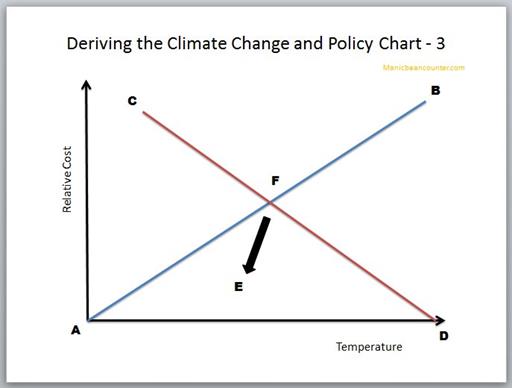
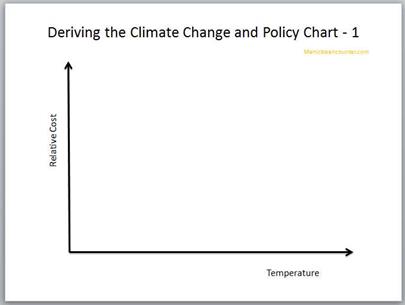
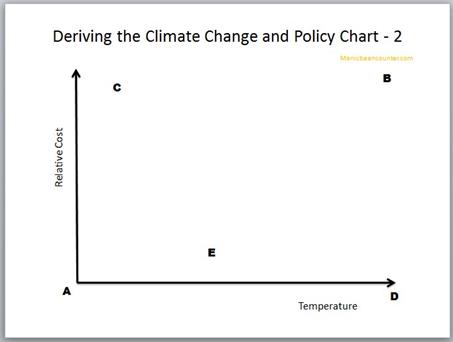
First draw two axis’s – for temperature and relative cost.

Slide 2

Next, add in five points.

A. If there had been no rise in human greenhouse gases, there would be no rise in temperatures and thus no consequential costly climate impacts.

B. With “business as usual”, there will be a huge amount of warming, with hugely costly consequential climate impacts.

C. Globally, policy could be used to stop any further rise in greenhouse gases, but with huge global cost.

D. No policy and no policy costs.

E. Intersection of two curves, which in Stern’s view is at the point of constraining warming to about 3 degrees above pre-twentieth century levels.

Slide 3

Connecting up the points AB (climate costs) and CD (Policy costs) with straight lines (linear functions), creates an intersection at point F.

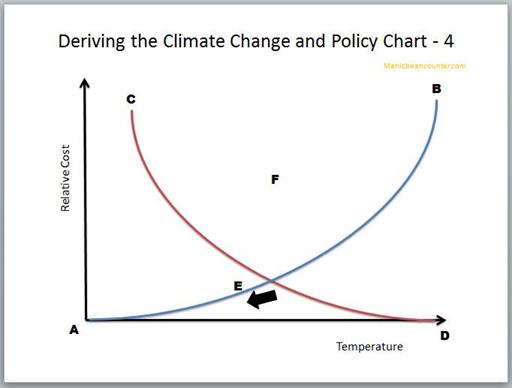
To replicate Stern, we need cost functions that intersect at point E. That is the climate cost curve connects AEB and the policy costs curve connects CED.

Slide 4

Drawing curves within PowerPoint is beyond my current skills. Simple curves have symmetrical properties. The required cost curves do not have such properties.

Slide 5

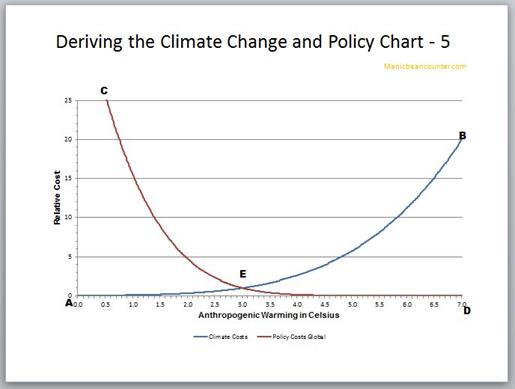
Above is the actual graph used.

Slide 6

On my graphs the cost curves are unstable functions

For climate costs

RC = f(T4)

For policy costs

RC = f((10-T)5)

To justify policy

  1. Must have reliable consequences of warming beyond human experience. Climate models must be robust for the high temperature rise forecast and have a phenomenal degree of precision on the shorter-term cost impact forecasts.
  2. Must be sure that got achievable high-impact low-cost policies, with a highly results-driven approach to policy implementation.

Smoking Causes Lung Cancer therefore Climate Change will cause more Extreme Weather: Unpicking a pseudo-analogy

A few weeks ago Stephen Lewandowsky, James Risbey and Naomi Oreskes posted at the Conversation “Climate change is not all disaster and uncertainty“. This compared the strongly-supported hypothesis that “Smoking causes lung cancer” with the hypothesis that “climate change will cause extreme weather events”. Below is the comment I posted.

You make an analogy between climate change and smoking causes lung cancer. It is worth exploring this analogy further. According to Cancer Research UK 86% of people who caught lung cancer in 2010 were smokers. A smoker is 15 times more likely to catch lung cancer than somebody who has never smoked. Put another way, only 1 in 15 smokers who caught lung cancer would have caught it anyway – and you cannot identify which these people are. Also lung cancer has a 90% mortality rate and can be diagnosed by professionals very clearly. It is a nontrivial problem both for the people experiencing it and there are large numbers dying from it.

http://www.cancerresearchuk.org/cancer-info/cancerstats/types/lung/riskfactors/

Climate policy is about prevention of nontrivial adverse climate change, predicted to happen many years into the future. With less than one degree of warming so far (which might be partly natural), the severe effects are difficult to detect amongst all the infrequent naturally-caused extreme events, with natural cycles and fluctuations. There are two ways that this differs from lung cancer.

Firstly, somebody either has lung cancer or not. There is no trivial in between. In between human caused climate change being false and there being an apocalyptic problem, there is a huge range of possibilities. This is from the highly trivial through being a significant problem, to being serious enough to justify global mitigation policy.

Secondly, whereas for a smoker who catches lung cancer it is most probably caused by smoking, an extreme weather event occurring now will most probably not be caused by climate change, whereas (if the predictions are correct and no successful policies are implemented) one happening in 2100 will most probably will be.

That leads to a dual problem. Extreme weather events may become much more extreme in the future, but this will only be detectable over large numbers of similar events at the present time. Even that will not necessarily point to a problem severe enough to justify the adoption of mitigation policies.

If there is false attribution or exaggeration for promotion people will smell something quite different than the climate science. There has been huge damage to climate change cause in England from the prediction in 2000 that children will grow up never knowing what snow is, or in the USA by saying hurricanes would become more frequent and stronger after Katrina. As a result of these and other failures many people will fail to believe anything that is said by competent scientists. Unless more objective and scientific methods are discerned for isolating the anthropogenic climate change signal than the hollering of climate activists, then the message will not get across. Even for those not turned off, the failure of the short-term predictions will conclude (like most sceptics) that it is a far more trivial problem to that which the climate consensus portrays.

Kevin Marshall

UK Energy Research Centre (UKREC) doubly misleads

Yesterday the GWPF and Joanne Nova point to an article in Thursday’s Daily Express which declared

A report from the UK Energy Research Centre also shows the number of those who resolutely do not believe in climate change has more than quadrupled since 2005.

There are two fundamental issues with the press release. First the research shows a much bigger divergence in public opinion from climate orthodoxy than the press release by the QUANGO shows. Second, the opinion poll conducted in England, Scotland and Wales by psychologists had two fundamental errors that fail to connect with the real world situations that people are facing and will face in the renewable energy future.

Public Opinion on Climate Change

The Government funded report shows 19 per cent of people are climate change disbelievers – up from just four per cent in 2005 – while nine per cent did not know.

The Daily Express article only looks at the press release and then speaks to UK Green Party leader Natalie Bennett, who says, who says

Of course, however, the 72 per cent of the public who acknowledge the climate is changing are backed overwhelmingly by the scientific evidence.

If they had clicked on the second link on point 3 (of 5) in the “Notes to the Editors” (below where it says – Ends –) labelled “national survey“, they would have opened up the 62 page “SURVEY FINAL.pdf”. If they had then gone to Appendix B, they would have found the full results of all 72 survey questions. The following is relevant

Q3. How concerned, if at all, are you about climate change, sometimes referred to as ‘global warming’?

“Very” or “Fairly” concerned         74%

“Not very”, or “Not at all” concerned      26%

Don’t know                 1%

However, this should be more relevant.

Q5. Thinking about the causes of climate change, which, if any, of the following best describes your opinion?

CC is entirely or mainly caused by natural processes                 16%

CC is partly caused by natural processes and partly caused by human activity     48%

CC is entirely or mainly caused by human activity                 32%

The survey shows that two-thirds of the public disagree with the “scientists”, and thus disagree with a necessary condition to justify policy – that climate change is a non-trivial problem. The press release hides the real story in obscure places that no journalist has time to find.

The opinion poll failing to address real world situations

The questionnaire started with questions on attitudes to climate change. However, the vast majority of the questions, and the purpose of the survey, was upon the “Public Values, Attitudes and Acceptability” of pursuing the UK’s transformation to “green” energy. As this questionnaire was conducted by the School of Psychology at the University of Cardiff, there are two things one could reasonably expect.

  1. Empathy with the people impacted.
  2. Addressing the costs that people are most likely to face.

In both there is a depersonalisation of the impacts.

One of the most controversial areas of renewables is wind turbines. An innocuous question is

Q22. To what extent would you support or oppose the building of a new wind farm in your area? (By ‘area’ we mean up to approximately 5 miles from your home)?

The distance is relevant. Like the vast majority of people I live in a built-up area. If the world’s tallest building was located five miles from my house, I would likely not be able to see it from the ground floor in any direction. Five miles distant there is an airport with 20 million passengers and 170,000 flight movements a year. I rarely hear an aircraft, as I do not under the usual flight paths. To personalize it, you need to ask people if, when purchasing a house, having a wind turbine located at less than a mile from a house, clearly visible, would affect the decision to buy it.

This depersonalisation of the impacts also includes the benefits. In a remote rural area a nuclear power plant would bring a huge influx of jobs and prosperity, more than thousands of wind farms. There is a relevant example. In the 1960s Caithness boomed as a result of the building Dounreay nuclear research plant. The county is currently being overrun by wind turbines, which do little to replace the jobs lost as the nuclear facility is decommissioned.

Empathizing with the plight of a minority who are adversely affected by renewables is something that should be appreciated. However, for most people, it is the direct impact of renewables that will concern them most. For the vast majority, it is costs that are important. UKERC fully realize that switching from fossil fuels to renewables means receiving power solely in the form of electricity. Therefore, there are questions about switching from gas to electric for heating and cooking, and about the public perceptions of electric cars.

Q23. How positive or negative do you feel about heating with electricity?

Q24. Please indicate how willing you would be, if at all, to use electric heating in your home in the future.

Q25. …what if your friends, family and neighbours used electric heating? How willing would you be, if at all, to use electric heating in the future if this was the case?

Q26. …what if the performance of electric heating was no different to central gas heating systems? How willing would you be, if at all, to use electric heating in the future if this was the case?

Q27. …what if electric heating was significantly cheaper than heating with gas? How willing would you be, if at all, to use electric heating in the future if this was the case?

Q28. How positive or negative do you feel about cooking only with electricity?

Q29. Please indicate how willing you would be, if at all, to cook only with electricity in the future.

Q30. …what if your friends, family and neighbours cooked only with electricity? How willing would you be, if at all, to cook with electricity in the future if this was the case?

Q31. …what if the performance of an electric hob was no different to a gas hob (e.g. it heats up in the same time)? How willing would you be, if at all, to use an electric hob in the future if this was the case?

Q32. …what if cooking with electricity was significantly cheaper than cooking with gas? How willing would you be, if at all, to cook with electricity in the future if this was the case?

Q33. How positive or negative do you feel about driving an electric car?

Q34. Please indicate how willing you would be, if at all, to drive an electric car in the future.

Q35. …what if your friends, family and neighbours drove electric cars? How willing would you be, if at all, to drive an electric car in the future if this was the case?

Q36. …what if the performance of an electric car was the same as a petrol car (e.g. speed, range, availability of charging points)? How willing would you be to drive an electric car in the future if this was the case?

Q37. …what if the cost of buying and running an electric car was significantly less than the cost of a petrol car? How willing would you be, if at all, to drive an electric car in the future if this was the case?

UKREC could say they have dealt with costs in Q27, Q32 and Q37. But this only deals with the scenario if the electric alternative is cheaper. Currently the electric alternative is far more expensive. Maybe twice the cost for heating by electric than gas, and an electric car is around twice the cost (or more) of an equivalent size of diesel car. Will the reality change? There are four reasons why not, which need to be compared with the current domestic price (after distribution costs, reseller costs and reseller margin) of 10p Kwh.

First, is that renewables cost more, in total, per unit of electricity than fossil-fuelled power stations. When I last checked it was 4.1p for onshore turbines and 8.3p Kwh for offshore. This is on top of the wholesale market rate. In addition, there is the STOR energy scheme where the marginal cost per Kwh is over 20p-30p Kwh, and the average cost per Kwh could be 50p or more. Then there are the payments not to shut the things off when the wind blows too strongly.

Second, is that fossil fuels are likely to come down in price than go up. In particular in Britain the shale gas revolution will guarantee supplies for a generation and are more likely to see gas prices fall in real terms, than rise.

Third, is that if we switch energy from gas and petrol/diesel to electric, the amount of electric power generation capacity required will go through the roof. The first point applies even more strongly.

Fourth is that current technologies are developing rapidly as well. For an electric car to become competitive on running costs, it needs to overtake the next generation of diesel cars. For instance, last week I drove one of the current Volkswagen Golf diesels, a 1.6TDI. The fuel consumption of just over 60mpg(1), was at least 25% better than a 2007 Vauxhall (General Motors) Astra 1.7TDI, and 100% better than my first car – the much smaller 1978 Honda Civic 1.2 petrol.

Conclusion

The press release fails to show how far out of line the consensus of climate scientists are with mainstream public opinion. More importantly, a questionnaire commissioned by a QUANGO for renewable energy research and conducted by academic psychologists, fails to address the likely real situations people will face under a renewable future.

Kevin Marshall

  1. For Australians and Europeans, 60 miles per gallon is 4.7 litres per 100km. For those in the United States it is about 50 miles per US gallon.
Fundamentals that Climate Science Ignores

Updated 08/09/13 am

Updated 08/09/13 pm – M The Null Hypothesis

Climate Science is a hugely complex subject, dealing with phenomena that are essentially chaotic, with vague patterns. Yet the promotion of that science is banal and superficial. Below are some of the fundamentals that have been addressed in established areas like economics, philosophy and English Common Law, but which the Climate Science community ignores. Most overlap, or are different ways of looking at the same thing.

A Positive and Normative

I do not hold with the logical positivism in vogue in the early parts of the C20th and later underpinning the “positive economics” ideas of Milton Friedman that was popular in the 1950s to 1980s. But it made the useful distinction between positive statements (empirically based statements) and normative statements (what ought to be). The language of climate science is heavily value-laden. There is not attempt to distinguish positive from normative in language, nor highlight that competency in the sphere of positive statements is not necessarily an indication of competency in normative ones.  For instance, when scientists make statements about the moral imperative for policy, they may overemphasize the moral questions raised as they may be too close to the subject. In fact believing that that rising greenhouse gas levels causes a worsening of climate can lead to a bias towards the simplified solution to constrain that growth. It takes understanding of the entirely separate fields of economics and public policy-making to determine whether this is achievable, or the best solution.

B Boundary conditions

There is no clear definition of science in general or the study of climate in particular. The only underlying definitions are tantamount to saying that science is what scientists do, and scientific statements are those made by scientists. Without a clear definition of science, scientists end up making unsupported statements, outside their area of competency. For instance, scientists often make statements about the economic case for policy. With the term “climate change” encompassing both, the general public are misled into believing that “climate scientists” cover both areas.

C Open and closed questions

A closed question can by answered by a single word. The narrowest closed questions are those can be answered “Yes/No” or “True/False”. Open questions need fuller answers. Climate change is not just about closed questions. It is about how much, how likely, when and where. If terms of boundary, there is not a closed question of science versus non-science – with the boundary in actual work being between that published in a peer-reviewed journal and that published outside. That leads onto non-triviality and quality conditions and relevancy

D Trivial v. Non-trivial

The strongest evidence for global warming suggests a trivial issue. In one aspect this is true by definition. The non-trivial part – the potential climate catastrophe that policy seeks to avert – relies upon future projections. This relies on temperature rises many times greater than so far experienced. Projections will always be, weaker that the actual evidence. But there is an empirical aspect as well. If the actual trends are far below those predicted (surface temperature warming trends), or fail to show a switch to a path pointing to catastrophe (acceleration in the rate of sea level rise)

E Quality

There is good quality science and poor quality. Peer review should help, but (as suggested in the Climategate emails) acceptance/rejection can be based on criteria other than science. In most areas of science, and indeed in many professions, efforts have been made to improve the quality of results. One minor step towards improvement of quality is the insistence on publishing the data behind peer-reviewed articles. This has led to the quick exposure of shoddy work like Gergis et al 2012 and LOG12 papers, whereas it took many years of persistence by Steve McIntyre to get the full data on Keith Briffa’s deeply flawed Yamal tree-ring temperature proxy. However, as the forthcoming UNIPCC AR5 report will demonstrate, increasing quality is sacrificed in promoting climate catastrophism.

F False Positives and False Negatives

A particular subset of the quality issue is that of false positives and false negatives. With activists pressuring governments and scientific bodies to agree with the dogma, and promotion of pejorative language (e.g. deniers, fake skeptics), misattribution of significant weather events to climate change is a consequence. Whilst in cancer screening there have been efforts made to reduce the number of false positives and false negatives, in climate science there seems to be every effort to increase the numbers of false positives. (Superstorm Sandy that hit New York state last year, the extreme heat wave in Europe in 2003, the low sea ice point in September 2012).

G Relevancy and significance

Some pieces of information, or scientific papers, are more important than others. The vast majority of papers published are on trivial issues and/or fail to make a lasting impact. In terms of catastrophic global warming, most papers in the field are tangential to the subject. The same is true of items of information, statistics and opinions.

H Necessary and Sufficient

For a climate policy to give net benefits, a number of conditions are necessary, both in the science (greenhouse gas effect, significant warming, adverse consequences) and in policy area (policy with theoretical net benefits > costs of doing nothing, large enough policy area, effective policy management). Sufficient for policy success (net policy benefits > costs of doing nothing) all are to some extent necessary. For policy failure, it is only sufficient for one of the necessary conditions to fail. It does not matter whether this is

–       climate sensitivity being much lower than assumed

–       or adaptation at the non-governmental local level is much more effective than assumed

–       or the net adverse consequences of any given amount of warming are grossly exaggerated

–       or the theoretical economic case for policy is flawed (such as demand for energy is far more inelastic with respect to price over time than assumed, or that renewable energy is not a close substitute to fossil fuel energy)

–       or the actual policy enacted does not encapsulate the economic theory, diluting or nullifying the effectiveness

–       or unilateralist policy where success requires that the vast majority of the biggest economies to participate

–       or the policy on paper is potentially successful, but it is not project managed to drive through the maximum benefits at least cost

I Levels of evidence

In the legal systems, especially in criminal law, it has long been recognized that there are different qualities of evidence. The strongest is DNA, fingerprints, or catching somebody in the act. There is then secondary evidence from witnesses. There is then circumstantial evidence, such as the accused being near to the scene at the time, with no clear reason to be there. The lowest form of evidence, and usually rejected, is hearsay evidence. That is opinions of people with little interest in the case, giving unsupported opinions. The judicial process also views more highly evidence that is corroborated by other pieces of evidence, and evidence that on its own seems quite strong is downgraded or ruled out by contrary evidence, or alternative explanations.

J Values of the Legal Process in Reverse

Climate science, fails to grapple with the grading of evidence, as some its strongest arguments – consensus amongst scientists – is actually hearsay. Improving the quality of evidence would mean critically examining past forecasts in the light of evidence. In the judicial process, creating prejudice in the eyes of the jury against the defendants, or seeking to deny the accused a defence, is forcefully dealt with. Creating prejudice and denying a voice to those who question the climate change dogmas is viewed as part of the cause.

K Underdetermination Thesis

“The underdetermination thesis – the idea that any body of evidence can be explained by any number of mutually incompatible theories”

Quote from Kuhn vs Popper – Steve Fuller 2003

The global warming hypothesis is but one of a number of hypotheses trying to explain why climate changes over time. The problem is not just of a potential number of competing theories. It is that there might be a number of different elements influencing climate, with the various weightings dependent on the method and assumptions in analysis. It is not just trying to determine which one, but which ones and to what extent that they interplay.

L Vulnerability

Every scientific hypothesis is vulnerable to being refuted. Human-caused catastrophic global warming (CAGW) is based on extremely tentative assumptions, and is a forecast of future events. As the warming the past one hundred years is tiny compared that forecast to happen in the future, and that warming is partly obscured by natural variations, then the signal of future catastrophe will be weak. The issue is further clouded by the lack of long periods of data on climate variability before when human emissions became significant. That is data prior to 1945, when the post war economic boom led to a huge increase in human emissions. Assuming the forecasts of CAGW are correct, the hypothesis becomes incredibly vulnerable to rejection.
But if CAGW is false, or massively exaggerated, then the hypothesis is deeply susceptible to confirmation bias by those who only look to find evidence of its truth. The core belief of climate science is that the catastrophist hypothesis is true and the job of the “science” is to reveal this truth. The core mission of many co-believers is to stop any questioning of these core beliefs. The alternative view is that evidence for CAGW has become stronger over the last twenty-five years, making the hypothesis less vulnerable over time. This can be tested by looking at the success of the short-term predictions.

M The Null Hypothesis

Wikipedia’s definition is

In statistical inference of observed data of a scientific experiment, the null hypothesis refers to a general or default position: that there is no relationship between two measured phenomena,…… Rejecting or disproving the null hypothesis – and thus concluding that there are grounds for believing that there is a relationship between two phenomena …………….. – is a central task in the modern practice of science, and gives a precise sense in which a claim is capable of being proven false.

It applies to AGW theory, as the hypotheses are empirical relationships. With highly complex, and essentially chaotic, systems it is only by confronting the data using a battery of statistical tests that you can disprove the null hypothesis. Without the null hypothesis, and without such rigorous testing, all the data and observations will only confirm what you want to believe. Some of the best established empirically-based hypotheses, like “HIV causes AIDS” and “long-term heavy smoking significantly reduces life expectancy” have been confronted with the null hypothesis many times against large, high quality data sets. At extremely high levels of significance, the null hypothesis of no relationship can be rejected.

It could be claimed that the null hypothesis in not applicable to AGW theory as it forecasts something much worse happening than has so far been experienced. However, it is more important because of this. There is no bridge between reality and the theoretical relationships (with assumed magnitudes) in the climate models. The null hypothesis (general or default position) for testing against actual data is not that there is no relationship, but the double-negative of no non-trivial relationship. So the null hypothesis for testing “CO2 causes warming”, is not “CO2 does not affect temperature”, but “CO2 has no non-trivial impact on warming”. The reason is that the claimed requirement for policy is avoidance of a climate catastrophe, with relationships being non-trivial in magnitude.

Financial costs of Fulcrum Power’s Green Diesel Plant

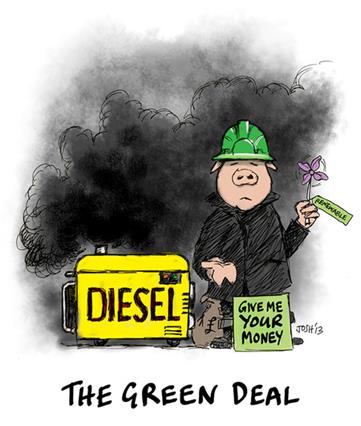
The BBC reports on a planning application submitted by Fulcrum Power to Plymouth Council to build a 20 MW diesel engine power station. This plant will operate backup for when renewables energy fails – mostly in the form of the wind failing to blow in the cold weather. Bishop Hill is, rightly, quite scathing because the diesel power is required to backup so-called green solutions. Josh weighs in with a cartoon


My posting is on the scandalous cost of this backup power station.

(Links are at the foot of the posting)

The BBC says

The application by Fulcrum Power is for a 20 megawatt (MW) Stor (Short Term Operating Reserve) power station on the former Toshiba plant at Ernesettle Lane, which company bosses said would cost “several million pounds”.

Its 52 generators will consume more than 1.1m litres of diesel a year, or about one tanker a week.

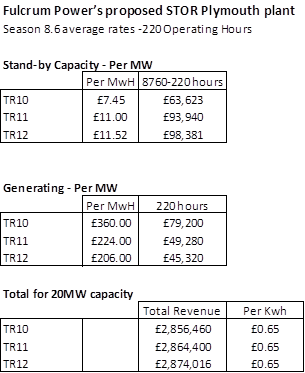
A litre of diesel with generate around 4kwh hours of electricity. (The normal measure is grams/kwh. A small diesel generator uses about 200 g/kwh and the RD of diesel is about 0.83 from memory). A 20 MW power station will therefore consume about 5,000 litres an hour of fuel. 1.1m litres will be consumed in just 220 hours, which means the plant is expected to operate for the equivalent of full power for just 2.5% of the hours in a year.

These companies will be paid a backup fee by the National Grid and then a rate per kwh generated. For this calculation I will look at just the cost per kwh. The fuel cost is easy. Diesel currently costs about £0.60 a litre, so that is £0.15 per kwh or 50% more than what I paid on my last electricity bill.

I tried to do some quick estimates and believe that the operating costs and cost of capital on “several million pounds” would be as much again. Being a little more curious, I did a search and found the “National Grid STOR Market Information Report No.19” on the National Grid’s Website. There is a bidding process every couple of months for Short Term Operating Reserve (STOR) capacity. Within the report is published the average winning and rejected bid rates. The most recent was season 8.6. As expected the bid is in two parts. First, a standby rate and second a (much higher) generating rate. There are bands, with the lower the standby rate, the higher the generating rate. I plugged the values into Excel and found that on all three rates Fulcrum Power could receive the equivalent of £0.65 Kwh. Gross Revenue would be around £2.86m. Deducting the cost of 1.1m litres for diesel leaves a contribution of £2.2m. There is probably a few hundred thousand of fixed costs, but payback on “several million pounds” looks to be pretty quick.


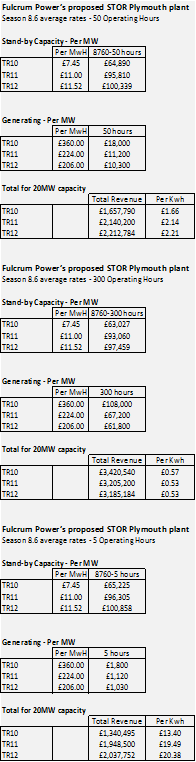
I have also done a check on other operating hours, shown below. The average in 2011-12 for STOR capacity was nearer 50 hours. At this level the revenue is much lower and more varied – from £1.66m to £2.12m. Dropping to just 5 hours per year still gives £1.34m to £2.04m.

Kevin Marshall

BBC Report

Fulcrum Planning Application

Bishop Hill blog report

Josh Cartoon

Cartoons by Josh

Fulcrum Power

National Grid STOR

National Grid STOR Market Information Report No.19


Green Energy Unicorns

It is not just sufficient to diagnose a problem and get some noisy activists to think up a solution. It is not even sufficient to get some of the greatest economists to devise the theoretically ideal policy. It is also necessary to drive that policy through to a conclusion. Donna Laframboise provides a catalogue of recent green energy failures. It is far from being an exhaustive list, but it amply illustrates that even if we are facing an imminent climate apocalypse, these green policies are not only useless, they are making us poorer, and thus making the situation worse.

Donna Laframboise's avatarBig Picture News, Informed Analysis

Everywhere it has been tried, green energy is costly, unreliable & financially unsustainable over the long term. Here’s a reading list for those still in doubt.

I’ve recently been writing about the fossil fuel divestment movement which, according to someaccounts, is “sweeping” US college campuses. In the opinion of the idealistic young activists involved in this movement, fossil fuels are passé.

“It’s time for a new age of renewables” they declare. College endowment funds should invest in “renewable energies” instead.

Why do we hold on so firmly to green fantasies? Why won’t we admit that currently available renewable energy sources don’t measure up?

This past March, the chief investment officer for California’s state pension plan called investments in clean technology “a noble way to lose money.” It’s possible, he acknowledged, that some of these investments might turn out to be profitable on a timescale of…

View original post 694 more words

Three Positive Ways to Counter Climate Denial

Anyone who reads this blog will know that I am deeply sceptical of the whole global warming scare. That stems from trying to compare and contrast the arguments through understanding different positions. One element I found coming to the fore is trying to shut down any criticism by maligning of opponents through untruths, derogatory comments and questioning of motives. A recent example of is Paul Syvrets’ attack on Jo Nova, a Vince Whirlwind’s follow up to my comment.

Suppose for one moment that alarmists of being on the side of science, and hold the fundamental truth about the coming apocalypse unless the human race repents of its evil ways. As climate science is based on public relations, I would suggest that the whole approach of attacking opponents and shutting them out of the media is a PR disaster. Tell somebody they are wrong and smearing them will get their backs up and help persuade others you are not on the side of truth. Now scientific models are too difficult for the lay public to understand, and outputs ambiguous to the uninitiated.

Let me suggest three, very positive, ways of winning over people from the “false prophets of climate denial”.

First is building up a track record in predictions

As I have often read, only true climate scientists can understand the science. But people will understand when through the using the climate models clear, bold predictions are made that later come true. Nobody will expect a 100% hit rate, but a good track record will be sufficient to convert the most waverers.

Let me help out with some examples, which I am sure some climate scientists can complete.

  1. More than twenty years ago the models predicted a continuing upward trend in global surface temperatures if greenhouse gases emissions were not severely curtailed. Emissions have exceeded our worst expectations so…..
  2. In 2000 in both Britain and Germany, it was predicted that children would grow up no knowing what snow was. The decreasing can trend can be found ……
  3. Following the massive heat wave in Europe in 2003, it was predicted that would extreme heat waves would become more frequent. This trend is shown….
  4. Following Hurricane Katrina, it was predicted that would be an upward trend in these severe storms. The evidence can be found……
  5. In 2007 the UNIPCC predicted that climate change could lead to a drop fall in crop yields by up to 50% in some African countries by 2020. The latest evidence to support this prediction consists of…..
  6. One of the most visible signs of warming is the disappearing snows of Kilimanjaro. This continuing trend can be found…..
  7. One of the direst predicted consequences of global warming is accelerating sea level rise. The latest data demonstrating this trend can be found at…
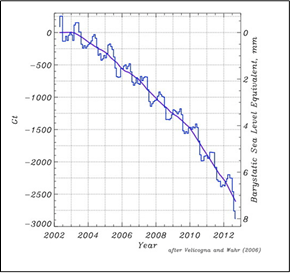
  8. One of the biggest contributors to sea level rise is melting of the polar ice caps. Velicogna and Wahr 2006 predicted that the contribution to sea level rise from Greenland alone would rise from zero to over 1mm per annum between 2002 and 2012. The actual data to support this is to be found……


Second is that the doubters believe that climate scientists practice pseudo-science.

To counter this

  • Show that the methods are in the tradition of the greatest scientists like Newton, Pasteur, Einstein and Feynman. Where different, explain why climate science’s methods are superior, or more appropriate.
  • Define clearly the boundaries of climate science, and the different skills and specialisms within it. People might then start appreciating what how complex and diverse the subject actually is.
  • Demonstrate how climate science learns from the different philosophies of science.
  • Demonstrate how climate science utilizes basic distinctions of philosophy. For instance the differences between open and closed questions, between positive and normative statements and between a priori and empirical statements.
  • Show how, like in the field of medical science, climate science is advancing and over-turning or modifying previously held views through better quality analysis.
  • Climate science needs to draw upon a number of areas. Demonstrating how the science draws upon specialists in statistics, forecasting and other disciplines where it overlaps.
  • Show how proper controls are being implemented and adhered to in order to prevent any conflicts of interest from, for instance, the same people creating temperature sets who are also the trying to vigorously promote their theories.

Third is the support of policy controls

Medical practitioners and pharmaceutical companies fully realise that whilst medication properly diagnosed can deliver huge benefits, it can also generate great harm if there is not a proper diagnosis, or the incorrect medication or dosage of that medication was prescribed. Similarly, there would be great alarm if the armed forces did not have proper control of their weapons, so that rogue elements could seize control of those weapons to start an insurrection.

From a policy point of view, the UNIPCC in the Summary for Policymakers in 2007 that

Peer-reviewed estimates of the social cost of carbon in 2005 average US$12 per tonne of CO2, but the range from 100 estimates is large (-$3 to $95/tCO2).

Given that it would be totally immoral to impose policy whose consequences are more damaging that the issue it is supposed to alleviate, proposals for the proper implementation and control of policy are to be found ……

I welcome any discussion or debate on these issues. If you have more examples, or help with links, please use the comments.

Kevin Marshall

Update 29/05/13 23.56

To encourage debate , left the following comment at http://watchingthedeniers.wordpress.com/six-aspects-of-denial/

In any realm of life, calling people names, or making claims that they think are false will only get their backs up. Further blocking them from any access to the media will generate the idea they are a victimized minority.
The best public relations present positive images about one’s own ideas. Negative images of opponents always backfire. I have made three suggestions how this might be done.
First, loudly proclaim the predictions of climate change that have come true.
Second, counteract the claims of pseudo-science by demonstrating that climate science not only builds of the greatest scientists and philosophies of science, but enhances them.
Third, disperse the claims about pursuing high-risk policies, by proposing safeguards and audit checks against them being usurped by profiteers and swindlers.
See https://manicbeancounter.com/2013/05/29/three-positive-ways-to-counter-climate-denial/

Update 30/05/2013 03.00

Watching the Deniers says:

Nice comment. Thanks for posting it.

I hope this leads to positive discussion, and recognition that there are legitimate positions that can be taken contrary to one’s own. 

Update 30/05/2013 00.19

Have also contacted desmog.blog at http://www.desmogblog.com/contact_us with the following.

As you are experts in public relations, you must realize that negative images against opponents will create a group of “victims” who will garner support from the alleged “oppression” by the media. Much better is to present positive image of climate science. I have suggested three ways this could be done at my blog.

Three Positive Ways to Counter Climate Denial

Best Regards
Kevin Marshall

Update 02/06/2013 20.40

Posted to the Guardian  here:-

Why all this negativity? Imagine if a similar public relations campaign was launched against those who deny that six million Jews died in the Holocaust? Headline would be

“Deniers of the Holocaust are wrong because they disagree with 99.9% of expert historians.”

It would have just created an underclass of believers in denial, claiming that the “truth” was being suppressed. I know that projections about the future are more difficult to persuade people of than historical facts, but a positive public relations campaign might include:- 
1. Short-term predictive successes. A track record of bold predictions that turn out true is highly persuasive.
2. Showing that climate science is building on traditions of the greatest scientists and philosophies of science.
3. Third is the support of policy controls. Many nay-sayers point to alleged policy failures that enrich businesses at the expense of the poor. Campaigning for independent auditing of policy outcomes would show concern for wider society.

China’s Renewable Policy in Context – The Ningxia Example

China has been lauded for an aggressive renewable policy, particularly for wind turbines. When you next hear praise for this policy, consider the example of the Ningxia Hui Autonomous Region in Mid-China. There are wind turbines being developed here, but only in the context of massive industrial development. That primary motive for the industrial development in this area is coal. For instance

Sun Mountain has something China needs very badly to feed the thundering beast of its economy: 14.6 billion tons of coal reserves lying under its rocky, arid desert. There are also 5 billion tons of limestone, nearly 2 billion tons of dolomite, and – a modern touch this – 300 days of wind power per year. But there is no doubt that King Coal, a tyrannical monarch who has devoured land and lives in Ningxia for the past 50 years, rules Sun Mountain. If China is to quench its thirst for electricity and industrial chemicals the old king will be on the throne for many years to come.

The scale of the development is seen from another, 2008, article.

Shenhua Ningxia Coal Industry Company….. has begun construction of a 1000 square kilometer coal-chemical complex in northwest China’s Ningxia province. The 280 billion yuan (40 billion USD) project, located at Ningdong, 42 kilometers southeast of provincial capital, Yinchuan, will include coal production, electricity generation and coal chemicals, including coal to liquid fuel conversion (CTL). (Italics mine)

The coal will be partly used for power generation.

By the time the base is fully operational in 2020 it will have eight power plants with a capacity of 30 million KW.

That is eight power plants in one small region, each bigger than anything in Britain. But why develop coal to liquid fuel conversion?

With China’s crude oil imports rising 12.3 percent to 163.17 million tons in 2007, and the price of oil reaching $140 a barrel in 2008, one of the most keenly watched facilities in the Ningdong base will be its coal to oil conversion plants.

As of 2013, one of these plants is already in operation, and should be producing the equivalent of 70,000 barrels per day (bpd) if the mid-2006 forecasts were correct. The other is being constructed, with a capacity of over 90,000 bpd. Although these two plants will only provide the equivalent of 4% of the 163.17 million tonnes imported in 2007, China has huge reserves of coal. Further, Ningxia is one of just 30 main coal producing areas.

This 2008 article admits to drawbacks of CTL.

Coal liquefaction projects have many drawbacks from the point of view of the environment and resource conservation. Firstly they consume vast amounts of water, which is a huge concern in China’s dry northwest. Fifty-seven percent of the land area of Ningxia is desert. The Ningdong coal-chemical base will draw 100 million tons of water from the Yellow river every year. Secondly, the process of liquefying coal emits much more carbon dioxide than conventional coal fired power stations. When fully operational, the Ningdong base will discharge 80,000 cubic meters of Carbon Dioxide (CO2) per day …….. Finally, while liquefied coal fuels provide an alternative to crude oil, they are not necessarily an efficient use of coal. It takes four to five tons of coal to produce one ton of oil, so coal to oil projects deplete coal reserves much more rapidly than conventional coal power generation.

Therefore, China’s rush into renewables should be seen as just a small part of the general industrialisation of China, whilst minimising dependence on external energy sources. The eco-image, such as support for Earth Day and Kite Tournaments is just to keep the environmentalists from trying to sabotage China’s rush to western levels of prosperity for 1300 million people.

Bjorn Lomborg on Climate Costs in the Australian

Australian Climate Madness blog points to an article, “Wrong way, go back“, in the Australian Newspaper by Skeptical Environmentalist Bjorn Lomberg on Australia’s climate policies. This is my comment.

This statement in the article is significant

When economists estimate the net damage from global warming as a percentage of gross domestic product, they find it will indeed have an overall negative impact in the long run but the impact of moderate warming (1C-2C) will be beneficial. It is only towards the end of the century, when temperatures have risen much more, that global warming will turn negative.

Now consider the Apocalypse Delayed? posting of March 28th. Referring to an Economist article, it says that a number of empirical studies show that climate sensitivity is much lower than the climate models assume. Therefore, moving into the net cost range seems much less likely.
But why are there net costs? Lomberg’s calculations are based on William Nordhaus’s DICE model that

calculates the total costs (from heat waves, hurricanes, crop failure and so on) as well as the total benefits (from cold waves and CO2 fertilisation).

I would claim that the destablisation of the planet’s climate by rapid warming has very little evidence. Claims in AR4 that hurricanes were getting worse; that some African countries would see up to a 50% reduction in crop yields by 2020; that the Himalayan Glaciers would largely disappear by 2035; that the Amazon rainforest could catastrophically collapse – all have been over-turned.
Thus the policy justification for avoiding climate catastrophe as a result rising greenhouse gases is a combination of three components. First, a large rise in temperatures. Second, the resulting destablisation of the climate system having net adverse consequences. Third, is that the cost of constraining the rise in greenhouse gases is less than the cost of doing nothing.
It is only this third aspect that Bjorn Lomberg deals with. Yet despite that he shows that the Australian Government is not “saving the planet for future generations”, but causing huge net harm. Policy-making should consider all three components.

That is, there are three components to the policy justification to combatting “climate change” by constraining the growth in greenhouse gas emissions

  1. That there will be a significant amount of global warming.
  2. That this is net harmful to the planet and the people on it.
  3. That the net harm of policies is less than the net harm of warming. To use a medical analogy, the pain and risks of treatment are less than the disease.

Lomberg, using the best cost model available, comes up with far less costs of global warming than, say, the Stern Review of 2006. He also uses actual policy costs to assess the net harm of global warming. Lomberg does not, however, challenge the amount of warming from a given quantity of CO2 rise, nor the adverse consequences of that warming. The Economist article
and editorial of March 30th conversely challenges the quantity of warming from arising from a given rise in CO2, but just sees it as “apocalypse delayed” and not “apocalypse debunked“.

Kevin Marshall

Are Climate Change and Obesity Linked?

Judith Curry has a (somewhat tongue-in-cheek) look at the links between climate change and obesity.

One of the two references is to the care2 website.

Consider the three alleged “links” between climate change and obesity that Dr Curry summarised:-

  • Rising inactivity rates because of hot temperatures
  • Drought-induced high prices on healthy foods
  • Food insecurity promotes unhealthy food choices

Rising inactivity is commonly thought to be due to less manual work, the rise of the car and evermore staring at the TV or computer. If a rise of 0.8C in temperature were a major factor then in Britain you would see (for instance) the Scots being more active than those in the South of England, or people being more active in winter than summer. In both cases the opposite is true.

Drought-induced high prices would have to show that droughts were the main cause of high prices of health foods compared to junk foods. Maybe convenience and taste have something more to do with the preference for unhealthy diets. Also you would need to show that rising food prices are connected to decreasing crop yields. Biofuels may have more with the rising food prices.

Food insecurity diminishes as per capita income rises, whilst obesity increases. That is the poorest of the world have hunger as a problem, whilst the rich countries have obesity as a growing problem. Obesity may be a problem of the poor in the developed nations, but food as a whole is not a problem.

The above article is a very extreme example of

The underdetermination thesis – the idea that any body of evidence can be explained by any number of mutually incompatible theories

Kuhn Vs.Popper: The Struggle for the Soul of Science – Steve Fuller 2003 Page 46.

Kevin Marshall