David Evans has provided a succinct explanation of why climate scientists’ theories, ignore some fundamental data. The views that feedbacks amplify the effects of CO2 (see Evans’s diagram below) is due to a highly selective reading of the data in a number of different ways.

Now we need to pull the recent strands together.
On actual temperature history we are getting evermore examples of data manipulation, whether on US temperatures (A Watts), Australian Temperatures (See Jo Nova), or the GISSTEMP global surface temperatures (Steven Goddard).
On past temperature history, we have the famous hockey stick graphs, starting with Mann et al in 1998 and culminating in the recent Gergis et al Australasian temperature reconstruction. All need a combination of one, or a few, very poor data sets that are promoted to prominence by statistical techniques unique to climatologists, and ignoring better quality data sets.
Something else needs to be added to the mix to obtain the high role for feedbacks – climate modelling. If recent temperature trends are exaggerated AND past temperature fluctuations smoothed out, then running a model that tries to look at relative influence of natural and anthropogenic factors on temperature will massively over-estimate the anthropogenic over the natural influences.
But go the other way. Look at the more accurate satellite data for recent temperatures and the temperature rises do not track the CO2 rises nearly so well. Go back to the raw data from the thermometers (adjusting properly for UHI), along with homogenization techniques developed by professional statisticians and the C20th warming deflates.
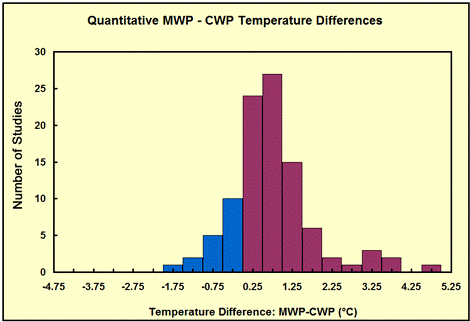
Then take the widest range of proxy records over a long period (even leave in the lowest quality ones) and suddenly the picture looks very different.
Then look at the role of feedbacks from a number of different perspectives, like Sherwood Idso, (possibly further corroborated by Esper et al 2012) and the real picture becomes clearer. Global average temperatures have increased in the last 200 years. Not quite as much in recent years as the temperature records maintain, but are now significantly higher than in during the 17th century. Furthermore, there is circumstantial evidence that a part of this increase (even up to 0.4 Celsius if non-C02 GHGs are included) has been due to the human greenhouse gas emissions. But this is a curiosity for a few academics to ponder, whilst the thrust of the research effort is put into improving the accuracy and integrity of the data.
Defence of the Consensus
The response of mainstream climatology (and with it a vast array of hangers-on) is not to improve the standards and moderate their wilder comments. Instead it has been to shut down debate by attacking the opponents. Australia has the unfortunate achievement to be home to two of the vilest the proponents of this assault on dissent. Prof Stephan Lewandowsky’s latest instalment is publishing a survey which associates climate skeptics with the worst of the conspiracy theorists. John Cook, a climatologist, ignores expert etymologists to justify calling his site skepticalscience.com
Climatology does not rank as a true science, as it has long since abandoned the search for challenging questions and improvements in quality of answers. Rather than explain the anomalies and meet the challenge of alternative explanations, climatology protects itself by employing intellectual bully-boys.

 ManicBeancounter