Show Warming After it Has Stopped Part 2

Last week I posted how Miles Allen had pulled off a trick to show warming in the 21st century after that trend had stopped in 1998. According to David Middleton at Watts up with That, the BBC’s Richard Black is using a similar decadal comparison to show that warming has continued. There are two Richard Black’s claim that the GWPF are cherry-picking the data. First, that an employee of the UK state broadcaster should choose to use a foreign temperature record over the UK one. Second, why the switch to decadal comparisons, when the IPCC has long used the norm.

Let me break this down with two graphs. Like with the previous posting, I see no scientific reason to necessitate why the starting point for the earth’s orbit of the sun has to be on 1st January. I therefore include all 12 month moving averages. That is Jan-Dec, Feb-Jan, Mar-Feb etc. I have also included three lines on my analysis. First the NASA GISSTEMP; second the HADCRUT3 and third the difference between the two.

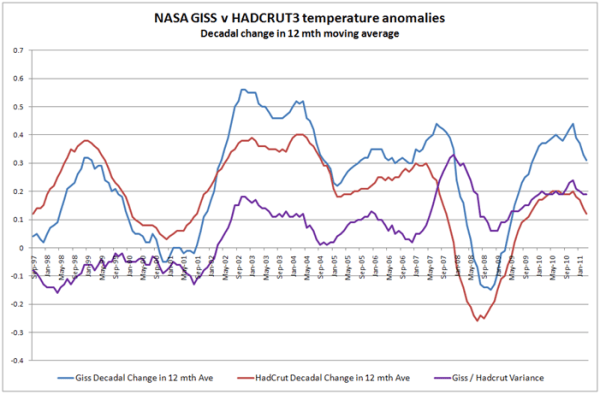
The first graph shows the decadal change in the NASA GISS figures that Richard Black is talking about. Sure enough the only period where the 12 month average temperature anomaly is lower than a decade before is in 2008. Using the HADCRUT3 data reveals a similar pattern, but the negative period is much longer. If The HADCRUT3 decadal change is subtracted from the GISSTEMP, there is shown to be a greater decadal warming trend in the NASA than in the UK figures. This might suggest the reason for Richard Black’s preference for foreign data over that paid for by the UK taxpayer’s.

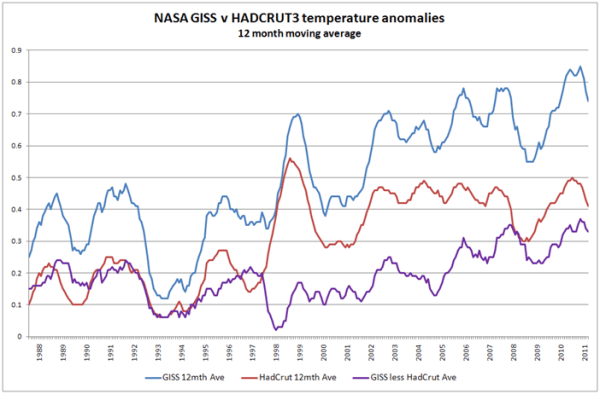
The second graph shows the 12 month moving average data – and clearly shows the reasons for both using decadal temperature changes over annual, and foreign data over British. From 1988 to 1997, there was no real warming trend if the Pinatubo cooling is removed from 1995. However the NASA anomaly seems to be around twice as volatile is the Hadley. But in 1998 the position reverses. The natural 1998 El Nino effect is twice according to the British scientists, as it is to Dr Hansen and his team. Post 1998 the story diverges. According to NASA, the warming resumes on an upward trend. According to the Hadley scientists, the 1998 El Nino causes a step change in average temperatures and the warming stops. As a result the NASA GISS warming trend is mirrored by its divergence from the more established and sober British series.

Keynes, Hayek and Global Warming

Jo Nova points to the excellent Keynes versus Hayek rap videos and compares with global warming views. My own observations are more to do with the nature of theory.

To compare Keynes & Hayek, I believe that we need to separate Keynes from the mainstream Keynesians. Keynes saw theory as a means to get the policy he wanted. It was the Keynesians (starting with John Hicks’ IS-LM analysis) that started the modelling approach. Both Keynes and Hayek eschewed the mathematical modelling of modern economics. In this Keynes would be closer to the perspective of GLS Shackle than Keynesians

  1. Keynes saw the economic system as being essentially unstable. There was no tendency for the economic system to tend towards an optimal equilibrium. Rather it could get stuck for long periods with high unemployment. This seems to parallel to the notion of tipping points. The Keynesian multiplier The parallel in CAGW theory can be seen in the positive feedbacks and tipping points. When Bob Carter says that climate is homeostatic (or Warren Meyer at climate-skeptic uses his ball in a bowl illustration), they criticize the climate models for being Keynesian. I would think that the Carter/Meyer view of climate is similar to that of Hayek on economic phenomena. Climate is essentially chaotic, having only general empirical regularities. However, it has tendencies towards equilibrium. Please note that Hayek occupies a position close to Keynes this issue. Walrasian General Equilibrium with perfect knowledge and instantaneous leaps from one equilibrium to another is an extreme caricature of more mainstream economics. Here Keynes v. Hayek is more apt for the views on climate.
  2. Keynesians view all the essential features of the economic system as being essentially knowable, capable of being reasonably represented in mathematical models. Hayek calls this a “pretence of knowledge” (the title of his Nobel Prize lecture), as although we may know essential features of the system, the relationships are highly complex and changing. The problem is not just lack of measurement, it is having data that is capable of being modelled in order make manipulation of these variables possible. In economics, the manipulation is control of macro economy. In climate, it is to control the global average temperature.
  3. Keynesians believe that a few major measures are sufficient to describe an economy. CAGW theorists believe that the global surface temperature and atmospheric CO2 are key measures. Hayek questioned whether such variables were meaningful. CAGW theorists are on much shakier ground than the Keynesians here. Bob Carter points out in his book that the stored heat in the atmosphere is a tiny fraction of that stored in the oceans. When it comes to stored CO2 the problems are even greater.

But when it comes to the rhetoric of global warming, the analogy should not be with Keynes, but with Karl Marx. Climate models give true scientists perfect insight into the real nature of climate. Those who are on the outside are delusional and/or are either knowingly, or subconsciously, acting as lackeys of the oppressive class. In Marx the oppressive class are the bourgeois, in climate alarmism they are Big Oil.

CAGW – Paralleling Kuhnian Science or New Labour Spin?

A review of Montford’s “Hockey Stick Illusion” suggests that it is an example science described by Thomas Kuhn in “The Structure of Scientific Revolutions”. Both the Hockey Stick in particular, and CAGW theory in general, I believe parallel something entirely different.

Catastrophic AGW theory is not an example of Kuhnian science. It was swallowed whole by the political establishment without going through the strictures of scientific acceptance. Furthermore, it is coupled with a major political policy objective – to constrain CO2 emissions. The IPCC was then set up to confirm and fortify the science and the policy. CAGW is thus not a proper science as such, but “politicised science”.

The Hockey Stick is the major example of this – a public relations ploy to promote policy and direct attention away from proper analysis of the data. The shenanigans may have milder and more short-lived parallels in other fields of science, but better parallels are to be found in New Labour Spin. That is, never admit to error; talk over opponents and view them as self-evidently wrong; deflect adverse comments by saying something different; deflect criticism and error by making an easily answerable point the major issue, or conceding a minor point; and then quickly moving the discussion onto safer ground. Most of all rely on image more than substance. In the case of CAGW, make peer review and agreement with collective experts the ultimate demarcations between science and non-science.

Comparing Politicians to Global Warming Deniers

At CafeHayek, Don Bordeaux has a post that requires careful reading. It is an attack on politicians and overbearing government, couched in a metaphor of global warming deniers.

My comment was

Using the metaphor of global warming is apt, but like any metaphor breaks down once examined closely. I would claim that a global warming “denier” has a more tenable position once the evidence is examined in detail and from different perspectives. Conversely, a denier of the unintended consequences of interventionism, like a holocaust denier, has a less tenable position once the alternative evidence is examined.

This brings me onto a second point. Politicians are selling themselves to get elected, which implies building up coalitions of diverse interest groups. Early Public Choice theory called this Pork-Barrel politics. A more successful approach in the television era is one based on image. That is projecting personality over policy substance. It goes against the notions of weighing up the pros and cons, learning from error in one’s past judgments, and recognizing limitations in one’s abilities and knowledge. Good government requires questioning skeptics, but has a propensity to elect the smooth-talking deniers.

An early example of image-based politics – indeed the forerunner in modern times – is JF Kennedy. A more recent example in Britain is New Labour. The image-based politics justified building up a structural deficit in the boom years. The need to save face, and the political ambitions of the key player, meant that the political business cycle did not operate after the 2005 general election. That is, according to Public Choice Theory, to boost the economy to get re-elected and then take the necessary measures to reduce the deficit immediately after.

NASA excludes an inconvenient figure on 2010 Temperatures

The NASA Earth Observatory has a nice graph to show average global surface temperatures.

I noticed a small anomaly with the 2010 figures. The blue line, for the British Hadley Centre, appears to be missing.

You can check this by downloading the HADCRUT3 data set from here. Popping these figures into an Excel graph I get the following.

Excel even defaulted to the correct colour! The 2010 average temperature anolmaly on this data set is .468, as against .474 in 2005 and .529 in 1998. This is significant in that the NASA GISS figures show 2010 to be the warmest year on record, something that was pre-announced by leader James Hansen before the year was half way through. Try Googling 2010 Warmest Year on record to see the number of hits. But inclusion of the HADCRUT figures refutes the headline. Statistically it may not be significant, but the headlines show that politically it is important. It is the difference between the claim that global warming stopped in 1998, and that it is continuing.

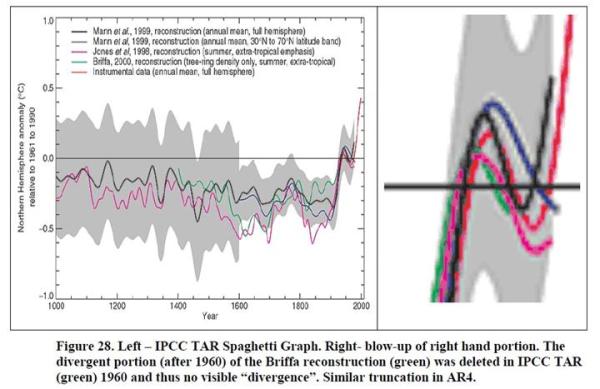
There is previous form in the climate community, as Steve McIntyre has noted. McIntyre has the following graphic (at page 28 of McIntyre, S. 2008b. How do we “know” that 1998 was the warmest year of the millennium?. Ohio State University Seminar, may 16, 2008.)

As Steve McIntyre states

“In the IPCC Third Assessment Report, they did worse than simply ignoring the problem.

They deleted the declining portion after 1960, thereby giving a false sense of coherence

between the proxies. In AR4, as a reviewer, I asked them to restore the deleted portion.

They refused saying that showing this information would be “inappropriate” (See


IPCC WG1 chapter 6 29 Review Comments) and the downward late 20th century portion

of the Briffa et al 2001 reconstruction was once again deleted in IPCC AR4.”

The Economist on Corn Production over 30 degrees

The Economist gives a positive spin to the article ““Nonlinear heat effects on African maize (corn) as evidenced by historical yield trials”, Lobell et al.” in Nature : Climate Change. I posted the following comment:-

Experimental conditions must be controlled to get comparable results. But this is not real world conditions. In the real world farmers will seek to optimize output given the constraints. When temperature, or rainfall changes, farmers will adapt. It is part of the human condition to adapt, which is why there is agriculture to be found in Southern Sweden and the blazing heat of Minas Gerais. Corn production is to be found in Edinburg, Texas with 136 days a year above 30 degrees. This is achieved through both planting and harvesting earlier in the year than further north.

As well as looking to the negatives of warming, we should look to the positives. More temperate climates should, ceteris paribus, see increasing yields as temperatures get warmer. For instance, Northern Europe, the Steppes of Central Asia and the Canadian plains should benefit from higher temperatures. Also higher temperatures will be caused by higher CO2 levels. Experimental studies have shown a doubling of CO2 will increase maize biomass by around a third. Finally, according to Al Gore, precipitation increased by 20% in the last century, mostly in above mentioned areas, Southern South America and SE Australia.

One of the biggest risks for climate change is supposedly to the stability world food supplies, with possible famines. But, as Amartya Sen has shown, the biggest famines are made serious not by natural factors but by adverse terms of trade. The Bengal famine of 1943, in which more than 3 million died, was exacerbated by a ban on exports between provinces in India, at the same time as extra demand was present from those supplying the troops fighting in Burma.


http://wattsupwiththat.com/2011/03/14/which-group-is-smarter/


http://www.co2science.org/data/plant_growth/dry/z/zeam.php

Al Gore : An Inconvenient Truth pages 114-115

http://www.economist.com/node/4293198

Julia Gillard’s Carbon Taxes– An ineffective policy

Jo Nova claims the Australian Prime Minister, Julia Gillard, lied to the Australian public by being circumspect about a carbon taxes, then when in office to introduce a carbon tax to be followed by cap and trade.

Betrayal of promises is to be expected and welcomed if to meet changed circumstances. For instance new taxes to close a deficit brought on by a recession. But in this case nothing has changed. However, there is a much better reason for Australian’s to oppose the policy – it will inflict economic pain and hardship for little or no returns.

The political argument for the introduction of the policy is that we should meet international obligations. OECD countries “need” to cut CO2 emissions by 80% by 2050 to constrain CO2 levels to around 550-600ppm. It is claimed by the IPCC & the Stern Review that this can be achieved by at a cost much less than the costly consequences of global warming. My example below suggests that a gasoline tax of 6.5 cents a litre would be almost totally ineffective. It would only serve to reduce living standards. Yet this is the start of CO2 reduction policies, when there should be some easy wins. It is as bigger inroads are made that reductions in CO2 should become more costly. Unless more effective policies can be devised, the CO2 reduction policies will leave us and future generations worse off than if nothing was done. Therefore, those who believe in the impending climate catastrophe, but are policy realists should join the climate sceptics in opposing the introduction in Australia of a carbon tax and carbon trading.

I try to explore demonstrate the case for climate change mitigation policies graphically here and which the policy will never link

A Carbon Tax on Gasoline

Consider a motorist in Australia who travels high distances in an old, inefficient truck. He travels 30000km a year and consumes a litre every 6km (6km/l or 17mpg in British terms). So the cost of 5000 litres used will increase the fuel bill by AU$325. If there are no gasoline taxes in Australia, fuel prices will be around $1.20 per litre, so the motorist will already be paying $6000 per year for fuel and (if he is lucky) $2000 for insurance, other taxes, maintenance and depreciation. So the tax will add 4% to his motoring costs.

At a more moderate level, consider a British example (in Australian dollars). Somebody has a medium sized car that is three years old, travelling 10,000 miles (16,000km) per year at 40mpg (14km/l). Fuel is $2 (£1.30) per litre , so costs $2280 for 1140 litres. With no serious maintenance issues, tax, depreciation, insurance and servicing cost around $4500 per annum. Total costs (rounded) are $7000 per year. A 6.5 cent carbon tax will add $71.25, or 1% to this bill.

For a newer car the percentage increase will be lower. Upgrade the specification and the percentage will be lower.

As real incomes rise people are able to afford more luxury. Compare the typical car in Australia with say Brazil, or Brazil with an African nation. In Brazil the best-selling cars have mostly one litre capacity and low specification. Many cars new cars still do not have air conditioning or electric windows. A carbon tax will take people in the reverse direction a long way before they will give up the utility of a private vehicle.
Richard Black implies UNIPCC scientific conclusions have political bias

Richard Black, an environment correspondent with the BBC, loses sight of the purpose of climate change negotiations in criticizing the USA.

There is a proposal to withdraw funding from the UNIPCC, a result of climate change deniers taking control of House of Representatives in the mid-term elections last year. The consequence, according to Black, is that the USA could have reduced influence over the scientific part of the next UNIPCC report. Does this mean that the scientific conclusions of the UNIPCC reports are politically biased?

The result is that the USA looks

    “set to marginalise the country even further within the global community of nations – at least when it comes to climate change.”

So joining a global climate change agreement is to avoid censure from one’s intellectual superior? Not a matter of making a real positive difference for future generations? If you believe, like Richard Black seems to, that global agreement is all that is necessary to avoid global climate catastrophe, please consider my previous posting here.

Hattip BishopHill

Bishop Hill and Comment Moderation

BishopHill has been having problems with comment moderation.

The comments are getting completely out of hand. Once again, please do not call people names. Stay on topic. I’m simply snipping whole comments now, because I do not have time to edit our people’s poor behaviour.


Perhaps if people would have more courtesy towards their opponents they would start to understand the opposing arguments. Then they may contrast it with their own and moderate their views.

Dogmatically assuming that your side is right and by implication that the opposition are either betrays our own fallibility. It is only by demonstrating an overwhelming and coherent case that one can legitimately use this in current debates without appearing out of touch with reality.

We must remember that the burden of presenting the case is on the side those who say we must act to prevent catastrophic global warming
climate change climate disruption. That just not just mean showing the case for the science is, on balance, correct. Simplified it means

First to demonstrate that CO2 and other greenhouse gases can cause a bit of warming, and how much
AND THEN
Show that this small temperature rise will lead to an increase in water vapour at high level to cause massive positive feedbacks (despite negative feedbacks being the norm in science)
AND THEN
Show that this warming will be of massive net harm to humanity and the planet (and that neither human society, nor the other creatures, nor plants will be able to adapt – despite much evidence to the contrary).
AND THEN
Show that mitigation policies – carbon taxes, cap n’ trade, subsidies to “clean” energy – will reduce greenhouse gases in THEORY, so long as all countries participate.
AND THEN
Show that when most of the emerging nations, particularly China and India, do nothing to curb emissions, that curbing emissions in theory will still work for the OECD countries.
AND THEN
Show that the governments pursuing the policies are capable of delivering the theoretical results. That is only taking on policies that meet the cost criteria laid down by the IPCC or Stern. Then project managing in fine detail and quickly ending failing projects.

As well as making the case for each of Forecast, Consequences, Policy theory and policy Implementation (FCPI), it must be combined together to show that, on balance, there is an expectation that the policy outcome will be better than if nothing was done. I believe that it is only on the basis of extreme and untenable assumptions in ALL of these four areas that the current policies can be justified.

My concern is that the “consensus” quickly grasps onto obscure bits of detail, or fine points of theory, or relies on prestige and opinion when challanged. Alternatively they question the motives of the critics.


BBC Horizon gives a one-sided explanation of temperature

I saw the Horizon programme last night on “What is One Degree?” Ben Miller returned to his physicist routes to explain why a small rise in global temperatures is significant. There was some interesting science, but it fell apart towards the end when it came to explaining how one degree is significant. Using shifts in a binomial distribution curve it was explained that

“You only have to move the average temperature up a bit for the number of stinking hot days to become much more frequent.”


What was not explained was the implication for the other end of the distribution. The number of extremely cold days will become much rarer. For Britain, where snow is fairly infrequent, it could easily become a thing of the past. The cold spell twelve months ago, and December being the coldest in the 352 years that the Central England Temperature Record has been in existence are simply not possible. Especially at the Met Office were repeating this forecast just twelve months ago.

Before you get all skeptical, there is something that salvages the global warming case. The scientific consensus has long stated that climate change will disrupt the planetary weather systems. Therefore, the distribution of temperature will not just have a peak that will shift to the right, the distribution will also broaden. It may broaden sufficiently that there could be more extreme cold weather than extreme hot weather events. Along with this there will be more extreme weather events like hurricanes, tornados, flooding and droughts.

The problem with this is that the prediction of more hurricanes has not occurred. The 2010 season was one of the quietest on record. The forecast drier climate in Queensland seems to have gone a bit adrift as well.

In analyzing our extremely varied climate, whether British or Global, one has to look for instances that contradict out hypotheses as well as confirming instances. Otherwise you get a distorted picture of what is actually happening, and an exaggerated view of the human influences.