Head of the IPCC Rajendra Pachauri misleads on pause in Global Warming

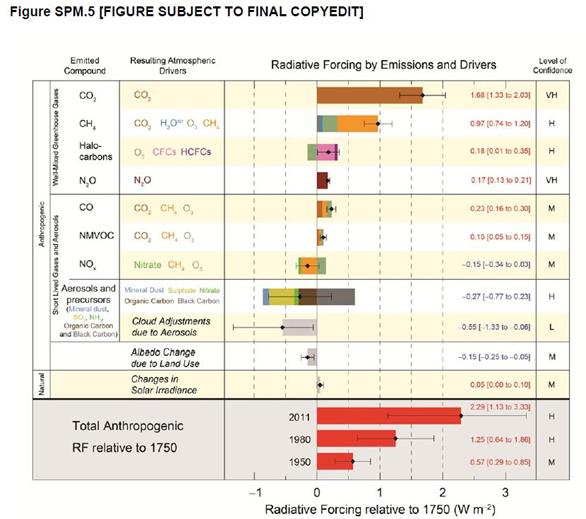
Prof Rajendra Pachauri made a number of misleading statements (or was misquoted) in an interview with BBC Environment analyst Roger Harrabin, This includes:-.

He also dismissed suggestions of a slowdown in global warming.

“There’s definitely an increase in our belief that climate change is taking place and that human beings are responsible,” he told me.

“I don’t think there is a slowdown (in the rate of temperature increase). I would like to draw your attention to the World Meteorological Organization which clearly stated on the basis of observations that the first decade of this century has been the warmest in recorded history.

The first sentence is wrong. It is contradicted by another BBC article “Global warming pause ‘central’ to IPCC climate report.

The second sentence is a statement about beliefs. It is hearsay at best, the antithesis of stronger evidence.

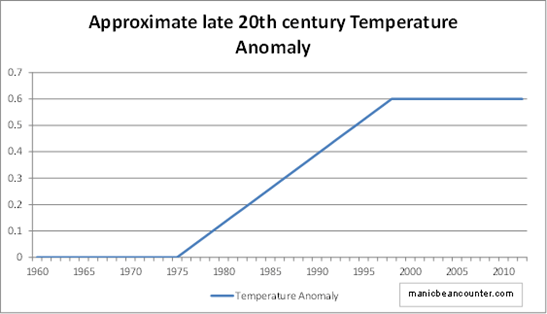
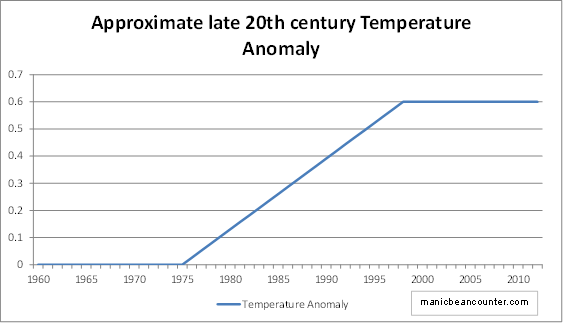
I showed why the third and fourth sentences are a dodge around the warming pause last month. In a stylized form temperatures were flat to 1975, rose through to 1998 and have stalled since.


From this, you can show that there has been five decades of rising temperatures. It is misleading to say that global warming is still happening when it has paused.


Maybe the leader of the IPCC is, at least in part, a victim of the zealous support of climate alarmism that the BBC shows, in betrayal of its’ charter.

I doubt if there will be a falling out of the head of the UNIPCC with the BBC. After all the caption beneath the photograph is a falsehood that Pachauri has been peddling for a few years now.

Prof Pachauri shared the 2007 Nobel peace prize for his work

This is what you will find at the Nobel Prize Website

The Nobel Peace Prize 2007


Intergovernmental Panel Photo: Ken Opprann

on Climate Change (IPCC) Albert Arnold (Al) Gore Jr.

Pachauri collected the Nobel Peace Prize as head of the IPCC. He did not share the prize. The inaccuracy is the same as that shown in reporting the lack of warming. It shows something more significant than what is there. At least the BBC puts that it is a Peace Prize.


Answering Michael the Realist

The summary conclusion I reach from this posting is

Cherry-picking is being selective, to confirm one’s prejudices. To use all the available data is (according to Michael) the sign of a true skeptic. So (a) Michael is right, therefore wrong (b) Michael is wrong, therefore right (c) Michael contradicts himself. I cannot think of any other logical category.

One of the issues I find with the blogs on climate, and particularly with many of the comments, is that many believe that the arguments hinge on a single piece of data, or on the weight of opinion. There is also a lot of denigration of others but no substantiation. The reason I chose “Michael the Realist” was because he was trolling Jo Nova’s blog, whingeing that nobody would answer his ridiculous points, which were totally out of context with the theme. When I do a search on “Michael the Realist”, in one posting I get 37 hits out of 297 comments. This understates the way he sought to hijack the debate. A couple of comments he made are at the foot, with comments by Joanne Nova

My subsequent postings with direct answers to his questions met with no acknowledgement that I may have anything useful. I fully realise that I could be fundamentally wrong somewhere, or rejecting good strong arguments for superficial reasons. Climate is an enormously complex issue. The study of climate is an applied science, requiring drawing upon a range of skills from a variety of areas. I have therefore listed, and explained, the fundamental issues that climate science ignores. It is from the study of the philosophy of science, economics, econometrics, accountancy, and history. I also draw analogies with principles of trial by jury in English Common Law. Over hundreds of years there has developed principles for establishing whether a claim is proven beyond reasonable doubt by the prosecution. The people that need convincing are ordinary people. It is an analogy that the PR people should draw upon.

The fundamental issues are listed below. In some cases I will refer to only the letter for brevity.

A Positive and Normative

B Boundary conditions

C Open and closed questions

D Trivial v. Non-trivial

E Quality

F False Positives and False Negatives

G Relevancy and significance

H Necessary and Sufficient

I Levels of evidence

J Values of the Legal Process in Reverse

K Underdetermination Thesis

L Vulnerability

M The Null Hypothesis

To retain the flow I will post my previous comments in orange, and Michaels in green. New comments are in black. This exchange took place here and here.

  1. Your so called “proof” of AGW is lacking something. It has data on the alleged effect (C20th warming), but no data on the alleged cause – human greenhouse gas emissions. Do you agree?

    No. It is warming, this fits the theory of AGW as greenhouse gas emissions are increasing K. Natural factors are examined and cannot be the cause. All other predictions of AGW caused warming are also occurring, including falling ph in the oceans D, melting Arctic D, falling global ice volume D, rising sea levels D, increasing extreme weather especially floods D, heat waves D and droughts D and much more. Also
    F applies to weather trends.

    There is no other plausable explanation put forward that I have seen yet.

  2. Above I show there is no apparent link between C20th CO2 emissions and the pattern of warming.

    That is incorrect. C CO2 emission have been increasing and temps have been rising, plus all the other observations. Both rose in the C20th, but I claim that “the relationship of CO2 emissions to average temperature is weak.” I look beyond the simplistic statement, and Michael does not.

  3. If I used HADCRUT4 or GISSTEMP, the fit would be closer, but still have anomalies.

    The trend with GISS, even against the satelites is the same. So unless Michael is claiming that HADCRUT4 and GISSTEMP is the same as HADCRUT3 (thus contradicting his earlier claim that HADCRUT3 was out of date), then they are only the same in an unscientific, cherry-picking sort of way. So there are three option here. First, we trust the Michael who says HADCRUT3 is out-of-date and thus inferior to HADCRUT4 and GISSTEMP. Second, we trust the Michael who says HADCRUT3 gives the same results as HADCRUT4 and GISSTEMP. Third we conclude that Michael does not know what he is talking about.

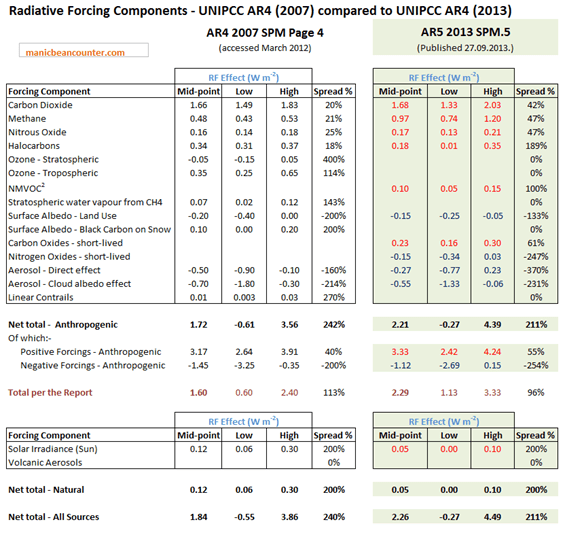
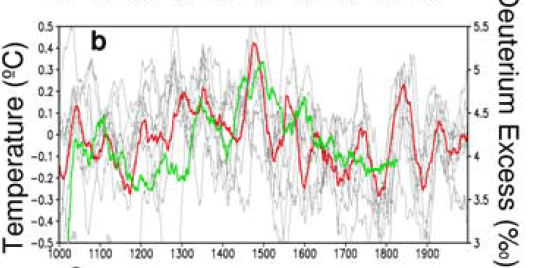
  4. Pages 2K shows considerable natural fluctuations, including two previous warm periods in the last 2000 years. Maybe not as much at in Esper et al 2012 (published in Nature), but there nonetheless. In the absence of an accurate and clear method of deciphering the human signal from the natural signal, it is easier to assert that C20th warming was predominantly due to natural factors, than >100% due to human factors. (The AR4 of 2007 had aerosols as offsetting much of the GHG effect.)

    Natural factors do indeed exist, but just because we have less information about past natural factors than present ones does not nullify how much we know about present ones. G, I, L, M Most significant natural factors that we can measure and are currently aware of since the 50′s have been cooling. (Unsubstantiated claim) . Also the 2001 to 2010 decade, the hottest on the instrumental record, has been significantle in the grip of cooling la ninas and falling solar. (Unsubstantiated claim) Despite that it is still hotter than the previous decade with predominantly warming el ninos. (Answered here, which Michael has not contradicted) This is the proof that you are wrong, I even skeptic scientists expected it to cool by now. It is not cooling because it is being overwhelmed by greenhouse gas warming.

  5. Given that the GISSTEMP shows much a greater warming spurt in the late C20th than the second half, and that most the extreme rise is in the Northern Hemisphere (especially the Arctic), is it not surprising that the Pages 2K proxies have most of the Arctic and European warming in the early C20th, with little warming thereafter?

    The fastest warming is in the second half, with .5 degree rise snce the 50′s. Repeats what I said about GISSTEMP, but does not engage with the significant bit – that the Pages2K temperature reconstruction contradicts the GISSTEMP temperature record. Pages2K (Michael promotes) appears more in line with HADCRUT3 (Michael rejects as being out-of-date) than GISSTEMP (Michael promotes).

  6. Given a lack of comment to the contrary, you accept that your claims about hottest decades is not evidence against warming having stopped. Rather it is what Stephen Lewandowsky terms “misinformation”.

    No, as I have pointed out, when you take all the science, information and data into account, it is clearly still warming. That statement only works if all your (lack of) science comes from an eyeball look at a cherry picked portion of a graph out of context and ignoring all other data. People, like David Whitehouse of the GWPF, have looked at the surface temperature over the last 15 years or so and found there is no statistically significant warming. Even Nature Climate Change has a peer-reviewed paper showing that the recent warming over the last 20 years is a lot less than the climate models predicted, and agrees that no significant warming in the last 15 years. (see quote in Appendix 2) Note the difference in the periods of the last two sentences. It is a matter of degree. So Michael falls foul of H and I, as established in the peer-reviewed science. Will Lewandowsky and Cook (a) now acknowledge that one of their own spreads “misinformation” (b) declare “Michael the Realist” an outsider (c) duck the issue and implicitly deny that somebody who agrees with the “science” could be more of an “eccentric” than some of the skeptic scientists.

  7. That your definition of “Skeptic” is completely at odds with the premier dictionary of the English Language.

    I use skeptic to be kind and because if I use the term that more accurately describes your behavour I get fake indignation. I actually believe myself to be the skeptic as I look at all the data and information with an open mind. This referred to Michael’s definition of “skeptic” here and my follow-up here. The definition he used was

    A true skeptic is somebody who looks at all the data, science and observations and makes rational and logical determinations on that…

    So Michael does use the term skeptic to refer not to me, but himself. Despite being pointed to the definitions in the Oxford English Dictionary, he still persists in promoting a falsity.

Also from the same comment.

On Correlations

This pearl of wisdom from Michael.
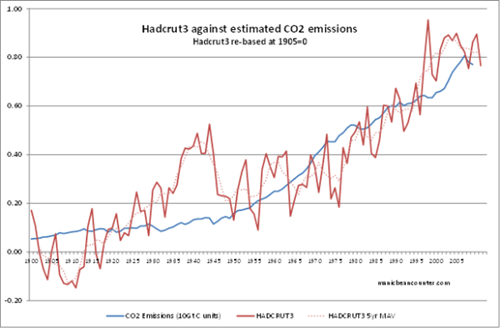

Even your graph above shows fairly good correlation with CO2 and temperature.

Correlations are obtained from running statistical tests against the numbers. It is purely obtained from eyeballing the data – which anybody who understood data would not do. If Michael, the self-proclaimed expert on climate science, wants to run the appropriate correlations, and report on whether they are “good” or not by the appropriate statistical tests, then I will provide them with the data. I will also provide the Excel spreadsheets (raw data and adjusted data) to anybody else who requests it. They can then run this data for CO2 emissions against any temperature set they see fit. It will not be easy, as the test is for a non-linear, time-series correlation. As such a battery of tests are required.

Michael’s opener on my blog is

Your cherry picking again. Your use of hadcrut 3, a superseded non global data set is a dead giveaway and then choosing specific proxies that match your confirmation bias.

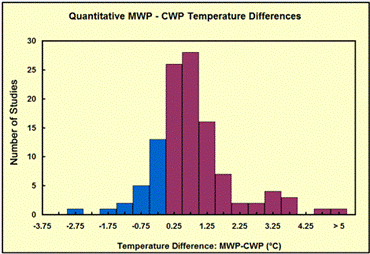
I went to CO2 science.org, where they summarize all the available proxies. From those that show estimates of average temperatures estimates since the medieval warm period, they produced this graph.

Cherry-picking is being selective, to confirm one’s prejudices. To use all the available data is (according to Michael) the sign of a true skeptic. So (a) Michael is right, therefore wrong (b) Michael is wrong, therefore right (c) Michael contradicts himself. I cannot think of any other logical category.

A couple of comments by “Michael the Realist”, with bold-type comments by Joanne Nova.

Michael the Realist August 25, 2013 at 5:57 pm · Reply

I also do not ignore responses. I hope you can appreciate that I work for a living and so by the time I get back on it is hard to work out whom has replied to whom and when. So keeping up is a huge issue. THere is one of me and I get attacked by 10+ of you guys. If someone would pay me then I could devote full time to this but I doubt that will happen. I reply to as many as possible.
I’m unpaid too. Do your research before you comment. – Jo

As to repetition, the main arguments from skeptics revolve around 3 areas.
1. There is no consensus, or there is a global conspriracy

[Dishonest or ignorant. This is not remotely a “main” argument. On this site almost everyone agree there is a consensus among climate scientists — the issue is that it’s meaningless. You pretend I talk about a conspiracy. Our main point is the empirical evidence. – jo

The post above with the list of scientific organisations puts those claims to bed. It is not feasable to maintain those views when organisations as far apart as China, US, Russia, Mexico, Peru, France, Canada, India, Nigeria, Nicaragua, Japan, Turkey etc, just to name a few all agree in the science of AGW.

[Consensus proves nothing about the atmosphere. It can be bought (with say $100 bn in science grants) or bullied or a genuine mistake from groupthink. Scientific consensus has been wrong many times before. Name which of these agencies actually surveyed it’s members? Ans None, apart from 2 or 3 surveys on tightly defined and annointed “climate scientists”. The other statements come from 6 – 8 activists in a committee in each group, are meaningless and have been protested by thousands of members of the major groups. I have covered all this over and over, you don’t respect us enough to read my site before arriving here to lecture us repeatedly on a topic we know better than you. – Jo]

2.The models are wrong
I avoid the models completely in discussions as I want to stick to the actual data and observations. The models are useful, and have been really accurate in many areas, because you cannot put the planet in a test tube, isolate variables and see what happens. But as I have pointed out many times, they are still just projections based on ceratin scenarios and reality is always going to be slightly different due to natural variations that are not completely predictable (like ENSO), lack of computing power and accuracy due to grid sizes, and the parameters like how much CO2 or aerosols emitted being different to that entered. The science is not based on the models, it is based on the physics, data and observations, and I make my points on those basis.

[The models are broken and even alarmists admit that now. They have not been accurate about anything that matters. This is blather you can’t back up. Read my “new Here” post. We agree with alarmists on physics, but not on feedbacks, you’ve been misled and are waging the wrong war. – Jo]

3. Warming stopped 16 years ago, or there is a pause etc.
This is answered by the fact that it is a dynamic system with natural and anthropogenic forcings and that even though there are many dips and pauses in the long term record the trend is up. I prove that the 2001 to 2010 decade was the hottest on record globally, over ocean, land and both hemispheres, and that every decade bar 1 in a hundred years has been hotter than the previous one. Using years in such a complicated system is deception becasue it has to many natural cycles to make judgements that way. I show the ENSO charts to prove that the current 13 years have been mainly la nina, but temperatures have not fallen and the period is still hotter than the decade with predominantly el ninos. I show skeptic scientists who have predicted cooling due to natural factors, but this has not occurred. This proves warming is occurring as it has overpowered natural factors. This has not been able to be explained away by your readers using any properly scientifically accepted theories and data. Is this why you are blocking me.

[Since I’ve published over 700 of your comments, will you apologize for dishonestly suggesting I am blocking you? _Jo]
[As as for the “pause” read my last comment again. Even if is still warming in the long term trend, the models are broken and the 300 years of warming does not correlate to CO2.- Jo]

As to the repetition, I would say that 90% of your posters postings are based around those 3 themes so the repetition is all here.

[You start and amplify these themes by posting 700 comments on exactly these points. That’s why commenters get so angry. You drive threads off topic and into these inane repetitious channels. Jo]

Obviously since I am using accepted sceince…

[You don’t know what science is. Logical fallacies are not “Science”. – Jo]

…and data my answers are not going to change. The posters will repeatedly not accept my answers and keep posting the same questions over and over and over again (Heywood especially but many others) Why are they not being moderated? If I have answered a question but asked it again how should I respond?

[Stop taking the threads off topic and repeating errors and you won’t get caught in the same loops. – Jo]

So I have valid answers to all queries that clearly point to a consensus

[Which means nothing in science… -Jo]

and clearly answers why there is a pause,

[Trenberth, Jones and Mann don’t know why there is a pause, if you do, you should write to them, quick, they need you! -Jo]

using previous periods is not proof of anything unless you can put forward measurements to show that natural factors were not the cause. Currently natural factors are not the cause, they can be measured and determined. That being the case, to promote delay and to not accept the science, for what I can presume are only ideological reasons, is not the right thing to do. There is more than enough evidence for concern and to justify action, until the science and the data start pointing the other way. The consequences are to severe.

Obviously being moderated this might not (likely) be posted, but I hope you actually read it and think about it. My only motivation is my kids and they do not deserve the short shrift they are getting in regards to the future planet we are leaving them.

[Your kids deserve better science – we’re happy to help them have a future with less corruption, better reasoning, and based on evidence – Jo]

Michael the Realist August 26, 2013 at 7:57 pm · Reply

Michael, I don’t want to moderate you or block you. I want you to learn what our basic position is so you can argue at a level commenters will enjoy. I want debate, and I want people to point out where we might be wrong, but repeating logical fallacies is too basic a level. Perhaps I should write an FAQ? _Jo
———————————————————————–

You still haven’t provided a working email address. You are now on the moderated list until you do

I have not been dishonest about questioning my blocking.

You’ve posted 700 comments repeating the same points many times. You have not been blocked. It’s dishonest to say you have.

I have been told that my address is false as I have not responded but I have responded many times, and you have replied. I work, check when I can, the replies come into the hundreds, I will scroll through trying to pick up which ones applied to me. It is easy to miss individual ones, your email does not come in special, it just looks like it is from the list.

Yes you work to but most of your posters do your work for you, I have many more responses to answer personally than you do.
Wow. That is some delusional framework you are creating there. Or perhaps you don’t read my posts? -Jo

My query above has been unable to be successfully answered with any firm science.

What query? I suspect there is no answer anyone could give you… – Jo

That is why they get angry, they cannot answer it. It is based on actual data and observations, not models. I attempt to be as polite as possible and I try to answer as much as possible, repetition comes from them asking me the same questions over and over and making the same complaints. Do you find Heywoods million questions on how much in deg c Australias emissions reductions will reduce temps? I don’t, it is not about one country or minute temps it is about global responsibility and consequences, thats what everybody is resonding to. Do you find blackadder throwing in vikings, without any references as an argument that disproves AGW? What about all the personal questions about why I have kids and drive a car? You say my questions are irrelevent to the science, do you ever question supporters?

[Yes I do. I send emails to commenters privately. Theirs works. They respond before they write another 14 comments. – Jo]

I am not sure what you are after now. Do you want me to go through point by point on your evidence list? Do you want it done on this thread or that one? Can you answer clearly where my logic above is wrong and prove it so that I can be secure in my childrens future?

Read your emails before you write comments asking for answers I have sent you.
PS No I don’t want to tutor you on any thread. 
Argument from authority is a logical fallacy known for 2300 years. It isn’t evidence about the climate.

Jo

Appendix 2 – The Nature Climate Change paper.

The inconsistency between observed and simulated global warming is even more striking for temperature trends computed over the past fifteen years (1998–2012).

For this period, the observed trend of 0.05 ± 0.08 °C per decade is more than four times smaller than the average simulated trend of 0.21 ± 0.03 °C per decade… It is worth noting that the observed trend over this period — not significantly different from zero — suggests a temporary ‘hiatus’ in global warming. 

Blocked by the Great Firewall of China?

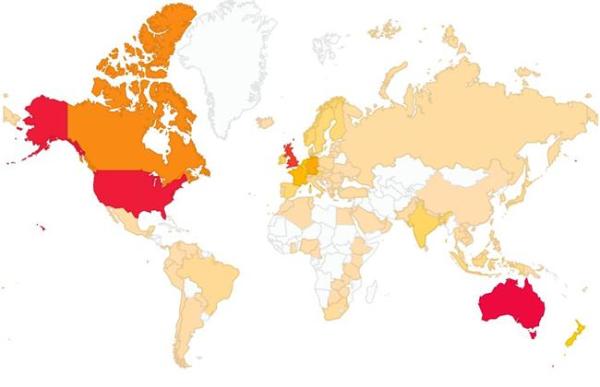
One of the advantages of using WordPress is that they provide details of the countries where hits originate from. It is fascinating to see that in the last 18 months I have received hits from well over 100 countries.


As I have only posted in English, it is not surprising that the top three countries, accounting for nearly three-quarters of all hits are Australia, United States, UK (where I live). Yet there are fully 23 nations where I have received just one hit. As I have never mentioned countries such as Laos, Saint Lucia, Papua New Guinea or Ghana, Given that they have small numbers of people and/or with limited internet access, and having mentioned these countries, then this is not surprising. But there is one glaring anomaly in these 23 nations – China. With over 20% of the world’s population, and having mentioned the country at least once – on China’s Coal to Oil Policy – this is at first surprising. Maybe it is the Great Firewall of China that is blocking me. However, there is a site http://greatfirewallofchina.org. The results show that my site is not blocked. This is further confirmed by over half my spam is from China, often with Chinese script.


The explanation might be that the Great Chinese Fire Wall acts like Google incognito window.

I tested some other sites and got mixed results. BBC.co.uk and wattsupwiththat are not blocked. Amongst those blocked are amazon.co.uk, telegraph.co.uk. thegwpf.org and ebay.co.uk.

There is a couple of lesson’s here. First is that no matter how good you consider the data, (and WordPress has, I am sure, site stats to the highest standards) it may not capture everything. Secondly, when statistics do not add up, it is easy to come to a conspiracy conclusion. It might be that you are ignored because you are not recognized, or in being recognized others do not give two hoots to your opinions. Below is the Chinese translation, to act as a test. A further test is to mention Tiananmen Square Massacre 1989, and post the posting in Chinese – See below.

使用WordPress优势之一是,他们提供的点击来自的国家。有趣的是可以看到,在过去的18个月中,我已经收到命中以及超过100个国家和地区。

正如我刚才只张贴英语,这并不奇怪,把上面三个国家占近四分之三的所有点击,澳大利亚,美国,英国(我住的地方)
。然而,是完全有23个国家在那里我只收到一击。因为我从来没有提到国家如老挝,巴布亚新几内亚,圣卢西亚或加纳,鉴于他们有少量的人及/或有限的互联网接入,并在提到这些国家,那么这是不奇怪的。但在23个国家中国,有一个明显异常。随着世界人口的20%以上,至少有一次提到国家中国煤炭石油政策这是第一个令人惊讶的。也许这是伟大的中国防火墙阻止我。然而,有是一个网站http://greatfirewallofchina.org的。结果表明,我的网站没有被阻塞。这进一步证实了我的垃圾邮件的一半以上是来自中国,经常与中国的脚本。

释可能是伟大的中国防火长城就像谷歌隐身窗口。

测试了其他一些网站,并得到了好坏参半的结果。 BBC.co.uk wattsupwiththat没有阻塞。当中那些阻塞amazon.co.uk telegraph.co.uk thegwpf.orgebay.co.uk.

这里有一对夫妇的教训。首先是再好你考虑数据(和WordPress网站统计的最高标准)
,我敢肯定,它可能无法捕捉一切。其次,当统计加起来不,它很容易阴谋的结论来。这可能是被忽略,因为你不承认,或在被认可别人不给两个鸣响您的意见。下面是中文翻译,作为一个测试。进一步的测试是提到天安门大屠杀1989年,发布张贴在中国见下文。

Fundamentals that Climate Science Ignores

Updated 08/09/13 am

Updated 08/09/13 pm – M The Null Hypothesis

Climate Science is a hugely complex subject, dealing with phenomena that are essentially chaotic, with vague patterns. Yet the promotion of that science is banal and superficial. Below are some of the fundamentals that have been addressed in established areas like economics, philosophy and English Common Law, but which the Climate Science community ignores. Most overlap, or are different ways of looking at the same thing.

A Positive and Normative

I do not hold with the logical positivism in vogue in the early parts of the C20th and later underpinning the “positive economics” ideas of Milton Friedman that was popular in the 1950s to 1980s. But it made the useful distinction between positive statements (empirically based statements) and normative statements (what ought to be). The language of climate science is heavily value-laden. There is not attempt to distinguish positive from normative in language, nor highlight that competency in the sphere of positive statements is not necessarily an indication of competency in normative ones.  For instance, when scientists make statements about the moral imperative for policy, they may overemphasize the moral questions raised as they may be too close to the subject. In fact believing that that rising greenhouse gas levels causes a worsening of climate can lead to a bias towards the simplified solution to constrain that growth. It takes understanding of the entirely separate fields of economics and public policy-making to determine whether this is achievable, or the best solution.

B Boundary conditions

There is no clear definition of science in general or the study of climate in particular. The only underlying definitions are tantamount to saying that science is what scientists do, and scientific statements are those made by scientists. Without a clear definition of science, scientists end up making unsupported statements, outside their area of competency. For instance, scientists often make statements about the economic case for policy. With the term “climate change” encompassing both, the general public are misled into believing that “climate scientists” cover both areas.

C Open and closed questions

A closed question can by answered by a single word. The narrowest closed questions are those can be answered “Yes/No” or “True/False”. Open questions need fuller answers. Climate change is not just about closed questions. It is about how much, how likely, when and where. If terms of boundary, there is not a closed question of science versus non-science – with the boundary in actual work being between that published in a peer-reviewed journal and that published outside. That leads onto non-triviality and quality conditions and relevancy

D Trivial v. Non-trivial

The strongest evidence for global warming suggests a trivial issue. In one aspect this is true by definition. The non-trivial part – the potential climate catastrophe that policy seeks to avert – relies upon future projections. This relies on temperature rises many times greater than so far experienced. Projections will always be, weaker that the actual evidence. But there is an empirical aspect as well. If the actual trends are far below those predicted (surface temperature warming trends), or fail to show a switch to a path pointing to catastrophe (acceleration in the rate of sea level rise)

E Quality

There is good quality science and poor quality. Peer review should help, but (as suggested in the Climategate emails) acceptance/rejection can be based on criteria other than science. In most areas of science, and indeed in many professions, efforts have been made to improve the quality of results. One minor step towards improvement of quality is the insistence on publishing the data behind peer-reviewed articles. This has led to the quick exposure of shoddy work like Gergis et al 2012 and LOG12 papers, whereas it took many years of persistence by Steve McIntyre to get the full data on Keith Briffa’s deeply flawed Yamal tree-ring temperature proxy. However, as the forthcoming UNIPCC AR5 report will demonstrate, increasing quality is sacrificed in promoting climate catastrophism.

F False Positives and False Negatives

A particular subset of the quality issue is that of false positives and false negatives. With activists pressuring governments and scientific bodies to agree with the dogma, and promotion of pejorative language (e.g. deniers, fake skeptics), misattribution of significant weather events to climate change is a consequence. Whilst in cancer screening there have been efforts made to reduce the number of false positives and false negatives, in climate science there seems to be every effort to increase the numbers of false positives. (Superstorm Sandy that hit New York state last year, the extreme heat wave in Europe in 2003, the low sea ice point in September 2012).

G Relevancy and significance

Some pieces of information, or scientific papers, are more important than others. The vast majority of papers published are on trivial issues and/or fail to make a lasting impact. In terms of catastrophic global warming, most papers in the field are tangential to the subject. The same is true of items of information, statistics and opinions.

H Necessary and Sufficient

For a climate policy to give net benefits, a number of conditions are necessary, both in the science (greenhouse gas effect, significant warming, adverse consequences) and in policy area (policy with theoretical net benefits > costs of doing nothing, large enough policy area, effective policy management). Sufficient for policy success (net policy benefits > costs of doing nothing) all are to some extent necessary. For policy failure, it is only sufficient for one of the necessary conditions to fail. It does not matter whether this is

–       climate sensitivity being much lower than assumed

–       or adaptation at the non-governmental local level is much more effective than assumed

–       or the net adverse consequences of any given amount of warming are grossly exaggerated

–       or the theoretical economic case for policy is flawed (such as demand for energy is far more inelastic with respect to price over time than assumed, or that renewable energy is not a close substitute to fossil fuel energy)

–       or the actual policy enacted does not encapsulate the economic theory, diluting or nullifying the effectiveness

–       or unilateralist policy where success requires that the vast majority of the biggest economies to participate

–       or the policy on paper is potentially successful, but it is not project managed to drive through the maximum benefits at least cost

I Levels of evidence

In the legal systems, especially in criminal law, it has long been recognized that there are different qualities of evidence. The strongest is DNA, fingerprints, or catching somebody in the act. There is then secondary evidence from witnesses. There is then circumstantial evidence, such as the accused being near to the scene at the time, with no clear reason to be there. The lowest form of evidence, and usually rejected, is hearsay evidence. That is opinions of people with little interest in the case, giving unsupported opinions. The judicial process also views more highly evidence that is corroborated by other pieces of evidence, and evidence that on its own seems quite strong is downgraded or ruled out by contrary evidence, or alternative explanations.

J Values of the Legal Process in Reverse

Climate science, fails to grapple with the grading of evidence, as some its strongest arguments – consensus amongst scientists – is actually hearsay. Improving the quality of evidence would mean critically examining past forecasts in the light of evidence. In the judicial process, creating prejudice in the eyes of the jury against the defendants, or seeking to deny the accused a defence, is forcefully dealt with. Creating prejudice and denying a voice to those who question the climate change dogmas is viewed as part of the cause.

K Underdetermination Thesis

“The underdetermination thesis – the idea that any body of evidence can be explained by any number of mutually incompatible theories”

Quote from Kuhn vs Popper – Steve Fuller 2003

The global warming hypothesis is but one of a number of hypotheses trying to explain why climate changes over time. The problem is not just of a potential number of competing theories. It is that there might be a number of different elements influencing climate, with the various weightings dependent on the method and assumptions in analysis. It is not just trying to determine which one, but which ones and to what extent that they interplay.

L Vulnerability

Every scientific hypothesis is vulnerable to being refuted. Human-caused catastrophic global warming (CAGW) is based on extremely tentative assumptions, and is a forecast of future events. As the warming the past one hundred years is tiny compared that forecast to happen in the future, and that warming is partly obscured by natural variations, then the signal of future catastrophe will be weak. The issue is further clouded by the lack of long periods of data on climate variability before when human emissions became significant. That is data prior to 1945, when the post war economic boom led to a huge increase in human emissions. Assuming the forecasts of CAGW are correct, the hypothesis becomes incredibly vulnerable to rejection.
But if CAGW is false, or massively exaggerated, then the hypothesis is deeply susceptible to confirmation bias by those who only look to find evidence of its truth. The core belief of climate science is that the catastrophist hypothesis is true and the job of the “science” is to reveal this truth. The core mission of many co-believers is to stop any questioning of these core beliefs. The alternative view is that evidence for CAGW has become stronger over the last twenty-five years, making the hypothesis less vulnerable over time. This can be tested by looking at the success of the short-term predictions.

M The Null Hypothesis

Wikipedia’s definition is

In statistical inference of observed data of a scientific experiment, the null hypothesis refers to a general or default position: that there is no relationship between two measured phenomena,…… Rejecting or disproving the null hypothesis – and thus concluding that there are grounds for believing that there is a relationship between two phenomena …………….. – is a central task in the modern practice of science, and gives a precise sense in which a claim is capable of being proven false.

It applies to AGW theory, as the hypotheses are empirical relationships. With highly complex, and essentially chaotic, systems it is only by confronting the data using a battery of statistical tests that you can disprove the null hypothesis. Without the null hypothesis, and without such rigorous testing, all the data and observations will only confirm what you want to believe. Some of the best established empirically-based hypotheses, like “HIV causes AIDS” and “long-term heavy smoking significantly reduces life expectancy” have been confronted with the null hypothesis many times against large, high quality data sets. At extremely high levels of significance, the null hypothesis of no relationship can be rejected.

It could be claimed that the null hypothesis in not applicable to AGW theory as it forecasts something much worse happening than has so far been experienced. However, it is more important because of this. There is no bridge between reality and the theoretical relationships (with assumed magnitudes) in the climate models. The null hypothesis (general or default position) for testing against actual data is not that there is no relationship, but the double-negative of no non-trivial relationship. So the null hypothesis for testing “CO2 causes warming”, is not “CO2 does not affect temperature”, but “CO2 has no non-trivial impact on warming”. The reason is that the claimed requirement for policy is avoidance of a climate catastrophe, with relationships being non-trivial in magnitude.

Showing Warming when it has Stopped

There has been no statistically significant warming for at least 15 years. Yet some people, like commentator “Michael the Realist”, who is currently trolling Joanne Nova’s blog, are claiming otherwise. For instance

Again look at the following graph.

Now let me explain it to the nth degree.
# The long term trend over the whole period is obviously up.
# The long term trend has pauses and dips due to natural variations but the trend is unchanged.
# The current period is at the top of the trend.
# 2001 to 2010 is the hottest decade on the record despite a preponderance of natural cooling trends. (globally, ocean, land and both hemispheres)
# Hotter than the previous decade of 1991 to 2000 with its preponderance of natural warming events.
# Every decade bar one has been hotter than the previous decade since 1901.

Please explain why the above is true if not AGW with proof.

State of the climate 2012
http://www.climate.gov/news-features/understanding-climate/state-climate-2012-highlights

The three highlighted comments are the ones that this posting addresses.

Using decadal average temperature changes to cover up the standstill.

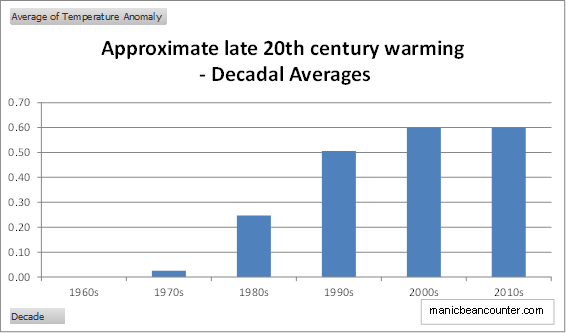
The latest way to avoid the truth that warming has stopped for 15 years or more is by decadal averages. This can be illustrated by using an approximate model of the data. Assume constant average temperatures from 1960 to 1975, a linear warming of 0.6oC from 1976 to 1998, followed by a further standstill.


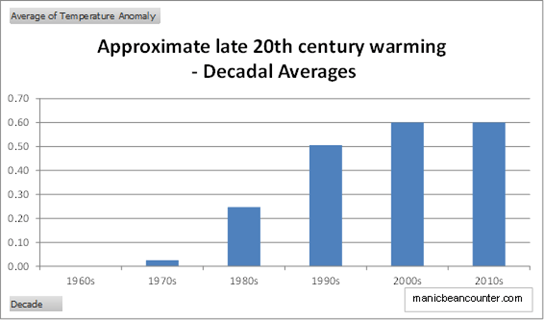
The decadal averages are


So, instead of 24 years of warming, it is 4 consecutive decades, that are each warmer than the last. The 2000s are warmer than the 1990s simply because there was warming the 1990s. It is political spin, relying on an ignorance of basic statistics, that is needed to make such claims.


Was the twentieth century warming mostly due to human emissions?

There has been no statistically significant warming for at least 15 years. Yet some people, like commentator “Michael the Realist”, who is currently trolling Joanne Nova’s blog, are claiming otherwise. His full claims are as follows

Again look at the following graph.

Now let me explain it to the nth degree.
# The long term trend over the whole period is obviously up.
# The long term trend has pauses and dips due to natural variations but the trend is unchanged.
# The current period is at the top of the trend.
# 2001 to 2010 is the hottest decade on the record despite a preponderance of natural cooling trends. (globally, ocean, land and both hemispheres)
# Hotter than the previous decade of 1991 to 2000 with its preponderance of natural warming events.
# Every decade bar one has been hotter than the previous decade since 1901.

Please explain why the above is true if not AGW with proof.

The claims against the warming standstill I will deal with in a later posting. Here I will look at whether the argument proves, beyond reasonable doubt, that AGW exists and is significant.

There might be a temperature series, but there is no data on greenhouse gases. There is data on the outcome, but there is no presentation of data on the alleged cause. It is like a prosecution conducting a murder trial with a dead body, with the cause of death not established, and no evidence presented linking the accused to the death. I will have to fill this bit in. The alleged cause of most of the twentieth century global warming is human greenhouse gas emissions. The primary greenhouse gas emission is CO2. First I will compare estimated global CO2 emissions with the warming trend. Second, I then show evidence that the twentieth century warming is nothing exceptional.

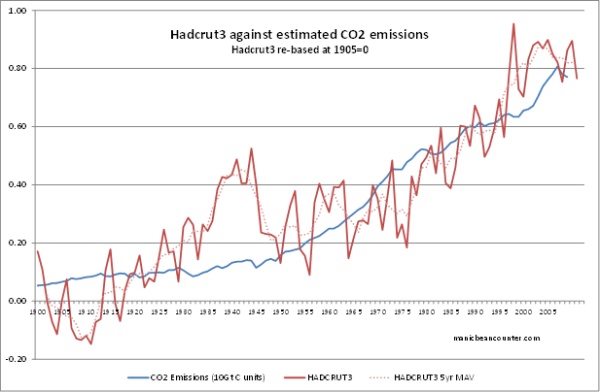
The relationship of CO2 emissions to average temperature is weak

Some time ago I downloaded estimates of national CO2 emissions data from what is now the CDIAC website, then in filled my own estimates for all major countries where there were data gaps, using the patterns of other countries and my knowledge of economic history. This shows steady growth up to 1945 (with dips in WW1, the Great Depression and at the end of WW2) The post war economic boom, the 1973 oil crisis, the recession of 1980-81 and the credit crunch of 2008 are clearly visible. It therefore seems reasonable and not too dissimilar from the increase in atmospheric CO2 levels.


I have charted the growth in human CO2 emissions against the HADCRUT3 data, putting them on a comparative scale. The 5 year moving average temperature increased by around 0.5oC between 1910 and 1944 and 0.6oC between 1977 and 2004. In the former period, estimated CO2 emissions increased from 0.8 to 1.4 giga tonnes. In the latter period, estimated CO2 emissions increased from 4.9 to 7.4 giga tonnes. The period in between the 5 year moving average temperature decreased very slightly and CO2 emissions increased from 1.4 to 4.9 giga tonnes. 1945 and the late 1998 have two things in common – the start of a stall in average surface temperature increases and an acceleration in the CO2 emission rate of increase. On the face of it, in so far as there is a relationship between CO2 emissions and temperature, it seems to be a pretty weak one.

The longer view

The case for claiming human emissions affect temperature is even weaker if you take a longer perspective. Human CO2 emissions were negligable before the industrial revolution, yet there is plenty of evidence that temperatures have shown larger fluctuations in last couple of millennia. Four example are Law Dome, Esper et al 2012, Gergis et al 2012 and the CO2 Science website.

This Law Dome ice cores are the highest quality ice cores in Antarctica.


There seems to be no warming there at all. With 75% of the global ice packs in Antarctica it is fortunate that there is nothing exceptional about Antarctica warming. But maybe the Arctic is different.

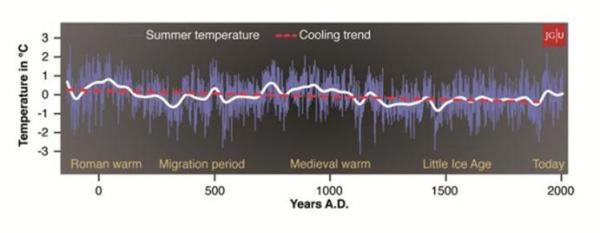
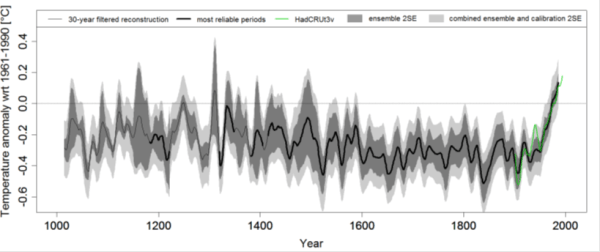
Esper et al 2012, published in Nature, has the following Summer temperature reconstruction for Northern Scandinavia over two millennia.


There is a twentieth century uptick, but only in the context of a long term cooling trend.

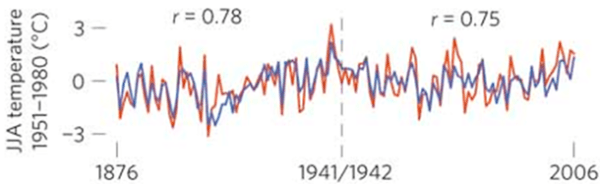
Focussing on the last 130 years shows something at odds with the global position.


The highest temperatures were in the 1930s, just like the record temperatures in the USA. The warming trend from the mid-1970s is still far greater than the global averages, but less than the warming trends in the early twentieth century. It corroborates data that shows recent warming trends are higher in the Arctic than the global average, but also shows claims that there is nothing significant in these trends.

I find the most convincing evidence is from the withdrawn Gergis 2012 temperature reconstruction for the combined land and oceanic region of Australasia (0°S-50°S, 110°E-180°E). This is because it set out with the aim of showing the opposite – that the recent warming was much more significant than anything in the last millennium. Despite breaking their own selection rules for proxies, they managed to only demonstrate that the last decade of the last millennium the warmest by the narrowest of margins. See below.


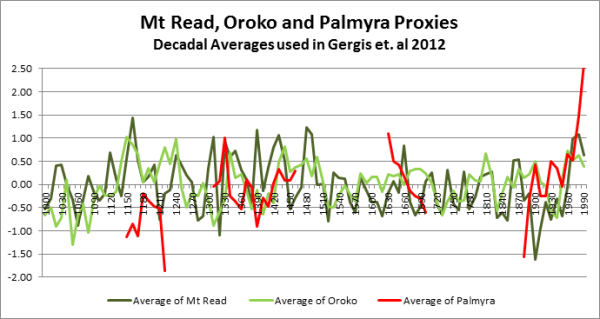
There are many reasons to reject the paper (see here), but one significant point can be illustrated. There were only three reconstructions had any data prior to 1430. There were two tree ring studies from New Zealand, and coral study from Palmyra Atoll. Plotting the decadal averages shows that the erratic Palmyra data suppresses the medieval period and exaggerates the late twentieth century warming. Further, Palmyra Atoll is over 2000 km outside the study area.


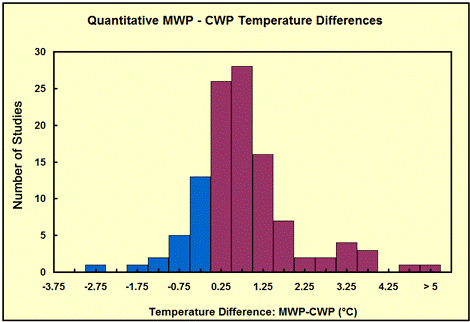
Finally, CO2Science.org specialises in accumulating evidence of the impacts of CO2. It also has a database of studies on the medieval warm period. There is a graph that summarizes the quantitative studies


Figure Description: The distribution, in 0.5°C increments, of Level 1 Studies that allow one

to identify the degree by which peak Medieval Warm Period temperatures either exceeded

(positive values, red) or fell short of (negative values, blue) peak Current Warm Period

temperatures.

In conclusion, on the face of it, there is very weak support for human emissions being the cause of most of the warming in the last century by the fact that changes in human emissions do not appear to move in line with changes in temperature. The case is further weakened by evidence that at times in the last 2000 years were warmer than in the current period. It does not discount the possibility that human emissions are responsible for some of the warming. But demonstrating that empirically would mean understanding and accurately measuring the full extent of the natural processes, then demonstrating that these were not operating as strongly as in previous epochs. By definition, the evidence will be more circumstantial than if there was a direct correlation. Furthermore, the larger the actual human impact the more circumstantial will be the evidence.

Reply to Hengist McStone’s “Climate Truthers and 9/11 Skeptics”

At the Heretics Corner blog of Hengist McStone has a posting “Why can’t we have climate truthers and 911 skeptics?” My comment, which I am about to submit is:-

Your statement that

“running through the heart of climate skepticism is the belief that truth about climate science has been suppressed”

is a new one on me. Major climate sceptic blogs (WUWT, Jo Nova, BishopHill) do not see a hiding of the truth, but that a lot of spurious claims are based on very little evidence and of prophesies that fail to come true. They also point to other ways of looking at the data. They would agree that the public is being misled, but this is about the quality of the science, and ultimately the very definition of what is called “science”.

There is a huge weight of evidence for 911 being an act of al-Qaeda terrorism, with no assistance from the CIA. Similarly there is a huge weight of evidence for millions of Jews being killed in the Holocaust and that the average adult smoking 60 cigarettes a day from age 18 will live a much shorter and unhealthier life than the average adult who never inhales a single lung full.

Analogy with these different strongly-supported propositions can be in three areas. The first is on based on numbers of expert supporters of a proposition. The second is showing that there is similarly very strong evidence. The third is showing that techniques and standards of outside from other areas are utilized.

Use of the first area is attempting to gain credibility by association. The second area would make analogy and name-calling superfluous. The third area is contradicted by claims that only expert climate scientists can divine the real truth.

Perhaps another analogy would help. Suppose that a popular and charismatic celebrity is accused of rape of young children. Despite the overwhelming evidence showing that person’s guilt the accused vehemently denies the charges and many who idolise that person make all sorts of spurious claims about the evidence and the victims. What would be the best course of action?

  1. Dispense with a trial due to the overwhelming evidence, then deny a voice to those who not believing that their idol is guilty, question the evidence. Furthermore, mount a propaganda campaign against “evidence deniers” and “supporters of paedophilia”.
  2. Have a fair trial, even funding the defence, so that people can see the evidence being presented and challenged. If the evidence is overwhelming, the idolizers will be silenced.

I would suggest that the first course of action is taken by those who dogmatic belief in their being right is based upon very little evidence.  Widely applied would undermine people’s faith in the ability of the court system to achieve justice, thereby undermining the rule of law. Widespread practice will result in highly repressive regimes, often with discrimination against sections of the community, in particular anyone who challenges orthodoxy. The second approach might sometimes result in the guilty getting found not guilty on a technicality, or getting found guilty of lesser crimes. But pursuit of the highest standards will win over the doubters and gain support for the rule of law. This is the thinking that led to the development of the trial by jury system in Anglo-Saxon England. If you give people a fair and open trial, then others will trust authority. If you let a ruler or appointed expert divine the truth, then, even when they consistently get decisions right there will be distrust. If they are perceived to get things wrong, or the process is hidden from public view, then distrust will emerge.

In a similar fashion, supporters of climatology are making a massive public relations blunder. Rather than engaging in open debate, and encouraging people to analyse the differing arguments they make false analogies, misrepresent the opponents and discourage people from questioning, or comparing differing points of view. 

James Hansen favouring Richard Lindzen over IPCC

Much has been made of James Hansen’s recent claim in a youtube video that runaway global warming will make the oceans boil. However, people have not picked up an earlier point, where the father of global warming alarmism clearly contradicts the consensus.

In the first minute of the clip, Hansen talks about the impact of ice sheets disintegrating in the polar regions. All this extra cold fresh water decreases ocean temperatures. This, in turn, increases the temperature gradient between the poles and the tropics. This, in turn, increases the strength of storms.

If Hansen looks his own GISSTEMP figures for global average temperatures, he will notice that the warming has been higher is the Artic than in the tropics. According to UNIPCC in 2007, the fastest warming in this century will be in the Arctic. I propose that cooling of the Arctic Ocean will have two effects. First it will counterbalance the most extreme warming of the planet, thereby reduce the total temperature rise. Also it will counter-balance some of the rise in temperatures, so reducing the impact of Greenland ice melt and slowing the reduction in sea ice. Second, it will reduce the impact of extreme storms. If melting ice cools the oceans, it is a negative feedback.


Sources of the boiling oceans comment are:-

WUWT comments 2 and 3 by Eric Worrall

http://carbon-sense.com/ on April 13th 2013

C3 Headlines


China’s Renewable Policy in Context – The Ningxia Example

China has been lauded for an aggressive renewable policy, particularly for wind turbines. When you next hear praise for this policy, consider the example of the Ningxia Hui Autonomous Region in Mid-China. There are wind turbines being developed here, but only in the context of massive industrial development. That primary motive for the industrial development in this area is coal. For instance

Sun Mountain has something China needs very badly to feed the thundering beast of its economy: 14.6 billion tons of coal reserves lying under its rocky, arid desert. There are also 5 billion tons of limestone, nearly 2 billion tons of dolomite, and – a modern touch this – 300 days of wind power per year. But there is no doubt that King Coal, a tyrannical monarch who has devoured land and lives in Ningxia for the past 50 years, rules Sun Mountain. If China is to quench its thirst for electricity and industrial chemicals the old king will be on the throne for many years to come.

The scale of the development is seen from another, 2008, article.

Shenhua Ningxia Coal Industry Company….. has begun construction of a 1000 square kilometer coal-chemical complex in northwest China’s Ningxia province. The 280 billion yuan (40 billion USD) project, located at Ningdong, 42 kilometers southeast of provincial capital, Yinchuan, will include coal production, electricity generation and coal chemicals, including coal to liquid fuel conversion (CTL). (Italics mine)

The coal will be partly used for power generation.

By the time the base is fully operational in 2020 it will have eight power plants with a capacity of 30 million KW.

That is eight power plants in one small region, each bigger than anything in Britain. But why develop coal to liquid fuel conversion?

With China’s crude oil imports rising 12.3 percent to 163.17 million tons in 2007, and the price of oil reaching $140 a barrel in 2008, one of the most keenly watched facilities in the Ningdong base will be its coal to oil conversion plants.

As of 2013, one of these plants is already in operation, and should be producing the equivalent of 70,000 barrels per day (bpd) if the mid-2006 forecasts were correct. The other is being constructed, with a capacity of over 90,000 bpd. Although these two plants will only provide the equivalent of 4% of the 163.17 million tonnes imported in 2007, China has huge reserves of coal. Further, Ningxia is one of just 30 main coal producing areas.

This 2008 article admits to drawbacks of CTL.

Coal liquefaction projects have many drawbacks from the point of view of the environment and resource conservation. Firstly they consume vast amounts of water, which is a huge concern in China’s dry northwest. Fifty-seven percent of the land area of Ningxia is desert. The Ningdong coal-chemical base will draw 100 million tons of water from the Yellow river every year. Secondly, the process of liquefying coal emits much more carbon dioxide than conventional coal fired power stations. When fully operational, the Ningdong base will discharge 80,000 cubic meters of Carbon Dioxide (CO2) per day …….. Finally, while liquefied coal fuels provide an alternative to crude oil, they are not necessarily an efficient use of coal. It takes four to five tons of coal to produce one ton of oil, so coal to oil projects deplete coal reserves much more rapidly than conventional coal power generation.

Therefore, China’s rush into renewables should be seen as just a small part of the general industrialisation of China, whilst minimising dependence on external energy sources. The eco-image, such as support for Earth Day and Kite Tournaments is just to keep the environmentalists from trying to sabotage China’s rush to western levels of prosperity for 1300 million people.

Two Comments on Antarctic Ice Accumulation

Jo Nova blogs on a study that claims the Antarctic continent is accumulating ice mass at a rapid rate. I have made two comments. One is opposing someone who claims that Antarctica is actually losing ice. The other is that the claimed rate of ice accumulation does not make sense against known data on sea levels.

Manicbeancounter

April 17, 2013 at 6:27 am · Reply

John Brooks says

I’m also interested that the mass of antarctic land ice follows solar irradiance. This makes perfect sense. However I can’t see why the effective of an increase in the greenhouse effect wouldn’t have exactly the same result.

Maybe you should look at the period covered by the graph John. There is an 800 year correlation of mass of antarctic land ice with solar irradiance, with the biggest movements in both prior to 1800. Insofar as the greenhouse effect is significant, it is nearly all after 1945.

And for some reason, I’ve got the idea in my head that antarctic land ice is decreasing.

Sure enough from the Carbon Brief link, this quote

Measurements from the Gravity Recovery and Climate Experiment (GRACE) satellite since 2002 have shown that the mass of the Antarctic ice sheet is decreasing at an average rate of 100 cubic kilometres every year – the size of a small UK city.

(emphasis mine)
The size of a city is usually measured in area, not volume. The ancient City of York, for instance, has an area of 272 square kilometres (105 square miles) and a population of 125,000. Or maybe they mean the volume of the buildings in a city? A famous building in New York is the Empire State Building. Not only is it quite tall it also has quite a large volume. Around 1,040,000 cubic metres or 0.001 cubic kilometres in fact. So does the Carbon Brief claim that a small UK city have a volume of buildings equivalent to 100,000 Empire state buildings? Or each average person in a small UK city occupies a building volume greater than Buckingham Palace?
Alternatively, does John Brooks quote a source that does not have a clue about basic maths?

Manicbeancounter

April 17, 2013 at 8:01 am · Reply

I think this paper does not stack up. I worked as a management accountant in industry for 25 years. One thing I learnt early on when estimating or forecasting was to sense-check the estimates. No matter how good your assumptions are, when estimating or extrapolating well beyond the data trend (where there is potential for error), the best check on the data is by reconciling with other data.
From the above

“The SMB of the grounded AIS is approximately 2100 Gt yr−1, with a large interannual variability. Those changes can be as large as 300 Gt yr−1 and represent approximately 6% of the 1989–2009 average (Van den Broeke et al., 2011).”

A gigatonne of ice is equivalent to a cubic kilometre of water. If the land ice volume is increasing, the water must come from somewhere. Nearly all of that water needs to come from the oceans.
Now for some basic maths. A gigatonne is a billion tonnes. As water has a relative density of 1.0, a tonne of water (1,000 litres) is a cubic metre. Therefore a gigatonne of water is a cubic kilometre (1000^3 = 1,000,000,000 = one billion).
A further factor to consider is the area of the oceans. According to my Times Concise Atlas, the total area of the oceans and seas (excluding the enclosed waters like the Dead Sea and Lake Baykal) is 325,000,000km^2. A cubic kilometre of water added to an enclosed sea of one million square kilometres, would raise the sea level by just 1mm (1000mm x 1000m = 1,000,000mm in a kilometre). So 325km^3 = 325Gt-1 of new ice accumulation above sea level in Antarctica would reduce sea levels by 1mm, or 2100GT-1 by 6.5mm.
Some of the ice accumulation will be on ice shelves, so the impact of 2100GT-1 extra ice per annum extra ice might be to reduce sea levels by just 5mm per annum. Also sea levels might be rising by a little less than the 3.2mm a year that official figures claim, but there is no evidence that sea levels are falling. Further, any net ice melt elsewhere (mostly Greenland) is only adding 1mm to sea level rise. So the rest must be mostly due to thermal expansion of the oceans. I think that the evidence for the oceans heating is very weak and of insignificant amounts. Even Kevin Trenberth in his wildest flights of fantasy would not claim the missing heat (from the air surface temperatures) adds more than 1-2mm to sea level rise.
What this study does show is that by honestly looking at data in different ways, it is possible to reach widely different conclusions. It is only by fitting the data to predetermined conclusions (and suppressing anything outside the consensus) that consistency of results can be achieved.

My scepticism on global warming stems from a belief that scientific evidence is strengthened by being corroborated from independent sources. Honest and independent data analysis means that wildly different conclusions can be reached. Comparing and contrasting these independent sources leads me to believe that the public face of the global warming climate change consensus massively exaggerates the problem.

Kevin Marshall