Kyoto Protocol is now dead – DNR

The first stage of the 1997 Kyoto Protocol officially comes to an end today. We should say DNR – Do Not Resuscitate

The underpinnings of the Kyoto Protocol used benefit-cost analysis to achieve a compromise solution. To achieve is goal it needed ALL of the following assumptions to be true.

  1. CO2 causing a massive increase in global warming.
  2. For that warming to have massive catastrophic consequences.
  3. For economic theory to provide a theoretical solution with benefits ≥ costs.
  4. The actual solution matches the theory.
  5. There are no unintended consequences of actual policy implementation need to be taken into account.
  6. That the Kyoto Protocol was originally estimated at being 97% useless in constraining temperature rises.

CO2 causing a massive increase in warming.

If you still believe the hype that CO2 is going to cause a massive increase in global warming, you are now at odds with the latest estimates from the IPCC. David M. Hoffer at Wattsupwiththat shows why.

Massive catastrophic consequences

Where is the evidence of accelerating sea level rise; increasing tropical storms; desertification; accelerating rate of polar ice melt; disappearing Himalayan glaciers causing water shortages; or massively reduced crop yields in Africa leading to famines? Where is all the talk of reaching climate “tipping points”, which must be avoided at all costs? You will not find them in the latest AR5 SPM, because there is no half-decent scientific evidence to support these claims,

Support from economic theory?

William Nordhaus, the world’s leading climate change economist, calculates that the benefit-cost ratio is 1/7. Nordhaus accepts the first two points, but still calculates that on economic terms you should not touch the scheme with a bargepole. More recently, Dieter Helm has described emissions trading schemes as the most expensive way of reducing emissions. Both advocate a carbon tax.

Actual scheme matches theory

Kyoto proposed that countries adopt an emissions trading scheme. In the EU it did not work because credits were issued at too low a cost.

Unintended Consequences

The emissions trading schemes have essentially collapsed, mostly because there has been no commitment to extend Kyoto. Given that there have been numerous fraud scandals from the large through to the small, this is no bad thing. The schemes are open to abuse, yet the investment banks that run them make billions of dollars annually.

Kyoto is Limited

The Kyoto Protocol, if it has been fully implemented would have only constrained a projected 2 celsius rise in CO2 by 2050 by just 0.06 degrees. At the outset policy-makers knew it would be 97% worthless, yet still went ahead anyway.

Continued support for Kyoto must disregard the latest opinions of climate science, economic theory, and the practical problems of public policy-making. Continued support must implicitly support the investment banks to make profits at the expense of ordinary folk, and numerous fraudsters. You must also support a policy that was pretty close to useless at the outset, and now is positively harmful.


Lewandowsky on Radio 4 – missing out basic human psychology

Mike Haseler comments upon the appearance of Prof Stephan Lewandowsky on Radio 4 this week.

Lewandowski is a nasty piece of work who set out to fabricate data using bogus questions by which he attempted to prove sceptics are conspiracy theorists. All he managed to prove is that he is incapable of admitting the poor quality of his work. So, imagine my disgust tonight when I heard the BBC were broadcasting some of his material:

“Why do we continue to believe information even when we are told it’s wrong? Claudia Hammond discovers how the brain stores facts and why we don’t erase erroneous explanations.” (all in the mind)

That section of the program wasn’t very interesting (I fell asleep listening) but having had the misfortune to read the scenario before, the gist of it was that sometimes people will use ideas that they have been explicitly told are wrong showing that most people do not trust academics like Lewandowski.

Obviously that’s not what he intended the result to be.

The scenario given was that subjects were told there was a fire in a barn. They were told oil paints were stored in the barn. They were then told they were not stored in the barn (at which point is anyone going to believe the researcher?). Then they are asked why the fire had thick smoke. Lewandowski is trying to prove “false memories” or some such junk, by showing people still use the information that there was oil paints which they have been told is false. The reality is that what he proves is that very often people don’t believe the information the academics force down their throat and they come up with quite plausible explanations (the smoke was caused by the oil paints the researcher told them wasn’t present) which don’t agree with the “truth” ordained to them by academics like Lewandowski. What this clearly shows is that the general public is more inclined to trust their own ideas of what happened rather than rely on academics like Lewandowski when they are so untrustworthy they can’t make up their mind whether there is or is not paint in the barn.

My comment was

Your point about not believing somebody who has fed you false information is an enormously important part of human psychology. In close relationships, such as with one’s partner or a close friend we trust the other implicitly. If that trust is betrayed – such as a wife finding out after many years of marriage that the husband has a mistress – then it is not easily regained. A lot of distrust in climate science is that when the science gets it wrong, or is found giving false certainties (such as Glaciergate and Climategate), the reaction has not been to confess to error, but to sweep the issue under the carpet, or blame others.

Another aspect is that people tend to trust new information from people that they trust and respect, rather than people that they are prejudiced against. However hard we try to be neutral, people tend to more easily accept the words of the politicians that have their world view, than those of the opposite party. A life-long Tory from Haslemere has similar prejudices to a Labour supporter from Middlesbrough. They would far sooner trust a politician from their party than from the other side.

The problem with Lewandowsky is he fails to understand the problems of regaining trust when it has been breached, but instead tries to create prejudice against those who question his dogmatic views.


Monbiot and BBC – Accusing an innocent man due to a common prejudice?

Boris Johnson has something spot on about Newsnight’s accusing Lord McAlpine of paedophilia in a children’s home. Morally, it is probably today the worst sort of crime somebody could be accused of. Mass murder is not so bad, as long as you have higher motive. Even though it is meant to inspire terror into ordinary peaceful folk, it will not be called terrorism. The BBC will probably point to an excuse that as Newsnight supressed Jimmy Savile’s paedophilia due to sensitivity to Savile’s family, they did not want to fail in their duty for a second time. But there is something more than this, suggested by the Twittering George Monbiot. He was one of two prominent Twitterers to falsely “finger” Lord McAlpine as the culprit. Monbiot is now profusely apologetic, but I would suggest that his knee-jerk reaction was not out of character. It has some commonality with his take on the Gleick affair.

Earlier this year there was “released” a cache of documents from the Libertarian Heartland Institute. Peter Gleick, a dogmatic climate activist and scientist with a passionate dislike of any opposition obtained the documents by deception, and the released them anonymously. Most were innocuous, except for a “2012 Strategy Document”. Gleick was “outed” as the likely leaker, as this document was in Gleick’s peculiar writing style, not the more polished house-style of Heartland. It also contained a number of errors. George Monbiot praised Gleick’s actions as those of a “democratic hero” exposing the secret funding of climate denial by this right-wing think tank. There is no acknowledgement of the piffling size of this funding compared with government and private funding of alarmism and no acknowledgement of the evidence of forgery. Monbiot has no perspective on figures. If a few million dollars of Heartland “denial” is so effective against the billions poured into the science, Heartland should be chock full of internees infiltrated by every major Ad agency and democratic political party on the planet. Further, if there is a dominant, untenable, ideological position, then democracy is endangered not served by those who seek to confront the dominancy, but by those who seek to obliterate criticism. If the vast majority are on the side of the overwhelming truth, then publicity examining falsities can only serve to strengthen the perception of that truth. But, if it is a falsity, then exposing those who speak out to ad hominem attacks and slander is the thuggish way of silencing opposition. This principle is ingrained in the trial by jury system.

The reactions of the now BBC-departed Richard Black were in a similar vein.

What possible bearing can this have on George Monbiot’s judgement of the (false) allegations that Lord McAlpine was a paedophile? Might it be that Lord McAlpine was the former Treasurer (and very effective fundraiser) of the Conservative Party during the Thatcher years have something to do with it? When a tiny think tank can be so effective in sustaining climate denial, is not Lord McAlpine principally responsible for all that Mrs T inflicted on the Britain? And with the BBC culturally inculcated by similar pro-Guardian views, is it not conceivable that their failure to question the evidence might have something to do with McAlpine’s history?

Has Kevin Trenberth Reversed his position on Reversing the Null Hypothesis?

There is an interesting quote from Kevin Trenberth at SciGuy on Hurricane Sandy

It is true that hurricanes normally recurve and head east, especially at this time of year. So we do have a negative NAO and some blocking anticyclone in place, but the null hypothesis has to be that this is just “weather” and natural variability.

(emphasis mine)

Now would this be the same Kevin Trenberth who just 12 months ago was advocating that we reverse the null hypothesis?

“Humans are changing our climate. There is no doubt whatsoever,” said Trenberth. “Questions remain as to the extent of our collective contribution, but it is clear that the effects are not small and have emerged from the noise of natural variability. So why does the science community continue to do attribution studies and assume that humans have no influence as a null hypothesis?”

Has Trenberth now reversed his position on reversing the null hypthosis?

(I linked to SciGuy from Wattsupwiththat)

Comment made at Jo Nova’s Weekend Unthreaded.

Stephan Lewandowsky on Hurricane Sandy

Jo Nova posts on Stephan Lewandowsky’s analysis of Hurricane Sandy. Below is my comment, with the relevant links.

Lewandowsky has a lot to say about the overwhelming evidence for smoking causing lung cancer, but in substance has just this to say about the impending catastrophic global warming.

Trends such as the tripling of the number of weather-related natural disasters during the last 30 years or the inexorable rise in sea levels. Climate scientists predicted those trends long ago. And they are virtually certain that those trends would not have occurred without us pumping billions of tons of CO2 into the atmosphere.

There are 3 parts to this.

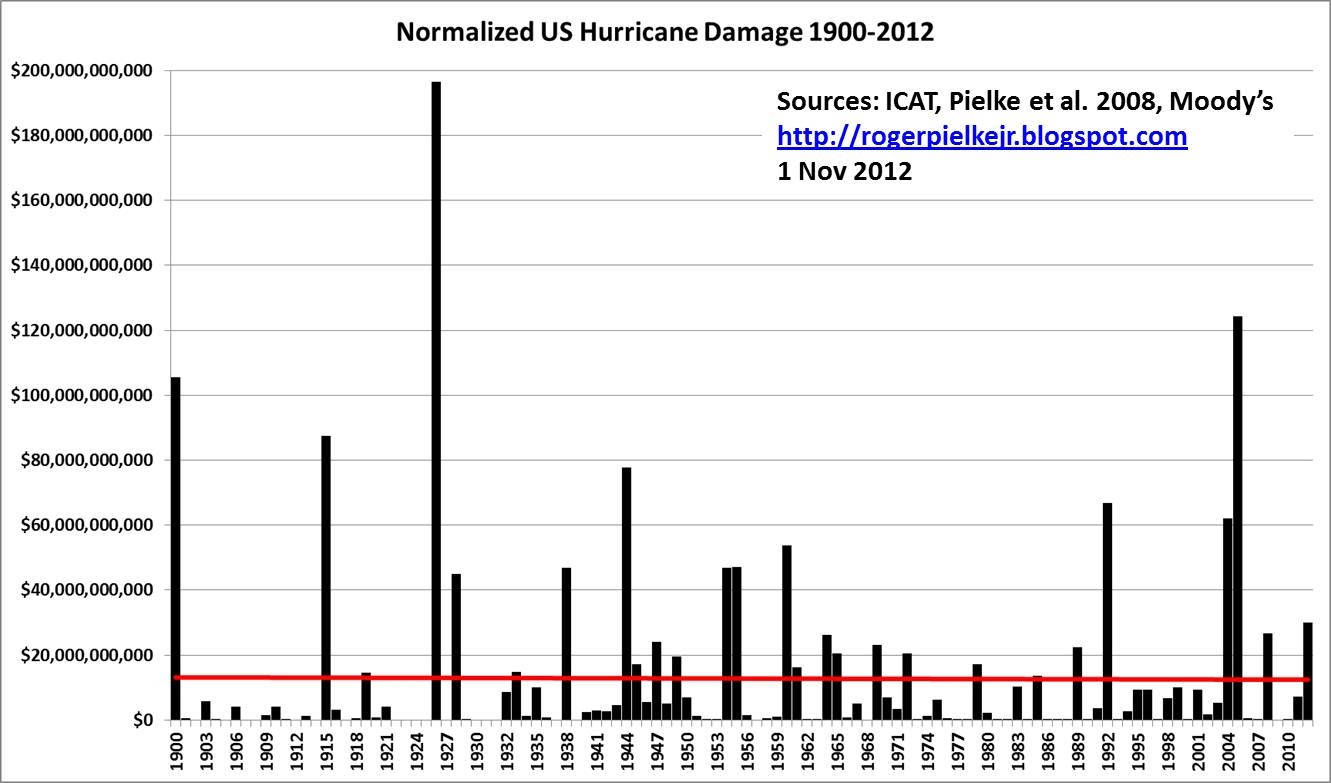
First, the economic analysis of natural disasters is Lewandowsky’s own. He ignores completely the opinions of Roger Pielke Jr, an expert in the field, with many peer reviewed studies on the subject. Pielke Jnr has shown there is nothing exceptional in the normalised cost of Hurricane Sandy. Furthermore, a 2009 report showed that New York is vulnerable to hurricanes, and the shape of the coastline makes it particularly vulnerable to storm surges.

Second, the sea level rise is a trivial issue. From the University of Colorado graph, it is clear that sea levels are rising at a steady rate of 31cm a century.

Third, he claims the predictions of unnamed “experts” have been fulfilled. A balanced analysis would point out that the CO2 levels have risen faster than predicted, but temperatures have not.

Last week I posted a proposal for analysing the costly impacts of global warming. Using the “equation”, I would suggest Lewandowsky overstates both the Magnitude and Likelihood that Sandy was caused by global warming. He misperceives the change in frequency (1/t). Furthermore, given than he has a track record in the highly biased use of statistics in his own field, and his deliberate lack of balance, the Weighting attached to anything he says should be negative. That is, like to newspapers of the Soviet Union, if Lewandowsky claims something, we should read between the lines to see what he does not say. However, unlike the Soviet Union we are still able to look for alternative opinions.


Normalized US Hurricane damage impacts


2012_rel4: Global Mean Sea Level Time Series (seasonal signals removed)

Costs of Climate Change in Perspective

This is a draft proposal in which to frame our thinking about the climatic impacts of global warming, without getting lost in trivial details, or questioning motives. This builds upon my replication of the thesis of the Stern Review in a graphical form, although in a slightly modified format.

The continual rise in greenhouse gases due to human emissions is predicted to cause a substantial rise in average global temperatures. This in turn is predicted to lead severe disruption of the global climate. Scientists project that the costs (both to humankind and other life forms) will be nothing short of globally catastrophic.

That is

CGW= f {K}                 (1)

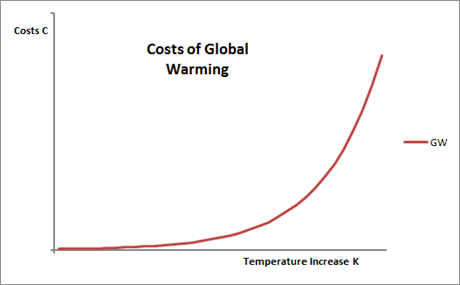
The costs of global warming, CGW are a function of the change in the global average surface temperatures K. This is not a linear function, but of increasing costs per unit of temperature rise. That is

CGW= f {Kx} where x>1            (2)

Graphically


The curve is largely unknown, with large variations in the estimate of the slope. Furthermore, the function may be discontinuous as, there may be tipping points, beyond which the costly impacts of warming become magnified many times. Being unknown, the cost curve is an expectation derived from computer models. The equation thus becomes

E(CGW)= f {Kx}                (3)

The cost curve can be considered as having a number of elements the interrelated elements of magnitude M, time t and likelihood L. There are also costs involved in taking actions based on false expectations. Over a time period, costs are normally discounted, and when considering a policy response, a weighting W should be given to the scientific evidence. That is

E(CGW)=f {M,1/t,L,│Pr-E()│,r,W}    (4)

Magnitude M is the both severity and extent of the impacts on humankind or the planet in general.

Time t is highly relevant to the severity of the problem. Rapid changes in conditions are far more costly than gradual changes. Also impacts in the near future are more costly than those in the more distant future due to the shorter time horizon to put in place measures to lessen those costs.

Likelihood L is also relevant to the issue. Discounting a possible cost that is not certain to happen by the expected likelihood of that occurrence enables unlikely, but catastrophic, events to be considered alongside near certain events.

│Pr-E()│ is the difference between the predicted outcome, based on the best analysis of current data at the local level, and the expected outcome, that forms the basis of adaptive responses. It can work two ways. If there is a failure to predict and adapt to changing conditions then there is a cost. If there is adaptation to anticipation future condition that does not emerge, or is less severe than forecast, there is also a cost. │Pr-E()│= 0 when the outturn is exactly as forecast in every case. Given the uncertainty of future outcomes, there will always be costs incurred would be unnecessary with perfect knowledge.

Discount rate r is a device that recognizes that people prioritize according to time horizons. Discounting future costs or revenue enables us to evaluate the discount future alongside the near future.

Finally the Weighting (W) is concerned with the strength of the evidence. How much credence do you give to projections about the future? Here is where value judgements come into play. I believe that we should not completely ignore alarming projections about the future for which there is weak evidence, but neither should we accept such evidence as the only possible future scenario. Consider the following quotation.

There are uncertain truths — even true statements that we may take to be false — but there are no uncertain certainties. Since we can never know anything for sure, it is simply not worth searching for certainty; but it is well worth searching for truth; and we do this chiefly by searching for mistakes, so that we have to correct them.

Popper, Karl. In Search of a Better World. 1984.

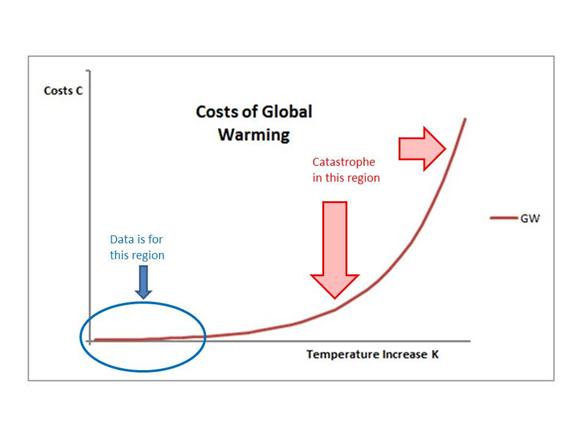
Popper was concerned with hypothesis testing, whilst we are concerned here with accurate projections about states well into the future. However, the same principles apply. We should search for the truth, by looking for mistakes and (in the context of projections) inaccurate perceptions as well. However, this is not to be dismissive of uncertainties. If future climate catastrophe is the true future scenario, the evidence, or signal, will be weak amongst historical data where natural climate variability is quite large. This is illustrated in the graphic below.


The precarious nature of climate costs prediction.

Historical data is based upon an area where the signal of future catastrophe is weak.

Projecting on the basis of this signal is prone to large errors.

In light of this, it is necessary to concentrate on positive criticism, with giving due weighting to the evidence.

Looking at individual studies, due weighting might include the following:-

  • Uses verification procedures from other disciplines
  • Similarity of results from using different statistical methods and tests to analyse the data
  • Similarity of results using different data sets
  • Corroborated by other techniques to obtain similar results
  • Consistency of results over time as historical data sets become larger and more accurate
  • Consistency of results as data gathering becomes independent of the scientific theorists
  • Consistency of results as data analysis techniques become more open, and standards developed
  • Focus on projections on the local level (sub-regional) level, for which adaptive responses might be possible

To gain increased confidence in the projections, due weighting might include the following:-

  • Making way-marker predictions that are accurate
  • Lack of way-marker predictions that are contradicted
  • Acknowledgement of, and taking account of, way-marker predictions that are contradicted
  • Major pattern predictions that are generally accurate
  • Increasing precision and accuracy as techniques develop
  • Changing the perceptions of the magnitude and likelihood of future costs based on new data
  • Challenging and removal of conflicts of interest that arise from scientists verifying their own projections

    Kevin Marshall

Electric Cars – toys of the rich, subsidised by the masses

Joanna Nova reports on a new study showing that electric cars produce more CO2 that either petrol or diesel cars if that electricity is produced principally from coal-fired power stations.

The most practical electric car

In Britain there is more a market for electric vehicles, but still puny sales. The European Car of the Year is the Chevrolet Volt, which has a 1.4 petrol engine to accompany the electric motor. At £29,995 it costs 50% more than a similarly-sized Ford Focus diesel, even with the £5,000 government subsidy. In fact, it is more than a similarly-sized Audi, BMW or Mercedes and will not last nearly as long. If you look at the detail, the Volt has a claimed CO2 emission 27 g/km, as against 99 g/km for the best diesels. This takes no account of the CO2 emissions from the power stations. In Britain electricity is mostly from gas, with much of the rest from coal and nuclear.

There is also a question of equity. Domestic electricity has a 5% tax added on. Diesel has over 120% added. So the cost for 100 km (using official figures and 15p per kwh + 5% vat) is £2.66 for the Volt and £6.00 for the equivalent diesel car (combined 67.3mpg and £1.43 per litre). But tax is £0.13 and £3.30, so most of the cost saving is in tax. In the UK the average is 12,000 miles or 19,300km per year. So the tax saving from driving the Volt is up to £610 per annum. Although if you travel that distance per annum there will be a number of long distance journeys. Let us assume half the 12,000 miles is on the petrol engine at 50mpg, with petrol at £1.38. Then the annual tax saving drops to just £70.

The biggest saving for electric car owners is in London, with the congestion charge. Drive 5 days a week for 11 months of the year into London, and the conventional car owner will pay £2,750 a year. Drive an electric car or hybrid and the charge is zero.

So what sort of people would be persuaded to buy such a device? It is the small minority who have money for at least two cars, but want to appear concerned about the environment. They have the open-top sports car for summer days, the luxury car for long journeys, and the Volt for trips to the supermarket or to friend’s houses. It is the new form of conspicuous consumption for the intelligentsia, making the Toyota Prius so last year.

The least practical electric car

Launched this year the Renault Twizy is claimed to be about the cheapest “car” available today. As a car it is also by far the smallest available as well, being more a quadricycle, with no proper doors. The cost is kept low by not including the battery which is rented for at least £48 a month. As the Telegraph concludes, it is an expensive toy. My 12 year old son said he would love one when he saw it in a car showroom recently. But he would soon regret it if he was transported to school in it every day, instead of riding on the top-deck of a bus. At least if his dad forgot to plug it in, it would be small enough for him to push.

The Role of Pivot Tables in Understanding Lewandowsky, Oberauer & Gignac 2012

Summary

Descriptive statistics, particularly in the form of pivot tables enable a bridging of the gap between the public pronouncements and the high level statistical analysis that can only be performed by specialists. In empirically-based scientific papers, data analysis by spread sheet enables the robust questions to be asked by the non-specialist and the expert reviewer alike. In relation to Lewandowsky et. al 2012, it highlights the gulf between the robust public claims and the actual opinion poll results on which it is based.

Introduction

In a blog post “Drilling into Noise” on 17 September, Stephan Lewandowsky (along with co-author Klaus Oberauer) makes an interesting comment

The science of statistics is all about differentiating signal from noise. This exercise is far from trivial: Although there is enough computing power in today’s laptops to churn out very sophisticated analyses, it is easily overlooked that data analysis is also a cognitive activity.

Numerical skills alone are often insufficient to understand a data set—indeed, number-crunching ability that’s unaccompanied by informed judgment can often do more harm than good.

This fact frequently becomes apparent in the climate arena, where the ability to use pivot tables in Excel or to do a simple linear regressions is often over-interpreted as deep statistical competence.

Now let me put this in context.

    The science of statistics is all about differentiating signal from noise. This exercise is far from trivial:

A more typical definition of statistics is

Statistics is the study of how to collect, organize, analyze, and interpret numerical information from data.

So Lewandowsky and Oberauer appear to seem to have a narrow and elitist interpretation.

“it is easily overlooked that data analysis is also a cognitive activity.”

Lewandowsky and Oberauer are cognitive scientists. They are merely claiming that this is within their area of competence.

Numerical skills alone are often insufficient to understand a data set—indeed, number-crunching ability that’s unaccompanied by informed judgment can often do more harm than good.

Agreed – but that implies that what follows should demonstrate something unique, they can only be gained by higher level or “scientific” analysis.

This fact frequently becomes apparent in the climate arena, where the ability to use pivot tables in Excel or to do a simple linear regressions is often over-interpreted as deep statistical competence.

I have not found pivot tables used before to analyse data in the climate arena. Nor have I seen simple linear regressions. The heavyweight statistical analysis from those who dispute the science has centred around one person – Steve McIntyre. In fact, to my knowledge, the first instance of when pivot tables were presented are primary analysis by sceptics was when I published my analysis

I would quite agree that pivot tables are not a replacement for deep statistical analysis. But it has role. My analysis using pivot tables, published on 1st September has a number of things which I identified independently which are not brought out in the original paper. These I present below. Then I will suggest how the reporting in the mainstream media might have been somewhat different if they had seen the pivot table summaries. Finally I will make some suggestions as to how the low level statistical analysis can contribute to relating to more “scientific” statistics.

Analysis using pivot tables

How Many Sceptics?

When I first glanced through the paper at the end of July, I wrote

It was an internet based survey, with links posted on 8 “pro-science” blogs. Five skeptic blogs were approached. As such, one would expect that “pro-science” responses would far outweigh “denialist” responses. I cannot find the split.

On obtaining the data, this was what first looked at. In the posting I looked at the 4 Climate Science questions, classifying into acceptors and rejectors (“denialist”) of the science.
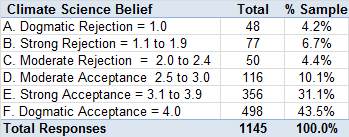

Or summarising into 3 categories
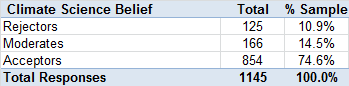

Those who dogmatically rejected every question were outnumbered more than 10 to 1 by those who dogmatically accepted. Those who accept the science comprise three-quarters of the respondents. Most people would believe this to be material to a paper analysing those who reject the science.

NASA faked the moon landing|Therefore (Climate) Science is a Hoax

This is the beginning of the title of the paper. Pivot tables are great analysing this. The row labels are “Climate Science Belief”, the columns are CYMoon, and under “∑ values” enter the count of another column of values.

After a bit of formatting, and three more columns of simple formulas, I got this.
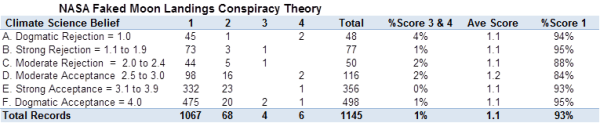

Just 10 out of 1145 respondents agree that NASA faked the moon landings. (I was not the first to publish this result. Anthony Watts piped me by a few hours.)

Strictly this is a claim against the “Climate Change” conspiracy theory CYClimChange and CYMoon. I did this table as well


Of the 64 who strongly accept that the climate change conspiracy theory, just 2 also strongly accept CYMOON. Even worse the title is the other way round. So the sample of those who believe NASA faked the moon landings is just 10. The sample size was just too small to make a prediction. Even worse, you could make the wrong result due to the next issue.

Identification of scam responses

One test was to look at the average agreement to each of 12 conspiracy theories that were independent of the climate area. So I rounded the average response to the nearest whole number for each respondent. And then did a pivot table.


I believe I was the first to identify publically the two that averaged 4 on the conspiracy theories and rejected the climate science. These are the two that Steve McIntyre has dubbed “Super-scammers”.

The biggest conclusion that I see is that the vast majority of respondents, no matter what their views on climate, don’t have much time for conspiracy theories. In fact, if you take out the two super-scammers, the most sceptical bunch are the group that dogmatically reject climate science.

This is confirmed if you take the average conspiracy score for each group.
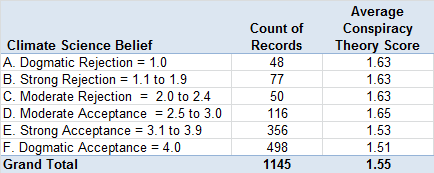

Taking out the two super-scammers brings the average for the dogmatic rejectors from 1.63 to 1.49. With such small numbers, one or two outliers can have an impact on the data.

Measuring up against the public perception

There were two major newspaper articles that promoted the

The Guardian article on 27th July started

Are climate sceptics more likely to be conspiracy theorists?

New research finds that sceptics also tend to support conspiracy theories such as the moon landing being faked

Even a paper such as the Guardian, which prints all sorts of extremist dogma in denigrating sceptics, would have thought twice about publishing that comment if they had been presented with the tables.

The Telegraph article of 28th August included

“NASA faked the moon landing – Therefore (Climate) Science is a Hoax: An Anatomy of the Motivated Rejection of Science”, was based on a survey of more than 1000 visitors to blogs dedicated to discussion of climate change.

An astute reporter, on the basis of my pivot tables, could reasonably ask Professor Lewandowsky how it follows from just 10 respondents who support the idea that “NASA faked the moon landing” that you can make any sort of prediction about beliefs about climate. The questionnaires were placed on climate blogs, not conspiracy-based blogs, so surely any prediction should be framed the other way round?

It also included

The lead researcher, Professor Stephan Lewandowsky, from the University of Western Australia, said conspiracy theories are the “antithesis to scientific thinking” and those who believe them are more likely to reject the scientific consensus that humans contribute to climate change.

“Science is about weeding out bad ideas,” he told The Daily Telegraph. “With conspiracy theories, you start out with a theory and stick to it no matter what the evidence. So it is not that surprising that conspiracy theorists would not accept scientific propositions … If the scientific evidence is overwhelming and you don’t like the conclusion, you have to find a way to reject those findings.”

An astute reporter, on the basis of my pivot tables, could reasonably ask why Professor Lewandowsky is still sticking to his hypothesis when such small numbers support the wacky conspiracy theories. They may then ask a supplementary question. Given that there were 15 questions on conspiracy theories (14 with results reported), and just 5 on free markets, was not the original purpose to establish the conspiracy theory hypothesis and the secondary one on political orientation?

Suggestions for the Role of Low Level Statistical Analysis

In summary, whilst would quite agreeing that spread sheet analysis using pivot tables are not a replacement for deep statistical analysis there are a number of ways where it can be a powerful aid.

Firstly, it is a quick way of getting a sense of what the data is suggesting. Pivot tables can enable a quick summary visually in lots of different ways. It may need additional classifications, such as my acceptors / rejectors. It also needs thought, and an almost a manic sense of trial and error.

Second, it can give a quick comparison to what is being derived from the higher level statistics or modelling. For scientists it is a way of reviewing the data, to make sure that they have the most important points, and have not gone up blind alleys. For non-scientists (and for those scientists reviewing the work of others) it is a way of quickly getting a sense of whether the conclusions are substantiated by the empirical evidence.

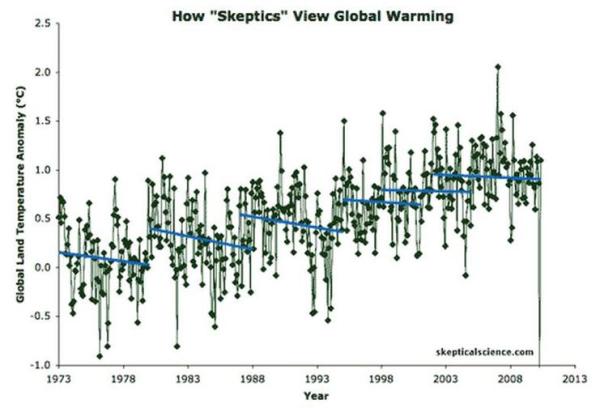
Thirdly, and most importantly, it is a means of communicating to the wider public. It provides a bridge between the mainstream media and the scientists. If climate scientists want to win the trust of the wider public, then they need to relate their work in more intelligible terms, capable of being cross-examined. Instead we have the high level models and a then lot of shouting about how wrong and biased are any criticisms. That leads to a lot of scientists, including Lewandowsky, who are totally incapable of perceiving that they could be wrong, or that there could be even modicum of truth in what the critics say. This denial is best summarized in the graphic displayed in the Lewandowsky and Oberauer posting of the “skeptics” view on recent warming trends. It is a total misrepresentation, used as a means of avoiding intelligent discussion.
 

Kevin Marshall
A Reply to Lewandowsky’s sideswipe

In looking analysing the data on the Lew et al paper I made the following comment.

If you sample some of their articles, you will find a dogmatic defence of climate change, and blocking, editing or denigration views that are contrary to their own. The claim in the paper that they contacted five sceptical blogs to improve the spread of views is highly suspect. Jo Nova contacted 24 such blogs (including all the most prominent ones), with not a single one remembering such an approach. Prof. Lewandowsky is currently refusing to divulge the names of the blogs contacted. As there was no proper control of the answers, there could be rogue results generated.

It turns out that Prof. Lewandowsky’s assistant Charles Hanich did contact 5 “skeptic” blogs with requests. These requests were either ignored or rejected with little or no thought nearly two years ago. On his blog Stephan Lewandowsky stated

At this juncture one might consider a few intriguing questions:

1. When will an apology be forthcoming for the accusations launched against me? And how many individuals should now be issuing a public apology?

To explore the magnitude of this question we must take stock of public statements that have been made about my research. For example, one blogger considered it “highly suspect” whether I had contacted any “skeptic” sites.

It troubled me greatly this comment. Why had I failed to trust the word of a professor of psychology? A science which I have never studied? I will not give excuses, but give the reasons that were going through my mind at the time.

Firstly, I was prejudiced against Prof. Lewandwosky. I had first heard of him in relation to the Peter Gleick affair. This was when a so-called scientist impersonated someone else to fraudulently obtain documents from the Heartland Institute. He was “outed” because the key document – which was fabricated – was in the style of Peter Gleick. Yet, Lewandowsky’s believed Gleick’s lying to defend “science” was on the same moral plane as Churchill’s lying to deceive Hitler. Further, he accepted Gleick’s statement that he was sent the forged document in the post. In my eyes that was a choice between strong circumstantial evidence and the statement of a self-confessed liar. Also, for Gleick, admission of fabrication might be a far more serious crime, than his claim to receiving something in the post gullibly accepting it as genuine. So whatever the truth, there might be motive for an additional lie. Further, I do not believe that climate denial is as evil as Nazism. In fact I happen to believe that the term “climate denial” is a vicious smear.

Secondly, my prejudices were further exaggerated when I came across a climate opinion survey at “Watching the Deniers” blog. I not only answered this opinion survey, but recorded the questions and commented upon them. When I saw the Lewandowsky paper, with the some of the same questions on free markets and conspiracy theories, I erroneously thought that this was the same questionnaire. In fact, the questionnaire I answered is probably a later development of the survey behind the Lewandowsky paper. Looking at the actual questionnaire, my comments can be applied to the earlier and shorter survey.

Thirdly, I saw the paper and read the opening paragraphs. I see Lewandowsky’s belief (and the climate scientists as being) along the lines of climate scientists are the experts with PhDs, and are in strong agreement. I believe that far from the strong foundation sufficient to declare anyone who disagrees a motivated denier of the truth.

Fourthly, I am also prejudiced against using psychology to declare that critics sub-normal after reading in the 1980s about the abuses of psychiatry in the Soviet Union, to consign dissidents to mental institutions. Or the arguments the KGB put forward to dissidents of how they could possibly disagree with the huge consensus. Maybe this is an analogy that Lewandowsky will cry foul as one who knows the subject, but this is the honest truth.

Fifthly, I then looked at the data. I found a number of misleading statements in the paper, including the small minority of skeptic responses; the fact that the typical respondent wanted little or anything to do with any conspiracy theory not related to climate. In the extreme case of the “NASA Faked the Moon Landings” referred to in the title only 10 responses out of 1145 responses agreed with the proposition. Further, the two dogmatic rejecters of climate science I identified (before Tom Curtis) as being likely scammed. In other words, the dogmatic conclusions rested on little or no evidence.

My conclusion was this. Prof. Lewandowsky believes it is alright to lie and smear opponents in his “noble” cause. He has issued a highly prejudiced survey to verify a hypothesis that those who reject what he believes are nutters. He then failed to get a decent sample of skeptics and then failed to filter out the rogue responses. When the vast majority of responses failed to verify his hypothesis, he used the small differences in the minority who believed in conspiracy theories to support his dogmatic conclusions. Yet those could be accounted for by scam responses.

On the basis of all this, I had completely lost trust in any statement that Lewandowsky and his mates wrote. I believe I had more than sufficient grounds for suspecting that he had lied about contacting sceptical blogs.

What this leads me onto is something that Lewandowsky has completely missed. The claim is that we should trust climate scientists, as they are the experts.

But what happens when you betray that trust? Let me give three cases.

1. A business fails to deliver on time and what was specified. Then digs themselves into a deeper hole be making excuses and telling the customer that if they have not broken the small print of the contract. After such an experience would the customer ever trust that business again, even if dealing with a different department or people?

2. Somebody was wrongly convicted of murder due to misinterpretation of the evidence by experts, or tampering of the evidence by the police. After this is exposed, there is no action taken to release the innocent party or to stop these events occurring again. What would happen to people’s trust in the judicial process?

3. After twenty years of marriage, one of the partners sleeps with another. What happens to the trust in the marriage if the guilty partner then makes excuses, including blaming the other?

Betrayal of that trust will lead to the betrayer being viewed in a completely different light by the betrayed party. The betrayed now questions every statement and every motive. Once you have lost people’s trust, it is very hard to regain that trust – a point that Dale Carnegie makes in “How To Win Friends And Influence People”. Shifting blame, or failing to acknowledge fault, will only make matters worse. Yet this is what the climate science community has being doing for years. Look at the skeptic blogs and you will find lots of reasons for questioning the science. Some are valid, some are less valid. It is by a group of people that has, with multiple reasons, lost trust in the “science”. The response of the scientists is to call them names, question their motives and (if you look at the skepticalscience blog) provide feeble and biased excuses. By not acknowledging that differences of opinion are possible, or that the science is weak, or that misinterpretations are possible, they are destroying the trust people have in science.

In short what Lewandowsky has completely missed is that people reject the “science” because of lack of trust in scientists, for reasons that they believe in. His actions and those of climate scientists are just exacerbating the rift between the climate science community and people who live in the real world.

Final Note

I am not a scientist. But I have a degree in economics and worked for over 20 years in industry as a management accountant, mostly within the manufacturing sector. I am a Christian, who believes that people are fallible. That is human beings are prone to error, whether by design or by failing to perceive whether they are wrong. I am certainly fallible. In fact, my best work has often by analysing figures in different ways, wasting my time going up blind allies, learning and eventually getting to better solutions. But I strongly believe that those who believe themselves to be the most infallible are those who are usually the most wrong.

I have used an anonymous handle for various reasons, including that people who support “science” think that is alright to make unsubstantiated character assassinations against those who question them.

Kevin Marshall

Lewandowsky et al. 2012 MOTIVATED REJECTION OF SCIENCE – Part 5 the Missing Links

Jo Nova has now provided the first full list of the survey questions used for the Lewandowsky, Oberauer & Gignac paper, along with a well-written summary. However, there are a number of elements that need to be emphasised

  1. If “climate denial” is on a par with “holocaust” or “smoking” denial, why not start by referencing the clearest statement of the evidence, rather than past opinion surveys? That is, if direct evidence is available, why resort to hearsay evidence?
  2. But if opinion surveys are used, then they should at least be good ones. But the primary references are Anderegg, Prall, Harold, & Schneider, 2010 (Most climate scientists believe in what they do) and Doran & Zimmerman, 2009 (97% of climate scientists = 75/77 cut from >3000 responses).
  3. Even so, surely the association with NASA Moon Landings was correct? After all, the title is “NASA faked the moon landing|Therefore (Climate) Science is a Hoax: An Anatomy of the Motivated Rejection of Science.”
    Not when 93% of all respondents gave it a firm thumbs down.
  4. When Lewandowsky says over >1100 responses, and only talks about those who “reject the science”, it surely implies that all (or at least the vast majority) of responses were from the people he is attacking? Actually, around 15% of responses were from skeptics, in terms of answers to four “climate science” questions. Professional polling organisations in the UK state these figures. But a scientific journal seems not to have insisted.
  5. There are loads of conspiracy theories. But one of the most popular in recent years is something like “Climate denial only exists as a serious force due to significant funding by oil and tobacco interests.” Lewandowsky and his junior partners cannot have missed that one.

The basic psychology behind this can be found in “The Debunking Handbook” on the front page of the skepticalscience website. Here is the justification for lying, ad hom attacks and continued government grants to a failed research program. They know the truth, and are claiming a monopoly of that truth. But to legitimately claim a monopoly it is necessary to show the corollary. The corollary is that every person who disagrees with you is wrong on everything. In empirical sciences this leaves no gap for different interpretations from the same data; no gap for the unexplained; no gap for hypotheses or assumptions to be falsified; and no gap for new data contradicting old data or forecasts. Lewandowsky’s opinion poll applies the truth in the “The Debunking Handbook” to justify one version of climate science having a continued monopoly by showing that opponents are a load of undesirable nutters. It is not just full of gaps. Like past claimants to the throne of dictators of truth, he is more wrong than his detractors.

But if you do not have a monopoly of the truth in climate science, what is the alternative? What if there is a potential future threat, which is very real, but for which there is very little firm evidence? A tentative proposal will be the subject of my next posting.