The Full Case for Climate Change Action

Have just reposted a posting by Willis Eschenbach at “Watts up with That”. Eschenbach contends what is lacking in the AGW argument is not just a coherent scientific case. It is also the proper verification and defence of the science. Predictive failures are ignored, and critics vilified.

I made the following comment on the blog.

Might I point out that you have left out a couple of stages?

It is necessary and but not sufficient to

1. Show a strong probability that extra-normal global warming will occur.

2. That if such warming occurs, that it will have catastrophic consequences – with likely impacts in extent and in place.

At this point the Climate Scientists pass the problem over to the economists.

3. Even, if you accept the disaster scenarios, there is no policy available that will contain CO2 at 2 or 3 degrees of further warming, without imposing greater costs on humanity that impose greater costs on humanity than the worst case scenarios. However, some will say that Stern solved this problem and showed this was theoretically possible. However, it was one that would work by hitting the poorest hardest.

4. Even if you accept that a mitigation policy is theoretically possible, it will only work if every country contains their emissions. If the rapidly growing countries, especially China and India, do not contain their emissions then the emissions- cutting of the West will be of no effect. Further, if the policies to not fall into Stern’s maximum cost of $80 per tonne of CO2 saved (The IPCC’s is much lower), then the policies are doing more harm than good.

So there are four stages of this justification – Forecast, consequences, policy and implementation. It is only the first two that the climate scientists have some competency.

Just because a doctor diagnoses a new condition does not give him the instant insight into the cure, nor the ability to know the dosage or the side-effects of any new medicine.

I hope to post a graphical explanation of the AGW case in the coming days or weeks.


Unequivocal Equivocation – an open letter to Dr. Trenberth (via Watts Up With That?)

This is a hard-hitting post that shows the Global Warming Catastrophy does not rely 1) on a simplistic analysis of warming in the past thirty years or so. 2) A demonstration in a lab that CO2 can cause a greenhouse effect. 3) That all extreme weather is attributable to the climate disruption caused by this warming.
Instead it relies on verifying a number of hypotheses, and sustaining them against criticism. Please see the following post as to what it leaves out.

Unequivocal Equivocation - an open letter to Dr. Trenberth New articles appear below this one, which is top posted for a few days. This essay from Willis appeared on WUWT overnight Saturday while I slept. After reading it this morning, I decided to make it a sticky at the top of WUWT (I also added the open letter reference) because it says everything that needs to be said about the current state of affairs in climate science and the skeptic position. I ask readers not only to read it, but to disseminate … Read More

via Watts Up With That?

BBC Horizon gives a one-sided explanation of temperature

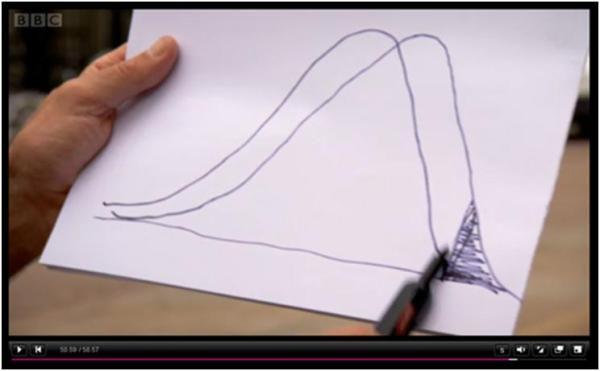
I saw the Horizon programme last night on “What is One Degree?” Ben Miller returned to his physicist routes to explain why a small rise in global temperatures is significant. There was some interesting science, but it fell apart towards the end when it came to explaining how one degree is significant. Using shifts in a binomial distribution curve it was explained that

“You only have to move the average temperature up a bit for the number of stinking hot days to become much more frequent.”


What was not explained was the implication for the other end of the distribution. The number of extremely cold days will become much rarer. For Britain, where snow is fairly infrequent, it could easily become a thing of the past. The cold spell twelve months ago, and December being the coldest in the 352 years that the Central England Temperature Record has been in existence are simply not possible. Especially at the Met Office were repeating this forecast just twelve months ago.

Before you get all skeptical, there is something that salvages the global warming case. The scientific consensus has long stated that climate change will disrupt the planetary weather systems. Therefore, the distribution of temperature will not just have a peak that will shift to the right, the distribution will also broaden. It may broaden sufficiently that there could be more extreme cold weather than extreme hot weather events. Along with this there will be more extreme weather events like hurricanes, tornados, flooding and droughts.

The problem with this is that the prediction of more hurricanes has not occurred. The 2010 season was one of the quietest on record. The forecast drier climate in Queensland seems to have gone a bit adrift as well.

In analyzing our extremely varied climate, whether British or Global, one has to look for instances that contradict out hypotheses as well as confirming instances. Otherwise you get a distorted picture of what is actually happening, and an exaggerated view of the human influences.

Prof Nordhaus forgets some basic Economics

Wattsupwiththat today carries a summary of William D. Nordhaus’s latest paper on climate change policy. The paper “The architecture of climate economics: Designing a global agreement on global warming” is published at the Bulletin for the Atomic Scientists here.

The basic economic fundamental for any policy is to have a net welfare improvement. Therefore in designing this policy, there should be a reasonable expectation that benefits will outweigh the costs. Prof. Nordhaus simply looks at the improvements to be made from switching from cap and trade (per Kyoto Agreement) to a carbon tax. Not just any carbon tax, but one that is uniform throughout the world.

Nordhaus claims that people should face the social costs of their activities. A carbon tax provides four strong incentives:-

First, it provides signals to consumers about what goods and services produce high carbon emissions and should therefore be used more sparingly. Second, it provides signals to producers about which inputs (such as electricity from coal) use more carbon, and which inputs (such as electricity from wind) use less or none. It thereby induces producers to move to low-carbon technologies. Third, high carbon prices provide market signals and financial incentives to inventors and innovators to develop and introduce low-carbon products and processes that can eventually replace the current generation of carbon-intensive technologies. Finally, and most subtle of all, the use of carbon pricing provides simple, straightforward information that market participants need to undertake each of these three tasks. Of course, placing a market price on carbon use will not work magic.

As a means of making consumers use fossil fuels more sparingly, taxes on fuel are highly inefficient. With no close substitute (at least in cost) for fossil fuels (whether for transport, domestic fuel and light, or industry) rises in price are highly inelastic with respect to demand. That is why in the UK, it is a great way of raising tax revenue – you can raise with impunity without major fall-off in demand. Prof Nordhaus can check this out from the effect on demand to the rising price of oil.

As for making producers move to non-carbon sources of power, it is mostly being driven by government policy. The costs of wind and solar power are still far beyond those of fossil fuels and prone to supply problems. For instance, the recent extreme cold in the UK was accompanied by weak sunlight (it is winter with less than 8 hour days) and virtually no wind.

The incentives to producers to switch to alternative energy sources are already there from the high oil price. It has more than tripled in price in less than a decade. The marginal impact of increases energy prices through taxes will be small, if not insignificant.

The fourth is just a combination of the three. It is only a reason if the word “subtle” is replaced by “insignificant”.

The disadvantages of a carbon tax

What Nordhaus does not look at are the disadvantages.

  1. Carbon Tax is regressive within countries. Those who will have to give up cars and foreign holidays and suffer lower heating and lighting in their homes are the poorest. In Britain, where death rates already surge in cold weather, this will be exacerbated.
  2. A carbon tax works by providing a stark choice – you either reduce energy consumption (and reduce your standard of living) or see your living standards fall in other areas. Without
  3. For many in the poorer, but developing countries, aspirations will be dashed. Economic growth is closely related to increase in energy usage per capita. In India and China with rapid economic growth, hundreds of millions of families will be aspiring to cars, foreign travel, washing machines, refrigerators and warmer (or air conditioned) homes. To control CO2 emissions means denying them these opportunities for many years. This is not just making them less affordable. It is also through slowing those high rates of economic growth. For these people – 40% of the world population – this welfare loss will be far greater than anything that runaway global warming can engender.
  4. A uniform tax is ludicrous. In the UK of the £1.23 per litre I last paid for petrol ($7.30 per US gallon of gasoline) over 50% was in taxation. Yesterday the VAT went up 2.5%, adding another 3p per litre. In the USA it is much lower. In Brazil, diesel is restricted to goods vehicles only and carries no tax. In Iran fuel is subsidized. In the UK (and much of Western Europe) a uniform tax would lead to a reduction in tax in an area where you want to reduce emissions most, whilst achieving large emission reductions in some of the poorest, but developing countries.
  5. Society bears the costs of individual consumption externalities. You should compensate the losers whilst punishing the polluters. But to do this efficiently you need to first identify the losers and the gainers from CO2 emissions. Who will lose from the consequences of climate change is purely speculative.


Prof Nordhaus’s mistake is only to look at the advantages of a Carbon Tax over Cap and Trade. He does not look at improving the situation on having no policy at all. He ignores the poor, proposing a policy that will deny the aspirations of billions. Further, he does not take into account the political dimension. The democratic and rich countries will not vote for a policy that can only be effective by significantly reducing their living standards. In Western Europe, this is further exacerbated by most studies showing climate change will do little harm, or be of slight benefit. In China, constraint on CO2 emission growth will also strongly constrain economic growth, which will probably cause political turmoil. Yet without China and other emerging economies buying into CO2 constraint, then Western CO2 reductions are in vain. See a talk by Roger Pielke Jr.

However, Prof Nordhaus recognizes that non-participation costs are very high for achieving emissions targets

ASI on the Minimum Price for Alcohol

Uncharacteristically, the Adam Smith Institute has made a serious error in its economic analysis. The idea of alcohol being a Giffen good is certainly a contestable one. There are a couple of pertinent areas here. The first is whether alcohol in the UK meets the requirements of a Giffen good. The second is whether the pattern of discounting is such that installing a minimum price will create the Giffen good conditions.

The Conditions for a Giffen Good. (Descriptions here and here)

  1. A staple on which people spend a significant part of their income.
  2. Applies to the very poor.
  3. There are no close substitutes

The current state of play in the UK market.

1. The major supermarkets concentrate their promotions on premium brands. Most of the promotions for cider & beer are for premium brands. The wine promotions similarly are mostly for the more expensive (& often branded) varieties. Own brand (especially the budget brands) are less frequently and less deeply discounted.

2. Many promotions do not involve a gross loss for the supermarket. By allocating space for high volume promotions a small gross margin can generate a larger net profit than the full price low turn product. It is all about overhead absorption.

3. Promotions made more profitable by promotional & volume discounts from the suppliers.  As I regularly shop at more than one major supermarket I notice similar promotions across different supermarkets.

4. Many promotions are partly spurious. For instance I recently noticed a bottle of standard Cava at half price. The full price would significantly more the vintage variety. Or compare the undiscounted price per litre for large packs of beer with the smaller pack sizes. You will find the “undiscounted” price is often more expensive, indicating the discount is exaggerated.

5. Many people pay the top prices at clubs and pubs in city centres. Cheaper prices are obtained at local pubs (known as bars in the USA & on mainland Europe). Much cheaper still is the supermarket. So for English bitter beer, you pay £5 per pint (568ml) in a club in town centres, £3.50 in a local pub, £2 equivalent for a 500ml bottle, £1.40 for a 4 pack cans and £0.99 for the best offers of 3 x 8 440ml can packs. Therefore, there are many close substitutes without change of brand, though the quality and ambience may not be the same! Higher prices lead to the next best substitute, which is why many choose to drink at home, or on the street, rather than in the more sociable public houses.

6. The UK is a rich country. In spending power (purchasing power parity) is at least 35 times richer than in 1750 (or modern day Ethiopia). In nominal terms at least 200 times richer. Someone on the minimum wage with the proverbial wife and two kids, will have in excess of £1200 per month disposable income. If an alcoholic drinking the cheapest booze – 3 litres of 6% cider (at £1 per litre) a day, they would spend just 10% of their income on booze. At 70p per unit minimum (10ml of pure alcohol) they would see this rise to a third of income. This is the most extreme case. In practice, most problem drinkers consume less and do not get the cheapest alcohol from the cheapest source. There are opportunities for substituting to cheaper forms of alcohol and reducing other forms of consumption.

In its flawed analysis the ASI actually understates the case against the minimum price of alcohol. Any proposed level of pricing would simply be ineffective in reducing alcohol consumption.  It will merely serve to hasten the decline in pubs and drive people down market. Most of the discounting in supermarkets is aimed at getting consumers to move up market, where the larger profits reside. The only effective levels of seriously reducing alcohol consumption would be far above the bounds of political acceptability.

Volokh Conspiracy on VAT in USA

Volokh Conspiracy posts on the proposals to introduce VAT into the USA here.

The essence of the post is that VAT is hidden, so it makes it easy to creep up revenues. Therefore it will not serve to reduce the phenomenal deficits of the USA, but  increase government expenditure. As the cousins over the pond are inexperienced in the workings of VAT, I made two comments.

The first was that VAT (at least in the UK ) encourages the black economy, gives opportunities for fraud and is often a tax on tax.

There are a couple of big issues with VAT here in the UK, that the US should be aware of. (NB the rate is 17.5%, soon to rise to 20%)
1. Small businesses do not pay VAT. The current threshold for registration is around $90,000. Therefore sole traders have a big advantage over larger businesses for decorating, plumbing etc. Due to this cost advantage (on top of avoiding around 35% marginal tax rates for self-employed up to $60,000 per year), the black economy is large. VAT exposes people to the fly-by-night rogues.
2. The UK has a large amount of trade with other EU nations. The Intrastat scheme for dealing intra-state VAT is open to fraud. Criminal gangs have made $m’s through carousel fraud. See http://en.wikipedia.org/wiki/Missing_trader_fraud
3. VAT is charged on other taxes. In the UK the current price of gasoline is GBP 1.13 per litre or $6.60 per US Gallon. With VAT at 17.5%, $1 is VAT, and around 60c is VAT on around $3.20 of excise taxes.

There are a couple of big issues with VAT here in the UK, that the US should be aware of. (NB the rate is 17.5%, soon to rise to 20%)
1. Small businesses do not pay VAT. The current threshold for registraton is around $90,000. Therefore sole traders have a big advantage over larger businesses for decorating, plumbing etc. Due to this cost advantage (on top of avoiding around 35% marginal tax rates for self-employed up to $60,000 per year), the black economy is large. VAT exposes people to the fly-by-night rogues.
2. The UK has a large amount of trade with other EU nations. The Intrastat scheme for dealing intra-state VAT is open to fraud. Criminal gangs have made $m’s through carousel fraud. See http://en.wikipedia.org/wiki/Missing_trader_fraud
3. VAT is charged on other taxes. In the UK the current price of gasoline is GBP 1.13 per litre or $6.60 per US Gallon. With VAT at 17.5%, $1 is VAT, and around 60c is VAT on around $3.20 of excise taxes.

On a comment on how wondering how to calculate the average rate of of tax, pointed out it was irrelevent. In theory the accounting is simple. In practice it is enormously complex.

jmaie, although I do not like VAT, the accounting treatment is quite simple. For any business, they charge VAT on sales and pay VAT on purchases.
It is the detail that creates a mindfield of complexity. The effective rate is superfluous.

The following is for the tax accountants and the insomniacs:-

If VAT is 10%, for a $1000 net sale the entries are CR Sales $1000, CR VAT payable $100, DR Accounts receivable $1100.

For a $500 purchase, then DR purchases $500, DR VAT reclaim $50, CR Accounts payable $550.

The business then pays $100 — $50 = $50 in VAT.

In theory the system is simple. With basic accounting software filling in a VAT form takes 15 minutes a month. The effective rate that is paid is therefore irrelevant.

The complexity comes with the exceptions. In the UK we have zero rate; VAT exempt; (One businesses can reclaim VAT on the purchases the other they cannot); non-reclaimable (e.g. business entertainment); and special rates (especially 5% for domestic gas and electricity).
Indeed, a supposedly simple tax has help manuals about as long as for income tax. So I would expect the accountancy firms in the USA are privately backing VAT introduction.

The Myths of Green Jobs – from the Classical Economists and a Beancounter

The Adam Smith blog posts (here) on the seven myths of green jobs (by the Policy Network). They are useful as a criticism, but more fundamentally the classical economists gave a rebuttal over a century ago.

From Adam Smith, you get increased prosperity from division of labour. Localism reduces the division of labour, thus reduces the wealth of nations

From David Ricardo this is augmented with the idea of comparative advantage. Trading nations gain advantage by specialisation in areas where they have a comparative advantage. Green economics ignores this. (Mises applies this concept to the labour markets. Low productivity, green, jobs will be created at  the expense of high productivity, conventional jobs.)

From Alfred Marshall there is concept of opportunity costs. In evaluating a measure you should not only look at the benefits of a choice, but the alternatives forgone. Green jobs will be creating, but at the expense of conventional, higher productivity jobs along with higher taxes.

From Karl Marx, you should look at the distribution of the national pie. Green jobs will only be created by forcibly reducing non-green industries. This enforced tendency towards monopoly will increase the profits accruing to the bourgeoisie, at the expense of the working classes. Given that the rate of return on Capital has fallen dramatically over the past two decades, is the Green Movement just a puppet of a degenerate Capitalist Class?

But as a (slightly manic) Beancounter, the economist’s arguments pale into insignificance beside a project management issue. In a major project, if you have no dynamic concept of how to control and continually reduce costs, or a clear idea of how to achieve objectives, along with ridiculing of any questioning of the attainability of the objectives –  then you have a recipe for massive cost overruns, and benefits failing to be achieved on a massive scale.  In the UK, the NHS computer system, the Scottish Parliament and the New Deal for jobs were all massive policy failures for these reasons. But they all pale into insignificance beside the global attempt to stop global warming by reducing CO2 emissions. Not just the scale, but also the lack of clarity as well.

(Roger Pielke Jnr’s recent talk is instructive on the perspective here)

The Division of Labour & Climate Science Part 1

Bishop Hill displays to an excellent short video at TED by Matt Ridley, encapsulating the concepts of the division of labour and comparative advantage. One thing that Matt Ridley leaves out is the creative destructiveness of competition through supplanting the existing order. Specialisation leads to new products and processes. By implication, the established processes and products are overturned. (Joseph Schumpeter needs to be added to the list of Adam Smith and David Ricardo)

It is not just in the sphere of production that these concepts apply. It is also with empirical science, be it economics, medical research or climatology. With complex data and many facets to the subject, there is scope for division of labour into

–         Data collectors,

–         Data analysts & measurers,

–         Statisticians to validate the analysis,

–         Theoreticians to innovate or create new ideas.

–         Mathematicians, to provide tools for analysis.

–         Methodologists, to provide structures of meaning and assess the boundaries of science.

–         This is alongside the general sub-divisions of the subject, which may change over time.

–         Alongside greater specialists there is also scope for generalist assessors who get a total perspective of the corpus of knowledge, weighing up the status of competing ideas.

–         Academic competition (to gain status) leads to improvements, but can also lead to diversity in conclusions. It also tends to blunt the conclusions where data is ambiguous or fuzzy.

This makes things a bit messy. In economics there has ceased to be any dominant schools of thought or policy prescriptions. But in climatology we are lucky to have the IPCC, which divides the world into a small group of generalist experts (who agree their main conclusions) and the masses, who accept the wisdom handed down. A bit like the guild system, that kept England in the Dark Ages.

Keeping ahead of China and India

John Redwood is comments that the Chinese and Indian economies will soon be larger than those of The EU or USA. The high growth rates, coupled with their huge populations means that this will happen quite soon. I believe that if the most advanced nations are not to stagnate they must accelerate the advance into higher value-added activities*.

 The government’s role in this should be, at minimum, to refrain from hampering the creativity and the flexibility that this requires. Further it should provide a structure to enhance the comparative advantages that the UK enjoys. For example, in no particular order:-

 1. In learning. Britain is probably second in the world (behind the USA) for attracting foreign students. For the size of population, we lead the world in world-class universities. The government should encourage/enable the universities to build upon this. Our comparative advantage is that we are the home of the English language, the World’s second language.

2. In Finance. Sorting out a proper structure for banking regulation that will both prevent the build-up of systemic risk, whilst at the same time encouraging/enabling future innovation. The apparent contradiction between these two aims is best resolved by emphasising general all-encompassing principles, rather than the detailed rules of the American’s or the detailed form-filling that was key feature of the last decade.

3. In Climate Change. The current aims to reduce CO2 emissions by 80% by 2050 are totally unrealistic. The attempts to do so will only serve to make Britain’s poorer and fail to meet our growing energy requirements. Roger Pielke Jnr explains why here.

* It is usual to say that higher productivity per person is required. From that tautologous statement the National Income = National Output, the way to increase income per person is to increase output person. As working time tends to decrease, more that 100% of this must come from higher output per unit of time. That is, greater productivity. However, the way to increase the income of a business is to increase the margins. The output of a university is not in the raw number of published papers, but the rare papers that create a seismic shift in out knowledge. In finance, it is not the quantity of deals done, but the large deals that create the most profit. For these reasons, I prefer the term more value-added rather than productivity as the driver of increased income per capita.

Why Electric Cars Cannot Pay

In the Sunday Times of  1st August, Jeremy Clarkson does a review of BMW Mini E – an electric test car. (In Gear Pages 15 & 16).

He concludes that  electric cars are something that cannot be achieved – simply because they are too expensive, too short a range, and we have not got the electrical capacity.

There is another reason. We would decimate out public finances. Clarkson estimates that topping the Mini E up with standard rate electricity would cost £4, compared with about £12 for a standard Mini Cooper, or around £10 for a 60mpg diesel for 104 miles.

Now consider the exchequer impact. The £4 of electricity carries 20p of tax (VAT at 5%). The tax on petrol or diesel is about 60%, so £7.20 for petrol and £6.00 for diesel. The net loss for a typical 10,000 mile per year motorist is in the order of £650 – plus the road tax loss of around £100 or more.

If just a million car users switch to electric – 3% of the total – then the loss is around £750m per annum.

 Will motorists actually go for these savings? Not if they look at the total costs of ownership. The life of the batteries will be less than the 100,000+ miles that you expect from a modern engine. Current lithium ion might give you about 300 charges, or 30,000 miles in the Mini E. With the cost maybe £6,000 per pack (for simplicity), that would add 20p per mile to costs – equivalent to annual costs of £2,000 per year. The servicing may cost a bit less (no engine, but still all the other mechanical bits like brakes, tyres, etc.), but overall the cost of ownership.

Therefore, it will only be a small minority who will buy these cars – probably the richer end of the Prius set. Alternatively, the government will step in to subsidise the battery pack. So the middle class conspicuous consumers will be subsidised by the, poorer, users of internal combustion engines.

Finally, will this save the planet within Lord Stern’s criteria cost of £80 per tonne of carbon? Let us assume somebody swaps their standard small car with 130g/km of carbon with the zero-emission car. At 10,000 miles per year, that is a saving of 2 tonnes of carbon IF the electricity comes from zero-emission sources. The net cost to society is going to be at least 10 times that, so it fails the economic test as well.