Keynes, Hayek and Global Warming

Jo Nova points to the excellent Keynes versus Hayek rap videos and compares with global warming views. My own observations are more to do with the nature of theory.

To compare Keynes & Hayek, I believe that we need to separate Keynes from the mainstream Keynesians. Keynes saw theory as a means to get the policy he wanted. It was the Keynesians (starting with John Hicks’ IS-LM analysis) that started the modelling approach. Both Keynes and Hayek eschewed the mathematical modelling of modern economics. In this Keynes would be closer to the perspective of GLS Shackle than Keynesians

  1. Keynes saw the economic system as being essentially unstable. There was no tendency for the economic system to tend towards an optimal equilibrium. Rather it could get stuck for long periods with high unemployment. This seems to parallel to the notion of tipping points. The Keynesian multiplier The parallel in CAGW theory can be seen in the positive feedbacks and tipping points. When Bob Carter says that climate is homeostatic (or Warren Meyer at climate-skeptic uses his ball in a bowl illustration), they criticize the climate models for being Keynesian. I would think that the Carter/Meyer view of climate is similar to that of Hayek on economic phenomena. Climate is essentially chaotic, having only general empirical regularities. However, it has tendencies towards equilibrium. Please note that Hayek occupies a position close to Keynes this issue. Walrasian General Equilibrium with perfect knowledge and instantaneous leaps from one equilibrium to another is an extreme caricature of more mainstream economics. Here Keynes v. Hayek is more apt for the views on climate.
  2. Keynesians view all the essential features of the economic system as being essentially knowable, capable of being reasonably represented in mathematical models. Hayek calls this a “pretence of knowledge” (the title of his Nobel Prize lecture), as although we may know essential features of the system, the relationships are highly complex and changing. The problem is not just lack of measurement, it is having data that is capable of being modelled in order make manipulation of these variables possible. In economics, the manipulation is control of macro economy. In climate, it is to control the global average temperature.
  3. Keynesians believe that a few major measures are sufficient to describe an economy. CAGW theorists believe that the global surface temperature and atmospheric CO2 are key measures. Hayek questioned whether such variables were meaningful. CAGW theorists are on much shakier ground than the Keynesians here. Bob Carter points out in his book that the stored heat in the atmosphere is a tiny fraction of that stored in the oceans. When it comes to stored CO2 the problems are even greater.

But when it comes to the rhetoric of global warming, the analogy should not be with Keynes, but with Karl Marx. Climate models give true scientists perfect insight into the real nature of climate. Those who are on the outside are delusional and/or are either knowingly, or subconsciously, acting as lackeys of the oppressive class. In Marx the oppressive class are the bourgeois, in climate alarmism they are Big Oil.

British-Irish Council taken over by Climate Alarmists?

The Irish Times has carried a report that

THE BRITISH government could massively subsidise the Irish wind energy industry under proposals to be considered in London today.

Would that be the same British Government who are struggling to control a record budget deficit? A Government that presides over a territory which is in many parts extremely windy. Where would these windmills be located? The proposal would be offshore. So the UK is a short of coastline then?

Who put forward this proposal? The famous British-Irish Council. Their website is here.

And here is a screen-shot of that homepage.

It strikes as a little odd that the website should be hosted in Jersey. Or if you do a Google search you will find lots of references to renewable energy and the Isle of Man. Promoting the minor islands and wind power would be a major part of its’ purpose then?

To quote the website

Priority areas of work

At its first summit in London in December 1999, the council decided on a number of priority areas of work which would benefit from such co-operation. While the list is not exhaustive, it includes:

  • agricultural issues
  • health
  • regional issues
  • consideration of inter-parliamentary links
  • energy
  • cultural issues
  • tourism
  • sporting activity
  • education
  • approaches to EU issues
  • minority and lesser used languages
  • prison and probation issues

    So that would be a no then.

    It would seem that the original purpose of the British-Irish Council has been lost and that the organisation has been taken over by some Climate Alarmists from the Isle of Man, Jersey or Scotland. Perhaps the Council is no longer fit for purpose.

    Update

    The actual meeting in London was full of the wind issue. See the Irish Times and BBC Wales.

CAGW – Paralleling Kuhnian Science or New Labour Spin?

A review of Montford’s “Hockey Stick Illusion” suggests that it is an example science described by Thomas Kuhn in “The Structure of Scientific Revolutions”. Both the Hockey Stick in particular, and CAGW theory in general, I believe parallel something entirely different.

Catastrophic AGW theory is not an example of Kuhnian science. It was swallowed whole by the political establishment without going through the strictures of scientific acceptance. Furthermore, it is coupled with a major political policy objective – to constrain CO2 emissions. The IPCC was then set up to confirm and fortify the science and the policy. CAGW is thus not a proper science as such, but “politicised science”.

The Hockey Stick is the major example of this – a public relations ploy to promote policy and direct attention away from proper analysis of the data. The shenanigans may have milder and more short-lived parallels in other fields of science, but better parallels are to be found in New Labour Spin. That is, never admit to error; talk over opponents and view them as self-evidently wrong; deflect adverse comments by saying something different; deflect criticism and error by making an easily answerable point the major issue, or conceding a minor point; and then quickly moving the discussion onto safer ground. Most of all rely on image more than substance. In the case of CAGW, make peer review and agreement with collective experts the ultimate demarcations between science and non-science.

NASA excludes an inconvenient figure on 2010 Temperatures

The NASA Earth Observatory has a nice graph to show average global surface temperatures.

I noticed a small anomaly with the 2010 figures. The blue line, for the British Hadley Centre, appears to be missing.

You can check this by downloading the HADCRUT3 data set from here. Popping these figures into an Excel graph I get the following.

Excel even defaulted to the correct colour! The 2010 average temperature anolmaly on this data set is .468, as against .474 in 2005 and .529 in 1998. This is significant in that the NASA GISS figures show 2010 to be the warmest year on record, something that was pre-announced by leader James Hansen before the year was half way through. Try Googling 2010 Warmest Year on record to see the number of hits. But inclusion of the HADCRUT figures refutes the headline. Statistically it may not be significant, but the headlines show that politically it is important. It is the difference between the claim that global warming stopped in 1998, and that it is continuing.

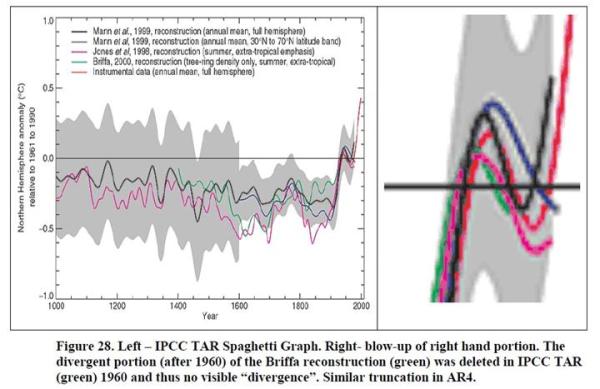
There is previous form in the climate community, as Steve McIntyre has noted. McIntyre has the following graphic (at page 28 of McIntyre, S. 2008b. How do we “know” that 1998 was the warmest year of the millennium?. Ohio State University Seminar, may 16, 2008.)

As Steve McIntyre states

“In the IPCC Third Assessment Report, they did worse than simply ignoring the problem.

They deleted the declining portion after 1960, thereby giving a false sense of coherence

between the proxies. In AR4, as a reviewer, I asked them to restore the deleted portion.

They refused saying that showing this information would be “inappropriate” (See


IPCC WG1 chapter 6 29 Review Comments) and the downward late 20th century portion

of the Briffa et al 2001 reconstruction was once again deleted in IPCC AR4.”

Prof Nir Shaviv Presentation

A couple of blogs (Bishophill and Jo Nova) direct you to a short 30 minute presentation by Prof Vincent Courtillot. The proceeding presentation by Prof. Nir Shaviv on cosmic ray theory, though more technically advanced, is worth a look, especially if you compare the strength of his argument with the IPCC greenhouse theory.

For the non-scientist, the Shaviv thesis of solar changes explaining the 20th century warming episode is better than the IPCC greenhouse theory as

  • Has some corroborating evidence to suggest that cosmic rays are affecting the climate, with the extent.
  • Has a simple computer model that explains most of the twentieth century warming. In particular the two similar periods of warming from 1915 to 1940 and 1975 to 1998, and the pauses are all modelled quite well. Using Occams Razor  (the most succinct hypothesis, or that which needs the fewest assumptions), it beats the anthropogenic greenhouse gas theories. Alternatively, it is a better fit of the data, as AGW only fits the later warming. The early 20th century warming can only be explained by predominantly natural factors.
  • Is happy flicking between the decadal time-scale that he is trying to explain to geological time scale of hundreds of millions of years and then to the influence of solar flares that last a few days. Neither does he have problems with natural variations.

The IPCC greenhouse gas models do have a number of models that concur. But this can be explained that they have similar assumptions and assumptions behind them. Indeed, given the strong coherence it is a weakness that they have such a wide variation in the data. The IPCC

  • Lacks corroborating evidence, particularly of the tropical tropospheric hotspot.
  • Relies on computer models are highly complex, rely on a two-stage process (see note below), and have many ad hoc adjustments.
  • Yet these computer models that do not tie in very well with the data. To explain the lack of warming in the 1945 to 1978 period and post 1998 you have to resort to an ad hoc inclusion of aerosols. The early-twentieth century warming, so similar empirically, has to have a different explanations.
  • Greenhouse gas theory is uncomfortable with looking beyond the twentieth. It cannot explain the medieval warm period, hence the amount of backing for the infamous hockey stick which suggests the twentieth century warming was unusual. Neither can it explain the other natural fluctuations in the current inter-glacial.

An opposite view that Shaviv’s work is insignificant can be referenced at Sourcewatch, a highly pro-AGW site. They state

“While he does believe the earth is warming, he contends that the sun’s rays, rather than human produced CO2, are the cause. But a 2009 analysis of data “on the sun’s output in the last 25 years of the 20th century has firmly put the notion to rest. The data shows that even though the sun’s activity has been decreasing since 1985, global temperatures have continued to rise at an accelerating rate.”

There are counters to this is that Sourcewatch is speaking about the wrong thing. Shaviv contends it is cosmic rays emanating from elsewhere in the galaxy that affect cloud cover and by this means temperature. Solar winds (determined by solar activity) heavily influence the levels of cosmic rays reaching the earth. A much smaller influence is the solar variability. Shaviv shows the following slide (at 17 mins) to show the difference in his measured magnitudes.

Note on IPCC Climate models

The IPCC climate models do not just rely on greenhouse gases directly impacting on the temperature to generate global climate catastrophe. This was nicely summarized by Prof Richard Lindzen in his Congressional testimony of November 17th 2010. (Full pdf here, Warren Meyer comments here)

  1. A doubling of CO2, by itself, contributes only about 1C to greenhouse warming. All models project more warming, because, within models, there are positive feedbacks from water vapour and clouds, and these feedbacks are considered by the IPCC to be uncertain.
  2. If one assumes all warming over the past century is due to anthropogenic greenhouse forcing, then the derived sensitivity of the climate to a doubling of CO2 is less than 1C. The higher sensitivity of existing models is made consistent with observed warming by invoking unknown additional negative forcings from aerosols and solar variability as arbitrary adjustments.

Biofuels – a policy that is killing the poor

The GWPF reports on a new paper by Indur M. Goklany, Ph.D. that estimates the biofuels policy may be causing 200,000 additional deaths a year. This is compared to the 141,000 deaths (on a like by like basis) that WHO claims may be attributable to climate change.

This paper understates the comparison as the biofuels estimates are many times more robust than the climate change deaths estimates.

The biofuels element is a direct relationship. As real income increases above $1.25 per day, the quantity of food that people can buy increases. From mostly a subsistence existence people can trade. Variety and calorific value of food increase. Also constancy of food supply is assured as a rapidly shrinking portion is reliant on the local harvest. Push up the real cost of food rapidly and this virtuous growth cycle is reversed.

The aspect of Global Warming comes from page 72 of the WHO World Health Report 2002.

“Climate change was estimated to be responsible in 2000 for approximately 2.4% of

worldwide diarrhoea, 6% of malaria in some middle income countries and 7% of dengue

fever in some industrialized countries. In total, the attributable mortality was 154 000 (0.3%)

deaths and the attributable burden was 5.5 million (0.4%) DALYs. About 46% this burden

occurred in SEAR-D, 23% in AFR-E and a further 14% in EMR-D.”

The global warming element comes from

  1. Looking at other elements and relating the impacts to temperature and climate volatility empirically.
  2. Measuring accurately recent temperature record to show increases in temperature. The warming in recent years may have been overstated due to failure to adjust for the urban heat island effect and possible biases in the calculation.
  3. Correctly relating this a proportion of this warming to anthropogenic factors. If it is overstated, then so is the justification for policy to mitigate the climatic effects of that warming.
  4. Accurately measuring the impacts of warming on the climate factors such as floods, droughts, sea level rise, extreme heat waves etc.

If any of these issues are overstated individually, then they can significantly reduce the relationship. But compound and they make the global warming deaths insignificantly different from Zero. For instance the relationship between temperature and malaria is highly controversial and has been dismissed. This might be 10% of the deaths. If the recent rise is only 0.3 degrees, rather than 0.4 degrees, then the mortality impact will reduce more than proportionately. If half the temperature rise due to anthropogenic factors, then it more than halves the impact. Most importantly there is the influence on climate variability. If extreme weather has not increased due to global warming – for instance the hurricane impacts were based on insurance claims rather than increasing frequency and intensity of storms (they may be decreasing), then some of the factors are decreased. Let us give a minimal impact of each of these impacts. Linking each of the elements to climate change could reduce of the attribution by 10% to >90% (say 60%). Measurement actual AGW reduces by 20% to 60% (say 40%). Weather variability due to AGW is highly suspect due to separation from the highly variable natural variability, so the will reduce the attribution by 50% to >100%. Take this as an 80% reduction. The compound effect on attributable deaths is 154,000(100%-60%)(100%-40%)(100%-80%) equals around 7,400. In other words, it is statistically insignificant.

On the other hand there is no mention of the most direct and beneficial impact of increasing greenhouse gases on the health and well-being of the poorest. Higher CO2 levels are directly related to increased plant growth rates and biomass. That means increased agricultural productivity for free.

The later 2003 WHO report “Climate Change and Human Health – Risks and Responses” used this report’s findings, but had plenty of hidden warnings. For instance the final conclusion was

“The increasing trend in natural disasters is partly due to better reporting, partly due to increasing population vulnerability, and may include a contribution from ongoing global climate change.”

Finally, one must consider that if the global warming estimate is accurate, it is not an either/or comparison. Current climate change policies will not achieve a significant reduction in CO2 levels. So the poor will be hit with extra deaths from both sources.


Quote on Openness in Government

The Bovine Spongiform Encephalopathy (BSE) Inquiry, United Kingdom

“Our experience over this lengthy Inquiry has led us to the firm conclusion that a policy of openness is the correct approach. When responding to public or media demand for advice, the government must resist the temptation of attempting to appear to have all the answers in a situation of uncertainty. We believe that food scares and vaccine scares thrive on the belief that the Government is withholding information. If doubts are openly expressed and publicly explored, the public are capable of responding rationally and are more likely to accept reassurance and advice

if and when it comes.”

Quoted on page 40 of the WHO World Health Report 2002. (Here)

This seems to be also pertinent to the Climate Science in general and the UNIPCC in particular.

The BSE Inquiry Report details

http://www.cabdirect.org/abstracts/20002219667.html;jsessionid=42B120D8A52B9E491149695EB22E4EEB

Abstract

The inquiry was set up in 1997 to: establish and review the history and emergence and identification of BSE and variant CJD in the UK and of the action taken in response to it up to March 1996; to reach conclusions on the adequacy of that response; and to report the findings to relevant ministries. The resulting report documents in detail the development of two new diseases, one of cattle that devastated the British cattle industry (more than 170000 animals affected) and another that has caused the deaths of more than 80 people so far. The report identifies several shortcomings in delayed responses and lack of rigour in implementing measures. Poor coordination between health and agricultural departments and bureaucracy impeded prompt responses. The cause of the epidemic was identified as the inclusion of meat and bone meal in ruminant feed. Despite the banning of specified bovine offals in ruminant feed in 1990, cattle born after this date still contracted the disease, probably through cross contamination of feed with feed destined for non-ruminants. The report makes compelling reading for all those who have followed the epidemic. It is available from The Stationary Office (http://www.thestationeryoffice.com/bse/) in print (#325 for the complete boxed set of 16 volumes [ISBN 0105569860]; or #29.50 for Volume 1: Findings and Conclusions [contains a CD-ROM of the full text of the report; ISBN 0105569704]), on CD-ROM (#235 which includes the full text of the report on Disc 1. Discs 2-12 include all the witness statements, transcripts, SEAC and ACAF documents and other supporting documents; ISBN: 0105569879), or can be freely accessed on the Internet.

Sir John Houghton to Clarify Climate Change

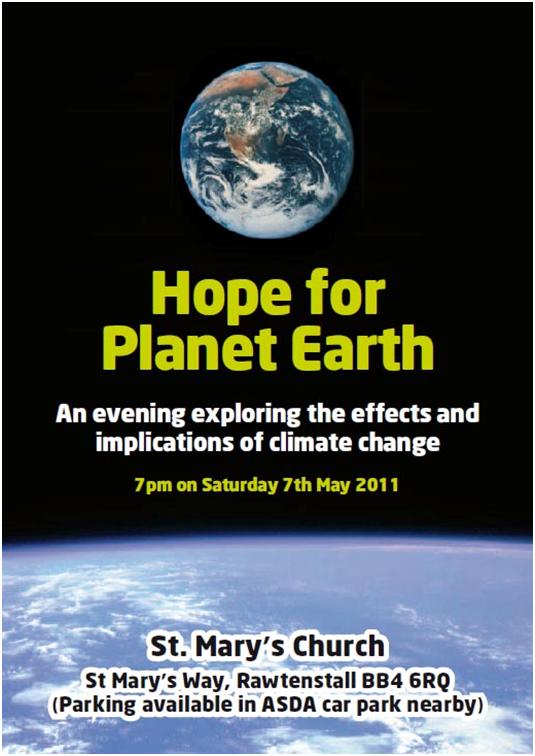
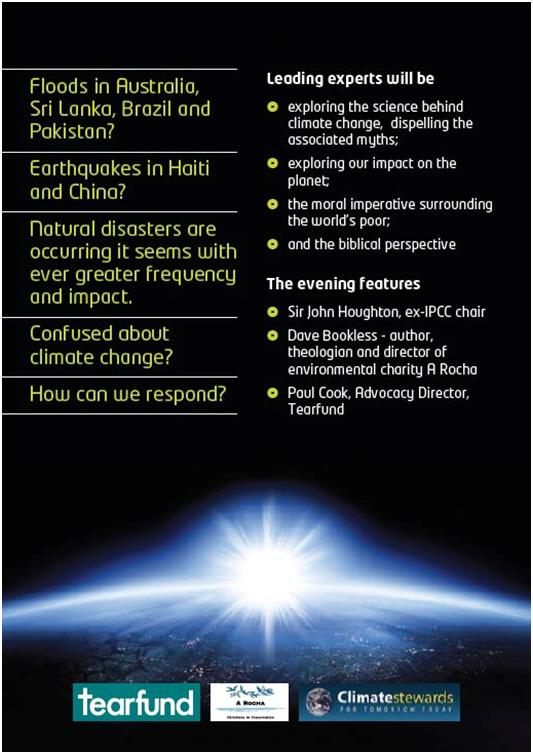
For those who reside in the North-West of England, I would like to direct them to what may be a very informative event on 7th May. Sir John Houghton, ex-IPCC Chair, will be talking about climate change in Rawtenstall on 7th May. Also speaking will be Dave Bookless – author, theologian and director of Christian environmental charity A Rocha and Paul Cook, Advocacy Director of Tearfund, the aid charity of the UK Evangelical Alliance.


It is something that I would like to attend, as this might help clarify some of my own questions.

  1. How can small changes in air temperature or air pressure influence the pressures and temperatures many times greater at 10km to 30km beneath the Earth’s surface?
  2. How do we distinguish the true scientific forecasts from false prophecies, such as the Himalayan Glaciers, the Amazon Rainforests, or extreme sea level rise?
  3. Within a Christian context, should those who know the truth about climate change being reaching out to those who live in denial rather than marginalising them?

Jesus, the Samaritan Woman and Climate Change

Bishophill draws attention to Thought for the Day on Radio 4 on 25th March

The talk is confusing because it is, perhaps deliberately, ambiguous. Consider the last words of the talk

“all the knowledge in the world is worthless to us without the right perspective”

It speaks and encourages anyone who believes that “the right perspective” is on their side, believer or sceptic. Now modern theological perspective is to consider the Bible in the context of the times. For instance, John 4, where Jesus talks to a foreigner, divorcee woman appears normal in modern times, breaking multiple social conventions 2000 years ago. Furthermore, Jesus reveals more about his nature than he had in John 3 to Nicodemus a leading Rabbi.

As Bishophill has found out, the BBC now has a deliberate, but secret, policy of not giving equal airtime and treatment to alarmists and sceptics. The debate is settled and the science is in. Those who doubt the truth of global warming are cranks, in the pay of big business, or plain evil. Therefore, in the context of our times, any deliberately ambiguous or coded statements are more likely to be from a sceptical rather than a consensus viewpoint. In the context of our times, where orthodoxy is only the permissible theology, neutrality on climate change is a mark of dissent.

The Economist on Corn Production over 30 degrees

The Economist gives a positive spin to the article ““Nonlinear heat effects on African maize (corn) as evidenced by historical yield trials”, Lobell et al.” in Nature : Climate Change. I posted the following comment:-

Experimental conditions must be controlled to get comparable results. But this is not real world conditions. In the real world farmers will seek to optimize output given the constraints. When temperature, or rainfall changes, farmers will adapt. It is part of the human condition to adapt, which is why there is agriculture to be found in Southern Sweden and the blazing heat of Minas Gerais. Corn production is to be found in Edinburg, Texas with 136 days a year above 30 degrees. This is achieved through both planting and harvesting earlier in the year than further north.

As well as looking to the negatives of warming, we should look to the positives. More temperate climates should, ceteris paribus, see increasing yields as temperatures get warmer. For instance, Northern Europe, the Steppes of Central Asia and the Canadian plains should benefit from higher temperatures. Also higher temperatures will be caused by higher CO2 levels. Experimental studies have shown a doubling of CO2 will increase maize biomass by around a third. Finally, according to Al Gore, precipitation increased by 20% in the last century, mostly in above mentioned areas, Southern South America and SE Australia.

One of the biggest risks for climate change is supposedly to the stability world food supplies, with possible famines. But, as Amartya Sen has shown, the biggest famines are made serious not by natural factors but by adverse terms of trade. The Bengal famine of 1943, in which more than 3 million died, was exacerbated by a ban on exports between provinces in India, at the same time as extra demand was present from those supplying the troops fighting in Burma.


http://wattsupwiththat.com/2011/03/14/which-group-is-smarter/


http://www.co2science.org/data/plant_growth/dry/z/zeam.php

Al Gore : An Inconvenient Truth pages 114-115

http://www.economist.com/node/4293198