Quote on Openness in Government

The Bovine Spongiform Encephalopathy (BSE) Inquiry, United Kingdom

“Our experience over this lengthy Inquiry has led us to the firm conclusion that a policy of openness is the correct approach. When responding to public or media demand for advice, the government must resist the temptation of attempting to appear to have all the answers in a situation of uncertainty. We believe that food scares and vaccine scares thrive on the belief that the Government is withholding information. If doubts are openly expressed and publicly explored, the public are capable of responding rationally and are more likely to accept reassurance and advice

if and when it comes.”

Quoted on page 40 of the WHO World Health Report 2002. (Here)

This seems to be also pertinent to the Climate Science in general and the UNIPCC in particular.

The BSE Inquiry Report details

http://www.cabdirect.org/abstracts/20002219667.html;jsessionid=42B120D8A52B9E491149695EB22E4EEB

Abstract

The inquiry was set up in 1997 to: establish and review the history and emergence and identification of BSE and variant CJD in the UK and of the action taken in response to it up to March 1996; to reach conclusions on the adequacy of that response; and to report the findings to relevant ministries. The resulting report documents in detail the development of two new diseases, one of cattle that devastated the British cattle industry (more than 170000 animals affected) and another that has caused the deaths of more than 80 people so far. The report identifies several shortcomings in delayed responses and lack of rigour in implementing measures. Poor coordination between health and agricultural departments and bureaucracy impeded prompt responses. The cause of the epidemic was identified as the inclusion of meat and bone meal in ruminant feed. Despite the banning of specified bovine offals in ruminant feed in 1990, cattle born after this date still contracted the disease, probably through cross contamination of feed with feed destined for non-ruminants. The report makes compelling reading for all those who have followed the epidemic. It is available from The Stationary Office (http://www.thestationeryoffice.com/bse/) in print (#325 for the complete boxed set of 16 volumes [ISBN 0105569860]; or #29.50 for Volume 1: Findings and Conclusions [contains a CD-ROM of the full text of the report; ISBN 0105569704]), on CD-ROM (#235 which includes the full text of the report on Disc 1. Discs 2-12 include all the witness statements, transcripts, SEAC and ACAF documents and other supporting documents; ISBN: 0105569879), or can be freely accessed on the Internet.
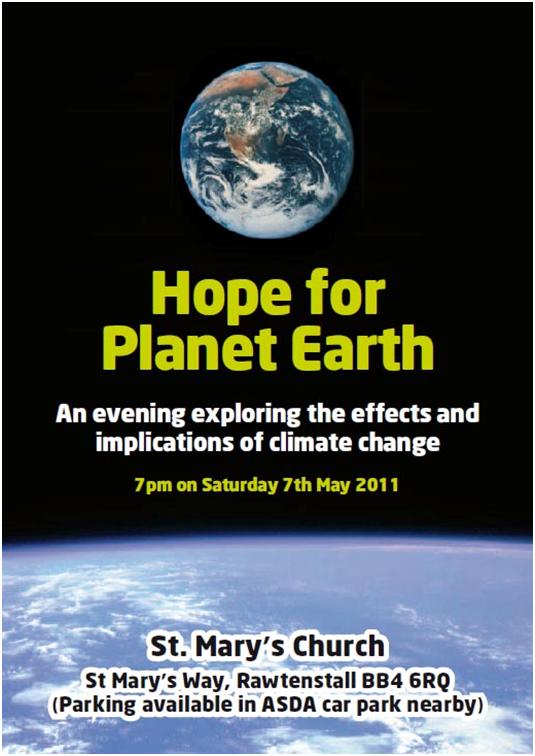
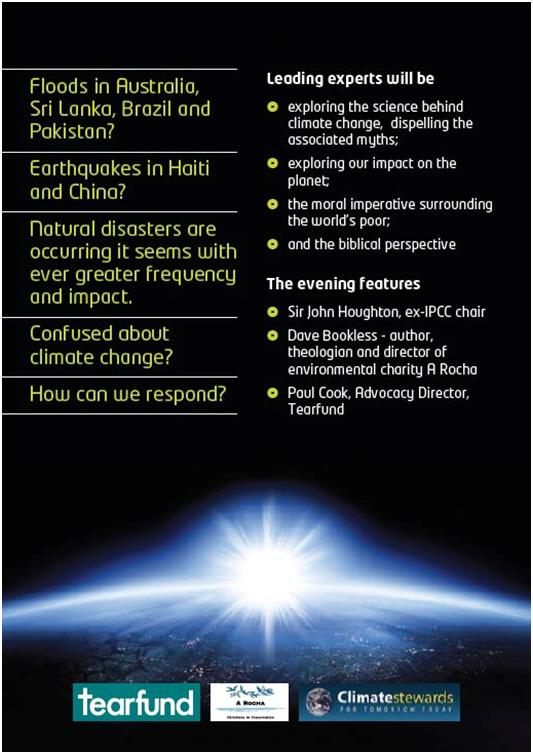
Sir John Houghton to Clarify Climate Change

For those who reside in the North-West of England, I would like to direct them to what may be a very informative event on 7th May. Sir John Houghton, ex-IPCC Chair, will be talking about climate change in Rawtenstall on 7th May. Also speaking will be Dave Bookless – author, theologian and director of Christian environmental charity A Rocha and Paul Cook, Advocacy Director of Tearfund, the aid charity of the UK Evangelical Alliance.


It is something that I would like to attend, as this might help clarify some of my own questions.

  1. How can small changes in air temperature or air pressure influence the pressures and temperatures many times greater at 10km to 30km beneath the Earth’s surface?
  2. How do we distinguish the true scientific forecasts from false prophecies, such as the Himalayan Glaciers, the Amazon Rainforests, or extreme sea level rise?
  3. Within a Christian context, should those who know the truth about climate change being reaching out to those who live in denial rather than marginalising them?

Jesus, the Samaritan Woman and Climate Change

Bishophill draws attention to Thought for the Day on Radio 4 on 25th March

The talk is confusing because it is, perhaps deliberately, ambiguous. Consider the last words of the talk

“all the knowledge in the world is worthless to us without the right perspective”

It speaks and encourages anyone who believes that “the right perspective” is on their side, believer or sceptic. Now modern theological perspective is to consider the Bible in the context of the times. For instance, John 4, where Jesus talks to a foreigner, divorcee woman appears normal in modern times, breaking multiple social conventions 2000 years ago. Furthermore, Jesus reveals more about his nature than he had in John 3 to Nicodemus a leading Rabbi.

As Bishophill has found out, the BBC now has a deliberate, but secret, policy of not giving equal airtime and treatment to alarmists and sceptics. The debate is settled and the science is in. Those who doubt the truth of global warming are cranks, in the pay of big business, or plain evil. Therefore, in the context of our times, any deliberately ambiguous or coded statements are more likely to be from a sceptical rather than a consensus viewpoint. In the context of our times, where orthodoxy is only the permissible theology, neutrality on climate change is a mark of dissent.

The Economist on Corn Production over 30 degrees

The Economist gives a positive spin to the article ““Nonlinear heat effects on African maize (corn) as evidenced by historical yield trials”, Lobell et al.” in Nature : Climate Change. I posted the following comment:-

Experimental conditions must be controlled to get comparable results. But this is not real world conditions. In the real world farmers will seek to optimize output given the constraints. When temperature, or rainfall changes, farmers will adapt. It is part of the human condition to adapt, which is why there is agriculture to be found in Southern Sweden and the blazing heat of Minas Gerais. Corn production is to be found in Edinburg, Texas with 136 days a year above 30 degrees. This is achieved through both planting and harvesting earlier in the year than further north.

As well as looking to the negatives of warming, we should look to the positives. More temperate climates should, ceteris paribus, see increasing yields as temperatures get warmer. For instance, Northern Europe, the Steppes of Central Asia and the Canadian plains should benefit from higher temperatures. Also higher temperatures will be caused by higher CO2 levels. Experimental studies have shown a doubling of CO2 will increase maize biomass by around a third. Finally, according to Al Gore, precipitation increased by 20% in the last century, mostly in above mentioned areas, Southern South America and SE Australia.

One of the biggest risks for climate change is supposedly to the stability world food supplies, with possible famines. But, as Amartya Sen has shown, the biggest famines are made serious not by natural factors but by adverse terms of trade. The Bengal famine of 1943, in which more than 3 million died, was exacerbated by a ban on exports between provinces in India, at the same time as extra demand was present from those supplying the troops fighting in Burma.


http://wattsupwiththat.com/2011/03/14/which-group-is-smarter/


http://www.co2science.org/data/plant_growth/dry/z/zeam.php

Al Gore : An Inconvenient Truth pages 114-115

http://www.economist.com/node/4293198

More than just shreds of evidence

BishopHill quotes approvingly from a comment made on the Booker column in yesterday’s Sunday Telegraph

I have worked in government for 28 years as an economist, and for the last 20 years I have worked on environmental programs. In that time I have not seen a shred of evidence to justify global warming, let alone man made global warming and I have not seen a shred of evidence that there is going to be a green economic boom. The only evidence I have seen is that there is a green economic bust, that money invested in green technologies is usually wasted and simply consumes investment that could be better used elsewhere. I think that anybody in government or industry who can not understand this is either dishonest, stupid, or both. That applies to Cameron – I think he is both.

For those who support the sentiments expressed should consider trying to convince someone who is a true believer in climate change consensus of their error. If the consensus supporter finds shreds of evidence of global warming, and hints that the warming may be due to anthropogenic factors, then they have refuted this experienced economist. Just as a sceptic who finds fault with the temperature record, or who has read about “hiding the decline” concludes that climate change is all a hoax, or a global conspiracy.

An economist should look at the costs and benefits. In terms of Climate Change there are two sets of costs. First, those of climate change impacts and second, the costs of the policy to contain the global warming. The Stern Review put argument that the mitigation policy costs were 5 to 20 times less than letting climate change progress unchecked. Therefore there is a clear-cut case for global mitigation policy. But crucially Stern does not look at the consequences of ineffective and over-expensive policy. The Booker article “For every new ‘green’ job, nearly four are lost” looks at one aspect of these real policy costs. An economist would also claim that the Greens fail to look at the opportunity costs, claim that the new jobs are a benefit.

I have tried to demonstrate this economic argument for climate change mitigation here. Then I examine why the policy proposed will be ineffective in constraining CO2 rises and the costs will escalate here. I hope to post soon on why the costs of climate change are hugely overstated.

The argument against the climate change policy is not that there is no evidence. Rather, it is that blundering and ineffective policy will be far more costly than five or six degrees of warming bringing on highly variable weather systems. That is an argument for the economists, not the climate scientists.

Limits of an Economists Policy Tool Kit

Tim Worstall on the ASI Blog looks at the robust economic tools that are available to control externalities. Here I enlarge on a blog comment looking the limits of these tools in combating climate change.

Although economic solutions may be “hugely cheaper than the sort of command and control systems”, that does not mean they are a solution in every circumstance. In the area of climate change mitigation there are four practical areas where such solutions may have higher costs than the original problem.

  1. The economic policy is applied too far. The benefit to cost ratios will fall the greater the desired change. A 1% reduction in CO2 can be achieved, ceteris paribus, by economic solutions at a benefit to cost ratio of much greater than 1. The costs will rise exponentially after that, so for a given state of technology, the ratio will quickly reduce to less than one. This is the implication of Richard Tol’s 2010 paper “An Analysis of Mitigation as a Response to Climate Change” (2.5MB pdf). Looking at various scenarios, reducing the total amount spent on climate change mitigation from $2.5 trillion to a twentieth of the size increases the benefit to cost ratio from 1/100 to 3/2. I try to graph this here.
  2. Any Cap and trade or Carbon taxes will not be implemented in their purest form. Public Choice theory (or practical examples) will predict that special interest groups will seek to maximize their returns. Those businesses that will be harmed will seek to reduce the effectiveness. Those who can make easy gains (and thus have permits to sell) along with any potential administrators of the scheme will be keen to promote it. There is a long policy chain linking the pure theory and the final outcomes. These various levels of policy formulation and implementation diminish the benefit / cost ratio as I attempt to outline here.
  3. Scheme avoidance. For either a carbon tax or a carbon trading scheme, if there is competition from those outside the area of the scheme that is not proportionately shared by all emitters, then those facing the competition will have the gravest effect on their business. For instance both the steel industry and fossil-fuel power stations are huge CO2 emitters. The European steel firm cannot pass on the cost of the permits to its customers, as it is competing with firms in emerging economies with little or no carbon-trading. A British coal or oil power station does not have this competition, and its main competition comes from the more expensive nuclear power stations, the less reliable wind and the finite hydro-power stations. In the short-term it can pass on the costs. Protectionism is not a solution as it imposes extra costs.
  4. The more encompassing a cap and trade scheme, the greater the number of participants and the complexity. The greater of severity of the scheme, the greater the potential economic gains and losses. Combine these two areas and you create large potential gains from out-right corruption, or engineering biases through the political system, or having unidentified inefficiencies.


    The economic tools might be quite powerful and robust, but put into the hands of inexpert users can create a lot of harm. A bit like a hot-hatch in the hands of 17-year-old trying to impress his mates on a night out.

Julia Gillard’s Carbon Taxes– An ineffective policy

Jo Nova claims the Australian Prime Minister, Julia Gillard, lied to the Australian public by being circumspect about a carbon taxes, then when in office to introduce a carbon tax to be followed by cap and trade.

Betrayal of promises is to be expected and welcomed if to meet changed circumstances. For instance new taxes to close a deficit brought on by a recession. But in this case nothing has changed. However, there is a much better reason for Australian’s to oppose the policy – it will inflict economic pain and hardship for little or no returns.

The political argument for the introduction of the policy is that we should meet international obligations. OECD countries “need” to cut CO2 emissions by 80% by 2050 to constrain CO2 levels to around 550-600ppm. It is claimed by the IPCC & the Stern Review that this can be achieved by at a cost much less than the costly consequences of global warming. My example below suggests that a gasoline tax of 6.5 cents a litre would be almost totally ineffective. It would only serve to reduce living standards. Yet this is the start of CO2 reduction policies, when there should be some easy wins. It is as bigger inroads are made that reductions in CO2 should become more costly. Unless more effective policies can be devised, the CO2 reduction policies will leave us and future generations worse off than if nothing was done. Therefore, those who believe in the impending climate catastrophe, but are policy realists should join the climate sceptics in opposing the introduction in Australia of a carbon tax and carbon trading.

I try to explore demonstrate the case for climate change mitigation policies graphically here and which the policy will never link

A Carbon Tax on Gasoline

Consider a motorist in Australia who travels high distances in an old, inefficient truck. He travels 30000km a year and consumes a litre every 6km (6km/l or 17mpg in British terms). So the cost of 5000 litres used will increase the fuel bill by AU$325. If there are no gasoline taxes in Australia, fuel prices will be around $1.20 per litre, so the motorist will already be paying $6000 per year for fuel and (if he is lucky) $2000 for insurance, other taxes, maintenance and depreciation. So the tax will add 4% to his motoring costs.

At a more moderate level, consider a British example (in Australian dollars). Somebody has a medium sized car that is three years old, travelling 10,000 miles (16,000km) per year at 40mpg (14km/l). Fuel is $2 (£1.30) per litre , so costs $2280 for 1140 litres. With no serious maintenance issues, tax, depreciation, insurance and servicing cost around $4500 per annum. Total costs (rounded) are $7000 per year. A 6.5 cent carbon tax will add $71.25, or 1% to this bill.

For a newer car the percentage increase will be lower. Upgrade the specification and the percentage will be lower.

As real incomes rise people are able to afford more luxury. Compare the typical car in Australia with say Brazil, or Brazil with an African nation. In Brazil the best-selling cars have mostly one litre capacity and low specification. Many cars new cars still do not have air conditioning or electric windows. A carbon tax will take people in the reverse direction a long way before they will give up the utility of a private vehicle.

Richard Black implies UNIPCC scientific conclusions have political bias

Richard Black, an environment correspondent with the BBC, loses sight of the purpose of climate change negotiations in criticizing the USA.

There is a proposal to withdraw funding from the UNIPCC, a result of climate change deniers taking control of House of Representatives in the mid-term elections last year. The consequence, according to Black, is that the USA could have reduced influence over the scientific part of the next UNIPCC report. Does this mean that the scientific conclusions of the UNIPCC reports are politically biased?

The result is that the USA looks

    “set to marginalise the country even further within the global community of nations – at least when it comes to climate change.”

So joining a global climate change agreement is to avoid censure from one’s intellectual superior? Not a matter of making a real positive difference for future generations? If you believe, like Richard Black seems to, that global agreement is all that is necessary to avoid global climate catastrophe, please consider my previous posting here.

Hattip BishopHill

Betraying Socialist Principles to Combat Climate Change

Jo Nova reports that a Carbon Tax is coming to Australia. This is to be followed by carbon trading. Comment submitted

In economic theory, in a closed economy and zero transaction costs, with all other things being equal, a carbon trading should work quite well to reduce carbon emissions. In the real world consider these points.

1. The oil price has more than tripled in the past decade. There are enough incentives to improve energy efficiencies from this alone. The marginal impact of carbon trading will be much lower than if the oil price had been static.

2. Those businesses which can most easily pass on the extra costs to the customer are those with no competition from abroad. Supermarkets, which consume huge amounts of energy, are a good example. Australians cannot hop over to New Zealand or Singapore for their weekly groceries. The biggest burden relatively, will be borne by the poor. Manufacturing businesses will be incentivised by the profits from selling carbon credits to ship production abroad to China. High polluting, old production processes will gain a new income stream. New, efficient, competing ventures will have to pay the incumbents to enter the market.

3. The energy trading schemes are highly complex and need experts to set up the rules. Or rather people who read up on the theory, and know more than the naive punters the elected representatives of the people. Enron was bidding to be a big player, before it went bust. Lehman Brothers was bidding to be a big player, before it went bust. With mortgage securitisation now so out of fashion, this presents a new way for the masters of the universe to make extraordinary profits.

I do not keep up with politics much, especially on t’other side of globe like. (I am from Manchester, England). So have I got this reet? A socialist government in Australia is bringing in a regressive policy that could cause consumers to subsidise the movement of manufacturing jobs abroad, and help a return to the multi-million dollar bonuses in the financial services industry. All this, in the name of a policy that will be near impotent in constraining CO2 emissions.

If you follow the UNIPCC or Stern Review line, the policies to combat climate change are highly cost effective. But that requires correctly identifying the low-cost alternatives and successfully pursuing those options. Politicians have not the skill-sets, the incentives, the staying power, the knowledge, the longevity, the power, or the incentives to achieve these aims. They may inadvertently undermine the very things in which they originally believed.

Antony Watts in addition reports that whilst the socialist government in Australia is taking on carbon trading, the Republicans of New Hampshire are ditching the same policy. I commented

I do not keep up with politics too much, so Anthony, are you sure that you have things the right way round? A socialist government in Australia is bringing in a regressive policy that could cause consumers to subsidise manufacturing jobs abroad, and help a return to the multi-million dollar bonuses in the financial services industry. All this, in the name of a policy that will be near impotent in constraining CO2 emissions. The Republican Party (who represent business interests) in New Hampshire is proposing binning a policy that would help their real constituents.

Revision on 25th February.

  1. Having slept on the issue, I would like to put a perspective on my comments above. Carbon trading will have some early successes over and above rises in the oil price, as it gives a cost-bias to non-GHG energy sources. However, given that

    1. Regulation is making it difficult to build high-carbon power-stations, particularly coal. So the movement away from high fossil-fuel power is happening anyway.
    2. High carbon-emitting manufacturing has been moving away from the developed countries for years. For instance, steel, shipbuilding and bulk chemicals are goods examples, along with labour-intensive low-carbon options.
    3. Government subsidies for clean energy sources.

    So even with a well-designed and well-run policy, the impact will be limited to start off with. That is the cost per unit of CO2 saved will already be high. Then as the policy is progressed, diminishing returns will set in.


Name-Calling in Climate Change may harm Our Future

The Economist blog has a posting about the name calling from both sides of the Global Warming / Climate Change divide. Here is my comment, complete with links.

The name calling will lead to polarized views and more extreme policy. This is why.


There is no balance to all this name-calling. There is abundant evidence that anyone who doubts the Consensus, whether the science or the policy, is vilified. For sceptics, research grants are not nearly as available and sceptical views are more difficult to publish. Any public figure who doubts orthodoxy, or any business which funds scepticism, are targeted by pressure groups. Similarly, scientific groups who do not make strong position statements in favour are targeted by pressure groups and bloggers.

Even if the evidence is over-whelming in favour of there being significant anthropogenic climate change, consider the incentives for a scientist or policy-maker working in the field. The prerequisite for acceptance is singing-up to the main conclusion that mitigation policies are needed to combat likely and severe climate change. To pour doubt on that conclusion risks standing accused of being in the other camp. Novelty comes from restatement of this position in an original way, or from original, and more alarmist research.


It is in the area of policy this bias is most skewed. To check, the Economist should do a benefit-cost analysis, using as a starting point the Stern Review. Stern estimated the likely costs of climate change at 5 to 20 times the mitigation costs*. Then adjust for the more moderate view of climate change outlined in the Economist article in hyperlinked in the article, including a modicum of uncertainty. Then allow for some of the worst impacts (hurricanes, droughts, floods, etc.) are largely speculative. Then allow that some consequences, like sea level rise, will occur over generations. Therefore slow and low-cost adaptation is possible. Then allow for the benefits of temperature and CO2 rise in extending the margins and intensity of agriculture in many areas. Then allow that any politically feasible mitigation policy will be far less comprehensive (on a global scale) than Stern assumed. Then allow that policy choices will be constrained by political realities and that large ill-defined and complex government projects have a tendency to massively over-run on costs and underachieve on benefits – the Economist archive is a good place to verify this supposition.


Well before crunching the final numbers, there will an irreversible tipping-point reached on the benefit-cost analysis. Current mitigation policies will leave future generations worse off than if nothing were done at all. We reach the wrong policy conclusion by letting the issue become polarized.


*The Stern review has some ambiguous statements. The directgov site hyperlinked above says

If we take no action to control emissions, each tonne of CO2 that we emit now is causing damage worth at least $85 – but these costs are not included when investors and consumers make decisions about how to spend their money.  Emerging schemes that allow people to trade reductions in CO2 have demonstrated that there are many opportunities to cut emissions for less than $25 a tonne.   In other words, reducing emissions will make us better off.


But what is clear is that the costs of climate change have been overstated and an extremely naïve assumptions about the efficacy of policy is included.