Joseph Stiglitz on the causes of the current crisis

Roger Pielke Jr. takes a critical look (here and here) at a novel theory of the recession from Nobel Laureate Joseph Stiglitz in Vanity Fair, the eminent economics journal. This is an extended version of the comment that I made on the second posting.

The Stiglitz theory would make a bit of sense if it were not for what he misses.

  • Your evidence that other countries, like, Germany, have similar increases in productivity but not the endemic problems.
  • That output per capita is identical in National Income Accounting with income per capita. Therefore, the long term rise in per capita income is a result of increased productivity per capita.
  • Since the start of the industrial revolution, real per capita output has risen (in the wealthy economies) more than 200 times. If there has been no corresponding increase in per capita income, unemployment would be greater than 99%.
  • Stiglitz quite rightly points to the rise in personal debt. He makes no mention of public sector debt. In the USA and in Britain in the period 2000 to 2007 government finances swung from a small structural surplus to significant structural deficit. If deficit-financed investment is expansionary, it was not just the low interest rates that kept the boom going but the fiscal stimuli. Similar structural deficits were present in many European countries like Greece, Portugal and Italy.
  • In the 1990 Japan entered a prolonged slump. In the following decade the economy stagnated despite huge public works investment like Stiglitz advocates. The Japanese national debt spiralled to 300% of GDP, with nothing to show for it, except a lot of fantastic roads to nowhere.
  • Japan was fortunate in that its borrowings are at near zero interest rates. The European economies are not so fortunate. Those European economies with large deficits reached a crisis tipping point when interest rates exceeded 7%. To save the economy, radical contractionary policies have been implemented.

I would therefore contend that Keynesian fiscal expansion in the USA or elsewhere would not only be ineffective (coming on top of other fiscal expansion), but carries a huge risk of making matters dramatically worse. Morally I believe that economic policy-making has a powerful analogy to medical practice. It is not just a matter of diagnosing properly the type and extent of the ailment. It is providing, at a minimum, a remedy for which there is a reasonable expectation that the patient will be better off being treated than not. Like with a GP, an economist has a duty of care in what they advocate, particularly when there are very clear and evident risks. Joseph Stiglitz seems to take no such care.

Stern’s flawed opinion of Energy Stock Valuations

There is an interesting response by Profs Richard Tol and Roger Pielke Jnr on the latter’s blog to an article in the FT by Lord Stern on energy companies being overvalued

Have Markets Misvalued Energy Companies?

Roger Pielke Jr. and Richard Tol

Writing in the Financial Times (Dec. 9) Lord Stern of Brentford suggests that the financial markets have grossly misjudged the valuation of companies that produce fossil fuels, writing, “the market has either not thought hard enough about the issue or thinks that governments will not do very much.” Stern argues that the misjudgment poses a “risk to the balance sheets of large companies – or to the planet, or both.”

Have markets misvalued energy companies? While markets are of course not perfect, for two reasons we believe that in this instance there is no evidence to suggest that the valuation of fossil fuel producers has been grossly misjudged.

First, let us assume that governments around the world decide to take swift and effective action to reduce emissions. Would this mean that fossil fuel companies would go out of business in the near term? No.

Consider the case of Apple. Apple’s revenues depend upon selling products that will be obsolete within years and historical relics in a generation. That does not stop the company from being among the most highly valued in the world. If the world transitions to carbon free energy supply, the big energy producers of today are likely to play a big role.

Under all scenarios for future energy consumption the world is going to need vastly more energy and – whether governments act to decarbonize or not – vastly different types of energy too. Energy majors are so highly valued not simply because of the fossil fuel reserves they own, but because they have the expertise to supply energy at a massive scale along with a track record of successful and rapid innovation, with the ongoing shale gas and ultradeep oil revolutions as the latest examples.

Second, what if governments fail to deeply cut emissions? Might the impacts of unmitigated climate change lead to a dramatic reduction in the valuation of fossil fuel companies?

According to the work of Nick Stern himself this seems highly unlikely. In his famous review of climate change Stern argued that unmitigated climate change might reduce global GDP by as much as 20% by 2100. Using Stern’s own numbers for the most extreme impacts would mean that instead of growing by 2.5% per year to 2100, GDP would grow by 2.24%, with the largest effects occurring at the end of the century. This hardly seems cause for a dramatic revaluation of fossil fuel companies today. 

The impacts estimated by Stern on behalf of the British government are very pessimistic compared to the estimates found in the academic literature. Furthermore, changes in the growth rate of the economy have a muted impact on the growth in energy demand.

Indeed, future demand for energy is largely insensitive to whether governments decide to act on climate change. The more than 1.5 billion people without reliable access to electricity will demand access regardless. A world with unmitigated climate change could in fact be more energy intensive, for instance if more people demand air conditioning. In either case the future for energy companies would be bright.

Humans affect the climate system and it is important for policy makers to respond. But it is unlikely that efforts to second guess the market valuation of energy companies will contribute to such responses. Of course, if Nick Stern really believes that energy companies have been grossly over-valued he could put his money where his convictions lie. Who knows, he may one day be the subject of the sequel to the Big Short.

Roger Pielke Jr. is a professor at the University of Colorado. Richard Tol is a professor at the Economic and Social Research Institute in Dublin and at the Vrije Universiteit in Amsterdam.

My own comment is

The Stern review was not only criticized for being too concerned with the more extreme scenarios, but for applying a near zero discount rate. Whatever the economist’s policy-related arguments over discount rates (and Prof. Tol uses 3% plus), the market valuations of share prices are based upon much, much higher discount rates. This is for good reason. Suppose at the end of 1911 someone could have known that there would be an oil embargo in 1973, resulting from a cartel of oil-producing nations usurping the considerable power of the oil companies. What should have been the discount factor on the 1911 price of oil stocks considering in the interim there were two world wars, between which there was a massive global depression? Even if this was the case the local market factors (such as the emergence of the car industry, global growth, the development of the internal combustion engine and the relative fall in the oil price against coal) were far more important than the historical events. I would contend that in 1911, even if were highly likely that an oil company would be rendered bankrupt 60 years later, the discount factor on the share price would be approximately zero.

Furthermore, since the Stern review the scientific evidence has consistently failed to support the more alarmist scenarios resulting from any further warming (e.g. rapid melting of the Himalayan Glaciers or increased severity of hurricanes), nor for extreme temperature rises resulting from positive feedbacks to the CO2 induced warming. To the outsider looking at the emerging evidence, the cost impact of do-nothing scenarios (weighted by risk) is many times lower than when the Stern Review or AR4 were being published.

I fully realise that your comments were moderated to increase the chance of publication. However, if a more balanced version of Stern were done on today’s evidence, I firmly believe that (like Prof. Tol has concluded) current proposed mitigation policies do not have any form of benefit-cost justification.

Lord Stern might be a distinguished climate change activist, but he falls into the same trap of the amateur armchair activist. By seeing the world from their own narrow perspective, they misread the wider opinions and the facts of the real world. It is when such people acquire positions of power, with immoderate views not softened by political experience, that they can become deniers of reality and haters of sections of the community.
Hydro at Northenden Weir – Poor subsidising the Greens?

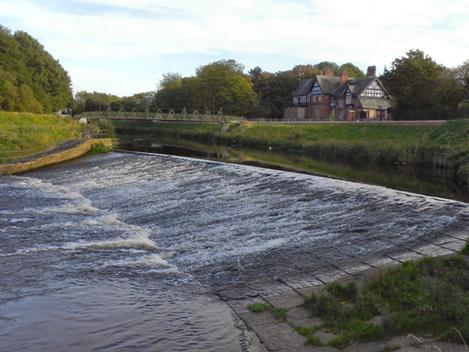
The South Manchester Reporter carried an article about a plan to install hydro power in South Manchester.

The Didsbury Greening and Growing Group (DGG) is hoping to install a new water-powered turbine on the grounds of the old Northenden Mill on the River Mersey.”

For around £500,000 they group, lead by the local Rector Greg Foster, hope to install an Archimedes Screw generating up to 50kw.

Will this save the world? I commented

For half a million quid you get 50kw (67hp) – the power of a small car. For most of the year it will be less. It will only be financially viable due to the 18.7p/kwh feed-in tariff. That is a charge added to everyone’s bill. So those with money to invest in this green scheme will (in a small way) be increasing fuel poverty.

Another way of seeing how the true perspective of this scheme is to measure it against a modern nuclear power station. This can churn out over 25,000 times the power at steady levels 365 days per year. With accelerated closure of fossil-fueled power stations we need to build one such power station every year for a generation.

I received the following reponse

“Manicbeancounter”: let’s just look at your 1.2l petrol engine comparison and see if it really stands up. Your engine has to go flat out, foot to the floor all the time to get say 50kW at the shaft. It’s going to chew through about 10 litres of petrol an hour. Let’s get that to run for the 40 years or so life of a hydro plant (without major refurb). So at say £1.30/litre for petrol, that engine gets through £4.55 million pounds worth of petrol at today’s prices. So does £0.5million all in for the capital expense of an environmentally friendly scheme look so silly after all? Oh, and your little 1.2l car would have done about 35 million miles flat out at 100mph. And that one little generator would have made enough electricity for about half a billion cups of tea in its lifetime taking into account seasonal variations in rainfall. Not such small numbers after all eh?

Must admit, David Slee has done his maths. However, his calculations are out by a factor of two. A stationery generator’s consumption is measured in grams per kwh. 10 litres to produce 50 kwh works out at around 170g/kwh. (RD of petrol approx. 0.85?) This is roughly the fuel consumption of a diesel engine in a large ship. A small petrol engine optimised for flexible power output would use about twice as much.

However, I do not use the comparison of a 1.2 litre petrol engine for cost, but for power output. If anyone was daft enough to generate power from an internal combustion engine filled up from the filling station, they would do the over-taxed masses a favour. Of the £4.55m (or £9m) fuel cost, over half would be tax. So the rich investors would be subsidizing everyone else. A power station does not pay tax. (Generators use red diesel – and businesses reclaim the VAT). A quick calculation reveals is that if this hydro scheme averages 25kw over the year, over 25 years the index-linked subsidy (4% inflation) would generate £1.7m. If the wholesale price of around 8p/kwh is inflated by just 1% a year, the investors will get their money back under 8 years*. From selling electricity to the grid over 40 years investors would get a further £1.7m. Then around £300k for an overhaul to keep £80k+ a year rolling in.

So if this scheme gets off the ground, those lucky enough to have £50,000 to invest could secure a pension equivalent to the basic state pension, and will probably get a national award for their money-making wheeze. Most will be green with envy, or red with anger at their rising utility bills.

*NB If a discount rate of 8% is used, NPV = 0 in just over 11 years. Over 40 years to the projected major overhaul, NPV is £400k.

Climate Change Impacts in AR5 – It is better than we thought

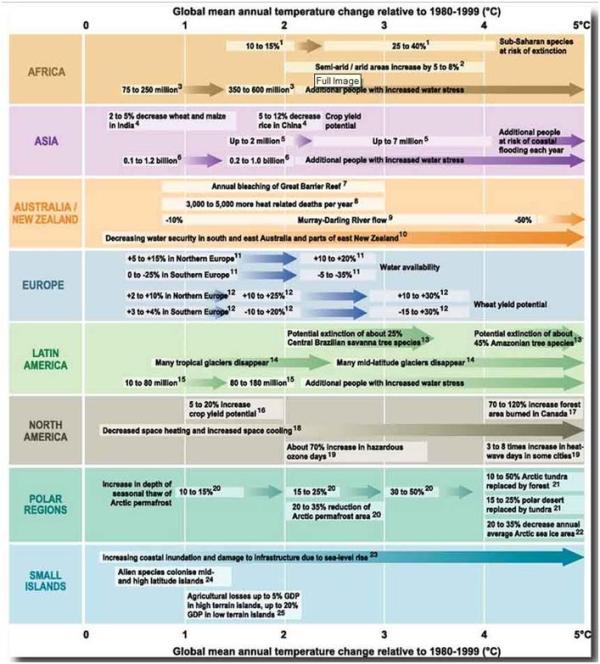
BishopHill has a screen shot of Climate change impacts for the new IPCC report. He notes the similarity to the AR4.

The differences are noticeable and demonstrate a subtle dilution of AR4.

First, the disappearing Himalayan Glaciers have disappeared – to be replaced by disappearing glaciers in Latin America.

Second, the potential disappearing Amazon forest has disappeared, to be replaced by tree species extinction.

Third, no mention of potential catastrophic losses of Antarctic sea ice or land ice. So that means that sea level rises are less of a problem.

Fourth, there is no mention of coastal storm damage. Roger Pielke Jnr has won the argument on hurricanes?

Fifth, species extinction is much more localised.

Sixth, global loss of wetlands reduced, to more seasonal coastal flooding in Asia. So that means that sea level rises are less of a problem.

Check out for yourselves.

2007 AR4

Which was developed from the Stern Review.

Climate Change Damage Impacts – A story embellished at every retelling

Willis Eschenbach has a posting on a recent paper on climate change damage impacts. This is my comment, with hyperlinks and tables.

My first reaction was “Oi– they have copied my idea!”

Well the damage function at least!

https://manicbeancounter.wordpress.com/2011/02/11/climate-change-policy-in-perspective-%E2%80%93-part-1-of-4/

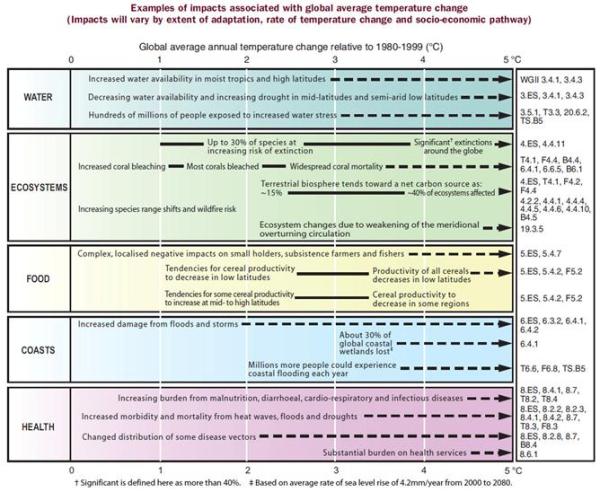
Actually, this can be found by the claims of the Stern Review or AR4. Try looking at the table in AR4 of “Examples of impacts associated with global average temperature change” and you will get the idea.

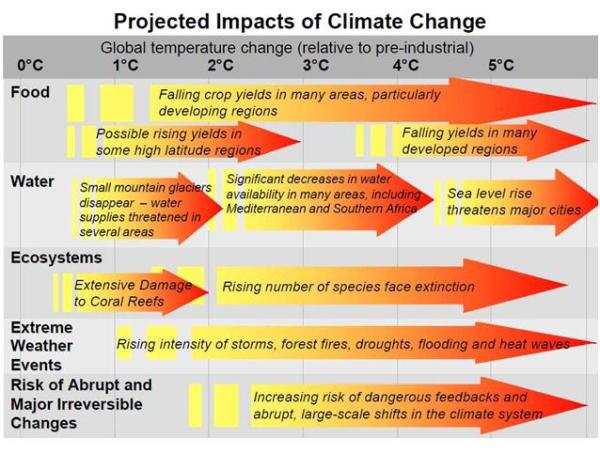
A simpler, but more visual, perspective is gained from a slide produced for the launch of the Stern Review.

More seriously Willis, this is worse than you thought. The paper makes the claim that unlikely but high impact events should be considered. The argument is that the likelihood and impacts of potential catastrophes are both higher than previous thought. The paper then states

“Various tipping points can be envisaged (Lenton et al., 2008; Kriegler et al., 2009), which would lead to severe sudden damages. Furthermore, the consequent political or community responses could be even more serious.”

Both of these papers are available online at PNAS. The Lenton paper consisted of a group of academics specialising in catastrophic tipping points getting together for a retreat in Berlin. They concluded that these tipping points needed to include “political time horizons”, “ethical time horizons”, and where a “A significant number of people care about the fate of (a)

component”. That is, there is a host of non-scientific reasons for exaggerating the extent and the likelihood of potential events.

The Krieger paper says “We have elicited subjective probability intervals for the occurrence of such major changes under global warming from 43 scientists.” Is anybody willing to assess if the subjective probability intervals might deviate from objective probability intervals, and in which direction.

So the “Climate Change damage impacts” paper takes two embellished tipping points papers and adds “…the consequent political or community responses could be even more serious.”

There is something else you need to add into the probability equation. The paper assumes the central estimate of temperature rise from a doubling of CO2 levels is 2.8 degrees centigrade. This is only as a result of strong positive feedbacks. Many will have seen the recent discussions at Climateaudit and wattsupwiththat about the Spencer & Bracewell, Lindzen and Choi and Dessler papers. Even if Dessler is given the benefit of the doubt on this, the evidence for strong positive feedbacks is very weak indeed.

In conclusion, the most charitable view is that this paper takes an exaggerated view (both magnitude and likelihood) of a couple of papers with exaggerated views (both magnitude and likelihood), all subject to the occurrence of a temperature rise for which there is no robust empirical evidence.

WWF aims for World Domination?

Donna Laframboise has a posting on the sheer scale of the World Wildlife Fund (cross- posted at wattsupwiththat). No longer a small cuddly charity it has global revenues of €524m, 5,000 staff and a presence in 30 countries.

This is Part 1. What will part 2 bring? Might I guess that it could be on future ambitions?

Might I suggest that Donna Laframboise will direct us to pages 26 & 27 of the 2010 Annual Review (Page 14 on Google Docs)? WWF is celebrating its’ 50th Anniversary, so naturally it will look ahead.

The Section is “WHAT WE WILL ACHIEVE“. There is no “might” or “by supporting others”. It is what WWF will achieve on their on.

The first is mild and a laudatory objective, well-within their remit.

By 2022 the number of tigers in the wild has doubled from just 3,200 in 2010.”

That is great and why many support the WWF, along with saving pandas and polar bears. Although, they might need to persuade others, like the Indonesian and Indian Governments, to do most of the work. Next is a bit more ambitious.

By 2030 “the amazon’s land and freshwater ecosystems are properly conserved, so they’re no longer under threat.”

A bit more ambitious, but short of funding thousands of armed environment enforcement officers to police over a million square miles of Brasil, Peru, Columbia, Bolivia and Venezuela, along with the necessary legal powers this may not be achieved without some assistance. Sovereignty issues spring to mind.

By 2020 “Through energy efficiency, sustainable management of natural resources and emissions cuts, China’s economy is growing within the capacity of one planet.

Now, unless this is meaningless guff, China will make actual cuts in their emissions through the actions of WWF (not the UNIPCC). Currently the Chinese government has said it will grow their emissions by less the nation’s growth rate. With 10% growth, it means the current plans are for China’s emissions will more than double from 2010 levels and still meet the targets. An actual cuts would mean closure of new coal-fired power stations, closing the airports, denying hundreds of millions the prospect of car ownership, covering the area in windmills and a drastic reduction of growth to maybe 2-3%. This could only be achieved by a coup d’etat followed by a government as brutal as Mao Zedong or Josef Stalin in their primes. But the biggest one is.

By 2050 “Global Greenhouse gas emissions have been cut by 80% compared to 1990 levels”

This is the biggest ambition by far. Since 1990 greenhouse gas emissions has increased substantially. So the level of cuts in little more than a generation is immense. There is no global agreement in place, nor is there likely to be. Even if there were an agreement, it cannot be achieved without vast human suffering (here & here). To impose a reduction not just in growth, but in living standards as well, would require a highly repressive global regime, the like of which the world has never seen. There are three possible scenarios

1. WWF has advanced plans underway for World Domination

First it will take over the UNIPCC (where it is already highly influential). Then it will organise a coup d’etat in China. It will then use this as a springboard for world domination.

2. The WWF has a vastly overblown sense of its’ own importance

The WWF has been taken over by a bunch of climate extremists who have lost a true perspective on reality.

3. The WWF does not internally check its’ major annual report

Which means that the longer reports WWF produces on climate change, (the famous grey literature on UNIPPC AR4) are probably not checked as well. WWF therefore needs to clean-up its act if it is to be taken seriously as an environmental organisation.

One might notice an ascending order of likelihood in the scenarios 🙂

Economic v Climate Models

Luboš Motl has a polemical look at the supposed refutation of a sceptics arguments. This is an extended version of my comment.

Might I offer an alternative view of item 30 – economic v climate models?

Economic models are different from climate models. They try to model empirical generalisations and (with a bit of theory & a lot of opinion) try to forecast future trends. They tend to be best over the short term when things are pretty much the same from one year to the next. The consensus of forecasts are pretty useless at predicting discontinuities in trends, such as the credit crunch. At there best their forecasts at little better than the dumb forecast that next period will be the same as last period. In general the accuracy of economic forecasts is inversely proportional to their utility.

Climate models are somewhat different according to Dr MacCracken.

“In physical systems, we do have a theory—make a change and there will be a response in largely understandable and calculatable ways. Models don’t replace theory; their very structure is based on our theoretical understanding, which is why they are called theoretical models. All that the computers do is to very rapidly make the calculations in accord with their theoretical underpinnings, doing so much, much faster than scientists could with pencil and paper.”

The good doctor omits to mention some other factors. It might be the case that climate scientists have all the major components of the climate system (though clouds are a significant problems), but he omits to include measurements. The interplay of complex factors can cause unpredictable outcomes depending on timing and extent, as well as the theory. The climate models, though they have a similarity of theory and extent, come up with widely different forecasts. Even this variation is probably limited by sense-checking the outcomes and making ad hoc adjustments. If the models are basically correct then major turning points should capable of being predicted. The post 1998 stasis in temperatures, the post 2003 stability in sea temperatures and the decline in hurricanes post Katrina are all indicators that models are overly sensitive. The novelty that the models do predict tend not to be there, but the novelties that do exist are not predicted.

If it is the case that climate models are still boldly proclaiming a divergency from trend, whilst economic models have much more modest in their claims, is this not an indicator of climate model’s superiority? It would be if one could discount the various economic incentives. Economic models are funded by competing in institutions. Some are private sector, and some are public sector. For most figures there is forecast verification monthly (e.g. inflation, jobs) or quarterly (growth). If a model were consistently an outlier if would lose standing, as the forecasts are evaluated against each other. If it was more accurate then the press would quote it, being good name placement for the organisation. In the global warming forecasts, there is not even an annual variation. The incentive is either to conform, or to provide more extreme (it is worse than we thought) prognostications. If the model projected basically said “chill-out, it ain’t that bad man”, they authors would be ostracized and called deniers. At a minimum the academics would lose status and ultimately lose out on the bigger research grants.

(A more extreme example is of a major earthquake forecast. “There will not be one today” is a very accurate prediction. In the case of Tokyo area over the last 100 years that would have been wrong only twice, an accuracy of greater than 1 in 10,000).

Al Gore’s faulty case for CAGW

Wattsupwiththat have an estimate of Al Gore’s Climate Reality online viewing figures. I posted at the follow-up article

manicbeancounter says:

September 22, 2011 at 12:17 pm

I was one of those who stayed for over 5 minutes.

A video they had justified the case for global warming by re-doing the CO2 in a jar experiment – very nicely as well. Only they did not say what the concentrations were compared to the atmosphere (probably >1000 times the 0.04% at the moment).

Then in the space of a sentence mentioned feedbacks amplifying the effect.

So of the predicted warming up to 6 degrees centigrade this century predicted by the most extreme alarmists, Al Gore’s little video had a flawed experiment to justify the insignificant first 20%, and a “trust the computer models” for the alarming bit.

Don’t take my word for it – I am just a (slightly) manic beancounter. Check out for yourself at http://climaterealityproject.org/video/climate-101/

By the way – don’t worry about the stats – Alexa currently ranks this site at 16,989 and Climate Reality at 64,734.

REPLY: I have a post coming up on this video, which is online here also, without the need to visit Gore’s site: http://vimeo.com/28991442
-Anthony


Antarctic Ice Melt at the dogmatic “Skeptical Science”

Have just posted the following at BishopHill (who has being looking at review comments skepticalscience.com)

The comments are not the major issue with skepticalscience. It is the analysis. It picks from the peer-reviewed data to give the most alarmist spin, often ignoring the more rounded, more recent and less alarmist articles or data. (a pattern familiar to those who have read the Hockey Stick Illusion)

On Antarctic ice melt, this is certainly the case. SkS relies on a single author – Velicogna (two papers 2006 & 2009) – to substantiate the claim that the Antarctic pack ice is not just melting, it is accelerating. The 2009 paper looked at only six years of data. Yet less than two months ago there was published a paper that looked at a much longer period, looked at various studies (including Velicogna) and at different ways of estimating. It concluded that there may be some ice loss, but no acceleration. Anthony Watts summarises this paper quite nicely at http://wattsupwiththat.com/2011/07/27/antarctic-ice-%E2%80%93-more-accurate-estimates/

Watts’s article also links to the original article. Do not take the word of a (slightly) manic beancounter. Do the comparison and you will find that the SkS is anything but sceptical and far from scientific.

I would suggest that this is not an isolated incident either. I have found at least two more. Perhaps others could have a delve?

Would anyone like some suggestions where to start comparing SKs with other (more rounded) viewpoints?

  1. Why has it not warmed since 1998? SKS – It is because the oceans have been warming instead says Sks. But their data stops in 2003 – just when we started to get far more accurate data from some fancy buoys (search wattsupwiththat). It has stabilised since then. The air is not warming, neither are the oceans, so the alarmists have to go beyond the measurable.
  2. The economic case for carbon pricing has been made. If you take economic models as being reality, ignore the contrary arguments and most importantly ignore the public policy problems. I explain in theoretical terms here. Alternatively read books by Roger Pielke Jnr (the Climate Fix), Nigel Lawson (An Appeal to Reason), or Tim Worstall (Chasing Rainbows) for a better understanding of why policies will necessarily fail.

Will add others when I come across them.


Another example of Censorship of Skeptics

The blog Zone5 (written by an environmentalist who is thoughtfully sceptical of global warming) has had an article taken down from what has been one of the more moderate pro-CAGW blogs. I left the following comment

The removal of your article is another small example of what you were writing about. Any attempt to offer counter arguments, or to criticize, is being shut down. This is true of blog comments or of peer-reviewed papers. But enough of the negative. Your article made some excellent points, particularly on Al Gore’s movie

First he misrepresents the science by claiming we are facing near certain doom, then he completely downplays the kind of changes we would have to make to prevent catastrophe if we accept the worst case scenario.

It is the crux of what I consider to be the problem of the climate change agenda. I believe there is quite strong science to back up the claim that a doubling of CO2 will cause about one degree of warming. Maybe the climate models are right, and this effect will be doubled or more by clouds feedbacks (though the virulence with which scientific papers that suggest otherwise have been attacked, and a similarly weak rebuttal suggesting the opposite praised greatly, suggests this is an Achilles heel). However, your comment on Al Gore’s film neatly summarises the issue in general. The potential effects of climate change are over-estimated in two ways – of magnitude and likelihood. The most important magnitude is time. For instance, the potential sea level rise is treated as if it would be in metres per year. So fast that large areas of land would be swamped before the harvest could be brought in. But even if global temperatures rose by five degrees in a generation (very unlikely), the resultant sea level rise would be sufficiently slow to relocate homes and agriculture, or to build dykes. People’s ability to adapt to rapidly to changes are remarkable, as emigrants from Britain to Australia (or from Asia to Britain) can testify, yet this is vastly underplayed.

The downplaying of effective policy issues is, if anything, even worse. It is assumed that with a little extra tax, everybody will switch to electric cars or bicycles, and plug a few drafts to cut heating bills by 90%. All this until we get a technological breakthrough in a few years to allow super-abundant carbon free power and near costless power. If Britain (or the EU) takes the lead, then everybody else will follow. No problem about over-running on costs, or pursuing the wrong type of green energy. No concern that a million or more families will enter fuel poverty every year, whilst still failing far behind on emissions reduction targets.

The overplay of risks / underplay of policy costs was put in a more sophisticated way in the Stern Review. I have attempted to analyse this at

https://manicbeancounter.wordpress.com/2011/02/11/climate-change-policy-in-perspective-%E2%80%93-part-1-of-4/

Please continue to encourage people to think for themselves and compare the various perspectives.

Is this another example of shutting down any sort of dissent, like the increasing dogmatism & extremism of sceptical science? (see here
here
here).