Notes on John Cook’s presentation at Bristol University

On Friday 19th September John Cook talked on “ Dogma vs. consensus: Letting the evidence speak on climate change” at Bristol University. He was introduced by Stephen Lewandowsky, who is now a professor there. The slides are available at Skepticalscience. Here are some notes on the talk, along with brief comments.

The global warming hypothesis

John Cook started by asking people to see if they can define the greenhouse effect as a way of detecting if people know what they are talking about. However, he did not then apply this criteria in evaluating consensus views.

He stated that there is no single cause of global warming (including solar and volcanic), but that there is a major or principle one. From then on Cook proceeded as if there was a single cause. There was no evidence for relative size of each cause of global warming. Nor was there any consideration of the implications if AGW accounted for half or less of the warming rather than the entirety of it.

He stated that there are multiple lines of evidence for AGW actually operating, no mention of the quality of the evidence, or of contrary evidence that the pattern of warming does not fit the models.

Cook et. al 97% scientific consensus paper

Cook than went on to talk about his 97% consensus paper. He then showed the Barak Obama tweet.
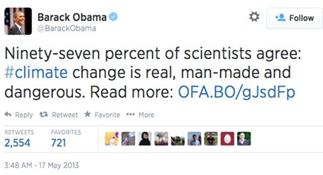
In the Q&A John Cook admitted to two things. First, the paper only dealt with declared belief in the broadest, most banal, form of the global warming hypothesis. That is greenhouse gas levels are increasing and there is some warming as a consequence. Second is that the included papers that were outside the realm of climate science1, and quite possibly written by people without a science degree. The Barak Obama tweet account seems to have got the wrong impression.

This should be seen in the light of a comment about why consensus is important.

Communicating consensus isn’t about proving climate change. It’s addresses a public misconception about expert opinion.

John Cook has spectacularly failed on his own terms.

Fake Experts

Cook pointed to a petition of a few years ago signed by over 31,000 American scientists, opposing the Kyoto Treaty on the basis that it would harm the environment, hinder the advance of science and technology and damage the health and welfare of mankind. They also signed to say that there was no convincing evidence of catastrophic global warming.

He calls these people “fake experts” because these “scientists”, but are not “climate scientists”. But as we have seen neither were all the authors on his climate consensus paper.

If scientists from other areas are “fake experts” on climate science, then this equally applies to those making statements in support of the “climate consensus”. That means all the statements by various scientific bodies outside of the field of “climate” are equally worthless. Even more worthless are proclamations by political activists and politicians.

But most of all neither is John Cook a “climate expert”, as his degree is in physics.

Four Hiroshima Bombs and a Zillion Kitten Sneezes

As an encore, Cook had a short presentation on global warming. There were no hockey sticks showing the last thousand years of warming, or even a NASA Gistemp global surface temperature anomaly graph for the last century. The new graph is the earth’s cumulative heat energy accumulation since 1970, broken down into components. It was a bit like the UNIPCC’s graph below from AR5 WG1 Chapter 3. However, I do not remember the uncertainty bands being on Cook’s version.
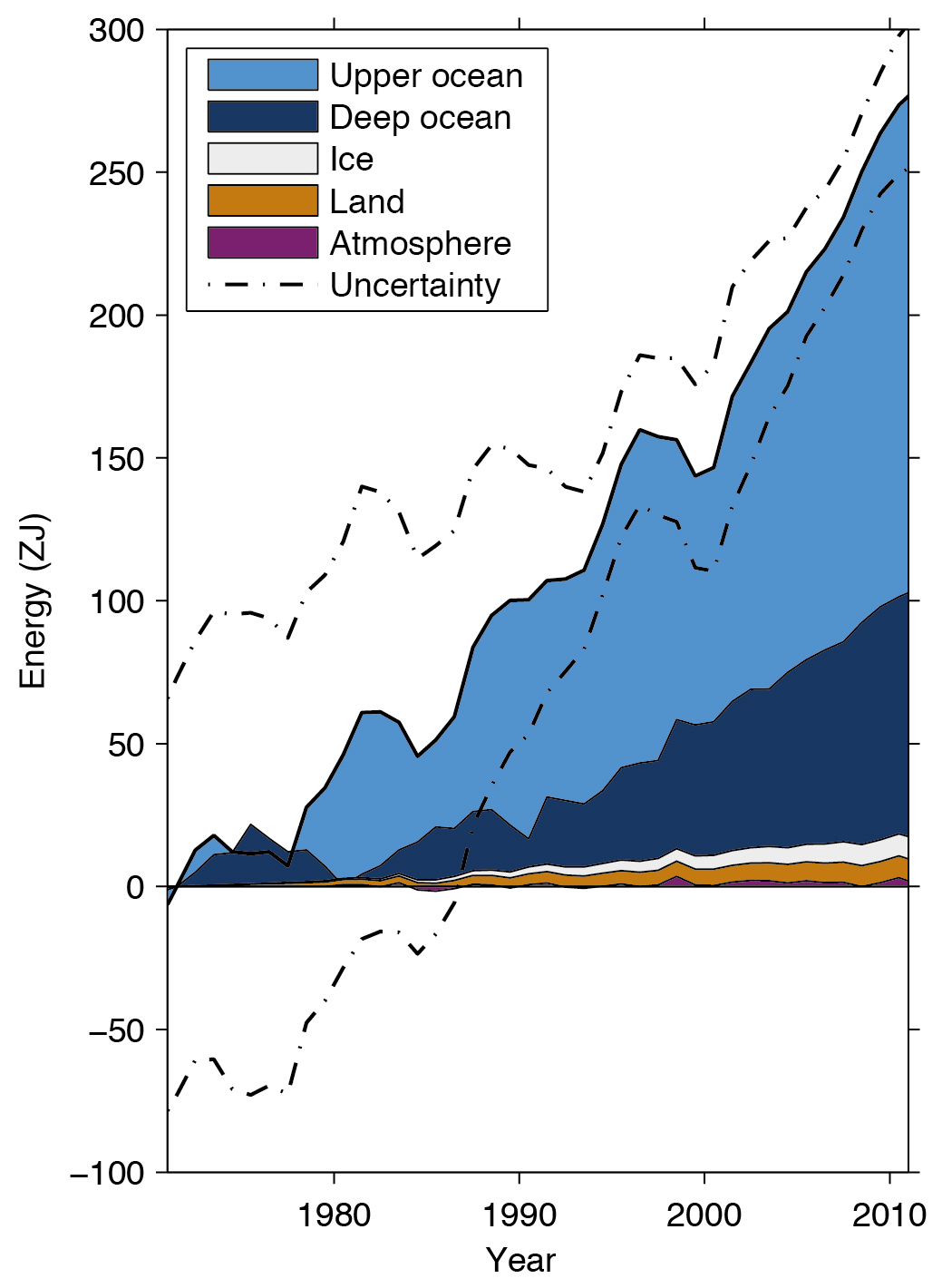
Seeing that, I whispered to my neighbour “Four Hiroshima Bombs”. Lo and behold the next slide mentioned them. Not a great prediction on my part, as skepticalscience.com has a little widget. But an alternative variant of this was a zillion kitten sneezes a second, or some such preposterous figure. The next slide was a cute picture of a kitten. Cook seems to be parodying his work.

The Escalator with cherries on top

The last slide was of Cook’s “Escalator” graph, or at least the “Skeptics” view. The special feature for the evening was a pair of cherries in the top left, to emphasise that “skeptics” cherry-pick the evidence.
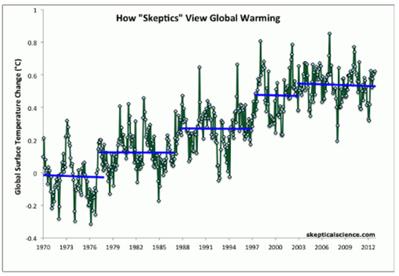
It was left flickering away for the last 15 minutes.


My thoughts on the presentation

Some of the genuine sceptics who left the room were seething, although they hung around and chatted.

But having reviewed my notes and the slides my view is different. John Cook started the presentation by trying to establish his expert authority on the global warming hypothesis. Then he let slip that he does not believe all global warming is from rising greenhouse gas levels. The centrepiece was the 97.4% scientific consensus paper where he was lead author. But, as Cook himself admitted, the survey looked for support for the most banal form of global warming, and the surveyed papers were not all written by climate scientists. Yet Barak Obama is enacting policy based on the false impression of a scientific consensus of dangerous warming.

Then in dissing an alternative viewpoint from actual scientists, Cook has implicitly undermined years of hard campaigning and entryism by green activists in getting nearly every scientific body in the world to make propaganda statements in support of the catastrophic global warming hypothesis and the necessity of immediate action to save the planet. Cook then parodied his own “four Hiroshima bombs a second” widget, before finishing off with a flickering gross misrepresentation of the sceptics, a number of whom were in the room listening politely.

About the final question was from someone who asked about why nearly all the questions were coming from sceptics, when the vast majority of the people in the room were in support of the “science”. At the end there was polite applause, and the room quickly emptied. I think the answer to the lack of questions was the embarrassment people felt. If John Cook is now the leading edge of climate alarmism, then the game is up.

Kevin Marshall

Notes

  1. This was in response to a question from blogger Katabasis pointed out some papers that were clearly not climate science, I believe using Jose Duarte’s list.
Climatologists and gambling addicts

At Jo Nova’s unthreaded Carbon500 asks

How can the opposing points of view be effectively communicated without using too much temperature data?

There are no easy answers. Start quoting one set of figures and an “expert scientist” will counter with some other figures, call you a denier and say you know nothing.

An alternative approach is to compare climate “experts” with experts in other fields. Hundreds of expert scientists, over nearly three decades, should have gained a track record in predictions through their understanding of the climate system, and learnt from their mistakes. The public relations aspect should now be in emphasising their scientific achievements in predictions and the increasing quality of their work. The PR should not be in banal statements, saying how much they all agree, and denigrating the opposition.

Let me give an analogy. Suppose someone claims, after years of study, to have a developed a scientific system for predicting the winners of horse races. How would you distinguish between that person being a true expert or just a gambling addict, whose system is just a sophisticated way of denying their problem?

Using the climate consensus approach, the true expert would be somebody who has published on the subject in the peer-reviewed literature, and has a lot of similar experts reaching similar conclusions. The gambling addict would be marked out by the one who goes it alone, rejecting the opinion of other “experts”.

My approach would be to evaluate on whether the betting system actually works.

  1. As the purpose of placing a bet is to win, one would expect a minimum requirement is to make money. That is not that you get a winner ever time, but over a series of bets to more than break even.
  2. From a human point of view, a way to identify the expert to see observe they cope with losses. The true expert would learn from the mistakes and use this to improve the predictive ability of the system. Over time, the profit margin would get greater. The gambling addict would come up with a plethora of excuses why their system did not work, then proclaim that a winning streak is just around the corner.
  3. A true expert would know the limits if their system, whilst the addicted gambler would make totally exaggerated claims about the precision and accuracy of their unimpeachable system.

The analogy does break down after this. Catastrophic global warming is a belief system, mainly deriving from extreme left-environmentalist political perspectives. CAGW is a collective belief system, not an isolated individual. The consequences of the climate alarmists to recognize their failure in understanding go far beyond that of someone with a gambling problem.

William Connolley’s “correction” of the dictionary

William Connolley, at Roy Spencer’s blog, claims that those who disagree with him are not skeptics.

He hyperlinks to his 2004 posting “Septics and skeptics; denialists and contrarians

Consider his definition of the word “skeptic”

the true definition of skeptic in this context is something like: 

skeptic [Gr. skeptiko`s thoughtful, reflective, fr. ske`ptesqai to look carefully or about, to view, consider] 1. One who is yet undecided as to what is true; one who is looking or inquiring for what is true; an inquirer after facts or reasons. 

(I got that from here and edited it lightly (update 2004/12/11: but! they’ve changed the page. Argh. OK, so for the moment you can get the version I saw from googles cache, and if that fails, the original source is Webster’s Revised Unabridged Dictionary. I’ve also created an entry atwictionary in frustration; and the same defn is also available from BrainyDictionaryAnyway you know what I mean…)). 

I got that from here and edited it lightly” is a confession that he manipulated the definition to suit his purposes.

The “light” editing is from to dictionary.com, whose current definition is.

1. a person who questions the validity or authenticity of something purporting to be factual.

2. a person who maintains a doubting attitude, as toward values, plans, statements, or the character of others.

3. a person who doubts the truth of a religion, especially Christianity, or of important elements of it.

4. (initial capital letter) Philosophy.

a. a member of a philosophical school of ancient Greece, the earliest group of which consisted of Pyrrho and his followers, who maintained that real knowledge of things is impossible.

b. any later thinker who doubts or questions the possibility of real knowledge of any kind.

The first definition is about questioning something “purporting” to be factual. If somebody makes a claim that they earnestly believe to be true, they may not comprehend how anybody can be somewhat sceptical (or even incredulous) about those claims. Those who believe in alien abductions, for instance, may present “overwhelming” evidence to support that belief. If you try to convince them otherwise, you will be called stupid, or even as part of the conspiracy to discredit the truth.

The second definition is about a doubting attitude. There is nothing in those definitions that demarcates between good and bad scepticism. There can be a huge number of reasons for the doubt. For instance, a good marriage depends on trust. If one party has an affair, there will likely be a breakdown in that trust. The betrayed will now questions every statement and every motive. Once lost, that trust, it is very hard to regain – a point that Dale Carnegie makes in “How To Win Friends And Influence People“. Shifting blame, or failing to acknowledge fault, will only make matters worse.

However, given that it is worth having a healthy scepticism to any claims on the internet, a more reliable source is the printed word. My dictionary is a Shorter Oxford English Dictionary 1983 reprint edition. William Connolley, with a Dhil from Oxford, can hardly dispute its authority. This is what I wrote a couple of years ago:-

Definition 1 pertains to a school of philosophy after the Greek Pyrrho, which doubts the possibility of knowledge of any kind.

Definition 2 is someone who doubts the validity of knowledge claims in a particular area of inquiry. This includes, but is not confined to the natural sciences.

Definition 2.1 is “one who maintains a doubting attitude with reference to a particular question or statement”. The OED has this as the popular definition.

Definition 3 is one who doubts the truth of Christianity.

Definition 4 is one who is seeking the truth. That is “an inquirer who has not arrived at definite convictions”. This is only occasionally used, at least in the late 20th century.

Like with the dictionary.com definitions, there is no implied demarcation, between scepticism and denial of the truth. William Connolley’s definition is nearest to 4, implying that scepticism is transitional stage on the road to enlightenment or denial. But the oldest definition is denial of knowledge in general, and doubts of the truth of Christianity, can be a static state.

There are a huge number of possible reasons for the doubt that is scepticism. For instance, a good marriage depends on trust. If one party has an affair, there will likely be a breakdown in that trust. The betrayed will now question every statement and every action. Once lost, that trust it is very hard to regain – a point that Dale Carnegie makes in “How To Win Friends And Influence People“, although mostly with business relationships in mind. Shifting blame, or failing to acknowledge fault, will only make matters worse. William Connolley has helped betray the trust that people bestow on the authority of Wikipedia and in the authority of science. Rather than trying to restore that trust, he just makes comments that confirm people’s scepticism.

Kevin Marshall


Sea Level rise extremism of Professor Wanless and possible consequences for Miami-Dade

This article is written out of concern. A senior geology professor in Miami, who also chairs the science committee for the Miami-Dade Climate Change Advisory Task Force, has views on future sea level rise that are way more extreme than the available evidence. As a result, Southeast Florida Regional Plans could have been affected, with public money wasted, unnecessary stress caused to home owners, and land devalued.

Summary

The claim by Professor Wanless at the Conversation that sea levels could rise by 1.25 to 2m by 2100 is way too extreme it is based on top-slicing the estimates on a NOAA 2012 report. The top-end estimates were not included by the UNIPCC in its AR5 Sept 2013 report. In fact, the UNIPCC report stated it had low-confidence in estimates of sea level rise above its top-end 0.82m. The source of NOAA’s higher estimate might be from extrapolating from a 2011 paper on 1992-2010 ice-melt . The two leading authors of this paper also contributed to a much less extreme paper that formed the basis of the UNIPCC report. High estimates of ice melt have been effectively been repudiated by their authors. Further, even the UNIPCC’s estimates for 2100 could be extreme, as they are based on climate models. These climate models have all over-estimated the actual surface temperature rise of the last thirty years. On the basis of the warm bias, the projected consequential sea level rise is most likely much too high.

Professor Wanless has slightly moderated his views from 2008, but still maintains the same reasons for disagreeing with scientific consensus. A consequence of this sea level rise extremism might have been to influence the projected sea level rise in a Southeast Florida Regional Plan of 2012.


Introduction

At “The Conversation” Geology Professor Harold R. Wanless has posted an article “Rising sea levels will be too much, too fast for Florida“. The article is way too extreme on a number of levels. These views are similar to, but slightly moderated from views held in 2008. The consequences on this extremism might have been to adversely affect Southeast Florida Regional Planning.


An extreme Misquote

Professor Wanless says

The US National Oceanic and Atmospheric Administration (NOAA) published its assessment of sea level rise in 2012 as part of the
National Climate Assessment. Including estimates based on limited and maximum melt of the Greenland and Antarctic ice sheets, it anticipated a raise of 4.1 to 6.6ft (1.25 to 2m) by 2100, reaching 2ft (0.6m) by around 2050 and 3ft (0.9m) by around 2075.

Follow the link and the introduction says

Global sea level rise has been a persistent trend for decades. It is expected to continue beyond the end of this century, which will cause significant impacts in the United States. Scientists have very high confidence (greater than 90% chance) that global mean sea level will rise at least 8 inches (0.2 meter) and no more than 6.6 feet (2.0 meters) by 2100.

Professor Wanless relies upon the more extreme range of estimates, failing to mention that they require some very unlikely scenarios.

A quote from an extreme paper

A more authoritative and recent source than the NOAA report is the UNIPCC AR5 Working Group II (the Physical Science Basis) Summary for Policymakers. Page 23 has the following diagram

The likely range of sea level rise based on four climate models is 0.26 to 0.82 metres.


Extreme through looking at scientifically weak and unsupported data

But maybe there are factors that the UNIPCC did not take into account? On page 26 there is the following comment:-

The basis for higher projections of global mean sea level rise in the 21st century has been considered and it has been concluded that there is currently insufficient evidence to evaluate the probability of specific levels above the assessed likely range. Many semi-empirical model projections of global mean sea level rise are higher than process-based model projections (up to about twice as large), but there is no consensus in the scientific community about their reliability and there is thus low confidence in their projections.

In the coded language of the UNIPCC, to have low confidence in something that would support the alarmist cause means they think it is a load of rubbish.


The extreme estimates of ice melt acceleration

The reason Professor Wanless uses NOAAs top end estimate is due to believing in a much accelerated disintegration of the Greenland and Antarctic ice sheets. By looking at recent data a different picture could emerge from the consensus view.

The following from the UNIPCC gives some estimates of the rate of polar ice melt. In page 9

• The average rate of ice loss from the Greenland ice sheet has very likely substantially increased from 34 [–6 to 74] Gt yr–1 over the period 1992 to 2001 to 215 [157 to 274] Gt yr–1 over the period 2002 to 2011.

• The average rate of ice loss from the Antarctic ice sheet has likely increased from 30 [–37 to 97] Gt yr–1 over the period 1992–2001 to 147 [72 to 221] Gt yr–1 over the period 2002 to 2011. There is very high confidence that these losses are mainly from the northern Antarctic Peninsula and the Amundsen Sea sector of West Antarctica.

Further, on page 11 is stated

Over the period 1993 to 2010, global mean sea level rise is, with high confidence, consistent with the sum of the observed contributions from ocean thermal expansion due to warming (1.1 [0.8 to 1.4] mm yr–1), from changes in glaciers (0.76 [0.39 to 1.13] mm yr–1), Greenland ice sheet (0.33 [0.25 to 0.41] mm yr–1), Antarctic ice sheet (0.27 [0.16 to 0.38] mm yr–1), and land water storage (0.38 [0.26 to 0.49] mm yr–1). The sum of these contributions is 2.8 [2.3 to 3.4] mm yr–1.

These estimates are much lower than previous estimates, particularly on the implied acceleration. For instance Rignot et al 2011 looking at the period calculated polar ice melt contribution to sea levels of 0.91 mm yr–1, 50% higher than the UNIPCC. Further the acceleration on this paper from polar ice melt was 0.1 mm yr–21 mm yr–2and 0. 133 mm yr–2 including non-polar ice melt. Even at this rate of acceleration ice melt would only contribute 6 inches (150mm) to sea level rise. The upper NOAA estimates seem to be based upon taking this extreme figures and doubling them.

But less than two years later lead authors Eric Rignot and Isabella Velicogna were also amongst the 50 who wrote Sheppard et al 2012, which seems to have formed the basis for the UNIPCC report, as the figures are pretty much the same. Professor Wanless appears to be backing out of date science that the authors have effectively repudiated.


The climate models are extreme

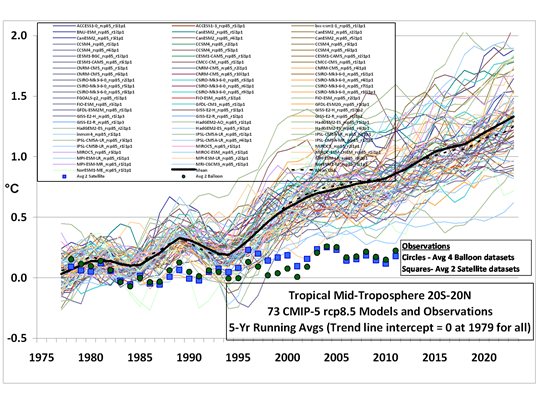
The climate models that the UNIPCC relies upon for temperature and sea rise levels are themselves extreme. Last year Dr Roy Spencer charted 73 climate model predictions of temperature rise against the actual data for over the last 30 years.

Every single one of the climate models is running too hot.

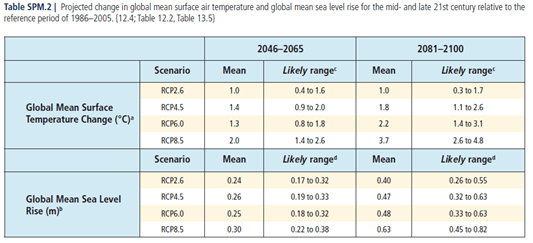
On that basis, the even the mid-point predicted temperature rise of the weakest of the above models – the 1.0 degree of warming from RCP2.6 – appears too extreme. As a consequence the predicted 40cm mid-point range for sea-level rise to 2100 as a consequence of this temperature rise also appears extreme.


Possible consequences of the extremism

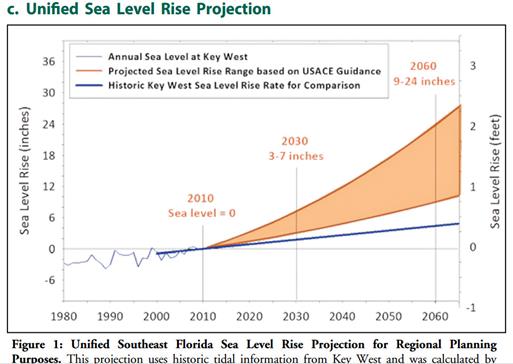
Professor Wanless is chairs the science committee for the Miami-Dade Climate Change Advisory Task Force. At the website is a 2008 presentation from him on expected sea level rise. Here Professor Wanless used the 2007 UNIPCC projection of 20cm to 50cm sea level rise by 2100, and then said (due to unaccounted for ice melt) he expected that rise to be at least 3-5 feet (0.9-1.5m) and possibly 7-9 feet (2.1-2.7m). Six years later he has moderated his views, but still believes sea levels will rise by at least twice the scientific consensus. The 2012 “Southeast Florida Regional Climate Change Action Plan” appears to reflect these views extremist views. Figure 1 on page 7 has projections for sea level rise.

Above the UNIPCC estimated sea levels rises of 17cm to 38cm by 2046-65 compared with 1986-2005. Eye-balling to the graph shows a range of 18-38 cm in 2045 and 28-75cm by 2065. It appears to be way out of line. Please note that the caption is for “Regional Planning Purposes”.

Personal Note

I do not believe that the responsibility for extreme views gaining currency lies with individuals who promote them, but with the abandonment of pluralism in favour of institutionalised dogma. The view that human-caused catastrophic global warming is either extremely likely or certain is accepted without question. Any questioning of the scientific authority has been treated as equivalent to denial of established fact, and with a manufactured moralistic contempt akin to that meted out to those who question the truth of the holocaust. As a result, the extremist and ill-supported pronouncements of scientific “experts” are not questioned. Instead they made headlines throughout the world. The solution is to actively promote pluralism and questioning in science.

Finally, all first time comments are moderated. Please use the comments as a point of contact. If you request for it not to be published, I will not do so provided it is not openly abusive.

I work hard to be accurate. If you can demonstrate that any of the above is inaccurate, I will correct it. If you disagree, I will publish the comment, though I reserve the right to edit out abuse and may respond. It is important that others can compare and contrast the arguments.


Kevin VS Marshall


Lewandowsky – Climate Scientists should be listened to because they are wrong

Stephen Lewandowsky has another couple of papers out. From e! Science News

Scientific uncertainty has been described as a ‘monster’ that prevents understanding and delays mitigative action in response to climate change. New research by Professor Stephan Lewandowsky of the University of Bristol, and international colleagues, shows that uncertainty should make us more rather than less concerned about climate change. In two companion papers, published today in Climatic Change, the researchers investigated the mathematics of uncertainty in the climate system and showed that increased scientific uncertainty necessitates even greater action to mitigate climate change.

The scientists used an ordinal approach — a range of mathematical methods that address the question: ‘What would the consequences be if uncertainty is even greater than we think it is?’

And

Professor Stephan Lewandowsky, Chair in Cognitive Psychology and member of the Cabot Institute at the University of Bristol, said: “We can understand the implications of uncertainty, and in the case of the climate system, it is very clear that greater uncertainty will make things even worse. This means that we can never say that there is too much uncertainty for us to act. If you appeal to uncertainty to make a policy decision the legitimate conclusion is to increase the urgency of mitigation.”

Co-author, Dr James Risbey of Australia’s CSIRO Marine and Atmospheric Research, said: “Some point to uncertainty as a way to minimize the climate change problem, when in fact it means that the problem is more likely to be worse than expected in the absence of that uncertainty. This result is robust to a range of assumptions and shows that uncertainty does not excuse inaction.”

If we assume that catastrophic climate change is a fundamental truth, the authors are right. The task of climate science is to reveal that truth to the world. If that truth cannot be accurately accessed, then the consequences of unmitigated climate change will be greater than if they could be. But if there is no fundamental truth to be revealed then all what you have is a number of dogmatic people who cannot accept that their theories are not backed by the evidence. The failure to understand the path to climate catastrophe might be due to no climate catastrophe in prospect. Persistent failures increase the likelihood that the belief in the fundamental truth of climate catastrophism is just a cult. Circumstantial evidence is in the unique methods and language of the “science”; moral certitude; failure to appreciate climate change could be a trivial problem; belief in their infallibility; reliance on belief in science, as opposed to accepting science that fails to be falsified; failure to recognize that those who disagree may also have valid viewpoint; and the denigration of anybody who asks questions as heretics deniers. Further, the solution is always the same, fitting in with an extremist socialist-environmentalist world view. There is no recognition that mitigation policies can fail. If mitigation can avert climate catastrophe it is a tautology to state that if mitigation is only practiced in a few minor emitting countries, those countries will bear all the cost of policies, and future generations will endure virtually all the consequences. The same is tautological truth applies if mitigation is practiced globally, but fails to reduce emissions.

The pay walled papers are here and here.

Kevin Marshall

Update :Jo Nova has a satirical take on the latest Lew papers.

New Lewandowsky study finds Uncertainty Monster under his bed, will cost billions

Smoking Causes Lung Cancer therefore Climate Change will cause more Extreme Weather: Unpicking a pseudo-analogy

A few weeks ago Stephen Lewandowsky, James Risbey and Naomi Oreskes posted at the Conversation “Climate change is not all disaster and uncertainty“. This compared the strongly-supported hypothesis that “Smoking causes lung cancer” with the hypothesis that “climate change will cause extreme weather events”. Below is the comment I posted.

You make an analogy between climate change and smoking causes lung cancer. It is worth exploring this analogy further. According to Cancer Research UK 86% of people who caught lung cancer in 2010 were smokers. A smoker is 15 times more likely to catch lung cancer than somebody who has never smoked. Put another way, only 1 in 15 smokers who caught lung cancer would have caught it anyway – and you cannot identify which these people are. Also lung cancer has a 90% mortality rate and can be diagnosed by professionals very clearly. It is a nontrivial problem both for the people experiencing it and there are large numbers dying from it.

http://www.cancerresearchuk.org/cancer-info/cancerstats/types/lung/riskfactors/

Climate policy is about prevention of nontrivial adverse climate change, predicted to happen many years into the future. With less than one degree of warming so far (which might be partly natural), the severe effects are difficult to detect amongst all the infrequent naturally-caused extreme events, with natural cycles and fluctuations. There are two ways that this differs from lung cancer.

Firstly, somebody either has lung cancer or not. There is no trivial in between. In between human caused climate change being false and there being an apocalyptic problem, there is a huge range of possibilities. This is from the highly trivial through being a significant problem, to being serious enough to justify global mitigation policy.

Secondly, whereas for a smoker who catches lung cancer it is most probably caused by smoking, an extreme weather event occurring now will most probably not be caused by climate change, whereas (if the predictions are correct and no successful policies are implemented) one happening in 2100 will most probably will be.

That leads to a dual problem. Extreme weather events may become much more extreme in the future, but this will only be detectable over large numbers of similar events at the present time. Even that will not necessarily point to a problem severe enough to justify the adoption of mitigation policies.

If there is false attribution or exaggeration for promotion people will smell something quite different than the climate science. There has been huge damage to climate change cause in England from the prediction in 2000 that children will grow up never knowing what snow is, or in the USA by saying hurricanes would become more frequent and stronger after Katrina. As a result of these and other failures many people will fail to believe anything that is said by competent scientists. Unless more objective and scientific methods are discerned for isolating the anthropogenic climate change signal than the hollering of climate activists, then the message will not get across. Even for those not turned off, the failure of the short-term predictions will conclude (like most sceptics) that it is a far more trivial problem to that which the climate consensus portrays.

Kevin Marshall

Head of the IPCC Rajendra Pachauri misleads on pause in Global Warming

Prof Rajendra Pachauri made a number of misleading statements (or was misquoted) in an interview with BBC Environment analyst Roger Harrabin, This includes:-.

He also dismissed suggestions of a slowdown in global warming.

“There’s definitely an increase in our belief that climate change is taking place and that human beings are responsible,” he told me.

“I don’t think there is a slowdown (in the rate of temperature increase). I would like to draw your attention to the World Meteorological Organization which clearly stated on the basis of observations that the first decade of this century has been the warmest in recorded history.

The first sentence is wrong. It is contradicted by another BBC article “Global warming pause ‘central’ to IPCC climate report.

The second sentence is a statement about beliefs. It is hearsay at best, the antithesis of stronger evidence.

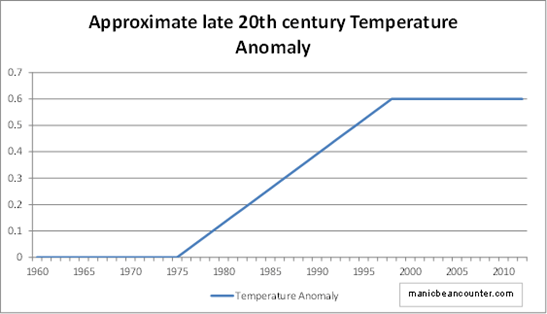
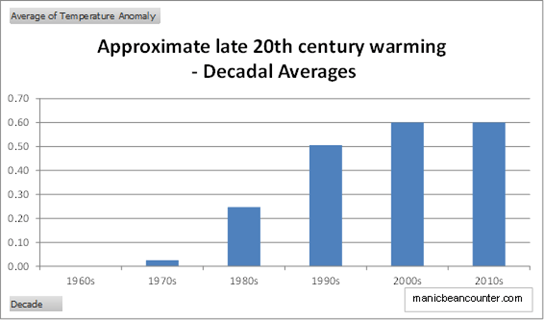
I showed why the third and fourth sentences are a dodge around the warming pause last month. In a stylized form temperatures were flat to 1975, rose through to 1998 and have stalled since.


From this, you can show that there has been five decades of rising temperatures. It is misleading to say that global warming is still happening when it has paused.


Maybe the leader of the IPCC is, at least in part, a victim of the zealous support of climate alarmism that the BBC shows, in betrayal of its’ charter.

I doubt if there will be a falling out of the head of the UNIPCC with the BBC. After all the caption beneath the photograph is a falsehood that Pachauri has been peddling for a few years now.

Prof Pachauri shared the 2007 Nobel peace prize for his work

This is what you will find at the Nobel Prize Website

The Nobel Peace Prize 2007


Intergovernmental Panel Photo: Ken Opprann

on Climate Change (IPCC) Albert Arnold (Al) Gore Jr.

Pachauri collected the Nobel Peace Prize as head of the IPCC. He did not share the prize. The inaccuracy is the same as that shown in reporting the lack of warming. It shows something more significant than what is there. At least the BBC puts that it is a Peace Prize.


Ed Davey’s anti-science, anti-British and anti-Liberal attack on Climate Sceptics

Ed Davey, Secretary of State for Climate and Energy has, according to the Telegraph recently said

“Of course there will always be uncertainties within climate science and the need for research to continue.

I agree that there are uncertainties with climate science. But if you only allow believers in that “science” to contribute, without any training in decision-making under conditions of uncertainty, then the conclusions drawn out of that research will be wrong.

“But some sections of the press are giving an uncritical campaigning platform to individuals and lobby groups,”

Such as the Guardian, the BBC, or central government departments? It can work both ways.

“This is not the serious science of challenging, checking and probing.”

Are you speaking of sceptics or of climatology? You must first establish that climatology is not just a science, but is a science of the highest standards.

“This is destructive and loudly clamouring scepticism born of vested interest, nimbyism, publicity seeking contraversialism or sheer blinkered, dogmatic, political bloody-mindedness.”

Matthew 7:3-5 says

Why do you stare at the splinter in your neighbour’s eye, but ignore the plank in your own? How can you say to your neighbour “Here – let me get the splinter out of your eye,” when you’ve got the plank in your own? You’re just play-acting! First take the plank out of your own eye, then you’ll see clearly to take the splinter out of your neighbour’s eye.”

These two thousand year old words, translated by Tom Wright (Britain’s leading New Testament Scholar and former Bishop of Durham), show the issue of climatology. Professor Stephan Lewandowsky or Bob Ward, or desmogblog are some of the “planks” that deliberately blind and prejudice people from examining the evidence, moral and political arguments for themselves. Putting in a milder fashion, you cannot say that people are wrong, or have a massively inferior argument, if you cannot first demonstrate that you are on the side of truth, or encourage others compare and contrast your arguments with the opponents. As I posted last week, there is a strong lack of a positive case for the science. As I posted last week, this should be a combination of trumpeting the short-term predictive successes, showing that climate science build on the traditions of the greatest scientists and philosophies of science and also of the moral case covered below.

“This tendency will seize upon the normal expression of scientific uncertainty and portray it as proof that all climate change policy is hopelessly misguided.”

Rubbish. Criticism of policy is often for separate reasons to scientific uncertainty. The argument is that the costs of policy are far greater than then benefits. Some of the policy might be totally ineffective, or in trying to reduce CO2 emissions may make people less capable of dealing with the impacts, through making them poorer.

He added: “By selectively misreading the evidence, they seek to suggest that climate change has stopped so we can all relax and burn all the dirty fuel we want without a care.”

Sceptics say that climatologists selectively read the evidence. Many would say that increased CO2 provides net benefits, and I do not come across any blog that we should create general pollution without a care. Many of the leading sceptic blogs (WUWT, BishopHill, Jo Nova) accept that increased greenhouse gases will lead to some level of warming, but not a significant one. As put by Warren Meyer, most sceptics deny the catastrophe, not the basic science.

“Those who argue against all the actions we are taking to reduce emissions, without any serious and viable alternative, are asking us to take a massive gamble with the planet our children will inherit, in the face of all the evidence, against overwhelming odds.”

I believe that morally politicians should act like medical professionals. They should have a duty of care towards the patient. That duty should be based on the reasonable expectation that treatment will leave the patient better off than not being treated at all. If anyone claims that climatology and public-policy making have the same level of knowledge of diagnosis and treatment as medical professionals and pharmacy on such ailments as common cancers or arthritis, then they are wrong. I would say that climate “ethics” needs to catch up with medical ethics as well.

Finally, let me point to four areas where Ed Davey is severely out of line.

First, my late father voted for the Liberal Party for over 50 years at every election – bar at one local election where no Liberal was standing. Then he voted for the underdog Conservative candidate. He believed in the consensus through seeking the middle ground, a thoroughly British trait. This middle ground was the opposite of the extremism of climatology, which is increasingly about demeaning the opposition and denying them a platform to speak.

Second, a virtue of English Common Law is that of letting the accused have the same rights of presentation, and to have the same rules of evidence as for the prosecution. This is not in the belief that the most notorious criminals can get off scot free. It is because the most guilty who proclaim their innocence will most convince an independent jury of their guilt as their lies and ridiculous stories unravel. On the other side, if the prosecution, convinced of the guilt of the accused perverts or supresses the evidence, the later unravelling of the case will undermine the rule of law. It did with the Guildford Four and the Birmingham Six, men falsely sentenced for heinous crimes that they did not commit. Another example is that I strongly believe that those who do not accept that around six million Jews were massacred in the Nazi genocide should not be silenced. Rather, comparing their evidence will the overwhelming evidence of the historical truth will demonstrated that there is no debate, and those deniers are have an inability to assess the evidence. Silencing such views will lead to false conspiracy theories that there is something to hide.

Third, is the British sense of fair play. The very British idea of having a level playing field is not unconnected to the fact that most major sports are British inventions, or have been strongly influenced by British rule-making. Winning is not at any cost is not the point. It is playing the game to the best of one’s ability. There is a lesson in life as well. Somebody might be far superior in a sport, or in science, or in any intellectual field, than anyone else alive. But it is only by going head-to-head with others that everyone will be convinced. But in losing in sport, we go back and try harder. If we are beaten in science, we are forced to re-examine our conclusions, and may improve. Finding out where we went wrong, or how to improve from failures is a general lesson in life. Within wider society it leads to improvement.

Fourth is something very anti-British. The most evil powers, whether governments, religious cults or tribal gangs, are those who assert their power by belittling and silencing others. Ed Davey and climatologists are not in their league by any means. But they fall into a false sense of superiority by demeaning others. It is a very human trait to practice this, but has mostly held back humanity.

The previous Secretary of State, Chris Huhne, earlier this year convicted of perverting the course of justice, was similarly dogmatic. Why there should be two ministers so at odds with the older philosophy of the moderate Liberal Party traditions is the subject of the next post.

Green Energy Unicorns

It is not just sufficient to diagnose a problem and get some noisy activists to think up a solution. It is not even sufficient to get some of the greatest economists to devise the theoretically ideal policy. It is also necessary to drive that policy through to a conclusion. Donna Laframboise provides a catalogue of recent green energy failures. It is far from being an exhaustive list, but it amply illustrates that even if we are facing an imminent climate apocalypse, these green policies are not only useless, they are making us poorer, and thus making the situation worse.

Donna Laframboise's avatarBig Picture News, Informed Analysis

Everywhere it has been tried, green energy is costly, unreliable & financially unsustainable over the long term. Here’s a reading list for those still in doubt.

I’ve recently been writing about the fossil fuel divestment movement which, according to someaccounts, is “sweeping” US college campuses. In the opinion of the idealistic young activists involved in this movement, fossil fuels are passé.

“It’s time for a new age of renewables” they declare. College endowment funds should invest in “renewable energies” instead.

Why do we hold on so firmly to green fantasies? Why won’t we admit that currently available renewable energy sources don’t measure up?

This past March, the chief investment officer for California’s state pension plan called investments in clean technology “a noble way to lose money.” It’s possible, he acknowledged, that some of these investments might turn out to be profitable on a timescale of…

View original post 694 more words

Three Positive Ways to Counter Climate Denial

Anyone who reads this blog will know that I am deeply sceptical of the whole global warming scare. That stems from trying to compare and contrast the arguments through understanding different positions. One element I found coming to the fore is trying to shut down any criticism by maligning of opponents through untruths, derogatory comments and questioning of motives. A recent example of is Paul Syvrets’ attack on Jo Nova, a Vince Whirlwind’s follow up to my comment.

Suppose for one moment that alarmists of being on the side of science, and hold the fundamental truth about the coming apocalypse unless the human race repents of its evil ways. As climate science is based on public relations, I would suggest that the whole approach of attacking opponents and shutting them out of the media is a PR disaster. Tell somebody they are wrong and smearing them will get their backs up and help persuade others you are not on the side of truth. Now scientific models are too difficult for the lay public to understand, and outputs ambiguous to the uninitiated.

Let me suggest three, very positive, ways of winning over people from the “false prophets of climate denial”.

First is building up a track record in predictions

As I have often read, only true climate scientists can understand the science. But people will understand when through the using the climate models clear, bold predictions are made that later come true. Nobody will expect a 100% hit rate, but a good track record will be sufficient to convert the most waverers.

Let me help out with some examples, which I am sure some climate scientists can complete.

  1. More than twenty years ago the models predicted a continuing upward trend in global surface temperatures if greenhouse gases emissions were not severely curtailed. Emissions have exceeded our worst expectations so…..
  2. In 2000 in both Britain and Germany, it was predicted that children would grow up no knowing what snow was. The decreasing can trend can be found ……
  3. Following the massive heat wave in Europe in 2003, it was predicted that would extreme heat waves would become more frequent. This trend is shown….
  4. Following Hurricane Katrina, it was predicted that would be an upward trend in these severe storms. The evidence can be found……
  5. In 2007 the UNIPCC predicted that climate change could lead to a drop fall in crop yields by up to 50% in some African countries by 2020. The latest evidence to support this prediction consists of…..
  6. One of the most visible signs of warming is the disappearing snows of Kilimanjaro. This continuing trend can be found…..
  7. One of the direst predicted consequences of global warming is accelerating sea level rise. The latest data demonstrating this trend can be found at…
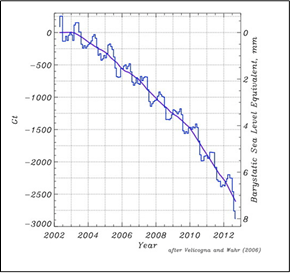
  8. One of the biggest contributors to sea level rise is melting of the polar ice caps. Velicogna and Wahr 2006 predicted that the contribution to sea level rise from Greenland alone would rise from zero to over 1mm per annum between 2002 and 2012. The actual data to support this is to be found……


Second is that the doubters believe that climate scientists practice pseudo-science.

To counter this

  • Show that the methods are in the tradition of the greatest scientists like Newton, Pasteur, Einstein and Feynman. Where different, explain why climate science’s methods are superior, or more appropriate.
  • Define clearly the boundaries of climate science, and the different skills and specialisms within it. People might then start appreciating what how complex and diverse the subject actually is.
  • Demonstrate how climate science learns from the different philosophies of science.
  • Demonstrate how climate science utilizes basic distinctions of philosophy. For instance the differences between open and closed questions, between positive and normative statements and between a priori and empirical statements.
  • Show how, like in the field of medical science, climate science is advancing and over-turning or modifying previously held views through better quality analysis.
  • Climate science needs to draw upon a number of areas. Demonstrating how the science draws upon specialists in statistics, forecasting and other disciplines where it overlaps.
  • Show how proper controls are being implemented and adhered to in order to prevent any conflicts of interest from, for instance, the same people creating temperature sets who are also the trying to vigorously promote their theories.

Third is the support of policy controls

Medical practitioners and pharmaceutical companies fully realise that whilst medication properly diagnosed can deliver huge benefits, it can also generate great harm if there is not a proper diagnosis, or the incorrect medication or dosage of that medication was prescribed. Similarly, there would be great alarm if the armed forces did not have proper control of their weapons, so that rogue elements could seize control of those weapons to start an insurrection.

From a policy point of view, the UNIPCC in the Summary for Policymakers in 2007 that

Peer-reviewed estimates of the social cost of carbon in 2005 average US$12 per tonne of CO2, but the range from 100 estimates is large (-$3 to $95/tCO2).

Given that it would be totally immoral to impose policy whose consequences are more damaging that the issue it is supposed to alleviate, proposals for the proper implementation and control of policy are to be found ……

I welcome any discussion or debate on these issues. If you have more examples, or help with links, please use the comments.

Kevin Marshall

Update 29/05/13 23.56

To encourage debate , left the following comment at http://watchingthedeniers.wordpress.com/six-aspects-of-denial/

In any realm of life, calling people names, or making claims that they think are false will only get their backs up. Further blocking them from any access to the media will generate the idea they are a victimized minority.
The best public relations present positive images about one’s own ideas. Negative images of opponents always backfire. I have made three suggestions how this might be done.
First, loudly proclaim the predictions of climate change that have come true.
Second, counteract the claims of pseudo-science by demonstrating that climate science not only builds of the greatest scientists and philosophies of science, but enhances them.
Third, disperse the claims about pursuing high-risk policies, by proposing safeguards and audit checks against them being usurped by profiteers and swindlers.
See https://manicbeancounter.com/2013/05/29/three-positive-ways-to-counter-climate-denial/

Update 30/05/2013 03.00

Watching the Deniers says:

Nice comment. Thanks for posting it.

I hope this leads to positive discussion, and recognition that there are legitimate positions that can be taken contrary to one’s own. 

Update 30/05/2013 00.19

Have also contacted desmog.blog at http://www.desmogblog.com/contact_us with the following.

As you are experts in public relations, you must realize that negative images against opponents will create a group of “victims” who will garner support from the alleged “oppression” by the media. Much better is to present positive image of climate science. I have suggested three ways this could be done at my blog.

Three Positive Ways to Counter Climate Denial

Best Regards
Kevin Marshall

Update 02/06/2013 20.40

Posted to the Guardian  here:-

Why all this negativity? Imagine if a similar public relations campaign was launched against those who deny that six million Jews died in the Holocaust? Headline would be

“Deniers of the Holocaust are wrong because they disagree with 99.9% of expert historians.”

It would have just created an underclass of believers in denial, claiming that the “truth” was being suppressed. I know that projections about the future are more difficult to persuade people of than historical facts, but a positive public relations campaign might include:- 
1. Short-term predictive successes. A track record of bold predictions that turn out true is highly persuasive.
2. Showing that climate science is building on traditions of the greatest scientists and philosophies of science.
3. Third is the support of policy controls. Many nay-sayers point to alleged policy failures that enrich businesses at the expense of the poor. Campaigning for independent auditing of policy outcomes would show concern for wider society.