Lewandowsky’s Recursive Corruption of Science

Wattsupwiththat have a guest post by Brandon Shollenberger on “Stephan Lewandowsky and John Cook – making things up“. It details how the Recursive Fury paper elements that are fabricated. This is a comment just posted.

The “Recursive fury” paper fails to consider an alternative hypothesis. If psychology expert L came along and said that you should not be listened to about subject A, which you believe strongly about, because:-

(a) Nearly all the “experts” disagree with you.

(b) Some fellow believers allegedly have political beliefs that the person L does not like.

(c) A higher proportion of your fellow believers than L’s group allegedly hold other beliefs that most people view as being “nutty

Then you would be somewhat upset – a normal, human, reaction. If you later found out that the claims about the experts were not true, the questions were biased and the statistical conclusions were contradicted by basic statistical analysis, you would be justifiably furious.

Like with people who attribute every extreme weather event to global warming, Lewandowsky bases his case for ignoring sceptical opinions on a distorted opinion of corrupted evidence. When it gets a very predictable response, he interprets this with a distorted opinion of corrupted evidence. The only recursive bit is in the methods Lewandowsky employs in corrupting science.

Lewandowsky et al. 2012 (LOG12) – Questionnaire examined

The latest paper from Lewandowsky is

Conspiracist ideation in the blogosphere in response to research on conspiracist ideation : Stephan Lewandowsky, John Cook1,, Klaus Oberauer and Michael Hubble

The authors explain

This article analyzes the response of the climate blogosphere to the publication of LOG12. We identify and trace the hypotheses that emerged in response to LOG12 and that questioned the validity of the paper’s conclusions. Using established criteria to identify conspiracist ideation, we show that many of the hypotheses exhibited conspiratorial content and counterfactual thinking.

In order to respond, it is first necessary to gain a proper understanding of the original questionnaire and the conclusions the authors reached. This posting starts with examining the forty questions to see if the questions were balanced or designed to support the authors’ hypotheses. The full list can be found at Joanne Nova’s website.

Free-market Politics Questions

1. An economic system based on free markets unrestrained by government interference automatically works best to meet human needs.
2. I support the free-market system but not at the expense of environmental quality
3. The free-market system may be efficient for resource allocation, but it is limited in its capacity to promote social justice
4. The preservation of the free market system is more important than localized environmental concerns
5. Free and unregulated markets pose important threats to sustainable development
6. The free-market system is likely to promote unsustainable consumption

There were two areas that the questionnaire tried to test around the motivated rejection of climate science – free-market ideology and conspiracist ideation. The first six questions dealt with belief in free markets. There are a number of issues.

First, those who believe in free-markets are libertarians. They value individual liberty above all else and see laissez-faire capitalism as the only means to achieve this. The reason for many rejecting climate change policies is a belief that it would lead to a suppression of individual choice. They can also see that those who oppose the “scientific” consensus are stigmatized, and criticism suppressed. They might see historical parallels in the rise of communism, Nazism and in the McCarthyist era. Without such questions, rejection of the consensus could be viewed as much shallower and more dogmatic than is actually the case.

Second is that these questions are framed by somebody who clearly does not understand nor like the market mechanism. Most free-marketers would not view it a structural system, but a spontaneous order. Nor would they see a market mechanism as being antagonistic to development or preserving the environment.

Third is that there are a large group of people who may general reject environmentalism, but be quite centrist in their political views. Conversely, there might be some people who are highly antagonist to capitalism, but also sceptical of global warming. Without questions for a broad range of political views, responses will be more polarized than is actually the case.

In conclusion, these six questions seem aimed at marginalizing sceptics.

Conspiracy Theory Questions

A total of 15 questions

7. The Iraq War in 2003 was launched for reasons other than to remove WMD from Iraq
8. A powerful and secretive group known as the New World Order are planning to eventually rule the world through an autonomous world government, which would replace sovereign governments
9. SARS was produced under laboratory conditions as a biological weapon
10. The US government had foreknowledge about the Japanese attack on Pearl Harbor, but allowed the attack to take place to as to be able to enter the Second World War.
11. US Agencies intentionally created the AIDS epidemic and administered it to Black and gay men in the 1970’s
12. The assassination of Martin Luther King Jr was the results of an organized conspiracy by US government agencies such as the CIA and FBI
13. The Apollo Moon landings never happened and were stages in a Hollywood film studio
14. Area 51 in Nevada US is a secretive military base that contains hidden alien spacecraft and or alien bodies
15. The assassination of John F Kennedy was not committed by the lone gunman, Lee Harvey Oswald, but was rather a detailed, organized conspiracy to kill the President
16. The US government allowed the 9/11 attacks to take place so that it would have an excuse to achieve foreign (eh wars in Afghanistan and Iraq) and domestic (eg attacks on civil liberties) goals that had been determined prior to the attacks
17. In July 1947, the US military recovered the wreckage of an alien craft from Roswell, New Mexico and covered up the fact
18. Princess Diana’s death was not an accident but rather an organised assassination by members of the British royal family who disliked her
19. The Oklahoma City Bombers, Timothy McVeigh and Terry Nicols did not act alone but rather received assistance from Neo Nazi groups
20. The claim that the climate is changing due to emissions from fossil fuels is a hoax perpetrated by corrupt scientists who wish to spend more taxpayer money on climate “research”.
21. The Coca Cola company intentionally changed to an inferior formular with the intent of driving up demand for their classic product, later reintroducing it for their financial gain.

When I first looked at these questions it struck me that some were related to the climate issue. Therefore I left them out as biasing the results.

I think there are five broad categories of question, which I have colour-coded.

Blue questions are neutral to the climate change issue.

Red questions are those that see the climate consensus as some sort of conspiracy.

Green questions are those that see motivations for rejecting the climate consensus as some sort of conspiracy.

Pink Questions are conspiracies that those who reject the climate consensus might believe in, but unrelated to the climate issue.

Brown Questions are conspiracies that those who accept the climate consensus might believe in, but unrelated to the climate issue.

What is clear is that there are no questions that ask if scepticism was underpinned by of some sort of conspiracy. A common theme is that denial being promoted by secretive funding by fossil fuel interests. For instance searching “Koch” on Desmogblog reveals 2440 hits. With such a question, there would have been symmetry. I have rated question 7 (WMD) as possibly appealing more to the climate consensus types, as they tend to be more to the left of centre and certainly are mostly anti George Bush. This was the only question NOT reported in the LOG12 paper. So two conspiracy-type questions specifically appealing to sceptics, and none (reported) that no conspiracy-type questions specifically appealing to “pro-science” types out of 14 would have been sufficient to bias the results towards “finding” that sceptics are more likely to believe in conspiracy theories.

Climate Change Science Questions

22. I believe that burning fossil fuels increases atmospheric temperature to some measurable degree
23. I believe that the burning of fossil fuels on the scale observed over the last 50 years has increased atmospheric temperature to an appreciable degree
24. I believe that the burning of fossil fuels on the scale observed over the last 50 years will cause serious negative changes to the planet’s climate, unless there is a substantial switch to non-CO2 emitting energy sources
25. I believe that the burning of fossil fuels on the scale observed over the last 50 years has caused serious negative changes to the planet’s climate

There is an complete absence of questions about future projections of accelerating warming; or of future catastrophes well in excess of anything so far observed; of the strength of the science or the uncertainties; our trust in what scientists are telling us; nor of the ability of policy to do anything successfully combat it. These are the questions that many sceptics, including myself, are grappling with. As Warren Meyer concludes, it is the projected catastrophe that sceptics “deny”. Joanna Nova, Lord Monckton, Prof Richard Lindzen, Anthony WattsBishop Hill (Andrew Montford), Prof Bob Carter and Lord Nigel Lawson all recognize to some extent that humans might be causing some global warming and that this may continue.
Many, like Lord Lawson (and myself) conclude that the policies to “combat climate change” are both ineffective and hugely harmful to economic prosperity, yet there is no recognition of this aspect. The whole thrust of the questions appears to be one of polarization, making sure that those who reject the consensus is as large as possible.

Environment questions

26. The problem of CFC;s is no longer a serious threat to the ozone layer
27. The problem of acid rain is no longer a serious threat to the global ecosystem

Two questions on the environment, that quite rightly see where people stand on other environment issues.

Personal Questions

28. In many ways my life is close to my ideal
29. The conditions of my life are excellent
30. I am satisfied with my life
31. So far I have gotten the important things I want in life
32. If I could live my life over I would change almost nothing
39. Out of 100 people in your neighborhood, how many do you think earn more than you do?
40. Out of 100 people in your country overall, how many do you think earn more than you do?

Six psychology questions. They do not appear in the conclusions of the paper. This might be because there was no relationship to respondents’ self-esteem and their views on climate science.

Established Science Questions

33. The HIV virus causes AIDS
34. Smoking causes lung cancer
35. Human CO2 emissions cause climate change
36. Out of 100 medical students how many do you think believe that the HIV Virus causes AIDS
37. Out of 100 medical students how many do you think believe that smoking causes lung cancer?
38. Out of 100 climate scientists how many do you think believe that human CO2 emissions cause climate change?

There are two sections. Three questions on what the respondent thinks about three propositions and three questions of about where the respondent thinks the scientific consensus lies. The questions are somewhat sneaky. That HIV causes AIDS and smoking causes lung cancer is quite clear to the vast majority. But human CO2 emissions causing “climate change” is something more ambiguous to anyone who thinks about the issue. Does a small amount of warming really mean a change in the climate? Is it a change of climate system – from rainforest to savannah for instance? Or is it the same climate type, but with more extreme weather events. As a political concept in the minds of the authors it might be quite clear, but to respondents who have a less polarized view of the world it may not be so clear. The ordering is quite clear though. The questions are viewed by the question-setters are equally valid, so answering the third question differently is indicating to the respondent something of how they are viewed.

Conclusions

The questions appear to have been devised to obtain verification of the hypothesis that rejection of climate science is motivated by belief in free-market ideology and due to a conspiracist ideation. In more colloquial language, the questions were biased to support the view that denial of climate science is due to free-market ideologues who are incapable of evaluating the evidence. The questions on free-market ideology betray the question-setters prejudices. The questions on conspiracy theories are show something of the question-setters own beliefs or a deliberate ploy to bias the results in the desired direction. The questions on climate science show a desire to show consensus amongst pro-science views, along with trying to ignore the possibility that policy questions are a matter of contention as well as the “science”.

Kevin Marshall
Is the EU’s proposed 20% of Spending on “Climate” just hype?

Bishop Hill thinks that the new EU budget is a funding bonanza for the Greens. I think it is just hype. My comment on the blog was:-

Page 6 of the Conclusions

Climate action objectives will represent at least 20% of EU spending in the period 2014-2020.

But looking at annex 1 on page 46 there is no separate category for climate. Of the EUR 960bn budget for 2014-2020

1. Smart and Inclusive Growth = 451 (47%)

2. Sustainable Growth: Natural Resources = 373 (39%)

The rest (Categories 3-6) = 136 (14%)

The EU no longer identifies agriculture as by far the biggest component. That would mean some obvious questions about why they spend so much on an increasingly minor component of EU output. Instead the spin doctors hide it in “growth” categories. The climate commitment is then broadly defined, to include subsidizing bio-fuels and paying farmers to grow trees instead of farming their land. The vast majority of the money will do nothing to “save the planet”. It is the environmentalists who should be crying foul here. Along with anybody who thinks claiming 86% of the budget is on “growth” is a highly misleading claim.

This is verified by two quotes courtesy of Joanne Nova verifies my opinions of earlier. First from WWF:-

International aid received a disproportionately large cut while investment in connecting Europe’s energy infrastructure, a move that would allow better pooling of renewable resources, was cut from €12bn to €5bn.

Second from European Environmental Bureau :-

EEB Secretary General Jeremy Wates said, “This is the worst of both worlds: a smaller budget that is explicitly dedicated to keep pumping money into Europe’s most wasteful and harmful policies and projects, in particular the CAP.”

The EU has adopted a re-branding of budgets. They know that the Common Agricultural Policy is unpopular and is anti-growth and anti-jobs. Historically it has encouraged massive spending and trashing of the traditional countryside to produce food that nobody wants. To get rid of the food mountains, CAP paid farmers not to produce. Now they will make the claim that this deadweight spending it pro-growth and pro-environment. It is just a re-branding exercise.

Are Climate Change and Obesity Linked?

Judith Curry has a (somewhat tongue-in-cheek) look at the links between climate change and obesity.

One of the two references is to the care2 website.

Consider the three alleged “links” between climate change and obesity that Dr Curry summarised:-

  • Rising inactivity rates because of hot temperatures
  • Drought-induced high prices on healthy foods
  • Food insecurity promotes unhealthy food choices

Rising inactivity is commonly thought to be due to less manual work, the rise of the car and evermore staring at the TV or computer. If a rise of 0.8C in temperature were a major factor then in Britain you would see (for instance) the Scots being more active than those in the South of England, or people being more active in winter than summer. In both cases the opposite is true.

Drought-induced high prices would have to show that droughts were the main cause of high prices of health foods compared to junk foods. Maybe convenience and taste have something more to do with the preference for unhealthy diets. Also you would need to show that rising food prices are connected to decreasing crop yields. Biofuels may have more with the rising food prices.

Food insecurity diminishes as per capita income rises, whilst obesity increases. That is the poorest of the world have hunger as a problem, whilst the rich countries have obesity as a growing problem. Obesity may be a problem of the poor in the developed nations, but food as a whole is not a problem.

The above article is a very extreme example of

The underdetermination thesis – the idea that any body of evidence can be explained by any number of mutually incompatible theories

Kuhn Vs.Popper: The Struggle for the Soul of Science – Steve Fuller 2003 Page 46.

Kevin Marshall

AR5 First Order Draft Summary for Policymakers – a few notes on pages 1 to 8

Alec Rawls has taken the brave step of releasing the first order draft of the UNIPCC AR5 Report. Anthony Watts has republished at Wattsupwiththat.

Although Alec Rawls published in breach of signed undertakings, I comment and quote the report in the public interest. There is more than a single, unequivocal, interpretation of the data. To claim otherwise is dogma. This dogma is being used to justify policies that promote net harm to western economies, particularly the poorer and more vulnerable sections of society. In the name of this dogma, impartiality is being annulled and dissenters called nutters.

I have started with some initial observations on the first eight pages on the Summary for Policymakers – the only bit that people ever read. Like utterings from the Kremlin on the 1970s and 1980s, the coded language says as much or more than the actual words.

Major points

  1. No admission of lack of recent rise in the surface temperature record.
  2. But the lack of recent rise is accounted for by a step change in the warming in the Southern Oceans.
  3. AR4 got it wrong on decreasing precipitation in the tropics (which underlay Africagate), and they got it wrong on increasing hurricanes.
  4. Sea level rise is not accelerating. In fact the recent rise since 1993 is similar to the 1930-1950 period.
  5. Global glacier melt is not accelerating. Himalayas do not even get a mention.
  6. Medieval Warm Period gains more recognition than the AR4. However, recent studies will render AR5 out of date before it even published.

Page 3 Lines 21-25.
On temperatures there is a cover-up of the recent lack of warming. They cannot admit that global average temperatures have not changed for 15 years.

Page 3 Lines 38-40. Precipitation in the tropics likely increased over the last decade, reversing a previous trend from mid-70s to mid-90s. The AR4 prediction of some African countries experiencing up to a 50% reduction in crop yields by 2020 (Africagate) was based upon a belief increasing extreme drought.

Page 3 Lines 46-48

Changes in many extreme weather and climate events have been observed, but the level of confidence in these changes varies widely depending on type of extreme and regions considered. Overall the most robust global changes are seen in measures of temperature {FAQ 2.2, 2.6} (see Table SPM.1).

Translation – Saying that an extreme weather events are evidence of global warming has no scientific validity. Best measures are of global temperature, which we can’t admit have been failing to rise.

Page 4 Line 14. An admission that previous IPCC reports got it wrong on tropical cyclones getting more extreme.

Page 4. Lot of stuff on Trenberth’s missing heat being in the oceans. Oceans have been warming since 1971. The lack of warming of air temperatures since the mid-90s could be accounted for by this comment on lines 36-37

It is very likely that the Southern Ocean has warmed throughout the full ocean depth since the 1990s, at a rate of about 0.03°C per decade.

The lack temperature rise is explained by the heating up of the oceans. Global warming is now confined to the Southern Ocean. It is imperceptible, so on the Southern perimeter it is not sufficient to have stopped the increase in Antarctic sea ice from extending slightly.

Then this

Warming of the ocean accounts for more than 90% of the extra energy stored by the Earth between 1971 and 2010. Upper ocean (0–700 m) heat content very likely increased at a rate between 74 [43 to 105] × 1012 W and 137 [120 to 154] × 1012 W for the relatively well-sampled 40 year period from 1971 to 2010. Warming has also been observed globally below 4000 m and below 1000 m in the Southern Ocean, in spite of sparse sampling (see Figure SPM.1). {3.2, Box 3.1, Figure 3.2, Figure 3.3}

The very likely heating of the Southern Ocean, is based on sparse sampling?

Page 4. Line 46. Seas have very likely become saltier. That is has become less alkaline. On Page 6 lines 30-31, Ph decline is 0.015 to 0.024 per decade over last 3 decades. Call becoming less alkaline “acidification”, which is inaccurate. Oceans are heading towards Ph neutrality.

Page 5. Glaciers are globally still shrinking. No mention of Himalayas, and no mention of global acceleration. Range is “210 [145 to 275] Gt yr–1 to 371 [321 to 421] Gt yr–1“. Omit to convert these to sea level rise. 210 Gt = 0.64mm. 421 Gt = 1.29mm (Oceans = 326.2m km2 & 1 Gt water = 1 km3). In old money, glaciers are contributing 2.5 to 5.1 inches per century.

Page 5 Lines 47-49. Sea levels

It is virtually certain that over the 20th century the mean rate of increase was between 1.4 to 2.0 mm yr-1, and between 2.7 and 3.7 mm yr-1 since 1993. It is likely that rates of increase were similar to the latter between 1930 and 1950.

Translation. Sea levels are rising but not accelerating. If sea levels are a lagged response to rising surface temperatures, then (using the HADCRUT3 surface temperature data) we would expect the rise in sea levels to level off in the next few years, unless there is continued warming in the oceans.

Pages 6 to 7 Long-Term Perspective from Paleoclimatic Records

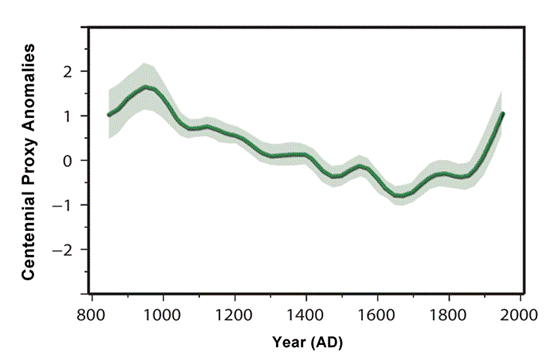
There was a medieval warm period, despite what Micheal Mann and others said in 1998 and 1999. But the MWP is less than the temperatures at the end of the twentieth century. However, due to time schedules for acceptance into AR5, they ignore Christiansen and Ljungqvist April 2012 and Ljungqvist et al 2012. The later, despite including discredited proxies such as Briffa’s notorious Yamal data, quite clearly shows rom 120 proxies that the 10th century had higher temperatures than at the end of the 20th century.


Similarly the Esper et. al 2012 of summer temperatures in Northern Scandinavia will render this part of the report out-of-date prior to it being published.

In 2006 the UNIPCC could bring themselves to bend the rules to allow in a corrupt scientific paper that suited their purposes, but this time they ignore two strong cases that undermine their case. If there is an AR6 around 2020, the UNIPCC will have to face the scientific evidence.

Page 8 The last IPCC report overestimated the impact of aerosols. The net impact of greenhouse gases and aerosols rises from 1.72 W m-2 to 2.40 W m-2. Negative forcings dramatically fall. The positive forcing impact falls, despite the major contributor, CO2 rising from 1.66 W m-2 to 1.82 W m-2. The net impact of CO2 reduces from 100% to around 75% of warming impact. It is no longer possible to talk of “rising CO2” as a shorthand for anthropogenically-caused rising greenhouse gases.

NB – the SPM file I refer to can be accessed below. Please compare my comments with the file.

SummaryForPolicymakers_WG1AR5-SPM_FOD_Final

Kevin Marshall

Wonthaggi Desal plant – Mothball to save Money and the Environment

Jo Nova has posted on the flagrant waste of money involved in the new Desalination Plant to serve the people of Melbourne. Here is my comment

Remember Topher, with his excellent “Forbidden History” video? Well, his earlier videos were on the problems of water shortage in Melbourne, and the Labour Government’s attempts to solve this problem. In his “Unpopular View #3” made in 2010, he looks at a magic solution. Rather than build a 150GL desalination plant, the Victorian Government could have spent $2.6bn on a pipeline from Tasmania producing 350GL of water. Topher further argues it would have helped Tasmanians. Why? the water is currently used for Hydro. Sold as water to the Victorians, the Tasmanians would make loads more money than they get from the electricity. This in turn could
Yet, in a huge report published, the authorities ignored this win-win solution, despite having four submissions that mentioned it.
Spend 15 minutes, and check it out for yourself.


Now for a bit of beancounting.

On these projects, the more you dig, the worse it gets.

Comparing Topher’s costs of the Tasmanian pipe-line (TPL) with your Shiny Desalination Plant (SDP).

Capital Cost – TPL $2.6bn, SDP $3.5bn (+$1.0bn?)

Annual costs – TPL $0.11bn (+up to $0.04bn running/maint costs?), SDP ($1.0bn)

Increase in Victorian Water Bills – TPL <5% (my estimate), SDP 34% (Herald Sun).

But it does not end there. The Tasmanian Pipeline would have nil power to deliver 350GL of water down a 2.5m pipe, as it would be gravity fed. The SDP requires massive amounts of power. The capital cost of wind generators to meet that power (as the project is committed to do) is estimated at $1.2bn. However, to be properly carbon neutral in operation, like the TPL, the desalination plant would require an estimated investment of approximately $6.0bn (See appendix)

Even though there is already at least $3.5bn already spent, there is a serious economic case for mothballing the desalination plant – and still building the Tasmanian Pipe-Line. In finance, one should only look forward, and let bygones-be-bygones. In politics, it is different. There are five possible scenarios.

  1. Mothball the desalination plant, and build the Tasmanian Pipe-line. Additional investment and damages might be $10bn, but is carbon neutral. Over 24 years it will pay around $2.5bn to Tasmania (paying for additional water infrastructure and/or protecting the wilderness), but with huge economic benefits for Victorian farmers with plentiful water supplies. Would require first voting out the Victorian Labor administration. Could recover $1m or so by suing the Labor administration of Victoria for gross negligence. (Financially not worthwhile, but would prevent others from doing similar mad schemes for a generation)
  2. Go ahead with the desalination plant and make it properly carbon neutral. Additional investment, and damages might be $7bn, but with around $10-$24bn of running costs, this “Green and honest” policy is expensive and electoral suicide.
  3. Go ahead with the desalination plant and pretend to carbon neutral by using actual capacity of wind farms. Additional investment, and damages might be $2.2bn, but with around $10-$24bn of running costs, this “Green and pretending to be honest” policy is expensive and would enough votes to guarantee an election would be lost.
  4. Go ahead with the desalination plant and pretend to carbon neutral by using nameplate capacity of wind farms. Additional investment for 100MW is $240m, and damages might be $1.0bn, but with around $10-$24bn of running costs, this “proclaiming to be honest” policy is expensive, but would lose votes for throwing money away.
  5. Go ahead with the desalination plant and forget about the green commitments. Additional investment is nil, and damages might be $1.0bn, but with around $10-$24bn of running costs, and this “ducking the issue” policy is expensive, but would lose less votes than being honest. However, the carbon tax at $10MWH, equates to $360,000 per annum if 150GL is produced. That is a trivial amount on the water bills and when it rises year-on-year, will hardly be noticed in the much bigger costs of the desalination plant.

So, in the interests of Melbourne and Tasmanian citizens, the best policy is to vote out the Labor Administration both nationally and locally. What will actually happen is the worst of options. Politicians will duck the issue, lumbering the Melbourne population with huge extra costs for a generation, going against national Labor policy on the environment, and failing to provide income to Tasmania, that could help Tasmanian farmers and finance the protection of the Tasmanian wilderness.

Appendix – Carbon Offsetting the Desalination Plant

The SDP will require 90-120MW to operate. Further, says Wikipedia, “additional energy will be required to pump the desalinated water from Wonthaggi to Cardinia Reservoir in Melbourne” To make the SDP carbon neutral, I will assume usage of wind power, as it is most popular type of renewable at present. To make the numbers easy I will assume 100MW is required (see below). The most popular type of renewable is wind power at present. Two such recent plants in the State of Victoria are the 192MW Waubra Wind Farm, which cost $600m, and 195MW Portland Wind Farm, projected to cost $330m. So that is $3.1m or $1.7m per megawatt plate capacity. That averages at $2.4m Wind turbines only have, however, an output of around 20% of nameplate. So to produce the average of 100MW, requires 500MW of capacity. However, if you want to be properly carbon neutral in Victoria, you need to allow for the coal-fired power stations running as back-up. True abatement levels are around 4% of nameplate. So for the SDP to be properly carbon neutral in Victoria, to offset the 100MW will require 2500MW of nameplate capacity wind farms To produce the required electricity from wind farms will mean investing $2.4m times 500 = $1.2bn. To be properly carbon neutral means investing $2.4m times 2500 = $6.0bn

Note – Power Requirements.

The figure of 100MW is calculated as follows. To produce 150GL of water assumes the plant is operating at 410 megalites per day 365 days a year. This gives the 90MW usage in normal operation. The extended capacity of 550 megalites per day is extended operation needs 120MW, which will be needed to allow some maintenance downtime. Let us assume 30 days normal downtime. So to produce 150GL in 335 days requires running the plant at 90MW for 224 days and 120MW for 91 days. Assume pumping adds around 10% to this gives and annual requirement of 36168 MWH, or a load of 99MW. Rounded is 100MW. 

Kevin Marshall 


Lewandowsky et al 2012 from two alternative philosophies of science

The following comment was made on Joanne Nova’s blog, in response to a comment by Jonathan Fordsham that Stephen Lewandowsky did not know what he was getting into by publishing his paper and the subsequent defence of that paper.

Whilst Lewandowsky may not have known what he was getting into, the aim of the paper was to find further reasons to dogmatically dismiss any views that question the established orthodoxy. It is from a view of science that sees conformity and belief in that orthodoxy as the mark of a scientist. From this conformity is the importance of opinion polls and declarations of belief by scientific bodies to this view. Promoting evidence or hypotheses that contradicts orthodoxy risks being branded a heretic or denier.

The alternative, “Popperian” view of science is that progress is often made by over-turning existing hypotheses, or subsuming them within more profound theories. Getting results that contradict hypotheses is a cause for celebration. It then raises a whole series of questions. In this view of science, belief in a specific hypothesis is dangerous. People do not like having their beliefs contradicted, and it would be hugely damaging psychologically to constantly attempt to undermine one’s core beliefs. Belief instead is in finding new understanding of the world by the most rigorous method.

The questionnaire, despite all its biases, clearly showed that the vast majority of respondents, whether skeptic or alarmist rejected cranky conspiracy theories. Lewandowsky’s theory about climate “deniers” having a conspiracist orientation was clearly contradicted by the evidence. A team of people then spent 18 months producing the paper. There is strong circumstantial evidence that the time was spent manipulating the data, choosing the best statistical methods to corroborate their story, and carefully phrasing what they wrote to claim the opposite of what the data revealed.

The “orthodox” view of science was clearly Lewandowsky’s enemy when the evidence contradicted his hypothesis. He could not publish the full results for risk of his status as a scientist and for future funding of his work. The “Popperian” view would have still allowed publication, as it falsifies a hypothesis that Lewandowsky and others believe in.

Kevin Marshall.


Lewandowsky et al. 2012 MOTIVATED REJECTION OF SCIENCE – Part 5 the Missing Links

Jo Nova has now provided the first full list of the survey questions used for the Lewandowsky, Oberauer & Gignac paper, along with a well-written summary. However, there are a number of elements that need to be emphasised

  1. If “climate denial” is on a par with “holocaust” or “smoking” denial, why not start by referencing the clearest statement of the evidence, rather than past opinion surveys? That is, if direct evidence is available, why resort to hearsay evidence?
  2. But if opinion surveys are used, then they should at least be good ones. But the primary references are Anderegg, Prall, Harold, & Schneider, 2010 (Most climate scientists believe in what they do) and Doran & Zimmerman, 2009 (97% of climate scientists = 75/77 cut from >3000 responses).
  3. Even so, surely the association with NASA Moon Landings was correct? After all, the title is “NASA faked the moon landing|Therefore (Climate) Science is a Hoax: An Anatomy of the Motivated Rejection of Science.”
    Not when 93% of all respondents gave it a firm thumbs down.
  4. When Lewandowsky says over >1100 responses, and only talks about those who “reject the science”, it surely implies that all (or at least the vast majority) of responses were from the people he is attacking? Actually, around 15% of responses were from skeptics, in terms of answers to four “climate science” questions. Professional polling organisations in the UK state these figures. But a scientific journal seems not to have insisted.
  5. There are loads of conspiracy theories. But one of the most popular in recent years is something like “Climate denial only exists as a serious force due to significant funding by oil and tobacco interests.” Lewandowsky and his junior partners cannot have missed that one.

The basic psychology behind this can be found in “The Debunking Handbook” on the front page of the skepticalscience website. Here is the justification for lying, ad hom attacks and continued government grants to a failed research program. They know the truth, and are claiming a monopoly of that truth. But to legitimately claim a monopoly it is necessary to show the corollary. The corollary is that every person who disagrees with you is wrong on everything. In empirical sciences this leaves no gap for different interpretations from the same data; no gap for the unexplained; no gap for hypotheses or assumptions to be falsified; and no gap for new data contradicting old data or forecasts. Lewandowsky’s opinion poll applies the truth in the “The Debunking Handbook” to justify one version of climate science having a continued monopoly by showing that opponents are a load of undesirable nutters. It is not just full of gaps. Like past claimants to the throne of dictators of truth, he is more wrong than his detractors.

But if you do not have a monopoly of the truth in climate science, what is the alternative? What if there is a potential future threat, which is very real, but for which there is very little firm evidence? A tentative proposal will be the subject of my next posting.

RWE Atlantic Array to gain GBP169m in Windfall Profits

I have worked in management accounts in manufacturing industry for over 25 years. In that time I have learnt that audit controls are imposed to stop the potential for fraud, by eliminating any scope for fraud. In Britain climate change arena, conflicts of interest are huge, but not considered important. This is an example of why truly independent oversight is required.

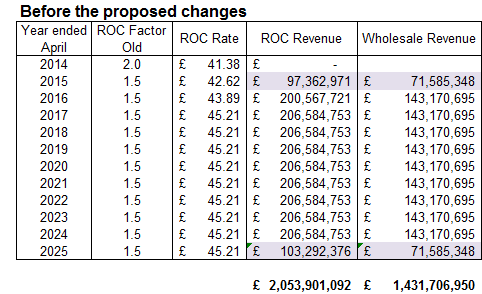
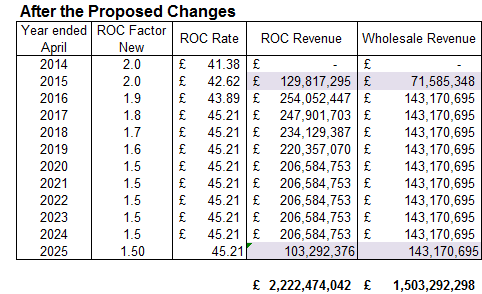
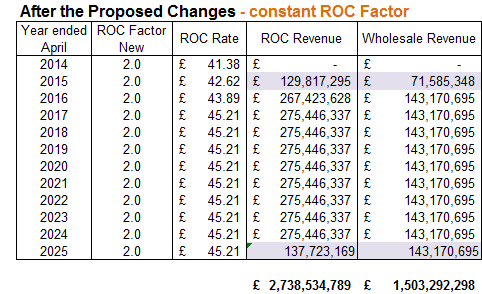
In July there was ministerial sign-off of a proposed to change the Renewables Obligation (RO) with respect to offshore wind power. Assuming that this proposal is enacted and the Atlantic Array gets the green light, I calculate will give a £169m (US$262m) windfall profit to the scheme in the first ten years of operation.

The numbers behind this are eye-watering.

The revenue from a wind farm is from selling the electricity produced to the grid. This is currently 4.7p per kwh. I will assume that this will remain constant for until 2025. This might be a heroic assumption given that under current policies Britain will be producing far less electricity than demanded, but it is beside the point of this posting. What is relevant is the subsidy from electricity bills. The RO currently gives renewables a subsidy of £41.38 per megawatt hour. This is the rate for onshore wind. However, to encourage offshore wind power, this currently attracts a factor of 2.0 times the standard rate. In 2009 this was planned to reduce to 1.5 times the standard rate from 2014*. The new proposals are to give a more gradual and delayed decrease to 1.9 in 2015/16 and 1.8 in 2016/17. I have assumed that this will continue until the 1.5 level is reached.

In Germany the average output from the wind farms is just 16.3%. However, Britain is somewhat more exposed, especially the Bristol Channel. It is reasonable to assume to that average output will be 25% of capacity. Then I have assumed that RWE will choose to build the maximum proposed capacity of 1390MW. The lower end is 1000MW.

Calculations over a 10 year period are


The difference will mean an extra £168,572,951 windfall for RWE.

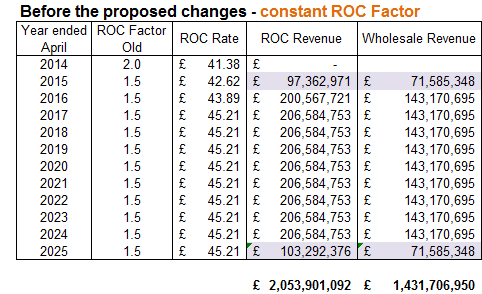
There is however a potential flaw in my analysis. If the Renewables Obligation works like the solar panels for houses, then the rate is fixed at the time of application. In other words, a scheme coming on stream in 2015 would now attract 2.0 ROC, instead of 1.5 for every year for 10 years.


If my analysis is correct, the difference will mean an extra £684,633,697 windfall for RWE over a 10 year period. That is $1.07 bn dollars. This from (the largest) of a number of similar projects.

The Bias of Climatology – Pulling Recent Strands Together

David Evans has provided a succinct explanation of why climate scientists’ theories, ignore some fundamental data. The views that feedbacks amplify the effects of CO2 (see Evans’s diagram below) is due to a highly selective reading of the data in a number of different ways.


Now we need to pull the recent strands together.

On actual temperature history we are getting evermore examples of data manipulation, whether on US temperatures (A Watts), Australian Temperatures (See Jo Nova), or the GISSTEMP global surface temperatures (Steven Goddard).

On past temperature history, we have the famous hockey stick graphs, starting with Mann et al in 1998 and culminating in the recent Gergis et al Australasian temperature reconstruction. All need a combination of one, or a few, very poor data sets that are promoted to prominence by statistical techniques unique to climatologists, and ignoring better quality data sets.

Something else needs to be added to the mix to obtain the high role for feedbacks – climate modelling. If recent temperature trends are exaggerated AND past temperature fluctuations smoothed out, then running a model that tries to look at relative influence of natural and anthropogenic factors on temperature will massively over-estimate the anthropogenic over the natural influences.

But go the other way. Look at the more accurate satellite data for recent temperatures and the temperature rises do not track the CO2 rises nearly so well. Go back to the raw data from the thermometers (adjusting properly for UHI), along with homogenization techniques developed by professional statisticians and the C20th warming deflates.

Then take the widest range of proxy records over a long period (even leave in the lowest quality ones) and suddenly the picture looks very different.

Then look at the role of feedbacks from a number of different perspectives, like Sherwood Idso, (possibly further corroborated by Esper et al 2012) and the real picture becomes clearer. Global average temperatures have increased in the last 200 years. Not quite as much in recent years as the temperature records maintain, but are now significantly higher than in during the 17th century. Furthermore, there is circumstantial evidence that a part of this increase (even up to 0.4 Celsius if non-C02 GHGs are included) has been due to the human greenhouse gas emissions. But this is a curiosity for a few academics to ponder, whilst the thrust of the research effort is put into improving the accuracy and integrity of the data.

Defence of the Consensus

The response of mainstream climatology (and with it a vast array of hangers-on) is not to improve the standards and moderate their wilder comments. Instead it has been to shut down debate by attacking the opponents. Australia has the unfortunate achievement to be home to two of the vilest the proponents of this assault on dissent. Prof Stephan Lewandowsky’s latest instalment is publishing a survey which associates climate skeptics with the worst of the conspiracy theorists. John Cook, a climatologist, ignores expert etymologists to justify calling his site skepticalscience.com

Climatology does not rank as a true science, as it has long since abandoned the search for challenging questions and improvements in quality of answers. Rather than explain the anomalies and meet the challenge of alternative explanations, climatology protects itself by employing intellectual bully-boys.