The Calculus of Climate Change morality

A couple of days ago Jo Nova highlighted another example of an environmentalist, Jonathan Moylan, who thought that to save the planet they were morally justified in committing criminal acts. My posting is on one journalist’s opinion that Moylan should be applauded, not prosecuted.

Katherine Wilson in the Age opinion says

Moylan’s hoax asks us to consider a broader category of victims: the world’s citizens and environments who are facing the real consequence of big polluters such as coal companies.

When asked by the Newcastle Herald whether his actions were justified, Moylan said

 My intention was to get ANZ Bank to expose themselves as the backers of the Maules Creek project. Some media organisations have used the word ”justify” – this is not my word. My prime concern is the local community, which has been feeling very despondent – the forest, our health and our water.

That is Moylan does not think he is saving the planet from catastrophic climate change. Or at least he claiming not to do have done so after the event. Let us, however, assume that Katherine Wilson is correct in assuming Moylan’s actions were more to do global climate change than local environmental issues.

The moral case is that the harms caused in the necessary publicizing of an issue are insignificant compared to beside larger damage occurring. It we were able to go back in a time machine to April 20th 1889, and strangle the newly born son of Klara and Alois Hitler, would we be justified in doing so. One death could have saved the life of millions, as without a charismatic leader the extremist nationalist elements in Weimar Germany would never have come to the fore. But what if the communists had come to power in Germany instead? They were certainly the main opposition that the Nazis staged street battles with in the 1920s. Suppose that they joined with the Soviets to invade Poland and then the rest of Europe? With the many millions of people that died in the Gulags, along with the tens of millions that had died in the collectivisation of agriculture, could the death of an infant conceivably have caused even greater misery?

I use this example, not to ponder nor the morality of killing infants (or later killing the Adolf Hitler once he became the charismatic leader of the Nazi party). It is to consider whether, for climate change, such a calculus of causing a small harm will lead to the prevention of a larger harm. With respect to climate change, this depends on three factors. First, the likely harm from future unimpeded climate change will have catastrophic consequences. Second, the likely harm of the action to highlight awareness of the issue is trivial compared to the impending climate catastrophe. Third, that will be significant success in getting the issue recognised.

If climate change is vastly exaggerated then there is a risk that Moylan is campaigning for policies that are not justified. The treatment is more harmful than the ailment. If the harm caused by the action is vastly greater than anticipated, or the full extent is not recognised post the event (“you’ve got to crack a few eggs to make an omelette” mentality), then there is an element of recklessness. If there are already policies in place to optimally tackle the issue, and the media is already on the side of the consensus opinion, then aggressive action to further highlight the cause is that is already more than fully recognised is positively harmful to society. It could lead to policies not justified by the scientific evidence, however construed.

Consider the following from Katherine Wilson’s argument.

At the parliamentary level, Greens senator Christine Milne has applauded his actions as being ”part of a long and proud history of civil disobedience, potentially breaking the law, to highlight something wrong”.

Read more: 
http://www.theage.com.au/opinion/society-and-culture/the-hoax-we-had-to-have-20130110-2cix8.html#ixzz2HrZL2qbJ

Like the Nazis smashing up the shops of Jews, or beating up communists to highlight that their great nation is being over-run? Most people will now accept that the racist laws that existed in America’s Deep South in the 1950s, or the denial of universal suffrage for all adults in Britain prior to 1918 were immoral, and therefore at least some of the protests were justified. But most sane people will accept that the cause of the Nazis was evil, so any sort of illegal actions to promote their ideas is wrong. Wilson and Milne are assuming they stand on the moral high ground. Whilst not considering them as bad as the Nazis, I do believe them morally to be nearer to that position than of Martin Luther King, or Emmeline Pankhurst, as the points below will demonstrate.

For those citizens who have not given up on the conviction that taking action is ”the greatest moral, economic and environmental challenge of our generation”, there is little choice but to pull off hoaxes of this kind.

Read more: http://www.theage.com.au/opinion/society-and-culture/the-hoax-we-had-to-have-20130110-2cix8.html#ixzz2HrZbJTY9

Again, others may disagree. Al Qaeda sees the greatest challenge as spreading Islam. For millions in Southern Europe finding a job, or being paid for their work, is far more important. Dr Indur Goklany. looking at the consensus projections of climate impacts thinks that in the next few decades there are far more important issues facing humanity.

Moylan’s hoax asks us to consider a broader category of victims: the world’s citizens and environments who are facing the real consequence of big polluters such as coal companies.

Read more: 
http://www.theage.com.au/opinion/society-and-culture/the-hoax-we-had-to-have-20130110-2cix8.html#ixzz2HreCE8d7

For more than two billion people in Asia, any environmental problems of rapid development may seem trivial to the huge benefits of being able to eat better, or having access to ever-increasing levels of healthcare and education.

For all the ”free market of ideas” posturing, the media and finance marketplace that Moylan sought to disrupt is not some equal playing field operating under rules of fair play. As countless journalism academics have documented, news agendas are set by public servants, PR agents, politicians and business leaders.

Read more: 
http://www.theage.com.au/opinion/society-and-culture/the-hoax-we-had-to-have-20130110-2cix8.html#ixzz2HrZwtWaP

It would be nice to know where Moylan’s views are under-represented. I know that I live on the other side of the planet here so I may have the wrong perspective. Did the Gillard Government enact a carbon tax last July to look tackle the problem of climate change? Was this policy one of the most stringent in the world? Does the “Age” publish the opinions environmentalists? Does the “Age” give fair coverage of both sides, or does it give voice to those deliberately misrepresent the sceptic position? Does the major TV network give impartial coverage, deliberately misrepresent one side? For example, when Jo Nova was interviewed for a “debate” on climate.

This is why Moylan orchestrated his hoax at a time when the Australian Securities Exchange is operating at a fraction of normal levels.

Read more: http://www.theage.com.au/opinion/society-and-culture/the-hoax-we-had-to-have-20130110-2cix8.html#ixzz2Hra4WJ6L

Wilson is implying that Moylan planned the attacked to minimize the potential damage. But Jonathan Moylan has said

“.. it has had a much bigger impact than I expected.”

It looks like Katherine Wilson is trying to make Moylan out as somebody who understood the cost-benefit calculus of minimal damage for maximum effect, whereas Moylan is claiming the opposite.

True, his action may have affected the sort of ”ordinary” people who have blind faith that finance markets are based on trust and immutable laws. But are the people who gamble their spare funds in coal industry investments really the victims here?

Read more: http://www.theage.com.au/opinion/society-and-culture/the-hoax-we-had-to-have-20130110-2cix8.html#ixzz2Hre6ea2i

Wilson in effect condemns Moylan. Finance markets are based on trust. If the hoax has consequences for undermining peoples trust in making contracts, then the consequential costs are far greater than the short-term losses. She would have to show that she has in place an alternative system where trust is not important. I can think of some, but these are inferior to a market-based system, both morally (based on rule by fear) and economically. Wilson then makes an assumption about the investors. It might be people’s pensions that are at stake here. It might be from people who do not share environmentalist’s morality, or who simply think that the Labor Government is doing sufficient from the carbon tax.

To charge Moylan on the basis of fraud would also be disingenuous. As Fairfax journalist Eric Johnston reported on Tuesday, the ASX is subject to frequent hoaxes. How many rogue traders have used false takeover bids or issued statements to profit illegally from movements in the market? How many finance journalists and PR agents were complicit in deceiving finance markets in the lead-up to the global financial crisis?

Read more: 
http://www.theage.com.au/opinion/society-and-culture/the-hoax-we-had-to-have-20130110-2cix8.html#ixzz2HrerI3p2

My reading of the law is that Moylan should be charged just the same as those who hoax for personal gain, or simply to cause damage for non-ideological reasons. The motives should be taken into account in deciding the severity of the charge, and if found guilty, the severity of the punishment. It could be argued that his hoax should be treated far more seriously than a fraud for personal gain, as it could viewed as an act of economic sabotage. In fact Wilson in effect condemns him For instance, burning down an empty building to instil fear should be viewed far more seriously than an arsonist who has a fixation with seeing buildings burn. In the first case, it undermines the rule of law, along with the other causes

In summary, none of the three conditions to say that there is a moral benefit in breaking the law are met. First. the climate change issue is likely to be grossly exaggerated. Second. the hoax may have had huge harm. Third, climate change policies have already been enacted and the media presence is considerable. For a journalist to claim otherwise is the sign of a blinkered extremist.

Kevin Marshall

My opinions are my own. If they are in error, then I will consider reasoned replies. If anyone would like a right of reply, I would be happy to publish it, so that people can compare the arguments. I reserve the right to publish a counter argument. If you wish to contact me, please do so through the comments. I will not publish any approach for debate, but reserve the right to publish any approach that uses threats to shut-off my counter-arguments, despite due warning.
Stephan Lewandowsky on Hurricane Sandy

Jo Nova posts on Stephan Lewandowsky’s analysis of Hurricane Sandy. Below is my comment, with the relevant links.

Lewandowsky has a lot to say about the overwhelming evidence for smoking causing lung cancer, but in substance has just this to say about the impending catastrophic global warming.

Trends such as the tripling of the number of weather-related natural disasters during the last 30 years or the inexorable rise in sea levels. Climate scientists predicted those trends long ago. And they are virtually certain that those trends would not have occurred without us pumping billions of tons of CO2 into the atmosphere.

There are 3 parts to this.

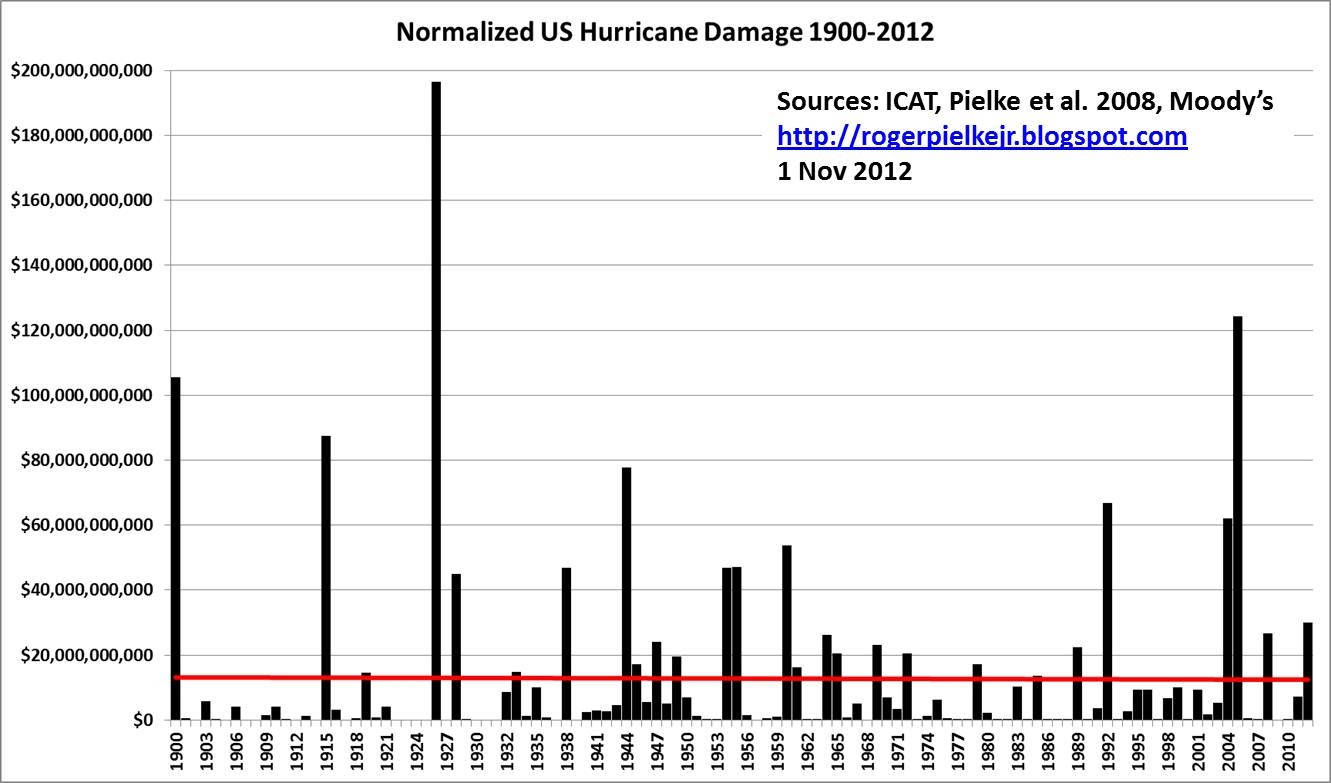
First, the economic analysis of natural disasters is Lewandowsky’s own. He ignores completely the opinions of Roger Pielke Jr, an expert in the field, with many peer reviewed studies on the subject. Pielke Jnr has shown there is nothing exceptional in the normalised cost of Hurricane Sandy. Furthermore, a 2009 report showed that New York is vulnerable to hurricanes, and the shape of the coastline makes it particularly vulnerable to storm surges.

Second, the sea level rise is a trivial issue. From the University of Colorado graph, it is clear that sea levels are rising at a steady rate of 31cm a century.

Third, he claims the predictions of unnamed “experts” have been fulfilled. A balanced analysis would point out that the CO2 levels have risen faster than predicted, but temperatures have not.

Last week I posted a proposal for analysing the costly impacts of global warming. Using the “equation”, I would suggest Lewandowsky overstates both the Magnitude and Likelihood that Sandy was caused by global warming. He misperceives the change in frequency (1/t). Furthermore, given than he has a track record in the highly biased use of statistics in his own field, and his deliberate lack of balance, the Weighting attached to anything he says should be negative. That is, like to newspapers of the Soviet Union, if Lewandowsky claims something, we should read between the lines to see what he does not say. However, unlike the Soviet Union we are still able to look for alternative opinions.


Normalized US Hurricane damage impacts


2012_rel4: Global Mean Sea Level Time Series (seasonal signals removed)

A Reply to Lewandowsky’s sideswipe

In looking analysing the data on the Lew et al paper I made the following comment.

If you sample some of their articles, you will find a dogmatic defence of climate change, and blocking, editing or denigration views that are contrary to their own. The claim in the paper that they contacted five sceptical blogs to improve the spread of views is highly suspect. Jo Nova contacted 24 such blogs (including all the most prominent ones), with not a single one remembering such an approach. Prof. Lewandowsky is currently refusing to divulge the names of the blogs contacted. As there was no proper control of the answers, there could be rogue results generated.

It turns out that Prof. Lewandowsky’s assistant Charles Hanich did contact 5 “skeptic” blogs with requests. These requests were either ignored or rejected with little or no thought nearly two years ago. On his blog Stephan Lewandowsky stated

At this juncture one might consider a few intriguing questions:

1. When will an apology be forthcoming for the accusations launched against me? And how many individuals should now be issuing a public apology?

To explore the magnitude of this question we must take stock of public statements that have been made about my research. For example, one blogger considered it “highly suspect” whether I had contacted any “skeptic” sites.

It troubled me greatly this comment. Why had I failed to trust the word of a professor of psychology? A science which I have never studied? I will not give excuses, but give the reasons that were going through my mind at the time.

Firstly, I was prejudiced against Prof. Lewandwosky. I had first heard of him in relation to the Peter Gleick affair. This was when a so-called scientist impersonated someone else to fraudulently obtain documents from the Heartland Institute. He was “outed” because the key document – which was fabricated – was in the style of Peter Gleick. Yet, Lewandowsky’s believed Gleick’s lying to defend “science” was on the same moral plane as Churchill’s lying to deceive Hitler. Further, he accepted Gleick’s statement that he was sent the forged document in the post. In my eyes that was a choice between strong circumstantial evidence and the statement of a self-confessed liar. Also, for Gleick, admission of fabrication might be a far more serious crime, than his claim to receiving something in the post gullibly accepting it as genuine. So whatever the truth, there might be motive for an additional lie. Further, I do not believe that climate denial is as evil as Nazism. In fact I happen to believe that the term “climate denial” is a vicious smear.

Secondly, my prejudices were further exaggerated when I came across a climate opinion survey at “Watching the Deniers” blog. I not only answered this opinion survey, but recorded the questions and commented upon them. When I saw the Lewandowsky paper, with the some of the same questions on free markets and conspiracy theories, I erroneously thought that this was the same questionnaire. In fact, the questionnaire I answered is probably a later development of the survey behind the Lewandowsky paper. Looking at the actual questionnaire, my comments can be applied to the earlier and shorter survey.

Thirdly, I saw the paper and read the opening paragraphs. I see Lewandowsky’s belief (and the climate scientists as being) along the lines of climate scientists are the experts with PhDs, and are in strong agreement. I believe that far from the strong foundation sufficient to declare anyone who disagrees a motivated denier of the truth.

Fourthly, I am also prejudiced against using psychology to declare that critics sub-normal after reading in the 1980s about the abuses of psychiatry in the Soviet Union, to consign dissidents to mental institutions. Or the arguments the KGB put forward to dissidents of how they could possibly disagree with the huge consensus. Maybe this is an analogy that Lewandowsky will cry foul as one who knows the subject, but this is the honest truth.

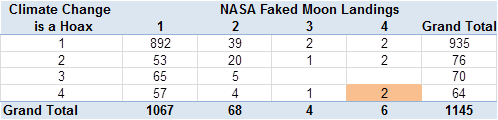
Fifthly, I then looked at the data. I found a number of misleading statements in the paper, including the small minority of skeptic responses; the fact that the typical respondent wanted little or anything to do with any conspiracy theory not related to climate. In the extreme case of the “NASA Faked the Moon Landings” referred to in the title only 10 responses out of 1145 responses agreed with the proposition. Further, the two dogmatic rejecters of climate science I identified (before Tom Curtis) as being likely scammed. In other words, the dogmatic conclusions rested on little or no evidence.

My conclusion was this. Prof. Lewandowsky believes it is alright to lie and smear opponents in his “noble” cause. He has issued a highly prejudiced survey to verify a hypothesis that those who reject what he believes are nutters. He then failed to get a decent sample of skeptics and then failed to filter out the rogue responses. When the vast majority of responses failed to verify his hypothesis, he used the small differences in the minority who believed in conspiracy theories to support his dogmatic conclusions. Yet those could be accounted for by scam responses.

On the basis of all this, I had completely lost trust in any statement that Lewandowsky and his mates wrote. I believe I had more than sufficient grounds for suspecting that he had lied about contacting sceptical blogs.

What this leads me onto is something that Lewandowsky has completely missed. The claim is that we should trust climate scientists, as they are the experts.

But what happens when you betray that trust? Let me give three cases.

1. A business fails to deliver on time and what was specified. Then digs themselves into a deeper hole be making excuses and telling the customer that if they have not broken the small print of the contract. After such an experience would the customer ever trust that business again, even if dealing with a different department or people?

2. Somebody was wrongly convicted of murder due to misinterpretation of the evidence by experts, or tampering of the evidence by the police. After this is exposed, there is no action taken to release the innocent party or to stop these events occurring again. What would happen to people’s trust in the judicial process?

3. After twenty years of marriage, one of the partners sleeps with another. What happens to the trust in the marriage if the guilty partner then makes excuses, including blaming the other?

Betrayal of that trust will lead to the betrayer being viewed in a completely different light by the betrayed party. The betrayed now questions every statement and every motive. Once you have lost people’s trust, it is very hard to regain that trust – a point that Dale Carnegie makes in “How To Win Friends And Influence People”. Shifting blame, or failing to acknowledge fault, will only make matters worse. Yet this is what the climate science community has being doing for years. Look at the skeptic blogs and you will find lots of reasons for questioning the science. Some are valid, some are less valid. It is by a group of people that has, with multiple reasons, lost trust in the “science”. The response of the scientists is to call them names, question their motives and (if you look at the skepticalscience blog) provide feeble and biased excuses. By not acknowledging that differences of opinion are possible, or that the science is weak, or that misinterpretations are possible, they are destroying the trust people have in science.

In short what Lewandowsky has completely missed is that people reject the “science” because of lack of trust in scientists, for reasons that they believe in. His actions and those of climate scientists are just exacerbating the rift between the climate science community and people who live in the real world.

Final Note

I am not a scientist. But I have a degree in economics and worked for over 20 years in industry as a management accountant, mostly within the manufacturing sector. I am a Christian, who believes that people are fallible. That is human beings are prone to error, whether by design or by failing to perceive whether they are wrong. I am certainly fallible. In fact, my best work has often by analysing figures in different ways, wasting my time going up blind allies, learning and eventually getting to better solutions. But I strongly believe that those who believe themselves to be the most infallible are those who are usually the most wrong.

I have used an anonymous handle for various reasons, including that people who support “science” think that is alright to make unsubstantiated character assassinations against those who question them.

Kevin Marshall

Lewandowsky et al. 2012 MOTIVATED REJECTION OF SCIENCE – Part 5 the Missing Links

Jo Nova has now provided the first full list of the survey questions used for the Lewandowsky, Oberauer & Gignac paper, along with a well-written summary. However, there are a number of elements that need to be emphasised

  1. If “climate denial” is on a par with “holocaust” or “smoking” denial, why not start by referencing the clearest statement of the evidence, rather than past opinion surveys? That is, if direct evidence is available, why resort to hearsay evidence?
  2. But if opinion surveys are used, then they should at least be good ones. But the primary references are Anderegg, Prall, Harold, & Schneider, 2010 (Most climate scientists believe in what they do) and Doran & Zimmerman, 2009 (97% of climate scientists = 75/77 cut from >3000 responses).
  3. Even so, surely the association with NASA Moon Landings was correct? After all, the title is “NASA faked the moon landing|Therefore (Climate) Science is a Hoax: An Anatomy of the Motivated Rejection of Science.”
    Not when 93% of all respondents gave it a firm thumbs down.
  4. When Lewandowsky says over >1100 responses, and only talks about those who “reject the science”, it surely implies that all (or at least the vast majority) of responses were from the people he is attacking? Actually, around 15% of responses were from skeptics, in terms of answers to four “climate science” questions. Professional polling organisations in the UK state these figures. But a scientific journal seems not to have insisted.
  5. There are loads of conspiracy theories. But one of the most popular in recent years is something like “Climate denial only exists as a serious force due to significant funding by oil and tobacco interests.” Lewandowsky and his junior partners cannot have missed that one.

The basic psychology behind this can be found in “The Debunking Handbook” on the front page of the skepticalscience website. Here is the justification for lying, ad hom attacks and continued government grants to a failed research program. They know the truth, and are claiming a monopoly of that truth. But to legitimately claim a monopoly it is necessary to show the corollary. The corollary is that every person who disagrees with you is wrong on everything. In empirical sciences this leaves no gap for different interpretations from the same data; no gap for the unexplained; no gap for hypotheses or assumptions to be falsified; and no gap for new data contradicting old data or forecasts. Lewandowsky’s opinion poll applies the truth in the “The Debunking Handbook” to justify one version of climate science having a continued monopoly by showing that opponents are a load of undesirable nutters. It is not just full of gaps. Like past claimants to the throne of dictators of truth, he is more wrong than his detractors.

But if you do not have a monopoly of the truth in climate science, what is the alternative? What if there is a potential future threat, which is very real, but for which there is very little firm evidence? A tentative proposal will be the subject of my next posting.

Lewandowsky et al. 2012 MOTIVATED REJECTION OF SCIENCE – Part 4 Political Opinions

This is the fourth in a series on Lewandowsky, Oberauer & Gignac – NASA faked the moon landing:Therefore (Climate) Science is a Hoax: An Anatomy of the Motivated Rejection of Science (in press, Psychological Science).

This posting is further analysis of the data set sourced by Katabasis. (The data is now available from Bishop Hill) The previous post looked at the conspiracy theory question, whilst this looks at the link that the survey makes between free market ideas and rejection of climate science. From the abstract, this was the primary theme of the survey.

Abstract

Although nearly all domain experts agree that human CO2 emissions are altering the

world’s climate, segments of the public remain unconvinced by the scientific evidence.

Internet blogs have become a vocal platform for climate denial, and bloggers have taken a

prominent and influential role in questioning climate science. We report a survey (N

> 1100) of climate blog users to identify the variables underlying acceptance and rejection

of climate science. Paralleling previous work, we find that endorsement of a laissez-faire

conception of free-market economics predicts rejection of climate science (r≈:80 between

latent constructs). Endorsement of the free market also predicted the rejection of other

established scientific findings, such as the facts that HIV causes AIDS and that smoking

causes lung cancer. We additionally show that endorsement of a cluster of conspiracy

theories (e.g., that the CIA killed Martin-Luther King or that NASA faked the moon

landing) predicts rejection of climate science as well as the rejection of other scientific

findings, above and beyond endorsement of laissez-faire free markets. This provides

empirical confirmation of previous suggestions that conspiracist ideation contributes to

the rejection of science. Acceptance of science, by contrast, was strongly associated with

the perception of a consensus among scientists.

There were relatively few questions to identify the political views of the respondent.

The Free Market Questions

FMUnresBest An economic system based on free markets

unrestrained by government interference automatically

works best to meet human needs.

FMNotEnvQual I support the free market system but not at the expense

of the environmental quality.

FMLimitSocial The free market system may be efficient for resource

allocation but it is limited in its capacity to promote

social justice.

FMMoreImp The preservation of the free market system is more

important than localized environmental concerns.

FMThreatEnv Free and unregulated markets pose important threats

to sustainable development.

FMUnsustain The free market system is likely to promote

unsustainable consumption.

The Climate Science Questions

CO2TempUp I believe that burning fossil fuels increases atmospheric

temperature to some measurable degree.

CO2AtmosUp I believe that the burning of fossil fuels on the scale observed over the last 50 years has increased atmospheric temperature to an appreciable degree.
CO2WillNegChange I believe that the burning of fossil fuels on the scale observed over the last 50 years will cause serious negative changes to the planet’s climate unless there is a substantial switch to non CO2 emitting energy sources.
CO2HasNegChange I believe that the burning of fossil fuels on the scale observed over the last 50 years has caused serious negative changes to the planet’s climate.

The Results

The answers for the free market questions are from 1 (reject the free market) to 4 (complete agreement to free market).

The answers for the climate science questions are from 1 (totally Reject) to 4 (complete agreement).

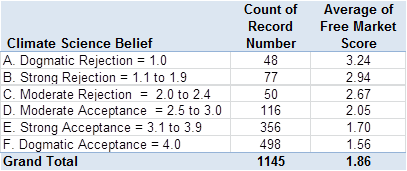
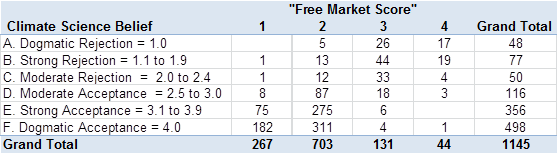
As in my previous posting, for the Climate Science questions I graded the answers to the four questions into groups based on the average score.


The answer is clear from the poll results. The stronger the support for free markets, the more likely one is to reject the climate science.

Taking the average score and rounding to the nearest whole number, the picture is even clearer.


The more free-market the views expressed, the greater the rejection of the science. Does this substantiate Lewandowsky et. al’s assertions?

Err No.

There are some series issues with this result.

Firstly, the survey was only available on a certain type of blog. Depending on your point of view, they are either pro-science or alarmist. These are

http://www.skepticalscience.com
http://tamino.wordpress.com
http://bbickmore.wordpress.com
http://www.trunity.net/uuuno/blogs/
http://scienceblogs.com/illconsidered/
http://profmandia.wordpress.com/
http://scienceblogs.com/deltoid/
http://hot-topic.co.nz/

If you sample some of their articles, you will find a dogmatic defence of climate change, and blocking, editing or denigration views that are contrary to their own. To regularly trawl through articles that you disagree with takes a certain kind of person that may not be representative of the wider sceptic community. Given that the sceptic blogs attract a wider audience than the “pro-science” ones, the fact that only 15% of responses were from sceptics says that only a minority regularly visit the blogs antagonistic to their views. In other words, the survey is not representative of the true population of those interested in the climate change / global warming issues.

Then there are the questions themselves.

At first glance the questions do not allow for the middle ground. Many sceptics who are not libertarian in outlook have then a number of options.

  1. Some might quit the survey in disgust, thus creating a sample less representative of the true population. There was no record kept of the numbers of part completed surveys, nor the point at which they were completed. The lack of neutrality and narrowness of the range of questions suggests that might be material.
  2. The second is to answer questions in opposition to the climate consensus. That is the join in coalition to free-marketers to oppose the environmentalist ideology. This is quite logical. Environmentalist ideology can be viewed as increasing authoritarianism, constraining economic growth (and thus the prospect of ever-rising standards of living) along with regressive cost increases in electricity and fuel for cars. In other words, those who want the status quo to be maintained join in coalition with those who want the direction of change to be the opposite of where environmentalists are pulling. There is no risk here for the moderates. Libertarianism is nowhere a major political force.

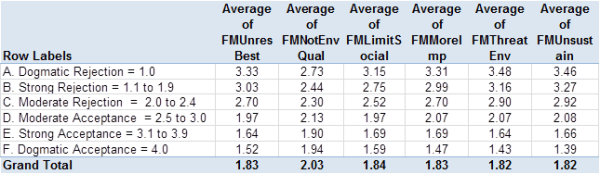
Let us look at the average response for each question to see if this is suggested.


The most pragmatic question is the least polarized. People may support a position ideologically, but will compromise if there is a demonstrable need or benefit. Conversely the last two questions are the most ideological. A lot of people are motivated to oppose a movement that is contrary to their own beliefs. In other words, the nature of the questions further drives people into opposing camps.

How should Lewandowsky have approached these problems? If he was an objective scientist, Lewandowsky would have sought advice from professional pollsters on the content of the questions. They would have advised more neutral, and a broader range of questions to enable people to express a range of views. They would have also advised validity checks to make sure the survey results were representative of the population at large. But Stefan Lewandowsky is not an objective scientist. His agenda is to prevent any opposition to the ideology he and others promote.

Are there any conclusions to be drawn?

The biases in the free market questions apply to those who reject climate science. However, as a survey of those who accept the climate science, it is more valid.

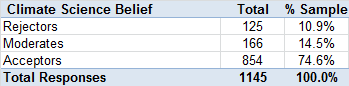
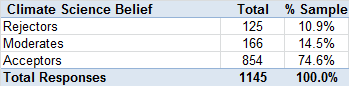
Firstly the sample size is significant. Merging the six groups into 3 gives:-


The sample size of 854 is quite large, and more than six times the size of those who reject climate science.

Secondly, the sample is likely to represent the true population of “Acceptors”, as it was placed on the blogs that they frequent.

Thirdly, as the survey was devised by people sympathetic to their point of view, the abandonment rate should not have been any higher than for more neutral polls.

The major conclusion is that those who “accept the science” have no truck with conspiracy theories. On political opinions, they strongly support an ideology which promotes the environment at the expense of economic growth and economic freedoms. That is the, planet should be given a higher priority relative to the people that live on it.

Thus the true result of the survey data is not that those who oppose climate science are nutters. Rather, it is that those who support climate science have views that are at odds to, and contrary to the best interests of, the vast majority. We have not got here the justification to silence the opposition, but giving them due weighting.


Lewandowsky et al. 2012 MOTIVATED REJECTION OF SCIENCE – Part 3 Data Analysis of the Conspiracy Theory element

A month ago made two postings on the paper Lewandowsky, Oberauer & Gignac – NASA faked the moon landing:Therefore (Climate) Science is a Hoax: An Anatomy of the Motivated Rejection of Science (in press, Psychological Science). In the first I showed that an opening statement about the beliefs of climate scientists was not supported by the references. The second raised some questions, which owing to a lack of data I was unable to answer.

When Katabasis offered in the comments at Jo Nova’s blog to provide the raw data for the paper I took him up on the offer.

The paper’s major findings were on the link between climate denial and belief in free markets. However, I first want to deal with the aspect of the link with beliefs in conspiracy theories due to

  1. the title
  2. The articles that have appeared in the Guardian and Telegraph newspapers.
  3. The following from the conclusion
  4. Also consider this from the conclusion

    “However, to our knowledge, our results are the first to provide empirical evidence for the correlation between a general construct of conspiracist ideation and the general tendency to reject well-founded science.”

The lead author, Prof. Stefan Lewandowsky has a history of dogmatically defending climate science, often by attacking the opponents. However, that is no reason to reject the results of a published scientific paper if those results are substantiated by the evidence.

The survey was posted on a number of climate blogs of all the same persuasion. Depending on your point of view, they are either pro-science or alarmist. These are

http://www.skepticalscience.com
http://tamino.wordpress.com
http://bbickmore.wordpress.com
http://www.trunity.net/uuuno/blogs/
http://scienceblogs.com/illconsidered/
http://profmandia.wordpress.com/
http://scienceblogs.com/deltoid/
http://hot-topic.co.nz/

If you sample some of their articles, you will find a dogmatic defence of climate change, and blocking, editing or denigration views that are contrary to their own. The claim in the paper that they contacted five sceptical blogs to improve the spread of views is highly suspect.* Jo Nova contacted 24 such blogs (including all the most prominent ones), with not a single one remembering such an approach. Prof. Lewandowsky is currently refusing to divulge the names of the blogs contacted. As there was no proper control of the answers, there could be rogue results generated.

Identification of those who “Reject the Science”

There were four questions on beliefs about “Climate Science”

CO2TempUp I believe that burning fossil fuels increases atmospherictemperature to some measurable degree.
CO2AtmosUp I believe that the burning of fossil fuels on the scale observed over the last 50 years has increased atmospheric temperature to an appreciable degree.
CO2WillNegChange I believe that the burning of fossil fuels on the scale observed over the last 50 years will cause serious negative changes to the planet’s climate unless there is a substantial switch to non CO2 emitting energy sources.
CO2HasNegChange I believe that the burning of fossil fuels on the scale observed over the last 50 years has caused serious negative changes to the planet’s climate.

The answers were from 1 (totally Reject) to 4 (complete agreement).

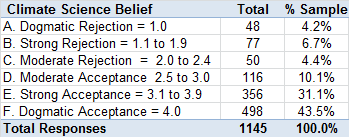
I found the average score for each respondent, graded and plotted the count.


Or summarising into 3 categories


As to be expected from the nature of the blogs where it was published, more than 4 in 10 gave the highest score and 85% are more positive than negative in their beliefs. The poll only includes 125 or 175 responses of those who “reject the science”.

Linking to Conspiracy Theories

The survey is about those who reject the science being more likely to believe in weird conspiracy theories than acceptors of the science. As Jo Nova puts it, the climate sceptics are meant to be nutters.

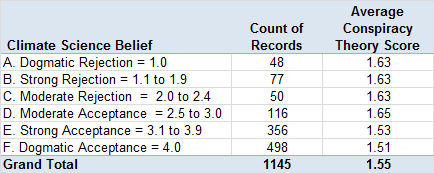
There were 14 conspiracy theories presented. Two (on New World Order and Climate Change) I will leave out for now as they are not entirely independent of the subject. Of the 12 remaining I took the average score. If the general hypothesis is correct, the more strongly the rejection of the science, the greater the score on conspiracy theories.


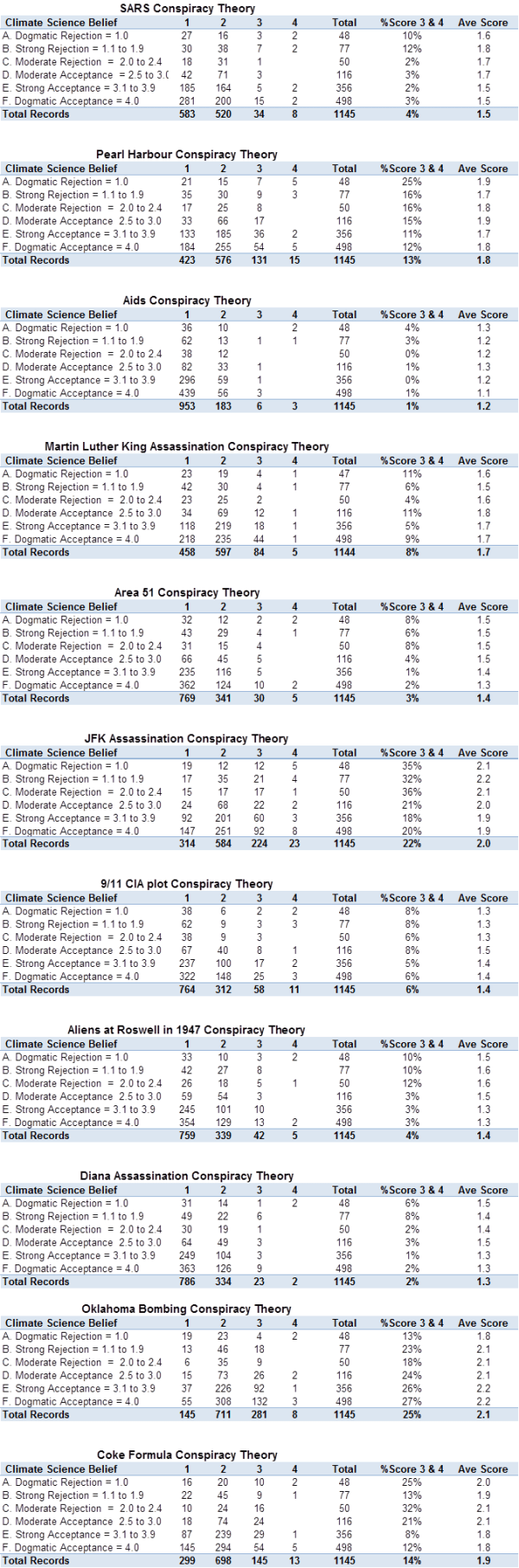
There is no significant relationship here at all. The typical respondent gives little or no credence to conspiracy theories.

To understand this better, I rounded the average score for each respondent to the nearest whole number. The pivot table is now.


There is no relationship here. The outlier is the two respondents with an average score of 4. One put a 4 for all, and the other put 4 on 11/12 and 3 on the other. These are clearly rogue responses and should have been removed as outliers from such a small sample. If removed, the average conspiracy theory score for those who dogmatically reject climate science conclusions drops to 1.49, the lowest of any group.

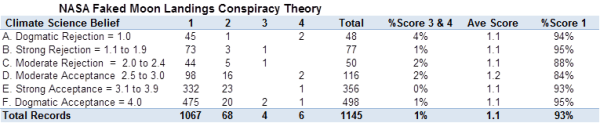
So what of the conspiracy theory that most the moon landings were faked? The one in the title “NASA faked the moon landing:Therefore (Climate) Science is a Hoax: An Anatomy of the Motivated Rejection of Science


45 out of 48 of those who dogmatically reject climate science, also dogmatically emphatically reject the conspiracy theory. The two who score 4 are rogue results.

In fact, the response is pretty emphatic in every group. Consider the abstract.

We additionally show that endorsement of a cluster of conspiracy theories (e.g., that the CIA killed Martin-Luther King or that NASA faked the moon landing) predicts rejection of climate science as well as the rejection of other scientific findings, above and beyond endorsement of laissez-faire free markets.

Maybe the correlation was with the Climate Science Conspiracy Theory?


If you take out the two rogue responses, then if any comment were to be extracted it would surely be the other way round. However, it is not significant, and internet responses get some rogue results on all sides.

Let me be quite clear. The title of the paper makes a false claim from authors with an agenda of silencing opponents. It is entirely without any proper evidence.

The other eleven results are below


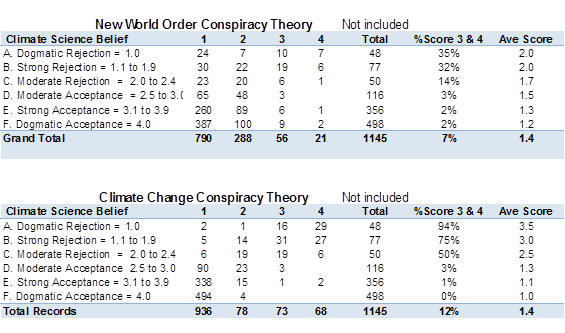
Finally, the two conspiracy theories not included.


*Update 11th Sept see reply to Prof Lewandowsky at comment 120

Australian Climate Science Opinion Survey – Confirming Prejudices?*

This survey I took in June is not the one used in the recent Lewandowsky et al paper. The one I took at “Watching the Deniers” is a development that 2010 survey. There are less questions on conspiracy theories (but “NASA faked the moon landing”, along with Diana, JFK and MLK assassinations are are still in) along with exactly the same questions on Free markets v Environmentalism. But the new survey has more on political beliefs (a good thing in my view) along with new sections on religious beliefs and GM foods. It seems to be directed beyond the free-marketeers, to other groups like the American Religious Right.

The Psychology Department of the University of Western Australia, under psychology research assistant Charles Hanich is conducting a short questionnaire on Science and Society.

UPDATE – The survey questions are available here.

SCIENCE AND SOCIETY

This study explores people’s beliefs about a wide range of topics, ranging from scientific propositions to claims made in the media and on the internet. In addition, the survey is interested in your attitudes towards your own life and issues confronting modern societies at the moment.

The questions all have five options – Strongly Disagree, Disagree, Neutral, Agree and Strongly Agree.

The questions are from both perspectives, so that people who are anything but totally neutral will have to agree with some questions and disagree with others.

The sections as follows (My headings)

  1. Climate Change – 5 questions
  2. Genetically Modified Foods – 5 questions
  3. Vaccines – Benefits and harms – 5 questions
  4. Position of the Conservative / Liberal perspective (US definitions) – 7 questions
  5. Select neutral (check of the software, or check for spam?) – 1 questions
  6. Free market system v social justice / environment / sustainability – 5 questions
  7. Conspiracy theories (political) – 6 questions
  8. Conspiracy theories (scientific) – 6 questions
  9. Personal Spirituality & Religion – 8 questions
  10. Evolution – views upon – 7 questions
  11. Corporations – 13 questions
  12. Personal emotional outlook – 6 questions

That is 74 questions in total. Like a lot of surveys, it understates the questions (“about 40”) and the time taken.

Climate Change Questions

  1. I believe that the climate is always changing and what we are currently observing is just natural fluctuation.
  2. I believe that most of the warming over the last 50 years is due to the increase in greenhouse gas concentrations.
  3. I believe that the burning of fossil fuels over the last 50 years has caused serious damage to the planet’s climate.
  4. Human CO2 emissions cause climate change.
  5. Humans are too insignificant to have an appreciable impact on global temperature.

There is a complete absence of questions about future projections of warming; whether that warming is catastrophic or benign; of the strength of the science or the uncertainties; our trust in what scientists are telling us; nor of the ability of policy to do anything successfully combat it. These are the questions that many sceptics, including myself, are grappling with.

Genetically Modified Foods
Questions

  1. I believe that genetic modification is an important and viable contribution to help feed the world’s rapidly growing population.
  2. I believe genetically engineered foods have already damaged the environment.
  3. The consequences of genetic modification have been tested exhaustively in the lab, and only foods that have been found safe will be made available to the public.
  4. I believe that because there are so many unknowns, that it is dangerous to manipulate the natural genetic material of foods.
  5. Genetic modification of foods is a safe and reliable technology.

In contrast these are questions do look at the benefits and costs of the science; the current impacts and future impacts; along with the strength of the science and the uncertainties.

NB the vaccines section follows more on the model of GM foods section rather than climate change.

The political spectrum questions I will leave for others to comment upon. It seems to be written by an American-influenced “liberal” who lacks knowledge of the full spectrum of political thought.

Free Markets v social justice / environment / sustainability

  1. An economic system based on free markets unrestrained by government interference automatically works best to meet human needs.
  2. The free market system may be efficient for resource allocation but it is limited in its capacity to promote social justice.
  3. The preservation of the free market system is more important than localized environmental concerns.
  4. Free and unregulated markets pose important threats to sustainable development.
  5. The free market system is likely to promote unsustainable consumption.

It is based on a notion of free-market anarchy against on the beneficial utopian society. No mention of awkward facts, like the worst environmental disasters and social injustices in the last century occurred in authoritarian regimes of left and right.

Conspiracy theories (political)

  1. A powerful and secretive group known as the New World Order is planning to eventually rule the world through an autonomous world government which would replace sovereign governments.
  2. The assassination of Martin Luther King, Jr. was the result of an organized conspiracy by U.S. government agencies such as the CIA and FBI.
  3. The Apollo moon landings never happened and were staged in a Hollywood film studio.
  4. The assassination of John F. Kennedy was not committed by the lone gunman Lee Harvey Oswald but was rather a detailed organized conspiracy to kill the President.
  5. The U.S. government allowed the 9-11 attacks to take place so that it would have an excuse to achieve foreign (e.g., wars in Afghanistan and Iraq) and domestic (e.g., attacks on civil liberties) goals that had been determined prior to the attacks.
  6. Princess Diana’s death was not an accident but rather an organised assassination by members of the British royal family who disliked her.

Basically, if you read the communiques and the proclamations coming out of annual meeting like Copenhagen, Cancun and Durban that say we must have a strong global organization to impose climate change, you should consider yourself as much a crank or nutter as those who think George Bush was capable of the phenomenally detailed planning required to stage the 9-11 attacks (but totally failed to successfully bring peace through conquest in Iraq or Afghanistan).

Conspiracy theories (Scientific)

  1. The claim that the climate is changing due to emissions from fossil fuels is a hoax perpetrated by corrupt scientists who wish to spend more taxpayer money on climate research.
  2. U.S. agencies intentionally created the AIDS epidemic and administered it to Black and gay men in the 1970s.
  3. The alleged link between second-hand tobacco smoke and ill health is based on bogus science and is an attempt by a corrupt cartel of medical researchers to replace rational science with dogma.
  4. The HIV virus causes AIDS.
  5. Smoking causes lung cancer.
  6. Lead in drinking water poses a serious long-term health risk.

The questions on climate and second-hand tobacco smoke lump two concepts together; a lot of money wasted for very little output along with the alleged motives of those practicing their research. In between is a particularly distasteful conspiracy theory, the very idea of which would be repellent to most people. The other three questions are simple statements of well-established science. There is no loading or controversy.

Religion and Evolution.

  1. God is important in my life
  2. I believe there is a life after death
  3. I get comfort or strength from religion
  4. There is no proof of God: if there is a God, he would have shown himself by now
  5. I think of myself as a religious person
  6. I have made a personal commitment to live my life for God
  7. I have had an experience of spiritual worship that was very moving and powerful
  8. I have experienced a definite answer to prayer or specific guidance from God
  9. Modern humans are the product of evolutionary processes that have occurred over millions of years
  10. The theory of evolution is based on speculation and not valid scientific observation and testing
  11. Most scientists accept evolutionary theory to be a scientifically valid theory
  12. There is a significant body of data that supports evolutionary theory
  13. Humans exist today in essentially the same form in which they always have
  14. Evolution is a scientifically valid theory
  15. Current evolutionary theory is the result of sound scientific research and methodology

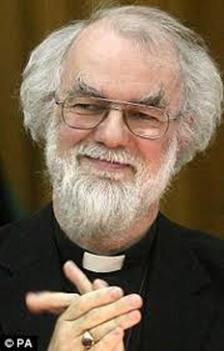
This is meant to distinguish between the US bible-belt evangelical Christians and the atheistic scientific community. It does so in a non-partisan way, so that Muslims could answer as well. However, it does not take into account the more nuanced, earnest, balanced and thoughtful approaches to the interactions of hard science and the timeless spiritual truths, as typified, is not caricatured, by Dr Rowan Williams, The Archbishop of Canterbury.

Corporations

  1. Corporations are not respectful of laws
  2. Corporations do not accept accountability for their actions
  3. People who run corporations will lie if doing so will increase company profits
  4. Corporations do not care about acting ethically
  5. Corporations will break laws if they can make more money from it
  6. Corporations put their own interests above the public’s interests
  7. Corporations are driven by greed
  8. Corporations care only about money
  9. Corporations want power at any cost
  10. Corporations take a lot more than they give
  11. Corporations intentionally deceive the public
  12. Corporations do not consider the needs of their employees when making business decisions
  13. Corporations exploit their workers

Any notion of balance goes completely out of the window. It is by far the largest section in a questionnaire on “Science and Society”. There is no switching between good points of corporations – such as technological breakthroughs, or much of our phenomenal prosperity. That includes the “Eco” technologies and the must-have gadgets from a fruity American 70s start-up. It is almost as if they want the more moderate participants to give up in disgust. Do avoid permanent psychological damage, they questionnaire end with a few personal questions about things in life you are thankful for, and people that you are grateful to.

The missing sections

No not the political spectrum one. The missing questions that a more balanced questionnaire might ask.

  1. General trust in climate science.
  2. Trust in carefully presented evidence, with questions respectively answered, as against the dogma of “scientists agree”.
  3. Questions for the Australian people, of whether carbon tax policies are worthwhile
  4. Questions on trust in government; the motives of politicians; the ability to deliver on promises. In relation to both Western democracies and tyrannies past and present.
  5. The importance of tackling climate change relative to other issues like unemployment and prospective financial meltdown in parts of Europe.

Conclusion

When devising a questionnaire, one must always try to eliminate bias, and avoid emotionally loaded the questions that will prejudice the answers. Neither should it contain multiple issues in a question. This survey does just the opposite. It is started off being deliberately designed to elicit certain polarized responses, ending up showing the deeply prejudiced and politically extreme position of the author.

*Please note. I am not aware of any copyright restrictions on reposting the questions. I accessed this from “Watching the Deniers” website, where there was no mention of copyright material. Neither was there any mention of copyright on the introductory front page. The doing a search I only came across a link to a 2010 survey. Neither could I find a link within The University of Western Australia Website, though it is on their servers.

Big Oil Funding of Climate Denial – An Examination of the Thesis

It is a common them by those who most dogmatically support the climate change agenda that the opposition are funded by big oil and similarly evil companies. There are potentially a number of angles to this viewpoint.

  1. If money does influence outcomes then we should see that where money on one side is hundreds of times greater than a ragbag of critics, then the critics will be drowned out. This is clearly not the case.
  2. When political parties complain of a money bias, this often goes hand-in-hand of complaints of media bias. But in the global warming sceptics have the most grounds for complaint on the media front. For instance the policies of the BBC and Guardian Newspaper.
  3. Maybe then the sceptics are winning, despite the lack of funds and despite the strong media bias against them, because they are using inappropriate language. My belief is that it is the mainstream who are guilty of intolerant and misleading language.
  4. Maybe the outside money has led to sceptics having undue influence on decision-making, subverting the democratic process. Like the WWF has achieved with the IPCC process?
  5. Maybe the sceptics are guilty of campaigns to misrepresent the status of the science. Like the eco activists “cajoling” scientific organisations to make political proclamations?
  6. Maybe it is the source of funding that creates the greatest bias. In the case of big oil money, if they decided to fund both ways, there are two ways to go. Either, the credibility of both sides is forever tainted, or, if the money was loaded massively one way, then on one side is tainted far more than the other.
  7. Maybe it is because big oil funds climate denial that we should be most concerned. The alternative explanation is that public knowledge of the funding will lead to attacks by environmental groups. To support of attacks by environmental groups (and hence viewing the secrecy of “denial” funding) require two moral points to be maintained. The first is that the views supported are evil. Second, that character assassination, or blockading of premises, or physical attacks on opponents are legitimate ways of opposing those you disagree with.
  8. Maybe, big oil could be viewed by some as being immoral or evil. Others might view with suspicion funding from anyone who makes their money in the gambling industry (especially if they pleaded guilty to money laundering in connection to those activities). They may also view with suspicion currency market speculators, especially one who made over $1bn at the expense of UK taxpayers.
  9. Maybe it is only recent big oil funding that has tainted the policy outcomes. The alleged bad reputation of the oil industry was largely down to one individual in creating a virtual US monopoly in oil production in the late nineteenth century. I do not see a similar smearing of the activities of the foundation created with the ultimate in big oil money.

In short I can see no valid reason to base rejection of critical viewpoints on climate change simply because of unsubstantiated allegations of big oil funding.

I offer an alternative view of those who make these allegations. The belief in “evil funding” stems from a belief they are guardians of some fundamental and irrefutable truths. Furthermore, these truths are concerning a future apocalypse. By implication, those who have an unwillingness to accept that truth is due to out-right lying, or having being deceived by some evil entities, or because they are not right in the head. Historically, those who have maintained to be Truth Guardians, have never substantiated their arguments or allowed for error, or allowed the slightest deviation. Instead they have sought to discourage or prevent people exploring alternatives, knowing deep down that the process of questioning will lead to the understanding that their beliefs are either extreme or in many respects wrong.

Bishop Hill and Comment Moderation

BishopHill has been having problems with comment moderation.

The comments are getting completely out of hand. Once again, please do not call people names. Stay on topic. I’m simply snipping whole comments now, because I do not have time to edit our people’s poor behaviour.


Perhaps if people would have more courtesy towards their opponents they would start to understand the opposing arguments. Then they may contrast it with their own and moderate their views.

Dogmatically assuming that your side is right and by implication that the opposition are either betrays our own fallibility. It is only by demonstrating an overwhelming and coherent case that one can legitimately use this in current debates without appearing out of touch with reality.

We must remember that the burden of presenting the case is on the side those who say we must act to prevent catastrophic global warming
climate change climate disruption. That just not just mean showing the case for the science is, on balance, correct. Simplified it means

First to demonstrate that CO2 and other greenhouse gases can cause a bit of warming, and how much
AND THEN
Show that this small temperature rise will lead to an increase in water vapour at high level to cause massive positive feedbacks (despite negative feedbacks being the norm in science)
AND THEN
Show that this warming will be of massive net harm to humanity and the planet (and that neither human society, nor the other creatures, nor plants will be able to adapt – despite much evidence to the contrary).
AND THEN
Show that mitigation policies – carbon taxes, cap n’ trade, subsidies to “clean” energy – will reduce greenhouse gases in THEORY, so long as all countries participate.
AND THEN
Show that when most of the emerging nations, particularly China and India, do nothing to curb emissions, that curbing emissions in theory will still work for the OECD countries.
AND THEN
Show that the governments pursuing the policies are capable of delivering the theoretical results. That is only taking on policies that meet the cost criteria laid down by the IPCC or Stern. Then project managing in fine detail and quickly ending failing projects.

As well as making the case for each of Forecast, Consequences, Policy theory and policy Implementation (FCPI), it must be combined together to show that, on balance, there is an expectation that the policy outcome will be better than if nothing was done. I believe that it is only on the basis of extreme and untenable assumptions in ALL of these four areas that the current policies can be justified.

My concern is that the “consensus” quickly grasps onto obscure bits of detail, or fine points of theory, or relies on prestige and opinion when challanged. Alternatively they question the motives of the critics.


Denialists become Superfluous

OR Who Needs Enemies when you have Friends like These

Climate Psychology is a blog specialising in mirror-posting articles from one side of the climate change argument, but with more lurid titles. The direct inference being that the truth of the science is so blatantly apparent that any criticism must be by the deluded, the deranged, or be in the pay of some sinister forces. One such mirror posting is of Tamino’s “Hockey Stick Delusion” at RealClimate under the Title “Tamino debunks the junk science of Montford and McIntyre for the umpteenth time — the hockey stick is still sticking around

To anyone who looks at both sides of the argument – who properly compares and contracts each point made, will see that Tamino fails to address the points made. As I said in an earlier posting

 Look at

1. Who gives the fullest answers?

2. Which side evades the points, or attempts sleight of hand?

3. How are contrary or neutral points treated. Clue – look at how Judith Curry (who is trying to remain neutral) is treated. Further, look at how contrary opinions are treated.

4. Finally who are the real deniers in all of this?

This leaning on psychology is nothing new. It was used by the KGB to punish dissenters without trial (see also here and here). The recent publication of a statistical analysis of the Hockey Stick by McShane and Warner again shows which side of the debate the delusional mostly reside. The greatest irony is the blog has the following quote:-

“Because the truth is that promoting science isn’t just about providing resources — it’s about protecting free and open inquiry. It’s about ensuring that facts and evidence are never twisted or obscured by politics or ideology.” Barack Obama