More than just shreds of evidence

BishopHill quotes approvingly from a comment made on the Booker column in yesterday’s Sunday Telegraph

I have worked in government for 28 years as an economist, and for the last 20 years I have worked on environmental programs. In that time I have not seen a shred of evidence to justify global warming, let alone man made global warming and I have not seen a shred of evidence that there is going to be a green economic boom. The only evidence I have seen is that there is a green economic bust, that money invested in green technologies is usually wasted and simply consumes investment that could be better used elsewhere. I think that anybody in government or industry who can not understand this is either dishonest, stupid, or both. That applies to Cameron – I think he is both.

For those who support the sentiments expressed should consider trying to convince someone who is a true believer in climate change consensus of their error. If the consensus supporter finds shreds of evidence of global warming, and hints that the warming may be due to anthropogenic factors, then they have refuted this experienced economist. Just as a sceptic who finds fault with the temperature record, or who has read about “hiding the decline” concludes that climate change is all a hoax, or a global conspiracy.

An economist should look at the costs and benefits. In terms of Climate Change there are two sets of costs. First, those of climate change impacts and second, the costs of the policy to contain the global warming. The Stern Review put argument that the mitigation policy costs were 5 to 20 times less than letting climate change progress unchecked. Therefore there is a clear-cut case for global mitigation policy. But crucially Stern does not look at the consequences of ineffective and over-expensive policy. The Booker article “For every new ‘green’ job, nearly four are lost” looks at one aspect of these real policy costs. An economist would also claim that the Greens fail to look at the opportunity costs, claim that the new jobs are a benefit.

I have tried to demonstrate this economic argument for climate change mitigation here. Then I examine why the policy proposed will be ineffective in constraining CO2 rises and the costs will escalate here. I hope to post soon on why the costs of climate change are hugely overstated.

The argument against the climate change policy is not that there is no evidence. Rather, it is that blundering and ineffective policy will be far more costly than five or six degrees of warming bringing on highly variable weather systems. That is an argument for the economists, not the climate scientists.

Richard Black implies UNIPCC scientific conclusions have political bias

Richard Black, an environment correspondent with the BBC, loses sight of the purpose of climate change negotiations in criticizing the USA.

There is a proposal to withdraw funding from the UNIPCC, a result of climate change deniers taking control of House of Representatives in the mid-term elections last year. The consequence, according to Black, is that the USA could have reduced influence over the scientific part of the next UNIPCC report. Does this mean that the scientific conclusions of the UNIPCC reports are politically biased?

The result is that the USA looks

    “set to marginalise the country even further within the global community of nations – at least when it comes to climate change.”

So joining a global climate change agreement is to avoid censure from one’s intellectual superior? Not a matter of making a real positive difference for future generations? If you believe, like Richard Black seems to, that global agreement is all that is necessary to avoid global climate catastrophe, please consider my previous posting here.

Hattip BishopHill

Betraying Socialist Principles to Combat Climate Change

Jo Nova reports that a Carbon Tax is coming to Australia. This is to be followed by carbon trading. Comment submitted

In economic theory, in a closed economy and zero transaction costs, with all other things being equal, a carbon trading should work quite well to reduce carbon emissions. In the real world consider these points.

1. The oil price has more than tripled in the past decade. There are enough incentives to improve energy efficiencies from this alone. The marginal impact of carbon trading will be much lower than if the oil price had been static.

2. Those businesses which can most easily pass on the extra costs to the customer are those with no competition from abroad. Supermarkets, which consume huge amounts of energy, are a good example. Australians cannot hop over to New Zealand or Singapore for their weekly groceries. The biggest burden relatively, will be borne by the poor. Manufacturing businesses will be incentivised by the profits from selling carbon credits to ship production abroad to China. High polluting, old production processes will gain a new income stream. New, efficient, competing ventures will have to pay the incumbents to enter the market.

3. The energy trading schemes are highly complex and need experts to set up the rules. Or rather people who read up on the theory, and know more than the naive punters the elected representatives of the people. Enron was bidding to be a big player, before it went bust. Lehman Brothers was bidding to be a big player, before it went bust. With mortgage securitisation now so out of fashion, this presents a new way for the masters of the universe to make extraordinary profits.

I do not keep up with politics much, especially on t’other side of globe like. (I am from Manchester, England). So have I got this reet? A socialist government in Australia is bringing in a regressive policy that could cause consumers to subsidise the movement of manufacturing jobs abroad, and help a return to the multi-million dollar bonuses in the financial services industry. All this, in the name of a policy that will be near impotent in constraining CO2 emissions.

If you follow the UNIPCC or Stern Review line, the policies to combat climate change are highly cost effective. But that requires correctly identifying the low-cost alternatives and successfully pursuing those options. Politicians have not the skill-sets, the incentives, the staying power, the knowledge, the longevity, the power, or the incentives to achieve these aims. They may inadvertently undermine the very things in which they originally believed.

Antony Watts in addition reports that whilst the socialist government in Australia is taking on carbon trading, the Republicans of New Hampshire are ditching the same policy. I commented

I do not keep up with politics too much, so Anthony, are you sure that you have things the right way round? A socialist government in Australia is bringing in a regressive policy that could cause consumers to subsidise manufacturing jobs abroad, and help a return to the multi-million dollar bonuses in the financial services industry. All this, in the name of a policy that will be near impotent in constraining CO2 emissions. The Republican Party (who represent business interests) in New Hampshire is proposing binning a policy that would help their real constituents.

Revision on 25th February.

  1. Having slept on the issue, I would like to put a perspective on my comments above. Carbon trading will have some early successes over and above rises in the oil price, as it gives a cost-bias to non-GHG energy sources. However, given that

    1. Regulation is making it difficult to build high-carbon power-stations, particularly coal. So the movement away from high fossil-fuel power is happening anyway.
    2. High carbon-emitting manufacturing has been moving away from the developed countries for years. For instance, steel, shipbuilding and bulk chemicals are goods examples, along with labour-intensive low-carbon options.
    3. Government subsidies for clean energy sources.

    So even with a well-designed and well-run policy, the impact will be limited to start off with. That is the cost per unit of CO2 saved will already be high. Then as the policy is progressed, diminishing returns will set in.


Name-Calling in Climate Change may harm Our Future

The Economist blog has a posting about the name calling from both sides of the Global Warming / Climate Change divide. Here is my comment, complete with links.

The name calling will lead to polarized views and more extreme policy. This is why.


There is no balance to all this name-calling. There is abundant evidence that anyone who doubts the Consensus, whether the science or the policy, is vilified. For sceptics, research grants are not nearly as available and sceptical views are more difficult to publish. Any public figure who doubts orthodoxy, or any business which funds scepticism, are targeted by pressure groups. Similarly, scientific groups who do not make strong position statements in favour are targeted by pressure groups and bloggers.

Even if the evidence is over-whelming in favour of there being significant anthropogenic climate change, consider the incentives for a scientist or policy-maker working in the field. The prerequisite for acceptance is singing-up to the main conclusion that mitigation policies are needed to combat likely and severe climate change. To pour doubt on that conclusion risks standing accused of being in the other camp. Novelty comes from restatement of this position in an original way, or from original, and more alarmist research.


It is in the area of policy this bias is most skewed. To check, the Economist should do a benefit-cost analysis, using as a starting point the Stern Review. Stern estimated the likely costs of climate change at 5 to 20 times the mitigation costs*. Then adjust for the more moderate view of climate change outlined in the Economist article in hyperlinked in the article, including a modicum of uncertainty. Then allow for some of the worst impacts (hurricanes, droughts, floods, etc.) are largely speculative. Then allow that some consequences, like sea level rise, will occur over generations. Therefore slow and low-cost adaptation is possible. Then allow for the benefits of temperature and CO2 rise in extending the margins and intensity of agriculture in many areas. Then allow that any politically feasible mitigation policy will be far less comprehensive (on a global scale) than Stern assumed. Then allow that policy choices will be constrained by political realities and that large ill-defined and complex government projects have a tendency to massively over-run on costs and underachieve on benefits – the Economist archive is a good place to verify this supposition.


Well before crunching the final numbers, there will an irreversible tipping-point reached on the benefit-cost analysis. Current mitigation policies will leave future generations worse off than if nothing were done at all. We reach the wrong policy conclusion by letting the issue become polarized.


*The Stern review has some ambiguous statements. The directgov site hyperlinked above says

If we take no action to control emissions, each tonne of CO2 that we emit now is causing damage worth at least $85 – but these costs are not included when investors and consumers make decisions about how to spend their money.  Emerging schemes that allow people to trade reductions in CO2 have demonstrated that there are many opportunities to cut emissions for less than $25 a tonne.   In other words, reducing emissions will make us better off.


But what is clear is that the costs of climate change have been overstated and an extremely naïve assumptions about the efficacy of policy is included.

Climate Change in Perspective – Part 2 of 4 – The Mitigation Curve


The previous posting developed a simple graph showing the consensus case for climate change mitigation. This posting looks at the policy arguments, suggesting a huge gap between what is believed to be theoretically possible and what may be realistically achieved. The conclusion is stark. Mitigation policy optimization requires a political process that cannot deliver a result that will leave the world better for future generations.

The Mitigation Cost Curve

The previous posting presented in graphical form the consensus argument (UN IPCC & Stern) for stabilizing CO2 at around double the pre-industrial level, along with stabilizing other greenhouse gas emissions. That is that the costs of constraining the growth in levels of CO2 – are much less than the costs of allowing greenhouse gases temperature rises to go unchecked. Mitigation is essentially a cost minimization strategy with the Stern Review claims the benefits outweigh the costs 5 to 20 times. To put this into context, the Review states that the expected mean costs of mitigation will be annually 1% of annual global product (GWP). The costs of the actual climate change impact could be 5% of GDP or more.

The Prudent approach from this graph is to aim for point P. That is not the absolute minimum costs, but still much lower cost than the likely costs of doing nothing.

What is important to note is that the policy is not to reduce CO2 levels from the current levels of around 380ppm, but to stabilize the growth in emissions. This growth in emissions will come from the emerging economies, in particular from China where emissions per capita have recently been growing by 12% a year. The OECD countries have had largely static emissions per capita, and the population is very slow growing as well.

To turn theory into successful stabilization of CO2 at 550 to 600ppm, requires quite a extended process. I have attempted to break down this process into a flow chart showing the major steps. Next to each step is an arrow suggesting the direction the curve will move if the process is less than perfect.


The graph below shows the impact on the mitigation curve of a movement in the arrows.

A movement to the right will shift the curve from M to M’. This is when the marginal costs increase. A movement upwards will shift the curve from M to M”. This is when costs are incurred that totally ineffective in influencing on CO2 levels. Finally there are policy shifts upwards and to the right, from M to M”’, which is a combination of higher marginal costs and ineffective elements.
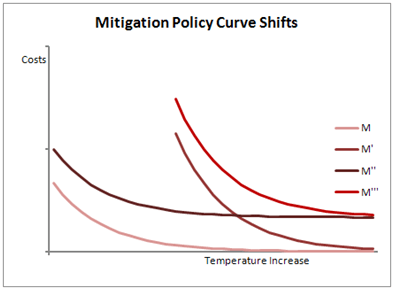
Looking at the issues in turn.

Economic Theory

I will assume that the shape and position of the curve is correct. That is, there is a set of policies or actions in the real world that if applied will achieve the outcomes desired. However, these have to be discovered. Some low-cost constraints will be quite easy to discover. Others might be more difficult, relying on estimates from self-interested parties. The optimal policies will not be given for long periods, but could change over time with relative costs and technological advances. For instance, a technological breakthrough enabling much cheaper and compact batteries could transform the viability of electric cars. Therefore the switch from gasoline and diesel could be achieved with little or no subsidies.

A second assumption is that although the right economic policies will cost money, the optimal policies will have absolutely no impact on economic growth. This is a crucial assumption of the Stern Review. The policy costs will amount to around 1% of GDP at the end of the century, against costs of around 5% of GDP of climate change impacts if nothing is done. However, if growth rates are reduced by just 0.1% then in ninety years output will be over 9% lower. It is quite conceivable that a drastic change in climate policy would reduce China’s growth rate by 0.5%. By 2100 this would mean output was a full 35% lower than without the policy change. If growth by then has slowed to 3% per annum, living standards would lag 25 years, or a generation, behind where they would have been. Even if the 0.5% growth reduction is for just the first 40 years, output is still 17% lower. There may be a preference of trading a 9% lower living standards with certainty, to possible suffering from the harmful and random effects that will costAny policy that fails to recognize this

Equity

A simplistic analysis would take into account the actual costs. The cheapest ways to constrain growth in emissions is to impose a uniform policy globally. A country like Ethiopia, for instance, has nominal GDP per capita of less than 1% of the OECD average ($330 against $39473) according to World Bank Data. The real impact of a uniform carbon tax will be disproportionately felt by the poorest. The UNIPCC and Stern recognize this, but have not made an adequate provision allowance. The proposals are for the rich countries bear the overwhelming burden of the constraint in emissions and for monetary transfers to enable the poorest to grow economically without increasing their CO2 emissions. Stern recommends that the rich countries reduce their emissions by 80% per capita by 2050. However, this split will not be totally equitable. Within countries there are large inequalities in income and wealth. For instance, the richest 10% in Brazil have far better life styles than the poorest 10% in the United States. Any split between countries will leave many of the rich and powerful untouched by the policies, whilst leaving the poor in the OECD countries worse off.

Policy Identification

There are a number of possible tools to achieve a cost effective containment of CO2 growth. These include Cap and Trade; Carbon Taxes; encouraging technological development; carbon sequestration; building (or regulating the building of) new carbon-neutral power stations; and promoting energy saving through subsidies and regulation. Minimizing the costs and maximising the effectiveness of this containment requires optimizing these alternatives in terms of extent, combination and timeliness. As we do not know when to use each of these in terms of time and place, there needs to be learning through experience. When policies or initiatives are not producing results, there needs to be quick and decisive actions in constraining, changing or abandonment. Yet these decisive decisions need to be taken in the context of often only vaguely perceiving, even retrospectively, whether we are taking the best course of actions. Are we pursuing the right sort of alternative power supply? Is funding for our favoured form of future technology the correct one? If that technological preference is broadly the best are we favouring the best approach, or disregarding a far more efficient alternative? Are we applying Cap and Trade too far, or is the design of the policy inappropriate to achieve optimal result? Are any carbon taxes delivering reductions in CO2 with our cost constraints?

If we fail to optimize then policies like Cap and Trade will generate marginal costs much higher than planned. The curve shifts to the right. If the research for new low-cost carbon neutral energy consumption fails, then the curve shifts upward as we waste money. So overall, sub-optimal policy choice will shift the curve upwards and to the right.

International Negotiation

Climate change policies need to be spread broadly to be effective. If major countries are excluded, then the burden of constraint on the others will be that much greater. Yet mitigation policy is to inflict some costs now to avoid much greater costs in two, five or twenty generations down in the future. To get

  • Overstate the urgency and the extent of the problem.
  • Understate or fudge the immediate cost implications.
  • Alienate any who raise the slightest question about the efficacy of such agreements. There are plenty of NGOs to do this.
  • Understate the alternatives.
  • Provide a world stage for the leaders, including those would normally be ostracized. (Such as here and here).
  • Leave aside the implementation problems.


International Polices & Targets

The fudging is likely to affect the final policy. Nation states do not accept strict targets within cost constraint, with punishments meted out to those that fail. They will not relinquish part of their sovereignty and possibly their economic growth easily. But the poorer ones, with promises of cash to help them out, will be enthusiastic. Therefore any final agreement will load costs on those keenest on the policy, and plenty of loop-holes to allow those with other priorities, or those with a weak political grasp on power, to fudge. This does not have to be a permanent fudge

National Policies

There will be a number of different approaches. Cutting or CO2 levels or constraining the growth requires long-term policies, with short-term plaudits. In Britain’s case the implementation CO2 reduction target of 80% gained much praise in the international community. But the costs are mostly left to successor governments. The favoured form of green energy is easy to promote, but the rising energy costs and the prospect of future energy blackouts on windless and frost winter nights will be blamed on later governments.

In the short-term there may be some job benefits and subsidies. Promoting Cap and Trade will create jobs for those administering the scheme and large profits for those who can easily reduce their emissions and sell on the carbon credits. There are also jobs to be had in climate research and the development of new technologies.

There is also political benefit to be had from providing a reason to raise taxes. In Britain the green taxes have mostly been loaded onto the motorist. Yet such a policy is likely to have very little marginal impact on CO2 emissions for precisely them same reason that it is a very good way of raising extra tax revenue – demand is very inelastic with respect to price. It is only with viable and cost-effective substitutes (electric to replace the internal combustion engine) that we will see a switch.

The nature of deriving and maintaining political census will be to have little project management from the top down. Therefore, there will be initiatives that were sub-optimal to start with and less effective moving forward. There will be little focus on research, but plenty on public relations. Rather than maximizing effectiveness and minimizing costs, there will be other, self-justifying matrices developed. The biggest justification will be international obligations.

Policy Outcomes and Policy Feedbacks

There may be plenty of policy and much more rhetoric, but the policy outcomes are likely to be feeble at great cost. However, to obtain and maintain the optimal policies, there must be a feedback process. This feedback needs to influence every level, including the economic theory as shown below.

This needs to be a continual and dynamic process. For this to happen there needs to be objective and honest analysis of results to better refine and amend our view of the optimal policies at both national and international level. The size of the arrows indicates my personal assessment of the importance of each aspect. The biggest feedback is in the continuous altering of national policies, to bring into line with optimal policies. But there must be an ability to easily change course at all levels. This requires not just openness and flexibility, but surrender of policy in this area to an international body. But countries will not easily agree to shoulder more of the burden, or lose subsidies. They will not easily be told that they must change course. Vested interests in the environmental matters do not have a unique humility and objectivity that is absent in other groups. Neither will politicians easily admit that they have made errors of judgment, or that there are areas where they have neither the competency nor power to act upon.

Conclusion

The process of implementing an optimal policy, requires an openness and flexibility that does not exist. The whole policy process works against this. Politics is about negotiation and compromise between competing interests. It is about jostling for power, rewarding supporters and undermining the influence of opponents. It is also about other priorities as well, which in the short-term are more pressing. In the section on economic theory we I showed how a small reduction in economic growth can more than offset the worst consequences of the policy.

The problem now becomes two-fold.

  1. Guaranteeing how the revised optimal policy P”’ will be less costly than doing nothing and letting the total climate impact costs reach CCImax.
  2. Justifying to the developed nations why they should be significantly worse off than doing nothing.

In the next posting I will look at the validity of the estimation of the costs of climate change.


Climate Change Impacts – UNIPCC and the Skeptics

Climate feedbacks are crucial to climate change forecasts. As Richard Lindzen1 said in his congressional testimony last year

  1. A doubling of CO2, by itself, contributes only about 1C to greenhouse warming. All models project more warming, because, within models, there are positive feedbacks from water vapor and clouds, and these feedbacks are considered by the IPCC to be uncertain.
  2. If one assumes all warming over the past century is due to anthropogenic greenhouse forcing, then the derived sensitivity of the climate to a doubling of CO2 is less than 1C. The higher sensitivity of existing models is made consistent with observed warming by invoking unknown additional negative forcings from aerosols and solar variability as arbitrary adjustments.

As Roy Spencer has recently claimed2,

In fact, NO ONE HAS YET FOUND A WAY WITH OBSERVATIONAL DATA TO TEST CLIMATE MODEL SENSITIVITY. This means we have no idea which of the climate models projections are more likely to come true.

Warren Meyer3 comments that

70-80% or more of the warming in catastrophic warming forecasts comes from feedback, not CO2 acting.

The impact is worse than that. It is not predicted temperature rise that is important. It is the catastrophic consequences that follow. These rise exponentially with temperature, so without the feedbacks more than 95% of the catastrophe does not happen. This is illustrated by the Climate Impacts table on page 10 of the UNIPCC Summary for policy makers4, where most of the impacts dramatically – almost exponentially – increase with temperature.

To illustrate this simply, the consequences of global warming will create costs. The reduced water availability, or crop failures will lead to increased hunger and in the extreme lead to deaths. The costs could also include the loss of species, both plant and animal.

To illustrate this graphically, plotting temperature increase against climate change costs, gives a Climate Change Impact curve as illustrated below.


There is no scale. There is no firm forecast of how high temperatures could go. The Stern review (Page 12) even saw fit to include a study with an upper estimate of 17.1oC maximum increase, and the UNIPCC AR4 has outlier estimates of 10oC. Neither do we know the costs. However, without the feedbacks, there is a temperature increase of around 1oC and so no hardly any noticeable costs. It is the pink line CCIS (S for skeptic) below.


References

  1. Quoted by Warren Meyer at http://www.climate-skeptic.com/2010/11/lindzen-testimony.html.

  2. Roy Spencer on 28th January 2011 http://www.drroyspencer.com/2011/01/update-further-evidence-of-low-climate-sensitivity-from-nasas-aqua-satellite/.
  3. http://www.climate-skeptic.com/2011/01/my-favorite-topic-feedback.html
  4. UNIPCC Summary for Policy Makers (SPM) reached from http://www.ipcc.ch/publications_and_data/ar4/syr/en/spms1.html

Interpreters of Interpreters to the nth degree

James Delingpole has attracted some ire for saying he is an “interpreter of interpreters”. I commented on Bishop Hill’s Blog

Wasn’t the original hockey stick paper an “interpreter of interpretations”? That is it gathered together a selection of data studies of past climate proxies and tried to give an interpretation – with some elements of bias. The IPCC, liking this paper’s conclusion then interpreted this as being definitive, despite its conclusions being contrary to many other studies. Learned societies, not least the Royal Society then interpret this as being the final argument, being the opinion of 2500 leading scientists. With learned pronouncements from the leading scientific organizations, the BBC, Guardian etc interprets that the science is settled, so the subject is closed. James Delingpole, in putting himself as a second tier interpreter, might be over-reaching himself in the ranking. However, he actually considers the arguments, unlike those who rely on multi-layered interpretations.

But more important than lowly a person is in the interpretation chain, is the reliability of that opinion compared with the ultimate reality that we are interpreting. Scientific enquiry must positively endeavour to free itself from biases. That was part of Popper’s injunction to make hypotheses capable of falsification. But with climate science

In the Hockey Stick Studies you will find (See “The Hockey Stick Illusion”)

  • Positive efforts to choose the limited number of data interpretations that suite the conclusion desired (with some having their own strong biases)
  • Giving these favourable studies an undue statistical bias against those that come to no, or contrary, conclusions.
  • Choosing the statistical tests that give favourable results.
  • A clique of people providing similar results through using similar methods around a core group of papers.
  • Peer review being used as a means of peer pressure in promoting favourable comments and papers, whilst obstructing contrary views.

The IPCC has been set up to act as a biased interpreter. It is there to argue the case for action on global warming climate change, not to arrive at a balanced opinion on the science.

The bias is upon interpretation in one direction is at every level of science and opinion.

  • Funding of research is based on conformity.
  • Pressure groups exist to “out” the non-conformists, like the McCarthyists of two generations ago.
  • There is also pressure on scientific organizations to declare unequivocal support.
  • There is severe censure and libelous statements made against any who dissent.


So, however much Delingpole may provide interpretations of interpretations without reading all the original literature, his opinions might be more valuable than those prestigious scientists who conform.


Bishop Hill and Comment Moderation

BishopHill has been having problems with comment moderation.

The comments are getting completely out of hand. Once again, please do not call people names. Stay on topic. I’m simply snipping whole comments now, because I do not have time to edit our people’s poor behaviour.


Perhaps if people would have more courtesy towards their opponents they would start to understand the opposing arguments. Then they may contrast it with their own and moderate their views.

Dogmatically assuming that your side is right and by implication that the opposition are either betrays our own fallibility. It is only by demonstrating an overwhelming and coherent case that one can legitimately use this in current debates without appearing out of touch with reality.

We must remember that the burden of presenting the case is on the side those who say we must act to prevent catastrophic global warming
climate change climate disruption. That just not just mean showing the case for the science is, on balance, correct. Simplified it means

First to demonstrate that CO2 and other greenhouse gases can cause a bit of warming, and how much
AND THEN
Show that this small temperature rise will lead to an increase in water vapour at high level to cause massive positive feedbacks (despite negative feedbacks being the norm in science)
AND THEN
Show that this warming will be of massive net harm to humanity and the planet (and that neither human society, nor the other creatures, nor plants will be able to adapt – despite much evidence to the contrary).
AND THEN
Show that mitigation policies – carbon taxes, cap n’ trade, subsidies to “clean” energy – will reduce greenhouse gases in THEORY, so long as all countries participate.
AND THEN
Show that when most of the emerging nations, particularly China and India, do nothing to curb emissions, that curbing emissions in theory will still work for the OECD countries.
AND THEN
Show that the governments pursuing the policies are capable of delivering the theoretical results. That is only taking on policies that meet the cost criteria laid down by the IPCC or Stern. Then project managing in fine detail and quickly ending failing projects.

As well as making the case for each of Forecast, Consequences, Policy theory and policy Implementation (FCPI), it must be combined together to show that, on balance, there is an expectation that the policy outcome will be better than if nothing was done. I believe that it is only on the basis of extreme and untenable assumptions in ALL of these four areas that the current policies can be justified.

My concern is that the “consensus” quickly grasps onto obscure bits of detail, or fine points of theory, or relies on prestige and opinion when challanged. Alternatively they question the motives of the critics.


GM Food can prevent Global Hunger – but not as part of a Global Plan

According to the Telegraph today, Professor Sir John Beddington, the Government’s recognizes that genetically modified foods are part of the solution to growing population and climate change. He has a point, but only if Government’s do not create a plan. If climate change happens, it will happen in ways that we have not predicted. It will not be in more frequent category five hurricanes in the Caribbean, nor the sudden disappearance of the Amazon through a dramatic drop in precipitation, nor the West Antarctic Ice Sheet melting one summer (causing a four metre rise in sea levels), nor permanent drought in Eastern Australia, nor the shrinkage of water supplies in Northern India through the rapid disappearance of Himalayan glaciers. If it does happen, the form of rapid climate change will probably have not been predicted. We could develop drought resistant crops for areas that get higher rainfall, or disease resistant crops where we get drought. The best policy to alleviate hunger is to stop doing anything that may cause it. There are two things that have caused hunger in the last century.

  1. Collectivization and State Planning. The vast majority of deaths through starvation in the twentieth century were due to this cause, including 5 million under Lenin’s Soviet Union, 8 million under Stalin, 1-3 million under the current North Korean dictatorship in the 1990s and 20 million plus as a result of Mao’s Great Leap Forward
  2. War such as the Second World War, or the war in Congo in the 1990s have lead to mass hunger as well.

The best way to prevent famine is to have a peaceful, integrated world economy, where every nation has developed far enough for only a small proportion of the national output to be devoted to food production for consumption within the nation. In consumption terms it means a small proportion of average disposable incomes being spent on food. That implies globalization and free trade to foster economic growth.

Government’s and International Agencies, in meeting future needs, should first aim to do no harm. In the last few years world food prices have more than doubled, adversely affecting the non-farming world’s poor. A contributing factor is the impact is the competition from bio fuels, especially ethanol. This could become more significant if rapid climate change reduces global food production capacity.

Update – on a similar theme, Haunting the Library takes George Monbiot to task in a 2002 prophecy that there would be starving inten years if we did not all become vegans.


Boris Johnson spoils a good polemic on Fuel Costs

Boris Johnson is in great form in today’s Telegraph on the escalating cost of fuel. However, he is wide of the mark on the costs side.

The cost of the fuel for deliveries does not impact not through greatly price of goods in the shops. Our distribution systems are fairly efficient – though the low volumes to small shops proportionately big impact than deliveries to Tescos or Sainsburys.

It is on the consumer that this pays a larger impact, but less than you might think. Take somebody with a 1995 petrol Toyota Previa living in London and doing 5000 miles per year at around 18mpg. That is 278 gallons per annum, or 1264 litres. With petrol at £1.29 per litre, that is £1630 per year. That seems a lot. But add in £1000+ for maintenance and the MOT, £1000+ for insurance (if a VIP it gets quite steep), £200 tax, and £200 for depreciation, then it is not a huge cost. Trading in for a more modern monster could make our jolly Mayor worse off. Spending £15,000 on a secondhand Galaxy Diesel will save on fuel, the occasional big maintenance bills, maybe nothing on the insurance, but will cost £2000+ more on depreciation.

Consider also

The electric revolution is happening, but it will not be overnight. The up-front cost of the vehicles remains high, and there is still no electric people carrier. For the foreseeable future, millions of people will have to invest not just in a car but in an overpriced lagoon of fossil fuel.

The reason that the costs of fuelling electric cars are so much cheaper is that the only taxes for domestic customers are the additional 5% VAT.  The excise duty and petrol, plus the 20% VAT add more than 100% to the cost. They may be more fuel efficient because they are so much lighter. Furthermore, a new electric car can only have a comparable cost to an efficient diesel with huge subsidies. If you look at the true cost per mile excluding tax and subsidies, then it would be twice the cost. And the cost distinction will get worse not better. The chemicals in the batteries are scarce, so the phenomenal push for electric cars will push up the costs of the chemicals exponentially. And this government does not help – the ConLib Coalition one. The government’s plans for new “alternative” electricity supplies will push up real costs by at least 30% in coming years and even more when it cannot keep up with the extra demand.

       The worst part is the government finances. When Mayor Johnson gets his electric people carrier, he will deny his government £800 a year in taxes, have a subsidy of £5,000 from the worse off to help pay for it and still be out of pocket. Oh – and the people carrier will be more Meriva than Previa in size.