Kyoto Protocol is now dead – DNR

The first stage of the 1997 Kyoto Protocol officially comes to an end today. We should say DNR – Do Not Resuscitate

The underpinnings of the Kyoto Protocol used benefit-cost analysis to achieve a compromise solution. To achieve is goal it needed ALL of the following assumptions to be true.

  1. CO2 causing a massive increase in global warming.
  2. For that warming to have massive catastrophic consequences.
  3. For economic theory to provide a theoretical solution with benefits ≥ costs.
  4. The actual solution matches the theory.
  5. There are no unintended consequences of actual policy implementation need to be taken into account.
  6. That the Kyoto Protocol was originally estimated at being 97% useless in constraining temperature rises.

CO2 causing a massive increase in warming.

If you still believe the hype that CO2 is going to cause a massive increase in global warming, you are now at odds with the latest estimates from the IPCC. David M. Hoffer at Wattsupwiththat shows why.

Massive catastrophic consequences

Where is the evidence of accelerating sea level rise; increasing tropical storms; desertification; accelerating rate of polar ice melt; disappearing Himalayan glaciers causing water shortages; or massively reduced crop yields in Africa leading to famines? Where is all the talk of reaching climate “tipping points”, which must be avoided at all costs? You will not find them in the latest AR5 SPM, because there is no half-decent scientific evidence to support these claims,

Support from economic theory?

William Nordhaus, the world’s leading climate change economist, calculates that the benefit-cost ratio is 1/7. Nordhaus accepts the first two points, but still calculates that on economic terms you should not touch the scheme with a bargepole. More recently, Dieter Helm has described emissions trading schemes as the most expensive way of reducing emissions. Both advocate a carbon tax.

Actual scheme matches theory

Kyoto proposed that countries adopt an emissions trading scheme. In the EU it did not work because credits were issued at too low a cost.

Unintended Consequences

The emissions trading schemes have essentially collapsed, mostly because there has been no commitment to extend Kyoto. Given that there have been numerous fraud scandals from the large through to the small, this is no bad thing. The schemes are open to abuse, yet the investment banks that run them make billions of dollars annually.

Kyoto is Limited

The Kyoto Protocol, if it has been fully implemented would have only constrained a projected 2 celsius rise in CO2 by 2050 by just 0.06 degrees. At the outset policy-makers knew it would be 97% worthless, yet still went ahead anyway.

Continued support for Kyoto must disregard the latest opinions of climate science, economic theory, and the practical problems of public policy-making. Continued support must implicitly support the investment banks to make profits at the expense of ordinary folk, and numerous fraudsters. You must also support a policy that was pretty close to useless at the outset, and now is positively harmful.

Stephan Lewandowsky on Hurricane Sandy

Jo Nova posts on Stephan Lewandowsky’s analysis of Hurricane Sandy. Below is my comment, with the relevant links.

Lewandowsky has a lot to say about the overwhelming evidence for smoking causing lung cancer, but in substance has just this to say about the impending catastrophic global warming.

Trends such as the tripling of the number of weather-related natural disasters during the last 30 years or the inexorable rise in sea levels. Climate scientists predicted those trends long ago. And they are virtually certain that those trends would not have occurred without us pumping billions of tons of CO2 into the atmosphere.

There are 3 parts to this.

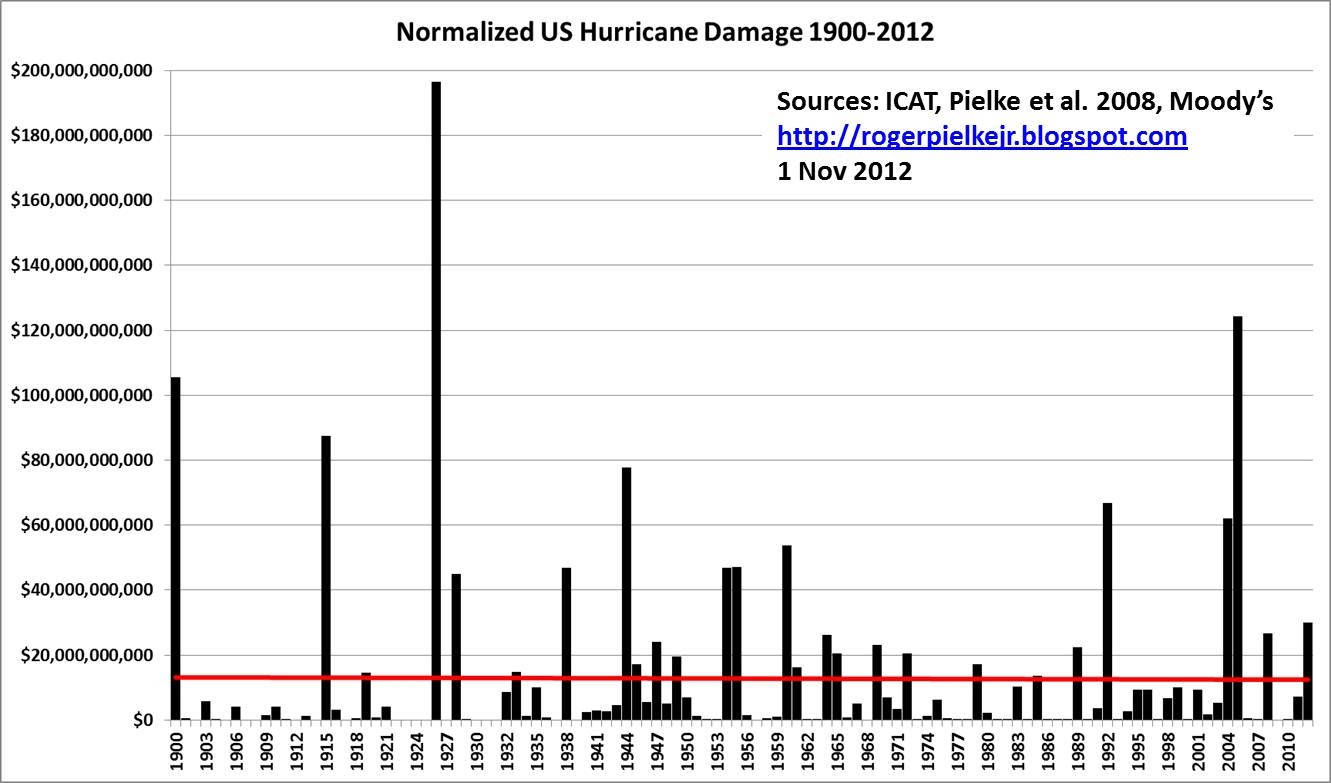
First, the economic analysis of natural disasters is Lewandowsky’s own. He ignores completely the opinions of Roger Pielke Jr, an expert in the field, with many peer reviewed studies on the subject. Pielke Jnr has shown there is nothing exceptional in the normalised cost of Hurricane Sandy. Furthermore, a 2009 report showed that New York is vulnerable to hurricanes, and the shape of the coastline makes it particularly vulnerable to storm surges.

Second, the sea level rise is a trivial issue. From the University of Colorado graph, it is clear that sea levels are rising at a steady rate of 31cm a century.

Third, he claims the predictions of unnamed “experts” have been fulfilled. A balanced analysis would point out that the CO2 levels have risen faster than predicted, but temperatures have not.

Last week I posted a proposal for analysing the costly impacts of global warming. Using the “equation”, I would suggest Lewandowsky overstates both the Magnitude and Likelihood that Sandy was caused by global warming. He misperceives the change in frequency (1/t). Furthermore, given than he has a track record in the highly biased use of statistics in his own field, and his deliberate lack of balance, the Weighting attached to anything he says should be negative. That is, like to newspapers of the Soviet Union, if Lewandowsky claims something, we should read between the lines to see what he does not say. However, unlike the Soviet Union we are still able to look for alternative opinions.


Normalized US Hurricane damage impacts


2012_rel4: Global Mean Sea Level Time Series (seasonal signals removed)

Costs of Climate Change in Perspective

This is a draft proposal in which to frame our thinking about the climatic impacts of global warming, without getting lost in trivial details, or questioning motives. This builds upon my replication of the thesis of the Stern Review in a graphical form, although in a slightly modified format.

The continual rise in greenhouse gases due to human emissions is predicted to cause a substantial rise in average global temperatures. This in turn is predicted to lead severe disruption of the global climate. Scientists project that the costs (both to humankind and other life forms) will be nothing short of globally catastrophic.

That is

CGW= f {K}                 (1)

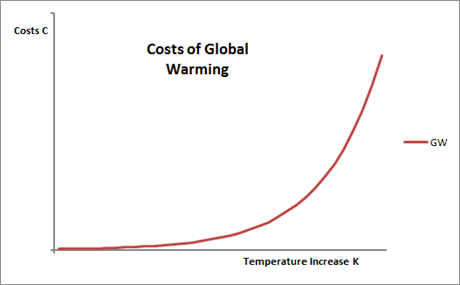
The costs of global warming, CGW are a function of the change in the global average surface temperatures K. This is not a linear function, but of increasing costs per unit of temperature rise. That is

CGW= f {Kx} where x>1            (2)

Graphically


The curve is largely unknown, with large variations in the estimate of the slope. Furthermore, the function may be discontinuous as, there may be tipping points, beyond which the costly impacts of warming become magnified many times. Being unknown, the cost curve is an expectation derived from computer models. The equation thus becomes

E(CGW)= f {Kx}                (3)

The cost curve can be considered as having a number of elements the interrelated elements of magnitude M, time t and likelihood L. There are also costs involved in taking actions based on false expectations. Over a time period, costs are normally discounted, and when considering a policy response, a weighting W should be given to the scientific evidence. That is

E(CGW)=f {M,1/t,L,│Pr-E()│,r,W}    (4)

Magnitude M is the both severity and extent of the impacts on humankind or the planet in general.

Time t is highly relevant to the severity of the problem. Rapid changes in conditions are far more costly than gradual changes. Also impacts in the near future are more costly than those in the more distant future due to the shorter time horizon to put in place measures to lessen those costs.

Likelihood L is also relevant to the issue. Discounting a possible cost that is not certain to happen by the expected likelihood of that occurrence enables unlikely, but catastrophic, events to be considered alongside near certain events.

│Pr-E()│ is the difference between the predicted outcome, based on the best analysis of current data at the local level, and the expected outcome, that forms the basis of adaptive responses. It can work two ways. If there is a failure to predict and adapt to changing conditions then there is a cost. If there is adaptation to anticipation future condition that does not emerge, or is less severe than forecast, there is also a cost. │Pr-E()│= 0 when the outturn is exactly as forecast in every case. Given the uncertainty of future outcomes, there will always be costs incurred would be unnecessary with perfect knowledge.

Discount rate r is a device that recognizes that people prioritize according to time horizons. Discounting future costs or revenue enables us to evaluate the discount future alongside the near future.

Finally the Weighting (W) is concerned with the strength of the evidence. How much credence do you give to projections about the future? Here is where value judgements come into play. I believe that we should not completely ignore alarming projections about the future for which there is weak evidence, but neither should we accept such evidence as the only possible future scenario. Consider the following quotation.
There are uncertain truths — even true statements that we may take to be false — but there are no uncertain certainties. Since we can never know anything for sure, it is simply not worth searching for certainty; but it is well worth searching for truth; and we do this chiefly by searching for mistakes, so that we have to correct them.

Popper, Karl. In Search of a Better World. 1984.

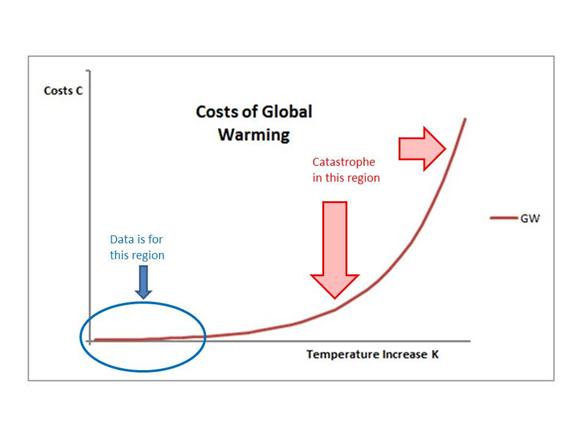
Popper was concerned with hypothesis testing, whilst we are concerned here with accurate projections about states well into the future. However, the same principles apply. We should search for the truth, by looking for mistakes and (in the context of projections) inaccurate perceptions as well. However, this is not to be dismissive of uncertainties. If future climate catastrophe is the true future scenario, the evidence, or signal, will be weak amongst historical data where natural climate variability is quite large. This is illustrated in the graphic below.


The precarious nature of climate costs prediction.

Historical data is based upon an area where the signal of future catastrophe is weak.

Projecting on the basis of this signal is prone to large errors.

In light of this, it is necessary to concentrate on positive criticism, with giving due weighting to the evidence.

Looking at individual studies, due weighting might include the following:-

  • Uses verification procedures from other disciplines
  • Similarity of results from using different statistical methods and tests to analyse the data
  • Similarity of results using different data sets
  • Corroborated by other techniques to obtain similar results
  • Consistency of results over time as historical data sets become larger and more accurate
  • Consistency of results as data gathering becomes independent of the scientific theorists
  • Consistency of results as data analysis techniques become more open, and standards developed
  • Focus on projections on the local level (sub-regional) level, for which adaptive responses might be possible

To gain increased confidence in the projections, due weighting might include the following:-

  • Making way-marker predictions that are accurate
  • Lack of way-marker predictions that are contradicted
  • Acknowledgement of, and taking account of, way-marker predictions that are contradicted
  • Major pattern predictions that are generally accurate
  • Increasing precision and accuracy as techniques develop
  • Changing the perceptions of the magnitude and likelihood of future costs based on new data
  • Challenging and removal of conflicts of interest that arise from scientists verifying their own projections

    Kevin Marshall

RWE Atlantic Array to gain GBP169m in Windfall Profits

I have worked in management accounts in manufacturing industry for over 25 years. In that time I have learnt that audit controls are imposed to stop the potential for fraud, by eliminating any scope for fraud. In Britain climate change arena, conflicts of interest are huge, but not considered important. This is an example of why truly independent oversight is required.

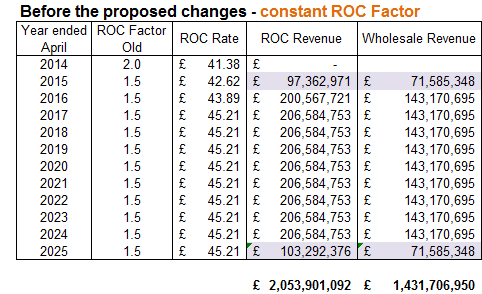
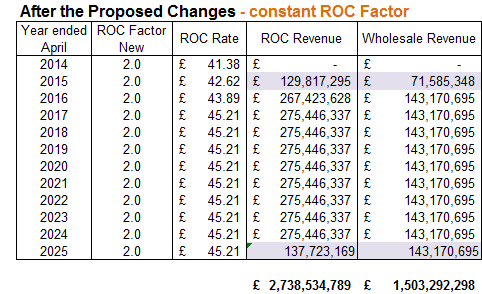
In July there was ministerial sign-off of a proposed to change the Renewables Obligation (RO) with respect to offshore wind power. Assuming that this proposal is enacted and the Atlantic Array gets the green light, I calculate will give a £169m (US$262m) windfall profit to the scheme in the first ten years of operation.

The numbers behind this are eye-watering.

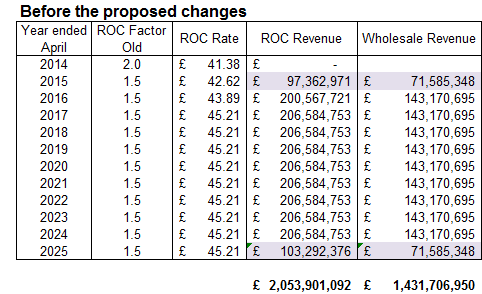
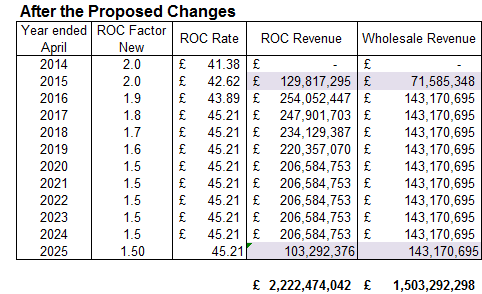
The revenue from a wind farm is from selling the electricity produced to the grid. This is currently 4.7p per kwh. I will assume that this will remain constant for until 2025. This might be a heroic assumption given that under current policies Britain will be producing far less electricity than demanded, but it is beside the point of this posting. What is relevant is the subsidy from electricity bills. The RO currently gives renewables a subsidy of £41.38 per megawatt hour. This is the rate for onshore wind. However, to encourage offshore wind power, this currently attracts a factor of 2.0 times the standard rate. In 2009 this was planned to reduce to 1.5 times the standard rate from 2014*. The new proposals are to give a more gradual and delayed decrease to 1.9 in 2015/16 and 1.8 in 2016/17. I have assumed that this will continue until the 1.5 level is reached.

In Germany the average output from the wind farms is just 16.3%. However, Britain is somewhat more exposed, especially the Bristol Channel. It is reasonable to assume to that average output will be 25% of capacity. Then I have assumed that RWE will choose to build the maximum proposed capacity of 1390MW. The lower end is 1000MW.

Calculations over a 10 year period are


The difference will mean an extra £168,572,951 windfall for RWE.

There is however a potential flaw in my analysis. If the Renewables Obligation works like the solar panels for houses, then the rate is fixed at the time of application. In other words, a scheme coming on stream in 2015 would now attract 2.0 ROC, instead of 1.5 for every year for 10 years.


If my analysis is correct, the difference will mean an extra £684,633,697 windfall for RWE over a 10 year period. That is $1.07 bn dollars. This from (the largest) of a number of similar projects.

Stop the blighting of Lundy & North Devon by RWE’s Atlantic Array

Please act to help stop a major act of vandalism to the British Coastline. Visit the Slay the Array site by 31st of August to find out how to help.

I have just returned from a holiday in North Devon, including a day trip to Lundy Island. Here I learnt about a mega wind farm proposed for the Bristol Channel by energy giant RWE. This is an area of outstanding coastal beauty, attracting millions of tourists annually to the area.

Proposed are 188 to 278 turbines, of either 180 or 220 metres (590 or 722 feet) in height, located as near as 13km (8 miles) from Lundy and 14km (9 miles) from the North Devon Coast.

Compare this with the second highest point on Lundy. The small building in the photograph is Tibbetts, 128 metres (420 feet) above sea level.


Or compare in height to some London skyscrapers.

Tower 42 (formerly the Natwest Tower) is 183m

The Gherkin (30 St Mary’s Axe) is 180m

One Canada Square, Canary Wharf is 235m

In Manchester, the tallest building is the Beetham Tower at just 169m tall, whilst the older Blackpool Tower, that dominates the resort’s skyline, is a mere 158 metres.


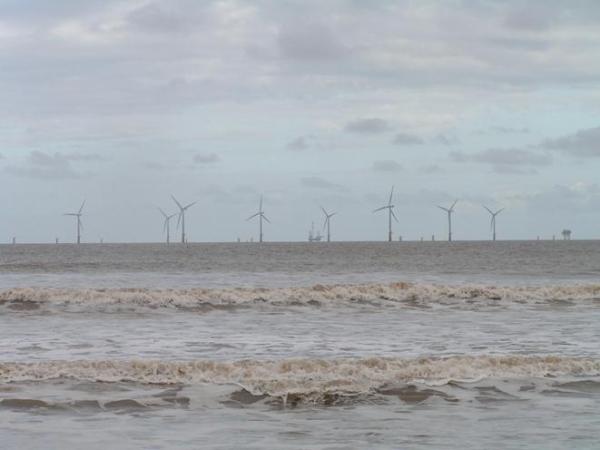
Another comparison is to the Skegness wind farm. Here there are just 57 134 metre-high turbines located 5km from shore. It has blighted the outlook from the beach level at Skegness. This picture I took at Easter of this year, on a very grey day. Better pictures are available here. The pictures do not fully recreate the visual impact, as the eye is drawn to the turning blades – or in the case of Skegness the difference between those blades that were turning, and the large number which were not.

Yet Skegness is a declining resort, not noted for its scenery. It does not have high cliffs from which to look out at a distant coastline. There is no equivalent of Butter Hill at Countisbury or the cliff tops of Lundy where you can survey the coastline of Wales. Should this Atlantic Bristol Channel Array go ahead, the eye will be drawn instead to the turning mega turbines, as the scenery.

John Redwood lights the “Global Warming” fuse again

John Redwood bravely touched on the global warming subject again in “Challenging establishment orthodoxies“.

One of the strange features of global warming theory is the reaction of its leading protagonists. They say it is scientifically derived, but then go on to say the science is proven and established. I thought the essence of scientific method was to reach a hypothesis that seemed to fit the facts, and then to keep trying to improve or destroy it by further testing or experiment. This seems to be a thesis where the aim is always to buttress it rather than test it. For many years scientists thought Newton had said the last word on planetary motion, but the twentieth century did not rest until they had replaced or improved on the Newtonian universe in a dramatic way.”

My comment (following from previous comments made on this blog) was

You will notice that whenever you mention “Global Warming” that you are guaranteed to get a greater number of comments compared to practically any other issue. Further the views are probably more polarized and politicized than any other issue.
However, the way to proceed might not be one of hypothesis testing. The data is complex and most of the science is about future events. Rather, it might be worth using the experience with which you are more familiar.
1. In business, a new investment proposal will just be assessed on the theoretical profits, but on the capacity to see that proposal through to actual success. The Stern Review allegedly gave the theory, but there was nothing on public policy issues of controlling policy costs, and maximizing policy benefits (CO2 benefits). Whatever the policy, this failure to focus and project management is a sure guarantee of policy disaster.
2. In politics, the greatest threat to extremist and untenable viewpoints has been from the majority who are able to compare these viewpoints to their other perspectives. That is why authoritarian regimes only can exist in an environment where they silence criticism. There is growing evidence of excluding contrary views without a fair hearing in our scientific institutions, in research funding, and in the mainstream media.
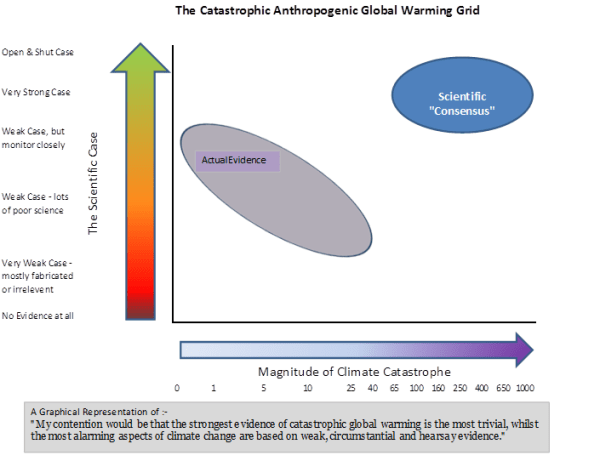
3. Science at the frontiers about making bold hypotheses that can be falsified by later testing. Similarly, the police in a crime investigation make conjectures and then gather evidence. Established science (on which policy should be based) is like a successful prosecution in a criminal case. It is about presenting the evidence and under-going a cross examination by the opponents. This to convince a randomly-selected group of people. My contention would be that the strongest evidence of catastrophic global warming is the most trivial, whilst the most alarming aspects of climate change are based on weak, circumstantial and hearsay evidence.

Two relevant references
https://manicbeancounter.com/2011/02/13/climate-change-in-perspective-%E2%80%93-part-2-of-4-the-mitigation-curve/
https://manicbeancounter.com/2012/02/20/a-climate-change-global-warming-spectrum/

Did Wivenhoe dam operators SEQwater swallow the CAGW hype on Australian Droughts?

The Australian “The Climate Sceptics Blog” takes a look at the Wivenhoe dam’s involvement in the catastrophic Queensland flood. I disagreed with the opinion that it might be sufficient to show that operators SEQwater did not undertake a proper, impartial risk assessment.


The question of having to prove the “AGW is not true” in the Wivenhoe case may be a little extreme.

Rather, they would need to show that the operators had a revised policy that gave due weighting to the Australian Government’s Report. I have only read the results. It says here quite clearly

“Observed trends in exceptionally low rainfall years are highly dependent on the period of analysis due to large variability between decades.”

In other words the results are not robust. This is not surprising. The report only looked at period of 40 years, so could say little about the frequency of once-in-a-generation extreme events. It does not say that floods will never occur again, like they have in the area since time immemorial.

If the authorities did not undertake a proper risk assessment of future scenarios based upon a balance of existing knowledge, and the report, then the change of purpose from flood management to reserve storage facility is flawed. This is unless there is near certainty that a climatic shift has occurred in a definite way. This was because

  1. The Report clearly stated that its results were not robust, AND did not predict that extreme rainfall would never happen again.
  2. There is a further complication that may hold. If there is not an extreme climatic shift (or only a partial one, or are in a slow transition from one state to another), then an area with extreme floods in the past will still likely have extreme floods in the future.
  3. Further, the lack of extreme floods for an extended period might pose a greater risk of extreme flooding in the immediate future.

This whole thing becomes a complex matter of balance of risks. That is why they should have solicited expert opinion on risk management from different perspectives, and tried to eliminate any corporate or individual biases. Furthermore, a risk management body should have publicly stated this change of use of the Wivenhoe Dam, so that householders could make adjustments to their risk portfolios.


These conclusions are based analysis of unfolding news reports hype on droughts and floods; the hype that exists for Catastrophic Anthropogenic Global Warming; and my developing analysis of Climate Change (see here, here and here) This comment is not intended as a legal opinion on the case, nor should it be taken as such.

Stern’s flawed opinion of Energy Stock Valuations

There is an interesting response by Profs Richard Tol and Roger Pielke Jnr on the latter’s blog to an article in the FT by Lord Stern on energy companies being overvalued

Have Markets Misvalued Energy Companies?

Roger Pielke Jr. and Richard Tol

Writing in the Financial Times (Dec. 9) Lord Stern of Brentford suggests that the financial markets have grossly misjudged the valuation of companies that produce fossil fuels, writing, “the market has either not thought hard enough about the issue or thinks that governments will not do very much.” Stern argues that the misjudgment poses a “risk to the balance sheets of large companies – or to the planet, or both.”

Have markets misvalued energy companies? While markets are of course not perfect, for two reasons we believe that in this instance there is no evidence to suggest that the valuation of fossil fuel producers has been grossly misjudged.

First, let us assume that governments around the world decide to take swift and effective action to reduce emissions. Would this mean that fossil fuel companies would go out of business in the near term? No.

Consider the case of Apple. Apple’s revenues depend upon selling products that will be obsolete within years and historical relics in a generation. That does not stop the company from being among the most highly valued in the world. If the world transitions to carbon free energy supply, the big energy producers of today are likely to play a big role.

Under all scenarios for future energy consumption the world is going to need vastly more energy and – whether governments act to decarbonize or not – vastly different types of energy too. Energy majors are so highly valued not simply because of the fossil fuel reserves they own, but because they have the expertise to supply energy at a massive scale along with a track record of successful and rapid innovation, with the ongoing shale gas and ultradeep oil revolutions as the latest examples.

Second, what if governments fail to deeply cut emissions? Might the impacts of unmitigated climate change lead to a dramatic reduction in the valuation of fossil fuel companies?

According to the work of Nick Stern himself this seems highly unlikely. In his famous review of climate change Stern argued that unmitigated climate change might reduce global GDP by as much as 20% by 2100. Using Stern’s own numbers for the most extreme impacts would mean that instead of growing by 2.5% per year to 2100, GDP would grow by 2.24%, with the largest effects occurring at the end of the century. This hardly seems cause for a dramatic revaluation of fossil fuel companies today. 

The impacts estimated by Stern on behalf of the British government are very pessimistic compared to the estimates found in the academic literature. Furthermore, changes in the growth rate of the economy have a muted impact on the growth in energy demand.

Indeed, future demand for energy is largely insensitive to whether governments decide to act on climate change. The more than 1.5 billion people without reliable access to electricity will demand access regardless. A world with unmitigated climate change could in fact be more energy intensive, for instance if more people demand air conditioning. In either case the future for energy companies would be bright.

Humans affect the climate system and it is important for policy makers to respond. But it is unlikely that efforts to second guess the market valuation of energy companies will contribute to such responses. Of course, if Nick Stern really believes that energy companies have been grossly over-valued he could put his money where his convictions lie. Who knows, he may one day be the subject of the sequel to the Big Short.

Roger Pielke Jr. is a professor at the University of Colorado. Richard Tol is a professor at the Economic and Social Research Institute in Dublin and at the Vrije Universiteit in Amsterdam.

My own comment is

The Stern review was not only criticized for being too concerned with the more extreme scenarios, but for applying a near zero discount rate. Whatever the economist’s policy-related arguments over discount rates (and Prof. Tol uses 3% plus), the market valuations of share prices are based upon much, much higher discount rates. This is for good reason. Suppose at the end of 1911 someone could have known that there would be an oil embargo in 1973, resulting from a cartel of oil-producing nations usurping the considerable power of the oil companies. What should have been the discount factor on the 1911 price of oil stocks considering in the interim there were two world wars, between which there was a massive global depression? Even if this was the case the local market factors (such as the emergence of the car industry, global growth, the development of the internal combustion engine and the relative fall in the oil price against coal) were far more important than the historical events. I would contend that in 1911, even if were highly likely that an oil company would be rendered bankrupt 60 years later, the discount factor on the share price would be approximately zero.

Furthermore, since the Stern review the scientific evidence has consistently failed to support the more alarmist scenarios resulting from any further warming (e.g. rapid melting of the Himalayan Glaciers or increased severity of hurricanes), nor for extreme temperature rises resulting from positive feedbacks to the CO2 induced warming. To the outsider looking at the emerging evidence, the cost impact of do-nothing scenarios (weighted by risk) is many times lower than when the Stern Review or AR4 were being published.

I fully realise that your comments were moderated to increase the chance of publication. However, if a more balanced version of Stern were done on today’s evidence, I firmly believe that (like Prof. Tol has concluded) current proposed mitigation policies do not have any form of benefit-cost justification.

Lord Stern might be a distinguished climate change activist, but he falls into the same trap of the amateur armchair activist. By seeing the world from their own narrow perspective, they misread the wider opinions and the facts of the real world. It is when such people acquire positions of power, with immoderate views not softened by political experience, that they can become deniers of reality and haters of sections of the community.