NASA excludes an inconvenient figure on 2010 Temperatures

The NASA Earth Observatory has a nice graph to show average global surface temperatures.

I noticed a small anomaly with the 2010 figures. The blue line, for the British Hadley Centre, appears to be missing.

You can check this by downloading the HADCRUT3 data set from here. Popping these figures into an Excel graph I get the following.

Excel even defaulted to the correct colour! The 2010 average temperature anolmaly on this data set is .468, as against .474 in 2005 and .529 in 1998. This is significant in that the NASA GISS figures show 2010 to be the warmest year on record, something that was pre-announced by leader James Hansen before the year was half way through. Try Googling 2010 Warmest Year on record to see the number of hits. But inclusion of the HADCRUT figures refutes the headline. Statistically it may not be significant, but the headlines show that politically it is important. It is the difference between the claim that global warming stopped in 1998, and that it is continuing.

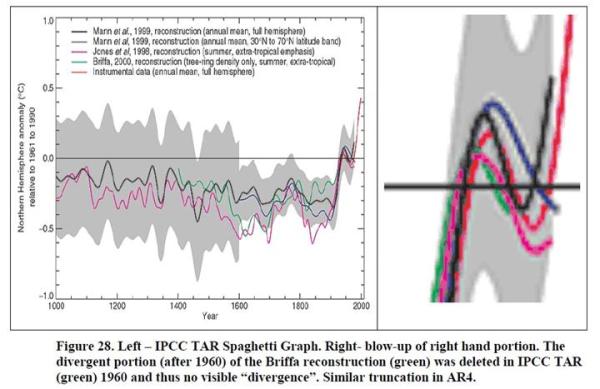
There is previous form in the climate community, as Steve McIntyre has noted. McIntyre has the following graphic (at page 28 of McIntyre, S. 2008b. How do we “know” that 1998 was the warmest year of the millennium?. Ohio State University Seminar, may 16, 2008.)

As Steve McIntyre states

“In the IPCC Third Assessment Report, they did worse than simply ignoring the problem.

They deleted the declining portion after 1960, thereby giving a false sense of coherence

between the proxies. In AR4, as a reviewer, I asked them to restore the deleted portion.

They refused saying that showing this information would be “inappropriate” (See


IPCC WG1 chapter 6 29 Review Comments) and the downward late 20th century portion

of the Briffa et al 2001 reconstruction was once again deleted in IPCC AR4.”

Baptist Times – Supporting Global Warming in the Extreme Cold

The front page of the Baptist Times of 10th December has two articles. One on churches helping those affected by the extreme cold snap. The other by Christian Campaigners urging tougher policies at Cancun to counter global warming. Here is my response.

Sir,

There is a distinct contrast in your two articles on the front of the BT of 10th Dec. The major article is of Baptist Churches opening their doors to help those affected by the cold weather. In central England it was the second coldest start to December in the last 350 years. This cold winter is explained by the combination of two natural factors – La Nina and low levels of solar activity.

The secondary article – “Standing up for Creation” – calls for the rich west and emerging India and China, to sacrifice their carbon-fuelled growth and prosperity to stop the global warming and thereby destabilising the climate. In the rich west it means paying more for fuel, something that will hit the poor hardest. In the China & India – with 2 out of 5 of the World’s population – it means preventing tens of millions breaking out of subsistence poverty every year. The policy outcome of Cancun will be more people in this country in fuel poverty, with a near-zero effect on climate change.

History will show that the climate consensus has overestimated our ability to change the climate, both for worse or better. The prophesies of catastrophe will be shown to be as misguided as past prophesies of Armageddon from selective reading of scripture.  We need a more balanced approach.

Cure Worse Than The Problem? – Global Warming and California Prop 21 Compared

Warren Meyer seems to have got a little confused on his blog posting on Judith Curry’s ostracism by the alarmist community. He states

I find it just staggering that Judith Curry, whose hypotheses about man-made global warming probably overlap those of the hard core alarmists by 80-90%, can no longer be tolerated by alarmists.  Much as the Catholic Church radicalized Martin Luther when all he initially wanted to do was reform some practices (many of which the Church later reformed), the attacks on Curry seem to be having a similar effect.

The typical response by politicians, of course, is to try to get more money from taxpayers.  California has a ballot initiative this November proposing to raise vehicle licensing fees to all its citizens in order to fund state parks.  Unfortunately, this kind of funds earmarking by ballot initiative is already threatening to bankrupt California.  One problem with this approach is that it demolishes accountability — once an unelected state agency gets dedicated funds the legislature can’t touch, there is nothing that taxpayers can do if these funds are not spent wisely short of another time-consuming ballot initiative to revoke them.

In the case of state parks, the accountability problem is even worse, as the initiatives replace park user fees, which at least enforce accountability in that users can stop visiting if park services are not up to expectations, with a no-strings-attached bureaucratic windfall.  Compounding the problem, in many states the parks organizations report to rubber-stamp boards rather than the governor or any elected official, so taxpayers have absolutely no path to enforce accountability.


The quotation seems to belong to Meyer’s Coyote Blog. I would direct folks to the Reason Video on this issue.

http://www.coyoteblog.com/coyote_blog/2010/10/coyote-on-reason-tv-private-management-of-public-parks.html

However, maybe, there are just some words missing here, because the funding of state parks and global warming have some common policy issues.

Let me start with Global Warming. The case can be divided into two main areas. There is the science bit (the forecast warming and the catastrophic consequences) and the policy devised as a remedy (divided into the policy itself – the Legislation and actions – along with the expected / actual results). Or more simply Forecast, Consequences, Policy, and Outturn (FCPO).

In the UK, the Stern Review looked at this whole issue as a cost benefit analysis. By assuming fairly alarmist consequences (without the uncertainty) and assumes a relatively cheap (but highly effective) policy fix, gave benefits of the policy are 5 to 15 times the costs. It looks a clear-cut case for action, so anyone who denies this is either ignorant or has ulterior motives. But if you start assessing the uncertainty in the science, you will quickly find unverified hypotheses, implicit assumptions and measurement errors tending in the same direction. Furthermore the climate disruption consequential on this postulated warming is possibly more speculative still.

Even if you accept this worst case scenario with all the damaging consequences as the near certain, there is still the fact that the policies proposed (like Kyoto & Copenhagen) would only be cost-effective if each individual government implemented them like a business plan – maximising revenues and minimising costs. In Britain (with a legislated 80% CO2 reduction by 2050), the levels of costs are often many times the cost boundaries set by Stern, and there are many other costs being incurred that are at best side-shows (targets on recycling, banning incandescent light bulbs, alcohol in gasoline). Yet no Government will implement the policy with the necessary ruthlessness and doggedness required to get the positive results.

Like when Steve McIntyre looked into Mann’s hockey stick, what looks superficially to be robust falls apart when you start looking at it the totality. If absolute minimum for policy is to be an justifiable expectation of improving the likely future state as a result of taking action, then there should be some top-level independent auditing. As no independent review has taken place – like a bank reviewing a business plan to justify a loan – any major gaps or faults in any area potentially undermines the whole case for taking action. But when if the minimum requires accelerating warming, strong positive feedbacks; along with cheap and effective policies and zero issues with policy implementation or cost overruns; then there is a serious problem. So it is only by making a number of extreme and untenable assumptions that the consensus policy be supported. The overall solution is likely to be worse than the actual problem.

How does this relate to California’s state parks? Unlike for global warming, the case for action is clear. The parks need new funding for maintenance. The proposed policy would be ineffective in this, as it is not just funding levels at issue, as part of the cost problem is ineffective management. The solution of separating revenue from paying customers (or the electorate) will exacerbate the management issue. Furthermore, free access to all will increase visitor pressure, potentially hampering conservation efforts, whilst having an element of unfairness towards the inner-city poor. The overall solution is likely to be worse than the actual problem.

Big Tobacco and Climate Change Deniers

NB – an article I wrote last year – slightly updated and posted here for the first time.

See also following post; “Climate Change – New Scientist puts smears before science

A comment thrown at the “skeptics” or “deniers” is that they use a similar tactics to Big Tobacco in the fight against the harm that tobacco does to health (1). That is they issue false data and research to throw policy makers off the scent. Further, it is claimed they use similar arguments as Big Tobacco in opposing the climate change science.

This is a misleading analogy in four areas.

  1. On the tobacco issue, the first major study on the link between lung cancer, heart attacks and smoking was ground-breaking research based on questionnaires returned from over 34000 British doctors. This study was continued for 50 years, reinforcing the original findings. Further, independent studies not only corroborated these initial findings, but enhanced the detail. Much of the initial temperature data for AGW studies were more ambiguous, reliant on a loose correspondence between the rise in greenhouse gases and average global temperatures. Moreover, data is often not properly archived, whether early studies (eg. Jones et al 1990), or later ones (e.g. Kaufman et al 2009)
  2. On tobacco issues, it is possible to have a control group. That is, you can follow the health of a large representative group of people who smoke, and follow a similar cross-section of society group who do not smoke. The control for anthropogenic warming is temperature histories. That is, if recent warming is unprecedented in a thousand years or more, it can only be explained by anthropogenic factors. If however, the 20th century warming was no bigger than similar warmings at 1,000 and 2,000 years ago, then the anthropogenic element is likely to be small. Not only has the two most influential past temperatures reconstructions showing the former case have been rebutted (MBH 1998 – see especially Mcintyre 2008b and Briffa 2000), but also the total temperature reconstructions that show the medieval period was at least as warm as currently outnumber 7 to 1 that show the it was cooler.
  3. The selection criteria on medical research is published, along with sample sizes and the statistical tests on the results. Therefore, statisticians can check the results. The statistician and climate skeptic Steve McIntyre has his work cut out to get similar information from the climate scientists. See for instance the battle for the Briffa’s Yamal data or the Jones data that underpins the temperature reconstructions of the IPCC.
  4. In general, the vast majority of medical research published in peer-reviewed journals is later refuted, or at least undermined. It is often of poor quality. Therefore in medicine, a peer reviewed research is but the first stage in getting an idea established. It needs to be replicated by other studies and cross-checked. Climate science is summarized by the UN IPCC is a form that reinforces a partisan viewpoint, rather than drawing conclusions through comparing and contrasting. For instance Steve McIntyre has posted his reviewer’s objections to the analysis of past temperatures in the 2007 assessment report, and the rejections. In the light of his subsequent exposure if the Yamal paper, these turn out to be entirely valid.


For the analogy to be upheld, climatologists need to show that their research programme is comparable in robustness and replication as the medical research was in the 1970s. My contention is that it falls far short. By implication, those who are either skeptical of the robustness of the results, or who deny completely the validity of the research programme, have much surer foundations for their doubts, even before presenting any research to the contrary.

1.See, for instance, Thomas Fuller (who, seeks communication between the opposing sides) at examiner.com

The fact that for many of the staunchest activists any bending is tantamount to surrender makes compromise difficult. They take their lessons from what happened with Big Tobacco, where the strategy of introducing doubt into the science allowed them to postpone accountability for their actions. They must take a blood oath or something to never admit error and never back down. I don’t admire them for that–they should trust the power of the truth.

Medical papers from sloppy analysis http://online.wsj.com/article/SB118972683557627104.html

(Hattip Anthony Watts blog http://www.norcalblogs.com/watts/2007/09/maybe_they_need_a_statistical.html#comments)

The argument of big tobacco and anti-AGW is backed by a BBC Newsnight on Phillip Morris funding one of the 1st anti-AGW groups. http://thinkprogress.org/2006/09/21/bbc-global-warming/