The Role of Pivot Tables in Understanding Lewandowsky, Oberauer & Gignac 2012

Summary

Descriptive statistics, particularly in the form of pivot tables enable a bridging of the gap between the public pronouncements and the high level statistical analysis that can only be performed by specialists. In empirically-based scientific papers, data analysis by spread sheet enables the robust questions to be asked by the non-specialist and the expert reviewer alike. In relation to Lewandowsky et. al 2012, it highlights the gulf between the robust public claims and the actual opinion poll results on which it is based.

Introduction

In a blog post “Drilling into Noise” on 17 September, Stephan Lewandowsky (along with co-author Klaus Oberauer) makes an interesting comment

The science of statistics is all about differentiating signal from noise. This exercise is far from trivial: Although there is enough computing power in today’s laptops to churn out very sophisticated analyses, it is easily overlooked that data analysis is also a cognitive activity.

Numerical skills alone are often insufficient to understand a data set—indeed, number-crunching ability that’s unaccompanied by informed judgment can often do more harm than good.

This fact frequently becomes apparent in the climate arena, where the ability to use pivot tables in Excel or to do a simple linear regressions is often over-interpreted as deep statistical competence.

Now let me put this in context.

    The science of statistics is all about differentiating signal from noise. This exercise is far from trivial:

A more typical definition of statistics is

Statistics is the study of how to collect, organize, analyze, and interpret numerical information from data.

So Lewandowsky and Oberauer appear to seem to have a narrow and elitist interpretation.

“it is easily overlooked that data analysis is also a cognitive activity.”

Lewandowsky and Oberauer are cognitive scientists. They are merely claiming that this is within their area of competence.

Numerical skills alone are often insufficient to understand a data set—indeed, number-crunching ability that’s unaccompanied by informed judgment can often do more harm than good.

Agreed – but that implies that what follows should demonstrate something unique, they can only be gained by higher level or “scientific” analysis.

This fact frequently becomes apparent in the climate arena, where the ability to use pivot tables in Excel or to do a simple linear regressions is often over-interpreted as deep statistical competence.

I have not found pivot tables used before to analyse data in the climate arena. Nor have I seen simple linear regressions. The heavyweight statistical analysis from those who dispute the science has centred around one person – Steve McIntyre. In fact, to my knowledge, the first instance of when pivot tables were presented are primary analysis by sceptics was when I published my analysis

I would quite agree that pivot tables are not a replacement for deep statistical analysis. But it has role. My analysis using pivot tables, published on 1st September has a number of things which I identified independently which are not brought out in the original paper. These I present below. Then I will suggest how the reporting in the mainstream media might have been somewhat different if they had seen the pivot table summaries. Finally I will make some suggestions as to how the low level statistical analysis can contribute to relating to more “scientific” statistics.

Analysis using pivot tables

How Many Sceptics?

When I first glanced through the paper at the end of July, I wrote

It was an internet based survey, with links posted on 8 “pro-science” blogs. Five skeptic blogs were approached. As such, one would expect that “pro-science” responses would far outweigh “denialist” responses. I cannot find the split.

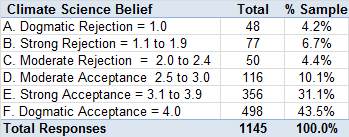
On obtaining the data, this was what first looked at. In the posting I looked at the 4 Climate Science questions, classifying into acceptors and rejectors (“denialist”) of the science.

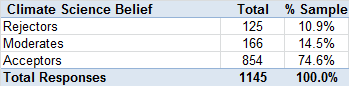
Or summarising into 3 categories
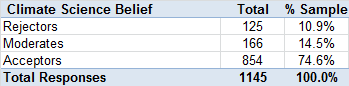

Those who dogmatically rejected every question were outnumbered more than 10 to 1 by those who dogmatically accepted. Those who accept the science comprise three-quarters of the respondents. Most people would believe this to be material to a paper analysing those who reject the science.

NASA faked the moon landing|Therefore (Climate) Science is a Hoax

This is the beginning of the title of the paper. Pivot tables are great analysing this. The row labels are “Climate Science Belief”, the columns are CYMoon, and under “∑ values” enter the count of another column of values.

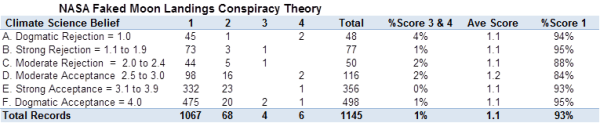
After a bit of formatting, and three more columns of simple formulas, I got this.
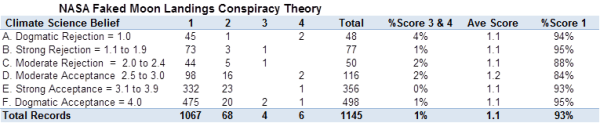

Just 10 out of 1145 respondents agree that NASA faked the moon landings. (I was not the first to publish this result. Anthony Watts piped me by a few hours.)

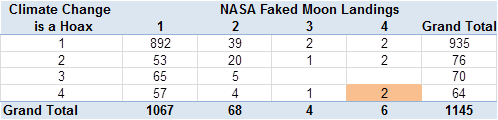
Strictly this is a claim against the “Climate Change” conspiracy theory CYClimChange and CYMoon. I did this table as well


Of the 64 who strongly accept that the climate change conspiracy theory, just 2 also strongly accept CYMOON. Even worse the title is the other way round. So the sample of those who believe NASA faked the moon landings is just 10. The sample size was just too small to make a prediction. Even worse, you could make the wrong result due to the next issue.

Identification of scam responses

One test was to look at the average agreement to each of 12 conspiracy theories that were independent of the climate area. So I rounded the average response to the nearest whole number for each respondent. And then did a pivot table.


I believe I was the first to identify publically the two that averaged 4 on the conspiracy theories and rejected the climate science. These are the two that Steve McIntyre has dubbed “Super-scammers”.

The biggest conclusion that I see is that the vast majority of respondents, no matter what their views on climate, don’t have much time for conspiracy theories. In fact, if you take out the two super-scammers, the most sceptical bunch are the group that dogmatically reject climate science.

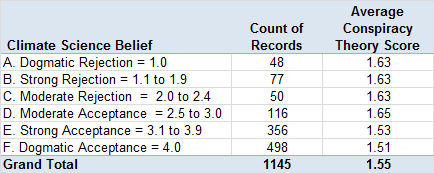
This is confirmed if you take the average conspiracy score for each group.
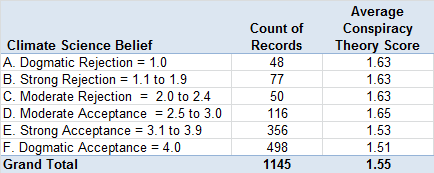

Taking out the two super-scammers brings the average for the dogmatic rejectors from 1.63 to 1.49. With such small numbers, one or two outliers can have an impact on the data.

Measuring up against the public perception

There were two major newspaper articles that promoted the

The Guardian article on 27th July started

Are climate sceptics more likely to be conspiracy theorists?

New research finds that sceptics also tend to support conspiracy theories such as the moon landing being faked

Even a paper such as the Guardian, which prints all sorts of extremist dogma in denigrating sceptics, would have thought twice about publishing that comment if they had been presented with the tables.

The Telegraph article of 28th August included

“NASA faked the moon landing – Therefore (Climate) Science is a Hoax: An Anatomy of the Motivated Rejection of Science”, was based on a survey of more than 1000 visitors to blogs dedicated to discussion of climate change.

An astute reporter, on the basis of my pivot tables, could reasonably ask Professor Lewandowsky how it follows from just 10 respondents who support the idea that “NASA faked the moon landing” that you can make any sort of prediction about beliefs about climate. The questionnaires were placed on climate blogs, not conspiracy-based blogs, so surely any prediction should be framed the other way round?

It also included

The lead researcher, Professor Stephan Lewandowsky, from the University of Western Australia, said conspiracy theories are the “antithesis to scientific thinking” and those who believe them are more likely to reject the scientific consensus that humans contribute to climate change.

“Science is about weeding out bad ideas,” he told The Daily Telegraph. “With conspiracy theories, you start out with a theory and stick to it no matter what the evidence. So it is not that surprising that conspiracy theorists would not accept scientific propositions … If the scientific evidence is overwhelming and you don’t like the conclusion, you have to find a way to reject those findings.”

An astute reporter, on the basis of my pivot tables, could reasonably ask why Professor Lewandowsky is still sticking to his hypothesis when such small numbers support the wacky conspiracy theories. They may then ask a supplementary question. Given that there were 15 questions on conspiracy theories (14 with results reported), and just 5 on free markets, was not the original purpose to establish the conspiracy theory hypothesis and the secondary one on political orientation?

Suggestions for the Role of Low Level Statistical Analysis

In summary, whilst would quite agreeing that spread sheet analysis using pivot tables are not a replacement for deep statistical analysis there are a number of ways where it can be a powerful aid.

Firstly, it is a quick way of getting a sense of what the data is suggesting. Pivot tables can enable a quick summary visually in lots of different ways. It may need additional classifications, such as my acceptors / rejectors. It also needs thought, and an almost a manic sense of trial and error.

Second, it can give a quick comparison to what is being derived from the higher level statistics or modelling. For scientists it is a way of reviewing the data, to make sure that they have the most important points, and have not gone up blind alleys. For non-scientists (and for those scientists reviewing the work of others) it is a way of quickly getting a sense of whether the conclusions are substantiated by the empirical evidence.

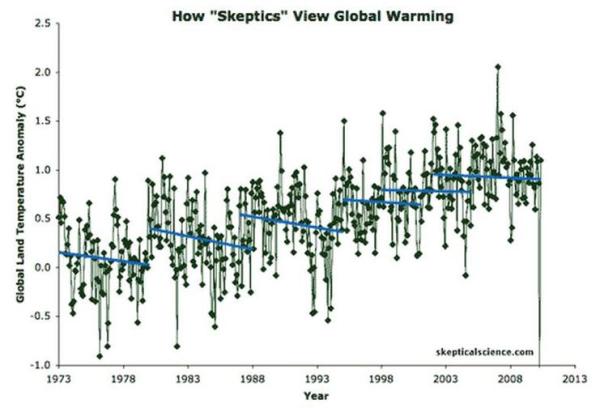
Thirdly, and most importantly, it is a means of communicating to the wider public. It provides a bridge between the mainstream media and the scientists. If climate scientists want to win the trust of the wider public, then they need to relate their work in more intelligible terms, capable of being cross-examined. Instead we have the high level models and a then lot of shouting about how wrong and biased are any criticisms. That leads to a lot of scientists, including Lewandowsky, who are totally incapable of perceiving that they could be wrong, or that there could be even modicum of truth in what the critics say. This denial is best summarized in the graphic displayed in the Lewandowsky and Oberauer posting of the “skeptics” view on recent warming trends. It is a total misrepresentation, used as a means of avoiding intelligent discussion.
 

Kevin Marshall
A Reply to Lewandowsky’s sideswipe

In looking analysing the data on the Lew et al paper I made the following comment.

If you sample some of their articles, you will find a dogmatic defence of climate change, and blocking, editing or denigration views that are contrary to their own. The claim in the paper that they contacted five sceptical blogs to improve the spread of views is highly suspect. Jo Nova contacted 24 such blogs (including all the most prominent ones), with not a single one remembering such an approach. Prof. Lewandowsky is currently refusing to divulge the names of the blogs contacted. As there was no proper control of the answers, there could be rogue results generated.

It turns out that Prof. Lewandowsky’s assistant Charles Hanich did contact 5 “skeptic” blogs with requests. These requests were either ignored or rejected with little or no thought nearly two years ago. On his blog Stephan Lewandowsky stated

At this juncture one might consider a few intriguing questions:

1. When will an apology be forthcoming for the accusations launched against me? And how many individuals should now be issuing a public apology?

To explore the magnitude of this question we must take stock of public statements that have been made about my research. For example, one blogger considered it “highly suspect” whether I had contacted any “skeptic” sites.

It troubled me greatly this comment. Why had I failed to trust the word of a professor of psychology? A science which I have never studied? I will not give excuses, but give the reasons that were going through my mind at the time.

Firstly, I was prejudiced against Prof. Lewandwosky. I had first heard of him in relation to the Peter Gleick affair. This was when a so-called scientist impersonated someone else to fraudulently obtain documents from the Heartland Institute. He was “outed” because the key document – which was fabricated – was in the style of Peter Gleick. Yet, Lewandowsky’s believed Gleick’s lying to defend “science” was on the same moral plane as Churchill’s lying to deceive Hitler. Further, he accepted Gleick’s statement that he was sent the forged document in the post. In my eyes that was a choice between strong circumstantial evidence and the statement of a self-confessed liar. Also, for Gleick, admission of fabrication might be a far more serious crime, than his claim to receiving something in the post gullibly accepting it as genuine. So whatever the truth, there might be motive for an additional lie. Further, I do not believe that climate denial is as evil as Nazism. In fact I happen to believe that the term “climate denial” is a vicious smear.

Secondly, my prejudices were further exaggerated when I came across a climate opinion survey at “Watching the Deniers” blog. I not only answered this opinion survey, but recorded the questions and commented upon them. When I saw the Lewandowsky paper, with the some of the same questions on free markets and conspiracy theories, I erroneously thought that this was the same questionnaire. In fact, the questionnaire I answered is probably a later development of the survey behind the Lewandowsky paper. Looking at the actual questionnaire, my comments can be applied to the earlier and shorter survey.

Thirdly, I saw the paper and read the opening paragraphs. I see Lewandowsky’s belief (and the climate scientists as being) along the lines of climate scientists are the experts with PhDs, and are in strong agreement. I believe that far from the strong foundation sufficient to declare anyone who disagrees a motivated denier of the truth.

Fourthly, I am also prejudiced against using psychology to declare that critics sub-normal after reading in the 1980s about the abuses of psychiatry in the Soviet Union, to consign dissidents to mental institutions. Or the arguments the KGB put forward to dissidents of how they could possibly disagree with the huge consensus. Maybe this is an analogy that Lewandowsky will cry foul as one who knows the subject, but this is the honest truth.

Fifthly, I then looked at the data. I found a number of misleading statements in the paper, including the small minority of skeptic responses; the fact that the typical respondent wanted little or anything to do with any conspiracy theory not related to climate. In the extreme case of the “NASA Faked the Moon Landings” referred to in the title only 10 responses out of 1145 responses agreed with the proposition. Further, the two dogmatic rejecters of climate science I identified (before Tom Curtis) as being likely scammed. In other words, the dogmatic conclusions rested on little or no evidence.

My conclusion was this. Prof. Lewandowsky believes it is alright to lie and smear opponents in his “noble” cause. He has issued a highly prejudiced survey to verify a hypothesis that those who reject what he believes are nutters. He then failed to get a decent sample of skeptics and then failed to filter out the rogue responses. When the vast majority of responses failed to verify his hypothesis, he used the small differences in the minority who believed in conspiracy theories to support his dogmatic conclusions. Yet those could be accounted for by scam responses.

On the basis of all this, I had completely lost trust in any statement that Lewandowsky and his mates wrote. I believe I had more than sufficient grounds for suspecting that he had lied about contacting sceptical blogs.

What this leads me onto is something that Lewandowsky has completely missed. The claim is that we should trust climate scientists, as they are the experts.

But what happens when you betray that trust? Let me give three cases.

1. A business fails to deliver on time and what was specified. Then digs themselves into a deeper hole be making excuses and telling the customer that if they have not broken the small print of the contract. After such an experience would the customer ever trust that business again, even if dealing with a different department or people?

2. Somebody was wrongly convicted of murder due to misinterpretation of the evidence by experts, or tampering of the evidence by the police. After this is exposed, there is no action taken to release the innocent party or to stop these events occurring again. What would happen to people’s trust in the judicial process?

3. After twenty years of marriage, one of the partners sleeps with another. What happens to the trust in the marriage if the guilty partner then makes excuses, including blaming the other?

Betrayal of that trust will lead to the betrayer being viewed in a completely different light by the betrayed party. The betrayed now questions every statement and every motive. Once you have lost people’s trust, it is very hard to regain that trust – a point that Dale Carnegie makes in “How To Win Friends And Influence People”. Shifting blame, or failing to acknowledge fault, will only make matters worse. Yet this is what the climate science community has being doing for years. Look at the skeptic blogs and you will find lots of reasons for questioning the science. Some are valid, some are less valid. It is by a group of people that has, with multiple reasons, lost trust in the “science”. The response of the scientists is to call them names, question their motives and (if you look at the skepticalscience blog) provide feeble and biased excuses. By not acknowledging that differences of opinion are possible, or that the science is weak, or that misinterpretations are possible, they are destroying the trust people have in science.

In short what Lewandowsky has completely missed is that people reject the “science” because of lack of trust in scientists, for reasons that they believe in. His actions and those of climate scientists are just exacerbating the rift between the climate science community and people who live in the real world.

Final Note

I am not a scientist. But I have a degree in economics and worked for over 20 years in industry as a management accountant, mostly within the manufacturing sector. I am a Christian, who believes that people are fallible. That is human beings are prone to error, whether by design or by failing to perceive whether they are wrong. I am certainly fallible. In fact, my best work has often by analysing figures in different ways, wasting my time going up blind allies, learning and eventually getting to better solutions. But I strongly believe that those who believe themselves to be the most infallible are those who are usually the most wrong.

I have used an anonymous handle for various reasons, including that people who support “science” think that is alright to make unsubstantiated character assassinations against those who question them.

Kevin Marshall
Lewandowsky et al. 2012 MOTIVATED REJECTION OF SCIENCE – Part 5 the Missing Links

Jo Nova has now provided the first full list of the survey questions used for the Lewandowsky, Oberauer & Gignac paper, along with a well-written summary. However, there are a number of elements that need to be emphasised

  1. If “climate denial” is on a par with “holocaust” or “smoking” denial, why not start by referencing the clearest statement of the evidence, rather than past opinion surveys? That is, if direct evidence is available, why resort to hearsay evidence?
  2. But if opinion surveys are used, then they should at least be good ones. But the primary references are Anderegg, Prall, Harold, & Schneider, 2010 (Most climate scientists believe in what they do) and Doran & Zimmerman, 2009 (97% of climate scientists = 75/77 cut from >3000 responses).
  3. Even so, surely the association with NASA Moon Landings was correct? After all, the title is “NASA faked the moon landing|Therefore (Climate) Science is a Hoax: An Anatomy of the Motivated Rejection of Science.”
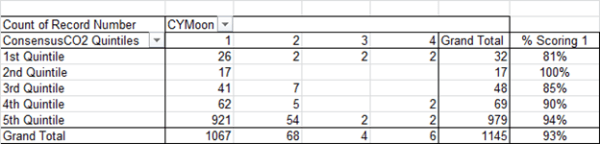
    Not when 93% of all respondents gave it a firm thumbs down.
  4. When Lewandowsky says over >1100 responses, and only talks about those who “reject the science”, it surely implies that all (or at least the vast majority) of responses were from the people he is attacking? Actually, around 15% of responses were from skeptics, in terms of answers to four “climate science” questions. Professional polling organisations in the UK state these figures. But a scientific journal seems not to have insisted.
  5. There are loads of conspiracy theories. But one of the most popular in recent years is something like “Climate denial only exists as a serious force due to significant funding by oil and tobacco interests.” Lewandowsky and his junior partners cannot have missed that one.

The basic psychology behind this can be found in “The Debunking Handbook” on the front page of the skepticalscience website. Here is the justification for lying, ad hom attacks and continued government grants to a failed research program. They know the truth, and are claiming a monopoly of that truth. But to legitimately claim a monopoly it is necessary to show the corollary. The corollary is that every person who disagrees with you is wrong on everything. In empirical sciences this leaves no gap for different interpretations from the same data; no gap for the unexplained; no gap for hypotheses or assumptions to be falsified; and no gap for new data contradicting old data or forecasts. Lewandowsky’s opinion poll applies the truth in the “The Debunking Handbook” to justify one version of climate science having a continued monopoly by showing that opponents are a load of undesirable nutters. It is not just full of gaps. Like past claimants to the throne of dictators of truth, he is more wrong than his detractors.

But if you do not have a monopoly of the truth in climate science, what is the alternative? What if there is a potential future threat, which is very real, but for which there is very little firm evidence? A tentative proposal will be the subject of my next posting.

Lewandowsky et al. 2012 MOTIVATED REJECTION OF SCIENCE – Part 4 Political Opinions

This is the fourth in a series on Lewandowsky, Oberauer & Gignac – NASA faked the moon landing:Therefore (Climate) Science is a Hoax: An Anatomy of the Motivated Rejection of Science (in press, Psychological Science).

This posting is further analysis of the data set sourced by Katabasis. (The data is now available from Bishop Hill) The previous post looked at the conspiracy theory question, whilst this looks at the link that the survey makes between free market ideas and rejection of climate science. From the abstract, this was the primary theme of the survey.

Abstract

Although nearly all domain experts agree that human CO2 emissions are altering the

world’s climate, segments of the public remain unconvinced by the scientific evidence.

Internet blogs have become a vocal platform for climate denial, and bloggers have taken a

prominent and influential role in questioning climate science. We report a survey (N

> 1100) of climate blog users to identify the variables underlying acceptance and rejection

of climate science. Paralleling previous work, we find that endorsement of a laissez-faire

conception of free-market economics predicts rejection of climate science (r≈:80 between

latent constructs). Endorsement of the free market also predicted the rejection of other

established scientific findings, such as the facts that HIV causes AIDS and that smoking

causes lung cancer. We additionally show that endorsement of a cluster of conspiracy

theories (e.g., that the CIA killed Martin-Luther King or that NASA faked the moon

landing) predicts rejection of climate science as well as the rejection of other scientific

findings, above and beyond endorsement of laissez-faire free markets. This provides

empirical confirmation of previous suggestions that conspiracist ideation contributes to

the rejection of science. Acceptance of science, by contrast, was strongly associated with

the perception of a consensus among scientists.

There were relatively few questions to identify the political views of the respondent.

The Free Market Questions

FMUnresBest An economic system based on free markets

unrestrained by government interference automatically

works best to meet human needs.

FMNotEnvQual I support the free market system but not at the expense

of the environmental quality.

FMLimitSocial The free market system may be efficient for resource

allocation but it is limited in its capacity to promote

social justice.

FMMoreImp The preservation of the free market system is more

important than localized environmental concerns.

FMThreatEnv Free and unregulated markets pose important threats

to sustainable development.

FMUnsustain The free market system is likely to promote

unsustainable consumption.

The Climate Science Questions

CO2TempUp I believe that burning fossil fuels increases atmospheric

temperature to some measurable degree.

CO2AtmosUp I believe that the burning of fossil fuels on the scale observed over the last 50 years has increased atmospheric temperature to an appreciable degree.
CO2WillNegChange I believe that the burning of fossil fuels on the scale observed over the last 50 years will cause serious negative changes to the planet’s climate unless there is a substantial switch to non CO2 emitting energy sources.
CO2HasNegChange I believe that the burning of fossil fuels on the scale observed over the last 50 years has caused serious negative changes to the planet’s climate.

The Results

The answers for the free market questions are from 1 (reject the free market) to 4 (complete agreement to free market).

The answers for the climate science questions are from 1 (totally Reject) to 4 (complete agreement).

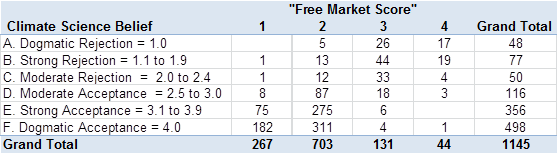
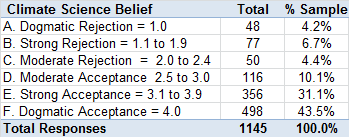
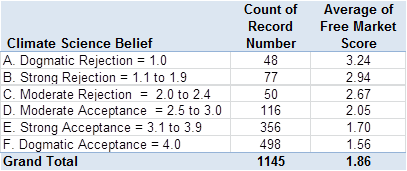
As in my previous posting, for the Climate Science questions I graded the answers to the four questions into groups based on the average score.


The answer is clear from the poll results. The stronger the support for free markets, the more likely one is to reject the climate science.

Taking the average score and rounding to the nearest whole number, the picture is even clearer.


The more free-market the views expressed, the greater the rejection of the science. Does this substantiate Lewandowsky et. al’s assertions?

Err No.

There are some series issues with this result.

Firstly, the survey was only available on a certain type of blog. Depending on your point of view, they are either pro-science or alarmist. These are

http://www.skepticalscience.com
http://tamino.wordpress.com
http://bbickmore.wordpress.com
http://www.trunity.net/uuuno/blogs/
http://scienceblogs.com/illconsidered/
http://profmandia.wordpress.com/
http://scienceblogs.com/deltoid/
http://hot-topic.co.nz/

If you sample some of their articles, you will find a dogmatic defence of climate change, and blocking, editing or denigration views that are contrary to their own. To regularly trawl through articles that you disagree with takes a certain kind of person that may not be representative of the wider sceptic community. Given that the sceptic blogs attract a wider audience than the “pro-science” ones, the fact that only 15% of responses were from sceptics says that only a minority regularly visit the blogs antagonistic to their views. In other words, the survey is not representative of the true population of those interested in the climate change / global warming issues.

Then there are the questions themselves.

At first glance the questions do not allow for the middle ground. Many sceptics who are not libertarian in outlook have then a number of options.

  1. Some might quit the survey in disgust, thus creating a sample less representative of the true population. There was no record kept of the numbers of part completed surveys, nor the point at which they were completed. The lack of neutrality and narrowness of the range of questions suggests that might be material.
  2. The second is to answer questions in opposition to the climate consensus. That is the join in coalition to free-marketers to oppose the environmentalist ideology. This is quite logical. Environmentalist ideology can be viewed as increasing authoritarianism, constraining economic growth (and thus the prospect of ever-rising standards of living) along with regressive cost increases in electricity and fuel for cars. In other words, those who want the status quo to be maintained join in coalition with those who want the direction of change to be the opposite of where environmentalists are pulling. There is no risk here for the moderates. Libertarianism is nowhere a major political force.

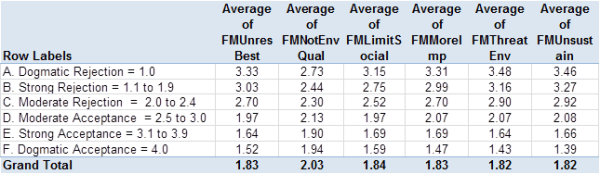
Let us look at the average response for each question to see if this is suggested.


The most pragmatic question is the least polarized. People may support a position ideologically, but will compromise if there is a demonstrable need or benefit. Conversely the last two questions are the most ideological. A lot of people are motivated to oppose a movement that is contrary to their own beliefs. In other words, the nature of the questions further drives people into opposing camps.

How should Lewandowsky have approached these problems? If he was an objective scientist, Lewandowsky would have sought advice from professional pollsters on the content of the questions. They would have advised more neutral, and a broader range of questions to enable people to express a range of views. They would have also advised validity checks to make sure the survey results were representative of the population at large. But Stefan Lewandowsky is not an objective scientist. His agenda is to prevent any opposition to the ideology he and others promote.

Are there any conclusions to be drawn?

The biases in the free market questions apply to those who reject climate science. However, as a survey of those who accept the climate science, it is more valid.

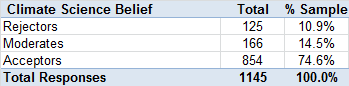
Firstly the sample size is significant. Merging the six groups into 3 gives:-


The sample size of 854 is quite large, and more than six times the size of those who reject climate science.

Secondly, the sample is likely to represent the true population of “Acceptors”, as it was placed on the blogs that they frequent.

Thirdly, as the survey was devised by people sympathetic to their point of view, the abandonment rate should not have been any higher than for more neutral polls.

The major conclusion is that those who “accept the science” have no truck with conspiracy theories. On political opinions, they strongly support an ideology which promotes the environment at the expense of economic growth and economic freedoms. That is the, planet should be given a higher priority relative to the people that live on it.

Thus the true result of the survey data is not that those who oppose climate science are nutters. Rather, it is that those who support climate science have views that are at odds to, and contrary to the best interests of, the vast majority. We have not got here the justification to silence the opposition, but giving them due weighting.


Lewandowsky et al. 2012 MOTIVATED REJECTION OF SCIENCE – Part 3 Data Analysis of the Conspiracy Theory element

A month ago made two postings on the paper Lewandowsky, Oberauer & Gignac – NASA faked the moon landing:Therefore (Climate) Science is a Hoax: An Anatomy of the Motivated Rejection of Science (in press, Psychological Science). In the first I showed that an opening statement about the beliefs of climate scientists was not supported by the references. The second raised some questions, which owing to a lack of data I was unable to answer.

When Katabasis offered in the comments at Jo Nova’s blog to provide the raw data for the paper I took him up on the offer.

The paper’s major findings were on the link between climate denial and belief in free markets. However, I first want to deal with the aspect of the link with beliefs in conspiracy theories due to

  1. the title
  2. The articles that have appeared in the Guardian and Telegraph newspapers.
  3. The following from the conclusion
  4. Also consider this from the conclusion

    “However, to our knowledge, our results are the first to provide empirical evidence for the correlation between a general construct of conspiracist ideation and the general tendency to reject well-founded science.”

The lead author, Prof. Stefan Lewandowsky has a history of dogmatically defending climate science, often by attacking the opponents. However, that is no reason to reject the results of a published scientific paper if those results are substantiated by the evidence.

The survey was posted on a number of climate blogs of all the same persuasion. Depending on your point of view, they are either pro-science or alarmist. These are

http://www.skepticalscience.com
http://tamino.wordpress.com
http://bbickmore.wordpress.com
http://www.trunity.net/uuuno/blogs/
http://scienceblogs.com/illconsidered/
http://profmandia.wordpress.com/
http://scienceblogs.com/deltoid/
http://hot-topic.co.nz/

If you sample some of their articles, you will find a dogmatic defence of climate change, and blocking, editing or denigration views that are contrary to their own. The claim in the paper that they contacted five sceptical blogs to improve the spread of views is highly suspect.* Jo Nova contacted 24 such blogs (including all the most prominent ones), with not a single one remembering such an approach. Prof. Lewandowsky is currently refusing to divulge the names of the blogs contacted. As there was no proper control of the answers, there could be rogue results generated.

Identification of those who “Reject the Science”

There were four questions on beliefs about “Climate Science”

CO2TempUp I believe that burning fossil fuels increases atmospherictemperature to some measurable degree.
CO2AtmosUp I believe that the burning of fossil fuels on the scale observed over the last 50 years has increased atmospheric temperature to an appreciable degree.
CO2WillNegChange I believe that the burning of fossil fuels on the scale observed over the last 50 years will cause serious negative changes to the planet’s climate unless there is a substantial switch to non CO2 emitting energy sources.
CO2HasNegChange I believe that the burning of fossil fuels on the scale observed over the last 50 years has caused serious negative changes to the planet’s climate.

The answers were from 1 (totally Reject) to 4 (complete agreement).

I found the average score for each respondent, graded and plotted the count.


Or summarising into 3 categories


As to be expected from the nature of the blogs where it was published, more than 4 in 10 gave the highest score and 85% are more positive than negative in their beliefs. The poll only includes 125 or 175 responses of those who “reject the science”.

Linking to Conspiracy Theories

The survey is about those who reject the science being more likely to believe in weird conspiracy theories than acceptors of the science. As Jo Nova puts it, the climate sceptics are meant to be nutters.

There were 14 conspiracy theories presented. Two (on New World Order and Climate Change) I will leave out for now as they are not entirely independent of the subject. Of the 12 remaining I took the average score. If the general hypothesis is correct, the more strongly the rejection of the science, the greater the score on conspiracy theories.


There is no significant relationship here at all. The typical respondent gives little or no credence to conspiracy theories.

To understand this better, I rounded the average score for each respondent to the nearest whole number. The pivot table is now.


There is no relationship here. The outlier is the two respondents with an average score of 4. One put a 4 for all, and the other put 4 on 11/12 and 3 on the other. These are clearly rogue responses and should have been removed as outliers from such a small sample. If removed, the average conspiracy theory score for those who dogmatically reject climate science conclusions drops to 1.49, the lowest of any group.

So what of the conspiracy theory that most the moon landings were faked? The one in the title “NASA faked the moon landing:Therefore (Climate) Science is a Hoax: An Anatomy of the Motivated Rejection of Science


45 out of 48 of those who dogmatically reject climate science, also dogmatically emphatically reject the conspiracy theory. The two who score 4 are rogue results.

In fact, the response is pretty emphatic in every group. Consider the abstract.

We additionally show that endorsement of a cluster of conspiracy theories (e.g., that the CIA killed Martin-Luther King or that NASA faked the moon landing) predicts rejection of climate science as well as the rejection of other scientific findings, above and beyond endorsement of laissez-faire free markets.

Maybe the correlation was with the Climate Science Conspiracy Theory?


If you take out the two rogue responses, then if any comment were to be extracted it would surely be the other way round. However, it is not significant, and internet responses get some rogue results on all sides.

Let me be quite clear. The title of the paper makes a false claim from authors with an agenda of silencing opponents. It is entirely without any proper evidence.

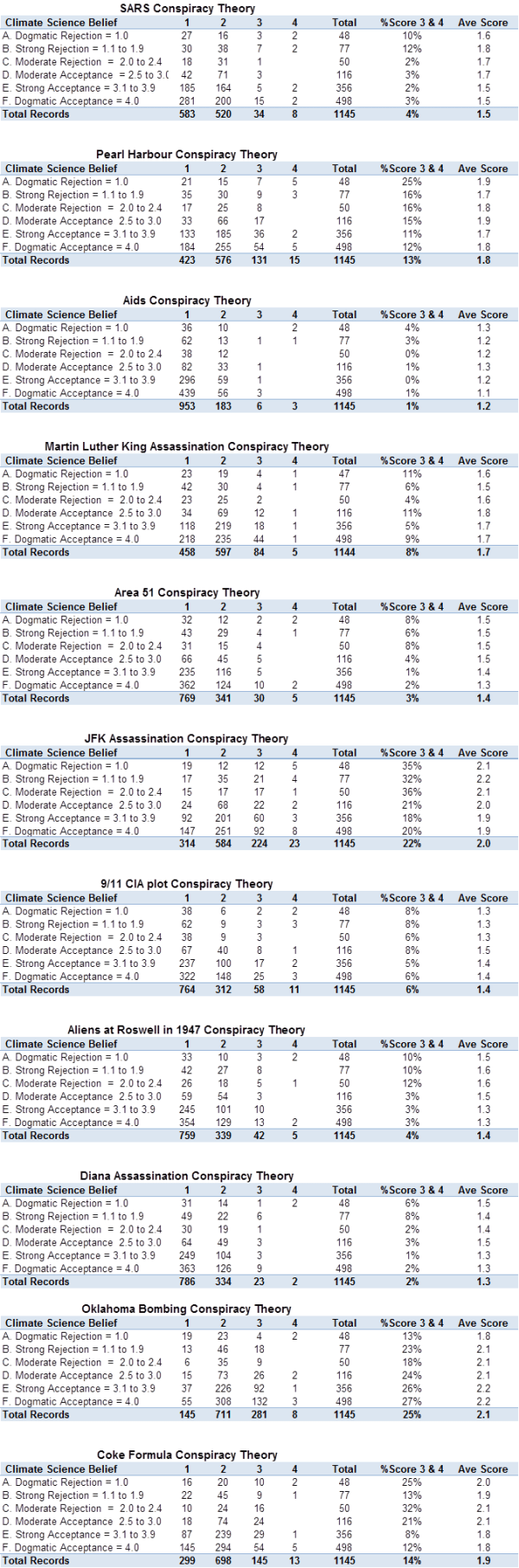
The other eleven results are below


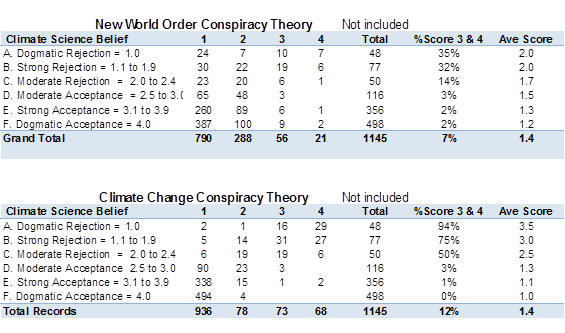
Finally, the two conspiracy theories not included.


*Update 11th Sept see reply to Prof Lewandowsky at comment 120

Lewandowsky et al 2012 – Data Analysis part 1

Katabasis offered in the comments at Jo Nova’s blog to provide the raw data for the paper

“NASA faked the moon landing  — Therefore (Climate) Science is a Hoax:

An Anatomy of the Motivated Rejection of Science”

  Lewandowsky, S., Oberauer, K., & Gignac, C. E. (in press) Psychological Science

I took Katabasis up on the offer. Here are some preliminary results.

Please see DR_UK’s comment below

The CONSENSCO2 question was

Out of 100 climate scientists how many do you think believe that human CO2 emissions cause climate change?

In other words is it a questions about what you believe about what others believe. The comparison should be with the results of the four questions on the respondent’s own beliefs in Climate Science to be found on Page 27 of the paper. The results I hope to post up later today. The sample skew is the similar. 75% of the respondents have strong beliefs in climate science, 14% have weak beliefs and just 11% – 125 respondents – reject the science. I will post later on the revised tables. 

Q. Was the sample size sufficient?

Lewandowsky et al 2012 say

We report a survey (N > 1100) of climate blog users to identify the variables underlying acceptance and rejection of climate science.

However they do not state the proportion of respondents on which they based the results – that is those who reject the science. The data summarizes the climate results as “Consensus C02” on a scale of 0 to 100. That is 0 is complete rejection through to 100 as complete acceptance. The CONSENSCO2 question was

Out of 100 climate scientists how many do you think believe that human CO2 emissions cause climate change?

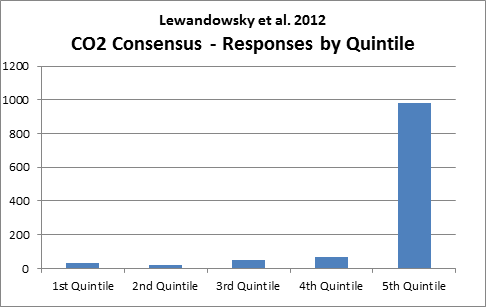
I divided the results into 5 bands to see the skew.


Fully 86% of responses largely accept the C02 consensus respondents believe that the vast majority of climate scientists believe that human CO2 emissions  and just 3% (32) strongly reject it. believe that a the vast majority are concealing the truth or lying.

This is not surprising, as the survey was only published on militant alarmist blogs such as SKEPTICALSCIENCE, TAMINO and DELTOID. Jo Nova has so far contacted 24 “skeptic” blogs, not one of whom says they received a request to publish the link to the survey.

Some of the raw results

Some quick pivot tables against the results.

Moon Landings


Comment: “Alarmists” are just as much conspiracy theorists as “Skeptics”

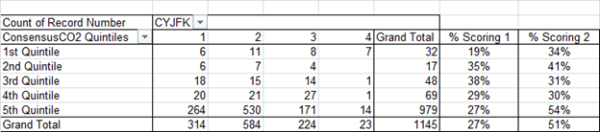
JFK Assassination


Comment: Not much difference here either between “Alarmists” and “Skeptics”

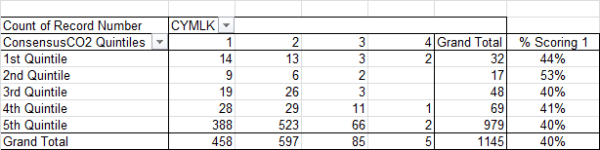
Martin Luther King Assassination


Comment: Not much difference here either between “Alarmists” and “Skeptics”

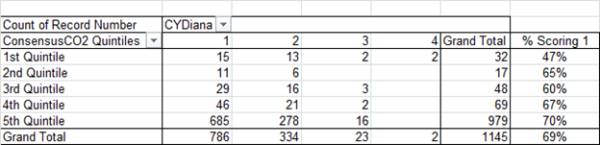
Diana “Assassination”


Comment: A slight much difference here between “Alarmists” and “Skeptics” – by 5 or 6 skeptic responses.

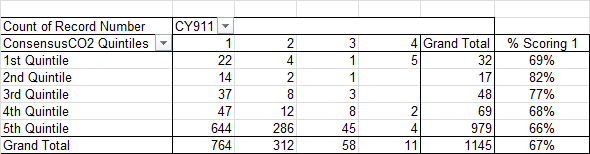
9/11 Conspiracies


Comment: Not much difference here either between “Alarmists” and “Skeptics”

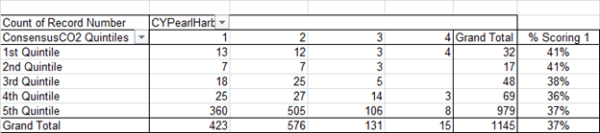
Pearl Harbour Conspiracies


Comment: Not much difference here either between “Alarmists” and “Skeptics”

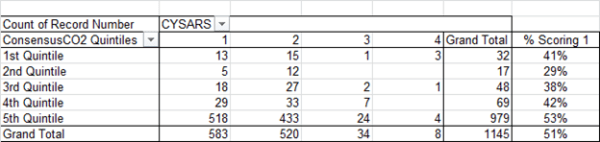
SARS Conspiracies


Comment: Not much difference here either between “Alarmists” and “Skeptics”

Preliminary Conclusion

Readers the climate alarmist blogs are full of weird conspiracy theories. Where people that frequent these blogs rate themselves on acceptance of the CO2 Consensus makes little difference to this conclusion. Given that these blogs exist to discourage any views but their own, it is not surprising that their readership:-

  1. Share a similar, unbalanced, way of evaluating evidence to the blogs authors.
  2. Are predominantly in agreement with the views promoted.

RWE Atlantic Array to gain GBP169m in Windfall Profits

I have worked in management accounts in manufacturing industry for over 25 years. In that time I have learnt that audit controls are imposed to stop the potential for fraud, by eliminating any scope for fraud. In Britain climate change arena, conflicts of interest are huge, but not considered important. This is an example of why truly independent oversight is required.

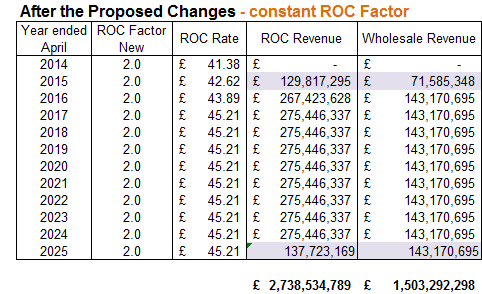
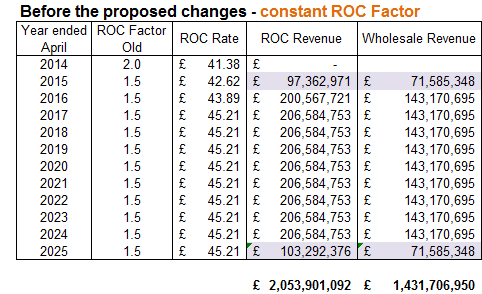
In July there was ministerial sign-off of a proposed to change the Renewables Obligation (RO) with respect to offshore wind power. Assuming that this proposal is enacted and the Atlantic Array gets the green light, I calculate will give a £169m (US$262m) windfall profit to the scheme in the first ten years of operation.

The numbers behind this are eye-watering.

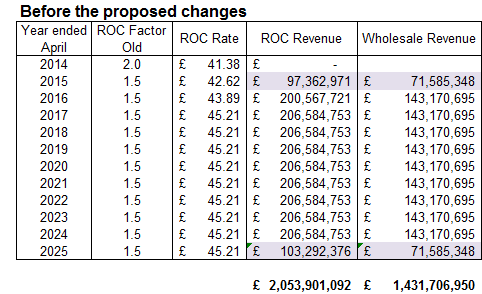
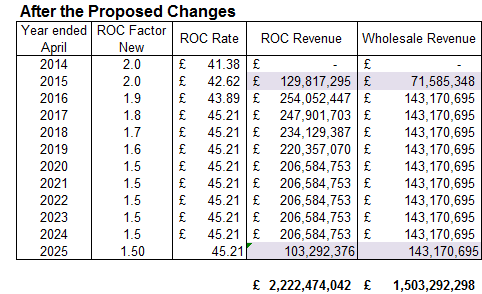
The revenue from a wind farm is from selling the electricity produced to the grid. This is currently 4.7p per kwh. I will assume that this will remain constant for until 2025. This might be a heroic assumption given that under current policies Britain will be producing far less electricity than demanded, but it is beside the point of this posting. What is relevant is the subsidy from electricity bills. The RO currently gives renewables a subsidy of £41.38 per megawatt hour. This is the rate for onshore wind. However, to encourage offshore wind power, this currently attracts a factor of 2.0 times the standard rate. In 2009 this was planned to reduce to 1.5 times the standard rate from 2014*. The new proposals are to give a more gradual and delayed decrease to 1.9 in 2015/16 and 1.8 in 2016/17. I have assumed that this will continue until the 1.5 level is reached.

In Germany the average output from the wind farms is just 16.3%. However, Britain is somewhat more exposed, especially the Bristol Channel. It is reasonable to assume to that average output will be 25% of capacity. Then I have assumed that RWE will choose to build the maximum proposed capacity of 1390MW. The lower end is 1000MW.

Calculations over a 10 year period are


The difference will mean an extra £168,572,951 windfall for RWE.

There is however a potential flaw in my analysis. If the Renewables Obligation works like the solar panels for houses, then the rate is fixed at the time of application. In other words, a scheme coming on stream in 2015 would now attract 2.0 ROC, instead of 1.5 for every year for 10 years.


If my analysis is correct, the difference will mean an extra £684,633,697 windfall for RWE over a 10 year period. That is $1.07 bn dollars. This from (the largest) of a number of similar projects.

Stop the blighting of Lundy & North Devon by RWE’s Atlantic Array

Please act to help stop a major act of vandalism to the British Coastline. Visit the Slay the Array site by 31st of August to find out how to help.

I have just returned from a holiday in North Devon, including a day trip to Lundy Island. Here I learnt about a mega wind farm proposed for the Bristol Channel by energy giant RWE. This is an area of outstanding coastal beauty, attracting millions of tourists annually to the area.

Proposed are 188 to 278 turbines, of either 180 or 220 metres (590 or 722 feet) in height, located as near as 13km (8 miles) from Lundy and 14km (9 miles) from the North Devon Coast.

Compare this with the second highest point on Lundy. The small building in the photograph is Tibbetts, 128 metres (420 feet) above sea level.


Or compare in height to some London skyscrapers.

Tower 42 (formerly the Natwest Tower) is 183m

The Gherkin (30 St Mary’s Axe) is 180m

One Canada Square, Canary Wharf is 235m

In Manchester, the tallest building is the Beetham Tower at just 169m tall, whilst the older Blackpool Tower, that dominates the resort’s skyline, is a mere 158 metres.


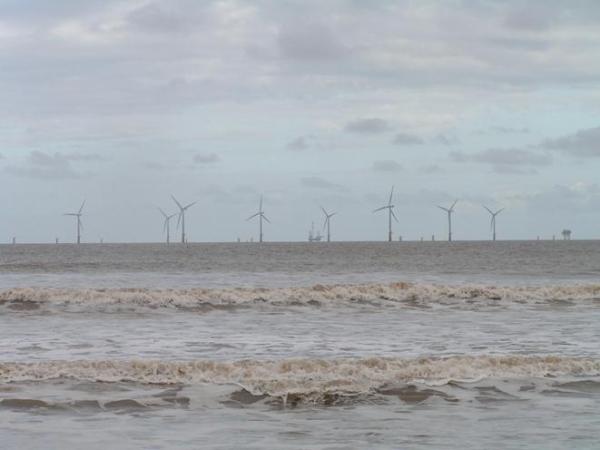
Another comparison is to the Skegness wind farm. Here there are just 57 134 metre-high turbines located 5km from shore. It has blighted the outlook from the beach level at Skegness. This picture I took at Easter of this year, on a very grey day. Better pictures are available here. The pictures do not fully recreate the visual impact, as the eye is drawn to the turning blades – or in the case of Skegness the difference between those blades that were turning, and the large number which were not.

Yet Skegness is a declining resort, not noted for its scenery. It does not have high cliffs from which to look out at a distant coastline. There is no equivalent of Butter Hill at Countisbury or the cliff tops of Lundy where you can survey the coastline of Wales. Should this Atlantic Bristol Channel Array go ahead, the eye will be drawn instead to the turning mega turbines, as the scenery.

The Bias of Climatology – Pulling Recent Strands Together

David Evans has provided a succinct explanation of why climate scientists’ theories, ignore some fundamental data. The views that feedbacks amplify the effects of CO2 (see Evans’s diagram below) is due to a highly selective reading of the data in a number of different ways.


Now we need to pull the recent strands together.

On actual temperature history we are getting evermore examples of data manipulation, whether on US temperatures (A Watts), Australian Temperatures (See Jo Nova), or the GISSTEMP global surface temperatures (Steven Goddard).

On past temperature history, we have the famous hockey stick graphs, starting with Mann et al in 1998 and culminating in the recent Gergis et al Australasian temperature reconstruction. All need a combination of one, or a few, very poor data sets that are promoted to prominence by statistical techniques unique to climatologists, and ignoring better quality data sets.

Something else needs to be added to the mix to obtain the high role for feedbacks – climate modelling. If recent temperature trends are exaggerated AND past temperature fluctuations smoothed out, then running a model that tries to look at relative influence of natural and anthropogenic factors on temperature will massively over-estimate the anthropogenic over the natural influences.

But go the other way. Look at the more accurate satellite data for recent temperatures and the temperature rises do not track the CO2 rises nearly so well. Go back to the raw data from the thermometers (adjusting properly for UHI), along with homogenization techniques developed by professional statisticians and the C20th warming deflates.

Then take the widest range of proxy records over a long period (even leave in the lowest quality ones) and suddenly the picture looks very different.

Then look at the role of feedbacks from a number of different perspectives, like Sherwood Idso, (possibly further corroborated by Esper et al 2012) and the real picture becomes clearer. Global average temperatures have increased in the last 200 years. Not quite as much in recent years as the temperature records maintain, but are now significantly higher than in during the 17th century. Furthermore, there is circumstantial evidence that a part of this increase (even up to 0.4 Celsius if non-C02 GHGs are included) has been due to the human greenhouse gas emissions. But this is a curiosity for a few academics to ponder, whilst the thrust of the research effort is put into improving the accuracy and integrity of the data.

Defence of the Consensus

The response of mainstream climatology (and with it a vast array of hangers-on) is not to improve the standards and moderate their wilder comments. Instead it has been to shut down debate by attacking the opponents. Australia has the unfortunate achievement to be home to two of the vilest the proponents of this assault on dissent. Prof Stephan Lewandowsky’s latest instalment is publishing a survey which associates climate skeptics with the worst of the conspiracy theorists. John Cook, a climatologist, ignores expert etymologists to justify calling his site skepticalscience.com

Climatology does not rank as a true science, as it has long since abandoned the search for challenging questions and improvements in quality of answers. Rather than explain the anomalies and meet the challenge of alternative explanations, climatology protects itself by employing intellectual bully-boys.

Lewandowsky et al. 2012 MOTIVATED REJECTION OF SCIENCE – Part 2

This post was based on the belief that the survey I took in June was the one used in the paper. I realize now this is not the case. The one I took at “Watching the Deniers” is a development of the 2010 survey. There are less questions on conspiracy theories (but “NASA faked the moon landing”, along with Diana, JFK and MLK assassinations are are still in) along with exactly the same questions on Free markets v Environmentalism. But the new survey has more on political beliefs (a good thing in my view) along with new sections on religious beliefs and GM foods. The summary I made back in June is here.

The paper Lewandowsky, Oberauer & Gignac – NASA faked the moon landing|Therefore (Climate) Science is a Hoax: An Anatomy of the Motivated Rejection of Science (in press, Psychological Science) is one of the biased and pernicious surveys I have come across. The previous posting was on the opening remarks on the validity of climate science. There are a few points where the survey deviates from a professional and balanced opinion survey.

Problems with the survey

  1. The access to the survey. It was an internet based survey, with links posted on 8 “pro-science” blogs. Five skeptic blogs were approached. As such, one would expect that “pro-science” responses would far outweigh “denialist” responses. I cannot find the split.
  2. There should have been a record kept of abandoned survey results. The survey gets more dogmatic as it progresses, and becomes far longer than originally stated (74 questions, as against 40 in 10 minutes quoted at the outset). Moderate skeptics would have quickly abandoned the survey when they realised what was being inferred. Others, as the questions became more time consuming and “weird”. See if this is a valid conclusion by first reading the questions, then my analysis.
  3. Not reported is the relationship between “climate denial” and genetically modified foods. Is the correlation the reverse? Nor is there any reporting of the section on climate change against conservative Christian religious views, or climate change against views on corporations. The survey only reported the most dogmatic results. Could it be that there is something relevant, but adverse to the desired conclusions here, or no relationship?
  4. There were also final questions on age and gender. Again, this should be reported.
  5. The main inference of the survey is that those who oppose climate change science are nut-jobs, whilst those who agree with it are pro-science. This saves having to explain the lack of any credible scientific evidence for the projected global catastrophe that we all need to be saved from.