The end of Nadine Dorries’s Career?


The Honourable Member for Mid-Beds has had her blog taken due to manic accusations about the Barclay Brothers, owners of the Telegraph. Full story from Dizzy, with additional comments by Iain Dale.

It is a shame that she should end the piece concerned with wild conspiracy theories. They do not stand up to close scrutiny. Nadine is also made wild suggestions on BBC Radio 5 Live that there is the risk of MPs committing suicide.  It looks like these extreme comments will drown out a very valid point – see next posting.

MP’s Expenses – Being Machiavellian to tackle the bigger financial issues

Yesterday I wrote a comment on John Redwood’s blog that

  1. That MPs costs are an insignificant part of public expenditure.
  2. David Cameron should take a decisive (Machiavellian) approach to this, providing a clear precedent for the government to follow.
  3. We should then move on to sorting out the economy.


This drew two responses. I repeat them hear, with more fulsome responses than I posted earlier on the blog.

Lynne Gill Reply:
May 12th, 2009 at 6:44 am

If you think the furore over MPs’ expenses is a mere distraction you have no idea of the outrage felt by the rest of the population. Removing the party whip and asking for admissions and apologies from these miscreants is only the beginning of the process.

Their behaviour is morally repellent and conniving, and in many cases criminal – but I guess it’s going to be deemed ‘not in the public interest to prosecute’, eh?

The very least they should be expected to do is pay back what they have stolen from the tax-payers pockets. How about putting their ill-gotten gains into a fund for, oh, lets say refurbishing the almost-slums some of our service personnel are living in, between putting their lives in danger at the behest of these gross pieces of work.


 I profoundly disagree with your comment. I believe that in politics, as in other areas, you should give people a chance to make amends and move on. This is what David Cameron has done today, setting a precedent for the government to follow.

If we start an inquisition it will go on for months. At this time when we need better government to sort out the economic mess we are in, not to turn parliament into a Roman Circus to watch good people being thrown to the lions.

Further, most MPs have acted within the existing rules. They have not “stolen” money, but that have acted dishonourably and immorally. For them, the conformance has been to the letter of the detailed rules, rather than to the spirit of why they were laid down.


Donna W Reply:
May 12th, 2009 at 8:33 am

Sorry, but it is going to need much more than punishment of the 3 worst offenders.

This is Cameron’s chance to clear the Party of the Old Guard – the Squire-ocracy who have no understanding of ‘normal’ peoples’ lives.

If he let’s them get away with claiming expenses for swimming pools, moats, chandeliers, horse-manure (how apt); domestic servants etc ….. then the Tory Party will sink like a stone.

He should be demanding they all pay back the money they have mis-appropriated, seek resignations – and if they’re not forthcoming, withdraw the Whip.


Your comment about Cameron demanding that money should be paid back is valid, and is exactly what Cameron has done today. However, Cameron has broadly followed my line. Draw a line in the sand to those who recognise their error and apologise, then move on. Indeed he has improved on my suggestion, as he has set a clear set of rules for those wishing to retain the Conservative Whip. To do as you suggest – essentially sack those the toffs, or those you disagree with – is poor leadership.

Political parties are essentially coalitions, and the leaders need to keep a large range of people on board, who are loyal to that leadership. Machiavelli wrote in 16th century Italy that when a Prince takes over a city he should kill a few and then clearly state that peace should ensue. This way, the new subjects have a clear decision – die or become loyal. For Machiavelli, going after all the vanquished enemies would be counter-productive. It is better to transform the majority and make them loyal subjects, for given that chance most will become loyal subjects. If you are continuously crushing the vanquished, then they will have reason to rise up against the Prince.

 Being “Machiavellian” in the modern political context, is about delivering a clear message in times of crisis, sacking those who do not conform, but then offering a clear way forward to those who wish to mend there ways.  

          As John Redwood has stated, the Conservatives in power will have much bigger battles to wage. Today Cameron has shown he can fight those battles more effectively than the current Prime Minister.

Dave Cameron is decisive on MPs expenses

Yesterday I wrote


 David Cameron should remove the party Whip from the 3 worst offenders (according defined criteria, including failure to recognize their waywardness), forgive the rest (after appropriate admissions and apologies) and move on. That would set a clear precedent for the Prime Minister to follow.  

Further, it would also show David Cameron to be able to make decisive and bold moves for the sake of the country, even if it means losing some friends on the way. With unprecedented cuts to be required in public expenditure when he enters office, this would increase his stature for much bigger battles ahead.

 Today, David Cameron has made the decisive and bold move, in a way that improves upon my suggestion of yesterday, first in John Redwood’s blog, then enlarged upon on this blog. Iain Dale has a fulsome account of the speech here. What was missing from by post was that MPs should pay back expenses they claimed immorally (but not outside the rules). Also Cameron is more benevolent (he will only sack those who do not conform, not sack 3 as a warning to others). In addition Cameron lays down that principles are more important than rules, with a filtering of expenses before they are submitted. In all 3 areas Cameron has improved on my suggestions.

 The result is that the general principles will become more important than the individual rules. This is manic beancounting at its best!

 Furthermore, the way is clear to move on forward onto the wider issues, building on the experience to move forward. To quote David Cameron

” But when it comes down to it I think all of us want the same thing – we want to be proud of our Parliament and the people in it. We’ve got big, big problems in this country. We need big change.

If we win the next election, we’ll be asking the whole country to come together to show social responsibility, personal responsibility and thrift. So the least we can do is to ask Parliament to live by those values as well.”

MPs Expenses – Cameron should be Machiavellian

Just posted the following comment to John Redwood’s Blog

MPs Expenses are (highly symbolic) distraction. If each MP’s cost us £300k each, 650 MPs cost £195m, or 0.03% of total government expenditure. A 50% saving on MP’s costs will be less than 0.1% of the total we need to save. Conservatives should be Machiavellian on this. David Cameron should remove the party Whip from the 3 worst offenders (according defined criteria, including failure to recognize their waywardness), forgive the rest (after appropriate admissions and apologies) and move on. That would set a clear precedent for the Prime Minister to follow.  

Further, it would also show David Cameron to be able to make decisive and bold moves for the sake of the country, even if it means losing some friends on the way. With unprecedented cuts to be required in public expenditure when he enters office, this would increase his stature for much bigger battles ahead.

Kelvin Hopkins – The Honourable Member for Luton North

As a break from all the revelations of MPs playing the system, please read this in today’s Telegraph.


A loose regime can only work for people with integrity. But a complex system will not only penalize the honest, but distract MPs from their proper role.

The three greatest obstacles to Britain’s recovery?


Posted to Daniel Finklestein’s blog, in answer to The three greatest obstacles to Britain’s recovery?


1. The ballooning deficit – Large tax rises and increases in interest rates will slow down any recovery. Real public expenditure cuts will only happen if we are forced to by the IMF.
2. The massive increase in regulation in the past decade means that the economy has not the flexibility to create new jobs quickly.
3. Most of the growth of the past decade came from financial services and the public sector. Neither of the sectors will create many jobs in the next few years. Neither are there emerging growth areas, as in the 1980s and 1990s (security, call centres, telecoms etc.)

Please note that the three are not mutually exclusive. The financial sector is going to be hobbled by increased regulation and government ownership. Whilst I am pessimistic about the ability of government’s to control expenditure, the public sector payroll will not be increasing much in the next decade.


It is possible to replace the third point by


3. The housing market. When housing activity increases, so does a large part of the retail sector such as DIY products, furniture and carpets. There is likely to be a prolonged slump, as the volume of house sales is constrained by current credit squeeze and the oncoming interest rate hikes. House prices are likely to continue to fall, as more buy-to-let investors either desire to, or are forced to sell up. Whilst house prices are falling, people will delay buying.

Labour does not understand (housing) markets

Spotted this article on LabourList on the difficulties of getting a mortgage for first-time buyers. The authour, Kate Groucott, complains of needing a 10% deposit for older properties, but 25% for new build flat. Kate complains that


            This extra barrier for people buying new build flats is surely hurting the companies developing these properties, and I’m sure will result in some flats going unsold when people are desperate to live in them.”


Further


          Our main frustration is about the rigidity of the rules imposed by the banks and the lack of help available. As taxpayers who currently make very little claim on public services, we thought the least we could expect from our publicly backed banks would be fair policies and consistency. Of course they need to be careful with public money, but this should be based on an assessment of our creditworthiness and the value of the property we are looking to buy, rather than a blanket policy. Those of us who have saved and want to buy a property within our means are being punished compared to those who bought a few years ago with 100% (or more) mortgages.”


There are two things that Ms Groucott needs to understand about the current situation.


The Risks for Banks


Imagine someone who loses their job a year after taking their first mortgage, so has to sell up quickly.


Up to mid-2007 the Housing Market was rising at 10% a year, and houses sold quickly. Someone who took out a 105% mortgage would be able to sell the house, pay off the mortgage and not be left with a debt. If the bank had to re-possess, it would be in no real haste to sell at a discount, as by waiting it would get a bigger return than by selling quickly. The jobs market was buoyant, so their were few people getting into difficulty and probably in a minority of cases would the bank have to repossess.


Now house prices are falling by 15% per year. New flats are falling (in value) even faster. In parts of Manchester that have fallen by 50% or more. Unemployment is rising rapidly, so there is a real risk that a fair proportion of the first-time buyers will get into difficulties in their first year. There are not many houses being sold, and to sell quickly requires a large discount. With a 90% mortgage, it is very likely that the homeowner will be unable to sell for more than the outstanding mortgage and the costs of sale. The bank will therefore be more likely to have to repossess, then auction off at a deep discount. With falling house prices, the longer the bank waits, the bigger the loss to the bank.


I would suggest that banks offering 90% mortgages in April 2009 are being more imprudent than those offering 105% mortgages in April 2005 or even April 2007 (based on the knowledge then available). If banks were


The Cost to the Taxpayer


As John Redwood has blogged, the taxpayer has sunk billions of pounds into the banks, and taken on hundreds of billions of toxic assets. We (taxpayers) may own a lot of banks, but they are like my late Father’s first car. In the late 1950’s he bought a 1932 Rolls-Royce for half the price a new mini. It was much grander than present day Rollers (and longer), but kept breaking down. It was not an asset, but a liability. One thing he did not do was race it around. In the banks we have a something like this 1932 Rolls. They may sound grand, but they are broken and in need of lots of maintenance. Bad debts need to be decreased, not (potentially) increased. It is imprudent to expect anything else.

From New Labour to the USSR

Twenty years ago I was reading works by Soviet dissidents such as Vladimir Bukovsky and Irina Ratushinskaya. There are parallels in what they wrote about under a rule-bound state and what we are seeing today. I do not suggest that in Britain today we have gone nearly as far as the USSR, but we are being lead by people who, given time, are getting us there. There are a number of common factors such as


  1. The belief that the government is always right.
  2. Contrary opinions are to be suppressed.
  3. The citizen is there to do the bidding and serve the state.
  4. Reality and truth is whatever the propagandists decide it should be.

Gordon Brown – The blinkered General

I got tot to thinking that the Labour Government’s strategy in dealing with the credit crisis can be compared with an Eighteenth Century Military Campaign.
Imagine the Grand Old Duke of York of nursery rhyme fame, for years believing that all that his troops were for was to make him look impressive. So he concentrated on spending on shiny uniforms and the latest equipment, and plenty of retinue. Further the troops were trained in drill, but not how to fire their muskets, or fix their bayonets.

Then the general has to face a critical battle. Fearing for his personal safety, (and distrusting his generals), the glorious general sends his personal valet to inspect the area. The valet spots a nice hilltop, with trees for shade where the area can be surveyed in safety. The troops on the low ground, so the general can view them. When the enemy is sited, he gets the cannons and muskets to fire a series of salutes to impress the enemy of the importance of the mighty general that they face. With the ammunition depleted, the order is given for the entire army to advance, with the band at the head, playing a victory anthemn. When the enemy give a warning shot, suddenly the general is no where to be seen….

Forecast for UK House prices – 6th Jan 2009

Using a composite of the Nationwide and Halifax indices, I forecast average house prices will fall a further 30% from December 2008 levels to £115,000.


One of the big uncertainties for the economy at present is the appropriate level for house prices. With the Halifax just announcing a 2.2% fall in house prices in December alone we apparently have no reasonable forecast of how low that prices can go. I therefore will try to forecast the following


  1. The value of the lowest house prices.
  2. When they will bottom out.
  3. When we can expect to see an upturn.


I will revise my forecast as new data emerges.


A simple forecast is to look at the levels to which house prices fell in the last bust. The Nationwide, and the Halifax use different methodologies, which amount to similar things.


Using the Nationwide methodology


The Nationwide believes that the long-term trend is for a 2.9% real growth in house prices per annum. Using this methodology they produced the following graph for their November 2008 report.
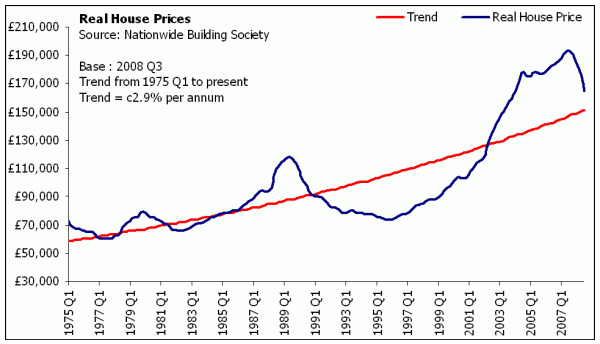
 image0013


At the in Q3 2008, average house prices were £165,000, or 109% of trend. The peaks were 132% of trend in Q3 2004 and 131% of trend in Q2 and Q3 2007.

This compares with the previous peak of 134% in Q2 1989. The low point relative to trend was not until nearly 7 years later in Q1 1996, when prices dipped below 70% of trend.

The actual low was in Q4 1992, when prices were 81% of trend.

Let us assume that house prices bottom out at 80% of trend, but do so after 10 to 12 quarters, instead of the 14 previously. That means house prices will reach around £127,000 at the end of 2009 to 2010. That is a 23% fall on end of November levels.


Using the Halifax methodology


The Halifax index recorded an average house price of £160,000 in December. This represented 4.44 times average earnings. The long-term average is around 4 times earnings, which would imply another 10% fall. However, the housing market bottomed out last time at 3.10 time average earnings. If this is reached in at the end of 2010 (with average earnings 6% higher), then the average house price will be 26% lower than December 2008 levels (27.6% lower than November) at £118,000.


An Opinion


The average of these two estimates s for house prices to fall a further 25% from the end of 2008 levels. This assumes we have the same pattern as the previous slump. This is a bold step to make. The previous slump in house prices was caused by a sharp rise in interest rates to combat 10% inflation, with interest rates reaching 15%. The differences are as follows.


  1. The current slump is much sharper. Using the Halifax index, in the first 17 months of the previous slump average house prices as a ratio of average earnings slumped 15%. In the 17 months since the peak in July 2007 the decline has been 24%.
  2.  In the last slump, much of the decline in employment was in that first 17 months of the decline in house prices. In this slump, much of the decline in employment will be in 2009. It will therefore prolong the period of decline as supply of houses onto the market continues to exceed supply. Furthermore the number of repossessions will increase the supply, unless banks (or the government) let the houses rather than sell.
  3. The Nationwide calculation is based on an underlying trend of 2.9%. The magnitude of this trend could be exaggerated as

i)                   The last few years have seen increased competition in the market, leading to more products and the ease of switching (with discounts).

ii)                 It would include the sustained 10 year increase in prices. This boom has been unusually prolonged.

iii)               There would have been a one-off effect from the end of inflation. Although the real cost of a mortgage would reminded unchanged, a high and fluctuating rates of inflation (as in the 1970s and 1980s) did mean higher real costs in the early years and volatility of repayments as a percentage of income. Also, if people moved to a more expensive property before the mortgage was paid off, then would end up missing out on some of the devaluation in the repayments as a consequence of the inflation.


All this leads to the conclusion that basing the cost on some multiple of average income is better than having a notional long-term trend. This would make the peak of 5.84 times earnings 146% of trend. The Q3 2008 price is therefore 119% of trend, not 109%. Therefore a slump to 80% of trend would give a house price of £111,000, or 33% lower than in Q3.


The average of my two estimates therefore becomes a fall of 30% on end 2008 levels to around £115,000. This is conditional on the banks stabilizing, and unemployment peaking in around 12 months time, or at least most of the uncertainties in the economy clearing in that time.

At present there appears to be more negatives, that could make this lower than the last time, than there are positives.


Why the forecast may be too optimistic.

  1. The current slide has occurred prior to the increase in unemployment that the recession will bring. A long period of uncertainty will leave both potential buyers and lenders cautious about entering the fray.
  2. A 30% slide will leave a great number of people with negative equity. They will therefore be unable to move without having first made considerable payments
  3. Inflation will be near zero, whereas in the early to mid-nineties it was in the 3-5% range. The real cost of housing and of the debt will not by reduced so quickly by inflation this time.
  4. A feature of the past boom was the large number of people who bought-to-let. Many houses were bought not for the return from letting, but for the return from appreciating value. For instance, in Manchester a three bedroom semi-detached sold for around £150,000 at the peak, yet could be rented for £600 a month. This would only fund a mortgage of £70,000 to £90,000. There is potentially a lot of people who would like to realize their investments, so any upturn in prices, or even more buyers coming to the market may lead to a huge increase in the supply of houses for sale.
  5. There is a prediction of 70,000 repossessions in 2009. This could be much higher if unemployment goes higher than forecast.
  6. In the past 5 years, interest rates have been much lower than historically. Once the economy stabilizes, it will be necessary to raise interest rates to levels of the 1990s of 5% to 7.5% range. Will real rates higher, real house prices will be suppressed.
  7. The lack of available credit may be prolonged, especially with banks being required to hold more capital. Banks will probably become much more conservative anyway in their lending for a few years. Also with a thinner market and flat house prices, the same risk policy may mean that banks would only lend at 80% of the valuation, whereas they would lend with less risk at 105% of the valuation is a booming market, with over 10% annual inflation and large volumes. The reason is simple. In a booming market, someone in financial difficulties can manage a quick sale for more than they paid for the property. With a flat, thin market, a quick sale can only be achieved at a considerable discount.


Why the forecast may be too pessimistic.

  1. The upturn will arrive when unemployment has stop increasing, or at least when the job uncertainties have much reduced. In the 1980s, house prices started to rise in 1983, three years before the numerical peak in unemployment.
  2. The very low rates on mortgages will enable people to make overpayments to quickly bring down the value of their debt. If they have repayment mortgages, the lower interest rates will mean that repayments will have a much larger element of capital repayment. Therefore negative equity may not be as prolonged as in the previous slump. For instance, before the UK crashed out of the ERM, interest rates were over 11%. Even after, in the late 1990s they were still 7% to 8%. Although with inflation at 2% to 4% real rates were lower, they are still considerably above the 4.5% currently quoted for a new mortgage, or around 3.5% for exiting mortgages.
  3.  Government actions to help support people with difficulties meeting mortgage repayments could stop the sharpness of the dip. However, this may conversely prolong a slump. A deep slump may reinforce the impact of a general economic upturn in making housing much cheaper for new entrants to the housing market, or for those wishing to move to more expensive housing.