Forecast for UK House prices – 6th Jan 2009

Using a composite of the Nationwide and Halifax indices, I forecast average house prices will fall a further 30% from December 2008 levels to £115,000.


One of the big uncertainties for the economy at present is the appropriate level for house prices. With the Halifax just announcing a 2.2% fall in house prices in December alone we apparently have no reasonable forecast of how low that prices can go. I therefore will try to forecast the following


  1. The value of the lowest house prices.
  2. When they will bottom out.
  3. When we can expect to see an upturn.


I will revise my forecast as new data emerges.


A simple forecast is to look at the levels to which house prices fell in the last bust. The Nationwide, and the Halifax use different methodologies, which amount to similar things.


Using the Nationwide methodology


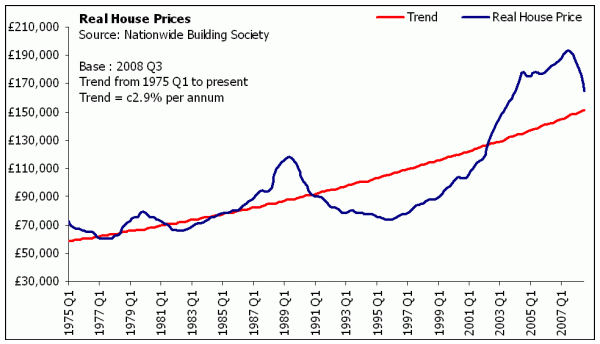
The Nationwide believes that the long-term trend is for a 2.9% real growth in house prices per annum. Using this methodology they produced the following graph for their November 2008 report.

 image0013


At the in Q3 2008, average house prices were £165,000, or 109% of trend. The peaks were 132% of trend in Q3 2004 and 131% of trend in Q2 and Q3 2007.

This compares with the previous peak of 134% in Q2 1989. The low point relative to trend was not until nearly 7 years later in Q1 1996, when prices dipped below 70% of trend.

The actual low was in Q4 1992, when prices were 81% of trend.

Let us assume that house prices bottom out at 80% of trend, but do so after 10 to 12 quarters, instead of the 14 previously. That means house prices will reach around £127,000 at the end of 2009 to 2010. That is a 23% fall on end of November levels.


Using the Halifax methodology


The Halifax index recorded an average house price of £160,000 in December. This represented 4.44 times average earnings. The long-term average is around 4 times earnings, which would imply another 10% fall. However, the housing market bottomed out last time at 3.10 time average earnings. If this is reached in at the end of 2010 (with average earnings 6% higher), then the average house price will be 26% lower than December 2008 levels (27.6% lower than November) at £118,000.


An Opinion


The average of these two estimates s for house prices to fall a further 25% from the end of 2008 levels. This assumes we have the same pattern as the previous slump. This is a bold step to make. The previous slump in house prices was caused by a sharp rise in interest rates to combat 10% inflation, with interest rates reaching 15%. The differences are as follows.


  1. The current slump is much sharper. Using the Halifax index, in the first 17 months of the previous slump average house prices as a ratio of average earnings slumped 15%. In the 17 months since the peak in July 2007 the decline has been 24%.
  2.  In the last slump, much of the decline in employment was in that first 17 months of the decline in house prices. In this slump, much of the decline in employment will be in 2009. It will therefore prolong the period of decline as supply of houses onto the market continues to exceed supply. Furthermore the number of repossessions will increase the supply, unless banks (or the government) let the houses rather than sell.
  3. The Nationwide calculation is based on an underlying trend of 2.9%. The magnitude of this trend could be exaggerated as

i)                   The last few years have seen increased competition in the market, leading to more products and the ease of switching (with discounts).

ii)                 It would include the sustained 10 year increase in prices. This boom has been unusually prolonged.

iii)               There would have been a one-off effect from the end of inflation. Although the real cost of a mortgage would reminded unchanged, a high and fluctuating rates of inflation (as in the 1970s and 1980s) did mean higher real costs in the early years and volatility of repayments as a percentage of income. Also, if people moved to a more expensive property before the mortgage was paid off, then would end up missing out on some of the devaluation in the repayments as a consequence of the inflation.


All this leads to the conclusion that basing the cost on some multiple of average income is better than having a notional long-term trend. This would make the peak of 5.84 times earnings 146% of trend. The Q3 2008 price is therefore 119% of trend, not 109%. Therefore a slump to 80% of trend would give a house price of £111,000, or 33% lower than in Q3.


The average of my two estimates therefore becomes a fall of 30% on end 2008 levels to around £115,000. This is conditional on the banks stabilizing, and unemployment peaking in around 12 months time, or at least most of the uncertainties in the economy clearing in that time.

At present there appears to be more negatives, that could make this lower than the last time, than there are positives.


Why the forecast may be too optimistic.

  1. The current slide has occurred prior to the increase in unemployment that the recession will bring. A long period of uncertainty will leave both potential buyers and lenders cautious about entering the fray.
  2. A 30% slide will leave a great number of people with negative equity. They will therefore be unable to move without having first made considerable payments
  3. Inflation will be near zero, whereas in the early to mid-nineties it was in the 3-5% range. The real cost of housing and of the debt will not by reduced so quickly by inflation this time.
  4. A feature of the past boom was the large number of people who bought-to-let. Many houses were bought not for the return from letting, but for the return from appreciating value. For instance, in Manchester a three bedroom semi-detached sold for around £150,000 at the peak, yet could be rented for £600 a month. This would only fund a mortgage of £70,000 to £90,000. There is potentially a lot of people who would like to realize their investments, so any upturn in prices, or even more buyers coming to the market may lead to a huge increase in the supply of houses for sale.
  5. There is a prediction of 70,000 repossessions in 2009. This could be much higher if unemployment goes higher than forecast.
  6. In the past 5 years, interest rates have been much lower than historically. Once the economy stabilizes, it will be necessary to raise interest rates to levels of the 1990s of 5% to 7.5% range. Will real rates higher, real house prices will be suppressed.
  7. The lack of available credit may be prolonged, especially with banks being required to hold more capital. Banks will probably become much more conservative anyway in their lending for a few years. Also with a thinner market and flat house prices, the same risk policy may mean that banks would only lend at 80% of the valuation, whereas they would lend with less risk at 105% of the valuation is a booming market, with over 10% annual inflation and large volumes. The reason is simple. In a booming market, someone in financial difficulties can manage a quick sale for more than they paid for the property. With a flat, thin market, a quick sale can only be achieved at a considerable discount.


Why the forecast may be too pessimistic.

  1. The upturn will arrive when unemployment has stop increasing, or at least when the job uncertainties have much reduced. In the 1980s, house prices started to rise in 1983, three years before the numerical peak in unemployment.
  2. The very low rates on mortgages will enable people to make overpayments to quickly bring down the value of their debt. If they have repayment mortgages, the lower interest rates will mean that repayments will have a much larger element of capital repayment. Therefore negative equity may not be as prolonged as in the previous slump. For instance, before the UK crashed out of the ERM, interest rates were over 11%. Even after, in the late 1990s they were still 7% to 8%. Although with inflation at 2% to 4% real rates were lower, they are still considerably above the 4.5% currently quoted for a new mortgage, or around 3.5% for exiting mortgages.
  3.  Government actions to help support people with difficulties meeting mortgage repayments could stop the sharpness of the dip. However, this may conversely prolong a slump. A deep slump may reinforce the impact of a general economic upturn in making housing much cheaper for new entrants to the housing market, or for those wishing to move to more expensive housing.


Analysis of the forecast impact of Tif Manchester

The two projections from pages 241 and 242 of the submission (Part 7), aiming to show the impact of the extra investments in public transport, along with the congestion charge. These I have combined to show the total changes projected, along with the total of public and private transport.

Figure 71 – Reference case:Difference in people Crossing the inner ring (2005 to 2016) p.241
Highway Bus Rail Metro-link Total Pt TOTAL Highway + Pt
Entering Regional centre 2,300 -1,300 1,300 4,000 4,000 6,300
Crossing Inner Charging Ring 8,400 -1,700 1,400 4,000 3,700 12,100
Figure 72 – TIF Package:Difference in people Crossing the inner ring (2005 to 2016) p.242
Highway Bus Rail Metro-link Total Pt TOTAL Highway + Pt
Entering Regional centre -3,300 5,800 2,100 2,400 10,300 7,000
Crossing Inner Charging Ring -6,400 7,200 2,300 2,800 12,300 5,900
Total Differences between people Crossing the rings if Tif Implemented (2005 to 2016)
Highway Bus Rail Metro-link Total Pt TOTAL Highway + Pt
Entering Regional centre -1,000 4,500 3,400 6,400 14,300 13,300
Crossing Inner Charging Ring 2,000 5,500 3,700 6,800 16,000 18,000

There are a number of comments to be made.


  1. Total travellers at peak time compared to employment growth.


Claims have been made that the difference in jobs will be 30,000 between the measures being enacted and not. With the measures, the region gets an extra 200,000 jobs, without 170,000.

Only a small proportion of these jobs will result in peak time travellers entering the regional centre, or crossing the inner charging ring, but the ratios should be similar. They are not.

The impact of the Tif Manchester on jobs and peak-time travellers
170,000 Jobs Extra 30,000 Jobs
Travellers Jobs / Traveller Travellers Jobs / Traveller
Entering Regional centre 6300 27.0 7000 4.3
Crossing Inner Charging Ring 12100 14.0 5900 5.1

Without Tif, the 170,000 extra jobs lead to only 6300 extra people entering the regional centre and 12100 crossing the inner charging ring. If these numbers all stack up, then it shows allowing congestion to increase would cause the new workers to locate close to their jobs, whilst improving transport will encourage people to live in the suburbs. But the differences are so huge, they can only mean that the extra travellers estimate is in no way related to the extra jobs. The figures do not stack up.

  1. Metrolink impact.


The impact of doubling carriages on the Altrinham/Bury line and added a spur to Trafford Park will increase peak passenger numbers by 4000. Adding a lines to East Didsbury and Rochdale/Oldham will add around 2400 to 2800 more. Clearly £1.2bn is not good value at peak times. Further, it puts the East Didsbury line in doubt. Between the regional centre boundary and the inner ring boundary, only a net 400 extra passengers are picked up. That is about 200 people from Chorlton and Didsbury areas using the Metrolink to travel into Manchester at peak times.

I believe the figures will be much greater. It is the model that is wrong. It is possibly the shift to the buses that is overstated.

Financially we have a problem. If you take out the cost of the congestion scheme, only 23% of the peak time growth in passengers on public transport will be on new Metrolink, but around half the cost.


  1. Buses


The buses are crucial to the whole plan, with over 55% of the growth in those travelling on public transport at peak times from the Tif Manchester using this mode of transport. The switch from cars will be mostly use Yet, as I blogged on 30th Sept (Flaw 2), there are good reasons to believe that people will continue to use the car over the bus. Those are

i)                  Cars are much quicker, and more reliable than buses. So even with if the average traffic speeds increase, people will spend much longer travelling by bus than they had previously done so by car.

ii)                With the congestion charge, traffic speeds at peak times are forecast to improve by 33%, but average bus journey times by just 12%. For those who can afford the congestion charge, the advantage of car over bus increases with the charge.

iii)             Many people will be able to afford the maximum £1200 congestion charge by keeping their cars for longer, or by switching to cheaper cars. The proposed fees are much too low.

iv)              The congestion charge is only impact on less than 20% of drivers. Even allowing for those who switch from cars to public transport, it is still a minority of car drivers. The congestion charge is not extensive enough, both is times, or in reach.


  1. Seasonal factors.


A further way that travelers can reduce the cost to them of the congestion charge is to use public transport in the summer, when the weather is pleasant, and to use their cars in the colder winter days, especially when travelling in the dark on the short days. That is when the benefits of travelling by car are the greatest it is more worthwhile to pay the premium. With a relatively low level of charge, this may be a pattern that emerges. It would mean there may be gridlock that can occur Christmas Eve would extend to other cold periods. This could also mean that not only would there be peak time public transport issues, but also seasonal ones as well.


Conclusion and implications


The numbers do not add up, nor do they correspond to other data on employment. The increase in volumes of travelers is not related to projected growth in the jobs; the impact of the new metrolink lines is understated for crossing the inner rings, and the switch from cars to buses is not simply not credible for the level and the extent of the charge.

The model and forecasts do not add up. I would strongly recommend that an independent auditor or economist checks the model and the results to see if the figures are credible, and to assess the risks.


How the projections can go wrong.


As an economics graduate and with over twenty years of management accounting experience, I can understand how the figures do not stack up.

1)    In compiling a model of human behaviour a number of simplifying assumptions and generalizations have to be made. With a complex issue like transport in a city over two million people, these are considerable. Using a simplified model based on existing structures to then look at the implications of a major structural change is fraught with dangers.

2)    There is little data on congestion charges so far, and the proposed Manchester charge will easily be the biggest charge area in the world. Therefore we can only draw tentative inferences from the few other examples. With a requirement to include congestion charging, it could be that there is an in-built bias towards the effectiveness of such schemes.

3)    When compiling a forecast with disparate elements, then totality of all the trends must form a credible picture. This will often mean adjustments to bring the factors into line. This has probably not occurred.

4)    In compiling the congestion charge model, political acceptability of the proposed charging structure may have overrode previous “optimal” charges. It could be that the forecast shifts from road use to public transport were based upon a more stringent congestion charging regime.