2 Climate Change Policy Choices

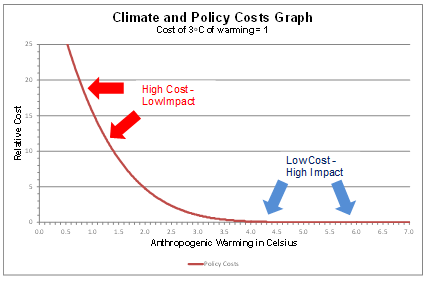
The risks from policy are becoming increasingly well-known. The question is how to manage these risks. Assuming there is a genuine problem, which is possible to overcome through policy, what are we doing to make a real difference? The policy curve gradient assumes there must exist a set of policy options which are low cost, high impact (LC-HI) as well as the high cost, low impact (HC-LI).

There are two possible types of policies which should be avoided. First are those with costs, but with zero impact (C-ZI) and second are those with a net negative impact (NNI). All of these costs may include unintended consequences, which may not be fully recognized.

The choice is quite clear. Policy creation and policy implementation requires a high degree of focus in driving through effective emission reductions.


3 The Mitigation Policy Curve – Part 1

One of the aspects of neoclassical economics is that you make a whole host of assumptions, some of which are highly unrealistic. This enables one to look at the consequences of removing or changing the assumptions one at a time. For this exercise, let us assume the global cost curves are correct. That is to assume that if no policy is enacted that there will be significant global warming with catastrophic consequences for the planet and the people upon it, whilst there are a set of feasible global policies that mitigate against this.

As stated above, for a viable mitigation policy curve to exist, there must exist a set of low cost, high impact (LC-HI) policies. If you believe, as I do, that public policy should aim to make the maximum positive difference, and at a minimum to avoid net harm, then for climate change there is a duty of care in creation and implementation of policy that this truly happens.

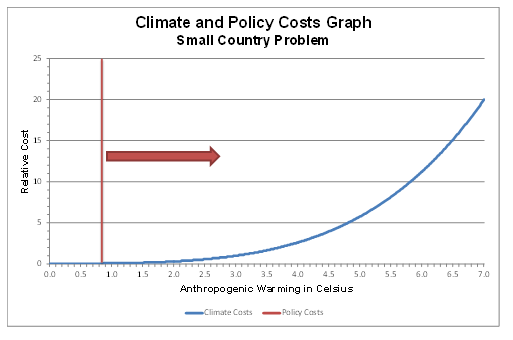
The Small Country Problem

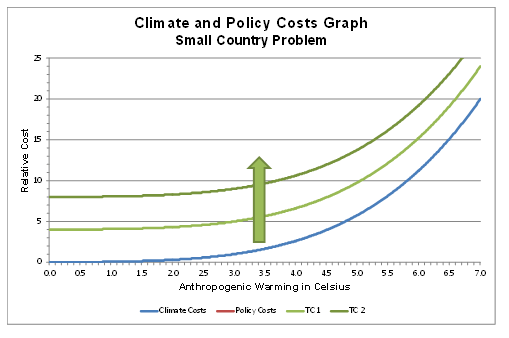
A small country is faced with the same climate cost curve as the entire planet. That is, if nothing is done to constrain the growth in greenhouse gas (GHG) emissions this country will face the same escalating costs of climate change. The only difference is that this cost is no longer relative to total gross world product (GWP), but relative to its own GDP. Assuming that the country’s emissions are an insignificant part of the total world amount to begin with, no matter how effective that country is in constraining its own emissions growth path, or even in cutting its total emissions, its policy cost curve will be vertical. It will move to the right with the relentless rise in global temperatures.

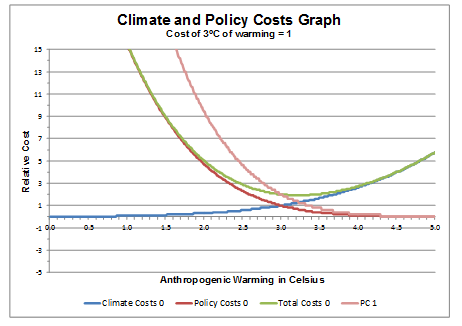
The total costs curve, for any temperature level will simply be the addition of the climate change costs and the money spent on emissions reductions.

The more spent by this small country, the greater its prestige in the green movement for unilaterally leading the way on “saving the planet.” But if nobody follows the small country’s example, then its “conspicuous impoverishment”(1) will be in vain.

Avoiding the small country example

How do we avoid the small country example, where the total costs are just added to by wasted effort on cutting emissions?

The standard answer is along the lines of saying if everybody does their bit, with the rich countries taking the lion’s share of the responsibility, then everything will be just fine. What is more, Britain already has some of most draconian emissions reductions targets in the world, as imposed by the Climate Change Act 2008 and others, such as the EU and Australia are also contributing. The small country argument does not hold.

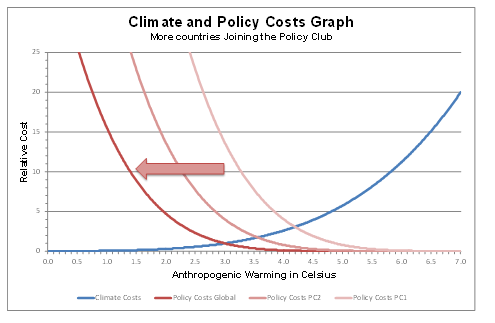
The minority of countries pursuing emission reduction policies I will term the PC1 group. Still assume for the moment that the policy cost curve is correct. The current issue is to enlarge that group to make it the PC2 group. Eventually it is to convince every country to join making the policy curve truly global. As the group enlarges the policy curve shifts to the left.

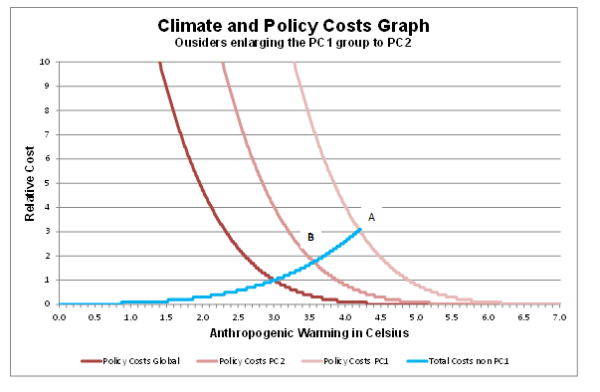
If all PC1 countries commit to restrain global warming to 3oC, then they can only do so by crippling their economies. The relative cost is a global one after all. They still could cripple their economies if they went to the climate costs equal policy costs point. If the PC1 countries accounted for 25% of GWP, then they would have a benefit a quarter of all the countries acting together. So should the in the economic interests of an outsider country to help create an enlarged group PC2, that represents 50% of GWP? The PC1 group will rid the planet of over 75% of the climate change costs. The PC2 group could halve that again.

Would it be in the economic interests of a country to join the PC2 group, or stay outside?

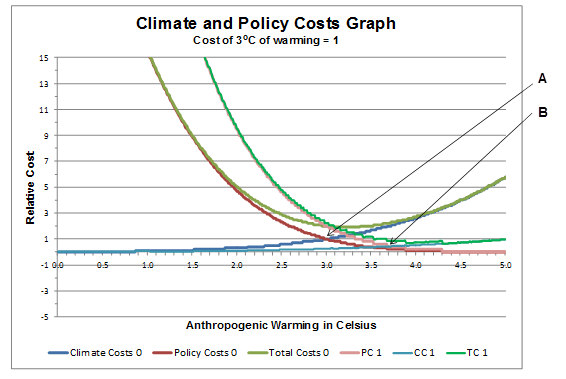
My Excel graph gets a bit blocky here – sorry.

Let’s do the maths, with approximate numbers. Enlarging the policy-enacting group moves from point A to point B.

PC1 group members have a climate cost of 3.1 plus a policy cost of 3.1/25% = 12.4

Non PC1 members have a climate cost of 3.1 = 3.1

PC2 group members have a climate cost of 1.7 plus a policy cost of 1.7/50% = 5.1

Non PC1 members have a climate cost of 1.7 = 1.7.

So to join the enlarged PC2 group, would increase costs from 3.1 to 5.1. To stay outside the policy countries would be better for the citizens of that country, even if there is a workable policy to adopt and the clear prospect of catastrophic global warming if no mitigation policy is enacted.

Later arguments on the effectiveness of policy and prospective costs of climate will make this choice look even more unambiguous. This aspect of all countries not acting together to share proportionately the costs has not, as far as I am aware, been seriously looked at in the literature. This is why the annual COP meetings – conferences in exotic locations – will never get anywhere. Any leaders that are persuaded to join the policy-enactors, unless their country will be disproportionately made worse by climate change, are acting against their own national interests.


Policy Risk

Policies carry risks. There is a risk of them not being effective, and costs running out of control. There is also a risk of a ratchet effective. That is once the policy is implemented, vested interests are created that make it very difficult to withdraw the policy even if results fall far short of those expected. The above assumes policy success. Policy failure within PC1 countries will demonstrate to potential PC2 countries that they should avoid adopting mitigation policies, no matter how great they believe in the looming climate catastrophe.


  1. Thorstein Veblen attacked in the rich for the “conspicuous consumption”. The “conspicuous impoverishment” of the global warming movement is a variant on this, the difference is that the “prestige” that Veblen went to those wasting their money. The “prestige” heaped on the unilateralist country by the green movement on those implementing the policy and not those suffering the policy consequences.


4 The Mitigation Policy Curve – Part 2 – Counter-Examples

In the first part on the mitigation policy curve I looked at

  • The Small Country Problem. How one small country acting unilaterally will make an insignificant impacts of global climate change.
  • How it is very likely to be against the economic interests of any country to join the small group of countries already with climate mitigation policies.

In this section I will look at two examples that go completely against logical thinking. There can be instances (like in Britain) where bold policies increase global warming at great cost to that economy, but the shale gas, which constrains global warming at net benefit to the gas-producing country?

To see the effect of policy, there is a need for analysis both at the front-end (prior to implementation), during and after. The question is about the gradient of the policy cost curve, at the point

Policy increasing global emissions?

We know that policy countries are in a minority of countries. With the structure of global growth this amount will fall.

Look at the long-term. Implementing a policy, you are saying to businesses that, ceteris paribus, your energy costs are going to rise year-on-year relative to those in non-policy countries. There will be a bigger incentive to make technological efficiency gains in these countries, but those gains can be transplanted to non-policy countries. In this global emissions may decrease more rapidly than they would have done, but the policy countries bear well over 100% of the costs and it becomes a policy benefit to the non-policy countries. By implication they will achieve around 200% of the global decline in emissions.

Question is, will it be more or less than 200% of the decline? Could it be that the policy countries energy-efficient factories are replaced by less energy-efficient factories in the non-policy countries?
There is some economic theory needed here. The Solow growth model shows a technological growth curve. Developing countries can achieve rapid growth by adapting to higher-productivity by adapting existing technologies. Their lower-unit labour costs will enable to undercut the more advanced economies, but the growth in these economies will grow the global economy as well. Most of this is unit labour costs. But by adapting previous generation technologies and exploiting labour costs less than a tenth those of the rich countries, they can under-cut the rich world. Greater technological advance is mostly in unit labour costs, but it can also mean lower unit energy costs. The portion of global output transferred from the rich countries to the poorer developing countries could result in higher total energy use, and ceteris paribus, higher CO2 emissions.

What is clear is that policy countries will increase unit energy costs. There is a two-pronged approach in Britain. The European-wide carbon-trading scheme will restrict supply of energy, bidding up the price. But also renewables cost more than fossil fuels. So the two-pronged approach doubly increases unit energy costs. Increasing unit energy costs accelerates the switching of manufacturing to developing countries, mostly China. The blue bit above postulates that energy per unit of output is globally could increase. But that is part of the problem. China has much higher CO2 emissions per unit of output as Britain. If Britain’s aggressive rush to renewables is successful, then this gap will increase, as much of Chinese energy output is from coal. A de-carbonised British economy will also be a de-industrialised one. But overall global emissions will have increased through switching of output to China.

The biggest cost of the policy for Britain is nothing to do with switching low-CO2 emitting production to high CO2 emitting countries. It is the restriction on economic growth. Loss of jobs from manufacturing, and pushing up higher energy costs elsewhere constrains growth. Due to the long-term consequences of that pushes policy costs through the roof. In the sectors where jobs are lost overseas, the policy curve is positive. If British Climate Change Act 2008 is massively unsuccessful in meeting the carbon targets, it could be a very expensive policy to increase global CO2 emissions.

The Shale-Gas Counter Example

In the USA, a consequence of the shale gas revolution has been to drastically reduce unit energy costs to industry. But also there has been a switch away from coal. As CO2 emissions of gas are around half that of coal, US CO2 emissions have been falling with electricity prices. The US is enjoying both cheaper and cleaner energy. Consequently, some chemical factories that relocated to China have returned to the USA. China has a greater proportion in its electricity production than USA, and the gap is widening. So the switching of a factory from USA reduces global CO2 emissions, even though the total energy usage remains the same.

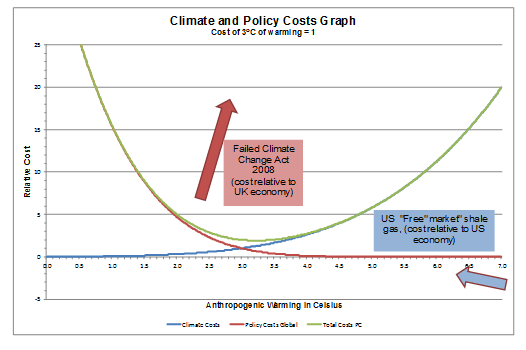
Let me show this graphically.

Suppose (as is likely at present), the Climate Change Act 2008 falls a long way short of its target but unintentionally moves a substantial part of manufacturing to China through higher costs. For Britain this will be a large cost relative to British, but may be a net contributor to global warming. The policy curve points gets a positive slope! Conversely, “free market” shale gas in the USA has constrained global carbon emissions doubly by reducing US carbon emissions per unit of output, and switching production from China, where carbon emissions per unit of output are higher. It is having positive benefits on the US economy as well (hence negative costs), whilst constraining (slightly) the top-end of global warming.

5 The Climate Cost Curve

This is a draft proposal in which to frame our thinking about the climatic impacts of global warming, without getting lost in trivial details, or questioning motives. It is an updated version of a draft posted on 26/10/2012.

The continual rise in greenhouse gases due to human emissions is predicted to cause a substantial rise in average global temperatures. This in turn is predicted to lead severe disruption of the global climate. Scientists project that the costs (both to humankind and other life forms) will be nothing short of globally catastrophic.

That is

CGW= f {K}                 (1)

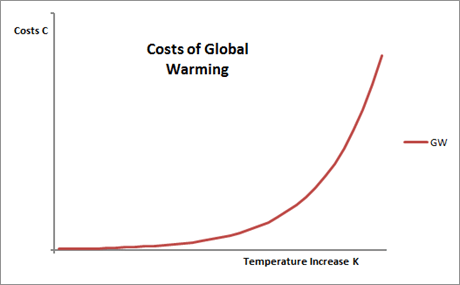
The costs of global warming, CGW are a function of the change in the global average surface temperatures K. This is not a linear function, but of increasing costs per unit of temperature rise. That is

CGW= f {Kx} where x>1            (2)

Graphically

The curve is largely unknown, with large variations in the estimate of the slope. Furthermore, the function may be discontinuous as, there may be tipping points, beyond which the costly impacts of warming become magnified many times. Being unknown, the cost curve is an expectation derived from computer models. The equation thus becomes

E(CGW)= f {Kx}                (3)

The cost curve can be considered as having a number of interrelated elements of magnitude M, time t and likelihood L. There are also the adaptation costs/benefits (which should lead to a planned credit) along with the costs involved in taking actions based on false expectations. Over a time period, costs are normally discounted by r. Then there are two subjective factors – The collective risk factor R, and, when considering a policy response, a weighting W should be given to the scientific evidence. That is

E(CGW)=f {M,1/t,L,A,│Pr-E()│,r,R,W}    (4)

Magnitude M is the both severity and extent of the impacts on humankind or the planet in general in a physical sense.

Time t is highly relevant to the severity of the problem. Rapid changes in conditions are far more costly than gradual changes. Also impacts in the near future are more costly than those in the more distant future due to the shorter time horizon to put in place measures to lessen those costs.

Likelihood L is also relevant to the issue. Discounting a possible cost that is not certain to happen by the expected likelihood of that occurrence enables due unlikely but catastrophic events to be considered alongside near certain events.

Adaptation A is for a project to adapt to the changed climate, to lessen or null the costs. It is the difference between the actual costs spent and the climate impacts saved. Upon completion, a project should have a net credit value.

│Pr-E()│ is the difference between the predicted outcome, based on the best analysis of current data at the local level, and the expected outcome, that forms the basis of adaptive responses. It can create a cost in two ways. If there is a failure to predict and adapt to changing conditions then there is a cost. If there is adaptation to an anticipated future condition that does not emerge, or is less severe than forecast, there is also a cost. │Pr-E()│= 0 when the outturn is exactly as forecast in every case. Given the uncertainty of future outcomes, there will always be costs incurred if the climate cost savings from adaptation is a unitary value. If there are a range of possible scenarios, then this value could be a credit.

Discount rate r is a device that recognizes that people prioritize according to time horizons. Discounting future costs or revenue enables us to evaluate the discount future alongside the near future.

Collective risk factor R, is the risk preference weighting. If policy-makers assume a collective risk-neutral position, then this weighting will be 1. Risk lovers – the gamblers and many self-made billionaires – have a weighting of less than one. Those who take out insurance are risk averse. Insurance gives a certain premium to compensate if a much greater probabilistic loss occurs. For instance, the probability of a £200,000 house being completely destroyed in a year is around 1 in 10,000. So the expected loss is just £20 in any year. Most people are risk averse when it comes to their most valuable asset, so would pay a premium of far greater than £20 compensate for this unlikely loss. With respect to potential catastrophes, we usually expect governments to take a risk-averse approach. That is to potentially spend more on certain costs (like flood defences) than the total expected losses from letting catastrophes from happening. For any problem on a vast scale, we need to articulate the risk preference weighting. The “precautionary principle”, used in arguing for tough and immediate mitigation policies, effectively creates a collective risk factor many times greater than 1. NB, as the costs of climate change will increase with time, a risk averse weighting is the equivalent of a negative discount rate r. That is, you could assume R = f {-r}.

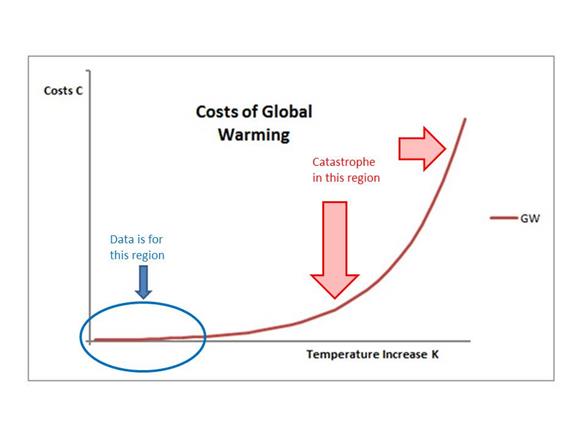
Finally the Weighting (W) is concerned with the strength of the evidence. How much credence do you give to projections about the future? Here is where value judgements come into play. I believe that we should not completely ignore alarming projections about the future for which there is highly circumstantial evidence, but neither should we accept such evidence as the only possible future scenario. In fact, by its very nature the “evidence” will be highly circumstantial. Consider the costs of climate change graph again. The data we have (which needs to converted into evidence) is for a very short section, and for miniscule fluctuations in costs, compared to the predicted catastrophe.

This leads to a vast area of evidence quality as

  • Small errors or biases in temperature measurement will have huge impacts on future projections. (Impacts on historical climate sensitivity)
  • Small errors or biases in distinguishing between natural and human-caused extreme weather events or short-run climatic changes will have huge impacts on projected costs.

If we assume that some sort of climate catastrophe is going to happen, convincing an independent third-party could include

  • Science building a clear track record of short-run predictive successes, both on warming trends and damage impacts.
  • Learning from the errors and exaggerations.
  • Be very clear as to the quality and relevance of the evidence.
  • Corroborating evidence. Show the coherence of one part of the picture with another. For instance, trying to reconcile with estimates of polar ice cap rate of melt with the rate of sea level rise reveals some very interesting questions.
  • Corroboration of between different techniques and evaluation methods.
  • For a junior science, show the underlying methodology draws upon the best of the mature sciences and philosophies of science.

The prediction of catastrophe is highly emotive. There are comparisons here with the justice system in has Britain failed where there are highly emotive crimes, for instance the IRA bringing their bombing campaign to the British mainland in the early 1970s.

  • Clear separation of the understandable emotion, from the evidence gathering.
  • Developing, and continually improving, quality standards for evidence gathering
  • A dim view taken for tampering with, or suppression of evidence.
  • A dim view taken on influencing the jury.
  • Allowing the accused a strong defence. The lack of any credible defence argument, despite a strong defence team, will remove any “reasonable doubt” in the minds of the jury, where the accused is in denial of the overwhelming evidence of their guilt.

6 A halving of climate sensitivity

Lord Lawson, in a spirited attack on the Energy Bill passing through parliament, said in the House of Lords on 18th June 2013

There is an emerging consensus among scientists that the climate sensitivity of carbon is probably less than they thought. That means, importantly, that any dangers from warming, if they occur, are postponed well into the next century. It means that there is no urgency to go ahead in this way, not only because the uncertainties are in the distant future but because we have no idea what technologies will develop over the next 100 years.

The analysis I have developed shows Lord Lawson understates how significant the climate sensitivity issue to the problem of catastrophic warming and mitigation policy.

In my analysis, the maximum warming would be 7oC. There can be a case for warming topping out at some level, as

  • There are diminishing returns to increases in greenhouse gas on temperature.
  • There are diminishing returns at some point for unit rises in emissions on levels of GHGs. That is, higher levels of GHGs in the atmosphere will lead to higher levels of absorption.

I will assume that climate sensitivity is halved, but will assume that temperatures eventually reach 5oC above pre-industrial levels.

The simple curve to work out the consequences is the policy curve. Any constraint of greenhouse gas levels will only have half the impact on temperature. The policy curve will shift to the right to PC1.

The climate costs curve is somewhat more difficult. The elements to consider in the curve are

E(CGW)=f {M,1/t,L,A,│Pr-E()│,r,R,W}

I have highlighted the elements to consider.

Time t will be doubled. Warming rates will therefore be halved. Some of the harmful consequences of warming are from unprecedented rapid change. For many animals and plants, it is speculated sudden change is much more damaging than a slower change. More importantly, sudden changes in average temperature could jolt climate systems into different patterns. Savannahs could become deserts, or the monsoon could shift. Another aspect to consider is that rapid warming of the tundra could release massive amounts of CH4 into the atmosphere, further accelerating warming. Or rapid warming could lead to rapid disintegration and breakup of the polar ice caps, leading to rapid acceleration of sea level rise. The slower warming will make us much less likely to cross these climate tipping points.

Adaptations A
can be phased in more gradually. For instance, with sea level rise, the Thames Barrier will no longer be adequate. A replacement to last 50 years will need to be much less extensive. If warming causes crop yields to fall by increased drought there is more time to adjust.

With changes happening more slowly, (and less chaotically), the adaptation cost errors, │Pr-E()│, are likely to be less.

For any positive rate of discount r, then the current net present value will be lower for the much extended warming period. However, as Stern had a discount value of not much different to zero, allowing for a discount rate would totally cover the other issues.

For all of these reasons, the climate cost curve will move down to CC1 and total cost curve to TC1. The point where policy costs equals climate change costs moves from A to B. That is at a significantly higher temperature, and for a much lower level of policy cost.

I have steered away from the weighting W issues. But given that sensitivity is a core issue that the climate models have got consistently wrong, then any weighting given to other predictions should be viewed with greater scepticism.

7 Appendix – Deriving the Policy and Forecast Graph

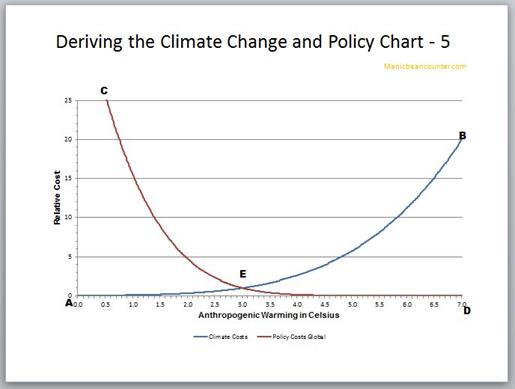
In the introduction, the derivation of the graph to replicate the claim that the costs of catastrophic global warming will be many times greater than mitigation policy costs was logically incomplete. This is a derivation of the two cost functions from a series of PowerPoint slides, which I find somewhat more satisfactory.

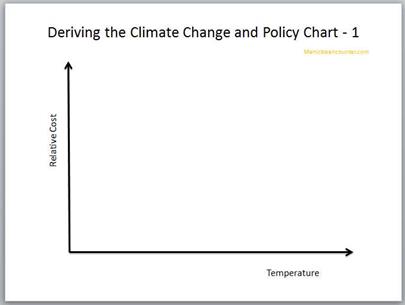
Slide 1

First draw two axis’s – for temperature and relative cost.

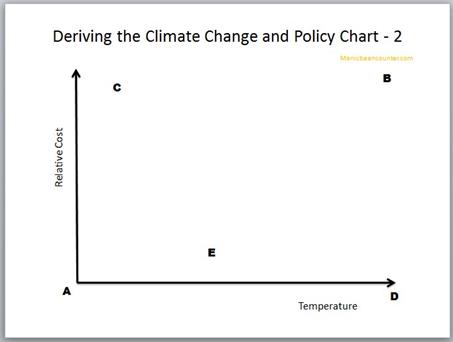
Slide 2

Next, add in five points.

A. If there had been no rise in human greenhouse gases, there would be no rise in temperatures and thus no consequential costly climate impacts.

B. With “business as usual”, there will be a huge amount of warming, with hugely costly consequential climate impacts.

C. Globally, policy could be used to stop any further rise in greenhouse gases, but with huge global cost.

D. No policy and no policy costs.

E. Intersection of two curves, which in Stern’s view is at the point of constraining warming to about 3 degrees above pre-twentieth century levels.

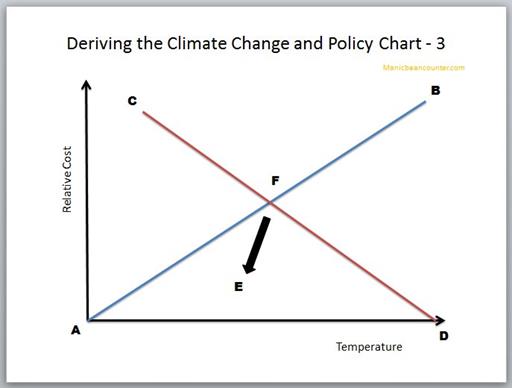
Slide 3

Connecting up the points AB (climate costs) and CD (Policy costs) with straight lines (linear functions), creates an intersection at point F.

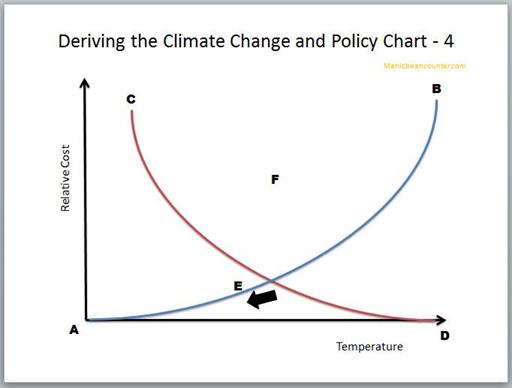
To replicate Stern, we need cost functions that intersect at point E. That is the climate cost curve connects AEB and the policy costs curve connects CED.

Slide 4

Drawing curves within PowerPoint is beyond my current skills. Simple curves have symmetrical properties. The required cost curves do not have such properties.

Slide 5

Above is the actual graph used.

Slide 6

On my graphs the cost curves are unstable functions

For climate costs

RC = f(T4)

For policy costs

RC = f((10-T)5)

To justify policy

  1. Must have reliable consequences of warming beyond human experience. Climate models must be robust for the high temperature rise forecast and have a phenomenal degree of precision on the shorter-term cost impact forecasts.
  2. Must be sure that got achievable high-impact low-cost policies, with a highly results-driven approach to policy implementation.

Smoking Causes Lung Cancer therefore Climate Change will cause more Extreme Weather: Unpicking a pseudo-analogy

A few weeks ago Stephen Lewandowsky, James Risbey and Naomi Oreskes posted at the Conversation “Climate change is not all disaster and uncertainty“. This compared the strongly-supported hypothesis that “Smoking causes lung cancer” with the hypothesis that “climate change will cause extreme weather events”. Below is the comment I posted.

You make an analogy between climate change and smoking causes lung cancer. It is worth exploring this analogy further. According to Cancer Research UK 86% of people who caught lung cancer in 2010 were smokers. A smoker is 15 times more likely to catch lung cancer than somebody who has never smoked. Put another way, only 1 in 15 smokers who caught lung cancer would have caught it anyway – and you cannot identify which these people are. Also lung cancer has a 90% mortality rate and can be diagnosed by professionals very clearly. It is a nontrivial problem both for the people experiencing it and there are large numbers dying from it.

http://www.cancerresearchuk.org/cancer-info/cancerstats/types/lung/riskfactors/

Climate policy is about prevention of nontrivial adverse climate change, predicted to happen many years into the future. With less than one degree of warming so far (which might be partly natural), the severe effects are difficult to detect amongst all the infrequent naturally-caused extreme events, with natural cycles and fluctuations. There are two ways that this differs from lung cancer.

Firstly, somebody either has lung cancer or not. There is no trivial in between. In between human caused climate change being false and there being an apocalyptic problem, there is a huge range of possibilities. This is from the highly trivial through being a significant problem, to being serious enough to justify global mitigation policy.

Secondly, whereas for a smoker who catches lung cancer it is most probably caused by smoking, an extreme weather event occurring now will most probably not be caused by climate change, whereas (if the predictions are correct and no successful policies are implemented) one happening in 2100 will most probably will be.

That leads to a dual problem. Extreme weather events may become much more extreme in the future, but this will only be detectable over large numbers of similar events at the present time. Even that will not necessarily point to a problem severe enough to justify the adoption of mitigation policies.

If there is false attribution or exaggeration for promotion people will smell something quite different than the climate science. There has been huge damage to climate change cause in England from the prediction in 2000 that children will grow up never knowing what snow is, or in the USA by saying hurricanes would become more frequent and stronger after Katrina. As a result of these and other failures many people will fail to believe anything that is said by competent scientists. Unless more objective and scientific methods are discerned for isolating the anthropogenic climate change signal than the hollering of climate activists, then the message will not get across. Even for those not turned off, the failure of the short-term predictions will conclude (like most sceptics) that it is a far more trivial problem to that which the climate consensus portrays.

Kevin Marshall

Head of the IPCC Rajendra Pachauri misleads on pause in Global Warming

Prof Rajendra Pachauri made a number of misleading statements (or was misquoted) in an interview with BBC Environment analyst Roger Harrabin, This includes:-.

He also dismissed suggestions of a slowdown in global warming.

“There’s definitely an increase in our belief that climate change is taking place and that human beings are responsible,” he told me.

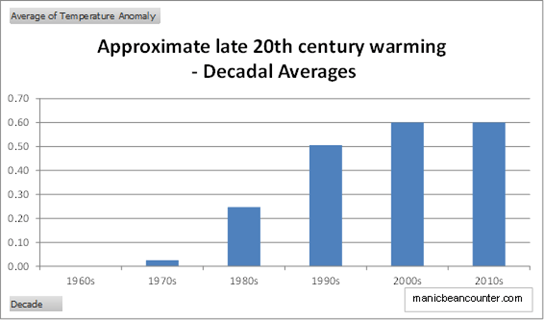
“I don’t think there is a slowdown (in the rate of temperature increase). I would like to draw your attention to the World Meteorological Organization which clearly stated on the basis of observations that the first decade of this century has been the warmest in recorded history.

The first sentence is wrong. It is contradicted by another BBC article “Global warming pause ‘central’ to IPCC climate report.

The second sentence is a statement about beliefs. It is hearsay at best, the antithesis of stronger evidence.

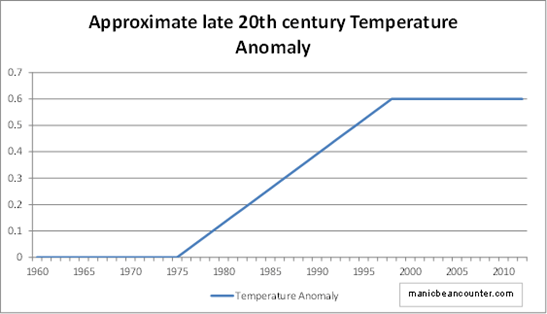
I showed why the third and fourth sentences are a dodge around the warming pause last month. In a stylized form temperatures were flat to 1975, rose through to 1998 and have stalled since.


From this, you can show that there has been five decades of rising temperatures. It is misleading to say that global warming is still happening when it has paused.


Maybe the leader of the IPCC is, at least in part, a victim of the zealous support of climate alarmism that the BBC shows, in betrayal of its’ charter.

I doubt if there will be a falling out of the head of the UNIPCC with the BBC. After all the caption beneath the photograph is a falsehood that Pachauri has been peddling for a few years now.

Prof Pachauri shared the 2007 Nobel peace prize for his work

This is what you will find at the Nobel Prize Website

The Nobel Peace Prize 2007


Intergovernmental Panel Photo: Ken Opprann

on Climate Change (IPCC) Albert Arnold (Al) Gore Jr.

Pachauri collected the Nobel Peace Prize as head of the IPCC. He did not share the prize. The inaccuracy is the same as that shown in reporting the lack of warming. It shows something more significant than what is there. At least the BBC puts that it is a Peace Prize.


UK Energy Research Centre (UKREC) doubly misleads

Yesterday the GWPF and Joanne Nova point to an article in Thursday’s Daily Express which declared

A report from the UK Energy Research Centre also shows the number of those who resolutely do not believe in climate change has more than quadrupled since 2005.

There are two fundamental issues with the press release. First the research shows a much bigger divergence in public opinion from climate orthodoxy than the press release by the QUANGO shows. Second, the opinion poll conducted in England, Scotland and Wales by psychologists had two fundamental errors that fail to connect with the real world situations that people are facing and will face in the renewable energy future.

Public Opinion on Climate Change

The Government funded report shows 19 per cent of people are climate change disbelievers – up from just four per cent in 2005 – while nine per cent did not know.

The Daily Express article only looks at the press release and then speaks to UK Green Party leader Natalie Bennett, who says, who says

Of course, however, the 72 per cent of the public who acknowledge the climate is changing are backed overwhelmingly by the scientific evidence.

If they had clicked on the second link on point 3 (of 5) in the “Notes to the Editors” (below where it says – Ends –) labelled “national survey“, they would have opened up the 62 page “SURVEY FINAL.pdf”. If they had then gone to Appendix B, they would have found the full results of all 72 survey questions. The following is relevant

Q3. How concerned, if at all, are you about climate change, sometimes referred to as ‘global warming’?

“Very” or “Fairly” concerned         74%

“Not very”, or “Not at all” concerned      26%

Don’t know                 1%

However, this should be more relevant.

Q5. Thinking about the causes of climate change, which, if any, of the following best describes your opinion?

CC is entirely or mainly caused by natural processes                 16%

CC is partly caused by natural processes and partly caused by human activity     48%

CC is entirely or mainly caused by human activity                 32%

The survey shows that two-thirds of the public disagree with the “scientists”, and thus disagree with a necessary condition to justify policy – that climate change is a non-trivial problem. The press release hides the real story in obscure places that no journalist has time to find.

The opinion poll failing to address real world situations

The questionnaire started with questions on attitudes to climate change. However, the vast majority of the questions, and the purpose of the survey, was upon the “Public Values, Attitudes and Acceptability” of pursuing the UK’s transformation to “green” energy. As this questionnaire was conducted by the School of Psychology at the University of Cardiff, there are two things one could reasonably expect.

  1. Empathy with the people impacted.
  2. Addressing the costs that people are most likely to face.

In both there is a depersonalisation of the impacts.

One of the most controversial areas of renewables is wind turbines. An innocuous question is

Q22. To what extent would you support or oppose the building of a new wind farm in your area? (By ‘area’ we mean up to approximately 5 miles from your home)?

The distance is relevant. Like the vast majority of people I live in a built-up area. If the world’s tallest building was located five miles from my house, I would likely not be able to see it from the ground floor in any direction. Five miles distant there is an airport with 20 million passengers and 170,000 flight movements a year. I rarely hear an aircraft, as I do not under the usual flight paths. To personalize it, you need to ask people if, when purchasing a house, having a wind turbine located at less than a mile from a house, clearly visible, would affect the decision to buy it.

This depersonalisation of the impacts also includes the benefits. In a remote rural area a nuclear power plant would bring a huge influx of jobs and prosperity, more than thousands of wind farms. There is a relevant example. In the 1960s Caithness boomed as a result of the building Dounreay nuclear research plant. The county is currently being overrun by wind turbines, which do little to replace the jobs lost as the nuclear facility is decommissioned.

Empathizing with the plight of a minority who are adversely affected by renewables is something that should be appreciated. However, for most people, it is the direct impact of renewables that will concern them most. For the vast majority, it is costs that are important. UKERC fully realize that switching from fossil fuels to renewables means receiving power solely in the form of electricity. Therefore, there are questions about switching from gas to electric for heating and cooking, and about the public perceptions of electric cars.

Q23. How positive or negative do you feel about heating with electricity?

Q24. Please indicate how willing you would be, if at all, to use electric heating in your home in the future.

Q25. …what if your friends, family and neighbours used electric heating? How willing would you be, if at all, to use electric heating in the future if this was the case?

Q26. …what if the performance of electric heating was no different to central gas heating systems? How willing would you be, if at all, to use electric heating in the future if this was the case?

Q27. …what if electric heating was significantly cheaper than heating with gas? How willing would you be, if at all, to use electric heating in the future if this was the case?

Q28. How positive or negative do you feel about cooking only with electricity?

Q29. Please indicate how willing you would be, if at all, to cook only with electricity in the future.

Q30. …what if your friends, family and neighbours cooked only with electricity? How willing would you be, if at all, to cook with electricity in the future if this was the case?

Q31. …what if the performance of an electric hob was no different to a gas hob (e.g. it heats up in the same time)? How willing would you be, if at all, to use an electric hob in the future if this was the case?

Q32. …what if cooking with electricity was significantly cheaper than cooking with gas? How willing would you be, if at all, to cook with electricity in the future if this was the case?

Q33. How positive or negative do you feel about driving an electric car?

Q34. Please indicate how willing you would be, if at all, to drive an electric car in the future.

Q35. …what if your friends, family and neighbours drove electric cars? How willing would you be, if at all, to drive an electric car in the future if this was the case?

Q36. …what if the performance of an electric car was the same as a petrol car (e.g. speed, range, availability of charging points)? How willing would you be to drive an electric car in the future if this was the case?

Q37. …what if the cost of buying and running an electric car was significantly less than the cost of a petrol car? How willing would you be, if at all, to drive an electric car in the future if this was the case?

UKREC could say they have dealt with costs in Q27, Q32 and Q37. But this only deals with the scenario if the electric alternative is cheaper. Currently the electric alternative is far more expensive. Maybe twice the cost for heating by electric than gas, and an electric car is around twice the cost (or more) of an equivalent size of diesel car. Will the reality change? There are four reasons why not, which need to be compared with the current domestic price (after distribution costs, reseller costs and reseller margin) of 10p Kwh.

First, is that renewables cost more, in total, per unit of electricity than fossil-fuelled power stations. When I last checked it was 4.1p for onshore turbines and 8.3p Kwh for offshore. This is on top of the wholesale market rate. In addition, there is the STOR energy scheme where the marginal cost per Kwh is over 20p-30p Kwh, and the average cost per Kwh could be 50p or more. Then there are the payments not to shut the things off when the wind blows too strongly.

Second, is that fossil fuels are likely to come down in price than go up. In particular in Britain the shale gas revolution will guarantee supplies for a generation and are more likely to see gas prices fall in real terms, than rise.

Third, is that if we switch energy from gas and petrol/diesel to electric, the amount of electric power generation capacity required will go through the roof. The first point applies even more strongly.

Fourth is that current technologies are developing rapidly as well. For an electric car to become competitive on running costs, it needs to overtake the next generation of diesel cars. For instance, last week I drove one of the current Volkswagen Golf diesels, a 1.6TDI. The fuel consumption of just over 60mpg(1), was at least 25% better than a 2007 Vauxhall (General Motors) Astra 1.7TDI, and 100% better than my first car – the much smaller 1978 Honda Civic 1.2 petrol.

Conclusion

The press release fails to show how far out of line the consensus of climate scientists are with mainstream public opinion. More importantly, a questionnaire commissioned by a QUANGO for renewable energy research and conducted by academic psychologists, fails to address the likely real situations people will face under a renewable future.

Kevin Marshall

  1. For Australians and Europeans, 60 miles per gallon is 4.7 litres per 100km. For those in the United States it is about 50 miles per US gallon.
Blocked by the Great Firewall of China?

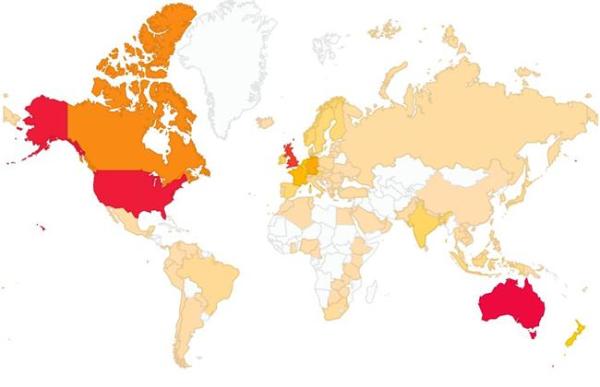
One of the advantages of using WordPress is that they provide details of the countries where hits originate from. It is fascinating to see that in the last 18 months I have received hits from well over 100 countries.


As I have only posted in English, it is not surprising that the top three countries, accounting for nearly three-quarters of all hits are Australia, United States, UK (where I live). Yet there are fully 23 nations where I have received just one hit. As I have never mentioned countries such as Laos, Saint Lucia, Papua New Guinea or Ghana, Given that they have small numbers of people and/or with limited internet access, and having mentioned these countries, then this is not surprising. But there is one glaring anomaly in these 23 nations – China. With over 20% of the world’s population, and having mentioned the country at least once – on China’s Coal to Oil Policy – this is at first surprising. Maybe it is the Great Firewall of China that is blocking me. However, there is a site http://greatfirewallofchina.org. The results show that my site is not blocked. This is further confirmed by over half my spam is from China, often with Chinese script.


The explanation might be that the Great Chinese Fire Wall acts like Google incognito window.

I tested some other sites and got mixed results. BBC.co.uk and wattsupwiththat are not blocked. Amongst those blocked are amazon.co.uk, telegraph.co.uk. thegwpf.org and ebay.co.uk.

There is a couple of lesson’s here. First is that no matter how good you consider the data, (and WordPress has, I am sure, site stats to the highest standards) it may not capture everything. Secondly, when statistics do not add up, it is easy to come to a conspiracy conclusion. It might be that you are ignored because you are not recognized, or in being recognized others do not give two hoots to your opinions. Below is the Chinese translation, to act as a test. A further test is to mention Tiananmen Square Massacre 1989, and post the posting in Chinese – See below.

使用WordPress优势之一是,他们提供的点击来自的国家。有趣的是可以看到,在过去的18个月中,我已经收到命中以及超过100个国家和地区。

正如我刚才只张贴英语,这并不奇怪,把上面三个国家占近四分之三的所有点击,澳大利亚,美国,英国(我住的地方)
。然而,是完全有23个国家在那里我只收到一击。因为我从来没有提到国家如老挝,巴布亚新几内亚,圣卢西亚或加纳,鉴于他们有少量的人及/或有限的互联网接入,并在提到这些国家,那么这是不奇怪的。但在23个国家中国,有一个明显异常。随着世界人口的20%以上,至少有一次提到国家中国煤炭石油政策这是第一个令人惊讶的。也许这是伟大的中国防火墙阻止我。然而,有是一个网站http://greatfirewallofchina.org的。结果表明,我的网站没有被阻塞。这进一步证实了我的垃圾邮件的一半以上是来自中国,经常与中国的脚本。

释可能是伟大的中国防火长城就像谷歌隐身窗口。

测试了其他一些网站,并得到了好坏参半的结果。 BBC.co.uk wattsupwiththat没有阻塞。当中那些阻塞amazon.co.uk telegraph.co.uk thegwpf.orgebay.co.uk.

这里有一对夫妇的教训。首先是再好你考虑数据(和WordPress网站统计的最高标准)
,我敢肯定,它可能无法捕捉一切。其次,当统计加起来不,它很容易阴谋的结论来。这可能是被忽略,因为你不承认,或在被认可别人不给两个鸣响您的意见。下面是中文翻译,作为一个测试。进一步的测试是提到天安门大屠杀1989年,发布张贴在中国见下文。