Idiotic Climate Cost Claims for Rosebank & Jackdaw

There are many exaggerated claims about the impacts of human-caused climate change. Despite being thrust upon the public as authoritative, they have no proper understanding of the assumptions behind those claims. Often, unsubstantiated claims are made to influence political decisions and thereby usurping democratic processes. A really idiotic example is the claims in The Guardian this week.

The climate damage caused by developing the Rosebank and Jackdaw oil and gas fields under consideration by the UK government would destroy their economic benefits many times over, according to an analysis.

It estimates the economic damage caused by the carbon pollution from the oil and gas produced would be between £119bn and £336bn in the coming decades, compared with the £28.7bn in value to the UK estimated by Adura, the fossil fuel company promoting the new fields.

The article “Projected climate loss and damages from new UK oil and gas fields unequivocally show their destruction of economic value globally” (Luke Hatton 2026) is available in a preprint version.

It states

For the P50 case, the Scope 1 and 2 emissions were estimated at 61,406 tCO2e (Jackdaw) and 4,543,176 tCO2e (Rosebank).

Cannot make out the units used. But with a little research find

  • At maximum production, Jackdaw will produce 34.8 MtCO2 and Rosebank 254 MtCO2.
  • The paper uses P50 case (likely production figures), not maximum production figures. For Rosebank, this translates to 30.12% annual production.

For ease, I will assume 210 MtCO2.

Thus, £119bn and £336bn equate to a carbon cost per tonne of £566 to £1600 ($770 to $2176).

These costs are consistent with the following statement in the article.

For example, using an open-source model Rennert et al. 2022 found that, 3.6 times higher than the US government’s previous value of 51 USD/t used for policy evaluation. Burke et al. 2026 in a more recent study used empirical data on the relationship between temperature rises and economic output to show that one tonne of CO2 emitted in 1990 caused USD 40-530 in damages up to 2020, with estimates of an additional USD500-5700 in damages up till 2100.

The climate damage costs of $770 to $2176 are well within the range of $500-$5700. As a former (slightly manic) beancounter, I like to validate the figures. A check is against global emissions. From the UNEP Emissions Gap Report 2025, we find that 2024 global greenhouse gas emissions were 57.7 GtCO2e, giving damage costs of $44,429 to $125,555 billion. The IMF estimates 2024 global GDP at $110,600 billion. The claimed climate damage costs of global emissions for a single year are equivalent to ~40%-110% of that year’s GDP. These climate damage costs have been accumulating for decades.

CO2 emissions (around 75% of GHG emissions) are cumulative. Let me give a counter estimate.

Estimating a more realistic cost of carbon

I will take an extreme example of claims about future climate damage costs. The 2006 Stern Review stated

(T)he Review estimates that if we don’t act, the overall costs and risks of climate change will be equivalent to losing at least 5% of global GDP each year, now and forever. If a wider range of risks and impacts is taken into account, the estimates of damage could rise to 20% of GDP or more.

Assume

  • Costs are for 2100 in 2024 values.
  • Global GDP grows by 2% a year 2024-2100 in real terms.
  • Cumulative CO2 emissions 1850-2024 are 2500 GtCO2.
  • 2024 CO2 emissions are 43 GtCO2, and grow at 1% a year 2024-2100

This will give, in round figures, a global GDP in 2100 at 2024 prices of $500 trn, with climate damages of $25-$100 trn. Cumulative CO2 emissions 1850-2100 are about 7500 GtCO2. This gives damage costs per year of around $3.33 – $13.33 per tonne, in a world that is maybe four times richer per capita than today. Those cost estimates are likely exaggerated, as they ignore other GHG emissions.

The Stern Review assumes (like Nobel Laureate William Nordhaus) a constant adaptation capacity. That is, they assume a very limited and fixed ability to cope with warming. This means long-term damage costs are a function of global average temperature rise. In the long term, rational people will adapt to changes, reducing climate change costs over time. This is not a complete dismissal of the claims about the catastrophic consequences of human-caused global warming. We should look at what makes up costs of 5-20% of global GDP, rigorously evaluating the magnitude and likelihood of these occurring. Then managing down such prospective costs with properly costed and effective solutions. From my experience with alarmist claims, these prospective costs are likely to be minimal. The danger is that too many have been trained to create alarming narratives to justify emissions reduction policies that cannot mitigate the claimed prospective problems. Nor are they aware of the harms of policies on the vast majority of people on the receiving end.

Claims of disproportionate UK harms

This is just a side note. Luke Hutton 2026 states in the abstract

We invert this calculation to show that only 5.9% of their future climate damages need to be felt by the UK to for them to destroy more value nationally than they create. Drawing on the existing literature on the UK’s exposure to climate risks, we discuss that this a not infeasible scenario.

From the IMF GDP estimates for 2026, the UK GDP is $4,264 bn, or 3.4% of $126,295 bn World GDP. If we assume climate damage costs from Rosebank & Jackdaw of $250 bn, based on nominal GDP, the share would be $8.5 bn. Similarly, the IMF estimates Nigerian GDP at $377 bn, or 0.3% of World GDP. This gives Nigeria’s share of $250 bn at $0.75 bn.

The World, UK and Nigerian populations are, respectively, about 8,310, 70, and 242 million people. Based on country shares of global GDP, per capita climate damage costs of Rosebank & Jackdaw are, for the World, $30; for the UK $121; and for Nigeria $3. If human-caused climate change is going to have catastrophic consequences, a typical Brit will not endure 40 times the adverse consequences of the average Nigerian. In fact, given that Nigeria is a much poorer country than the UK, the impacts of adverse climate change will be disproportionately felt in that African country. To claim that 5.9% of climate damage costs will be borne by the UK shows a lack of understanding of prospective climate impacts and global economics. Another reason for research to properly understand the make-up of prospective climate damage costs.

The insignificance of the Rosebank oil field on climate change

There is a belief, throughout the world, that a particular emissions reduction policy will save the planet from a climate catastrophe. An extreme form was the Just Stop Oil protests that plagued London and other cities. Their major demand was for no new oil and gas production within UK territory. A particular target was the proposed Rosebank oil field, a site about 200km due north of the Scottish mainland and located under 1100 metres of water.  The field may contain up to 300 million barrels of oil. The developers were ordered in January 2025 to conduct a climate impact assessment. The results are in, at least according to a recent BBC article.

The UK’s largest undeveloped oil field has revealed the full scale of its environmental impact, should it gain approval by the government.

Developers of the Rosebank oil field said nearly 250 million tonnes of planet warming gas would be released from using oil products from the field.

This is a ridiculous comment to make. Why? The climate impact of CO2 emissions is through raising atmospheric CO2 levels, which in turn causes rising global average temperatures. It is believed that this warming could have catastrophic consequences for the planet. So, how much warming will 250 million tonnes of CO2 (0.25 GtCO2) cause? I will first make the assumption that the oil from Rosebank will add to global oil consumption and not be instead of oil from say Russia, the Middle East, or Venezuela. The most authoritative source of data is from the UN IPCC Assessment Reports. In particular, from the 2021 AR6 WG3 Summary for Policymakers. This states historical cumulative net CO2 emissions from 1850 to 2019 were 2400 ± 240 GtCO2 (high confidence). A footnote on page 10 states that the ± 240 is at the 68% confidence interval. In statistics, a 95% confidence interval is conventional, which is double the ± 240 GtCO2. In AR6 various emissions pathways were calculated using that figure. Figure 1 is an extract from “Table SPM.2 | Key characteristics of the modelled global emissions pathways” on pages 18-19, looking at the additional emissions to reach various warming levels in 2100.
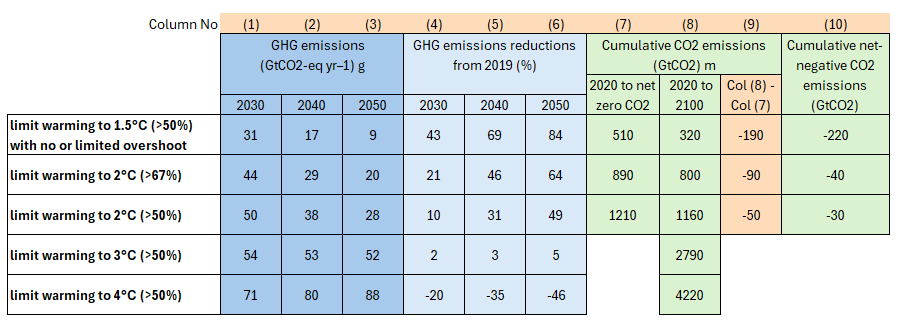
Figure 1: Extract from “Table SPM.2 | Key characteristics of the modelled global emissions pathways“, IPCC AR6 SPM. Uncertainty ranges not included. Data shaded orange are additions. Shaded blue refers to greenhouse gas (GHG) emissions. Shaded green refers to cumulative CO2 emissions. The report estimates that in 2019, CO2 emissions accounted for 75% of GHG emissions measured in CO2 equivalent tonnes.

Even though I have simplified the table (full table here), there are still a lot of figures to digest. Look at the top row – limit warming to 1.5 °C (>50%) – columns (7) – (9). To reach net zero requires 510 GtCO2, with -190 GtCO2 before 2100 to get a >50% chance of global average temperature rise not exceeding 1.5 °C above 1850 levels in 2100.* The similar figures for 2.0 °C are 1210 and -50 GtCO2. Taking the difference of the col (8) figures (1160-320) gives 840 GtCO2 for 0.5 °C of “warming”. By inference, 0.25 GtCO2 will give about 0.00015 °C of warming. 

Thus, even if the Rosebank oil field were 1000 times larger – containing over 8 years of global oil production instead of 3 days – it would still have no significant impact on global average temperatures in the context of the AR6 climate pathways. Hence, the climate impact of the Rosebank oil field is nil. The same can be said of any project in the UK, or indeed, the whole of UK climate policies slavishly tracking the 1.5 °C pathway, including net negative emissions after 2050. 

But could it be argued that, although the quantity of emissions that would emanate from Rosebank oil is insignificant, it is still part of a successful global emissions reduction policy? This is not the case. The UNEP Emissions Gap Report 2024 highlights that 2023 was a new record for GHG emissions at 57.1 GtCo2e. 2030 is likely to see emissions slightly higher than in 2019, consistent with just over 3 °C of warming in 2100 in IPCC AR6 projections. Why some countries, like the UK, follow emissions reduction policies in line with the 1.5 °C pathway when the world as a whole does not is a question that will be answered in an article in preparation.

Kevin VS Marshall 

*NB. The net 320 GtCO2 for 2020-2100 1.5 °C emissions pathway is less than the 480 GtCO2 confidence interval in the historical CO2 emissions estimate.