The Economic Legacy of Labour – A Summary for the Tories

Thirteen years of Labour has increased the National Debt by £600bn or £10,000 for every person in this country.

How is this worked out?

  1. A prudent government would have kept the National Debt at a constant level of GDP in the boom years. From 2001 to 2007, Labour let this grow by around 15% of GDP.
  2. A prudent government balance the budget over the course of the business cycle. In 2007 Labour were at least 4% short of that. That is, they had a structural deficit.


Take the two together. Under current forecasts the structural deficit will still be around in 2014. That is after four years of strong growth, the economy will have grown maybe 15% from the bottom in 2009 and be nearly 10% above the 2007 level. Yet the deficit will still be over 5% of GDP. Seven years at 4% is 28% of national income.

15% + 28% is 43%. Translate this into pounds by multiplying 43% by national income of £1400bn, gives £600bn.

Some could be a little less generous by adding compound interest to the extra £200bn of debt acquired in the good years and 4% structural deficits for seven years the at least £150bn to add to the end of 2014. So that is £750bn.

Under a Prudent Government, this very severe recession would have added up to £300bn to the National Debt. It would have peaked slightly higher than Labour managed in 2007 before the downturn. Most of that could be reduced with a sustained strong recovery and without real cuts in public expenditure.

Instead, the legacy of 13 years of economic mismanagement by a Labour government will be high taxes and a squeeze on public expenditure for a generation.

More detail for my earlier posting at https://manicbeancounter.wordpress.com/2010/03/21/the-impact-of-labour-on-the-current-crisis/.

This is prompted by John Redwood’s posting “Labour Government’s end in Economic Chaos“.

Thanks to Stuart Fairney for the suggestion of passing this idea to the Tory Front Bench.

The Impact of Labour on the Current Crisis

UPDATE 11th APRIL – I WAS RIGHT IN SAYING THAT THIS WAS TOO LOW AN ESTIMATE. IN THE BUDGET REPORT NATIONAL DEBT REACHES OVER 91% OF GDP, NOT 87% AS MODELLED HERE.

John Redwood today claimed that

“Labour governments typically devalue the currency, run out of money, and preside over industrial chaos. Welcome to the spring of discontent.”

However, Redwood fails to attempt to quantify the extent of this economic mess. Gordon Brown would counter that the current situation is none of his doing. The Labour Spin Doctors might try to imply that the Tories are saying that the worsening of the deficit & national debt is 100% down to them. This is literally untrue. The opposite – that none of the current economic crisis is due to Labour’s economic management – is equally not true.

It is important to be able to split out the worldwide impact from the Labour Government’s

economic ineptitude.

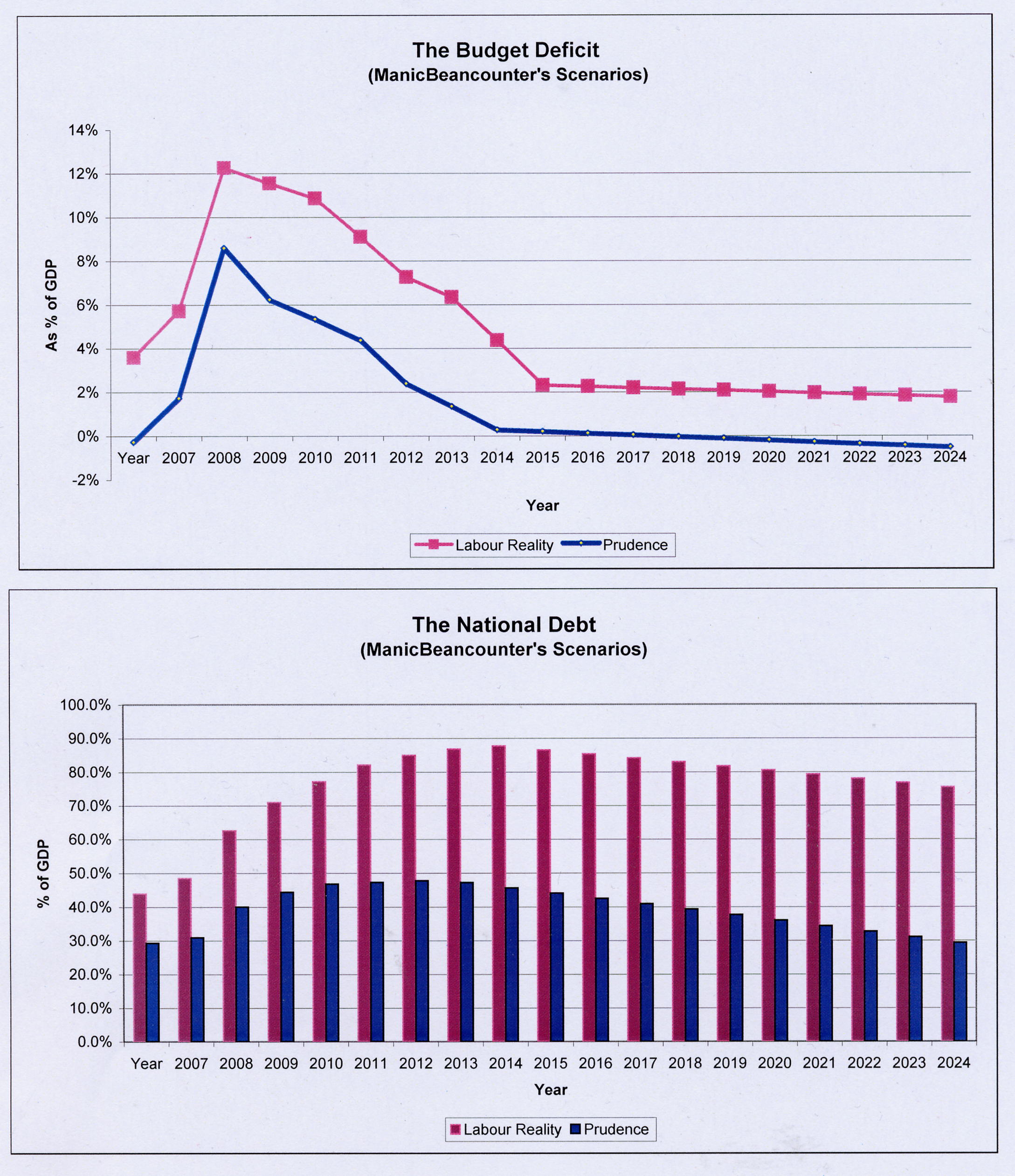
I did some simple calculations comparing two situations (all as a % of GDP)

1) An actual (Labour) one where in 2007, at the top of the cycle there was a budget deficit of 3.5% and a national debt of 44%.

2) A fiscally prudent (Prudence) one where budget deficits had not been incurred in the good years, so in 2007 the budget surplus was 0.30% and the national debt just under 30%.

Let us assume there is a similar worsening of public finances of 8.5% of GDP, so under Labour the deficit peaks at 12.2%, under Prudence 8.6%.

Under a Labour the national debt peaks at 87% of GDP in 2015; under Prudence 48% in 2013.

Under Labour we have a structural deficit of at least 6% of GDP; under Prudence at most 2%.

This is graphed below.

That is, the Labour (or specifically Brown) effect  is an increase if the National Debt of over 40% of GDP and a structural deficit of £90bn that must be eradicated. Under Prudence the increase in National Debt is less than 20% of GBP and a structural deficit of £30bn.

This is, however, much too generous on Labour, as I have assumed.

1)     Growth Rates are the same.

2)     The average level of interest on the National Debt is the same.

3)     The worsening of the Government Finances is the same from peak to trough.

4)     The effectiveness of the fiscal stimulus is the same.

5)     The turnaround in the public finances is the same.

6)     The growth forecast through to 2015 is 3.2% growth. This is roughly as forecast in the 2008 Autumn Pre-Budget forecast. Thereafter the growth rate will settle at 2% per year.

Therefore, by implication:-

–         There is no impact on the recovery through massive cuts in government spending and/or real tax rises.

–         There is no rise in interest rates as a result of the ballooning deficit.

–         There is no real problem in reducing public spending by 12% of the total in five years (or by around 30% of the total excluding the health sector, education and transfer payments), as against a 4% reduction.

–         The existing deficit pre-downturn had no impact on the size of the downturn.

–         The effectiveness of the economic stimulus was the same regardless of the size of the deficit, or whether it was on the back of a fiscal stimulus (through public expenditure increases) for the last seven years.

So going forward, it is fair to say that as long as the recovery is strong and interest premium does not rise in relation to the euro area, and the government achieves the deficit reduction targets, the national debt is at least 80% larger due to Labour, and the fiscal squeeze is at least 3 times greater.

Open Letter to Rt Hon Harriet Harmen MP

Dear Ms Harmen

I found it unfortunate this morning on Radio 5 Live that your were not given enough time to answer the question on how the selection of your husband as a Labour Party candidate reconciles with your campaigning for all women shortlists.
I would like to offer you the opportunity to explain here
I am sure that there are plenty of blogs who would replicate any reply. It would certainly help enlighten voters on a matter that they find somewhat opaque.

Your sincerely

(a slightly) Manic Beancounter

Futerra – The Propagandists of Climate Change Totalitarianism?


Ian Dale takes issue with the way taxpayer money is being used to indoctrinate people about climate change
The PR agency Futerra have produced a leaflet which allegedly make “It’s the use of totalitarian indoctrination techniques designed to manipulate public opinion.”

Having a quick look at their website, I am not sure from what perspective Futerra are coming from.

From the comments Dale makes they seem like a bunch of frustrated Marxists. The deniers are suffering from false consiousness. Hence the comments about there being no ‘rational man’ and using social learning. Then again, they could be frustrated telly-evangelists from the comments about “Link climate change mitigation to positive desires aspirations” and again use of social learning (or collective worship).

This can be more clearly seen from other documents on their website.

Be part of the revolution.” (http://www.futerra.co.uk/revolution/)

But this document provides the best clues. – http://www.futerra.co.uk/downloads/Sellthesizzle.pdf

“For years we’ve tried to ‘sell’ climate change, but a lot of people aren’t buying. Despite a strange recent resurgence in denial, the science is unequivocal.” “For all of us desperately promoting action, finding ingenious ways to communicate climate change or just banging our heads against the hard brick wall of climate denial – we need to find the sizzle.”

Translated as – the truth is self-evident to those of us who are in the know, we just have to explain it better.

The religious analogy is then clearly stated.

“Climate change sounds like hell, so where is heaven?

Climate change itself isn’t the sizzle, it’s the sausage. That’s where our second metaphor comes in. The most common message on climate change is that we’re all going to hell.” And “Hell doesn’t sell”


“Heaven sizzles

But there is one message that almost every audience responds to. A narrative that changes hearts, minds and even behaviours. An approach needed now more than ever before. And it’s the opposite of climate hell. We must build a visual and compelling vision of low carbon heaven.”

Or maybe neither is right. Maybe it is just a sideline of the Prime Minister’s. After all Futerra state For nearly nine years we’ve helped you save the world.” We know that such a statement can only refer to Gordon Brown. (http://www.futerra.co.uk/home) The New Labour theme also chimes with the ‘message is right, just the communication that is wrong.’

Maybe it is time for some of their clients to take another look at their Eco PR agency. Beneath its thin green veil lie fanatical, intolerant and pseudo-religious views.

If we are truely concerned with the planet, maybe we should weigh up the evidence, take on board genuine complaints and listen. In the realm of science it means a bit of humility and recognizing when we get things wrong.

Will Labour be kicked out by voters in the marginals?

Mike Smithson  of politicalbetting.com has posted the results of IPSOS-MORI analysis, which shows the swing to the Tories is greater in the LAB-CON marginals than in the country as a whole.

Unlike Smithson, I do not find this surprising. It is not due to an anti-Labour bias (though I confess, indeed proclaim this), but due to a simple analysis. There is considerable resentment of the current Labour government, that may surpass in the polls that of the Tories in the late nineties. That is, where they are able people will vote to get the government out. In a Tory or Lib Dem seat this will not matter. In a solid Labour seat, there is a de-motivating factor. But in a Labour marginal seat – and that can include seats with greater than 10% majorities, voting against the Labour candidate may help remove the government.

This is why I do not believe it when pundits say the Tories getting 40% of the vote against 30% for Labour will result in a hung parliament. We may not get a reverse of 2005, where Labour were on 35%, just 2% ahead of the Tories and still with a working majority. But the resentment factor is now mostly directed at Labour, and they will get punished accordingly, with the Tories being the principle beneficiaries.

Stephanomics shows anti-Tory Bias

Stephanie Flanders, on her BBC blog Stephanomics, can often provide thoughtful comments on the UK economy. Yesterday’s blog, “Cameron’s Nixon Moment” is anything but.

“Nixon famously denied he was a crook. At the weekend David Cameron denied he was a recovery-wrecker, confronting directly the argument that faster deficit reduction would jeopardise growth.”

Whatever the rights and wrongs of the arguments that SF later presents. There is a double meaning.

  1. The superficial one. Nixon’s claim that he was not a crook worked against him. So will Cameron’s denial that he is not a recovery-wrecker.
  2. Guilt by association. Nixon lied about Watergate. He was a crook and only a Presidential pardon allowed him to escape prosecution. The Tories, in trying to cut the deficit will wreck the economic recovery. They are not campaigning to do what is better for the country

There is no distinction made between the political realities (don’t frighten the voters) and the economic realities of doing what is best for the country. This is a tightrope all political parties are walking. With an election looming, the leaning is towards the political side. Any impartial analysis should recognize this. An impartial economic analysis should recognize the real risks that the economy is facing.

The economic reality is this

  1. We have a total deficit of over 12% of GDP. The majority of this is structural. On the Government’s optimistic growth forecast, the deficit will be reduced by a boom, but the structural deficit will be largely untouched. (At the top of the economic cycle, the actual deficit will be less than the structural)
  2. Most of the growth since 2001 has come from two sectors on the output side – the State and the financial services sector. Neither will contribute much to the recovery. In the expenditure side, much of the boom was debt financed – both consumer spending and Government spending.
  3. The flexibility of the UK economy has diminished in the past decade due to increased regulation. The growth will be slow from other sectors.
  4. Due to the high levels of debt, the recovery is at the mercy of interest rates. A modest rise could reverse the recent house price rises, and could add to the cost of servicing the National Debt.
  5. If the deficit is not tackled we could pass a tipping point. Every higher national debt will lead to higher interest rates, which will increase the debt, leading to higher interest rates. The only way out will be to have the IMF impose a solution. That will cause short-term intense expenditure cuts and tax rises. There may then be a long period of reduced growth the pay off the debt.

Himalayan Glaciers, the UNIPCC response and an Inquiry

The response of the UNIPCC to the revelation that its 2007 prediction that the Himalayan Glaciers would disappear by 2035 has been

  1. To claim the allegations are voodoo science.
  2. To apologize, but say it is a one-off and insignificant.


Most reporters accept this response. For instance The Economist.

Let up put this into context.

Consider three (hypothetical) scenarios form the UK.

1. The police investigation into a (possibly) racially-motivated murder is flawed, leading to the acquittal of the accused. The Chief Superintendant blames it on lack of funds for staff training, having previously said race was not a motive.

2. A profitable, listed company goes bust as a result of long-term massaging of the figures. This occurs three months after a respected accountancy firm signs off the annual accountants with no adverse comments. A senior partner says that the auditors were denied access to certain data, but had a signed note from the CFO that another accountancy firm had reviewed that data as part of a management-consultancy exercise. The CFO claims that the company was sound, and has an independent audit to prove it.

3. A highly-rated hospital turns out to have significantly higher death-rates than the average. The hospital chief executive says that it is due to having to cut back on the cleaning, having previously stated that the figures were flawed and politically biased.

In every case, the press and opposition politicians, would be asking for independent enquires (to assess the extent of the problem and to make preventative recommendations for the future), the suspensions of those involved and the sacking of the top person in the organization. So why no such questions, when there is a serious procedural failing in (probably) the most important scientific report of all time? A report that could adversely impact the living standards of billions of people should be to the highest scientific standards ever achieved.

It is not a minor mistake to misquote and embellish a tract from a campaigning group – and then say the forecast is highly likely, without any statistical analysis. This report is written by top Phd’s in their field, not first-year undergraduates. They should know how to assess reports, and draw accurate conclusions based on the evidence.

Further, whilst it is right for the UN IPCC to recognize the error and apologize, it is not for that organization to say, without internal investigation, that this is an isolated incident.

There should be an independent audit of all the report, to make sure that it is uniformly based on clearly-defined scientific standards. The starting point of an audit should be an evaluation of the laid-down scientific standards, and the documented internal control procedures for evaluating the adherence to those standards.

Areas of a full audit might include:-

  1. That the report is a balanced assessment of the current state of the science, at least noting competing views where it comes down on one side.
  2. Any statistical probabilities to be verified by trained statisticians.
  3. Assumptions, where made, should be identified.
  4. Measurement errors compared to the changes measured.
  5. The robustness of conclusions over differing timescales. For instance the correlations between increase in CO2 and temperature changes should not be over a defined period, but should test for a decade
  6. Gaps in the knowledge identified and put into the context of known factors and measurement errors.
  7. To note the relative standpoints of lead authors of parts of the report in respect to the established science. That is to whether they have recent, novel or controversial standpoints. And to the extent to which this influenced their review comments.
  8. For recently published peer-reviewed articles central to the aspect, whether it firmly establishes new ground in the debate.

Government is no longer New Labour of the 1997 Manifesto

The Government is now further from the “New” Labour in the 1997 Manifesto, than “New” Labour was from the traditional Labour party.

These extracts from that 1997 Manifesto demonstrate the point.

Spending and tax: new Labour’s approach


“The myth that the solution to every problem is increased spending has been comprehensively dispelled under the Conservatives.”

That is as true for investment as for current spending. It is certainly true for increased current spending, even if you attempt to re-define as investment. It is also true for spending your way out of recession, or a fiscal stimulus during a boom. As the manifesto goes on to state:-

“The level of public spending is no longer the best measure of the effectiveness of government action in the public interest. It is what money is actually spent on that counts more than how much money is spent.”

“The national debt has doubled under John Major. The public finances remain weak. A new Labour government will give immediate high priority to seeing how public money can be better used.

The national debt had indeed risen, and was coming down during a boom. It came down even further during Labour’s first term, due to their adhering to the Conservative’s policy. This high priority has been dusted off again, as a way to reduce spending, having failed for over twelve years to implement it.

New Labour will be wise spenders, not big spenders.”

Not for the last nine years they have not. By any measure, they have been big spenders, not wise spenders. Increased expenditure on the NHS has mostly been wasted on exhorbitant pay rises, and much expenditure of very expensive hospitals. However, the sharp end of survival rates from strokes to cancers is still amoungst the lowest of the OECD countries. That is lower productivity, or less value for money.That is less value for money. In Education, there has been a lot of new schools built, lower staff to pupil ratios, but little evidence of improving standards. That is lower productivity, or less value for money.

To be wise spenders you must first acknowledge your limits and seek counsel from those who have a track record in these matters. The Taxpayer’s Alliance has some good ideas, supported by Wat Tyler at Burning Our Money. John Redwood draws on his experience in government, along with his time in business. The Adam Smith Institute also provides some thoughtful pieces at times. Further, you should ignore the master’s of spin. That is the Mandelson’s, or the Campbell’s of this world. And treat as lepers the Mcbrides and the Drapers, who will only serve to destroy good government.


“No risks with inflation

We will match the current target for low and stable inflation of 2.5 per cent or less. We will reform the Bank of England to ensure that decision-making on monetary policy is more effective, open, accountable and free from short-term political manipulation.”

In the last year the Bank of England has pumped £200bn of money into the economy. They have reduced interest rates to 0.5%, a record low in over three centuries. Although nominally independent, are very much in line with Government policy, and would have been leaned on heavily if they had disagreed. Sound money has gone. In so far as it existed since 2001, it was despite of deficit-funded spending boom. The risks taken with future inflation are huge, and prices are already rising.

“Strict rules for government borrowing

We will enforce the ‘golden rule’ of public spending – over the economic cycle, we will only borrow to invest and not to fund current expenditure.

We will ensure that – over the economic cycle – public debt as a proportion of national income is at a stable and prudent level.”

Another policy that was shelved in the second term by pretending current expenditure is investment. Also by believing that the government had “ended boom and bust”. At the peak of the cycle in 2007, the deficit was about 4% of GDP, despite a long period of historically-low interest rates. At such a long-term peak, there should have been a surplus of around 2% of GDP. The differential – the structural deficit is around £80bn. With the collapse in the financial sector, that structural deficit now exceeds £100bn.

“We will clean up politics”

 After twelve years of government, the expenses scandal erupted. The headlines were grabbed by rich Tories (for cleaning the moat, a duck house, and manure), but the biggest monetary claims were mostly Labour MPs, including government ministers. It was kicked off by Home Secretary, Jacqui Smith claiming her main home as her sister’s house in London, not her family home in her constituency. The Labour party have not just failed on this policy. Many members of that party have helped bring it lower than at any time since the 1832 Great Reform Act abolished pocket boroughs.

NB – My thoughts were prompted by John Redwood’s short piece today on Labour’s Pledges. He says

“Keep this card and see that we keep our promises” says my copy of Labour’s pledge card from the start of the government. I did:

“Get 250,000 under 25 year olds off benefit and into work

Set tough rules for government spending and borrowing; ensure low inflation; strengthen the economy”

We all look forward to those. Any chance any time soon?
Jesus a Lefty-Liberal, Guardian reader? Not likely

Dizzy thinks, but wrongly, about the political leanings of Jesus. He may have a point through the modern liberal Church of England.

Dizzy’s posting on Jesus being a lefty-liberal is wide of the mark. He says

Seriously, if Jesus was alive today (a man’s who’s existence at least is not I think in dispute) he would be a Guardian reader. Yet, he would of course be pilloried for believing that he was the Son of an unprovable God, no doubt ridiculed for being a bit mad (oh the irony given the average Guardian readers hatred of prejudice towards the mentally ill), and his core beliefs about non-violence, turning the other cheek, forgiveness and the like would be dismissed out of hand.

I realise this is the second post in as many days where the subject of faith has come up, but honestly, I just don’t comprehend the sheer hypocrisy of those on the so-called “Liberal Left” when they display so much hatred for a faith that is essentially in keeping with their values, all, so it seems because of the bit about God.

If a kid is brought up with the liberal moral teachings of Christianity but also believes in God is it really “evil”?

Apologies for labouring the point here, but politically speaking, if you look at the New Testament, the carpenter’s son from Nazareth known as Jesus was essentially preaching a message that today would be seen as incredibly left wing. He was a little man standing up against an Imperial oppressor, he was preaching the evils of capitalism, and extolling the virtues of the weak and meek over the the rich.

Pardon my blasphemy for those that have an issue with it, but: Jesus Christ! Is it not patently absurd that Guardian readers should hate something so in line with their own beliefs just because it’s not secular?

My reply (in three sections) was as follows.

You are correct if you follow the Rowan Williams School of theology. An alternative line is to quote Jesus on the important bits. Take Matthew 23:40. After saying the two greatest commandments are love of God and love of your neighbour as yourself. Jesus says “All the Law and the Prophets hang on these two commandments”. Jesus was establishing a principles-based religion. If the law conflicted with this, then it was the law that had to give. So if someone needed healing on the Sabbath, they should be healed, despite the Jewish law saying you should not work. In Matthew’s gospel, the holy men who went around proclaiming they are superior because they uphold the law better than others Jesus calls “hypocrites” and a “brood of vipers”, as they were more concerned with appearances than the substance of faith in God.

Another aspect is forgiveness of sins. Human beings are fallible, despite their best efforts. They can leave the past behind without guilt and get on with being good.

Jesus today would have strong words for New Labour. For them the solution to every problem is more laws, more complexity and wads of cash. Political appearances are more important than substance. Principles are transitory – remember the need to balance the budget over the course of the business cycle? It was first re-defined then ditched. What would he have to say of the science of climate change, with any none-believers labeled deniers (the modern-day equivalent of heretics?). Jesus would probably quote the first commandment of Moses about “You shall have no other gods before me” (Exodus 20:3)

In these respects, Jesus was a Pre-Hayekian, though more dogmatic, and less diplomatic in his language.

 Finally on the subject of Jesus was anything but someone who stood up to the Roman oppressors. For many Jews he was anything but the expected Messiah. They thought he would be like what Muhammad turned out a few hundred years later. A prophet-cum-military conqueror who would drive the Roman’s into the sea. In fact Jesus studiously avoided the direct conflict with the military occupation. About paying taxes he said “give to Caesar what it is Caesar’s and to God what is God’s” (Mark 12:17)

 I realise that proper theologians will disagree with my analysis that Jesus was more a classical-liberal in the tradition of Adam Smith and Fredrich Hayek than a Socialist. But what is without doubt in the non-conformist tradition is that Jesus was against putting appearances over form, and that the Love of God and Love of one’s neighbour take precedence over religious traditions and rules. Furthermore, is the doctrine that we all sin, no matter how hard we try, but through the sacrifice of Jesus we are forgiven and can move on. This is hardly the attitudes of those politicians who claim to have all the answers, decry others are being always wrong (with ulterior motives), and never admit to their own falliability.

Monbiot tries to re-polarize the debate

In the Guardian, George Monbiot tries to brush aside the Climategate scandal and brush aside the doubts shown about the integrity of science.  Back comes the polarization of camps into the “scientific consensus” v the denialists funded by the oil companies.  He forgets to mention that government funding of alarmist “science” is greater than 100 times that of Exxon/Mobile, nor that being an alarmist gets media attention (no matter how extreme or unfounded), whilst being even moderately against can get you vilified.

My comment was as follows

The climate change e-mails crisis, at the very minimum, shows that there is room for doubt about the most extreme claims made for global warming. Whilst the most general claims about 20th century warming are beyond reasonable doubt, there is a big middle ground between the consensus and those, like Nick Griffin, who claim it is all a hoax. 

Whilst you say there are just the denialists and the scientists, look at the e-mails and you will see that it the competitors that really got the backs up of the Profs at CRU were those who could do most damage. Two of note are:-

 1. Steve McIntyre a professional statistician who has shown that some peer-reviewed articles do not stand up to scrutiny. The scientists did not get endless requests. (see MicIntyre’s account at http://camirror.wordpress.com/2009/12/01/dirty-laundry/) . They were less onerous than a visit by the VAT inspector. To a business with the books in order these people of HMRC are very pleasant, and will point out some honest mistakes (sometimes to business’s advantage). To those that know that there are “issues”, it means working through the night and trying to avoid the inevitable. But FOI requests have less precedential ground rules.

As a result of Mcintyre’s analysis no proper scientist can now say “We are experiencing the warmest temperatures for 10,000 or 2,000,000 years”.  We either do not know, or there are a number of studies to suggest that some areas were warmer 1000, 2000, or 3500 years ago. But there again, McIntyre is but

 2. Richard Lindzen, a Meteorologist Professor of MIT. Long a critic of the “consensus”, his recent paper with Yong-Sang Choi (summary pdf at http://www.drroyspencer.com/Lindzen-and-Choi-GRL-2009.pdf) claims that forecasts of future warming are overstated by a factor of six. Lindzen & Choi, however, only rely on 15 years of satellite date, whereas the consensus relies on more than 20 years of the best climate model forecasting. Furthermore, Lindzen has written articles for a virulently pro-capitalist financial daily of the t’other side o’pond.