Extremist Global Warming Paper Taken Down

The Guardian reports that a paper that report predicting that global temperatures would rise by 2.4oC or more by 2020, has now been dropped from the
Eurekalert!, a news service operated by the American Association for the Advancement of Science (AAAS). It was checked by Osvaldo Canziani, Nobel-prize winner and a former co-chair of the UNIPCC.

Problems with the report are

Expert Review

The report was meant to have been checked by Canziani. At a minimum that means that the reports major prediction is validated. As it was based upon the UNIPCC climate assessment report of 2007, then any figures that were substantially out of line should have been carefully justified. Instead, the author, Ms Liliana Hisas, says that instead of withdrawing the report

We are just going to go ahead with it. I don’t have a choice now. The scientist I have been working with checked everything and according to him it’s not wrong.

Therefore, the report is correct because a distinguished person put their name to it. However, they appear not have done basic checks, so the validation process has failed. Very much like the peer review

Ignoring Adaptation

The claim that the 900 million people extra people by 2020 will go hungry relies on some ignoring some basic adaptive facts.

  1. Changes in climate can be partly met by changes in crops. A slightly warmer climate in Europe can be met be changes in crop varieties.
  2. One of the countries with lower yields across crop varieties is Brazil. Having visited Brazil a number of times, I have observed vast tracts of farm land that are underutilized. I have picked oranges from trees that act as wind breaks, and where most of the fruit rots. I have sampled star fruit and large avocados from trees where the fruit is never commercially harvested. Similarly for large papaya, watermelons, bananas and cassava. Increased food prices have been, and will continue to increase outputs. It is not just in Brazil, but in the Russian Steppes, much of Africa and the plains of Canada that agricultural productivity can be increased.
  3. Low productivity is more often due to poor economic policies than natural factors. In the extreme, the greatest famines of the twentieth century are due to the collectivization of agriculture. Even the lesser famine of Ethiopia in 1984, where “only” 500,000 died was partly due to the collectivization policies of the communist government, and the need to feed the city populations where disaffection was centred.

Ignoring the Burden of Government

The claim that the 900 million people extra people by 2020 will go hungry relies not only on the rapid warming claim, but also upon no change in government policy. World food prices have doubled in the last few years due to vast areas being given over to growing fuel for cars. Repealing the subsidies and ethanol content regulations in fuel will release vast acres for food production. Back to Brazil, there are thousands of square miles given over to sugar cane production for ethanol production. Growing food instead in Brazil would probably close half the global gap. In Europe, where the less productive sugar beet is grown for ethanol (or USA where maize is used), then switch to food production could have similar dramatic impacts on food production. A lesser increase in productivity could be made from abandoning organic farming for more intensive varieties. Most studies have shown no difference in quality, or health effects with artificially-fertilized production. Also, by adapting more GM crops, which can vastly increase productivity and provide greater resistance to extreme weather.

Extreme position also requires Extreme Climate Disruption

The claim that the 900 million people extra people by 2020 will go hungry relies is based not only on the rapid warming claim, but also that this results in extreme weather and changed climate patterns. Even if we accept that the 2.4oC+ of warming is likely, the forecast changes in the weather as a result are speculative. Any mitigation policy should cost these as a risk, not as a certainty. The likely cost therefore should be weighted downwards by a risk factor.

Alarmist Policies Discriminate Against the Poor

The report is from a group trying to justify more intensive mitigation policies, whilst believing “in the need for a more equitable society, especially for those living under underprivileged circumstances.” That means that they should consider whether the policies will leave the poor in a worse position than if nothing was done at all. But the main policies of Cap-n-Trade or a Carbon Tax are highly regressive. It is those on the margin who will have to give up their cars and central heating, or hundreds of millions in developing countries who will be denied the opportunities to every obtain what is viewed as the staples of life in Europe. To work, both must impose economic pain, and that pain is greatest for the poor. Furthermore, if policies are imposed that are ineffective in controlling CO2, (such as windmills) then society as a whole will be made poorer for no benefit.


The Universal Ecological Fund (Fundación Ecológica Universal FEU-US) has produced an extremist report in more ways than just having a silly forecast. In failing to consider the wider adaptive ability of the human race, it is overstates both the likely consequences, whilst understating the harm to the poor of the policies it advocates. The author states

“Scientific information is usually not easy to understand. Communicating climate change is often also complicated. As a result, the understanding of climate change has led to misconceptions.”


A report that spreads undue alarmism is the enemy of true science, and will entrench the misconceptions.


Donna Laframboise at

Why China will not Constrain it’s CO2 Emissions

There is an interesting and simple explanation of why it is not possible for the West to emulate China’s growth rates at the ASI Blog. This is basically Robert Solow’s exogenous growth model – that is explained graphically at Wikipedia. China is increasing it’s output per capita by increasing it’s capital per worker on by moving up the current technological production frontier. They are still on the lower part of the curve, so the returns to substituting capital goods for labour are quite large. The western countries are at the top end, so returns can only come from moving to a higher technological boundary.

This does not explain all of the phenomenally high growth rates of China against the West. A clue is that it is not the traditional manufacturing industries that China is entering, such as steel, shipbuilding and textiles. It is also the production of the latest high-tech gadgets invented in the West. The reason is that the time taken in turning prototype to mass production is much quicker in China, due to a lack of regulations and statutory planning consents. Yet most of the profits from the last innovations come before anyone can replicate them. A saving of a few months or weeks for the latest mobile phone or digital camera can mean the difference between millions sold at very high margin and tens of thousands sold at a much lower margin.

China’s high growth rates are also accompanied by a rapid increase in energy production. Much of this comes from coal and oil. The advantage of fossil fuel over clean energy is primarily one of cost, but there is time and convenience as well. Coal is based on well-established technologies and China has large reserves of its own, as well as cheap and reliable supplies from elsewhere. Oil-fired power stations are easy to turn on and off. Against this nuclear power stations take a long time to build (and longer to de-commission), along with higher unit costs. Wind power and solar power are highly expensive, and have an extreme mismatch between the timing of the power supply and power demand. Hydro is limited in availability, takes a long time to build, and (like the Three Gorges or the Itaipu dams) cause environmental damage and the displacement of large numbers of people. To constrain China’s growth in energy will create a slowing down in the ability of China’s entrepreneurs to create new output, and therefore constrain a major advantage of manufacturing in China. The Chinese officials will attend the Climate Summits, smile politely and undermine any binding global commission agreements. It is not out of obstinacy that they do it. Rather they understand that the potential costs of constraint far outweigh any benefits.

The Full Case for Climate Change Action

Have just reposted a posting by Willis Eschenbach at “Watts up with That”. Eschenbach contends what is lacking in the AGW argument is not just a coherent scientific case. It is also the proper verification and defence of the science. Predictive failures are ignored, and critics vilified.

I made the following comment on the blog.

Might I point out that you have left out a couple of stages?

It is necessary and but not sufficient to

1. Show a strong probability that extra-normal global warming will occur.

2. That if such warming occurs, that it will have catastrophic consequences – with likely impacts in extent and in place.

At this point the Climate Scientists pass the problem over to the economists.

3. Even, if you accept the disaster scenarios, there is no policy available that will contain CO2 at 2 or 3 degrees of further warming, without imposing greater costs on humanity that impose greater costs on humanity than the worst case scenarios. However, some will say that Stern solved this problem and showed this was theoretically possible. However, it was one that would work by hitting the poorest hardest.

4. Even if you accept that a mitigation policy is theoretically possible, it will only work if every country contains their emissions. If the rapidly growing countries, especially China and India, do not contain their emissions then the emissions- cutting of the West will be of no effect. Further, if the policies to not fall into Stern’s maximum cost of $80 per tonne of CO2 saved (The IPCC’s is much lower), then the policies are doing more harm than good.

So there are four stages of this justification – Forecast, consequences, policy and implementation. It is only the first two that the climate scientists have some competency.

Just because a doctor diagnoses a new condition does not give him the instant insight into the cure, nor the ability to know the dosage or the side-effects of any new medicine.

I hope to post a graphical explanation of the AGW case in the coming days or weeks.


Unequivocal Equivocation – an open letter to Dr. Trenberth (via Watts Up With That?)

This is a hard-hitting post that shows the Global Warming Catastrophy does not rely 1) on a simplistic analysis of warming in the past thirty years or so. 2) A demonstration in a lab that CO2 can cause a greenhouse effect. 3) That all extreme weather is attributable to the climate disruption caused by this warming.
Instead it relies on verifying a number of hypotheses, and sustaining them against criticism. Please see the following post as to what it leaves out.

Unequivocal Equivocation - an open letter to Dr. Trenberth New articles appear below this one, which is top posted for a few days. This essay from Willis appeared on WUWT overnight Saturday while I slept. After reading it this morning, I decided to make it a sticky at the top of WUWT (I also added the open letter reference) because it says everything that needs to be said about the current state of affairs in climate science and the skeptic position. I ask readers not only to read it, but to disseminate … Read More

via Watts Up With That?

BBC Horizon gives a one-sided explanation of temperature

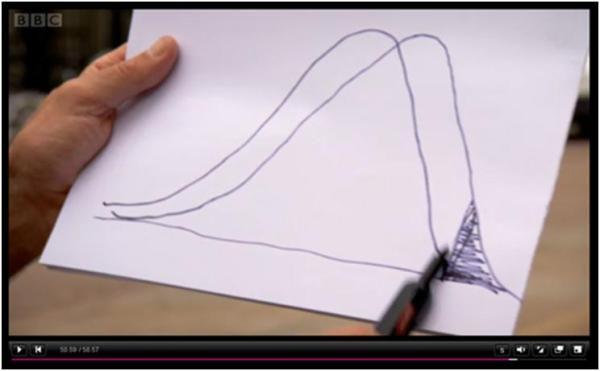
I saw the Horizon programme last night on “What is One Degree?” Ben Miller returned to his physicist routes to explain why a small rise in global temperatures is significant. There was some interesting science, but it fell apart towards the end when it came to explaining how one degree is significant. Using shifts in a binomial distribution curve it was explained that

“You only have to move the average temperature up a bit for the number of stinking hot days to become much more frequent.”


What was not explained was the implication for the other end of the distribution. The number of extremely cold days will become much rarer. For Britain, where snow is fairly infrequent, it could easily become a thing of the past. The cold spell twelve months ago, and December being the coldest in the 352 years that the Central England Temperature Record has been in existence are simply not possible. Especially at the Met Office were repeating this forecast just twelve months ago.

Before you get all skeptical, there is something that salvages the global warming case. The scientific consensus has long stated that climate change will disrupt the planetary weather systems. Therefore, the distribution of temperature will not just have a peak that will shift to the right, the distribution will also broaden. It may broaden sufficiently that there could be more extreme cold weather than extreme hot weather events. Along with this there will be more extreme weather events like hurricanes, tornados, flooding and droughts.

The problem with this is that the prediction of more hurricanes has not occurred. The 2010 season was one of the quietest on record. The forecast drier climate in Queensland seems to have gone a bit adrift as well.

In analyzing our extremely varied climate, whether British or Global, one has to look for instances that contradict out hypotheses as well as confirming instances. Otherwise you get a distorted picture of what is actually happening, and an exaggerated view of the human influences.

Prof Nordhaus forgets some basic Economics

Wattsupwiththat today carries a summary of William D. Nordhaus’s latest paper on climate change policy. The paper “The architecture of climate economics: Designing a global agreement on global warming” is published at the Bulletin for the Atomic Scientists here.

The basic economic fundamental for any policy is to have a net welfare improvement. Therefore in designing this policy, there should be a reasonable expectation that benefits will outweigh the costs. Prof. Nordhaus simply looks at the improvements to be made from switching from cap and trade (per Kyoto Agreement) to a carbon tax. Not just any carbon tax, but one that is uniform throughout the world.

Nordhaus claims that people should face the social costs of their activities. A carbon tax provides four strong incentives:-

First, it provides signals to consumers about what goods and services produce high carbon emissions and should therefore be used more sparingly. Second, it provides signals to producers about which inputs (such as electricity from coal) use more carbon, and which inputs (such as electricity from wind) use less or none. It thereby induces producers to move to low-carbon technologies. Third, high carbon prices provide market signals and financial incentives to inventors and innovators to develop and introduce low-carbon products and processes that can eventually replace the current generation of carbon-intensive technologies. Finally, and most subtle of all, the use of carbon pricing provides simple, straightforward information that market participants need to undertake each of these three tasks. Of course, placing a market price on carbon use will not work magic.

As a means of making consumers use fossil fuels more sparingly, taxes on fuel are highly inefficient. With no close substitute (at least in cost) for fossil fuels (whether for transport, domestic fuel and light, or industry) rises in price are highly inelastic with respect to demand. That is why in the UK, it is a great way of raising tax revenue – you can raise with impunity without major fall-off in demand. Prof Nordhaus can check this out from the effect on demand to the rising price of oil.

As for making producers move to non-carbon sources of power, it is mostly being driven by government policy. The costs of wind and solar power are still far beyond those of fossil fuels and prone to supply problems. For instance, the recent extreme cold in the UK was accompanied by weak sunlight (it is winter with less than 8 hour days) and virtually no wind.

The incentives to producers to switch to alternative energy sources are already there from the high oil price. It has more than tripled in price in less than a decade. The marginal impact of increases energy prices through taxes will be small, if not insignificant.

The fourth is just a combination of the three. It is only a reason if the word “subtle” is replaced by “insignificant”.

The disadvantages of a carbon tax

What Nordhaus does not look at are the disadvantages.

  1. Carbon Tax is regressive within countries. Those who will have to give up cars and foreign holidays and suffer lower heating and lighting in their homes are the poorest. In Britain, where death rates already surge in cold weather, this will be exacerbated.
  2. A carbon tax works by providing a stark choice – you either reduce energy consumption (and reduce your standard of living) or see your living standards fall in other areas. Without
  3. For many in the poorer, but developing countries, aspirations will be dashed. Economic growth is closely related to increase in energy usage per capita. In India and China with rapid economic growth, hundreds of millions of families will be aspiring to cars, foreign travel, washing machines, refrigerators and warmer (or air conditioned) homes. To control CO2 emissions means denying them these opportunities for many years. This is not just making them less affordable. It is also through slowing those high rates of economic growth. For these people – 40% of the world population – this welfare loss will be far greater than anything that runaway global warming can engender.
  4. A uniform tax is ludicrous. In the UK of the £1.23 per litre I last paid for petrol ($7.30 per US gallon of gasoline) over 50% was in taxation. Yesterday the VAT went up 2.5%, adding another 3p per litre. In the USA it is much lower. In Brazil, diesel is restricted to goods vehicles only and carries no tax. In Iran fuel is subsidized. In the UK (and much of Western Europe) a uniform tax would lead to a reduction in tax in an area where you want to reduce emissions most, whilst achieving large emission reductions in some of the poorest, but developing countries.
  5. Society bears the costs of individual consumption externalities. You should compensate the losers whilst punishing the polluters. But to do this efficiently you need to first identify the losers and the gainers from CO2 emissions. Who will lose from the consequences of climate change is purely speculative.


Prof Nordhaus’s mistake is only to look at the advantages of a Carbon Tax over Cap and Trade. He does not look at improving the situation on having no policy at all. He ignores the poor, proposing a policy that will deny the aspirations of billions. Further, he does not take into account the political dimension. The democratic and rich countries will not vote for a policy that can only be effective by significantly reducing their living standards. In Western Europe, this is further exacerbated by most studies showing climate change will do little harm, or be of slight benefit. In China, constraint on CO2 emission growth will also strongly constrain economic growth, which will probably cause political turmoil. Yet without China and other emerging economies buying into CO2 constraint, then Western CO2 reductions are in vain. See a talk by Roger Pielke Jr.

However, Prof Nordhaus recognizes that non-participation costs are very high for achieving emissions targets

AGW – The Limits of the Science

Just posted to Wattsupwiththat.

To say that we cannot make any predictions from models is inaccurate. However, a combination of the scarcity / inaccuracy of data and the highly complex nature of climate systems severely limit what we can be extrapolated. We are restricted to the most basic of “pattern predictions”. With respect to future temperature changes this is most probably restricted to the range of longer-term (30 plus years) trends. Prof. Bob Carter’s analysis is probably as far as we can go on the available data. That is we have a uniform, increasing, average temperature trend over the last 150 years, with 60 year cycles providing deviations around this trend. This trend is unexceptional when viewed from temperature data from ice-cores going back hundreds of thousands of years.

The attempt to cast every unusual weather event in terms of anthropogenic warming, and only selecting the data that fits the theories, not only risks policies that are inappropriate. It may lead us in failing to pick up the signals of potential trends for which the signal is weak, or where detection is from trends or patterns that do not fit theory. For example my house, along with hundreds of others in the area has been without water for over twelve hours now due to a burst water main, caused by the severe cold. A contributing factor to the delay in repair was the lack of resource available. Too much reliance on speculative forecasts of increasingly mild winters, and snow being a rare event has virtually eliminated contingency planning for extreme cold. Yet natural factors (e.g. La Nina, lack of sunspots) would have suggested otherwise.

The AGW science is not only costing us more for fuel. It is also putting us at greater risk of the consequences of extreme weather.

For Robert Carter’s views, see a video at http://video.google.com/videoplay?docid=-1326937617167558947#

Baptist Times – Supporting Global Warming in the Extreme Cold

The front page of the Baptist Times of 10th December has two articles. One on churches helping those affected by the extreme cold snap. The other by Christian Campaigners urging tougher policies at Cancun to counter global warming. Here is my response.

Sir,

There is a distinct contrast in your two articles on the front of the BT of 10th Dec. The major article is of Baptist Churches opening their doors to help those affected by the cold weather. In central England it was the second coldest start to December in the last 350 years. This cold winter is explained by the combination of two natural factors – La Nina and low levels of solar activity.

The secondary article – “Standing up for Creation” – calls for the rich west and emerging India and China, to sacrifice their carbon-fuelled growth and prosperity to stop the global warming and thereby destabilising the climate. In the rich west it means paying more for fuel, something that will hit the poor hardest. In the China & India – with 2 out of 5 of the World’s population – it means preventing tens of millions breaking out of subsistence poverty every year. The policy outcome of Cancun will be more people in this country in fuel poverty, with a near-zero effect on climate change.

History will show that the climate consensus has overestimated our ability to change the climate, both for worse or better. The prophesies of catastrophe will be shown to be as misguided as past prophesies of Armageddon from selective reading of scripture.  We need a more balanced approach.

Cure Worse Than The Problem? – Global Warming and California Prop 21 Compared

Warren Meyer seems to have got a little confused on his blog posting on Judith Curry’s ostracism by the alarmist community. He states

I find it just staggering that Judith Curry, whose hypotheses about man-made global warming probably overlap those of the hard core alarmists by 80-90%, can no longer be tolerated by alarmists.  Much as the Catholic Church radicalized Martin Luther when all he initially wanted to do was reform some practices (many of which the Church later reformed), the attacks on Curry seem to be having a similar effect.

The typical response by politicians, of course, is to try to get more money from taxpayers.  California has a ballot initiative this November proposing to raise vehicle licensing fees to all its citizens in order to fund state parks.  Unfortunately, this kind of funds earmarking by ballot initiative is already threatening to bankrupt California.  One problem with this approach is that it demolishes accountability — once an unelected state agency gets dedicated funds the legislature can’t touch, there is nothing that taxpayers can do if these funds are not spent wisely short of another time-consuming ballot initiative to revoke them.

In the case of state parks, the accountability problem is even worse, as the initiatives replace park user fees, which at least enforce accountability in that users can stop visiting if park services are not up to expectations, with a no-strings-attached bureaucratic windfall.  Compounding the problem, in many states the parks organizations report to rubber-stamp boards rather than the governor or any elected official, so taxpayers have absolutely no path to enforce accountability.


The quotation seems to belong to Meyer’s Coyote Blog. I would direct folks to the Reason Video on this issue.

http://www.coyoteblog.com/coyote_blog/2010/10/coyote-on-reason-tv-private-management-of-public-parks.html

However, maybe, there are just some words missing here, because the funding of state parks and global warming have some common policy issues.

Let me start with Global Warming. The case can be divided into two main areas. There is the science bit (the forecast warming and the catastrophic consequences) and the policy devised as a remedy (divided into the policy itself – the Legislation and actions – along with the expected / actual results). Or more simply Forecast, Consequences, Policy, and Outturn (FCPO).

In the UK, the Stern Review looked at this whole issue as a cost benefit analysis. By assuming fairly alarmist consequences (without the uncertainty) and assumes a relatively cheap (but highly effective) policy fix, gave benefits of the policy are 5 to 15 times the costs. It looks a clear-cut case for action, so anyone who denies this is either ignorant or has ulterior motives. But if you start assessing the uncertainty in the science, you will quickly find unverified hypotheses, implicit assumptions and measurement errors tending in the same direction. Furthermore the climate disruption consequential on this postulated warming is possibly more speculative still.

Even if you accept this worst case scenario with all the damaging consequences as the near certain, there is still the fact that the policies proposed (like Kyoto & Copenhagen) would only be cost-effective if each individual government implemented them like a business plan – maximising revenues and minimising costs. In Britain (with a legislated 80% CO2 reduction by 2050), the levels of costs are often many times the cost boundaries set by Stern, and there are many other costs being incurred that are at best side-shows (targets on recycling, banning incandescent light bulbs, alcohol in gasoline). Yet no Government will implement the policy with the necessary ruthlessness and doggedness required to get the positive results.

Like when Steve McIntyre looked into Mann’s hockey stick, what looks superficially to be robust falls apart when you start looking at it the totality. If absolute minimum for policy is to be an justifiable expectation of improving the likely future state as a result of taking action, then there should be some top-level independent auditing. As no independent review has taken place – like a bank reviewing a business plan to justify a loan – any major gaps or faults in any area potentially undermines the whole case for taking action. But when if the minimum requires accelerating warming, strong positive feedbacks; along with cheap and effective policies and zero issues with policy implementation or cost overruns; then there is a serious problem. So it is only by making a number of extreme and untenable assumptions that the consensus policy be supported. The overall solution is likely to be worse than the actual problem.

How does this relate to California’s state parks? Unlike for global warming, the case for action is clear. The parks need new funding for maintenance. The proposed policy would be ineffective in this, as it is not just funding levels at issue, as part of the cost problem is ineffective management. The solution of separating revenue from paying customers (or the electorate) will exacerbate the management issue. Furthermore, free access to all will increase visitor pressure, potentially hampering conservation efforts, whilst having an element of unfairness towards the inner-city poor. The overall solution is likely to be worse than the actual problem.

The Death Penalty and Catastrophic Global Warming

Just posted to Warren Meyer’s Coyote Blog. (Warren also runs the excellent Climate Sceptic blog)

Like you Warren, I too am both a global warming sceptic and oppose the death penalty. The reason I oppose the death penalty is that the police too often look for the evidence to support their case, but not for the evidence that contradicts this. As a result, here in Britain, some serious miscarriages of justice occurred. For instance in the 1970s the IRA brought their bombing campaign to Britain. 21 people died in Guilford and 10 people died in Birmingham. In both cases both groups of men convicted were entirely innocent. One group was convicted due to residue of a chemical used in the bomb being found on the hands of the accused. It was later explained by the chemical also being found on a new deck of playing cards.

However, the worst case was for the murder of the hugely popular TV presenter Jill Dando. It was a cold-blooded shooting, by someone who then calmly walked away and disappeared. Barry George, was convicted of her killing on the evidence that there was a speck of gun residue in a coat pocket; that he had tried to join a gun club; that he had multiple newspaper images of the accused; and had a picture of him masked and holding a gun. Turns out the guy had a low IQ, who had a stack of old newspapers in his room, had and old Polaroid of him fancy dress with a de-commissioned gun. Jill Dando was a celebrity who had appeared 6 times in that stack of papers. He had attended a day care centre a short while afterwards and appeared calm. Yet he was a man easily excited and incapable of calm planning. The coat was handled by police officers who had recently handled firearms and the speck of residue was miniscule.

The alternative explanation was this was a gangland hit. Jill Dando was mostly a newsreader, but whenever she fronted any other show, the ratings climbed. Once a month she fronted “CrimeWatch”, the first program in the world to recreate crime scenes to help solve crimes. It has scored some notable successes over the years.

We are all fallible, particularly those who are trying to confirm their answers. It is often those who are least able to defend themselves (due to low IQ, or race, or poverty) that get wrongly convicted.

The global warming hypothesis is similar. There is weak circumstantial evidence to suggest catastrophic warming, but with a superior Queens counsel (public prosecutor) a persuasive case can be made. But a similar defence counsel would have the case quashed early in the trial.