The Impact of Labour on the Current Crisis

UPDATE 11th APRIL – I WAS RIGHT IN SAYING THAT THIS WAS TOO LOW AN ESTIMATE. IN THE BUDGET REPORT NATIONAL DEBT REACHES OVER 91% OF GDP, NOT 87% AS MODELLED HERE.

John Redwood today claimed that

“Labour governments typically devalue the currency, run out of money, and preside over industrial chaos. Welcome to the spring of discontent.”

However, Redwood fails to attempt to quantify the extent of this economic mess. Gordon Brown would counter that the current situation is none of his doing. The Labour Spin Doctors might try to imply that the Tories are saying that the worsening of the deficit & national debt is 100% down to them. This is literally untrue. The opposite – that none of the current economic crisis is due to Labour’s economic management – is equally not true.

It is important to be able to split out the worldwide impact from the Labour Government’s

economic ineptitude.

I did some simple calculations comparing two situations (all as a % of GDP)

1) An actual (Labour) one where in 2007, at the top of the cycle there was a budget deficit of 3.5% and a national debt of 44%.

2) A fiscally prudent (Prudence) one where budget deficits had not been incurred in the good years, so in 2007 the budget surplus was 0.30% and the national debt just under 30%.

Let us assume there is a similar worsening of public finances of 8.5% of GDP, so under Labour the deficit peaks at 12.2%, under Prudence 8.6%.

Under a Labour the national debt peaks at 87% of GDP in 2015; under Prudence 48% in 2013.

Under Labour we have a structural deficit of at least 6% of GDP; under Prudence at most 2%.

This is graphed below.
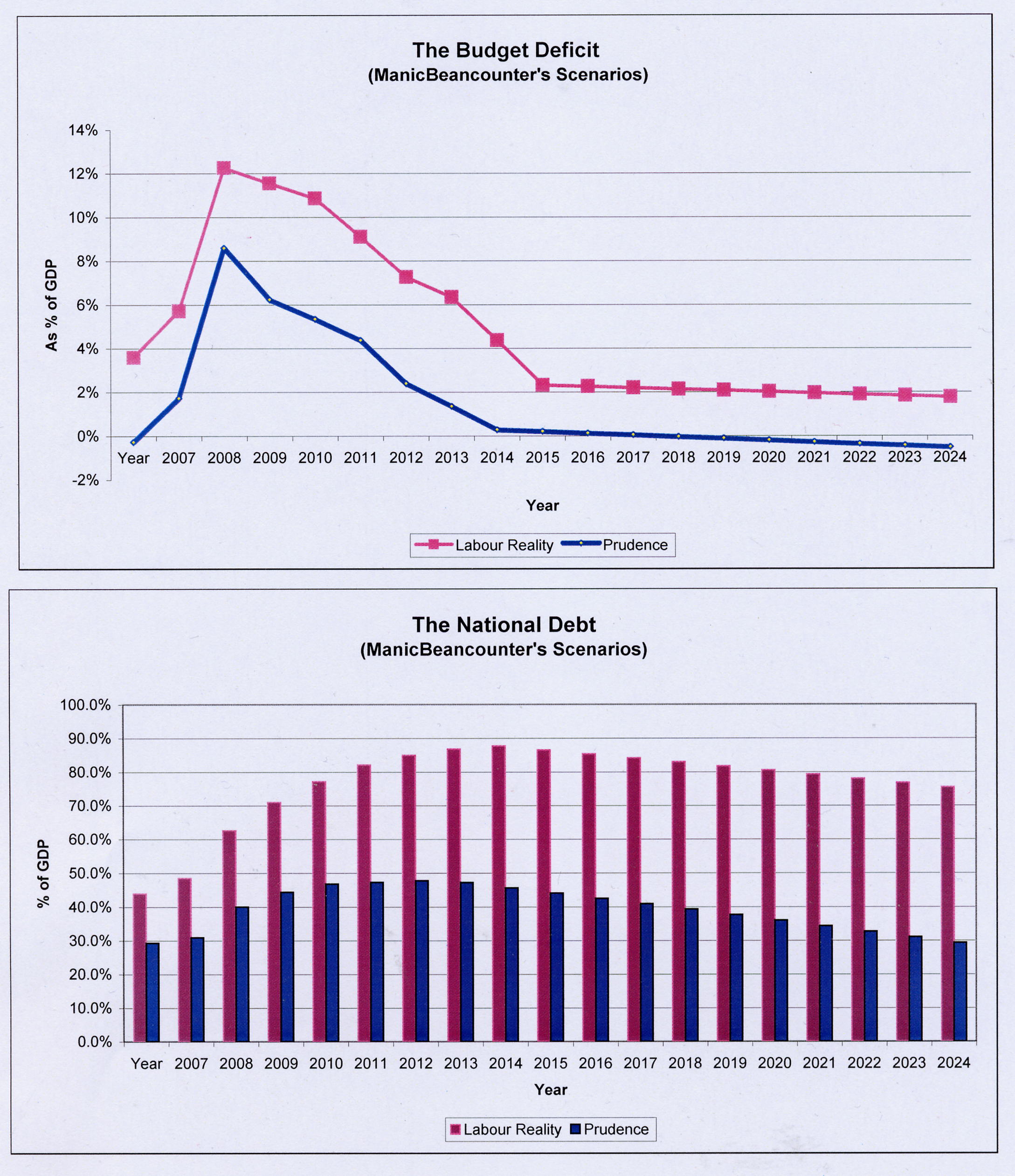
That is, the Labour (or specifically Brown) effect  is an increase if the National Debt of over 40% of GDP and a structural deficit of £90bn that must be eradicated. Under Prudence the increase in National Debt is less than 20% of GBP and a structural deficit of £30bn.

This is, however, much too generous on Labour, as I have assumed.

1)     Growth Rates are the same.

2)     The average level of interest on the National Debt is the same.

3)     The worsening of the Government Finances is the same from peak to trough.

4)     The effectiveness of the fiscal stimulus is the same.

5)     The turnaround in the public finances is the same.

6)     The growth forecast through to 2015 is 3.2% growth. This is roughly as forecast in the 2008 Autumn Pre-Budget forecast. Thereafter the growth rate will settle at 2% per year.

Therefore, by implication:-

–         There is no impact on the recovery through massive cuts in government spending and/or real tax rises.

–         There is no rise in interest rates as a result of the ballooning deficit.

–         There is no real problem in reducing public spending by 12% of the total in five years (or by around 30% of the total excluding the health sector, education and transfer payments), as against a 4% reduction.

–         The existing deficit pre-downturn had no impact on the size of the downturn.

–         The effectiveness of the economic stimulus was the same regardless of the size of the deficit, or whether it was on the back of a fiscal stimulus (through public expenditure increases) for the last seven years.

So going forward, it is fair to say that as long as the recovery is strong and interest premium does not rise in relation to the euro area, and the government achieves the deficit reduction targets, the national debt is at least 80% larger due to Labour, and the fiscal squeeze is at least 3 times greater.

Open Letter to Rt Hon Harriet Harmen MP

Dear Ms Harmen

I found it unfortunate this morning on Radio 5 Live that your were not given enough time to answer the question on how the selection of your husband as a Labour Party candidate reconciles with your campaigning for all women shortlists.
I would like to offer you the opportunity to explain here
I am sure that there are plenty of blogs who would replicate any reply. It would certainly help enlighten voters on a matter that they find somewhat opaque.

Your sincerely

(a slightly) Manic Beancounter

Government is no longer New Labour of the 1997 Manifesto

The Government is now further from the “New” Labour in the 1997 Manifesto, than “New” Labour was from the traditional Labour party.

These extracts from that 1997 Manifesto demonstrate the point.

Spending and tax: new Labour’s approach


“The myth that the solution to every problem is increased spending has been comprehensively dispelled under the Conservatives.”

That is as true for investment as for current spending. It is certainly true for increased current spending, even if you attempt to re-define as investment. It is also true for spending your way out of recession, or a fiscal stimulus during a boom. As the manifesto goes on to state:-

“The level of public spending is no longer the best measure of the effectiveness of government action in the public interest. It is what money is actually spent on that counts more than how much money is spent.”

“The national debt has doubled under John Major. The public finances remain weak. A new Labour government will give immediate high priority to seeing how public money can be better used.

The national debt had indeed risen, and was coming down during a boom. It came down even further during Labour’s first term, due to their adhering to the Conservative’s policy. This high priority has been dusted off again, as a way to reduce spending, having failed for over twelve years to implement it.

New Labour will be wise spenders, not big spenders.”

Not for the last nine years they have not. By any measure, they have been big spenders, not wise spenders. Increased expenditure on the NHS has mostly been wasted on exhorbitant pay rises, and much expenditure of very expensive hospitals. However, the sharp end of survival rates from strokes to cancers is still amoungst the lowest of the OECD countries. That is lower productivity, or less value for money.That is less value for money. In Education, there has been a lot of new schools built, lower staff to pupil ratios, but little evidence of improving standards. That is lower productivity, or less value for money.

To be wise spenders you must first acknowledge your limits and seek counsel from those who have a track record in these matters. The Taxpayer’s Alliance has some good ideas, supported by Wat Tyler at Burning Our Money. John Redwood draws on his experience in government, along with his time in business. The Adam Smith Institute also provides some thoughtful pieces at times. Further, you should ignore the master’s of spin. That is the Mandelson’s, or the Campbell’s of this world. And treat as lepers the Mcbrides and the Drapers, who will only serve to destroy good government.


“No risks with inflation

We will match the current target for low and stable inflation of 2.5 per cent or less. We will reform the Bank of England to ensure that decision-making on monetary policy is more effective, open, accountable and free from short-term political manipulation.”

In the last year the Bank of England has pumped £200bn of money into the economy. They have reduced interest rates to 0.5%, a record low in over three centuries. Although nominally independent, are very much in line with Government policy, and would have been leaned on heavily if they had disagreed. Sound money has gone. In so far as it existed since 2001, it was despite of deficit-funded spending boom. The risks taken with future inflation are huge, and prices are already rising.

“Strict rules for government borrowing

We will enforce the ‘golden rule’ of public spending – over the economic cycle, we will only borrow to invest and not to fund current expenditure.

We will ensure that – over the economic cycle – public debt as a proportion of national income is at a stable and prudent level.”

Another policy that was shelved in the second term by pretending current expenditure is investment. Also by believing that the government had “ended boom and bust”. At the peak of the cycle in 2007, the deficit was about 4% of GDP, despite a long period of historically-low interest rates. At such a long-term peak, there should have been a surplus of around 2% of GDP. The differential – the structural deficit is around £80bn. With the collapse in the financial sector, that structural deficit now exceeds £100bn.

“We will clean up politics”

 After twelve years of government, the expenses scandal erupted. The headlines were grabbed by rich Tories (for cleaning the moat, a duck house, and manure), but the biggest monetary claims were mostly Labour MPs, including government ministers. It was kicked off by Home Secretary, Jacqui Smith claiming her main home as her sister’s house in London, not her family home in her constituency. The Labour party have not just failed on this policy. Many members of that party have helped bring it lower than at any time since the 1832 Great Reform Act abolished pocket boroughs.

NB – My thoughts were prompted by John Redwood’s short piece today on Labour’s Pledges. He says

“Keep this card and see that we keep our promises” says my copy of Labour’s pledge card from the start of the government. I did:

“Get 250,000 under 25 year olds off benefit and into work

Set tough rules for government spending and borrowing; ensure low inflation; strengthen the economy”

We all look forward to those. Any chance any time soon?

Should Lord Stern remember some economics?

After Lord Stern’s comments about becoming a vegatarian to save the plant, I suggested he should be consistent and become a vegan. A post by Martin Livermore on the Adam Smith Insitute blog got me thinking that maybe Lord Stern would be advised to remember some lessons from economics. After all, as an economist, Lord Stern was employed to do a cost benefit analysis of tackling global warming. The report was only able to reach its conclusion that we should do something now by taking an extreme view of future temperature change (thus overstating the benefits of any remedy) and seriously understating the costs. Mostly this was by failing to apply an appropriate rate of discount to future costs and benefits.

Since then Lord Stern has become increasingly alarmist. If instead, he applied some of the tools of his profession he would conclude the following.


1. Most of the largest greenhouse gas producers are things that have an inelastic demand – such as petrol and fuel to heat one’s home. Therefore the costs will tend to exceed the benefits.


2. There are diminishing returns to emissions reductions. Small decreases can be achieved easily. At home most can save a bit by better insulation in the loft, or by turning town the thermostat by 1 degree. Car fuel consumption can be reduced by driving more economically. Bigger savings are less easy, without fundamental changes in lifestyle, which for the majority would mean a significant drop in living standards. For instance,

– switching from frozen and chilled foods to dried and tinned foods.

– switching foreign holidays to camping in the back garden.

– From travelling by car to work to spending three times as long going by public transport, or catching pneumonia cycling.


3. Large government projects tend to overrun on costs, and under-perform on benefits. The bigger and more idealistic the project, the larger the (proportionate) discrepancy between plan and outcome. International projects tend to overrun more than national one, as consensus is only achieved by compromise fudging. For the greatest trans-government project of all time, this risk alone should lead to the complete abandonment.


4. Complex models tend to fail most in their forecasting when you need them most. Consensus economic forecasts made in 2006 for 2009 would have predicted growth, not biggest slump since the 1930s. Yet compared to economic, climatology is more complex and still in its infancy as a subject. Further there is no competitive market in forecasting to encourage improvement and revision in the light of new data. In economics reputable  forecasting is a valuable commodity. In Climate Science, one is paid to agree with the consensus.

Nationwide and Halifax house price recovery is fragile

The recovery in house prices reported in the Nationwide and Halifax indices underlies a significant issue – that many existing borrowers would see a much higher rate of interest if they moved mortgages. As an example, my own repayment mortgage is currently 1.9% annual interest rat, or 1.4% above base rate. If I moved house Nationwide’s best deal on a tracker is 2.44% above base rate for 2 years and the reverts to 3.9%. There is also a nearly GBP 900 fee. Halifax are similar- 2.69% above base rate for 2 years, then reverts to 3.5%. A GBP 1200 fee here.

These are the cheapest deals, for a loan less than 60% of the house price and are competitive in a thin market. Halifax reports August 2009 approvals were 51% lower than in August 2007. The Nationwide’s measure of private housing sector turnover rate is now 4% , from a peak of 7% and a low of 3%.

As the driving force for the Housing Market is people upgrading to a better house, there may be a considerable number of people delaying moving house for this very reason. It is better to save for a new house by paying down existing borrowings than move to the more expensive house.

Paradoxically, a rise in base rates may prompt a narrowing of this differential and therefore perk up the housing market. The reason being that the marginal cost of moving will have diminished. However

–  there are other reasons for the low levels of housing activity – uncertainty over jobs and the need to pay off debt.

– a rise in interest rates may tip many existing hard-pressed borrowers towards selling. In particular buy-to-let landlords who have seen rents diminish this year.

Financial Regulators are as fallible as the rest of us

John Redwood, in defence of the banker’s, asked whether the regulator’s in the part four years has engaged in socially useless activity.

Unusually, I came to the defence of the regulator.

Regulators, even if nominally independent, work within the current political & economic climate. They would not have called for increasing capital requirements during the boom, as there was no visible reason to do so. After all, we had “ended boom & bust” – due to the prudent handling of our economy by the then Chancellor. Where was the risk factor that justified such a measure?

 If a Regulator had called for tougher rules, he would have been lambasted by the press, and criticized by most expert economists. Financial Experts would say capital requirements could be lower, as risk was now diversified throughout the global financial system.  Politicians would have said that such unilateral action would jeopardize London’s position as the World’s No.1 financial centre. If the Regulator had sufficient stature, then the £ would have gotten a bit jittery, and some shares in the banking sector would have taken a tumble. A government spin doctor would have come out we a speech saying “what I think you will find the Regulator actually said was .…” – and then say something that was the opposite, or renders the comments meaningless.

After a few days of ducking the issue, the Chancellor would have given his full support, followed the next day with the Regulator’s “voluntary” early retirement (or movement sideways).

A similar picture was with the Central Banks. By cutting interest rates after the dot.com bubble burst and again after 9/11 we obtained an asset price bubble. The US or the UK were not going to call a halt by raising interest rates, as it would have been both politically unpopular and raised exchange rates. The normal market adjustment, with a mild recession was averted. The long-term consequence was system imbalances becoming so large that the eventual correction nearly wrecked the financial system.

 The lesson to be learnt is not tougher and/or more detailed regulation. It should be a humility concerning our powers to intervene, as they can have consequences that we cannot foresee. Furthermore, markets have rushes of exuberance that will, sooner or later, be corrected. Avert the market correction and you build up trouble for the future.  Interventionism does not cure the problem of imbalances, merely delays it.

MARKETS WILL ADJUST. BEFORE OVERRIDING TO COUNTER FLUCTUATIONS,  YOU SHOULD FIRST BECOME OMINISCIENT.

Alan Greenspan convinced everyone that he had achieved this status, but turned out, in the long run, to be wrong.

The biggest current imbalance is in the housing market. The slide has been halted by near zero interest rates, but will resume when those rates get back towards normality. Why do I say this when average house prices are around the long-term average of four times average earnings? Because interest rates are well below their long-term average for existing borrowers. When they revert to around 5% that new borrowers are paying, and when unemployment peaks at 3 million plus (with some coming from the state sector), then the supply of houses will exceed demand.

300,000+ per annum dead due to Climate Change?

The claim by the Global Humanitarian Forum that over 300,000 people per year is unsubstantiated and most likely false. It is based on a selective reading of data and should be challenged. In particular, the assumption that 40% of the increase in disasters is climate change related and the implication is that we should severely curtail greenhouse gas emissions to mitigate it.

The case studies from the full report (here) illustrate why.

–         Hurricane Katrina (p.21). Latest evidence is that there is most likely a link between global warming and hurricanes, but the nature is unknown. It may be temporary whilst temperatures rise. The deaths and much of the economic destruction in Hurricane Katrina was a result of poorly-maintained levees breaking. The human costs (lives and $) was due to a powerful hurricane hitting land on a major population centre. The probability of any one hurricane doing this is very low.

–         2003 European heat wave — 35,000 deaths (p.33).  Unique events cannot be easily adapted to. Contingency plans have been put in place, but in almost 6 summers since there has been no repeat. However, higher temperatures mean than winters are milder. In the UK alone there are thousands of deaths amongst the elderly with elderly every time due to extremes of cold. So the net impact of global warming (even with more extreme conditions) could be a reduction in climate-related deaths.

–         Ethiopian drought and flooding (p.32). The report quite rightly points out that many of the population is malnourished, there is severe water shortages and there are frequent droughts. However, they fail to point out how this is increasing as global temperatures rise. If my memory serves correctly, there has been no famine matching that of 1984, despite the population having increased. There was also a large famine in 1973. Unless there are strong counter-arguments to the contrary, any climate change may have had a positive impact. The counter-arguments are that a) There has been economic growth in the last 25 years. Although still one of the poorest countries on earth, there is sufficient wealth around to cope with famines. b) Aid agencies have structures and plans in place to avert potential disasters. c) There is no longer a pro-Marxist government pushing through collectivization of agriculture and placing obstacles in the way of relief efforts.

The implication from my reading of these examples is that even if they are wholey due to climate change, the way to mitigate them is a targeted response at the local level. In the 3 cases above, it is unlikely that similar scale weather events would cause similar scale disasters, as there are now contingency plans in place. Further the evidence of earthquakes is that the most deaths occur in the poorer parts of the world. A similar-sized earthquake to that of China in 2008 or Bam, Iran in 2003 replicated in California or Japan would not cause the same number of deaths because of better buildings. and better emergancy services. And these are as a consequence of much greater wealth.

In terms of deaths through hunger, the greatest famines in the 20th century were due to authoritarian governments and wars. The suffering under various communist regimes trying to instill their various brands of utopianism should be a cautionary tale to trying to regulate the world economy. This was based on the certainty that theirs was the perfect system, implementation was not an issue, and those who disagreed were deluded, or in the pay of the capitalist class.

The vast reduction in the proportion of the world’s population suffering hunger is partly due to the green revolution (higher-yielding crops and better types of agriculture of the 1950s & 60s – not the organic fad of the rich countries) but mostly due to sustained economic growth promoted by globalization. The growing countries (China & India, along with others) have turned their backs on state control and embraced globalization and let enterprise flourish. A consequence of that growth has been a massive rise in greenhouse gases. A government managed reduction carries the very great risk that the growth will be reversed, with a consequent increase in human suffering far greater than 315,000 live per year. For these reasons, analysis of the impact of climate change need to be better justified before they form the basis of policy decisions.

Other Sources

  1. The Economist made similar comments when the report came out, commenting that the 40% of the increase in disasters is climate change related is arbitrary and also that money thrown at the problem will not necessarily provide answers. They do not point out the risks to the global economy, nor the local solutions to mitigate the impact rather than global reductions in greenhouse gases.
  2. Christopher Booker in the Telegraph said “Then there was the 103-page report launched by Kofi Annan, former UN Secretary-General, on behalf of something called the Global Humanitarian Forum, claiming, without a shred of hard evidence, that global warming is already “killing 300,000 people a year”. But Mr Annan himself had to admit that this report, drawn up by a firm of consultants, was not “a scientific study” but was “the most plausible account of the current impact of climate change”. He contrasts this with recent evidence that the planet has not warmed, and the recent cold winter.
  3. Robert Pielke Jr (c/f wattsupwiththat) gives a more scientific (and thorough) debunking of the basis of the report, concluding “This report is an embarrassment to the GHF and to those who have put their names on it as representing a scientifically robust analysis. It is not even close.” Link broken (02/13) , but referred to by Delingpole in the Telegraph and Climate Depot
  4. Willis Eschenbach in Feb 2013 at Wattsupwiththat, points out that the source of the figure is from Munich Re, the huge reinsurance company. The company has a vested interest in hyping the weather effects of global warming, as false perceptions  of risk leads to a willingness to pay higher premiums, and to over-insure. This in turn leads to larger profits for the insurance industry.
  5. Indur Goklany points to a figure of 141,000 deaths a year from the World Health Organisation. This figure puts it well down the list of risks, may well be excessive, and ignores the reduction in excess cold weather mortality that occurs with milder winters. 
  6. I looked at how the WHO figure of 141,000 deaths per year was estimated, finding a more balanced estimated is virtually zero.

Climate Change Camp – for good or evil?

The Tax Payers alliance have a posting on the Climate Change Camp set up in Blackheath.


Here is my comment:-


The comment you make is a fair one. Before proscribing a painful and potentially harmful course of treatment, an ethical doctor would

–         check the diagnosis is accurate – both in type and to the extent.

–         Make sure that the treatment is likely to improve the condition of the patient.

In a similar vein

–         The assessment of the extent of the climate change is not helped by failing to examine validity of the data or statistical analysis.

–         Nor by ignoring contrary science.

–         Nor by ascribing every bit of extreme weather to anthropogenic factors.

–         Nor by ignoring the benefits of warming (e.g. less old people dying in the winter cold)

–         Nor by assuming that a global policy is both the best available and that it will improve the situation.

–         Nor by ignoring the harmful effects of oppressive taxes and regulation. You could reduce economic output and bankrupt the government. This could lead to the collapse of public services (with many dying as a consequence) and millions permanently unemployed. In the emerging nations, reduced output will lead to the mass hunger from which many have just escaped. It will also lead to an increase in wars.


To establish that climate change is the “biggest threat the world has known” needs substantiation. In the last century the cause of every major famine was either caused authoritarian government policies or by war. On the other hand, global growth ensured that, for the first time in human history, the vast majority of the worlds population can live free from hunger as a normal state of affairs, and each generation can look forward to better livings standards than their parents. For those who believe in peace and helping the poor should make sure that these achievements are not reversed.

Pensions – The Missing Factor

We are told (for instance here and here, the major reason increase in the real cost of pensions (and the consequent demise of private sector final-salary pension schemes) over the last few years are

1. The increase in life expectancy.

2. Changes to accounting rules, meaning that companies have to include future pension liabilities in their balance sheets

3. The low returns from the stockmarket since 2000 – exacerbated in the current recession.

4. In the UK the 1997 Gordon Brown tax on the investment income of pension funds.

But the biggest cause of the rise of the pension deficits is the fall the long-term real rate of interest. This not only impacts on the compound returns to the pension “pot”, but also the size of the annual annuity that can be purchased on retirement. As a consequence, a fall of just 1% in the rate of interest might increase the contributions by 50% to obtain the same size pension. Always low interest rates benefit borrowers to the disadvantage of savers. Like sub-prime, pensions are another long-term hangover from the low-interest party since 2000.

In the UK, as a consequence of the low interest rates and high government spending we now have the following problems.

EITHER – We have low interest rates, meaning those working now have to save more for retirements

OR – We have higher interest rates, meaning higher taxes to fund the ballooning national debt and a steep fall in house prices.

The short-expediency of boosting the economy by low interest rates and deficit spending has reduced living standards for the elderly in the long term.

Cameron fails to understand the Booze Problem

ToryDiary reports David Cameron as saying yesterday

“We need to look at the unbelievable availability of very cheap drink, getting three litres of cider for £1.99, at all hours of day and night. We’ve got to do something about this and I’m exploring what we can do to deal with the drink that’s fuelling so much of the crime in our country.”

Please, please, Mr Cameron can you rise above the thinking of the Labour government?

On my ‘O’ Level economics course I learnt that raising taxes on booze was a good way of raising revenue, as demand is inelastic with respect to price. This is still true, so to plug the budget deficit they could look to raising the tax.

The other side of the coin is that it is a poor way to reduce consumption. For young people it may have more of an impact of their expenditure on alternatives (alcohol in pubs or nightclubs, clothing or car expenditure, or saving). For some it may be a Giffin good. Their consumption will increase on booze at home, and they will spend less on going out.

Minimum price is even worse. You may get people going up market,as the differancial between white cider and better alternatives diminishes. Also the quality may improve. But what will increase massively in the profit per unit to the retailer. Supermarket and Off-licence shares might rise is this is pursued.

 The social problem of alcohol will not be solved by stricter laws or by higher price. It needs a social change. It is only when large numbers of people stop believing that the best way to have a good time is to get totally pissed; and when it is seen as a weakness to lose control of one’s faculties. Then the consumption and the binge drinking will go down.

 Update 23 08 09

The Adam Smith Institute similarly see this as a social problem.