Is the Rawlings and Thrasher English Elections Forecast a bit timid?

At the weekend I posted my forecast for the English council elections to take place on May 4th, using a comparison with opinion polls both now and 2013, along with the forecast made by Harry Hayfield at Political Betting.

On Sunday, The Times published a forecast from Colin Rawlings and Michael Thrasher, both Professors of Politics at the University of Plymouth.

Again they use local by-election results a a basis for their forecast, and come up with similar results to Hayfield for the Lib-Dems (+9%) and UKIP (-12%). The biggest difference is with Labour, predicting no change, as against -4% for Hayfield. More relevant is the forecast for seats, where they predict Conservative +50, Labour -50, Lib Dem +100, UKIP -100

Despite these chaps having considerable experience of election data, having written a number of post-election reports for the Electoral Commission, I believe that their forecasts might be somewhat out. This I have split into share of the vote and seat predictions.

Rawlings & Thrasher share of the vote prediction

I have summarized some data in figure 1.
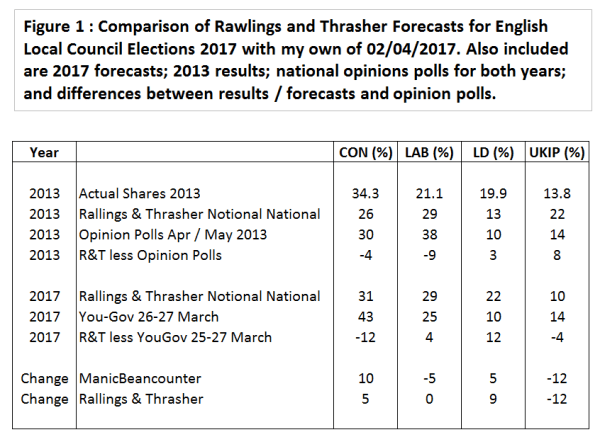
Rawlings & Thrasher base their forecast on the Notional National Change, so I have shown the difference between those figures and the General Election Opinion Polls. There are reasons why the local council elections are different from the opinion polls, aside from the fact that opinion polls may not fully reflect actual decisions.

In 2013 UKIP benefitted in the local elections as people used their vote as a protest against the Coalition Government and/or in support of an EU Referendum.  That no longer exists as Brexit is underway; whilst UKIP is in disarray and has fund-raising issues. In this I would agree with Rawlings and Thrasher in a huge drop in support for UKIP, swinging from outperforming the opinion polls, to underperforming.

With the Liberal Democrats, I would agree that they should not only outperform the opinion polls, but do so by a greater margin than in 2013, when being in Coalition Government damaged their brand as being the alternative to the Conservatives in the non-socialist areas. This year they may also benefit as being the Party of those most opposed to Brexit. But the actual share of the vote was 20%. For the notional share of the National Vote to rise nine points would indicate a larger rise to over 30% of the actual vote. It would effectively make the arch-Remainers effectively the biggest beneficiaries of the fall in support for UKIP. That is possible, but would imply very large underlying switches in effective party support. Also, this large net increase in Lib-Dem vote share would be despite no net movement in the general election opinion polls in the last five years. Even if local by-elections results indicate such a swing, when voting for full councils I do not believe that this will replicate this result.

The forecast for Labour to have no change from 2013 is perhaps the most out of line with reality. Just four years ago Labour seemed likely to be in a position to be win the 2015 election. Now they are 13 points lower in the opinion polls. Most of the councils concerned are in the Conservative heartlands, with Labour traditionally trailing in third place. They thus have less far to fall than nationally, but barring a miracle in the next four weeks, they will lose vote share.

By difference, this leaves the Conservatives making much larger gains that 5% of the Notional National Vote.

Rawlings and Thrasher seat change predictions

This I think is the most timid part of the seat changes to repeat they are

Conservative +50, Labour -50, Lib Dem +100, UKIP -100

Prof John Curtice on the Sunday Politics thought, based upon a 12 point swing in the opinion polls, Labour could suffer a much bigger loss of seats than the 50 forecast by Rallings and Thrasher. (hattip Guido Fawkes)

But to get an idea of the likely level of seat changes, it is worth looking at the changes in the similar (but not quite identical in terms of seats and councils) council elections in 2009 and 2013. These, from Wikipedia (here and here) are shown in Figure 2.
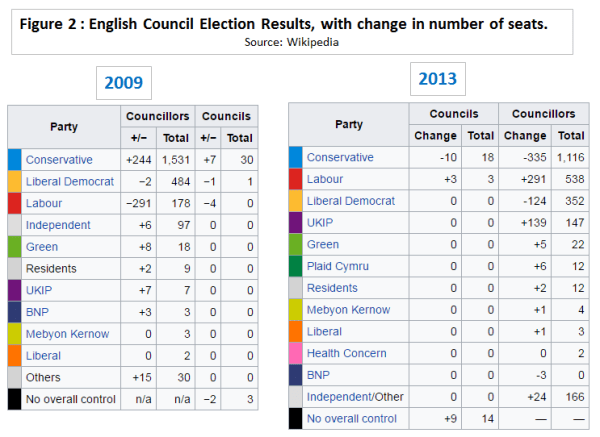
Please note that the numbers do not quite stack up due to (a) one more council in 2013 (b) boundary changes (c) by-elections. But broad comparisons can still be made.

UKIP gained 139 seats in 2013. The swing from 2009 to 2013 was probably greater than the counter swing they will likely suffer next month, so the loss of 100 seats is a reasonable estimate.  Similarly the Lib Dem estimate of 100 seats gain seems about right, despite the likely net change in fortunes maybe be less at a National level not likely nearly countering the loss in popularity between 2009 and 2013.

When it comes to Labour, they are nationally in a worse position than in 2009. So their loss of seats could be greater than then suffered in 2009. A reduction of 300 seats, or nearly 60% of the defended seats, seems a reasonable forecast, with a 200 seat loss or less being a relatively good night for Labour with their current unpopularity.

The Conservatives should easily be the biggest gainers. Most of the councils are in Conservative Heartlands. Others, like Lancashire and Derbyshire, are where they have managed majorities in the recent past. Yet in 2013 the Conservative share of the vote was below that achieved in the UK as a whole in the General Election just two years later. Two years after the General Election, the party is in a considerably stronger position, so should gain considerably. A gain of 300 seats is my forecast.

Final points

An aspect to consider in local elections is the impact of turnout. In their report on the 2013 English and Anglesey Council Elections, Rawlings and Thrasher noted that turnout was 31%, compared with over 39% in 2009.

In the similar 2009 report they note that this turnout was higher than in the previous three years.

Could the relatively high turnout be due to the confidence of Conservative voters? In 2009 the Conservative vote was 44.5%, 10% higher than in 2013. Labour had a 12.7% share (over 8% lower) and Lib-Dems were at 24.9% (5% higher). Then the Conservatives were a year away from going back into Government. In 2013, they looked like reverting to opposition. In 2017, there is a new sense of optimism among Conservative supporters, not seen since the end of the Falklands War – or at least with their Brexit supporters. These are concentrated in the middle-aged and older people, among whom turnout is usually higher than in the population at large. On the other hand, the Labour-supporting Remainers might stay at home, being doubly-demoralised. The change in seats could be even bigger than in either 2009 or 2013.

These are of course my forecasts compared with those of others who have more experience in these matters. What is crucial is how analyzing the difference between forecasts and actual results can deepen our collective understanding of what is happening in an interesting period in British history.

Kevin Marshall
 

Stoke Central By-Election – Labour’s achievement in statistics

Yesterday’s Parliamentary By-Elections were quite significant. The number of firsts about the result in Copeland have been gone over in fine detail. But in Stoke Central the winning Labour Candidate, Gareth Snell, can point to some records and distinctions that he has achieved. Purely in the interests of balance, I would like to help out. 🙂

Of the 650 MPs currently in the House of Commons, he will have the distinction of being elected on the least votes cast. Snell, in winning with 7853 votes, has removed from bottom place Angus MacNeil, SNP MP for Na h-Eileanan An Iar, who won with just 8662 votes. But this constituency covering the Hebrides has less than half of the Stoke-on-Trent Central electorate. Further, now 94% of sitting MPs are sitting in the House of Commons by virtue of winning with at least twice the numbers votes. In 2015 Tristram Hunt won Stoke Central with just 19.3% of electorate voting for him  – the lowest in England. Gareth Snell MP won with just 14.2% of the electorate voting for him, the lowest in Britain. Bottom place was previously held by Alasdair McDonnell, SDLP MP for Belfast South with 14.7% of the electorate voting for him. But in Belfast South six candidates saved their deposit, and seventh placed UKIP just missed out in getting 4.9% of the votes. In Stoke only four candidates saved their deposit and fifth placed Green candidate only got 1.4% of the vote. Whilst in Belfast South the majority was 2.3% of the votes cast, in Stoke Central it was 12.4%.

Another statistic is to look at the runner-ups in the General Election 2015. 560 of the 650 second-placed candidates received more than Gareth Snell’s 7853 votes. On average in GE 2015 the winners on average received and 23634 and the runners up 12121 votes, respectively 3 times and 1.5 times Snell’s mighty vote count. Although there were just 232 Labour MPs elected in 2015, 506 Labour Candidates received more than 7853 votes than Snell received yesterday. In the constituencies where they stood Labour received on average 14813 votes, nearly twice the votes received to win Stoke Central by a considerable margin. Of the 125 Labour candidates who received less votes than Gareth Snell, only 11 achieved the runner-up slot. The rest were lower-placed.

But this was a by-election, where turnout is usually much lower than at General Elections. Yet here Gareth Snell again sets records. You have to go all the way back to 15 July 2004 to find a winning candidate who won a by-election with less votes. That was Labour candidate Liam Byrne became the MP for Birmingham Hodge Hill with just 7451 votes. There have been 44 by-elections in between. Yet back then on average people won by-elections with smaller number of votes.

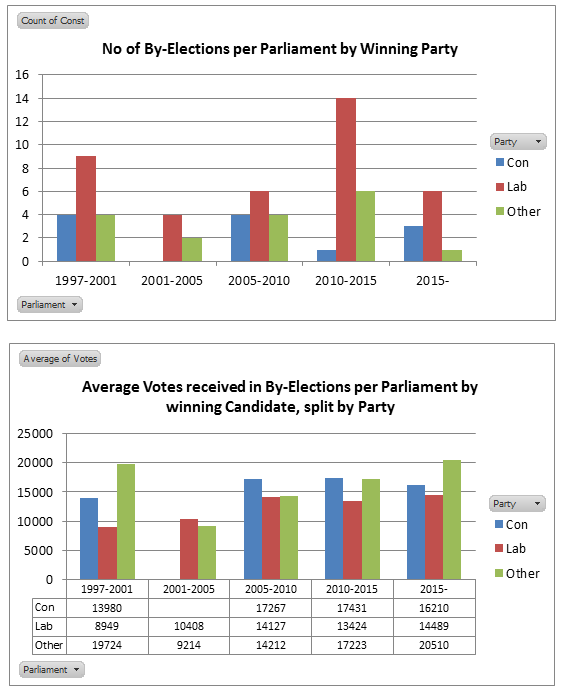
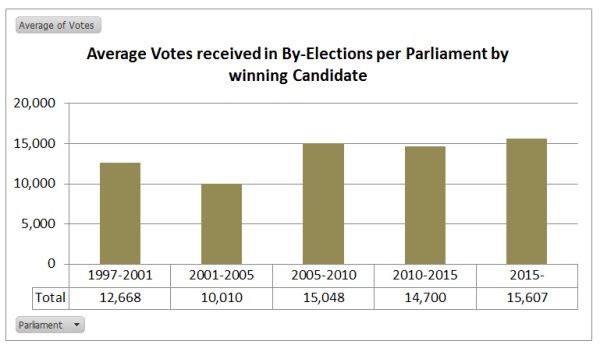
In the current Parliament winning by-election candidates achieve 50% more votes on average than in the 2001-2005 Parliament. It looks like more people turn out to by-elections now, maybe due to more focussed campaigning by the parties, and the greater national significance of the result than when Labour had large majorities in the House of Commons. Maybe it is due to the fact that less people tend to vote in Labour-held seats than for other parties. Below I show the numbers of by-elections held, splitting the winners into Conservative, Labour and Other.

The Labour Party seem to win by-elections with about 40% more votes than they did in 2001-2005.

Data for the 2015 General Election can be derived from http://www.data.parliament.uk/dataset/general-election-2015

Kevin Marshall

Manchester Withington Polling Fiasco

Whilst the Chair of the electoral commission should carry the can for the travesty that occurred, there are also lessons to be learned. As a voter in Mancheter Withington, I believe the following should be looked into.

  1. Mcr Withington has always had the highest turnout of the 5 Manchester constituencies. Was this allowed for?
  2. Students tend to vote late – on the way to the pub. The problems were mostly in areas with high student numbers e.g. Fallowfield and Ladybarn.
  3. Was lack of voting booths (2 per station) an issue?
  4. Were there procedural changes? The clerks seemed to take longer than usual (there was local elections as well). Was this due to having the electoral lists in postal address order, rather than alphabetical order of name or street address?
  5. Queues were already forming at 11am. Why did none of the clerks summon help? Or if they did, why was none available?
  6. Also, why did it take much longer in Manchester Town Hall to count the vote? The result was at least 3 hours later than usual. I think this happened in lots of other areas as results seemed to come through more slowly.


If government agencies cannot get a simple procedure like voting correct, then what hope have we for reducing the impact of cost-cutting in more complex areas? By improving and simplifying procedures, productivity can increase, so standards of service will not be reduced as much. Understanding a simple failure can give insights into other areas.

UKIP did not lose the Tories the Election

The notion that UKIP lost the election for the Conservatives is erroneous.

This claim originated by Richard North on EU Referendum, and repeated by Conservative Home (with figures), John Redwood and Cranmer.

UKIP cater for a niche of voters who would otherwise (mostly) vote Conservative. However, a mainstream party cannot cater for all tastes. If the Tories became more euro-sceptic to squeeze the UKIP vote, they would most probably have lost more votes to the Lib-Dems and Labour. Any main-stream political party must be a broad church. The problem with our current political opinion is that we had two left-of-centre parties that got over 50% of the vote, a mainstream right-of-centre party that got 36% of the vote and UKIP that got 3%.

The conclusion for the Conservatives is not to try to appeal to a very broad church by merging many different opinions. Rather, they must capture a vision that people can empathise with, as did New Labour and Thatcherism. The time to introduce this was not with the launch of the manifesto, but two or three years before an election. Further that vision should also be an implicit attack on the alternatives.

A positive vision to vote for; and the opposing failures to vote against.

Please Pray for Gordon Brown

After the events of last week (see here, here and here), I feel quite sorry for there appears to be a divergence between the public and private face of Gordon Brown. Christians attempt to reconcile these differences in their own lives through prayer, studying the bible, public worship and seeking God’s unconditional forgiveness for when they have made mistakes, or erred in the smallest way. The Labour doctrine of spin, I would suggest, tries to fudge, evade and deliberately obscure anything that contradicts their message. When there are is strong underlying growth and charismatic leaders to promote populist policies, then this spin doctrine can carry people along. But when the main thrust of future policy is recognized to be inflicting hardship then it becomes quite difficult to constantly put out positive messages. Instead Labour have chosen to maintain the upper ground by a constant barrage of negative, exaggerated or misleading statements about their major rivals.

            Whilst many would recognise the impact the slogan of “Labour Investment verses Tory Cuts” has had on delaying recognition of the crisis in the public finances many months, what is not recognised is the impact on those in the party. If they put a slant on policy that is fundamentally at odds with what they believe – genuine public service – it will eventually be personally damaging. Maybe some, like Ed Balls and Peter Mandleson, who are more thick-skinned and less ideologically-motivated, the conflict between the good of the party and the greater good of the nation does not seriously trouble them. But Gordon Brown is committed to serving the country and has always believed he is the most able to lead it. Until the downturn this justified his ruthlessness in the pursuit of the top job. He is also astute enough to realise that not only did he get bank regulation wrong, but that his justification of structural deficits (see here) has left the government finances in their most wretched state for over 30 years. In so doing he knows that public services will have to be cut and then constrained for a generation.

            So when you hear of Gordon Brown’s throwing Nokias, or calling a straight-talking pensioner a bigot under his breath, please pray for him. Pray that he may know Christ’s love and forgiveness, and turn away from the lust for power and the love of spin. Most of all pray that he may have time for rest and reflection.

Cutting the Deficit – The PR aspect for the Tories.

There is growing recognition that the job of cutting the deficit will destroy the electoral prospects of those carrying out the task for a generation. Capitalists at work, have (very much tongue in cheek) suggested that a war might be needed to save the next government, much as the Falklands boosted the Tories and helped win the 1983 General Election. A war would certainly help, but such a dreadful circumstance should not be wished upon the nation. The Falklands War was a minor skirmish with a decisive victory that helped topple a dictatorship.

Another way is to encourage the general public to despise Labour – something that Cameron has avoided. There is plenty to go out, for instance:-

  1. The structural deficit (the bit that needs to be closed) is Brown’s fault. I estimate by 2015, around £750bn (over 50%) of the national debt will be as a consequence of the deficits built up in the boom years.
  2. Uncovering the partisan attitudes of the civil service and the political appointees. Encouraging whistleblowers and conducting audits may help.
  3. Launching enquiries and audits into major projects – for instance the widening of the M25, the NHS computer system, GPs pay rises, estimating the cost of Brown’s raid on pensions, why the banks got out of line etc.
  4. Tories emphasising unconditional forgiveness to those who have been taken in by the Labour Spin doctrines that got us in this mess.
  5. Emphasize that Labour have betrayed their core voters.
  6. Launching the initiatives to minimize the pain and maximize the gain from the necessary cuts.
  7. Changing the emphasis from promoting the interests of party/ideology to the government serving the people.


The Tories should do this not only to drive home the contribution that Labour has had in our current crisis, but also to give a positive vision for the future. One where governments will learn from past mistakes and learn the limits of what they can accomplish.

Conservative bloody battle imagery is self-defeating

Centre-Right’s “Labour is down, and its throat is exposed. Finish it.” imagery is quite wrong – it will just drive people away from politics altogether, Much like Foot’s “Thatcher-Tebbitism speech”.

In the final days it is worth emphasising the negatives of the Labour Party and after the election bringing people into a positive image of the challenges ahead.

THE NEGATIVES.

1. The Raiding of Pensions.

2. Creating a Structural deficit in the Boom years – This is the bit of the deficit that now needs to be cut. Labour has betrayed its core voters.

3. The selling of Gold reserves shows poor judgement.

4. The fact that Labour has only tiny positive things to say, and a huge amount of venom.

5. The poisoning of the civil service, by partisan decision-making and political appointees.

THE POSITIVES

1. Cuts in services must be prioritised.

2. Old-fashioned value-for-money needs to be the core.

3. Government should Serve the people, not the interests of party.

4. Diversity in provision should be encouraged to make the best use of everyone’s talents. (As opposed to constant initiatives from a few inexperienced spin-doctors).

The Conservatives final dash for power should lay the foundation for removing the divisiveness and nastiness of the Brown Premiership, along with sorting the parlous state of the finances created under the Brown Chancellorship. This will only happen if the supporters of this era are encouraged and able to join in a better way.

The Two Faces of Labour

The gaffe and very humble apology later by Gordon Brown may have a significant impact on the General Election. But, as I wrote on John Redwood’s blog, there is a deeper public v private face to the Labour campaign.

In recent years our politics has become too like those of the countries that have defaulted in the past – like Brazil, Argentina and like Greece has become now. It has become about presenting a public face of concern and competency, whilst privately just wanting power and prestige. It is also about defending of that image by denigrating the opposition and distorting the reality of events to an extent that George Orwell would not have imagined.

 As a result, we had a structural deficit built up in the boom years and a refusal to recognize that growing debt was an issue. We have delay upon delay about tackling the issue, or even recognizing the problem. Now every minor proposal to tackle it is met with cries of destroying public services and ruined lives.

 The false face of the boom years and the delayed recognition means we have a much bigger problem. It will mean more painful cuts and more growth-damaging tax rises. However, like with personal debt problems, being open and honest there is a severe problem is the first step to solving it. Then you prioritize what is most important, both by area and within each area. That priority should be based on meeting needs – on serving the public – and not on maintaining jobs.

 As part of that recognition, we should divide the deficit between the structural part (using OECD guidelines) and the cyclical part.

 Like with a financial plan for families who have got into debt, we can see, year-by-year, how that deficit is reducing. It should not be enshrined in law, but at least will show how the pain of narrowing the deficit is bringing the nation back to financial health. Then we can also explain how targets are not being met – e.g. through growth faltering, or failing to meet targets.

We need, as a nation, to admit to the false face that all put on. We should now shun the spin, and recognise the poor state of the public finances so that we can repair the damage with the minimum of adverse consequences.

Labour Totally Loses It

Labour seem to have totally lost any sense of proportion when

  1. They talk about less than cuts of 0.5% of GDP sending the UK back into recession when most of that will due to not replacing leavers.
  2. When Gordon Brown is angry about other parties proposed Cuts in child Tax Credits and trust funds. Something that would hit the wealthier families. Or Ed Balls saying it was a “mistake to ghettoise the welfare state”.
  3. They attack the Conservatives innovative education policies, that could push up standards, because of potential minor budget cuts in LEAs that lost pupils.
  4. On cancer care, the target of seeing a specialist within two weeks is mostly met, but survival rates for most cancers are amongst the lowest in Europe.


Until last autumn they refused to discuss how to tackle the £70bn structural deficit they created in the boom years, instead parroting on about “Labour Investment v. Tory Cuts”. They then refused to have a full spending review until after the election.

Labour have further refused to answer questions on the Banks and the Deficit.

Labour are desperate. If they come third, they will be racked by in-fighting more gruesome than in the early 80s. The Lib-Dems will overtake them as the major left-of-centre party.

As a result, Labour lack any sense of proportion. Their very desperation makes them unqualified to govern, or even represent any of the constituencies.


(this is an updated version of a comment made on John Redwood’s blog today)

Why Labour has not the Courage to cut Public Expenditure

18 months ago, I voted on the Congestion Charge. I went into the ballot box having been promised  

 ‘There’s no Plan B. If we vote NO in December the money goes back to Government, all £3 billion of it.’

  See wevoteyes facts 09 Nov 08

I was one of the 812,815 who voted against, a staggering 78.8% of the votes cast.

Depite this promise, six  months later Manchester gets the Metro extensions – the big ticket item. Costing £1.4bn. South Manchester Reporter had the story here.


We now have a huge deficit to tackle. If Gordon Brown cannot keep to a firm promise in the face of strong opposition, how resolute will he be on the unspecified commitments to cut the deficit?

 NB the pdf is from wevoteyes.co.uk. This website has now been taken down. For the full story see http://en.wikipedia.org/wiki/Greater_Manchester_congestion_charge