There is a belief, throughout the world, that a particular emissions reduction policy will save the planet from a climate catastrophe. An extreme form was the Just Stop Oil protests that plagued London and other cities. Their major demand was for no new oil and gas production within UK territory. A particular target was the proposed Rosebank oil field, a site about 200km due north of the Scottish mainland and located under 1100 metres of water. The field may contain up to 300 million barrels of oil. The developers were ordered in January 2025 to conduct a climate impact assessment. The results are in, at least according to a recent BBC article.
The UK’s largest undeveloped oil field has revealed the full scale of its environmental impact, should it gain approval by the government.
Developers of the Rosebank oil field said nearly 250 million tonnes of planet warming gas would be released from using oil products from the field.
This is a ridiculous comment to make. Why? The climate impact of CO2 emissions is through raising atmospheric CO2 levels, which in turn causes rising global average temperatures. It is believed that this warming could have catastrophic consequences for the planet. So, how much warming will 250 million tonnes of CO2 (0.25 GtCO2) cause? I will first make the assumption that the oil from Rosebank will add to global oil consumption and not be instead of oil from say Russia, the Middle East, or Venezuela. The most authoritative source of data is from the UN IPCC Assessment Reports. In particular, from the 2021 AR6 WG3 Summary for Policymakers. This states historical cumulative net CO2 emissions from 1850 to 2019 were 2400 ± 240 GtCO2 (high confidence). A footnote on page 10 states that the ± 240 is at the 68% confidence interval. In statistics, a 95% confidence interval is conventional, which is double the ± 240 GtCO2. In AR6 various emissions pathways were calculated using that figure. Figure 1 is an extract from “Table SPM.2 | Key characteristics of the modelled global emissions pathways” on pages 18-19, looking at the additional emissions to reach various warming levels in 2100.
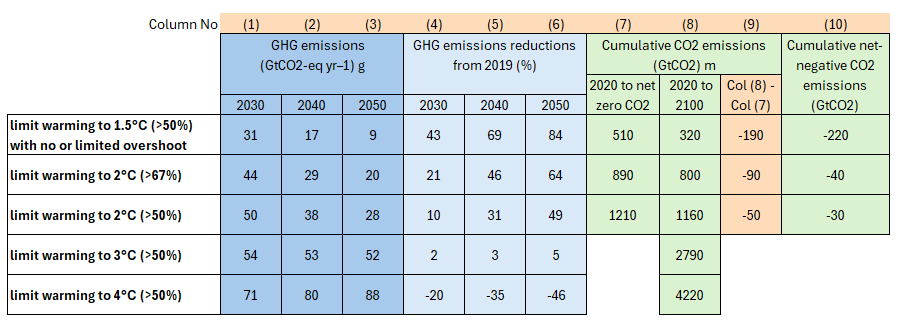
Even though I have simplified the table (full table here), there are still a lot of figures to digest. Look at the top row – limit warming to 1.5 °C (>50%) – columns (7) – (9). To reach net zero requires 510 GtCO2, with -190 GtCO2 before 2100 to get a >50% chance of global average temperature rise not exceeding 1.5 °C above 1850 levels in 2100.* The similar figures for 2.0 °C are 1210 and -50 GtCO2. Taking the difference of the col (8) figures (1160-320) gives 840 GtCO2 for 0.5 °C of “warming”. By inference, 0.25 GtCO2 will give about 0.00015 °C of warming.
Thus, even if the Rosebank oil field were 1000 times larger – containing over 8 years of global oil production instead of 3 days – it would still have no significant impact on global average temperatures in the context of the AR6 climate pathways. Hence, the climate impact of the Rosebank oil field is nil. The same can be said of any project in the UK, or indeed, the whole of UK climate policies slavishly tracking the 1.5 °C pathway, including net negative emissions after 2050.
But could it be argued that, although the quantity of emissions that would emanate from Rosebank oil is insignificant, it is still part of a successful global emissions reduction policy? This is not the case. The UNEP Emissions Gap Report 2024 highlights that 2023 was a new record for GHG emissions at 57.1 GtCo2e. 2030 is likely to see emissions slightly higher than in 2019, consistent with just over 3 °C of warming in 2100 in IPCC AR6 projections. Why some countries, like the UK, follow emissions reduction policies in line with the 1.5 °C pathway when the world as a whole does not is a question that will be answered in an article in preparation.
Kevin VS Marshall
*NB. The net 320 GtCO2 for 2020-2100 1.5 °C emissions pathway is less than the 480 GtCO2 confidence interval in the historical CO2 emissions estimate.
 ManicBeancounter