Reduce Gun Control to strengthen the Rule of Law?

I have commented on John Redwood’s Blog about the response to the murderous rampage by Derrick Bird through Cumbria. My claim that we may reduce gun control as a result needs to be substantiated. This posting does so in three parts.

  1. The posting, where I made the claim.
  2. A thought experiment on diverting police resources from gun control to tackling burglaries.
  3. The Rule of Law implications.


1. Posted to John Redwood’s blog

The Prime Minister’s response is the correct one. Government should act where there is an expected net benefit to society.

There are two sides to the argument.

Prevention – To argue how not only how any future occurrence could be prevented by the new measures.

Resource Diversion – To demonstrate that the implementation of any measures would be a worthwhile diversion of resources. That is both the police time in enforcement and the public’s time in complying with the regulations.

The rampage of a madman through Cumbria should mean a complete rethink on gun control. Paradoxically, it could mean less onerous regulations. The new laws introduced after Hungerford and Dunblane have not prevented a reoccurrence, but do involve a lot of police time and inconvenience to a section of the law-abiding public. There has been a net loss to society. The key to effective gun control is to concentrate on the substance and not on the political appearances.

2. A Thought Experiment

The tragic murders by a gunman on a rampage are, mercifully, very rare indeed in this country. Our laws should try to prevent an occurrence, but not at the expense of other things. For instance, the police claim there is a lot of time spent on enforcing exiting regulations. Suppose the effect of this has been to deaths from these rampages from 2 a year to 1. Now suppose that enforcement takes the equivalence of 200 police officers full time. This time instead is devoted to chasing up investigations into burglaries, with the result of one less burglary a week per officer. This could mean apprehending only one persistent burglar a year, or simply a team of officers reducing the number of burglaries per week of a professional burglar. Burglaries cause misery and upset. Suppose for every thousand burglaries there are ten serious confrontations and one very serious case of grievous bodily harm.

Also, for every hundred burglaries suppose one elderly person has their life reduced by a year due to the shock, fear and insecurity. Let us also state that the career of a police officer is 40 years.

So excessive gun control means, in this though experiment, one life saved for every five police officers spending their entire working careers on enforcement. This may be an exaggeration, as there is no evidence that the draconian laws have reduced the frequency of these mass killings, and the amount of police time spent on enforcement may be greater.

Alternatively those two hundred officer years will mean 10,000 fewer burglaries, 100 less cases of GBH and 100 years of extra years of lives prolonged. If average life expectancy is 80 years, that is one life saved for every four police officers spending their entire working careers on enforcement. There is no measure for misery caused by burglaries, though the cost of burglaries is in extra police resource, and higher insurance costs.

So on one hand you have law enforcement that means the a police officer spending their entire working career causing inconvenience to a large number of law-abiding citizens with have a one-in-five chance of saving one life. Or, alternatively, preventing one burglary a week. That, in turn, reduces the number of more serious crimes, and reduces the instances where crime makes people less secure in their own home, even shortening their life expectancy. They may, effectively, save more lives. But this is the tip of the pyramid. It is the other crimes that they will prevent as well, making people feel safer.  

3. The Rule of Law Implications

The police solving of minor crime provides a very positive image to the victims of crime, along with those in the wider community. People see the police as an agency that serves their interest, making them feel safer. Failure to clear up minor crime means contact with the police is simply to get a crime number for the insurance claim and a contact to the victims support unit. Major contact with police officers is for those who have transgressed (mostly traffic offences), or are suspected of doing so (stop and search late at night in inner cities). Therefore, by clearing up crime, the law-abiding see the police as their agents, not as people to be avoided.

Gun control is enforced by tight regulation of those who possess firearms. It means the police carrying out routine and regular checks on the personal circumstances of those involved and the places where those firearms are stored. Contact with the police is that of a potential suspect. It can thus serve to undermine the Rule of Law.
NICE Supports Big Business Profits at Expense of Consumers

The impact health watchdog NICE, consisting of non-economists, should be aware of a couple of points of economics when they propose a minimum price for alcohol. (Times and BBC)

First, alcohol is inelastic with respect to price. This is why, like tobacco and petrol, there can be such huge taxes with very little impact on consumption. In particular, those dependent on alcohol, like those dependent on class A drugs will absorb the price hike by reducing expenditure on other things (food and clothes for the children), rather than reduce consumption.

Second, the minimum price would raise the price of all alcohol, with the impact of squeezing shifting demand away from the cheapest varieties. Those who buy premium beers and £5 a bottle wine will see the price of their tipple rise, though maybe not quite as much a the white cider and the cheapest plonk. It is only the drinkers of 25 year old malt, first estate Chateaux Laffite and the older vintages of champagne and port who may not notice the difference.

Third, is to combine these two factors and see who gains. Consumption overall will drop very slightly, but the profit margins on 95% of the market will increase substantially, with the worst of the cut-throat competition eliminated. Add to that proposed restrictions of advertising, that will eliminate potential competition and the biggest gainers will be the retailers and the drinks companies. The losers will be the 99% of consumers who do not reduce total spend on alcohol.

Excessive alcohol consumption is a cultural, not an economic problem. From 1900 to 1930 consumption fell by 70% due to two factors – the temperance movement and the elimination of young men, the heaviest drinkers, in the Great War. It is only by a cultural change that consumption will fall. See my earlier posting here. A small change in price will not save thousands of lives per year. Any economic model that predicts this is flawed.

Higher Tax Rates – a Poison Pill for Government Finances?

John Redwood and the Adam Smith Institute may have inadvertently exposed a poison pill left by the outgoing Labour Government.

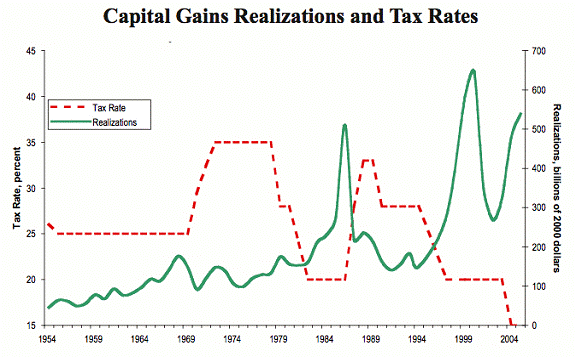
I completely agree with the contention that in the medium to long term higher tax rates reduce revenue. The ASI obtain this conclusion from the analysis of Capital Gains Tax Rates and revenues over the past fifty years. However, looking at the ASI’s graph on page 3, suggests something important for short-term tax policy as well.

For instance, in 1986, the year before tax rates rose from 20% to 28%, revenue rose 96%. In 2002, the year before tax rates dropped from 20% to 15%, tax revenue dropped 26%.

The expectation of a change in tax rates is highly significant on short–term revenue as people optimise the year in which they declare the capital gains

The UK had just the same effect with income tax in March. The deficit for the last financial year was £11bn lower than forecast in the last budget, (due to higher tax receipts from top earners than expected), and over £20bn lower than forecast last autumn.

In the budget I would therefore expect an adjustment for lower than expected tax revenues from higher rate tax payers in next month’s budget of at least £10bn.

Climate Change – New Scientist puts smears before science

The latest issue of the New Scientist features a series of articles on climate change deniers (see below). The second – “Living in denial: When a sceptic isn’t a scepticcompares “climate” deniers with deniers of the holocaust, 9/11, Aids, vaccine, evolution and the harmful effects of tobacco. It is this last that I have just posted a fuller analysis.

Alternatively consider these two arguments.

1. The proposition that smoking is harmful to health was initially based on a study of 34,000 British Doctors. The study itself was “heralded a new type of scientific research”. The results have been replicated, refined and further issues identified. To deny that smoking is harmful  to health is equivalent to denying a simple fact. By implication you are going against science, so must either have an ulterior motive or be a crank.

2. The proposition that the climate system will be changed catastrophically is agreed upon by a very large number of scientists, as a result of a huge numbers published papers, using similar empirical methods to that used in medical research. So those who oppose the AGW consensus, must be equivalent to those who oppose the medical consensus on smoking.

This is bad science seeking to piggy-back on the reputation of good science. If the results of climate change science were so clearly unambiguous, then the counter-arguments would be easily dismissed by clear presentation of that science. But there are deep flaws in the science, so smears are necessary.  


 Hatip wattsupwiththat From their article is the following:-

 
Here’s links to all the New Scientist articles on “denial”. They did include one article from Michael Fitzpatrick that is a 
feeble attempt at balance,but even it too strays into the ugly territory of comparing climate skeptics with AIDS deniers.

Big Tobacco and Climate Change Deniers

NB – an article I wrote last year – slightly updated and posted here for the first time.

See also following post; “Climate Change – New Scientist puts smears before science

A comment thrown at the “skeptics” or “deniers” is that they use a similar tactics to Big Tobacco in the fight against the harm that tobacco does to health (1). That is they issue false data and research to throw policy makers off the scent. Further, it is claimed they use similar arguments as Big Tobacco in opposing the climate change science.

This is a misleading analogy in four areas.

  1. On the tobacco issue, the first major study on the link between lung cancer, heart attacks and smoking was ground-breaking research based on questionnaires returned from over 34000 British doctors. This study was continued for 50 years, reinforcing the original findings. Further, independent studies not only corroborated these initial findings, but enhanced the detail. Much of the initial temperature data for AGW studies were more ambiguous, reliant on a loose correspondence between the rise in greenhouse gases and average global temperatures. Moreover, data is often not properly archived, whether early studies (eg. Jones et al 1990), or later ones (e.g. Kaufman et al 2009)
  2. On tobacco issues, it is possible to have a control group. That is, you can follow the health of a large representative group of people who smoke, and follow a similar cross-section of society group who do not smoke. The control for anthropogenic warming is temperature histories. That is, if recent warming is unprecedented in a thousand years or more, it can only be explained by anthropogenic factors. If however, the 20th century warming was no bigger than similar warmings at 1,000 and 2,000 years ago, then the anthropogenic element is likely to be small. Not only has the two most influential past temperatures reconstructions showing the former case have been rebutted (MBH 1998 – see especially Mcintyre 2008b and Briffa 2000), but also the total temperature reconstructions that show the medieval period was at least as warm as currently outnumber 7 to 1 that show the it was cooler.
  3. The selection criteria on medical research is published, along with sample sizes and the statistical tests on the results. Therefore, statisticians can check the results. The statistician and climate skeptic Steve McIntyre has his work cut out to get similar information from the climate scientists. See for instance the battle for the Briffa’s Yamal data or the Jones data that underpins the temperature reconstructions of the IPCC.
  4. In general, the vast majority of medical research published in peer-reviewed journals is later refuted, or at least undermined. It is often of poor quality. Therefore in medicine, a peer reviewed research is but the first stage in getting an idea established. It needs to be replicated by other studies and cross-checked. Climate science is summarized by the UN IPCC is a form that reinforces a partisan viewpoint, rather than drawing conclusions through comparing and contrasting. For instance Steve McIntyre has posted his reviewer’s objections to the analysis of past temperatures in the 2007 assessment report, and the rejections. In the light of his subsequent exposure if the Yamal paper, these turn out to be entirely valid.


For the analogy to be upheld, climatologists need to show that their research programme is comparable in robustness and replication as the medical research was in the 1970s. My contention is that it falls far short. By implication, those who are either skeptical of the robustness of the results, or who deny completely the validity of the research programme, have much surer foundations for their doubts, even before presenting any research to the contrary.

1.See, for instance, Thomas Fuller (who, seeks communication between the opposing sides) at examiner.com

The fact that for many of the staunchest activists any bending is tantamount to surrender makes compromise difficult. They take their lessons from what happened with Big Tobacco, where the strategy of introducing doubt into the science allowed them to postpone accountability for their actions. They must take a blood oath or something to never admit error and never back down. I don’t admire them for that–they should trust the power of the truth.

Medical papers from sloppy analysis http://online.wsj.com/article/SB118972683557627104.html

(Hattip Anthony Watts blog http://www.norcalblogs.com/watts/2007/09/maybe_they_need_a_statistical.html#comments)

The argument of big tobacco and anti-AGW is backed by a BBC Newsnight on Phillip Morris funding one of the 1st anti-AGW groups. http://thinkprogress.org/2006/09/21/bbc-global-warming/

Manchester Withington Polling Fiasco

Whilst the Chair of the electoral commission should carry the can for the travesty that occurred, there are also lessons to be learned. As a voter in Mancheter Withington, I believe the following should be looked into.

  1. Mcr Withington has always had the highest turnout of the 5 Manchester constituencies. Was this allowed for?
  2. Students tend to vote late – on the way to the pub. The problems were mostly in areas with high student numbers e.g. Fallowfield and Ladybarn.
  3. Was lack of voting booths (2 per station) an issue?
  4. Were there procedural changes? The clerks seemed to take longer than usual (there was local elections as well). Was this due to having the electoral lists in postal address order, rather than alphabetical order of name or street address?
  5. Queues were already forming at 11am. Why did none of the clerks summon help? Or if they did, why was none available?
  6. Also, why did it take much longer in Manchester Town Hall to count the vote? The result was at least 3 hours later than usual. I think this happened in lots of other areas as results seemed to come through more slowly.


If government agencies cannot get a simple procedure like voting correct, then what hope have we for reducing the impact of cost-cutting in more complex areas? By improving and simplifying procedures, productivity can increase, so standards of service will not be reduced as much. Understanding a simple failure can give insights into other areas.

UKIP did not lose the Tories the Election

The notion that UKIP lost the election for the Conservatives is erroneous.

This claim originated by Richard North on EU Referendum, and repeated by Conservative Home (with figures), John Redwood and Cranmer.

UKIP cater for a niche of voters who would otherwise (mostly) vote Conservative. However, a mainstream party cannot cater for all tastes. If the Tories became more euro-sceptic to squeeze the UKIP vote, they would most probably have lost more votes to the Lib-Dems and Labour. Any main-stream political party must be a broad church. The problem with our current political opinion is that we had two left-of-centre parties that got over 50% of the vote, a mainstream right-of-centre party that got 36% of the vote and UKIP that got 3%.

The conclusion for the Conservatives is not to try to appeal to a very broad church by merging many different opinions. Rather, they must capture a vision that people can empathise with, as did New Labour and Thatcherism. The time to introduce this was not with the launch of the manifesto, but two or three years before an election. Further that vision should also be an implicit attack on the alternatives.

A positive vision to vote for; and the opposing failures to vote against.

Please Pray for Gordon Brown

After the events of last week (see here, here and here), I feel quite sorry for there appears to be a divergence between the public and private face of Gordon Brown. Christians attempt to reconcile these differences in their own lives through prayer, studying the bible, public worship and seeking God’s unconditional forgiveness for when they have made mistakes, or erred in the smallest way. The Labour doctrine of spin, I would suggest, tries to fudge, evade and deliberately obscure anything that contradicts their message. When there are is strong underlying growth and charismatic leaders to promote populist policies, then this spin doctrine can carry people along. But when the main thrust of future policy is recognized to be inflicting hardship then it becomes quite difficult to constantly put out positive messages. Instead Labour have chosen to maintain the upper ground by a constant barrage of negative, exaggerated or misleading statements about their major rivals.

            Whilst many would recognise the impact the slogan of “Labour Investment verses Tory Cuts” has had on delaying recognition of the crisis in the public finances many months, what is not recognised is the impact on those in the party. If they put a slant on policy that is fundamentally at odds with what they believe – genuine public service – it will eventually be personally damaging. Maybe some, like Ed Balls and Peter Mandleson, who are more thick-skinned and less ideologically-motivated, the conflict between the good of the party and the greater good of the nation does not seriously trouble them. But Gordon Brown is committed to serving the country and has always believed he is the most able to lead it. Until the downturn this justified his ruthlessness in the pursuit of the top job. He is also astute enough to realise that not only did he get bank regulation wrong, but that his justification of structural deficits (see here) has left the government finances in their most wretched state for over 30 years. In so doing he knows that public services will have to be cut and then constrained for a generation.

            So when you hear of Gordon Brown’s throwing Nokias, or calling a straight-talking pensioner a bigot under his breath, please pray for him. Pray that he may know Christ’s love and forgiveness, and turn away from the lust for power and the love of spin. Most of all pray that he may have time for rest and reflection.

Cutting the Deficit – The PR aspect for the Tories.

There is growing recognition that the job of cutting the deficit will destroy the electoral prospects of those carrying out the task for a generation. Capitalists at work, have (very much tongue in cheek) suggested that a war might be needed to save the next government, much as the Falklands boosted the Tories and helped win the 1983 General Election. A war would certainly help, but such a dreadful circumstance should not be wished upon the nation. The Falklands War was a minor skirmish with a decisive victory that helped topple a dictatorship.

Another way is to encourage the general public to despise Labour – something that Cameron has avoided. There is plenty to go out, for instance:-

  1. The structural deficit (the bit that needs to be closed) is Brown’s fault. I estimate by 2015, around £750bn (over 50%) of the national debt will be as a consequence of the deficits built up in the boom years.
  2. Uncovering the partisan attitudes of the civil service and the political appointees. Encouraging whistleblowers and conducting audits may help.
  3. Launching enquiries and audits into major projects – for instance the widening of the M25, the NHS computer system, GPs pay rises, estimating the cost of Brown’s raid on pensions, why the banks got out of line etc.
  4. Tories emphasising unconditional forgiveness to those who have been taken in by the Labour Spin doctrines that got us in this mess.
  5. Emphasize that Labour have betrayed their core voters.
  6. Launching the initiatives to minimize the pain and maximize the gain from the necessary cuts.
  7. Changing the emphasis from promoting the interests of party/ideology to the government serving the people.


The Tories should do this not only to drive home the contribution that Labour has had in our current crisis, but also to give a positive vision for the future. One where governments will learn from past mistakes and learn the limits of what they can accomplish.

Conservative bloody battle imagery is self-defeating

Centre-Right’s “Labour is down, and its throat is exposed. Finish it.” imagery is quite wrong – it will just drive people away from politics altogether, Much like Foot’s “Thatcher-Tebbitism speech”.

In the final days it is worth emphasising the negatives of the Labour Party and after the election bringing people into a positive image of the challenges ahead.

THE NEGATIVES.

1. The Raiding of Pensions.

2. Creating a Structural deficit in the Boom years – This is the bit of the deficit that now needs to be cut. Labour has betrayed its core voters.

3. The selling of Gold reserves shows poor judgement.

4. The fact that Labour has only tiny positive things to say, and a huge amount of venom.

5. The poisoning of the civil service, by partisan decision-making and political appointees.

THE POSITIVES

1. Cuts in services must be prioritised.

2. Old-fashioned value-for-money needs to be the core.

3. Government should Serve the people, not the interests of party.

4. Diversity in provision should be encouraged to make the best use of everyone’s talents. (As opposed to constant initiatives from a few inexperienced spin-doctors).

The Conservatives final dash for power should lay the foundation for removing the divisiveness and nastiness of the Brown Premiership, along with sorting the parlous state of the finances created under the Brown Chancellorship. This will only happen if the supporters of this era are encouraged and able to join in a better way.