Copygate – the Underlying Significance

Steve McIntyre puts the Copygate scandal (paper here) of the 2006 Wegman Report into context.

A minor, but potentially significant, point in all of this is the timing issue. The Wegman Report was published in 2006. Given the Hockey Stick Team are keen to pick up on any points that may undermine any criticism of their scientific work, why has it taken four years to pick up on this accusation of plagiarism. I can see two possibilities.

  1. The climate consensus only reads what it wishes to read. Why would Bradley himself, who was cited in this very important report for paleo-climatology, did not have a quick read through it? Or at least a bright student who used his textbook and read around the subject a little.
  2. The hockey stick team is reeling at present. Montford’s Hockey Stick Illusion lays out clearly the debate, so “evidence” that may damage the reputation of the “opposition” is welcome.

Something that is perhaps related is why it took so long for anyone to ask for the data that underpinned MBH98. On the back of it Mann (and to a lesser extent, Bradley) received world-wide fame. Yet there was no upstart PhD student to take it apart, even when it overturned the established perception of there have been a medieval warm period.

This relates to a point I have made before on this blog. There seems to be a lack of critical and balanced analysis within climate science, coupled with the inability to compare and contrast the arguments.

Greg Craven’s Grid Extended

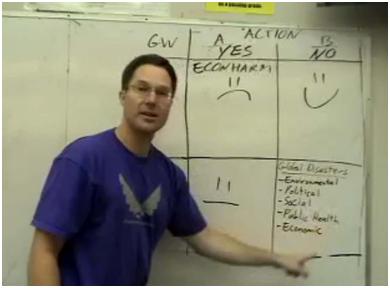
Greg Craven published a series of Youtube videos claiming to give a stark a simple choice for any non-scientist to rise above the “shouting match” a beliefs to reach a decision, with confidence as what to do about climate change. By understanding the flaws in his argument it is possible to develop a more sophisticated grid that enables us to make a more rounded assessment of the climate change problem.

Craven’s Grid

Greg Craven is a high school science teacher in Oregon, who has produced a series of Youtube videos (and later in a book), asking:-

“Which is the more acceptable risk?

  • Do nothing and accept the potential catastrophe of global warming?
  • Take action now, potentially harming the economy, but averting potential catastrophe?”

He puts this into a simple grid, with whether to take action along the horizontal axis and whether the global warming hypothesis is true or not on the vertical axis. Recognising that there are costs to combating climate change he allows for the worst case scenario. The cost will be global depression. However, this is as nothing compared with the worst case scenario the scientists are telling us will happen if we do nothing. The choice is stark. We do not know whether the global warming hypothesis is true or false – that is a shouting match that we will get no sense out of – but we should not take a chance, for our own sakes, the sake of the world’s poor and the sake of our children.

Craven’s Grid

Action?

Global Warming?

Lots Now

Little or None Now

FALSE

Global Depression

All Smiles

TRUE

Global Depression – BUT no catastrophe

Mega-Catastrophe

Someone then pointed out a gaping hole in Craven’s argument. This grid could be applied to anything that could potentially happen, no matter how unlikely. He uses the example of an invasion of giant mutant space hamsters. The outcome of everyone on the planet being eaten by such creatures is far worse than the costs of building the necessary defence shield to repel them. We must therefore look at the credibility of those who hold the hypothesis against those who do not. If the backers of the hypothesis are the vast majority of leading scientific organisations, and the opponents are few and far between, then we can give much greater weight to the global warming hypothesis. So the grid becomes like this:-

Craven’s Weighted Grid

Action

Global Warming

Lots Now

Little or None Now

FALSE

Global Depression

All Smiles

TRUE

Global Depression – BUT no catastrophe

Mega-Catastrophe

Craven’s Grid with numbers

Craven’s argument becomes much clearer if we put in some numbers. Let us say that the cost of action is 20, but the impact of the catastrophic warming is 400, or 20 times worse. The basic grid becomes:-

The basic grid, with numbers

Action

Global Warming?

Lots Now

Little or None Now

FALSE

-20

0

TRUE

-20

-400

AVERAGE RETURN

-20

-200

The figures are all negative, as the planet is worse off if catastrophic warming occurs, and the people on this planet are worse off if action is taken. The figure of twenty times worse is the upper limit of cost-benefits from the Stern Review (Tol & Yohe 2006). I chose 20 as a base to save on too many decimals when the grid becomes more sophisticated. (Twenty times of benefits over costs is the upper limit of the Stern Review?) Note that there is now an average return, with equal weighting given to whether the hypothesis is true or false. We end up with an expected cost of not taking action of 10 times greater than if we did. We can now incorporate Craven’s argument is that we should give much greater weighting to the consensus scientists than to the sceptics. Let us say the chances of the hypothesis being true are 4 times that of it being false. The weighted grid becomes:-

The weighted grid, with numbers

Action

Global Warming?

%

Lots Now

Little or None Now

FALSE

20%

-20

0

TRUE

80%

-20

-400

RETURN


-20

-320

So the expected outcome of not taking action is 16 times worse than of not taking action.

Major issues with Craven’s Grid

There are a number of issues with this basic decision-making grid. Most fundamentally, it relies on opinions of opinions. That is of the expert climate scientists convincing the scientists from other fields that they have a convincing case, then getting this much larger group to pass a resolution. If the vast majority of the membership can be shown to have studied this and agreed that the climate science is as strong as in their disparate fields and used for a basis of voting, then this might be a reliable, secondary, source. However, if there is evidence that the resolution is promulgated by a small number of the membership (and the majority not interested enough to oppose); or that there has been outside pressure to pass a resolution; or that there have been efforts to silence critics through abuse; or that pressure groups try to undermine the research grants on which critical scientists depend – then the resolutions should be at a minimum be viewed as worthless. This is along similar as the verdict of a jury in a court of law is viewed as worthless if there is any evidence jury tampering. Most courts would not just nullify the evidence, they may throw out the case, then prosecute those who would try to pervert the course of justice. If there is considerable evidence of this undue influence, then the balance of opinion should swing the other way. If the argument relies on secondary or tertiary opinions, then one should look very carefully at the actual scientific and policy arguments. As Craven does not offer up this argument (just mentions a paper by Richard Lindzen, to then neglect this issue entirely), I shall leave this as argument as just invalid and ignore it entirely. The alternative – to take as circumstantial evidence that the underlying case is weak – would cloud the analysis. Instead I shall concentrate on the science and policy issues. These can be divided into four areas:-

  1. The climate models do not just predict huge rises in temperatures. Rather, they offer up a range of scenarios. The UNIPCC’s scenarios show a greater than 90% chance of temperatures rising between 1.1oC and 6.4oC this century (UNIPCC 2007.1 p8). Both extremes are fairly unlikely. However, if these scenarios were taken to their peak then the distribution of final temperatures would be skewed towards the top end. That is the cut-off of 2099 is likely to be a matter of timing
  2. The consequence of such temperature rise, the models predict, will not simply be higher temperatures, but severe disruption to weather systems. Extreme weather events, like hurricanes, floods and droughts will become far more frequent. Although impossible to predict the extent of climate disruption with each rise degree in temperature, the impacts are more likely to be more towards the exponential than the linear.
  3. Craven appears to assume that the policy proposed will be entirely successful in combating warming. The UNIPCC recognise that this is not realistic. They propose of target of limiting CO2 to 550ppm (twice the pre-industrial levels) warming to 2.0oC. If this policy successfully contains the warming to 2.0oC, then there would still be some adverse consequences to that warming. Further, this proposal must be signed up to by all the nations of the world and then translated into actual policies.
  4. There are also two broad approaches to policy that need to be considered. The most frequently advocated is mitigation – stopping global warming by stopping the rise in anthropogenic greenhouse emissions, or even reducing them. The other is adaptation – adapting to the climatic changes that occur, such as improving coastal defences; changing crop production; improving irrigation systems; and changing house design.
  5. The policy targets then need to be implemented, recognising that often large, and ill-defined government projects poorly managed, tend to over-run on costs and under-perform on benefits. Further, governments may sometimes get freeloaders, who generate costs but do not contribute anything towards the desired outcome.

This gives four areas that can be analysed separately, under the acronym FCPO.

Forecast – How much temperatures are predicted to rise and in what time period.

Consequences – The forecast change in the weather patterns (droughts, floods, hurricanes, etc.), along with the impacts on crop yields, forestation, sea levels etc.

Policy – The adopted remedy recommended to combat the consequences, along with actual legislation enacted and structures created.

Outturn (of the policy) – The actual policies enacted, along the results of those actions – both intended and unintended.

There is a clear dividing line between the climate science (Forecast and Consequences) and the social sciences (Policy and Outturn). The sub-divisions between the Forecast and Consequences and between Policy and Outturn maybe less distinct, but, as later analysis will demonstrate, are useful for purposes of clarity.

Extending the Grid for FCPO

The grid can now be extended include the four elements discussed in a series of stages. We start with Craven’s scenario were a mitigation policy is 100% successful in combating the adverse effects of global warming.

  1. The costs of action

Extending Craven’s Grid by:-

  • Keeping the costs of mitigation to 20.
  • Extending the True / False Scenario to five categories of warming. (None, lower, median, higher & extreme).
  • Including an extra option of “Adapt”. This is split into two parts. First are low cost contingency plans, given a value of 5. Then there are the reactive costs. These costs rise steeply with more extreme climate change.

This gives a revised grid below.

Costs of Action

Category

Extent

Mitigate

Adapt

None

A

None

-20

-5

0

B

Lower

-20

-10

0

C

Median

-20

-15

0

D

Higher

-20

-25

0

E

Extreme

-20

-45

0

RETURN

-20

-20

0

  1. The Climate Change Impact

This shows the impact of taking action. Points to note

  • The extreme case of not taking action is still twenty times the impact of not taking action.
  • Adapting to climate change is only half as effective as mitigation.
  • The likely catastrophic impacts are likely to be non-linear. I have assumed that it will double with each category rise.

    Climate Change Impact

    Category

    Extent

    Mitigate

    Adapt

    None

    A

    None

    0

    0

    0

    B

    Lower

    0

    -25

    -50

    C

    Median

    0

    -50

    -100

    D

    Higher

    0

    -100

    -200

    E

    Extreme

    0

    -200

    -400

    RETURN

    0

    -75

    -150

  1. Net Costs of Action

    Adding 1. and 2. together.

    Net Costs of taking Action

    Category

    Extent

    Mitigate

    Adapt

    None

    A

    None

    -20

    -5

    0

    B

    Lower

    -20

    -35

    -50

    C

    Median

    -20

    -65

    -100

    D

    Higher

    -20

    -125

    -200

    E

    Extreme

    -20

    -245

    -400

    RETURN

    -20

    -95

    -150


  2. Weighted Returns – UNIPCC Scenarios as a basis

    The UNIPCC gives a 90% chance of temperatures rising between 1.1oC and 6.4oC this century. Using this pattern, I assume that the most extreme cases have a 5% probability and the median case as the most likely with a 50% probability. This gives a 20% probability to the lower and higher cases.

    Weighted Net Costs of Action

    Cat

    Extent

    %

    Mitigate

    Adapt

    None

    A

    None

    5%

    -20

    -5

    0

    B

    Lower

    20%

    -20

    -35

    -50

    C

    Median

    50%

    -20

    -65

    -100

    D

    Higher

    20%

    -20

    -125

    -200

    E

    Extreme

    5%

    -20

    -245

    -400

    RETURN


    -20.0

    -77.0

    -120.0


  3. Weighted Returns – Based on Peak Scenario Warming

    As noted above, the final peak temperatures from the models are likely to be more skewed towards the upper end, as some of the peaks are likely to be well after 2010.


    Weighted Net Costs of Action

    Cat

    Extent

    %

    Mitigate

    Adapt

    None

    A

    None

    5%

    -20.0

    -5.0

    0.0

    B

    Lower

    5%

    -20.0

    -35.0

    -50.0

    C

    Median

    40%

    -20.0

    -65.0

    -100.0

    D

    Higher

    40%

    -20.0

    -125.0

    -200.0

    E

    Extreme

    10%

    -20.0

    -245.0

    -400.0

    RETURN


    -20.0

    -102.5

    -162.5

  4. Weighted returns – restricting CO2 to 550ppm

    The policy to mitigate climate change does not have the unrealistic aim of stopping any future warming. Rather it seeks to stabalise CO2 at 550ppm or double pre-industrial levels. This will equate to a temperature rise of around 2 oC. This is around the lower level impacts.

    The climate change impact grid becomes

    Climate Change Impact

    Category

    Extent

    Mitigate

    Adapt

    None

    A

    None

    0

    0

    0

    B

    Lower

    -20

    -25

    -50

    C

    Median

    -20

    -50

    -100

    D

    Higher

    -20

    -100

    -200

    E

    Extreme

    -20

    -200

    -400

    RETURN

    -16

    -75

    -150

    Note that the lower levels have some benefit from the climate change. But mitigation prevents the most catastrophic scenarios.

    The final grid becomes

    Weighted Net Costs of Action

    Cat

    Extent

    %

    Mitigate

    Adapt

    None

    A

    None

    5%

    -20.0

    -5.0

    0.0

    B

    Lower

    5%

    -40.0

    -35.0

    -50.0

    C

    Median

    40%

    -40.0

    -65.0

    -100.0

    D

    Higher

    40%

    -40.0

    -125.0

    -200.0

    E

    Extreme

    10%

    -40.0

    -245.0

    -400.0

    RETURN


    -39.0

    -102.5

    -162.5


The FCPO Grid

The grid derived simply, but effectively summarises the “Consensus” case.

  1. There is a high degree of likelihood that we will have some serious global warming with huge consequences for the planet and the human race.
  2. The best policy is to limit CO2 to double pre-industrial levels. Re-active adaptation strategies are risky and ineffective compared with mitigation.
  3. The expected average costs of doing nothing are far greater than any costs of mitigation.
  4. More importantly than any expected average impact, there is a very real possibility of a massive catastrophe.

What is more it is a way of effectively gauging some of the arguments, underpinned with some risk analysis. By trying to turn the uncertainties into our best-guess risks we can get a more balanced and rigorous assessment of the science than Greg Craven’s. Further, we can also bring into the same analysis the potential effectiveness of any policy, and the project management aspect of delivering the planned results.

However, the ability of this grid to evaluate the science is limited. It can only be used for most top-down or broad-brush aspects. It is a way to get the relative importance of various aspects of science and policy within the totality of the subject, when they are vastly different in degree. If used for splitting hairs, then this will just be another tool to advance the “shouting match”. To focus and clarify the evaluation, a new question is required. “What is the worst that can happen?” is too loaded towards thinking of extreme, but highly improbable, events.

The New Question

To focus and clarify the evaluation, a new question is required. “What is the worst that can happen?” is too loaded towards thinking of extreme, but highly improbable, events. The FCPO Grid looks at both the future scenarios projected by the science and at our collective ability to provide a remedy. There the new question becomes

By taking action, is there, on the balance of the evidence, an expectation that the future state will be improved?

The climate change consensus would contend that this is clear-cut – something that my FCPO grid replicates.


References

Craven, Greg 2007 Jun – Youtube video “The Most Terrifying Video You’ll Ever See

Craven, Greg 2007 Oct – Youtube video “How it all ends

Craven, Greg 2009 – What’s the Worst That Could Happen?

Craven, Greg Website – http://www.gregcraven.org/

Tol & Yohe 2006 – A Review of the Stern Review – WORLD ECONOMICS • Vol. 7 • No. 4 • October–December 2006

UNIPCC 2007.1 – Climate Change 2007: Synthesis Report – Summary for Policymakers (Dec 08 format)

Kent Wind Farm – A dead loss to society

The Kent wind farm subsidy is mostly a waste of money, even measured by UNIPCC’s case for taking drastic action on CO2.

First, two statements and a bit of data.

“… the Kent windfarm. £780m invested to chase £50 ROCs. Offshore is double bubble, so £100/MWh generated.” (Sep 25, 2010 at 1:41 AM | Atomic Hairdryer at BishopHill )

“An effective carbon-price signal could realise significant mitigation potential in all sectors. Modelling studies show global carbon prices rising to 20-80 US$/tCO2-eq by 2030 are consistent with stabilisation at around 550 ppm CO2-eq by 2100. For the same stabilisation level, induced technological change may lower these price ranges to 5-65 US$/tCO2-eq in 2030.” (P.18 UNIPCC Summary for Policymakers)

An alternative for a wind farm is a small power station consisting of diesel engines. The most modern diesel engines can produce less than 500kg of CO2 per MWh. (See note)

So the subsidy should be no more than the trading credit CO2 of 12.5-50 £/tCO2.

Based on these figures, it is possible to state that of the £100/MWh subsidy, at a very minimum £75 is a dead loss to society. At most it could at much as £95. This is before you undertake a present value calculation on the trading credits value in 2030, or start questioning the underlying economic assumptions. Further this is whilst accepting UNIPCC consensus position in its entirety.

For an alternative take, see Christopher Booker in the Telegraph

Note on CO2 output for a diesel power plant

A large container ship engine has around 470kg to 560kg of CO2 output per MW (emission comparison table on page 13), with around 58% engine efficiencies. (See a MAN Diesel & Turbo paper “How to influence CO2” – 5MB pdf). Power-plants can higher up to 90% more efficiencies by heat recovery processes, potentially cutting the CO2 out per MW to 350kg. However, this would need to be verified by actual measurements.

Note on carbon credits v Subsidies

A carbon credit aims at adding to the cost of producing CO2 directly, with the objective of encouraging the most cost-effective means of saving CO2. That is if cost saving is less than the cost of the credit, you purchase the credit. If it is greater, then you make the investment. For power plants it might be very effective for bringing forward investments in newer power plants. It would not be so effective in choosing between new power plants with massive differences in cost per unit of output.

Royal Society lacks rigor in 20% cuts hypothesis

The New Scientist reports that the Royal Society believes that a “20 per cent cuts to British science means ‘game over’”. (Hattip BishopHill)

In the article, some of the scientists point to the need for innovation to promote the high-tech industries on which our recovery depends. I quite agree. However, I would profoundly disagree that government-funded research science is the best way to achieve this. Firstly, because government-funded research is notoriously bad at producing the job-creating outputs. In fact, the public sector tends to specialise in pure research, with only distant business opportunities. Second, is that government-funded research tends to be long-term. Most politicians would agree that currently we need the new jobs in the next few months, not a decade or more down the line.

As an aside, the idea that a 20% cut “would cause irreversible destruction” is a hypothesis that should be expounded in a more rigorous & scientific manner, with empirical evidence to back this up. I believe that it is analogous to the notion of tipping-points in climate science, so the Royal Society would do well to exchange notes with the folks at the Climate Research Unit at UEA. In trying to model their separate issues they will find that positing of such turning points relies on disregarding the real-world background “noise”. Such “noise” renders the turning points both unpredictable and highly unlikely.

My counter-argument is that, historically, Britain has been very good at the creative elements of pure science and invention. We are not so good at turning that into the reliable world-beating products that create the jobs. We are the country of Newton, Marconi, Whittle and Turing. We are not the country of Apple, Toyota, Nokia, Siemens or BMW.

Considering Uncertainty in Climate Science

Sir John Bedddington, provides the introduction to a summary of “The Science of Climate change” on  UK Business Department website. He states

            “The fact that uncertainty exists in climate science, as it does in other fields, does not negate the value of the evidence – and it is important to recognise that uncertainty may go in both (or a number of) directions.”

This may be true in a new field, but there is evidence that where the consensus is concerned, when assumptions have to be made, or choices made between different scientific conclusions, there has been a very strong bias towards the more alarmist conclusions. For instance,

  1. The emphasis on positive feedbacks;
  2. The over-statement of climate sensitivities;
  3. The promotion of the hockey stick as secondary verification of recent warming being largely due to anthropogenic factors.
  4. Further there has been a public relations failure to challenge unsound science, or wild predictions, or false confirmations.
  5. Neither have there been any consensus scientists standing up to emphasise that the model scenarios of future temperature changes are not forecasts

The consequence of recognising uncertainty means that an audit is required of the total picture. Each part of the science needs to be graded according to the certainties. Most certain is that a massive increase in greenhouse gases will, ceteris paribus, cause a rise in temperature. At the other extreme are predictions that within a generation the Arctic Ocean will be ice-free in summer, or the Himalayan glaciers will have vanished, or the Maldives will disappear beneath the waves. The rhetoric needs to be replaced by establishing the case on a scientific basis. It is not sufficient to say that there is uncertainty and move on as is nothing had happened. The presence of uncertainty severely weakens the claim that the science is established and settled. We should now see the consequences for policy.

Hattip to BishopHill

A (weak) case against the Sceptics weakens the AGW Case

Deutsche Bank tries to answer the sceptics by attempting to demonstrate the the AGW is not completely refuted.

The sceptics arguments do indeed fail to amount to a complete refutation of the AGW case. Most of the “sceptic” arguments are against the idea that there has been no anthropogenic warming at all and that there is no evidence at all for the case. This would be hard to establish, and most “sceptic” scientists would never make this case. But almost equally hard to establish is the case that there will be extreme warming in the future, with likely catestrophic and irreversible consequences. At the very least there must be a clear demonstration that the likely economic impact (valuing the flaura and fauna as well), will be greater than the economic impact on human society of reducing CO2 emissions. Being able to demonstrate that the extreme opposite is implausible (in the vaguest terms) does not establish a position without unambiguous evidence and relying on unstated assumptions. There are some analogies that might highlight my perspective.
1. In medicine to have a reasonable expectation that the “treatment” will leave the patient better off than the cure. Simply showing that a few patients survived the treatment and recovered from the illness does not mean that the treatment worked. Nor does showing that some patients suffered adverse (non-fatal, but painful) side effects from a generally successful treatment to a condition that is 100% fatal without this treatment mean, that the treatment should not be used.

2. In considering a loan to finance a new business venture, the lending bank would want to see more in the plan tham that revenues will be generated. It would want to see a reasonable expectation that even with some set-backs, it could both deliver an income to the borrowers and sufficient surplus to repay the loan.
3. In a criminal case, if all the prosecution had to do was
   (a) present a case, that could not be challanged by the defence no matter how weak.
   (b) demonstrate that the defence had not proved their case beyond reasonable doubt, whilst being able to dismiss any evidence they presented on the flimsiest of evidence, including that defence counsel are paid to be biased.

4. A child caught smoking behind the bike-sheds is told that they have shortened their life by up to a decade. This will happen on average if they smoke heavily throughout their adult lives, but will not happen, on average, if it is ten cigarettes a week for five teenage years. They may have minor health issues, such as less ability to fight off the common cold.

What they have missing here is the huge middle ground – not of some truth on either side – but the middle ground where there is a an insufficient case established and / or, an insuffiently coherant plan, and demonstrated capability to carry out the plan, to gain a signficantly positive outcome. That is to give a reasonable expectation that the solution will leave the planet and the human race the better off for having acted.

Put another way, without a clear-cut case that an imminent, catestrophic disaster can be averted with a clear-cut plan, that has little adverse consequences, then there is ground to be made in actively trying to clarifying the extent of our collective scientific knowledge and the improving on the solutions.

Hatip BishopHill

ASI on the Minimum Price for Alcohol

Uncharacteristically, the Adam Smith Institute has made a serious error in its economic analysis. The idea of alcohol being a Giffen good is certainly a contestable one. There are a couple of pertinent areas here. The first is whether alcohol in the UK meets the requirements of a Giffen good. The second is whether the pattern of discounting is such that installing a minimum price will create the Giffen good conditions.

The Conditions for a Giffen Good. (Descriptions here and here)

  1. A staple on which people spend a significant part of their income.
  2. Applies to the very poor.
  3. There are no close substitutes

The current state of play in the UK market.

1. The major supermarkets concentrate their promotions on premium brands. Most of the promotions for cider & beer are for premium brands. The wine promotions similarly are mostly for the more expensive (& often branded) varieties. Own brand (especially the budget brands) are less frequently and less deeply discounted.

2. Many promotions do not involve a gross loss for the supermarket. By allocating space for high volume promotions a small gross margin can generate a larger net profit than the full price low turn product. It is all about overhead absorption.

3. Promotions made more profitable by promotional & volume discounts from the suppliers.  As I regularly shop at more than one major supermarket I notice similar promotions across different supermarkets.

4. Many promotions are partly spurious. For instance I recently noticed a bottle of standard Cava at half price. The full price would significantly more the vintage variety. Or compare the undiscounted price per litre for large packs of beer with the smaller pack sizes. You will find the “undiscounted” price is often more expensive, indicating the discount is exaggerated.

5. Many people pay the top prices at clubs and pubs in city centres. Cheaper prices are obtained at local pubs (known as bars in the USA & on mainland Europe). Much cheaper still is the supermarket. So for English bitter beer, you pay £5 per pint (568ml) in a club in town centres, £3.50 in a local pub, £2 equivalent for a 500ml bottle, £1.40 for a 4 pack cans and £0.99 for the best offers of 3 x 8 440ml can packs. Therefore, there are many close substitutes without change of brand, though the quality and ambience may not be the same! Higher prices lead to the next best substitute, which is why many choose to drink at home, or on the street, rather than in the more sociable public houses.

6. The UK is a rich country. In spending power (purchasing power parity) is at least 35 times richer than in 1750 (or modern day Ethiopia). In nominal terms at least 200 times richer. Someone on the minimum wage with the proverbial wife and two kids, will have in excess of £1200 per month disposable income. If an alcoholic drinking the cheapest booze – 3 litres of 6% cider (at £1 per litre) a day, they would spend just 10% of their income on booze. At 70p per unit minimum (10ml of pure alcohol) they would see this rise to a third of income. This is the most extreme case. In practice, most problem drinkers consume less and do not get the cheapest alcohol from the cheapest source. There are opportunities for substituting to cheaper forms of alcohol and reducing other forms of consumption.

In its flawed analysis the ASI actually understates the case against the minimum price of alcohol. Any proposed level of pricing would simply be ineffective in reducing alcohol consumption.  It will merely serve to hasten the decline in pubs and drive people down market. Most of the discounting in supermarkets is aimed at getting consumers to move up market, where the larger profits reside. The only effective levels of seriously reducing alcohol consumption would be far above the bounds of political acceptability.

Volokh Conspiracy on VAT in USA

Volokh Conspiracy posts on the proposals to introduce VAT into the USA here.

The essence of the post is that VAT is hidden, so it makes it easy to creep up revenues. Therefore it will not serve to reduce the phenomenal deficits of the USA, but  increase government expenditure. As the cousins over the pond are inexperienced in the workings of VAT, I made two comments.

The first was that VAT (at least in the UK ) encourages the black economy, gives opportunities for fraud and is often a tax on tax.

There are a couple of big issues with VAT here in the UK, that the US should be aware of. (NB the rate is 17.5%, soon to rise to 20%)
1. Small businesses do not pay VAT. The current threshold for registration is around $90,000. Therefore sole traders have a big advantage over larger businesses for decorating, plumbing etc. Due to this cost advantage (on top of avoiding around 35% marginal tax rates for self-employed up to $60,000 per year), the black economy is large. VAT exposes people to the fly-by-night rogues.
2. The UK has a large amount of trade with other EU nations. The Intrastat scheme for dealing intra-state VAT is open to fraud. Criminal gangs have made $m’s through carousel fraud. See http://en.wikipedia.org/wiki/Missing_trader_fraud
3. VAT is charged on other taxes. In the UK the current price of gasoline is GBP 1.13 per litre or $6.60 per US Gallon. With VAT at 17.5%, $1 is VAT, and around 60c is VAT on around $3.20 of excise taxes.

There are a couple of big issues with VAT here in the UK, that the US should be aware of. (NB the rate is 17.5%, soon to rise to 20%)
1. Small businesses do not pay VAT. The current threshold for registraton is around $90,000. Therefore sole traders have a big advantage over larger businesses for decorating, plumbing etc. Due to this cost advantage (on top of avoiding around 35% marginal tax rates for self-employed up to $60,000 per year), the black economy is large. VAT exposes people to the fly-by-night rogues.
2. The UK has a large amount of trade with other EU nations. The Intrastat scheme for dealing intra-state VAT is open to fraud. Criminal gangs have made $m’s through carousel fraud. See http://en.wikipedia.org/wiki/Missing_trader_fraud
3. VAT is charged on other taxes. In the UK the current price of gasoline is GBP 1.13 per litre or $6.60 per US Gallon. With VAT at 17.5%, $1 is VAT, and around 60c is VAT on around $3.20 of excise taxes.

On a comment on how wondering how to calculate the average rate of of tax, pointed out it was irrelevent. In theory the accounting is simple. In practice it is enormously complex.

jmaie, although I do not like VAT, the accounting treatment is quite simple. For any business, they charge VAT on sales and pay VAT on purchases.
It is the detail that creates a mindfield of complexity. The effective rate is superfluous.

The following is for the tax accountants and the insomniacs:-

If VAT is 10%, for a $1000 net sale the entries are CR Sales $1000, CR VAT payable $100, DR Accounts receivable $1100.

For a $500 purchase, then DR purchases $500, DR VAT reclaim $50, CR Accounts payable $550.

The business then pays $100 — $50 = $50 in VAT.

In theory the system is simple. With basic accounting software filling in a VAT form takes 15 minutes a month. The effective rate that is paid is therefore irrelevant.

The complexity comes with the exceptions. In the UK we have zero rate; VAT exempt; (One businesses can reclaim VAT on the purchases the other they cannot); non-reclaimable (e.g. business entertainment); and special rates (especially 5% for domestic gas and electricity).
Indeed, a supposedly simple tax has help manuals about as long as for income tax. So I would expect the accountancy firms in the USA are privately backing VAT introduction.

The Myths of Green Jobs – from the Classical Economists and a Beancounter

The Adam Smith blog posts (here) on the seven myths of green jobs (by the Policy Network). They are useful as a criticism, but more fundamentally the classical economists gave a rebuttal over a century ago.

From Adam Smith, you get increased prosperity from division of labour. Localism reduces the division of labour, thus reduces the wealth of nations

From David Ricardo this is augmented with the idea of comparative advantage. Trading nations gain advantage by specialisation in areas where they have a comparative advantage. Green economics ignores this. (Mises applies this concept to the labour markets. Low productivity, green, jobs will be created at  the expense of high productivity, conventional jobs.)

From Alfred Marshall there is concept of opportunity costs. In evaluating a measure you should not only look at the benefits of a choice, but the alternatives forgone. Green jobs will be creating, but at the expense of conventional, higher productivity jobs along with higher taxes.

From Karl Marx, you should look at the distribution of the national pie. Green jobs will only be created by forcibly reducing non-green industries. This enforced tendency towards monopoly will increase the profits accruing to the bourgeoisie, at the expense of the working classes. Given that the rate of return on Capital has fallen dramatically over the past two decades, is the Green Movement just a puppet of a degenerate Capitalist Class?

But as a (slightly manic) Beancounter, the economist’s arguments pale into insignificance beside a project management issue. In a major project, if you have no dynamic concept of how to control and continually reduce costs, or a clear idea of how to achieve objectives, along with ridiculing of any questioning of the attainability of the objectives –  then you have a recipe for massive cost overruns, and benefits failing to be achieved on a massive scale.  In the UK, the NHS computer system, the Scottish Parliament and the New Deal for jobs were all massive policy failures for these reasons. But they all pale into insignificance beside the global attempt to stop global warming by reducing CO2 emissions. Not just the scale, but also the lack of clarity as well.

(Roger Pielke Jnr’s recent talk is instructive on the perspective here)

Denialists become Superfluous

OR Who Needs Enemies when you have Friends like These

Climate Psychology is a blog specialising in mirror-posting articles from one side of the climate change argument, but with more lurid titles. The direct inference being that the truth of the science is so blatantly apparent that any criticism must be by the deluded, the deranged, or be in the pay of some sinister forces. One such mirror posting is of Tamino’s “Hockey Stick Delusion” at RealClimate under the Title “Tamino debunks the junk science of Montford and McIntyre for the umpteenth time — the hockey stick is still sticking around

To anyone who looks at both sides of the argument – who properly compares and contracts each point made, will see that Tamino fails to address the points made. As I said in an earlier posting

 Look at

1. Who gives the fullest answers?

2. Which side evades the points, or attempts sleight of hand?

3. How are contrary or neutral points treated. Clue – look at how Judith Curry (who is trying to remain neutral) is treated. Further, look at how contrary opinions are treated.

4. Finally who are the real deniers in all of this?

This leaning on psychology is nothing new. It was used by the KGB to punish dissenters without trial (see also here and here). The recent publication of a statistical analysis of the Hockey Stick by McShane and Warner again shows which side of the debate the delusional mostly reside. The greatest irony is the blog has the following quote:-

“Because the truth is that promoting science isn’t just about providing resources — it’s about protecting free and open inquiry. It’s about ensuring that facts and evidence are never twisted or obscured by politics or ideology.” Barack Obama