Prejudiced economic analysis in South Manchester

Have responded to a letter in the South Manchester Reporter of 3rd June.

GM’s letter of last week is prejudiced against a small minority and ignorant of economics. The need to cut is mostly due to the government running up a deficit during the boom years, and then going on a wild spending spree to try to shore up the vote as an election approached. (The cyclical part will be (mostly) taken care of by a strong economic recovery.) So in this area, we can look forward to some shiny new trams and gleaming school buildings along with a generation of cuts to pay for it. For instance, the £120m for the Didsbury spur of the Metrolink alone is equivalent to over 30,000 teachers and nurses doing without a 3% annual pay rise for five years.

The consequence of this fiscal irresponsibility is not just financial. People will lose their jobs or have careers de-railed, others will be made ill through over-work, or through seeing their livings standards fall salaries are frozen, whilst taxes, prices and interest rates rise. Rather than opposing cuts now, people should look to areas where they are least painful. That means shelving some of the recently signed-off “investments”, such as the extra bus lanes on Wilmslow Road; less government advertising; or finding better value for money in the provision of local services. The consequence of not doing so is even bigger cuts later, and lower living standards for the next generation.

But why call somebody prejudiced and ignorant? I quote

“Once again, those who really control the wealth and power (the gambler’s in our casino economy and the obscenely wealthy) have demanded that their government makes the poorest people in society pay for the economic crisis.”


“….John (Leech MP) will no doubt remind him (The Chancellor) that the multi-millionaires are unlikely to feel any effect whatsoever from the cuts to education, benefits and the health service that will inevitably follow in 2011”

The underlying cause of the recession, I believe, are:-

–         The prolongation of the last boom through cutting interest rates after the dot-com bubble burst in 2000, and again in 2001.

–         Failure to raise interest rates in 2003. This would have been very difficult politically.

–         Failure of the regulatory authorities to realise the systemic risks building up in the financial sector, and the risks building up in individual banks.

–         Deficit spending in the boom years, which kept the boom going at the expense of creating structural deficits.

–         Political spin, and dubious accounting (PFI contracts to put liabilities outside the National Debt figure), to hide the reality.

Whether I have highlighted all the points, I am sure to be closer than someone who just blames the rich. The reason is that I, at least, attempt to understand the issues.
NICE Supports Big Business Profits at Expense of Consumers

The impact health watchdog NICE, consisting of non-economists, should be aware of a couple of points of economics when they propose a minimum price for alcohol. (Times and BBC)

First, alcohol is inelastic with respect to price. This is why, like tobacco and petrol, there can be such huge taxes with very little impact on consumption. In particular, those dependent on alcohol, like those dependent on class A drugs will absorb the price hike by reducing expenditure on other things (food and clothes for the children), rather than reduce consumption.

Second, the minimum price would raise the price of all alcohol, with the impact of squeezing shifting demand away from the cheapest varieties. Those who buy premium beers and £5 a bottle wine will see the price of their tipple rise, though maybe not quite as much a the white cider and the cheapest plonk. It is only the drinkers of 25 year old malt, first estate Chateaux Laffite and the older vintages of champagne and port who may not notice the difference.

Third, is to combine these two factors and see who gains. Consumption overall will drop very slightly, but the profit margins on 95% of the market will increase substantially, with the worst of the cut-throat competition eliminated. Add to that proposed restrictions of advertising, that will eliminate potential competition and the biggest gainers will be the retailers and the drinks companies. The losers will be the 99% of consumers who do not reduce total spend on alcohol.

Excessive alcohol consumption is a cultural, not an economic problem. From 1900 to 1930 consumption fell by 70% due to two factors – the temperance movement and the elimination of young men, the heaviest drinkers, in the Great War. It is only by a cultural change that consumption will fall. See my earlier posting here. A small change in price will not save thousands of lives per year. Any economic model that predicts this is flawed.

Higher Tax Rates – a Poison Pill for Government Finances?

John Redwood and the Adam Smith Institute may have inadvertently exposed a poison pill left by the outgoing Labour Government.

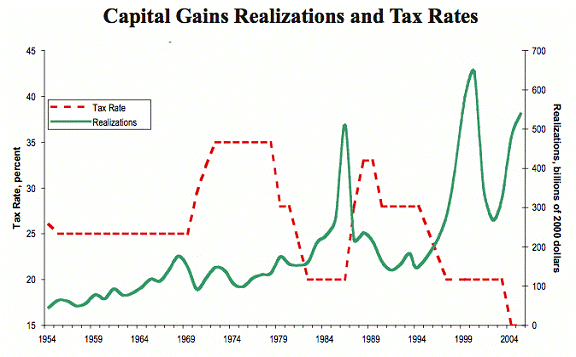
I completely agree with the contention that in the medium to long term higher tax rates reduce revenue. The ASI obtain this conclusion from the analysis of Capital Gains Tax Rates and revenues over the past fifty years. However, looking at the ASI’s graph on page 3, suggests something important for short-term tax policy as well.

For instance, in 1986, the year before tax rates rose from 20% to 28%, revenue rose 96%. In 2002, the year before tax rates dropped from 20% to 15%, tax revenue dropped 26%.

The expectation of a change in tax rates is highly significant on short–term revenue as people optimise the year in which they declare the capital gains

The UK had just the same effect with income tax in March. The deficit for the last financial year was £11bn lower than forecast in the last budget, (due to higher tax receipts from top earners than expected), and over £20bn lower than forecast last autumn.

In the budget I would therefore expect an adjustment for lower than expected tax revenues from higher rate tax payers in next month’s budget of at least £10bn.

Big Tobacco and Climate Change Deniers

NB – an article I wrote last year – slightly updated and posted here for the first time.

See also following post; “Climate Change – New Scientist puts smears before science

A comment thrown at the “skeptics” or “deniers” is that they use a similar tactics to Big Tobacco in the fight against the harm that tobacco does to health (1). That is they issue false data and research to throw policy makers off the scent. Further, it is claimed they use similar arguments as Big Tobacco in opposing the climate change science.

This is a misleading analogy in four areas.

  1. On the tobacco issue, the first major study on the link between lung cancer, heart attacks and smoking was ground-breaking research based on questionnaires returned from over 34000 British doctors. This study was continued for 50 years, reinforcing the original findings. Further, independent studies not only corroborated these initial findings, but enhanced the detail. Much of the initial temperature data for AGW studies were more ambiguous, reliant on a loose correspondence between the rise in greenhouse gases and average global temperatures. Moreover, data is often not properly archived, whether early studies (eg. Jones et al 1990), or later ones (e.g. Kaufman et al 2009)
  2. On tobacco issues, it is possible to have a control group. That is, you can follow the health of a large representative group of people who smoke, and follow a similar cross-section of society group who do not smoke. The control for anthropogenic warming is temperature histories. That is, if recent warming is unprecedented in a thousand years or more, it can only be explained by anthropogenic factors. If however, the 20th century warming was no bigger than similar warmings at 1,000 and 2,000 years ago, then the anthropogenic element is likely to be small. Not only has the two most influential past temperatures reconstructions showing the former case have been rebutted (MBH 1998 – see especially Mcintyre 2008b and Briffa 2000), but also the total temperature reconstructions that show the medieval period was at least as warm as currently outnumber 7 to 1 that show the it was cooler.
  3. The selection criteria on medical research is published, along with sample sizes and the statistical tests on the results. Therefore, statisticians can check the results. The statistician and climate skeptic Steve McIntyre has his work cut out to get similar information from the climate scientists. See for instance the battle for the Briffa’s Yamal data or the Jones data that underpins the temperature reconstructions of the IPCC.
  4. In general, the vast majority of medical research published in peer-reviewed journals is later refuted, or at least undermined. It is often of poor quality. Therefore in medicine, a peer reviewed research is but the first stage in getting an idea established. It needs to be replicated by other studies and cross-checked. Climate science is summarized by the UN IPCC is a form that reinforces a partisan viewpoint, rather than drawing conclusions through comparing and contrasting. For instance Steve McIntyre has posted his reviewer’s objections to the analysis of past temperatures in the 2007 assessment report, and the rejections. In the light of his subsequent exposure if the Yamal paper, these turn out to be entirely valid.


For the analogy to be upheld, climatologists need to show that their research programme is comparable in robustness and replication as the medical research was in the 1970s. My contention is that it falls far short. By implication, those who are either skeptical of the robustness of the results, or who deny completely the validity of the research programme, have much surer foundations for their doubts, even before presenting any research to the contrary.

1.See, for instance, Thomas Fuller (who, seeks communication between the opposing sides) at examiner.com

The fact that for many of the staunchest activists any bending is tantamount to surrender makes compromise difficult. They take their lessons from what happened with Big Tobacco, where the strategy of introducing doubt into the science allowed them to postpone accountability for their actions. They must take a blood oath or something to never admit error and never back down. I don’t admire them for that–they should trust the power of the truth.

Medical papers from sloppy analysis http://online.wsj.com/article/SB118972683557627104.html

(Hattip Anthony Watts blog http://www.norcalblogs.com/watts/2007/09/maybe_they_need_a_statistical.html#comments)

The argument of big tobacco and anti-AGW is backed by a BBC Newsnight on Phillip Morris funding one of the 1st anti-AGW groups. http://thinkprogress.org/2006/09/21/bbc-global-warming/

Manchester Withington Polling Fiasco

Whilst the Chair of the electoral commission should carry the can for the travesty that occurred, there are also lessons to be learned. As a voter in Mancheter Withington, I believe the following should be looked into.

  1. Mcr Withington has always had the highest turnout of the 5 Manchester constituencies. Was this allowed for?
  2. Students tend to vote late – on the way to the pub. The problems were mostly in areas with high student numbers e.g. Fallowfield and Ladybarn.
  3. Was lack of voting booths (2 per station) an issue?
  4. Were there procedural changes? The clerks seemed to take longer than usual (there was local elections as well). Was this due to having the electoral lists in postal address order, rather than alphabetical order of name or street address?
  5. Queues were already forming at 11am. Why did none of the clerks summon help? Or if they did, why was none available?
  6. Also, why did it take much longer in Manchester Town Hall to count the vote? The result was at least 3 hours later than usual. I think this happened in lots of other areas as results seemed to come through more slowly.


If government agencies cannot get a simple procedure like voting correct, then what hope have we for reducing the impact of cost-cutting in more complex areas? By improving and simplifying procedures, productivity can increase, so standards of service will not be reduced as much. Understanding a simple failure can give insights into other areas.

Inflation – How NOT to eradicate the deficit.

Nobel Laureate Paul Krugman makes a sensible comparison of the debt crisis in Britain with Greece in the New York Times.

His major error to say that an advantage for Britain of retaining its own currency is in possessing the ability to reduce its real debt levels through inflation. However, to do so could be quite dangerous for the economic health of Britain for two reasons linked to a simple fact. Nominal interest rates tend to follow inflation so real interest rates tend not to be negative for long.

1. Borrowing for house purchase tends to be on variable interest mortgages. Fix rate mortgages are uncommon. Assume inflation rose to 10% (halving the real value of debt every 7 years). People would, in the short-term see monthly repayments more than double. My own monthly repayment mortgage (lower than average) would go up from 20% of income to 50%. The impact would cause house prices to fall again and consumer spending to plummet. So far the UK has avoided the house price crash of the 1990 to 1992, when tens of thousands of homes were repossessed. Mortgage debt is relatively higher now than then.

2. If inflation took off before the deficit was much reduced, the average rate of interest on the national debt would increase rapidly. This could mean in the short term the real cost of interest payments could increase, increasing the primary surplus. Further, the experience in Britain both in the late 1980s and mid 1990s is that after inflation, real interest rates remain high for a long period.

Possessing a constraint is a positive advantage of the euro. However it is only feasible if member nations had stuck to the original rule of maintaining the government deficit to less than 3% of GDP. However, it did not work without an additional rule – to keep the budget in a small surplus when the economy was at, or above, the long-term growth rate of the economy – the project was bound to fail in a deep recession.

Hopi Sen is aggrieved, with a slight justification, that Paul Krugman makes similar points to his post of a day before.

Why Labour has not the Courage to cut Public Expenditure

18 months ago, I voted on the Congestion Charge. I went into the ballot box having been promised  

 ‘There’s no Plan B. If we vote NO in December the money goes back to Government, all £3 billion of it.’

  See wevoteyes facts 09 Nov 08

I was one of the 812,815 who voted against, a staggering 78.8% of the votes cast.

Depite this promise, six  months later Manchester gets the Metro extensions – the big ticket item. Costing £1.4bn. South Manchester Reporter had the story here.


We now have a huge deficit to tackle. If Gordon Brown cannot keep to a firm promise in the face of strong opposition, how resolute will he be on the unspecified commitments to cut the deficit?

 NB the pdf is from wevoteyes.co.uk. This website has now been taken down. For the full story see http://en.wikipedia.org/wiki/Greater_Manchester_congestion_charge

Alex Salmond’s anti-democratic spoiling tactics

Alex Salmond’s claim that he should take part in the British Political Leaders Debates is not just invalid, it is anti-democratic.

1. He represents a party that is only standing in less than 10% of the total constituencies.  (59 out of 650). If you are concerned about getting people interested in the political issues, then his utterances will be largely irrelevent.

2. This is a fraction of the candidates of UKIP (500+), the BNP (339) or the Green Party (300+).

2. If those three parties look at the European Elections in 2009, they can also claim to appeal to more people.  The fringe parties 31.3% of the vote verses 2.1% for the SNP. The English Democrats got 1.8%.

3. More importantly, many of the issues, such as Education and Health Services, are English issues. On the majority of the questions the SNP would have to be silent.

The only valid reason that the SNP taking part in the three main debates is to generate such a loathing for Scotland that the English public will want to throw them out. But British democracy is already weak and should not be weakened further.

ManicBeancounter Elsewhere

Commenting at

Mark Reckons on Nigel Farage on Drugs Policy.

– Why mainstream politicians will not back an open discussion.

John Redwood on Can Labour End it’s War on Business?

–         Not without Labour imploding, as it’s involvement

Burning Our Money on Bashing the Rich Bankers

–         As a way of diverting from Labour’s involvement in the current crisis.

John Redwood on Are Christian Country?

– Christ dying so that we might be forgiven is the central message. Watered-down implication is that we recognize our mistakes, say sorry and move on.

John Redwood on Cutting Spending Abroad

Perhaps the biggest risk we are facing is with the foreign purchase of our National Debt. The resulting high value of the pound would further erode the ability of our exporters to compete. Also, if the deficit is not brought under control we may not only have to pay higher interest rates, but issue debt in other currencies, to protect the lenders against any weakness in the pound. Then we will be like the emerging economies in the 1980s and 1990s.

The Golden Rule has lead to Economic Ruin

The current financial debt crisis can be laid at the door of the Golden Rule and its interpretations. It states

“The Golden Rule states that over the economic cycle, the Government will borrow only to invest and not to fund current spending.

Therefore, over the economic cycle the current budget (ie, net of investment) must balance or be brought into surplus.”

This gave two consequences for the UK.

1. For a number of years there was a deficit to finance the creation of assets which would give non-monetary returns.

2. This deficit increased the nominal National Debt faster than the nominal growth in GDP.

That is the new assets were either in the category of having no significant financial returns (such as schools or hospitals) or had financial returns that would never cover the capital cost.

In terms of level of public services, the country is probably benefitting. But we entered the severest downturn in 60 years with a structural deficit. Yet these assets created liabilities as well. There are the running costs of the new assets and there is the interest on the debt. Furthermore, there are a huge number projects financed by Public Finance Initiatives (PFI). That is the Private Sector meeting the initial capital cost and charging for the flow of services.

The consequence is the UK entered the severest downturn in 60 years with a structural deficit. This was for the financing of “investment”. Further, each addition to the capital stock added to the Nation’s liabilities. For a new school or hospital to deliver its’ stream of benefits requires staff and maintenance.

The Golden Rule turns out to be far from Prudent, because it was not for investment in the accounting sense. That is assets acquired with expectation of a future stream of revenue generation or cost savings. Rather, the acquisitions were liabilities. Under Labour, we have acquired extra debt to pay out extra money year after year. Gordon Brown took a gamble with the Nation’s finances, by failing to understand the term “investment”. It should not come as a shock that in the long term it would unravel.

For clarity, here is a simple analogy.

1. Someone sets up as a plumber. They acquire a van to transport themselves, tools and equipment to places of work. The van has running costs, and also there is a loan to repay. But it enables chargeable work to be undertaken. It therefore enables or augments an income stream by an amount that is expected to exceed the cost.

2. Someone owns a basic low-cost reliable car, acquires a new 4×4, partly financed by a loan. The fuel, servicing and insurance all go up, along with the finance cost. It may increase their standard of living, but substantially increases that person’s outgoings.

Most Government “investment” is in the second category. It may provide services that people individually could not afford, but increases the sense of well-being. However, if debt financed, will just result in extra costs.