Why Electric Cars Cannot Pay

In the Sunday Times of  1st August, Jeremy Clarkson does a review of BMW Mini E – an electric test car. (In Gear Pages 15 & 16).

He concludes that  electric cars are something that cannot be achieved – simply because they are too expensive, too short a range, and we have not got the electrical capacity.

There is another reason. We would decimate out public finances. Clarkson estimates that topping the Mini E up with standard rate electricity would cost £4, compared with about £12 for a standard Mini Cooper, or around £10 for a 60mpg diesel for 104 miles.

Now consider the exchequer impact. The £4 of electricity carries 20p of tax (VAT at 5%). The tax on petrol or diesel is about 60%, so £7.20 for petrol and £6.00 for diesel. The net loss for a typical 10,000 mile per year motorist is in the order of £650 – plus the road tax loss of around £100 or more.

If just a million car users switch to electric – 3% of the total – then the loss is around £750m per annum.

 Will motorists actually go for these savings? Not if they look at the total costs of ownership. The life of the batteries will be less than the 100,000+ miles that you expect from a modern engine. Current lithium ion might give you about 300 charges, or 30,000 miles in the Mini E. With the cost maybe £6,000 per pack (for simplicity), that would add 20p per mile to costs – equivalent to annual costs of £2,000 per year. The servicing may cost a bit less (no engine, but still all the other mechanical bits like brakes, tyres, etc.), but overall the cost of ownership.

Therefore, it will only be a small minority who will buy these cars – probably the richer end of the Prius set. Alternatively, the government will step in to subsidise the battery pack. So the middle class conspicuous consumers will be subsidised by the, poorer, users of internal combustion engines.

Finally, will this save the planet within Lord Stern’s criteria cost of £80 per tonne of carbon? Let us assume somebody swaps their standard small car with 130g/km of carbon with the zero-emission car. At 10,000 miles per year, that is a saving of 2 tonnes of carbon IF the electricity comes from zero-emission sources. The net cost to society is going to be at least 10 times that, so it fails the economic test as well.
Prejudiced economic analysis in South Manchester

Have responded to a letter in the South Manchester Reporter of 3rd June.

GM’s letter of last week is prejudiced against a small minority and ignorant of economics. The need to cut is mostly due to the government running up a deficit during the boom years, and then going on a wild spending spree to try to shore up the vote as an election approached. (The cyclical part will be (mostly) taken care of by a strong economic recovery.) So in this area, we can look forward to some shiny new trams and gleaming school buildings along with a generation of cuts to pay for it. For instance, the £120m for the Didsbury spur of the Metrolink alone is equivalent to over 30,000 teachers and nurses doing without a 3% annual pay rise for five years.

The consequence of this fiscal irresponsibility is not just financial. People will lose their jobs or have careers de-railed, others will be made ill through over-work, or through seeing their livings standards fall salaries are frozen, whilst taxes, prices and interest rates rise. Rather than opposing cuts now, people should look to areas where they are least painful. That means shelving some of the recently signed-off “investments”, such as the extra bus lanes on Wilmslow Road; less government advertising; or finding better value for money in the provision of local services. The consequence of not doing so is even bigger cuts later, and lower living standards for the next generation.

But why call somebody prejudiced and ignorant? I quote

“Once again, those who really control the wealth and power (the gambler’s in our casino economy and the obscenely wealthy) have demanded that their government makes the poorest people in society pay for the economic crisis.”


“….John (Leech MP) will no doubt remind him (The Chancellor) that the multi-millionaires are unlikely to feel any effect whatsoever from the cuts to education, benefits and the health service that will inevitably follow in 2011”

The underlying cause of the recession, I believe, are:-

–         The prolongation of the last boom through cutting interest rates after the dot-com bubble burst in 2000, and again in 2001.

–         Failure to raise interest rates in 2003. This would have been very difficult politically.

–         Failure of the regulatory authorities to realise the systemic risks building up in the financial sector, and the risks building up in individual banks.

–         Deficit spending in the boom years, which kept the boom going at the expense of creating structural deficits.

–         Political spin, and dubious accounting (PFI contracts to put liabilities outside the National Debt figure), to hide the reality.

Whether I have highlighted all the points, I am sure to be closer than someone who just blames the rich. The reason is that I, at least, attempt to understand the issues.

NICE Supports Big Business Profits at Expense of Consumers

The impact health watchdog NICE, consisting of non-economists, should be aware of a couple of points of economics when they propose a minimum price for alcohol. (Times and BBC)

First, alcohol is inelastic with respect to price. This is why, like tobacco and petrol, there can be such huge taxes with very little impact on consumption. In particular, those dependent on alcohol, like those dependent on class A drugs will absorb the price hike by reducing expenditure on other things (food and clothes for the children), rather than reduce consumption.

Second, the minimum price would raise the price of all alcohol, with the impact of squeezing shifting demand away from the cheapest varieties. Those who buy premium beers and £5 a bottle wine will see the price of their tipple rise, though maybe not quite as much a the white cider and the cheapest plonk. It is only the drinkers of 25 year old malt, first estate Chateaux Laffite and the older vintages of champagne and port who may not notice the difference.

Third, is to combine these two factors and see who gains. Consumption overall will drop very slightly, but the profit margins on 95% of the market will increase substantially, with the worst of the cut-throat competition eliminated. Add to that proposed restrictions of advertising, that will eliminate potential competition and the biggest gainers will be the retailers and the drinks companies. The losers will be the 99% of consumers who do not reduce total spend on alcohol.

Excessive alcohol consumption is a cultural, not an economic problem. From 1900 to 1930 consumption fell by 70% due to two factors – the temperance movement and the elimination of young men, the heaviest drinkers, in the Great War. It is only by a cultural change that consumption will fall. See my earlier posting here. A small change in price will not save thousands of lives per year. Any economic model that predicts this is flawed.

Inflation – How NOT to eradicate the deficit.

Nobel Laureate Paul Krugman makes a sensible comparison of the debt crisis in Britain with Greece in the New York Times.

His major error to say that an advantage for Britain of retaining its own currency is in possessing the ability to reduce its real debt levels through inflation. However, to do so could be quite dangerous for the economic health of Britain for two reasons linked to a simple fact. Nominal interest rates tend to follow inflation so real interest rates tend not to be negative for long.

1. Borrowing for house purchase tends to be on variable interest mortgages. Fix rate mortgages are uncommon. Assume inflation rose to 10% (halving the real value of debt every 7 years). People would, in the short-term see monthly repayments more than double. My own monthly repayment mortgage (lower than average) would go up from 20% of income to 50%. The impact would cause house prices to fall again and consumer spending to plummet. So far the UK has avoided the house price crash of the 1990 to 1992, when tens of thousands of homes were repossessed. Mortgage debt is relatively higher now than then.

2. If inflation took off before the deficit was much reduced, the average rate of interest on the national debt would increase rapidly. This could mean in the short term the real cost of interest payments could increase, increasing the primary surplus. Further, the experience in Britain both in the late 1980s and mid 1990s is that after inflation, real interest rates remain high for a long period.

Possessing a constraint is a positive advantage of the euro. However it is only feasible if member nations had stuck to the original rule of maintaining the government deficit to less than 3% of GDP. However, it did not work without an additional rule – to keep the budget in a small surplus when the economy was at, or above, the long-term growth rate of the economy – the project was bound to fail in a deep recession.

Hopi Sen is aggrieved, with a slight justification, that Paul Krugman makes similar points to his post of a day before.

ManicBeancounter Elsewhere

Commenting at

Mark Reckons on Nigel Farage on Drugs Policy.

– Why mainstream politicians will not back an open discussion.

John Redwood on Can Labour End it’s War on Business?

–         Not without Labour imploding, as it’s involvement

Burning Our Money on Bashing the Rich Bankers

–         As a way of diverting from Labour’s involvement in the current crisis.

John Redwood on Are Christian Country?

– Christ dying so that we might be forgiven is the central message. Watered-down implication is that we recognize our mistakes, say sorry and move on.

John Redwood on Cutting Spending Abroad

Perhaps the biggest risk we are facing is with the foreign purchase of our National Debt. The resulting high value of the pound would further erode the ability of our exporters to compete. Also, if the deficit is not brought under control we may not only have to pay higher interest rates, but issue debt in other currencies, to protect the lenders against any weakness in the pound. Then we will be like the emerging economies in the 1980s and 1990s.

The Golden Rule has lead to Economic Ruin

The current financial debt crisis can be laid at the door of the Golden Rule and its interpretations. It states

“The Golden Rule states that over the economic cycle, the Government will borrow only to invest and not to fund current spending.

Therefore, over the economic cycle the current budget (ie, net of investment) must balance or be brought into surplus.”

This gave two consequences for the UK.

1. For a number of years there was a deficit to finance the creation of assets which would give non-monetary returns.

2. This deficit increased the nominal National Debt faster than the nominal growth in GDP.

That is the new assets were either in the category of having no significant financial returns (such as schools or hospitals) or had financial returns that would never cover the capital cost.

In terms of level of public services, the country is probably benefitting. But we entered the severest downturn in 60 years with a structural deficit. Yet these assets created liabilities as well. There are the running costs of the new assets and there is the interest on the debt. Furthermore, there are a huge number projects financed by Public Finance Initiatives (PFI). That is the Private Sector meeting the initial capital cost and charging for the flow of services.

The consequence is the UK entered the severest downturn in 60 years with a structural deficit. This was for the financing of “investment”. Further, each addition to the capital stock added to the Nation’s liabilities. For a new school or hospital to deliver its’ stream of benefits requires staff and maintenance.

The Golden Rule turns out to be far from Prudent, because it was not for investment in the accounting sense. That is assets acquired with expectation of a future stream of revenue generation or cost savings. Rather, the acquisitions were liabilities. Under Labour, we have acquired extra debt to pay out extra money year after year. Gordon Brown took a gamble with the Nation’s finances, by failing to understand the term “investment”. It should not come as a shock that in the long term it would unravel.

For clarity, here is a simple analogy.

1. Someone sets up as a plumber. They acquire a van to transport themselves, tools and equipment to places of work. The van has running costs, and also there is a loan to repay. But it enables chargeable work to be undertaken. It therefore enables or augments an income stream by an amount that is expected to exceed the cost.

2. Someone owns a basic low-cost reliable car, acquires a new 4×4, partly financed by a loan. The fuel, servicing and insurance all go up, along with the finance cost. It may increase their standard of living, but substantially increases that person’s outgoings.

Most Government “investment” is in the second category. It may provide services that people individually could not afford, but increases the sense of well-being. However, if debt financed, will just result in extra costs.

The Impact of Labour on the Current Crisis

UPDATE 11th APRIL – I WAS RIGHT IN SAYING THAT THIS WAS TOO LOW AN ESTIMATE. IN THE BUDGET REPORT NATIONAL DEBT REACHES OVER 91% OF GDP, NOT 87% AS MODELLED HERE.

John Redwood today claimed that

“Labour governments typically devalue the currency, run out of money, and preside over industrial chaos. Welcome to the spring of discontent.”

However, Redwood fails to attempt to quantify the extent of this economic mess. Gordon Brown would counter that the current situation is none of his doing. The Labour Spin Doctors might try to imply that the Tories are saying that the worsening of the deficit & national debt is 100% down to them. This is literally untrue. The opposite – that none of the current economic crisis is due to Labour’s economic management – is equally not true.

It is important to be able to split out the worldwide impact from the Labour Government’s

economic ineptitude.

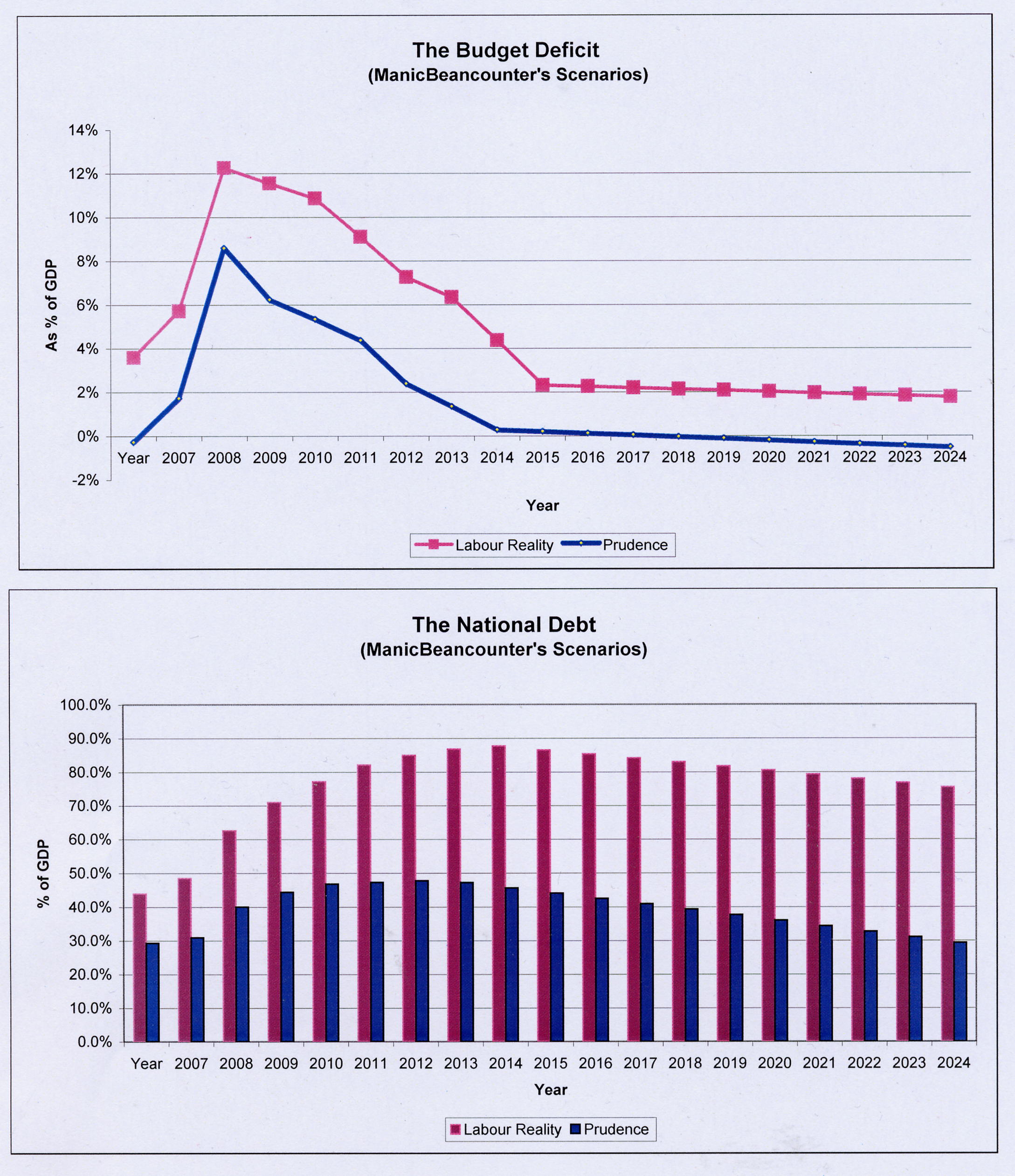
I did some simple calculations comparing two situations (all as a % of GDP)

1) An actual (Labour) one where in 2007, at the top of the cycle there was a budget deficit of 3.5% and a national debt of 44%.

2) A fiscally prudent (Prudence) one where budget deficits had not been incurred in the good years, so in 2007 the budget surplus was 0.30% and the national debt just under 30%.

Let us assume there is a similar worsening of public finances of 8.5% of GDP, so under Labour the deficit peaks at 12.2%, under Prudence 8.6%.

Under a Labour the national debt peaks at 87% of GDP in 2015; under Prudence 48% in 2013.

Under Labour we have a structural deficit of at least 6% of GDP; under Prudence at most 2%.

This is graphed below.

That is, the Labour (or specifically Brown) effect  is an increase if the National Debt of over 40% of GDP and a structural deficit of £90bn that must be eradicated. Under Prudence the increase in National Debt is less than 20% of GBP and a structural deficit of £30bn.

This is, however, much too generous on Labour, as I have assumed.

1)     Growth Rates are the same.

2)     The average level of interest on the National Debt is the same.

3)     The worsening of the Government Finances is the same from peak to trough.

4)     The effectiveness of the fiscal stimulus is the same.

5)     The turnaround in the public finances is the same.

6)     The growth forecast through to 2015 is 3.2% growth. This is roughly as forecast in the 2008 Autumn Pre-Budget forecast. Thereafter the growth rate will settle at 2% per year.

Therefore, by implication:-

–         There is no impact on the recovery through massive cuts in government spending and/or real tax rises.

–         There is no rise in interest rates as a result of the ballooning deficit.

–         There is no real problem in reducing public spending by 12% of the total in five years (or by around 30% of the total excluding the health sector, education and transfer payments), as against a 4% reduction.

–         The existing deficit pre-downturn had no impact on the size of the downturn.

–         The effectiveness of the economic stimulus was the same regardless of the size of the deficit, or whether it was on the back of a fiscal stimulus (through public expenditure increases) for the last seven years.

So going forward, it is fair to say that as long as the recovery is strong and interest premium does not rise in relation to the euro area, and the government achieves the deficit reduction targets, the national debt is at least 80% larger due to Labour, and the fiscal squeeze is at least 3 times greater.

Should Lord Stern remember some economics?

After Lord Stern’s comments about becoming a vegatarian to save the plant, I suggested he should be consistent and become a vegan. A post by Martin Livermore on the Adam Smith Insitute blog got me thinking that maybe Lord Stern would be advised to remember some lessons from economics. After all, as an economist, Lord Stern was employed to do a cost benefit analysis of tackling global warming. The report was only able to reach its conclusion that we should do something now by taking an extreme view of future temperature change (thus overstating the benefits of any remedy) and seriously understating the costs. Mostly this was by failing to apply an appropriate rate of discount to future costs and benefits.

Since then Lord Stern has become increasingly alarmist. If instead, he applied some of the tools of his profession he would conclude the following.


1. Most of the largest greenhouse gas producers are things that have an inelastic demand – such as petrol and fuel to heat one’s home. Therefore the costs will tend to exceed the benefits.


2. There are diminishing returns to emissions reductions. Small decreases can be achieved easily. At home most can save a bit by better insulation in the loft, or by turning town the thermostat by 1 degree. Car fuel consumption can be reduced by driving more economically. Bigger savings are less easy, without fundamental changes in lifestyle, which for the majority would mean a significant drop in living standards. For instance,

– switching from frozen and chilled foods to dried and tinned foods.

– switching foreign holidays to camping in the back garden.

– From travelling by car to work to spending three times as long going by public transport, or catching pneumonia cycling.


3. Large government projects tend to overrun on costs, and under-perform on benefits. The bigger and more idealistic the project, the larger the (proportionate) discrepancy between plan and outcome. International projects tend to overrun more than national one, as consensus is only achieved by compromise fudging. For the greatest trans-government project of all time, this risk alone should lead to the complete abandonment.


4. Complex models tend to fail most in their forecasting when you need them most. Consensus economic forecasts made in 2006 for 2009 would have predicted growth, not biggest slump since the 1930s. Yet compared to economic, climatology is more complex and still in its infancy as a subject. Further there is no competitive market in forecasting to encourage improvement and revision in the light of new data. In economics reputable  forecasting is a valuable commodity. In Climate Science, one is paid to agree with the consensus.

Nationwide and Halifax house price recovery is fragile

The recovery in house prices reported in the Nationwide and Halifax indices underlies a significant issue – that many existing borrowers would see a much higher rate of interest if they moved mortgages. As an example, my own repayment mortgage is currently 1.9% annual interest rat, or 1.4% above base rate. If I moved house Nationwide’s best deal on a tracker is 2.44% above base rate for 2 years and the reverts to 3.9%. There is also a nearly GBP 900 fee. Halifax are similar- 2.69% above base rate for 2 years, then reverts to 3.5%. A GBP 1200 fee here.

These are the cheapest deals, for a loan less than 60% of the house price and are competitive in a thin market. Halifax reports August 2009 approvals were 51% lower than in August 2007. The Nationwide’s measure of private housing sector turnover rate is now 4% , from a peak of 7% and a low of 3%.

As the driving force for the Housing Market is people upgrading to a better house, there may be a considerable number of people delaying moving house for this very reason. It is better to save for a new house by paying down existing borrowings than move to the more expensive house.

Paradoxically, a rise in base rates may prompt a narrowing of this differential and therefore perk up the housing market. The reason being that the marginal cost of moving will have diminished. However

–  there are other reasons for the low levels of housing activity – uncertainty over jobs and the need to pay off debt.

– a rise in interest rates may tip many existing hard-pressed borrowers towards selling. In particular buy-to-let landlords who have seen rents diminish this year.

Financial Regulators are as fallible as the rest of us

John Redwood, in defence of the banker’s, asked whether the regulator’s in the part four years has engaged in socially useless activity.

Unusually, I came to the defence of the regulator.

Regulators, even if nominally independent, work within the current political & economic climate. They would not have called for increasing capital requirements during the boom, as there was no visible reason to do so. After all, we had “ended boom & bust” – due to the prudent handling of our economy by the then Chancellor. Where was the risk factor that justified such a measure?

 If a Regulator had called for tougher rules, he would have been lambasted by the press, and criticized by most expert economists. Financial Experts would say capital requirements could be lower, as risk was now diversified throughout the global financial system.  Politicians would have said that such unilateral action would jeopardize London’s position as the World’s No.1 financial centre. If the Regulator had sufficient stature, then the £ would have gotten a bit jittery, and some shares in the banking sector would have taken a tumble. A government spin doctor would have come out we a speech saying “what I think you will find the Regulator actually said was .…” – and then say something that was the opposite, or renders the comments meaningless.

After a few days of ducking the issue, the Chancellor would have given his full support, followed the next day with the Regulator’s “voluntary” early retirement (or movement sideways).

A similar picture was with the Central Banks. By cutting interest rates after the dot.com bubble burst and again after 9/11 we obtained an asset price bubble. The US or the UK were not going to call a halt by raising interest rates, as it would have been both politically unpopular and raised exchange rates. The normal market adjustment, with a mild recession was averted. The long-term consequence was system imbalances becoming so large that the eventual correction nearly wrecked the financial system.

 The lesson to be learnt is not tougher and/or more detailed regulation. It should be a humility concerning our powers to intervene, as they can have consequences that we cannot foresee. Furthermore, markets have rushes of exuberance that will, sooner or later, be corrected. Avert the market correction and you build up trouble for the future.  Interventionism does not cure the problem of imbalances, merely delays it.

MARKETS WILL ADJUST. BEFORE OVERRIDING TO COUNTER FLUCTUATIONS,  YOU SHOULD FIRST BECOME OMINISCIENT.

Alan Greenspan convinced everyone that he had achieved this status, but turned out, in the long run, to be wrong.

The biggest current imbalance is in the housing market. The slide has been halted by near zero interest rates, but will resume when those rates get back towards normality. Why do I say this when average house prices are around the long-term average of four times average earnings? Because interest rates are well below their long-term average for existing borrowers. When they revert to around 5% that new borrowers are paying, and when unemployment peaks at 3 million plus (with some coming from the state sector), then the supply of houses will exceed demand.